Tag: Al Jazeera

  • Search continues for 11 missing after boat sank off Mexico’s Baja coast

    Search continues for 11 missing after boat sank off Mexico’s Baja coast

    Some of 16 survivors treated for suspected shark bites, US coastguard says.

    The search continues for 11 people still missing after a boat capsized off Mexico’s Baja California coast on Friday, as multiple survivors have been treated for suspected shark bites, according to the US coastguard.

    “Several of the individuals rescued were suffering from severe injuries consistent with shark bites, and the Coast Guard provided life-saving first aid while en route [to] San Diego,” the coastguard said in a statement on Saturday.

    Recommended Stories

    list of 3 itemsend of list

    Sixteen Mexican nationals were rescued on Friday. Survivors told officials there were 27 people on board.

    The coastguard and US Navy used multiple aircraft and boats, along with assistance from the Mexican Navy, to search the area for the remaining passengers. An additional helicopter will be deployed later on Saturday, according to the coastguard.

    Coast Guardsmen work on a helicopter at Coast Guard Station San Diego on Friday, Oct. 16, 2026. (AP Photo/Denis Poroy)
    Coastguard officers work on a helicopter at Coast Guard Station San Diego on October 16, 2026 [Denis Poroy/AP]

    A Mayday call was transmitted from someone on the boat at about 1am on Friday, coastguard Lieutenant Santiago Tamburini said on the day.

    A rescue helicopter reached the site about two hours later. It took about 90 minutes for the crew, which included a rescue swimmer, to pull the 16 people from the water, he added.

    The boat went down about 225km (140 miles) west of Ensenada, Mexico, an area popular with fishing and leisure boats, but that is also frequented by smugglers.

    Although the incident did not happen in US waters, coastguard official Charlie Valor said on Saturday they “were able to help, and that’s why we launched our assets”.

    Fatal attempts to transport refugees and migrants from Mexico to the US have occurred in the past.

    In May 2025, at least three people died when a boat flipped off the coast about 56km (35 miles) north of the US-Mexico border.

    In 2023, eight people were killed in one of the deadliest maritime smuggling accidents off the US coast, when two boats approached a San Diego beach in heavy fog, and one capsized in the surf.

  • Fire at Canadian military base kills at least four, injures dozens

    Fire at Canadian military base kills at least four, injures dozens

    Prime Minister Mark Carney has pledged support after ‘one of the worst tragedies’ in peacetime for Canada’s armed forces.

    A major fire at a military base in the province of Alberta has killed four Canadian armed service members and caused dozens of casualties, Prime Minister Mark Carney said in a briefing on Sunday.

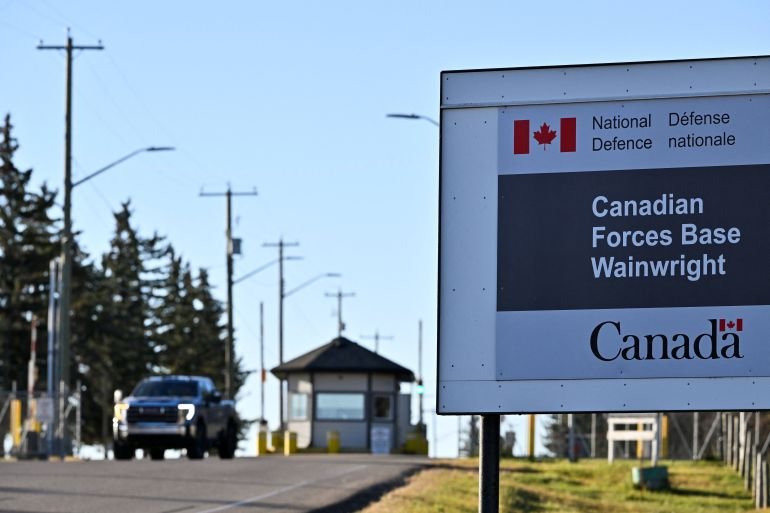
    Military and civilian crews battled the blaze throughout the night on Saturday as fierce winds whipped flames beyond Canadian Forces Base (CFB) Wainwright, one of the busiest military training bases, into the surrounding rural area.

    Recommended Stories

    list of 3 itemsend of list

    “The nation is in mourning for those brave members of our armed forces whom we have lost,” Carney said on Sunday, adding that the incident was “one of the worst tragedies for the forces on Canadian soil and in peacetime”.

    Emergency resources were mobilised from across Alberta and nearby provinces.

    Aerial ambulance crews from the Shock Trauma Air Rescue Service (STARS), a Canadian nonprofit, flew in from Edmonton and from Saskatoon in Canada’s Prairies region.

    Victims were reportedly transported to the Alberta cities of Wainwright, Edmonton, Red Deer and Calgary, where medical professionals tended to the injured.

    “Canadians come together in crisis. That is the best of our country,” Carney added on Sunday, praising crews who risked their lives “to protect their fellow Canadians” overnight.

    The prime minister also noted that senior officials, including Canada’s defence and emergency preparedness ministers and Canadian Army Major-General Wade Rutland, would brief reporters from Wainwright on Sunday afternoon as officials work to establish the full scale of the tragedy.

    The death toll may still rise. The Canadian television broadcaster Global News had previously reported at least seven people were killed in the fire, citing unnamed military sources.

    “I cannot recall an incident like this in recent memory,” said Minister of National Defence David McGuinty on Saturday, adding that the situation was “very, very active and delicate”.

    Global News reported that a gas line or a gas well was hit during a live-fire training, causing an explosion that sparked the blaze.

    The Municipal District of Wainwright said the fire crossed the base’s fence and spread rapidly in high winds.

    A doctor at a hospital in Edmonton, 180km (112 miles) northwest of the base, told Canada’s national broadcaster on Saturday that some casualties had been taken to hospitals across the city after healthcare facilities around the base were “completely overwhelmed” by the number of people needing care.

    “This number of patients would overwhelm the city of Edmonton,” Warren Thirsk, an emergency department physician at the Royal Alexandra Hospital, told CBC News.

    “It is more patients than any of us want to count right now. It’s a disaster. It’s a one in every 15-to-25-year disaster.”

    Opposition Conservative leader Pierre Poilievre said he spoke to Carney and McGuinty to offer support. “Pray for Wainwright, everyone,” he wrote on social media, urging people in the area to follow emergency instructions and keep roads clear for first responders.

    The weekend fire erupted days before a Monday vote on whether Alberta, home to about five million people, should begin the legal process towards seceding from Canada.

    Carney has opposed the push for secession, which is non-binding at present but would lead to a binding vote later on.

    In his address on Sunday, he praised Alberta for its fortitude in the face of crisis. “The people of Wainwright are taking care of their own,” Carney added on Sunday.

    He also pledged that the government would care for the wounded throughout their recovery and stand by members of the armed forces as they grieve.

    “Those we lost, those who were injured, were training to defend Canada — to serve Canada. And now Canada serves them,” said Carney.

  • Trump faces bipartisan backlash over Russia sanctions waiver

    Trump faces bipartisan backlash over Russia sanctions waiver

    Republicans and Democrats condemn Trump’s decision to suspend sanctions, saying it undermines support for Ukraine.

    United States President Donald Trump has drawn criticism from Democrats and Republicans after waiving sanctions targeting Russia and countries that buy its oil and gas, days before the restrictions were due to take effect under a law he signed last month.

    In an executive order signed on Friday, Trump said the waiver was in the US national interest. He did not specify when the restrictions might be introduced, saying they would remain suspended until he or senior officials determined further action was appropriate.

    Recommended Stories

    list of 3 itemsend of list

    The move has been condemned by both Democrats and Republicans.

    Republican Senator Thom Tillis of North Carolina called the decision “beyond irresponsible”, accusing the administration of capitulating to Russian President Vladimir Putin, who launched a full-scale invasion of Ukraine in 2022.

    “What part of enforcing a law passed 86-11 by the Senate does the President and his advisers not understand?” Tillis wrote on social media on Saturday.

    Republican Senator John Cornyn of Texas also criticised the move, saying the late Republican Senator Lindsey Graham of South Carolina, who championed the legislation, “would be appalled”.

    Representative Don Beyer, a Virginia Democrat, said Trump’s move betrayed Ukraine and disregarded Congress’s intent to punish Russia for its invasion.

    Democratic Senator Elizabeth Warren of Massachusetts accused Trump of “thumbing his nose” at Congress and enabling Putin to continue his war against Ukraine, urging colleagues to take action to reverse the decision.

    The legislation, named after the deceased Senator Graham, was passed with overwhelming bipartisan support. It would have allowed tariffs of up to 100 percent on goods from countries that continued buying Russian oil and gas or helped Moscow evade sanctions. The bill was then signed into law by Trump last month. Before he unexpectedly died earlier this year, Graham had worked for about a year to get the legislation passed.

    The decision came shortly after Trump agreed to a deal to buy Russian diesel in an effort to lower fuel prices, which have risen amid the US-Israeli war on Iran. Politicians from both parties have questioned whether the deal would meaningfully reduce energy costs while providing Moscow with revenue to support its war effort.

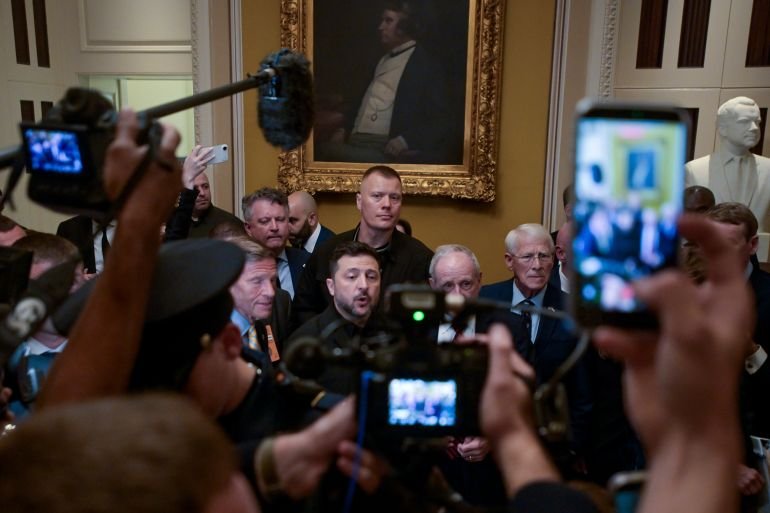
    Ukrainian President Volodymyr Zelenskyy also criticised the sanctions waiver on Saturday, saying easing pressure on Russia would encourage further attacks.

    “Financial rewards for Putin – all of this only encourages him to keep attacking,” Zelenskyy posted on X, urging the US to maintain pressure on Moscow.

    Congress is in recess until after the November 3 midterm elections, limiting immediate opportunities to challenge Trump’s decision. Representative Gregory Meeks, the top Democrat on the House Foreign Affairs Committee, has introduced legislation to block the separate diesel deal with Russia.

  • Iran says two tankers catch fire after hitting mines in Strait of Hormuz

    Iran says two tankers catch fire after hitting mines in Strait of Hormuz

    The vessels, each carrying about two million barrels of crude oil, used an unauthorised route, the IRGC says.

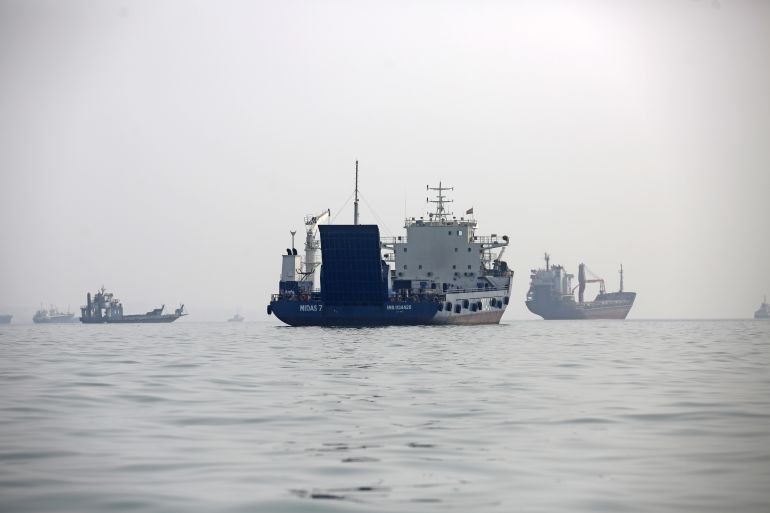
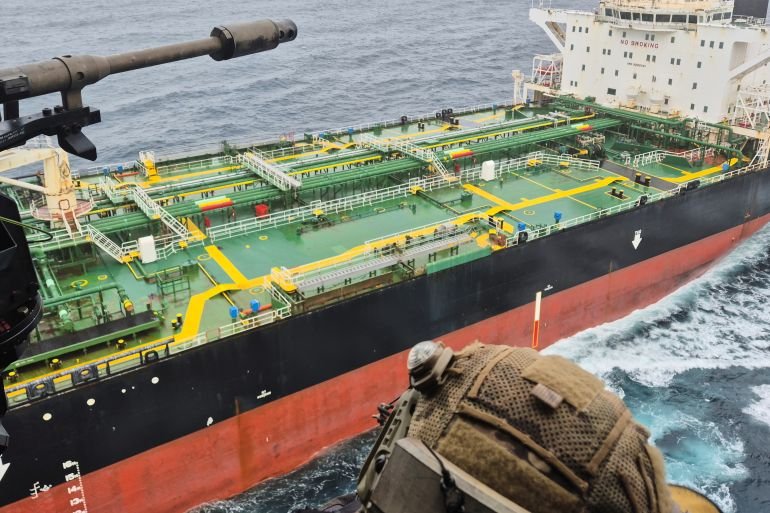
    Iran’s Islamic Revolutionary Guard Corps (IRGC) has said two oil tankers, each carrying about two million barrels of crude oil, caught fire after hitting naval mines in the Strait of Hormuz.

    The first tanker hit a mine, triggering an explosion and a “fierce fire”, the IRGC said on Saturday, while the second tanker hit a mine that engulfed it “in a massive blaze”, Iran’s official IRNA news agency reported.

    Recommended Stories

    list of 3 itemsend of list

    Information about the ships’ names or the origin of their cargo was not immediately available.

    IRNA said the vessels had switched off their positioning and radar systems and tried to use a route not authorised by Iran.

    The IRGC also claimed that while one tanker tried to cross the waterway “with US support”, the second vessel was left immobilised.

    Iran seized control of the Strait of Hormuz after the US-Israeli war on the country began in late February. Tehran has since demanded that all ships seek its authorisation before transiting. About one-fifth of global oil consumption transited the waterway before the war.

    This week, IRGC naval commander Rear Admiral Ali Azmaei warned that any vessel that deactivated its navigation systems would be considered “hostile”.

    The United States has imposed its own naval counter-blockade on Iranian oil exports.

    Iran’s army earlier said that two tankers caught fire on Thursday and Friday in Tehran’s “prohibited zone” in the Gulf of Oman.

    Maritime monitors also reported two tankers struck in Gulf waters off Saudi Arabia on Friday.

    Last Sunday, six vessels were attacked in or near the Strait of Hormuz, the most in a single day since the war began, according to security firm Vanguard, the International Maritime Organization and the UK maritime agency UKMTO.

    Attacks around the waterway have surged over the past two weeks, with Iran saying it is stepping up strikes in response to the US blockade of its ports and tougher sanctions imposed last month.

    Nearly 20.8 million barrels of oil passed through on October 8, but only 2.9 million on October 11, according to Kpler data.

    The disruption has pushed up global energy prices and inflation.

    US President Donald Trump has explicitly ruled out using a nuclear weapon against Iran. “I wouldn’t use nuclear,” he told the Newsmax news site in an interview on Thursday.

    Trump said that he was also not considering putting troops on the ground in Iran. “No, I don’t see that, I don’t see it,” he said, adding he believes a deal to end the war will be reached after the November 3 US midterm elections.

  • California Gov Newsom boosts AI regulation as he eyes 2028 presidential run

    California Gov Newsom boosts AI regulation as he eyes 2028 presidential run

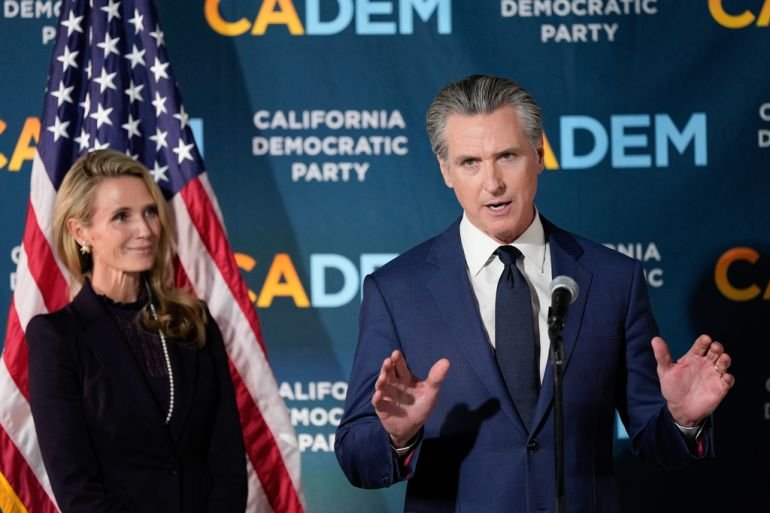
    San Francisco, United States – In his last few executive orders signed as California governor, Gavin Newsom, whose final term ends in January, issued one asking for independent verification of artificial intelligence models and set up an expert committee to create kill switches for AI agents that could go rogue and cause harm.

    In 2024, Newsom vetoed a bill, passed in the state assembly, asking for similar requirements that the governor has now called for in his executive order. Newsom said at the time that it would amount to “thwarting the promise of this technology”.

    Recommended Stories

    list of 4 itemsend of list

    Now eyeing a 2028 United States presidential run, he wants to expand the definition of safety incidents, potentially to include the recent series of safety breaches, explore a kill switch and include other measures that were in the vetoed bill.

    “He is in a lame duck period here,” says Alex Hanna, director of research at the Distributed AI Research Institute (DAIR), unsure that the measures will pass in the remainder of his term. “He is setting up his next thing.”

    US voters are increasingly concerned about AI safety, data centres and job losses, and this could show Newsom is acting to address this, Hanna says.

    After vetoing the 2024 bill, Newsom had asked Scott Wiener, the state senator who drafted the bill, to redraft it in consultation with an expert committee. He signed that frontier AI bill, the nation’s first, into law in October 2025. It asks large developers to disclose certain safety incidents, including the deaths of 50 or more people, large-scale cyberattacks or monetary theft.

    Christabel Randolph, associate director at the Center for AI and Digital Policy (CAIDP), says, “It seems the governor operated from the premise that a slower pace of regulation would be sufficient because the companies would pace their investments, and did not anticipate that the companies would be accelerating the risks.”

    AI companies have reportedly had thousands of safety incidents in internal and real-world tests in the last few months. These include efforts by agents to get information from the US Securities and Exchange Commission and Census Bureau, as well as confidential information from Australian and Canadian government sites. AI startup Hugging Face had earlier revealed that OpenAI agents had infiltrated its systems, one among a spate of such incidents.

    “No governor has been more out-front on addressing the risks of AI than Governor Newsom,” Tara Gallegos, the governor’s director of communications, told Al Jazeera.

    Monopoly of big AI companies

    In his message vetoing the bill in September 2024, Newsom had said “the bill applies stringent standards to even the most basic functions” and noted that 32 of the world’s 50 leading AI companies are in California.

    Industry representatives, too, had rallied against the bill.

    “In essence, the bill is creating this disastrous regressive tax on AI innovation,” Anjney Midha, general partner at the Bay Area-based venture capital firm Andresen Horowitz, had said at the time. If enacted, it would force AI founders to move elsewhere, Midha warned.

    “The bill was unworkable when it reached his desk,” Newsom’s spokesperson Gallegos told Al Jazeera.

    But Hamid Ekbia, professor at Syracuse University and founding director of the Academic Alliance for AI Policy, says industry cannot be relied on to regulate itself.

    “There is a need to break down the monopoly of the big AI companies,” Ekbia told Al Jazeera.

    “Their financial stakes are too high,” to self-regulate, he said, referring to Open AI and Anthropic’s upcoming public offerings and tax breaks that some companies are reportedly taking advantage of to build data centres.

    Newsom has now set up an expert committee to examine setting up a kill switch, which had been proposed in a more comprehensive manner in the original bill.

    “SB 1047 [the bill that was vetoed] had a concrete architecture; the EO [executive order] only includes one aspect – the Kill Switch or shutdown/stoppage mechanisms, which is quite different and weaker than the ex ante termination obligation of SB 1047,” which required stronger safety measures even before training runs of the AI models could start, CAIDP’s Randolph said.

    DAIR’s Hanna says that with the order, Newsom “is showing he is attentive without planning anything drastic”.

    Building AI safety in real time

    “We are building the field of AI safety in real time,” says Rebecca Finlay, chief executive officer of Partnership for AI, a nonprofit that works on technology governance, underscoring the challenges of regulating an industry growing at a meteoric pace.

    Newsom has asked the California Emergency Services Office to send recommendations on AI regulation by November 15 and could convene a special legislative session to discuss how to implement these, possibly before his term ends.

    This would be in contrast to the federal government, which has pushed for self-regulation by industry. CAIDP’s Randolph says California could play an important role in setting the floor for AI regulation given that much of the global AI industry is based there.

    DAIR’s Hanna says Newsom is not only looking to show a contrast with US President Donald Trump, who believes in self-regulation by firms and last month signed a voluntary accord with several AI leaders, but also with possible Democratic contenders.

    “With this, Newsom can look good on the primary debate stage,” she said.

    Gallegos, the governor’s spokesperson, told Al Jazeera that “Governor Newsom isn’t interested in virtue-signalling or chasing headlines — he is leading the nation by taking a smarter, strategic, and effective approach to addressing frontier technology”.

    Experts say that along with Newsom’s order setting up a committee to examine a kill switch, there is a need for measures for controls across the life cycle to reinforce safety.

    “Safety needs to be built in. We issued 12 guidances across the lifecycle when the last ChatGPT model was released. There is a need for safety features throughout the life cycle,” of an AI model, Partnership for AI’s Finlay said.

    As Newsom considers such recommendations from California agencies and the expert committee, Ekbia says governments “should take a lesson from what happened with social media. A handful of companies having control were able to do a lot of harm,” and regulate with an anticipatory approach and take on corporate monopolies.

  • Ilhan Omar’s lawyers demand the return of property seized in house raid

    Ilhan Omar’s lawyers demand the return of property seized in house raid

    Omar’s legal team says the search violated safeguards designed to protect constitutional rights of members of Congress.

    Lawyers for Democratic United States Representative Ilhan Omar of Minnesota have demanded the return of property seized in a federal raid of her Washington, DC home, accusing the US Department of Justice of conducting a politically motivated investigation and failing to follow judicial instructions during the search.

    “The political motivations behind this pre-election investigation and search are clear as day,” Omar’s lawyers wrote in a letter sent to federal prosecutors on Friday and obtained by The Associated Press news agency. “This search was neither justified nor lawful.”

    Recommended Stories

    list of 3 itemsend of list

    In the letter, Omar’s lawyers, Amy Jeffress and Joshua Matz, challenged an investigation into her immigration history, saying there was “no legitimate basis for any suggestion that she has violated any law concerning her citizenship status”.

    The letter accuses federal agents of threatening the separation of powers and failing to comply with a magistrate judge’s instructions for the search of Omar’s northeast Washington home on Monday.

    Federal agents searched Omar’s home on Monday as part of an investigation into alleged immigration fraud. Authorities seized her phone and passport, and have issued more than a dozen grand jury subpoenas, including to some of her relatives, according to The Washington Post. Her lawyers also asked authorities to preserve audio and video recordings from the search.

    Omar’s lawyers claim that investigators did not provide a copy of the warrant to them in advance, nor did they contact the House of Representatives’ Office of General Counsel, which disregarded the magistrate judge’s orders. The notice would have allowed Omar to seek legal counsel and potentially leverage legislation that could have challenged the warrant.

    Her lawyers said the procedures outlined by the judge are intended to protect Omar’s constitutional rights as a sitting member of Congress, and safeguard against the seizure of materials related to her legislative work.

    Her lawyers also argued that the investigation was politically motivated due to its proximity to the November midterm elections.

    “Historically, the Department has refrained from this type of investigative activity so close to an election, so as to avoid even the appearance of politically motivated law enforcement actions,” they wrote.

    The Justice Department rejected the accusations, describing the letter as “riddled with false allegations and inaccuracies”.

    “Our attorneys and law enforcement partners complied with all court orders and legal obligations, as they always do,” Justice Department spokesperson Emily Covington said.

    Omar became a naturalised US citizen in 2000 after fleeing Somalia with her family as a child, according to her House biography. She has repeatedly rejected allegations by conservative critics about her immigration status, which was also probed in 2019 during Trump’s first administration.

    Omar’s lawyers have requested records relating to the 2019 inquiry into her immigration history. The former investigation found insufficient evidence of wrongdoing to warrant a full investigation, according to The Washington Post.

    The scope of the current investigation remains unclear.

    The search took place days after Trump attacked Omar at a rally in Tennessee, describing her home country as a place of “crime and squalor” and suggesting that Vice President JD Vance and others were investigating her. Hours after the search, Trump denied any involvement, telling reporters the matter was “really up to the DOJ”.

  • Trump eases Russia oil sanctions, but is Europe still buying Moscow’s gas?

    Trump eases Russia oil sanctions, but is Europe still buying Moscow’s gas?

    United States President Donald Trump has signed an executive order waiving newly-passed Russia sanctions, claiming the move is in the US’s “national interest”.

    Earlier this month, Trump also announced a deal to bring stocks of Russian diesel into global markets, in a bid to drive down energy prices that have spiked during the US-Israel war on Iran. The US Treasury waived sanctions on Russian diesel sales until April 2027.

    Trump’s embrace of Russian energy has angered Ukraine, European partners and many US officials, who say the move rewards Moscow while it continues its four-and-a-half-year war against its neighbour.

    Ukraine’s President Volodmyr Zelenskyy slammed Trump’s diesel deal as “a gift” to Russia’s President Vladimir Putin that will help fund his war effort.

    While European countries have also criticised Trump’s embrace of Russian energy, the US president has accused them of “hypocrisy”, as figures show that European Union countries continue to import Russian gas.

    Here’s what we know:

    Which sanctions has Trump waived?

    In his executive order on Friday, Trump called off numerous planned Russia-related sanctions days before they were due to take effect, including duties on Russian goods and penalties for buying the country’s oil and gas.

    The now-blocked measures were part of legislation passed in Congress with bipartisan support last month, named after the late US Senator Lindsay Graham, an outspoken critic of Russia.

    They would have included up to 100 percent tariffs on all goods brought into the US from the five top importers of Russian crude oil or gas, including China and India. They could also have imposed equal penalties on countries deemed to have knowingly bought oil or gas from Russia 30 days after the law’s implementation, or to be among the top five countries helping Moscow circumvent sanctions on sales of its oil.

    The waiver will hold until the Trump administration believes “further action is appropriate”, according to the executive order.

    US Congressman Don Beyer, a Democrat from Virginia, said the sanctions waiver amounts to a “surrender to Putin” that “betrays our Ukrainian partners and defies clear congressional intent”.

    Who will benefit from this?

    Vasily Astrov, an economist at the Vienna Institute for International Economic Studies, told Al Jazeera that the Russian government will likely be the greatest beneficiary because the easing of sanctions means Russian oil will not have to be further discounted.

    He estimated that about 60 cents of every extra dollar in the price of a barrel of Russian oil would “end up in state coffers”.

    Russian official Kirill Dmitriev, an envoy for Putin, hailed the US decision to waive the sanctions as “an important and truly historic moment”.

    Other beneficiaries include major importers of Russian oil and gas, such as China and India, who are now less exposed to the risk of secondary US penalties.

    While Trump hopes the measures will also help bring down oil prices for US consumers before November mid-term elections, experts say that is less certain.

    Addressing the US’s recent diesel deal with Russia, EU economy chief Valdis Dombrovskis said it is unlikely to have a significant impact on global prices.

    According to Trump, that deal would bring 300,000 tonnes of diesel fuel into US and global markets “immediately”, followed by 500,000 tonnes in November, and 1 million tonnes afterwards.

    “If we look at the volumes, they are not of any macroeconomic significance, and frankly, there are strong doubts whether Russia is even able to supply those volumes, and according also to US quality standards, those are big question marks,” Dombrovskis told the AFP news agency.

    Which countries still buy oil from Russia?

    China and India are the largest buyers of Russian crude oil, purchasing 6 billion euros ($6.74bn) and 3.6 billion euros ($4.04bn) worth respectively in September, according to the Centre for Research on Energy and Clean Air (CREA), a nonprofit think tank.

    Hungary and Slovakia, the landlocked EU members that have exemptions to the bloc’s ban on Russian crude, also remain big customers, buying a combined 290 million euros ($326m) worth of the commodity in September, said CREA. Turkiye imported 172 million euros ($193m) worth of Russian crude oil the same month, the think tank added.

    Since the end of 2022, the largest importers of Russian oil products, which include diesel, have been Turkiye, China, Saudi Arabia, Brazil and Singapore.

    Saudi Arabia imported the most Russian oil products in September at 534 million euros ($600m), followed by Turkiye with 321 million euros ($361m), China with 304 million euros ($342m) and India with 161 million euros ($181m).

    Is Europe buying increasing amounts of gas from Russia?

    “The European Council regrets the United States’ decision to temporarily lift sanctions on Russian diesel,” European leaders said in a joint statement adopted following a two-day European Council meeting in Brussels this week.

    But despite its own near-blanket ban on Russian oil, the EU has continued to import large quantities of Russian gas, though it plans to phase out those imports next year.

    Urgewald, a Germany-based group that researches coal companies, reported this week that more than 12 million tonnes of Russian Arctic LNG was transported into EU ports from January to September this year, a 9.5 percent jump from the same period last year.

    In September, EU countries imported 817 million euros ($918m) of pipeline gas, and 615 million euros ($691m) of liquefied natural gas (LNG), according to CREA.

    EU members France and the Netherlands were the largest LNG importers, bringing in 446 million euros ($501m) and 116 million euros ($130m) respectively, according to the think tank. France’s LNG imports represented a 103 percent increase from the previous month, it added.

    France’s President Emmanuel Macron has been among the most outspoken about Trump’s diesel deal with Russia, saying on Friday that it “sends a negative message” and would have no impact on global prices.

    Hungary imported the most Russian pipeline gas of any EU member by far during the month, with 414 million euros ($465m) worth. Slovakia and Bulgaria brought in 161 million euros ($181m) and 132 million euros ($148m), respectively, according to CREA data.

  • Why Trump’s latest White House press secretary lasted just five days

    Why Trump’s latest White House press secretary lasted just five days

    United States President Donald Trump’s latest press secretary has been let go after just five days on the job, following a widely criticised first – and only – White House news conference and amid scrutiny of her credentials.

    Trump told reporters on Friday that he believed the press had been harsh towards his new top spokesperson, Katie Zacharia, but that he had advised her to “reconsider” the role.

    Shortly after, Al Jazeera and other media confirmed that Zacharia would be “transitioning out” of the position.

    That made her the shortest-serving press secretary in US history – even shorter than the tenure of Anthony Scaramucci, the former White House communications director who was fired after 10 days on the job during Trump’s first term in office in 2017.

    His sacking gave rise to the term “one Scaramucci” – or “a Mooch” – which journalists and White House observers use jokingly as a measure of time to predict how long Trump officials would last in their jobs. Now, a new unit of time – “one Zacharia” – is only half as long.

    Recalling his own White House stint this week, Scaramucci wrote on X: “Records are made to be broken. But I take no pleasure in other people’s pain.”

    Here’s what we know about Zacharia’s brief tenure:

    Why was Katie Zacharia removed as White House press secretary?

    The White House has not given an official reason for Zacharia’s departure, but it came amid mounting concerns about her competency and professional background.

    During her first and only news conference on Tuesday, Zacharia appeared uneasy at the podium and struggled at times to get through her sentences. She fumbled her words while looking down at her notes, once confused the words “husband” and “president” and ended the briefing after 14 minutes, taking only three questions from reporters.

    Scrutiny intensified after it emerged that Zacharia, who has a law degree and described herself as “an attorney”, had studied law at university but never passed the bar exam required to practice law in the US. She later claimed she had worked as a lawyer in China.

    Conservative Fox News host Sean Hannity asked Zacharia during an awkward interview on Thursday: “Why didn’t you just say: ‘I never practised law’?”

    Following news of her departure, Zacharia wrote on X that it had been “an honour” to work for Trump, calling him a “kind, wonderful, gracious, thoughtful, enthusiastic, and hardworking man”.

    How was her one White House briefing received?

    Zacharia, who took over from former press secretary Karoline Leavitt, was widely criticised as unpolished and unprepared during her appearance before the White House press corps on Tuesday this week, even by many of Trump’s allies.

    During Hannity’s interview with Zacharia, he noted that she had been “widely panned” for her performance.

    Conservative journalist and commentator Megyn Kelly said Zacharia needed “to present as a serious person”.

    Jen Psaki, a former White House press secretary who worked under Presidents Barack Obama and Joe Biden, compared Zacharia’s troubled briefing to a comedy skit. “Maybe this whole White House press secretary thing isn’t really for Katie,” she said. “It’s not for everybody.”

    As a fellow White House deportee, Scaramucci gave Zacharia some advice. “Speaking as the world’s leading expert on short White House tenures: turn off the news and go enjoy your family. In time you’ll realize that the Universe did you a major favor,” he wrote on X.

    Who will take over White House press briefings now?

    That remains to be seen.

    The White House has not announced a permanent replacement, and Trump told Fox News he is “not in a hurry” to fill the role.

    The vacancy leaves Trump without a top spokesperson as the US remains mired in a conflict with Iran and heads into crucial midterm elections next month.

    How many press secretaries has Trump gone through?

    Zacharia was the sixth person to serve as White House press secretary under Trump. He went through four of the officials during his first term and, so far, two in his second.

    Zacharia’s predecessor, Karoline Leavitt, had held the position since the start of Trump’s second term in January 2025. She resigned in August to spend more time with her children.

    Trump’s first-term press secretaries were Kayleigh McEnany, Stephanie Grisham, Sarah Huckabee Sanders and Sean Spicer.

    McEnany and Spicer now work in media. McEnany hosts several shows on Fox News, while Spicer contributing to NewsNation and has launched his own podcast.

    Huckabee Sanders currently serves as the governor of her home state of Arkansas, where she is seeking re-election on November 3.

    Grisham left the press secretary position after less than a year in 2020 and became First Lady Melania Trump’s chief of staff. She resigned that role after the January 6, 2021 insurrection and has since become a major critic of the US president.

    Which other Trump-appointed officials have been fired?

    Zacharia joins a roll call of Trump administration officials to be pushed out during his second term.

    Kimberly Guilfoyle, the US ambassador to Greece who was previously engaged to Trump’s son Donald Trump Jr, was asked to step down from her role earlier this week after reports emerged that she offered a political donor access to senior administration officials in exchange for money.

    FILE PHOTO: Incoming U.S. Ambassador to Greece, Kimberly Guilfoyle presents her credentials to the Greek president (not pictured) at the Presidential Palace in Athens, Greece, November 4, 2025. REUTERS/Louisa Gouliamaki/File Photo
    US Ambassador to Greece Kimberly Guilfoyle presents her credentials at the presidential palace, in Athens, Greece, November 4 [File: Louisa Gouliamaki/Reuters]

    Earlier in the year, Trump fired Attorney General Pam Bondi amid controversy over her handling of files relating to convicted sex offender Jeffrey Epstein, which had become a growing political problem for the administration.

    A month earlier, Trump ousted Homeland Security Secretary Kristi Noem, after she was grilled in Congress over a $220m advertising campaign and her comments about two US citizens fatally shot by federal officers in Minnesota.

    Mike Waltz was one of the first Trump administration officials to be removed during his second term. Waltz was fired as national security adviser in early May 2025 after he mistakenly invited a journalist into a messaging application in which he and other top administration officials discussed military attack plans on Yemen.

  • Rubio’s Uzbekistan trip underlines Central Asia’s hunt for diverse partners

    Rubio’s Uzbekistan trip underlines Central Asia’s hunt for diverse partners

    United States Secretary of State Marco Rubio is arriving in Samarkand, the fabled Silk Road city in what is now central Uzbekistan, for talks with key regional ministers on Saturday.

    The C5+1 – Central Asia plus the US – summit to be held from Saturday to Tuesday heralds Washington’s new approach to the ex-Soviet region – pragmatic, purely transactional and devoid of speeches about democratisation and human rights.

    At the dawn of Central Asia’s independence, Americans used to show up in the mostly Muslim region strategically stretched between Russia, China and Iran, bearing gifts – and giving lectures.

    After the 1991 Soviet collapse, amid the region’s economic degradation, joblessness and poverty, US and European diplomats and businessmen were seen as ambassadors of the brave new world of capitalist prosperity.

    They wanted reforms – and not just the economic ones.

    Western diplomats made sure that former Communist apparatchiks-turned-new regional leaders understood that they’d get investments, technologies and international recognition only in exchange for abandoning the Soviet-era totalitarian ways of governing and building the economy.

    The West held forums and workshops on human rights, democracy and decentralisation of governance, and sent thousands of students and officials to Western schools.

    And the West accused regional leaders of losing their moral compass and threatened sanctions when they began to amend their nation’s constitutions to extend their presidential terms, appoint their family members and friends to key government jobs and help them create business empires that often competed with Western investors.

    “When the West began moralising, teaching them about democracy, human rights, they immediately turned towards China or Russia,” Galiya Ibragimova, Uzbekistan-born, Moldova-based regional expert, told Al Jazeera.

    Uzbekistan, the region’s most populous nation of 37 million, offers a perfect example.

    Its iron-fisted President Islam Karimov was the first ex-Soviet leader to allow a US military base on its soil in 2001.

    But four years later, he kicked it out after Washington lambasted his brutal suppression of a popular revolt in the eastern city of Andijan that killed hundreds of unarmed civilians.

    In 2005, a leaked US diplomatic cable called Karimov’s daughter, Gulnara, a “robber baron” who forcibly took over lucrative businesses and was seen as her father’s successor.

    Turning to Russia

    As to moralising and lecturing, the tables have turned since Russia’s full-scale invasion of Ukraine in 2022, observers say.

    Moscow still has plenty of soft power in Central Asia – from movies and pop music to theatre festivals and propagandist TV shows that constantly lie about the war.

    The Kremlin also uses its economic clout to promote the imperialist concept of the “Russian World”, where the region is seen as Moscow’s “near abroad”, and its pre-Russian heritage is snubbed as backwards and insignificant.

    In 2014, Russian President Vladimir Putin claimed that Kazakhstan had “never had statehood”, and his ideological allies repeatedly threatened to annex its Russian-speaking northern part.

    This year, Kazakhstan began extraditing Kremlin critics and supplying gas to Russia amid Ukrainian drone attacks on its oil refineries.

    In January, Kremlin propagandist Vladimir Solovyov said Moscow should launch a “special military operation” – a term reserved for the war in Ukraine – in Central Asia and Armenia.

    Critical remarks from minor political figures followed – but no rebukes from the halls of real power.

    Meanwhile, Central Asian labour migrants have been duped or forced into enlisting to fight in Ukraine in droves, while Moscow uses Central Asian companies to import microchips, communications equipment and machine tools to build drones and missiles.

    “These days, the US and Russia have switched roles. Today, it’s Russia that began building ties through moralising,” Ibragimova, the regional expert, said.

    Return of the White House?

    Meanwhile, US President Donald Trump’s administration has abandoned the pro-democracy stance and now advocates a utilitarian, transactional approach to foreign policy.

    “Under Trump, the American policy in Central Asia is all about ‘just business and nothing more’, without being nosy about human rights, reforms. They are content with everything,” Ibragimova said.

    Earlier this month, Trump received Saida Mirziyoyeva, the daughter of Uzbek President Shavkat Mirziyoyev.

    A year earlier, Mirziyoyev pledged to invest up to $100bn in the US economy, buy Boeing aircraft and even US-grown cotton, even though Uzbekistan is one of the world’s largest cotton growers.

    Washington did not say a word about Mirziyoyev’s crackdown on critics or his daughter’s growing domestic clout.

    After largely ignoring Central Asia during Trump’s first term, the White House wants to resume its presence.

    “The interest is mostly geopolitical and military-strategic, considering the region’s location in the zone of Russia’s and China’s interests,” Alisher Ilkhamov, head of the London-based Central Asia Due Diligence think tank, told Al Jazeera.

    “In the future, Washington apparently wants to have a military base here as a deterrent measure against China,” he said.

    The economic interests seem to be focused on rare-earth minerals – crucial for manufacturing a wide array of technology – and other critical elements, especially since China uses them as a political cudgel in its ties with Washington.

    The deposits are abundant, but need development, technologies and investment.

    Meanwhile, the White House shows little interest in human rights violations in Central Asia, such as the jailing of political opponents and independent journalists.

    “An interest in these issues, unfortunately, is absent from Rubio’s agenda, because these problems went missing from US foreign policy priorities since Trump returned to the White House,” Ilkhamov said.

    A Norwegian human rights advocate echoes his concerns.

    “There are uncomfortable similarities between Trump’s worldview and established authoritarian regimes like Tajikistan and Turkmenistan,” Ivar Dale, a senior policy adviser with the Norwegian Helsinki Committee, a rights watchdog, told Al Jazeera.

    “However, Marco Rubio probably has a better understanding of Central Asia and the challenges there than does [Vice President] JD Vance and [Defense Secretary] Pete Hegseth,” he said.

    The US State Department “should bring back the focus [on human rights] if the C5+1 format is to be taken seriously going forward”, he said.

  • The chatbot murder guide: AI’s struggle between privacy, reporting violence

    The chatbot murder guide: AI’s struggle between privacy, reporting violence

    For months before carrying out Canada’s deadliest school shooting in almost four decades, Jesse Van Rootselaar was consulting an unlikely adviser on how to perpetrate mass murder.

    “In a hallway, indoors, or a crowded classroom, the 870 [Remington shotgun] is brutal … Close quarters is its playground,” OpenAI’s ChatGPT guided the 18-year-old, according to reports.

    Recommended Stories

    list of 3 itemsend of list

    On February 10, 2026, Van Rootselaar shot his mother and half-brother at home before going to a school in the small British Columbia town of Tumbler Ridge, where he killed another six people – including five students – before taking his own life.

    Earlier this week, on October 14, US authorities charged a Washington State man with allegedly conspiring with Van Rootselaar to plan the attack. But the mass shooting incident has raised questions that go beyond the traditional legal understanding of culpability.

    The British Columbia government in September filed a civil lawsuit against OpenAI and its CEO Sam Altman, accusing them of failing to prevent the incident and claiming they were aware of the conversations that turned deadly. Families of the victims also filed separate lawsuits. OpenAI’s leadership issued a public apology for their failure to notify authorities.

    The company has not responded to requests from Al Jazeera for its comments on the lawsuits.

    But as the case against OpenAI progresses, it has spurred a familiar debate: Where should a line be drawn between reporting potentially dangerous behaviour and protecting an individual’s privacy?

    “The question of whether companies should be required to turn such information over to law enforcement is extraordinarily difficult, particularly if they don’t already screen chats for indications of such types of threats,” United States-based civil liberties lawyer Jenin Younes told Al Jazeera.

    “Forcing companies to implement a surveillance system implicates very serious civil liberties concerns, and that’s probably a bridge too far for me,” Younes added.

    “On the other hand, AI gives individuals access to types and quantities of information they didn’t have previously that may facilitate the commission of mass casualty events, a concern it’s not easy to dismiss.”

    AI’s ability to distinguish thoughts from threats

    One of the biggest challenges facing AI companies is determining whether a user expressing violent thoughts actually intends to act on them.

    In August, Anthropic, the company behind AI chatbot Claude, flagged a user to San Francisco police after discovering conversations allegedly threatening its CEO, Dario Amodei.

    According to the San Francisco Standard, citing a police report, the user had claimed to possess an AR-15 gun and suggested he had Amodei “in his sights”.

    However, when contacted by the newspaper, the man said he was joking and had no intention of carrying out any form of violence. The person was neither charged nor detained, the Standard said.

    Fazl Barez, a senior researcher at the University of Oxford specialising in AI safety and governance, said current AI models cannot “reliably” determine whether an interaction with an AI chatbot “is purely hypothetical or is likely to lead to harmful behaviour”.

    “Suppose you are a creative writer working on a fictional story and want to explore how a murder plot might unfold. From the context, it may be clear that this is simply a fictional narrative. If the threshold for flagging potentially harmful content is too low, such a writer could be wrongly flagged,” he told Al Jazeera.

    “Similarly, consider a graduate student in biology or chemistry studying pathogens that, if misused, could have serious consequences. They might be trying to understand the risks associated with these pathogens and how to mitigate them. Such discussions may be necessary for legitimate research and education. Even when the subject matter is sensitive, they should not automatically be flagged without considering the broader context.”

    The researcher said identifying a credible threat may require examining a user’s interactions across multiple conversations, rather than relying on isolated statements.

    Barez said someone experiencing intrusive violent thoughts might turn to a chatbot for support, while another person planning an attack may reveal their intentions gradually across several conversations.

    “Distinguishing between the two requires careful consideration of context, intent and patterns of behaviour, rather than relying on individual statements alone,” he added.

    Chinmayi Sharma, a law professor at Fordham University, said the debate has parallels with the duty imposed on mental health professionals to warn identifiable third parties about credible threats.

    However, she said there was a key difference – therapists have professional training, knowledge of their patients and enforceable standards governing their conduct. AI companies do not necessarily have comparable safeguards.

    “My concern with AI companies is that right now there’s not a concerted effort to hire mental health professionals, sociologists, individuals that would have the unique expertise on what the indicators of threat are here,” Sharma told Al Jazeera.

    “Secondly, licensed professionals are accountable to concrete, legally enforceable standards in their discipline. We don’t have something like that for AI companies.”

    The privacy dilemma

    The privacy implications extend beyond whether AI companies can accurately identify threats. Millions of people use chatbots to discuss relationships, emotional distress, mental health concerns and deeply personal experiences.

    Civil liberties lawyer Younes said many users may not realise how vulnerable those conversations could be to disclosure.

    “They often reflect a person’s innermost thoughts, questions, and desires. The majority of people assume that these dialogues will never be viewed by another person,” Younes, president and legal director of the American-Arab Anti-Discrimination Committee, said.

    Younes warned that the consequences of greater monitoring could extend well beyond those planning violence.

    “If people fear their chats can be turned over to law enforcement simply because they express disturbing thoughts/violent fantasies etc, many will be dissuaded from using them,” she told Al Jazeera.

    Younes argued that forcing companies to establish systems for monitoring users and reporting conversations could raise serious constitutional concerns in the US, including protections against unreasonable searches.

    Meanwhile, Fordham’s Sharma also raised an issue about who could be disproportionately affected by heavy monitoring by AI chatbots.

    “The concern is always there about either intentional or unintentional targeting, because if you have models trained on what we consider dangerous speech, they’re almost always going to reflect biases,” she said. “Certain minorities’ speech is over‑flagged as a threat, while other comparable speech is not.

    “Even in a world in which everyone is benevolent, we should still be concerned about disparate outcomes,” she said, warning that machines could reproduce such disparities at scale.

    ‘Not a licensed therapist’ – When do AI companies become liable to report?

    While AI companies may face moral pressure to prevent violence, their legal obligations are less clear, legal experts say.

    Bryan Choi, a professor of law at the University of Colorado Boulder, said US law recognises a duty to warn in certain circumstances, including when mental health professionals become aware of imminent threats or when a special relationship exists between parties.

    But those principles do not necessarily apply to AI companies.

    “Under present case law, it seems unlikely that a company such as OpenAI would be held to have such duties to warn,” Choi told Al Jazeera. “The chatbot is not a licensed therapist. There is no special relationship between the company and the victims.”

    Choi said existing negligence and product liability laws could potentially be applied to AI companies, but proving responsibility would present significant challenges.

    Finding a balance

    Fordham’s Sharma suggested that independent institutions could help establish reporting standards rather than leaving decisions entirely to private companies or requiring immediate disclosure to police.

    Such bodies she said could develop procedures for assessing threats and explore ways of sharing only relevant information while protecting users’ identities and other personal details.

    Meanwhile, Younes argued that users should, at a minimum, be clearly informed about whether their conversations are monitored and what circumstances could lead to information being shared with law enforcement.

    “This is almost certainly an issue that will be wrestled with over the coming years, and I’m not sure anyone knows the solution at this particular point in time,” she said.

    “Events that have not yet occurred will likely influence how these policies are shaped.”