Russia to supply 300,000 tonnes of diesel immediately, followed by 1.5 million more, as prices soar amid the Iran war.
United States President Donald Trump said that Russia has agreed to supply 300,000 tonnes of diesel fuel to global markets amid discussions with Russian President Vladimir Putin.
“I have just concluded a highly successful discussion with President Vladimir Putin, of Russia, wherein it was agreed that Russia will immediately supply over 300,000 tons of diesel fuel to the American and global marketplace, another 500,000 tons during the month of November, and 1,000,000 tons immediately thereafter,” Trump said in a post on his Truth Social platform.
Recommended Stories
list of 4 itemsend of list
The president added that Russia would deliver an additional 3 million tonnes of fuel “within a short period of time”. He said that the country would supply 500,000 tonnes in November.
An envoy for Russian President Vladimir Putin, Kirill Dmitriev, praised cooperation between Russia and the United States on diesel and energy in a post on X shortly after.
“Russia-US cooperation on diesel and energy will benefit the world,” Dmitriev wrote on X.
Putin-Trump call
The Kremlin said Putin told Trump in a phone call on Friday that Russia was ready “to supply oil” to the US and world markets.
“The Russian side reaffirmed its readiness to supply oil and oil products to the American and world markets,” the Kremlin said regarding the talks.
The Kremlin said the call between Putin and Trump, which lasted an hour and half, covered large-scale economic initiatives, including Russian fuel supplies.
The read-out from Moscow said Trump welcomed Russia’s involvement in efforts to settle the war with Iran.
Earlier this week, Putin met Iranian President Masoud Pezeshkian in Turkmenistan and told him Russia would “do everything” to help end the war, Russian news agencies reported.
In a call on Wednesday, Putin told Pezeshkian that Moscow was prepared to mediate, according to Iran’s IRNA news agency.
Putin told Trump that Russia would consider when to resume peace talks, the Kremlin said. It added that both leaders were interested in taking part in the Asia-Pacific Economic Cooperation (APEC) summit in China in November.
Kremlin aide Yuri Ushakov said Trump warmly congratulated Putin on his birthday during the call and wished him success and wellbeing.
Petrol price pressures
The deal comes despite Ukrainian air strikes, which have taken more than half of the country’s oil refining capacity offline, according to claims made by Ukraine’s Ministry of Defence on Sunday.
The move also comes as prices of diesel, used in agriculture, heating homes and trucking goods, are near record highs ahead of the November 3 congressional elections that will determine control of Congress.
Diesel prices have been elevated in recent months but have started to decline. The average price for a gallon is $6.27 ($1.66 per litre), according to the American Automobile Association (AAA), which tracks daily petrol prices. That’s down $0.10 from this time last week, but up $5.94 from this time one month ago.
Diesel prices, which can drive inflation, are up 70 percent since the US and Israel’s war on Iran began this year, despite two high-profile recent moves by Trump to boost supplies of the fuel: pressuring allies to release emergency reserves and expanding access to tax-exempt red-dyed diesel, which is normally used for farm equipment.
The wars in Iran and Ukraine have triggered an unprecedented global fuel supply crunch.
An official at the Pentagon told Al Jazeera that former US Army Major Nidal Hassan’s execution would be ‘livestreamed’.
Published On 8 Oct 20268 Oct 2026
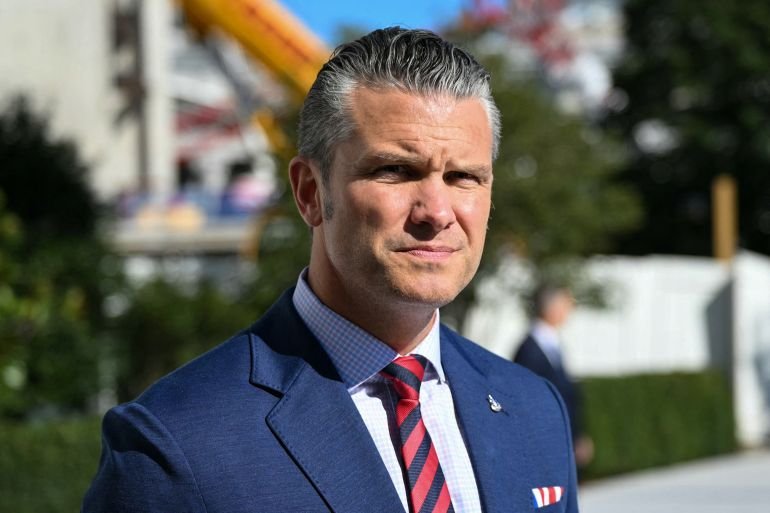
United States Defense Secretary Pete Hegseth has said the execution of a former US Army psychiatrist who killed 13 people at the Fort Hood military base in Texas will be publicly available to watch.
In an interview with the media outlet Real America’s Voice on Thursday, Hegseth was asked about President Donald Trump’s recent order to use a firing squad to execute Nidal Hasan, who was convicted of the 2009 shooting.
Recommended Stories
list of 3 itemsend of list
The secretary said he approved of the decision, calling it a “no-brainer”.
“We’ll make sure that people are able to watch it, that it’s public,” Hegseth told interviewer Jack Posobiec. “Because people need to understand that there’s serious consequences for these types of things.”
Hegseth added that the execution would take place at Fort Hood on December 3 at 1pm US Central Time (19:00 GMT), the same time that the 2009 shooting took place.
Hasan was sentenced to death in August 2013 after a military jury found him guilty of 45 counts of premeditated murder and attempted murder for the shooting.
The former Army major walked into an army processing centre on the Texas base, shouted “Allahu akbar” (God is greatest) and opened fire on fellow military members waiting to get medical attention.
Hasan’s execution required approval from Hegseth and Trump, who authorised the use of the firing squad on Monday.
An official with the Defense Department told Al Jazeera that Hasan’s execution would be “livestreamed”, adding that more details would come soon.
It is not clear from Hegseth’s remarks whether troops, spectators or US military officials would be present in person for the execution. US Army regulation states that at least two media outlets should be selected as witnesses.
No state or federal execution has ever been televised in the US. The last public execution in the country took place more than 90 years ago in Owensboro, Kentucky, on August 14, 1936.
The last time a US military execution was conducted by firing squad was in 1945, for desertion during World War II.
When asked to comment on Hegseth’s remarks – and whether Trump would view the execution – the White House referred Al Jazeera to the Pentagon.
The Trump administration announced it would add death by firing squad as an acceptable method for federal executions in April, along with gas asphyxiation and electrocution.
Crew members express relief upon return from record-breaking deployment of 265 days that strained conditions on board.
Published On 9 Oct 20269 Oct 2026
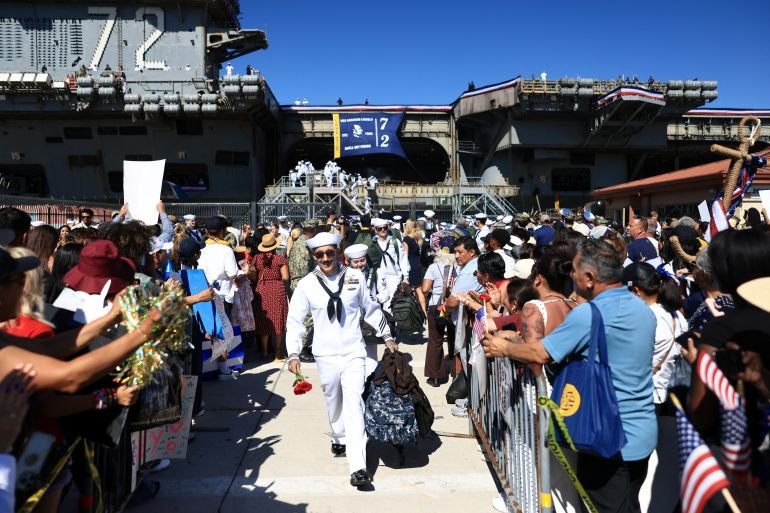
The United States aircraft carrier USS Abraham Lincoln has returned to its home port after a 322-day deployment, including a record 265 consecutive days at sea, during which it helped wage the US-Israel war on Iran.
The vessel returned to Naval Air Station North Island in San Diego, California, on Thursday, where members of its crew were greeted by family and friends.
Recommended Stories
list of 3 itemsend of list
“It feels amazing,” 20-year-old Abel Ramirez told The Associated Press news agency, adding that his parents had driven from Texas to meet him. “There was a certain point when I never thought I would come off.”
The record-setting deployment of the USS Lincoln became a symbol for larger criticisms of the US war effort, which has dragged on since February with no clear end in sight and has strained US military stockpiles.
The prolonged deployment prompted a series of news reports calling attention to deteriorating conditions, food shortages and a series of reported suicide attempts by crew members.
Pentagon chief Pete Hegseth praised the sailors on Wednesday in remarks that accused the media of trying to turn the ship into “a symbol of dysfunction or a symbol of low morale or a symbol of a failed mission”.
President Donald Trump and members of his administration have frequently lashed out at the news media for critical reporting on the war on Iran. Trump himself has called the reporting about the USS Lincoln “fake news”.
“The Lincoln has been out there for a period of time, a good period of time,” he said at an Oval Office meeting on August 17. “I know people on the Lincoln, and they say it’s beautifully maintained and beautifully taken care of.”
Earlier that month, when confronted with the amount of time the USS Lincoln had spent at sea without a port stop, Trump quipped that its deployment was “not nearly long enough“.
The reports of mental health strain on the USS Lincoln come as public opinion polls show low approval ratings among US voters for the war against Iran.
On Thursday, the Pew Research Center released a poll that found 65 percent of Americans disapproved of Trump’s handling of the war, compared with 33 percent who approved.
The war has also fuelled concerns about the cost of living ahead of the upcoming midterm elections. Since the war began, Iran has hindered commercial traffic through the Strait of Hormuz, a critical waterway for the trade of fuel, fertiliser and other goods.
Sailors returning home on the USS Lincoln said that they were looking forward to fresh meals and spending time with their families.
Alma Solano Velez said that her husband, one of the US service members on board, shared a list of foods he had been craving over his 10-month deployment: oxtail, barbecue chicken, broccoli and shrimp empanadas, among others.
She added that he had spoken about “the lack of food and showers” and was looking forward to seeing their four-year-old daughter.
The leading candidates in Michigan’s heated Senate race have faced off in their first televised debate, with less than a month remaining before the United States midterm elections.
Thursday’s hour-long debate was a microcosm of how tense the toss-up race has become.
Recommended Stories
list of 3 itemsend of list
Democratic nominee Abdul El-Sayed, formerly the health director for Wayne County, repeatedly sought to paint his Republican adversary Mike Rogers as a yacht-owning millionaire out of touch with ordinary voters.
For his part, Rogers, a former member of the US House of Representatives, lobbed accusations at El-Sayed that he was soft on “terrorism” and had foreign sympathies.
The Michigan-born El-Sayed has repeatedly faced Islamophobic attacks while on the campaign trail, with Republican President Donald Trump labelling him an “extremist, terrorist sympathizer” whose history “goes back to the days of the Jihad”. If elected, El-Sayed would be the first Muslim member of the US Senate.
The two candidates spent much of their hour onstage together speaking over one another, as they exchanged pointed barbs.
“He can’t condemn a terrorist act that happened on our soil in the state of Michigan. He can’t bring himself to condemn –,” Rogers began, referencing a March attack on a synagogue.
“I did condemn it,” El-Sayed said, jumping in. “No, you did not,” Rogers replied, with El-Sayed quickly responding, “You make stuff up. You make stuff up.”
The Senate race in Michigan is considered key to the battle for control of the US Senate. Democrats are seeking to flip both chambers of Congress, but shifting control of the Senate will be a tougher prospect, given that only a third of its 100 seats are on the November 3 ballot.
Host Rick Albin at times struggled to keep the debate on track, as tensions rose.
“We’ve got dozens of questions we want to get to. You can’t litigate all of these with 14 different rebuttals, so please work with me,” Albin told the two candidates at one point.
Here are the key takeaways from the evening’s debate.
Republican nominee Mike Rogers, right, speaks during a televised debate with Democratic nominee Abdul El-Sayed [Paul Sancya/Pool via AP Photo]
Rogers insinuates El-Sayed family ties to ‘terrorism watch list’
The ferocity of the debate was underscored by the high volume of ad hominem attacks the candidates deployed against each other.
But Rogers repeatedly pushed a series of attacks that seemed to centre on El-Sayed’s identity as a Muslim.
In response to a question about healthcare, Rogers said that El-Sayed has “taken money from individuals on his campaign who openly support Hamas, Hezbollah, al-Qaeda”.
Later, when asked about his position on surveillance by Flock cameras, Rogers argued that such technology has helped catch people suspected of terrorism. He then implied that El-Sayed’s concerns about the cameras were suggestive.
“Why would that bother you?” Rogers asked El-Sayed. “Well, if you have somebody in your family that might be on the terrorism watch list …”
El-Sayed interjected, seeming to dare Rogers to continue his thought.
“Are you going to go ahead and say that I’m a – go ahead and say it,” El-Sayed said. “You’ve been tiptoeing about it the whole time. Just say it. Just say it. Go ahead and say it.”
Muslim and Arab candidates in the US have frequently been subjected to Islamophobic attacks on the campaign trail, accusing them of support for “terrorism” and Islamic fundamentalism.
Republican Mike Rogers insinuated El-Sayed may have family on the ‘terrorism watch list’ [Paul Sancya/Pool via AP Photo]
Both sides agree on ending the Iran war
There were issues, however, on which both candidates found a measure of common ground.
Both Rogers and El-Sayed agreed the US-Israeli war against Iran should end, but they had opposite views on Washington’s relationship with Israel and its role in the conflict.
High gasoline prices and inflation, El-Sayed said, were directly caused by the Iran war, and he blamed the Trump administration for Iran’s decision to shut down the Strait of Hormuz, a critical trade route.
“This is what happens when you start wars you never should be fighting,” El-Sayed said. “We literally taught the Iranian regime that they have a choke on the Strait of Hormuz, and now we’re living in that reality.”
Rogers agreed that “we need [the war] to come to an end”, but he also justified the conflict, saying that Iran’s uranium enrichment programme had been “set back twenty years”, echoing a frequent White House talking point.
The Trump administration has argued that the war was necessary to prevent Iran from creating a nuclear weapon, a goal Tehran has long denied.
Rogers’s position led El-Sayed to accuse him of “cheerleading” for the war and the Trump administration.
Democratic nominee Abdul El-Sayed pushed for an end to unconditional support for Israel [Paul Sancya/Pool via AP Photo]
Rogers backs continued Israel aid, El-Sayed calls for end
As part of the debate about US foreign policy, the candidates were also pressed on their positions about the US alliance with Israel.
The country is considered the largest overall recipient of US aid since World War II. From the start of Israel’s genocidal war on Gaza in October 2023 through September 2025, experts estimate that Israel received nearly $21.7bn in military aid.
El-Sayed has openly called for ending aid to Israel, and he has repeatedly denounced the conflict in Gaza as a genocide, in line with evaluations from United Nations experts and human rights watchdogs.
During the debate, he indicated he preferred US taxpayer dollars to be spent on domestic concerns like education and healthcare, rather than Israeli aid.
“He wants unconditional support for a foreign government,” El-Sayed said of Rogers. “I want unconditional support for kids in our schools, unconditional support for our healthcare, childcare.”
He also blamed Israel for the US military action in Iran. “I don’t want to be pushed into war by Israel, and I don’t want to be in war with Iran,” El-Sayed said.
Rogers, meanwhile, has joined most of his fellow Republicans in continuing to support aid for Israel. He argued that the country had “the right to defend itself in a very difficult neighbourhood”.
“Is there anything Israel could do that would lose your support?” the debate host asked.
“Listen, if they’re talking about using nuclear weapons, they would definitely lose my support,” Rogers replied.
Abdul El-Sayed, right, and Mike Rogers shake hands prior to their debate [Paul Sancya/Pool via AP Photo]
Another hot-button issue during the debate was Trump’s crackdown on immigration.
The Republican leader has pledged to carry out the largest mass deportation effort in US history, and his campaign has spurred human rights concerns.
When asked how they would approach the crackdown, both Rogers and El-Sayed agreed on tempering the militarised nature of the campaign.
In several cities, including Minneapolis, Minnesota, immigration authorities have been accused of racial profiling and using excessive force against immigrants and protesters, as well as violating their rights to due process.
Multiple fatal shootings have occurred during immigration enforcement operations, including the deaths of Renee Good and Alex Pretti in January.
Rogers indicated he would not have supported such confrontational operations, but he repeated a Trump claim that the raids were taking dangerous criminals off the streets.
“I think the public efforts in Minnesota were probably not appropriate,” Rogers said. “You always want to go in quiet, get the bad guy, get out of the neighbourhood for less problems. So that, to me, was something that they could have done differently.”
He later claimed that, under Trump, the country had seen “the largest decrease in murders ever recorded”.
El-Sayed, meanwhile, has previously voiced support for abolishing Immigration and Customs Enforcement (ICE), a key agency in Trump’s deportation campaign. He defended that stance on the debate stage.
“ICE right now is not about immigration enforcement. ICE is about terrorising our streets,” he said.
Mike Rogers speaks to reporters in the spin room after the debate on October 8, 2026 [Jim Vondruska/Reuters]
Candidates debate Canada trade war and tariffs
Donald Trump’s trade war with Canada, felt acutely in neighbouring Michigan, was another key topic of conversation.
El-Sayed depicted Rogers as an uncritical backer of Trump and his tariffs and tied him to past free trade deals such as the North American Free Trade Agreement (NAFTA), which paved the way for companies to shift manufacturing facilities out of the US – though Rogers did not enter Congress until 2001, eight years after NAFTA passed.
“You did that, man. That was your policy. NAFTA, that was your policy,” said El-Sayed.
Rogers sought to distance himself from the current trade war but expressed support for a deal with Canada that would loosen some of Ottawa’s tariffs on US goods.
“I would like to see the deal made,” said Rogers, adding that high Canadian tariffs for US goods “should be eliminated”.
Both candidates tried to strike a balance between criticism of the economic fallout of the trade war and qualifying their support for more selective tariffs, favoured by some industries and labour unions as a means of protecting domestic jobs.
Coco Gauff admits the racism she suffered during the China Open exhausted her after the US tennis star missed out on the quarterfinals.
Published On 7 Oct 20267 Oct 2026
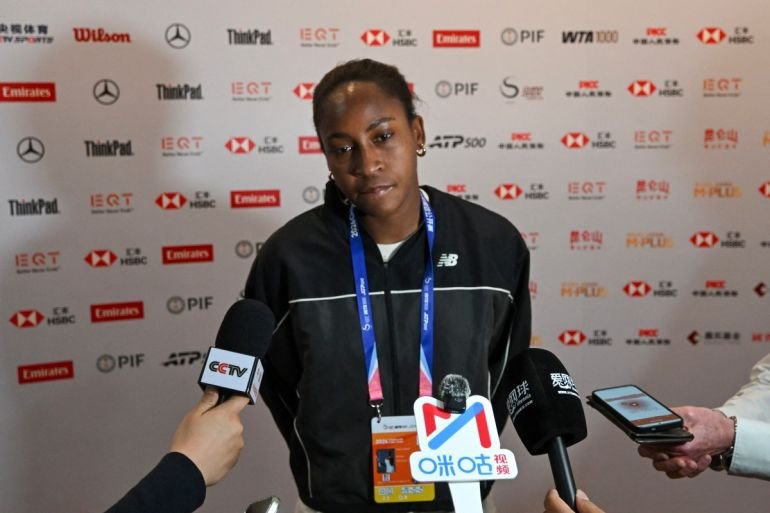
Coco Gauff says online racist abuse has left her feeling exhausted as she lost to Elise Mertens in the China Open.
The world number four, a Black American, turned in an uncharacteristically listless performance in Beijing on Wednesday, double-faulting eight times as she went down 6-3, 6-3 to her Belgian opponent.
Recommended Stories
list of 4 itemsend of list
Gauff, 22, was playing a day after she called out the “insane” amount of abuse she had received on the internet following her win over Chinese teenager Sun Xinran in the previous round.
“It has been kind of draining. I’m not going to lie,” Gauff said of the impact of the online comments.
“But I just turn off my phone and move on. There’s nothing you can do.”
Asked about the match, she said: “I think I just didn’t play well. I think I wasn’t moving well.
“There were a lot of things I didn’t do well. I thought Elise played well on the bigger points.”
During her previous match in Beijing, against Sun, Gauff requested a video review over flickering LED lights on the stadium’s advertising hoardings.
The move prompted some boos from the crowd. The umpire agreed to have the point replayed, and Gauff went on to win 7-5, 6-1.
Early on Tuesday, Gauff wrote on X: “Hey everyone, you can dislike me or disagree about what happened without being racist.”
She was responding to a post that contained a racial slur.
“The amount of racist comments and messages I’ve received in the last few hours is insane,” she wrote.
Belgian Elise Mertens, right, shakes hands with American Coco Gauff after their singles match [Pedro Pardo/AFP]
Gauff also clarified that she challenged the point before Sun had returned the ball, when she noticed the lights flicker for a second time.
Asked about the incident, a spokesperson for the Women’s Tennis Association, the global governing body, said it was “appalled by the racial abuse directed at Coco Gauff” and that it was “in contact with her to offer our full support”.
It added in a statement to the AFP news agency that there was “no place for racism, discrimination, or abuse in tennis”, and that it was “seeking action” against the abusive content.
Gauff, who won the Beijing title in 2024 and made the semifinals last year, was popular among fans during the tournament.
A group of supporters in the largely empty stadium tried to encourage her into a comeback on Wednesday.
Mertens was undeterred as she punched her ticket for a quarterfinal clash against Iga Swiatek.
The world number 19 called Gauff an “incredible player”, adding: “I knew it was going to be a very tough match.”
She dedicated her win to her coach, who is also her boyfriend.
Earlier, Swiatek swept aside American teenager Iva Jovic 6-1, 6-3 in one hour and 35 minutes.
“I had it under control from the beginning,” said the Polish world number nine. “I feel like I’m improving every day.”
China’s Zheng Qinwen is due to face 118th-ranked Alina Charaeva later on Wednesday.
Ukraine’s Elina Svitolina, the sixth seed, will play American Ann Li.
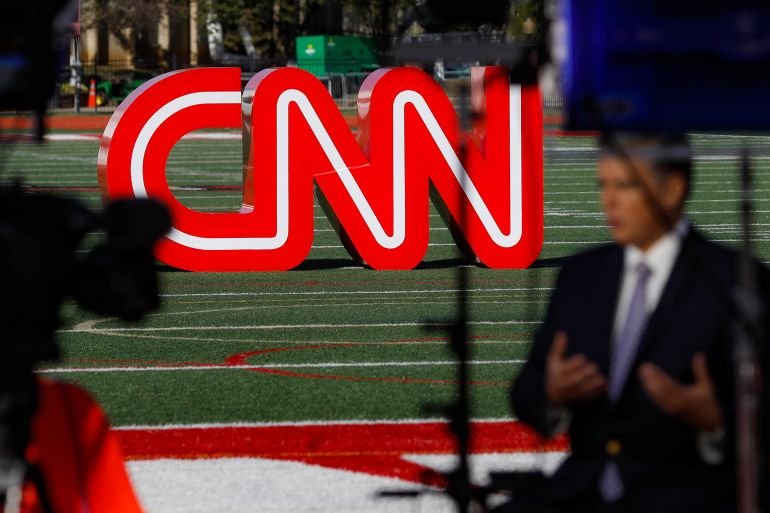
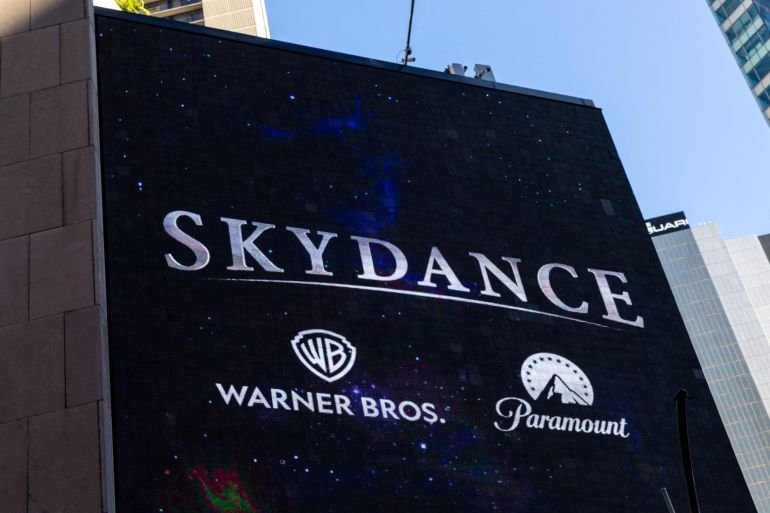
Paramount Skydance has completed its takeover of Warner Bros Discovery, bringing CNN and CBS News under the same corporate ownership, in a deal that has raised concerns about editorial independence and freedom of speech.
The acquisition, worth about $110bn including debt, combines two of Hollywood’s biggest studios after months of legal challenges lodged by state attorneys general and unions.
Recommended Stories
list of 4 itemsend of list
The new company, Skydance Corporation, brings together HBO, CBS, Nickelodeon, Showtime, Comedy Central, DC Studios and Food Network, alongside streaming services Paramount plus and HBO Max.
But its control of two major US news organisations has drawn particular scrutiny. David Ellison, Skydance’s chairman and chief executive, has promised to preserve their editorial independence, but his father, Oracle cofounder Larry Ellison is a major financial backer of the deal, and has previously donated funds to US President Donald Trump and Israel.
Asked about the takeover on Tuesday, Trump welcomed it. “They’re terrific people, and it’s going to be a great company,” he said.
Why was the merger challenged?
The takeover faced initial opposition from Hollywood workers, politicians and state prosecutors concerned about the mounting concentration of power in an industry already dominated by a handful of companies.
Netflix initially reached an agreement to buy part of Warner Bros Discovery. Paramount then launched a competing bid, prompting a bidding war before Netflix walked away.
A California-led coalition of 12 state attorneys general sued to block the deal, saying that it would reduce competition and raise prices. The Writers Guild of America brought a separate challenge.
Both cases were settled in September when Paramount agreed to commitments relating to film production, support for displaced workers and protections for the news networks, including the creation of a new editorial independence board.
But the settlement did not end opposition to the deal. “This merger will stifle creativity, weaken free speech and cost people their jobs,” actor and activist Mark Ruffalo has said.
Democratic Senator Elizabeth Warren linked the takeover to Trump’s efforts to restrict media access. “As Trump tries to ban CNN from the White House, it would be a massive mistake to cave on the Paramount merger,” she said, referring to the US president’s so-far thwarted attempt last month to bar reporters from several news organisations, including CNN, from accessing the White House.
Can an editorial independence board protect CNN and CBS?
One condition of the settlement requires Skydance to establish a “News Editorial Independence Board” within 180 days of completing the takeover.
The five-member body is to include active or retired journalists with at least 10 years of experience. It is intended to establish editorial principles and address disputes involving the news networks and corporate management.
However, its members will be appointed by, and will report to, Skydance’s board of directors, which Ellison chairs. Two members can belong to the same political party, and there is no requirement to publish its findings.
The condition has left critics with a multitude of questions, including: How can a member of an independent editorial board be a member of a political party? How can there be scrutiny if its findings are not public? How can it be independent if it is appointed by a board of directors, themselves appointed by the CEO of the company?
Seth Stern, chief of advocacy at the Freedom of the Press Foundation, said, “A Paramount-appointed editorial independence board for CNN and CBS is worthless. The fish rots from the head, and this particular fish is headed by a compromised oligarch with a history of throwing journalists under the bus to advance his business interests.”
Stern also questioned whether government enforcement of the settlement could itself threaten press freedom. “The editorial board creates the same First Amendment problems it’s supposed to solve – the government meddling in the news.”
The First Amendment provides constitutional protection for freedom of speech and the press.
Ellison argues that the two networks will continue to operate independently. “We’re going to make sure that CNN and CBS News are completely editorially independent,” he said on Tuesday.
On Monday, Skydance announced that Mark Thompson would remain CNN’s chairman and editor-in-chief, while Bari Weiss will continue as CBS News’s editor-in-chief, easing previous fears that Weiss would immediately take charge of both networks.
Why are there fears for editorial independence?
The takeover gives the Ellison family control of CNN less than a month before the November 3 US midterm elections, and follows Trump’s repeated attacks on the network as it seeks to hold the US president to account.
Shortly after Paramount launched its bid in December, Trump accused CNN of spreading “poison and lies” and said it was “imperative” that it be sold, while the Trump administration has moved to bar CNN from reporting in certain areas of the White House.
Ellison donated roughly $45m to a political nonprofit group supporting Trump’s election efforts in 2024, while he donated $16.6m to Friends of the Israel Defense Forces, a charity supporting Israeli soldiers – its largest single donation at the time.
Earlier this year, the White House criticised CNN’s coverage of the US-Israeli war on Iran, while Defence Secretary Pete Hegseth told reporters that “the sooner David Ellison takes over that network, the better.”
Sovereign wealth funds from Saudi Arabia, Qatar and the United Arab Emirates also hold indirect financial interests in the combined company. They have no voting stakes, although their involvement adds another layer of scrutiny over its funding.
Concerns about the future for editorial integrity, however, intensified after Skydance acquired Paramount in 2025, and layoffs followed, alongside the closure of CBS News Radio and changes to CBS News flagship investigative programme 60 Minutes.
High-profile firings enacted under CBS News Editor-in-Chief Bari Weiss and Skydance Media CEO David Ellison included correspondents Sharyn Alfonsi and Cecilia Vega, as well as 60 Minutes executive producer Tanya Simon.
The programme’s September season premiere attracted about 21 percent fewer viewers than a year earlier.
In 2025, Paramount also agreed to pay Trump $16m to settle a lawsuit over the editing of a 60 Minutes interview with then-presidential candidate Kamala Harris.
In a June 2 letter, nine advocacy groups, including Reporters Without Borders, the Freedom of the Press Foundation and the Committee for the First Amendment, warned that CNN could face similar upheaval and firings.
“Bari Weiss’ shameless actions fulfil the Ellisons’ commitment to President Trump to remake CBS to his liking,” they alleged, referring to the firings and changes at 60 Minutes.
“Larry Ellison has reportedly promised to do the same at CNN if allowed to take control through the pending Paramount-Warner Bros. Discovery merger. Not because it makes any business sense, but because they seek to control the public discourse.”
The groups described the proposed takeover as an “existential threat to the free press, independent media, and free speech in this country and beyond”.
Germany’s former spy chief, August Hanning, has been arrested on suspicion of passing state secrets to a foreign intelligence service.
Hanning, 80, headed up the Federal Intelligence Service, known by its German acronym BND, from 1998 to 2005.
A federal prosecutor’s statement said it strongly suspected him of “treasonous espionage, obtaining state secrets, attempted treason” through contact with foreign intelligence services since 2010, while working as a private consultant. He is accused of obtaining around 2,000 sensitive documents from a former bureau chief who has also been arrested.
But he isn’t the only high-ranking intelligence officer to have been discovered to have worked for foreign governments over the years.
Here are some of the highlights.
1940s to 1960s – Kim Philby and the ‘Cambridge Five’
Kim Philby was a British intelligence officer who secretly spent decades working for the Soviet Union during World War II and the early Cold War years.
He was recruited by Soviet Intelligence while studying at Cambridge University in the 1930s. He was the most prominent member of the “Cambridge Five” – a spy ring that gave away British secrets to the Soviet Union.
During the war, he joined MI6, where he rose to head its counter-Soviet division, and was later posted to Washington, DC. This gave him access to sensitive information through his close links to the CIA and FBI.
His tip-offs to his Soviet handlers are believed to have scuppered many Western operations and revealed the identities of agents. This included information operations to overthrow Albania’s communist leader Enver Hoxha as part of Western efforts to stop the spread of communism.
Philby came under suspicion in 1951 and was forced out of MI6 when Guy Burgess and Donald Maclean, two other members of the Cambridge Five, defected to the Soviet Union. Philby was suspected of having warned them that British intelligence officers were close to uncovering their identities as double agents for the Soviet Union, before being formally cleared of the allegations in 1955.
Then, in 1963, aware that the net was closing in on him because of his own involvement with Soviet intelligence, he fled to Russia, where he lived with his wife since 1971, Rufina Pukhova, until his death in 1988. Overall, he provided state secrets, the identities of agents, minutes from cabinet meetings, atomic research, diplomatic and military intelligence, and information about counter-intelligence operations to the Soviet Union for nearly 20 years.
Philby is regarded as the most damaging spy in British history.
According to the UK’s National Archives, one of the agents he unmasked to the Soviet Union was Constantin Volkov, a Soviet intelligence officer posted to Turkiye who wanted to defect to the UK in 1945. Volkov and his wife were seized and executed in Moscow as a result. The information he provided to the Soviet Union about a joint CIA-MI6 operation in communist Albania in the late 1940s and early 1950s resulted in the execution of hundreds of anti-communist agents.
Kim Philby, British intelligence agent, laughs with reporters during a 1955 news conference after being formally cleared of tipping off fellow double agents Guy Burgess and Donald Maclean [File: Getty Images]
1970s and 1980s – Oleg Gordievsky
Oleg Gordievsky was a KGB colonel who spied for British intelligence for more than a decade.
He was the son of an officer in the NKVD, which was the Soviet secret police and the direct predecessor to the KGB.
But he was recruited by MI6 in the early 1970s after becoming disillusioned by the Soviet crushing of mass protests during the Prague Spring in Czechoslovakia in 1968 and the building of the Berlin Wall.
While working for the KGB, he was stationed in Copenhagen and later in London, where he became KGB station chief in 1985.
The intelligence he provided to the British is thought to have revealed the KGB’s deep concerns that NATO’s 1983 Able Archer exercise might be cover for a real nuclear strike. This was invaluable for helping the West understand Soviet fears and to de-escalate.
Gordievsky came under suspicion and was recalled to Moscow in 1985. He was drugged and interrogated but had not yet been charged when MI6 ran a daring operation to rescue him and smuggle him out of Russia in the boot of a car across the Finnish border.
Russia sentenced Gordievsky to death in absentia.
He lived in the UK under protection until his death in 2025.
Oleg Gordievsky, the KGB Colonel-turned-British spy, is seen here wearing a disguise at the Marlborough Hotel in London, on October 16, 1990 [File: David Levenson/Getty Images]
1980s and 1990s – Robert Hanssen
Robert Hanssen was a high-ranking agent at the US Federal Bureau of Investigation (FBI) who spied for the Soviet Union and later for Russian intelligence services between 1979 and 2001.
Hanssen initially studied dentistry at Northwestern University before switching courses and receiving a degree in accounting and information systems. He worked as a police officer in Chicago before joining the FBI in 1976.
He approached Soviet military intelligence in 1979, eventually working with the KGB and its successor, the SVR. He operated using the alias “Ramon Garcia”.
Hanssen never met his handlers in person, instead using “dead drops” when he would leave classified documents in prearranged outdoor locations, including parks, wooded areas, under bridges and on street corners in the Washington, DC area, in exchange for cash or diamonds.
He handed over thousands of pages of classified material, including details about US nuclear war plans and the identities of Russian officials working for the US. At least two of those sources, including Dmitri Polyakov and Valery Marynov were executed.
The arrest in 1994 of Aldrich Ames, another US spy caught working for Russian intelligence, eventually led to his arrest in February 2001.
He pleaded guilty to avoid the death penalty and died in prison in 2023.
An undated FBI-issued photograph of Robert Hanssen, a former FBI agent deemed a traitor by the government and considered one of the most damaging spies in US history [File: FBI/Handout HK/SVReuters]
2000s – Alexander Yuk Ching Ma
Alexander Yuk Ching Ma is a former CIA officer who was caught spying for China.
He worked for the CIA from 1982 to 1989 and became a US citizen, living in Honolulu.
In March 2001, officers of China’s Shanghai State Security Bureau asked him to arrange a meeting with a now-deceased former CIA officer who served from 1967 to 1983. The two met in a Hong Kong hotel room for three days. In exchange for $50,000, they provided classified information to China.
The FBI became aware of his ties to Chinese intelligence and hired him as a contract linguist in its Honolulu office so that his activities could be monitored.
He was arrested in a sting after admitting to an undercover FBI employee that he had facilitated the provision of classified information to Chinese intelligence.
Ma pleaded guilty in May 2024 and is currently serving a 10-year prison sentence.
The suspect, from the western state of Washington, allegedly gave money and advice to the attacker over the internet.
Published On 6 Oct 20266 Oct 2026
Law enforcement in the northwestern United States have charged a suspect in connection with a deadly shooting at a Canadian school in Tumbler Ridge, British Columbia.
On Tuesday, prosecutors charged 30-year-old James Cody Bryant, a resident of Washington state, with conspiracy to murder persons in a foreign country.
Recommended Stories
list of 3 itemsend of list
Bryant allegedly provided money and technical advice to the attacker in conversations over the internet, starting six months before the February 10 attack.
The shooting was “a horrific tragedy for that small community and for all of Canada”, acting US Attorney Neil Floyd said at a news conference in Seattle. “Indeed, here in the Pacific Northwest, we felt the pain of those families devastated by this violence.”
Canadian officials have described the attack as one of the country’s worst mass shootings.
The suspect, 18-year-old transgender woman Jesse Van Rootselaar, shot and killed her mother and half-brother at their home before travelling to the Tumbler Ridge Secondary School and opening fire.
Six people were killed, including five students, and 27 other victims were injured. Van Rootselaar, a former student at the school, died by suicide at the end of the attack.
Police in Canada said at the time that Van Rootselaar had a history of mental health issues.
Alleged online advice and financial support
US prosecutors allege Bryant and Van Rootselaar had been in touch through the social media service Discord and had discussed how to carry out the mass shooting.
The pair discussed how to maximise notoriety after the attack, with Bryant allegedly agreeing to livestream it through Twitch, Floyd said on Tuesday.
Bryant also allegedly provided money for items like a pair of shoes for the attack and instructed Van Rootselaar on how to start and then drive a car to reach the school.
Prosecutors alleged Bryant, whom officials cited by The Associated Press and Reuters say identifies as female, had admitted to investigators that she was “maybe the only one who could have stopped the shooter”.
Warning signs ignored
In September, the British Columbia government sued the technology company OpenAI in a California court, saying its ChatGPT platform played a role in the shooting.
Van Rootselaar, the Canadian officials alleged, had been flagged by OpenAI’s safety team for her statements about gun violence, and her account had been suspended. But law enforcement authorities were not alerted to the problem.
In its lawsuit, British Columbia sought financial compensation from the company to cover its emergency response to the shooting and community recovery efforts.
It also asked the court to force OpenAI to reform how it identifies and handles users who threaten violence.
OpenAI CEO Sam Altman said he was “deeply sorry” his company had not contacted law enforcement in a public letter two months after the shooting.
“While I know words can never be enough, I believe an apology is necessary to recognize the harm and irreversible loss your community has suffered,” he wrote, adding that OpenAI would take steps to prevent such “tragedies” in the future.
The lawsuit filed in California alleges Altman’s company never undertook the promised policy changes.
By the time of the filing, OpenAI was facing more than 30 other lawsuits in California, where it is based, from victims’ families, survivors and others affected by the Tumbler Ridge attack over alleged negligence.
Paramount Skydance has completed its $110bn merger with Warner Bros Discovery to form Skydance.
The deal, which closed on Tuesday, brings together two entertainment giants that own movie studios and theme parks, but also brings two of the United States’ most influential news brands under one roof — CNN and CBS News.
Recommended Stories
list of 4 itemsend of list
Skydance CEO David Ellison, son of tech tycoon Larry Ellison, who is also a close ally of US President Donald Trump, has appointed Ynon Kreiz as co-CEO. Kreiz previously led Mattel.
The road to the merger has included lawsuits from unions and 12 different state attorneys general. But the deal was ultimately settled after the company agreed to appoint an independent editorial board to oversee both news networks amid concerns that the merger would lead to skewed coverage at the two networks.
On Monday, the company announced that Mark Thompson will stay on as CNN’s editor-in-chief, while Bari Weiss, editor-in-chief at CBS News, who was appointed to the role a year ago on Monday, will stay in her position.
Thompson’s continuation brought “a sigh of relief” among journalists at CNN, its media industry newsletter, Reliable Sources, reported.
Ever since the merger had been announced, there had been a wave of concerns at the network that major changes would be made to CNN if the Ellisons took over.
A looming future
There are still a lot of unknowns about what news will look like under Skydance. In a memo to staffers on Monday, Thompson said that “the specifics of how CNN will plug into and operate in the new company have yet to be finalized.”
That means looming fears of layoffs and consolidation still weigh on both news divisions as the combined company will carry $80bn in debt, while the entertainment giants look to cut costs, grow their streaming footprint and have pledged to produce 30 movies per year.
Thompson’s stay may be temporary, as The New York Times reported that his contract is up in the spring.
It is also not yet clear whether the networks will stay separate or combine in the long term, amid concerns that CBS News’ Weiss could be handed additional charge of CNN. In the past, the network’s top talent, including journalist Anderson Cooper, has threatened to leave if she came on board.
Weiss took over the network one year ago, and viewership has slumped across the board. Most recently, the news magazine programme 60 Minutes saw viewership slump during its season premiere last month, dropping 21 percent from the prior year and marking its worst viewership for a season premiere in 25 years, according to Nielsen ratings.
Editorial questions
The terms of the attorneys general’s lawsuit settlement require an independent editorial oversight board for both the networks. Skydance has 180 days to put it together. Press freedom experts do not believe that will help maintain editorial independence.
“It doesn’t take effect for 180 days. The newsroom can be totally overhauled in 180 days,” Seth Stern, director of advocacy for the Freedom of the Press Foundation, told Al Jazeera.
It is not the first time a publication has appointed an editorial board to weigh in on concerns about editorial influence. In 2007, when News Corp acquired Dow Jones, the parent company of the Wall Street Journal, the Bancroft family, which owned the publisher at the time, was concerned that new owner and media mogul Rupert Murdoch would impact the paper’s editorial independence with his conservative tilt.
The paper appointed a five-person independent committee to preserve editorial integrity. But it was later revealed, including by former members of the board during a roundtable discussion hosted by the Freedom of the Press Foundation, that it did not deliver the oversight that it was originally intended to provide.
In Skydance’s case, the board is to be made up of five journalists appointed by Ellison, and there is no requirement for the company to disclose its findings to the public. The terms say that no more than two people on the board can be affiliated with the same political party.
“The truth isn’t dictated by the fifty-yard line between political parties. Sometimes neither political party is even close to the truth. So having a commitment to bipartisan representation, as opposed to a commitment to truth-telling, totally misunderstands what news is,” Stern said.
On Wall Street, the new company began trading under the ticker symbol SKYD. Since opening on Tuesday, the stock has dropped 2.5 percent.
The 50-year-old has regained consciousness and is receiving care nearly one week after being sent to the hospital following a botched lethal injection.
Published On 6 Oct 20266 Oct 2026
Lawyers for Christa Pike say she is awake and able to speak after her botched execution attempt by the state of Tennessee on September 30.
Tuesday’s statement marks the first public indication that Pike’s condition has improved after she was transported to a Nashville hospital after receiving two doses of pentobarbitol, lethal injections intended to end her life.
Recommended Stories
list of 3 itemsend of list
Her failed execution has sparked debate about the use of the death penalty in the United States. Pike is thought to be the first person to have survived such an injection in the country.
“Against all odds, Christa Pike is conscious, speaking, and continues to receive critical medical care,” Pike’s lawyers said in a statement.
“Despite the severe damage she endured to her arms, she is still handcuffed and shackled to the bed. Her recovery is medically unprecedented. Her prognosis remains unclear but, at a minimum, we expect a long recovery.”
The statement also expresses gratitude to medical workers who the lawyers say have “treated Christa like a human and have provided exceptional care to her”.
Pike’s lawyers had previously stated that she was unconscious and on a ventilator. They described her arms as “swollen, burned and blistered” by the failed execution.
Pike was convicted and sentenced to die in 1996 for her participation in the murder of a classmate, Colleen Slemmer, when she was 18 years old. Two co-defendants received lesser sentences.
Pike’s defence lawyers had pointed to her mental health struggles in their attempts to commute her sentence. But the Slemmer family had advocated for the death penalty, pointing to the violent nature of the 19-year-old’s murder.
Accounts of Pike’s failed execution describe her kicking off the sheet covering her body and, at one point, appearing to snore. She reportedly expressed feeling pain as the lethal injections were administered.
The incident has brought attention to the prevalence of botched executions in the US criminal justice system.
Critics have argued that botched executions — defined as those that deviate from established procedures through unforeseen issues, delays or administrative incompetence — can cause unnecessary pain and suffering for those being put to death.
Citing the researcher Austin Sarat, the Death Penalty Information Center, a nonprofit, estimates that 3 percent of executions in the US from 1890 to 2010 were botched.