In a recent turn of events, the average monthly trading volume on South Korea’s five main won-based exchanges—Upbit, Bithumb, Coinone, Korbit, and Gopax—dropped from 125.2 trillion won to 98.1 trillion.
This happened in Q1 2026, which instilled fear that the nation’s crypto market might be losing interest. However, in reality, the cryptocurrency market in South Korea is maturing.
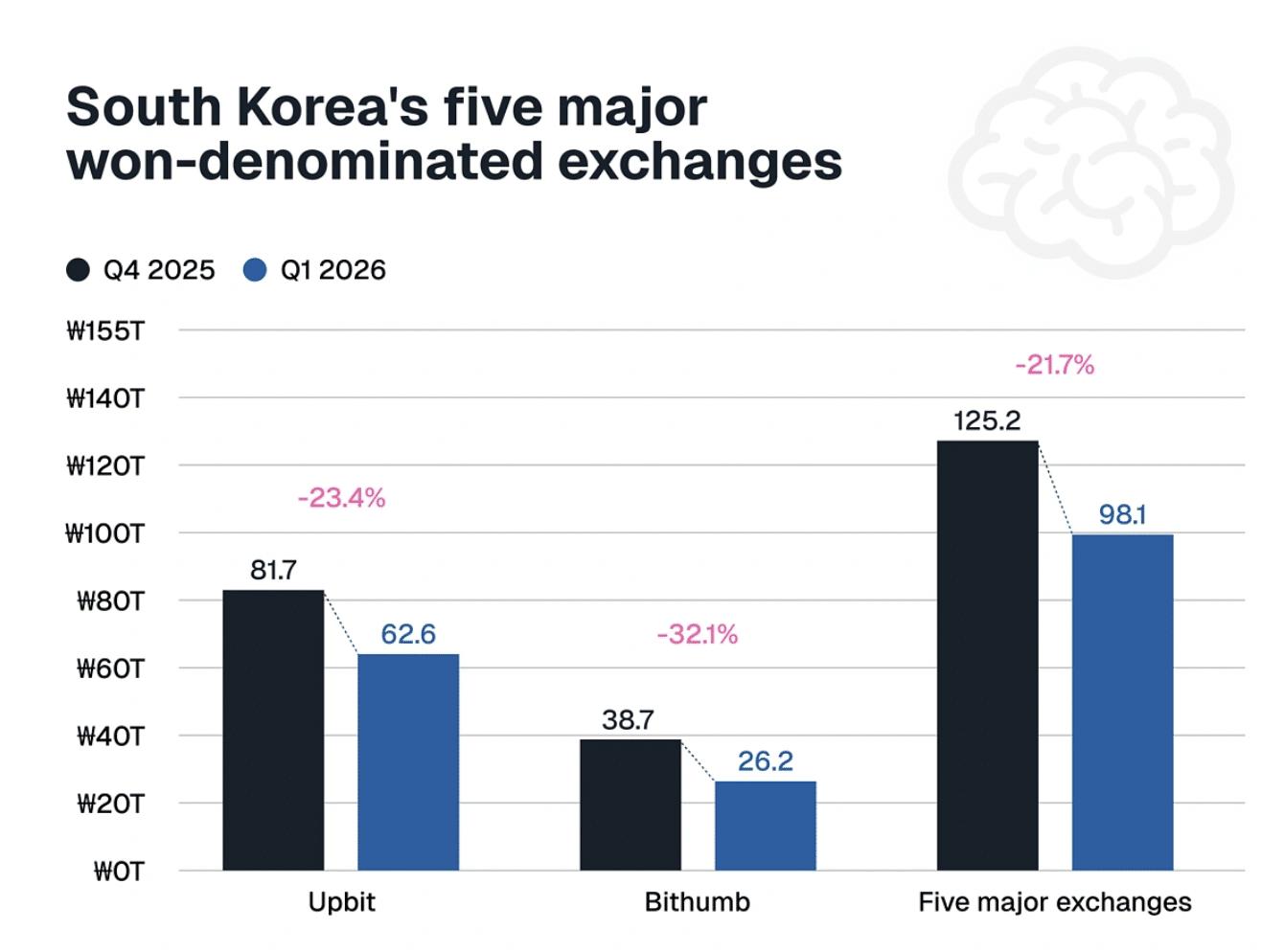
Well, the drop in trading volume was caused by investors moving toward long-term holdings, capital getting attracted to South Korea’s thriving stock market, rising oil prices, and higher interest rates. All this combined had reduced appetite for risky assets.
South Korea’s crypto regulatory shift
Although Upbit and Bithumb continue to control approximately 96% of trading volume, authorities are attempting to lessen market concentration. This they plan to do by implementing ownership caps under the Digital Asset Basic Act (DABA) Phase 2.
This comes on the heels of Bithumb accidentally giving out Bitcoin [$BTC] rather than tiny cash prizes during a February 2026 promotion.
As a result, a 17% flash crash was momentarily caused in the $BTC/KRW market. This, in turn, pushed lawmakers to come up with stringent oversight.
The stablecoin debate
That said, as lawmakers debate DABA Phase 2, which will also decide who can issue won-backed stablecoins, South Korea’s digital asset market is at a turning point.
To protect financial stability, the Bank of Korea supports bank-led issuance, but the Financial Services Commission is in favor of permitting participation from any eligible entity.
Yet, despite the uncertainty, demand remains unshaken. By April 2026, KRWQ, a won-pegged stablecoin that was introduced on Base in late 2025, had grown to a daily volume of roughly 1 billion won.
However, this was primarily due to foreign institutions using it as an affordable way to hedge their exposure to South Korean stocks.
Needless to say, this raised concerns about South Korea losing control over won-denominated liquidity due to the rise in offshore stablecoin activity.
While some contend that these actions may drive trading activity overseas, the enduring Bitcoin “Kimchi Premium” still illustrates how South Korea’s capital controls have affected the country’s cryptocurrency market.
Steps taken so far
GIWA, an Ethereum Layer-2 network based on the OP Stack, was introduced by Upbit operator Dunamu. This was in to facilitate regulated institutional blockchain activity by enabling multi-chain compatibility, identity verification, and quick settlement.
Although KRWQ indicates a strong demand for digital won liquidity on a global scale, GIWA seeks to integrate that activity into a domestic ecosystem that complies with regulations.
At the same time, Tether submitted seven trademark applications to the KIPRIS database in South Korea. KRWT and WONTETHER are the two names that were highlighted.
As expected, markets interpret both as a sign because they both unmistakably show the Korean won.
Final Summary
- Upbit and Bithumb account for about 96% of domestic trading activity, indicating that market concentration is still high despite lower volumes.
- Following the February 2026 Bitcoin distribution error by Bithumb, regulatory scrutiny increased, leading to stricter oversight.
Leave a Reply