Blog

  • Darius Jabloński, Kadri Kousaar and Rodrigo Susarte Make the Cut at Tallinn TV Beats Co-Financing Market (EXCLUSIVE)

    Darius Jabloński, Kadri Kousaar and Rodrigo Susarte Make the Cut at Tallinn TV Beats Co-Financing Market (EXCLUSIVE)

    Polish film and TV luminary Darius Jabloński’s spy thriller “Fortel” and Estonia’s “Stormbird” from multi-awarded Kadri Kousaar (“Magnus,” “Mother”) feature in the lineup of Tallinn’s TV Beats Co-Financing Market, running over Nov. 16-17.

    They are joined by Spain’s “When Devils Rule” from Rodrigo Susarte (“Patagonia”), and Belgium’s “The Inheritance” powered by “This is Not a Murder Mystery” producer Panenka.

    Picked among 50 submissions from Eurimages member states, the 10 selected series will vie for the coveted €50,000 ($56,000) Council of Europe Series Co-Production Development Award.

    TV Beats co-heads Roosa Toivonen and Petri Kemppinen

    Credit: TV Beats

    “Never before have we welcomed that many big names and companies,” said Petri Kemppinen, co-head of TV Beats, alongside Roosa Toivonen.

    This year’s crop hails from Belgium, Czechia, Estonia, Finland, Iceland, Ireland, Lithuania, Poland, Spain, and co-production partner Canada. As underscored by Toivonen, the geographical spread mirrors TV Beats’ core which is “to act as a bridge between the Baltics, Central Eastern Europe, and the Nordics. Three territories – Czechia, Finland, and Estonia – topped the list of applications.

    “Estonia is very dynamic in TV drama, and we did receive more applications than from Lithuania and Latvia,” said Toivonen who mentioned the catchy story of “Stormbird,” about a young female fugitive, under Soviet-occupied Estonia in 1949. Also from Estonia is the fast-paced YA drama “Breaking the Ice,” produced by Jevgeni Supin, who was distinguished last year with an Honorary TV Beats Producer Award.

    TV Beats co-heads also pointed at the larger number of projects in early development compared to previous years, set to make their very first pitch in Tallinn. “Obviously the hefty €50,000 development award from the Council of Europe is a major draw in today’s touch times for indie producers who struggle to gather development money when commissioners and public funders are cutting back. They need co-production partners to lift their projects,” Kemppinen said.

    Theme-wise, in an age of distrust and as the Baltics and CEE feel the heat from Russian threats, espionage is the beating heart of three shows (“Tanner,” “Fortel,” “The Woman Who Roared”), while oppressive regimes, systems or leaders -even disguised as devils-feature in the remaining slate, next to the ever-popular crime bets.

    Next to the TV Beats Co-Financing Market slate, more than 20 other top-tier series looking for additional financing, distribution and sales, will bow at ‘TV Beats Screenings’ and ‘TV Beats Coming Soon’, to be unveiled at a later date.

    The TV Beats Forum is part of the Tallinn Black Nights Film Festival’s industry platform Industry Tallinn & Baltic Event, running over Nov 9-20.

    Full rundown of TV Beats Co-Financing Market lineup:

    “Breaking the Ice” (“Päike mis sulatab jääd,” 6X45’, Estonia)
    Young adult drama from Estonian powerhouse Zolba Productions (“Von Fock”, “My Dear Mother,” “A Girl From Tallinn”), co-penned and co-created by the seasoned Leana Jalukse (“Mother”, “Von Fock”) and German screenwriting expert Joachim Friedmann.

    Beneath the polished surface of Estonia’s elite ice rinks, a Russian hockey prodigy ruled by his violent father and an Estonian figure skater groomed by a manipulative coach fall in love across a national divide. “Breaking the Ice” is not another fast-paced feel-good love story on skates,” says producer Jevgeni Supin. “Our series looks beneath the polished surface of youth sport, where abuse by parents and coaches is often disguised as pursuit for excellence. At its heart, it’s is a story about two young people who find the courage, through love, to break this cycle.”

    “Fortel” (8X45’, Poland)

    Credit: Apple Film Production

    Legendary Polish film mogul and director Dariusz Jabłoński (“The Pleasure Principle,” “The Cop-A New Chapter”), serves as creator and showrunner of this spy thriller penned by US screenwriter Marc Grey, episodic writer of Apple TV’s International Emmy-winning show “Tehran.”

    Jabłoński’s own pedigreed banner Apple Film Production is producing for commercial giant Polsat.
    The core of the action is the little-known Polish town of Rzeszów close to the Ukraine border which has turned into a spy nest and arms dealing platform. The story tracks a CIA officer who sets a trap for Russian saboteurs, targeting confidential Western arms shipments while secretly searching for his missing brother, who may hold the key to the leak, says the logline.

    “Fortel” is about the history we’re living through right now, in real time, two hours from my home,” Jabłoński tells Variety. “Rzeszów is a city that woke up one morning to find itself at the center of the war, with no instruction manual and no way out. I want to make a thriller that feels the way the war feels – chaotic, morally unresolved and shot through with unexpected moments of humanity, with a cast drawn from several of the countries involved. A Polish-based story that the whole world needs to see right now,” he claims.

    “Happy New Year!” (“Laimingų Naujų!” 10X21’, Lithuania)

    Credit: Big Drama

    Created and helmed by rising talent Montis Norvaisis for his outfit Big Drama, setup with producer Lineta Lasiauskaitė. The drama turns on a young woman, victim of spike drinking at a lavish New Year’s Eve party in a remote manor. When the guests refuse to confront the crime, her best friend seeks justice herself. Norvaisis will draw from his own experience to portray a raw and authentic portrait of New Year’s Eve youth parties.

    “Kalmann” (6X45’, Iceland, Finland, Estonia)
    TV adaptation of Icelandic-Swiss crime author Joachim B. Schmidt’s “Kalmann” book series, penned by María Heba Þorkelsdóttir and Kristófer Dignus who directs.

    Produced by Kontent’s Guðný Guðjónsdóttir and Sara Djeddou Baldursdóttir, who have attached Iceland’s main streamer Síminn and co-pro partners Snapper Films from Finland and Cuba Films from Estonia. Headlining the show is the eccentric sheriff Kalmann, who uses unique instincts to solve murders.

    “’Kalmann’ sits within the internationally established Nordic crime space, but brings warmth, humor, melancholy and humanity to the genre alongside a compelling murder investigation,” says Baldursdóttir, who plans to use TV Beats to test the show’s concept, tone and international potential. Production is set to start in the fall 2027.

    “Intimacy on Prescription” (“Intimita na předpis, 8X60’, Czechia)
    “Can good sex save every marriage,” says the logline about the tragicomedy set in 1970s Czechoslovakia, and inspired by the real story of Stanislav Kratochvíl, a pioneer of couples sex therapy. The show, helmed by established theater and film director Jiří Havelka (“Owners”), is set in a psychiatric clinic, where couples are invited to say out loud what society, marriage and shame have taught them to hide.

    “For us, ‘Intimacy’ is not only about sex, but about the courage to speak honestly about desire, fear, shame, power and the need to be seen by the person closest to you,” says producer Karolina Zalabáková, who looks forward to pitching in Tallinn this story “strongly rooted in Czech and Czechoslovak history” with “emotional themes that are universal and highly exportable.” The screenplay from head-writer Kristina Májová, co-written with Matěj Randár and Jan Smutný, is based on an original idea by Kateřina Kořínková.

    “Stormbird” (“Tormilind,” 5X42’, Estonia)

    Credit: Meteoriit

    Historical thriller from acclaimed filmmaker Kadri Kõusaar, credited for the Cannes Un Certain Regard’s “Magnus” and Estonia’s Oscar pick “Mother.” Set in 1949, under Soviet occupied Estonia. After killing soldiers who attack her family, Lee (18), known as ‘Stormbird’, becomes a fugitive and joins the Forest Brothers band led by “Geronimo” to rescue her imprisoned brother, Uku. Hunted by the Red Army, she fights to survive, while her childhood friend Reinhardt becomes her enemy. producer Aet Laigu says “Stormbird” “is first and foremost a story about people trying to survive and forced to make impossible choices under occupation.” It’s also a unique take of a “rarely seen part of European history”, depicted through a young woman’s eyes, turning on topical themes such as freedom, resistance and identity.

    “Tanner” (6X50’, Ireland, Canada)
    Produced by Fíbín Films’ Bernie Hoban and Darach Ó Tuairisg, co-produced by Fraser Ash and Kevin Krikst for Canadian power-player Rhombus Media, attached to HBO’s Emmy nominated “The Sympathizer.”

    The story created and penned by Keith Hodder, with Damian McCann and Sarah Gordon turns on a former Irish intelligence officer who returns home to investigate a missing teenager and uncovers a tech-powered conspiracy reaching from elite schools to the highest levels of government. Hoban says “Tanner” stands out thanks to its unique world “rarely seen before, the Irish intelligence services operating in a country whose prosperity is increasingly intertwined with some of the world’s most powerful multinational corporations, creating fascinating tensions between democracy, sovereignty and corporate influence.”” Through a uniquely Irish lens, “Tanner” tackles themes that resonate across the world while anchoring them in the journey of an unforgettable protagonist – a deeply flawed investigator whose greatest gift may also be his undoing,” she adds.

    “The Inheritance” (“De Erfenis,” 6X45’, Belgium)
    From fast-expanding powerhouse Panenka behind the New8 hit show “This is Not a Murder Mystery” and Series Mania 2025 Special Mention winner “Putain.” Commissioned by leading Flemish broadcaster VTM.
    Created and penned by Alexandra Jans with Jan Van Dyck for producers Kato Maes, Kristoffel Mertens and Karlijn Van de Cruys. Psychological thriller set against the world of animal welfare and hunting. When Hanne, a staff member of a struggling animal rescue, unexpectedly becomes executor of a wealthy hunting family’s estate, a bitter battle over the inheritance erupts. Van de Cruys says the show will draw from its breathtaking location-Belgium’s largest national park of Limburg’s Hoge Kempen, and the personal take from Jans who has crafted the story out of her own personal experience.

    “The Woman Who Roared” (4X45’, Finland)

    Credit: Olga Dimenshtein/Sons of Lumière

    From box-office hit habitué, actor and filmmaker Pamela Tola (“Ladies of Steel,” “Bad Apples”). Dramedy in which the recently widowed Leena (65) discovers that the Helsinki Zoo is actually an arena where international spies gather. She believes the place is linked to a top-secret nuclear weapon her late husband had hidden.

    “The Woman Who Roared” offers a fresh take on the spy genre – thrilling, funny, and full of heart,” says producer Mete Sasioglu of Sons of Lumière, who will be looking for co-producers, especially from France, Eastern Europe and the Nordics in Tallinn.

    “When Devils Rule” (“Los demones mandan,” 6X35’, Spain)
    Darkly humorous political thriller with supernatural elements from the team behind Movistar Plus’ anticipated “Patagonia.” Atlantika Films’ Nano Arrieta-creator and producer with Claudia Ruíz — shares the writing room with Popy Blasco, Ibai Ariztegi and Bárbara Zemelman. In a world fractured by power, fear and political extremism, a group of women uncovers a demonic force operating at the highest level of society-and realizes the chaos around them may be part of a much darker design.

  • Man who claims he spent 18 days in heaven says Jesus is a ‘6ft Mustang full of testosterone’

    Man who claims he spent 18 days in heaven says Jesus is a ‘6ft Mustang full of testosterone’

    Gabe Poirot, who met God says Earth isn't real
    Gabe Poirot claimed he met Jesus when he spent 18 days in a coma (Picture: Fox News)

    An American man who claims he met Jesus after spending 18 days in a coma has described ‘him’ as ‘6ft but as tall as eternity’ and a ‘Mustang full of testosterone’.

    Gabe Poirot was riding an electric skateboard at around 30 miles per hour without a helmet in October 2021 when he hit a small bump in the road and flipped backwards, landing directly on his head.

    The impact cracked the then 20-year-old’s skull, causing a traumatic brain injury.

    However, during Gabe’s 18-day coma, he apparently had a near-death experience, where he recalled leaving his body, encountering Jesus, and witnessing how heaven is a person rather than a place. 

    He also says that Earth isn’t actually ‘real’ and heaven is true existence.

    Gabe Poirot, who met God says Earth isn't real
    Gabe also says Earth isn’t real (Picture: Fox News)

    Gabe spoke to Fox News about his ordeal, telling the presenter that ‘Jesus had waited his entire life just for [him],’ and that he was ‘suctioned up’ to a ‘tunnel of light’ where he could see his body from above.

    ‘I watched my own friend hold my body in his arms and he was praying, and the closer I got to this light, I knew that I had an appointment. I could see the nurses with bewilderment across their faces, thinking, “How are you alive?”‘ he said.

    On ‘meeting’ Jesus on the other side, Gabe said that ‘when Jesus looked at me, he picked up my face, and said, “Gabriel, why are you concerned about that which has been paid?”‘

    Gabe continued: ‘I didn’t originally see him face-to-face, because my face was down, and I was so concerned that the list of my mistakes was going to be pulled up and I was done for.’

    Adding that he believed he had ‘no hope,’ Gabe said Jesus ‘showed [him] the wounds on his hands, and said, “they have a name: Gabriel.”‘

    Gabe told the presenter that Jesus endured the injuries for him. ‘Like I was his only one, I’ll forever be his only one. He’d waited his entire life just for me.’

    Gabe Poirot, who met God says Earth isn't real
    Gabe suffered a traumatic head injury (Picture: Fox News)

    Gabe later said the ‘heaven that he was headed for wasn’t just a destination,’ but that it was a ‘person.’

    He also claimed that everywhere he looked, he saw heaven, from the mountains to the trees. He said: ‘As the wind hits the leaves, they’ll go back and forth, and they have a note to them. They’ll sing “worthy is the lamb,” and then the waves and the rivers in the waters of life will receive that same note, and they’ll sing back, “worthy is the lamb.”

    ‘Even the sand will receive the waves, and they’ll sing “worthy is the lamb.”‘

    Visually, Gabe added that the colours in heaven are ‘beyond description.’ He also said that when you look at the flowers, they say “Jesus, you’re beautiful,” because ‘he is all of heaven.’

    According to Gabe’s experience, Jesus is ‘left, right, centre, back,’ and ‘there’s no escape’ from him.

    He described his meeting as a ‘soldier freefalling into an ocean of liquid love,’ adding: ‘That was the place I found myself in.’

    When asked what Jesus looked like, Gabe’s answers were quite contradictory. However, the one thing he was sure of? That Jesus is male.

    ‘When I hear other people’s testimonies, they didn’t meet a female Jesus; they didn’t meet a soft or a passive Jesus. Jesus is a man.’

    Gabe Poirot, who met God says Earth isn't real
    Gabe said Jesus is full of testosterone (Picture: Fox News)

    Gabe added that ‘in America, Jesus has been misrepresented. And there are so many cultural things that present him as if he’s some tolerant guy.’

    But, Gabe said ‘that’s not the Jesus [he] met,’ referring to him as ‘a lion.’

    ‘He’s not a lion angry against me; he’s a lion angry for me. He’s a Mustang on my behalf. He did it all for me.’

    Finally, Gabe described Jesus as ‘pure fire,’ who stands at a confusing height of 5ft11″ or 6ft, ‘yet as tall as eternity.’ He said Jesus looked like ‘an ocean of love’ with eyes that were ‘burning white and red at the same time.’

    ‘And talk about testosterone, he was like a Mustang, I’m telling you.’

    Well, there you have it. Jesus is a 6ft bloke who roars like a lion, apparently.

  • Anchorage Digital expands USD accounts and SWIFT access through Standard Chartered

    Anchorage Digital expands USD accounts and SWIFT access through Standard Chartered

    The expansion is designed to bring fiat and digital asset operations into the same platform rather than requiring institutions to use separate providers for banking, custody, trading and settlement.

    Clients can access institutional USD accounts, named virtual accounts with unique routing details, SWIFT transfers and Anchorage Digital’s Atlas settlement network alongside the firm’s digital asset custody and trading services.

    “Global businesses should not have to choose between the speed of digital assets and the reliability of traditional banking rails,” Anchorage Digital CEO and co-founder Nathan McCauley said.

    The company said the service is aimed at global trading firms, crypto exchanges, protocols, neobanks, banks, asset managers, family offices and corporates operating across multiple markets.

    The move also expands Anchorage Digital’s presence in Asia Pacific, where the company said institutional demand for digital asset infrastructure continues to grow.

    Standard Chartered Global Head of Fintech Luke Boland said the partnership combines the bank’s payments and risk infrastructure with Anchorage Digital’s regulated platform to make it easier for institutional firms to manage fiat and digital assets across borders.

    Anchorage Digital said the broader goal is to consolidate payments, custody, trading and settlement into a single institutional platform as traditional banking rails and blockchain infrastructure increasingly converge.

  • Crypto’s campaign arm, Fairshake, sets lists of U.S. House favorites it’ll spend on

    Crypto’s campaign arm, Fairshake, sets lists of U.S. House favorites it’ll spend on

    For Democrats, the higher support level is going to Steven Horsford, a Nevada lawmaker who helped get a bipartisan crypto tax bill through the House tax committee he serves on, and Derek Tran of California, Fairshake said. Both of them have an “A” rating on digital assets issues from Stand With Crypto, as does the third recipient, Janelle Bynum.

    Bynum is an Oregon Democrat incumbent who had beaten Republican Lori Chavez-DeRemer for her seat two years ago. Chavez-DeRemer, who was backed by Fairshake in the prior election, went on to run President Donald Trump’s Department of Labor, though she resigned earlier this year under multiple misconduct allegations. Bynum voted for crypto bills during her first term and appeared at the Digital Chamber’s DC Blockchain Summit earlier this year.

    The 32 House incumbents on Fairshake’s latest list are well targeted for the industry’s next legislative maneuvers, with many of them on the House Ways and Means Committee that will deal with crypto tax issues, and many others on the key House Financial Services Committee. Agriculture, science and judiciary panels — each promising to be important for future crypto bills — also are represented by the candidates.

    Vetter said his organization has so far backed 53 winners out of 57 races in the primaries and is working toward “the largest pro-crypto caucus in American history.” In many of those primaries, Fairshake favored a candidate from the party that’s likely to win the general election — a strategy it succeeded with in the prior election.

  • Is Bitcoin Heading Toward $90,000? Bloomberg Legend Mike McGlone and Three Experts Weigh In

    The program also discussed Bitcoin’s price behavior in recent weeks. While a rise in the dollar index normally puts pressure on risky assets, it was noted that despite the US dollar reaching an 18-month high, Bitcoin has maintained its upward trend over the past five or six weeks. The fact that Bitcoin remained above its 50-week moving average while gold fell below it reinforced the view that the cryptocurrency has recently been behaving differently than a classic risk asset.

    Related News A Critical Day Has Arrived for This Altcoin: $337 Million in Tokens Will Be Unlocked—But There’s an Important Detail

    Howell also believes that a rally in the bond market could be a significant catalyst for Bitcoin. Noting that US Treasury bonds are one of the fundamental collaterals in the global financial system, the strategist stated that if bond prices rise and bond volatility decreases, the collateral multiplier will strengthen, injecting more liquidity into the financial system. According to Howell, in such a scenario, Bitcoin could also be expected to rise.

    Dave Weisberger similarly stated that Bitcoin reacts to perceived monetary expansion and liquidity inflows with an extremely high beta. Weisberger argued that a strong bond rally could emerge if economic growth slows, bringing with it expectations of further monetary expansion. He said it would be difficult for him to expect Bitcoin not to benefit from such a global bond rally.

    Mike McGlone, however, painted a more cautious picture. Arguing that risky assets, including Bitcoin and gold, are still significantly tied to the US stock market, McGlone stated that taking positions against the Fed at current levels carries serious risk. Suggesting that Bitcoin has shown similar performance with much higher volatility in the long term compared to the Nasdaq, McGlone believes that the true resilience of cryptocurrency will only be tested if a significant correction occurs in the S&P 500.

    *This is not investment advice.

  • Cardano price prediction: Can bulls reclaim $0.27 after rally?

    Cardano price prediction: Can bulls reclaim $0.27 after rally?

    Cardano clears $0.26 as daily money flow stays positive

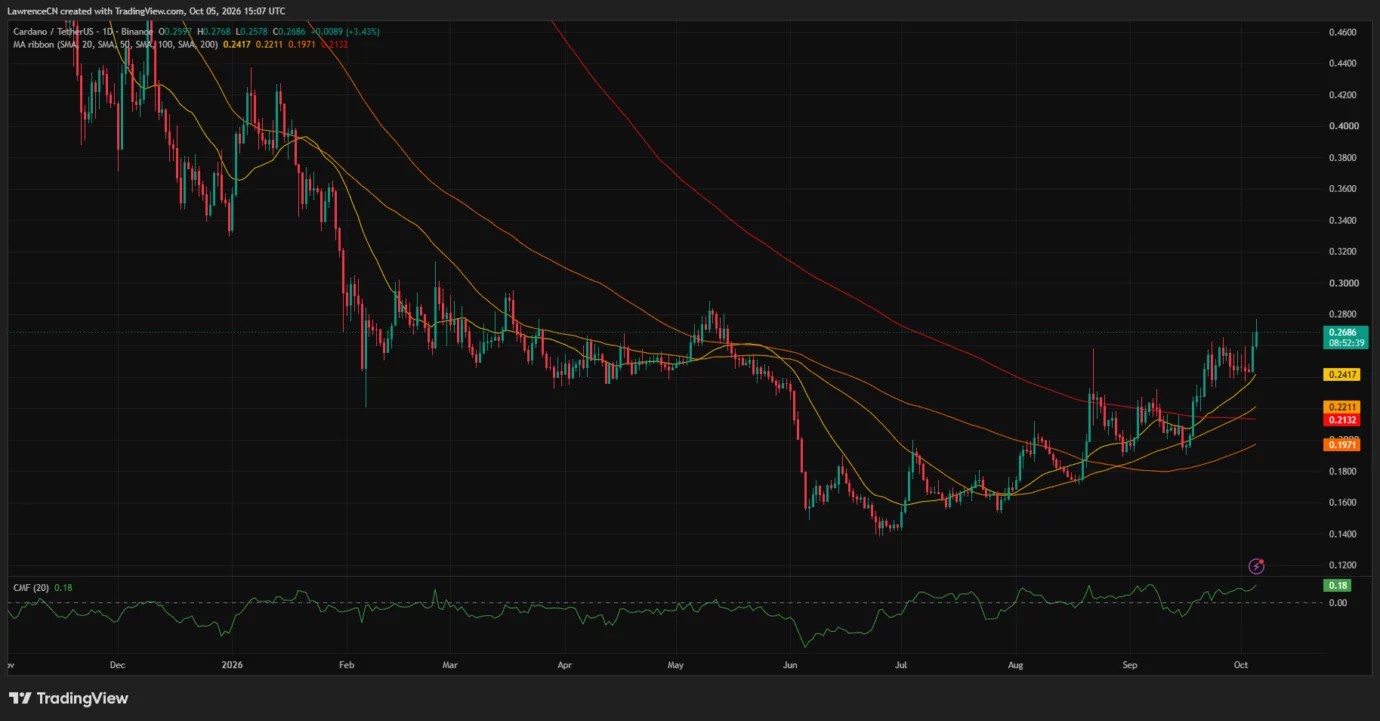
    TradingView’s daily chart showed $ADA trading above its 20-day simple moving average at $0.2417, its 50-day average at $0.2211, its 100-day average at $0.1971 and its 200-day average at $0.2132.

    Cardano price daily chart — Oct. 5 | Source: TradingView

    The 20-day average was above the other three readings, while the 50-day average also stood above the 200-day average. The 100-day average remained below the 200-day line, leaving the longer-term averages in a different order from the shorter-term pair.

    At $0.2686, $ADA traded about 11% above its 20-day average and 26% above its 200-day average. The daily price structure showed a sharp September advance followed by trading around $0.24–$0.26 before the latest push higher.

    The same chart recorded Chaikin Money Flow at 0.18. A reading above zero indicates positive buying pressure under the indicator’s volume-based calculation, adding a positive money-flow signal to the move above the recent range.

    The daily chart’s next visible historical price area sits around $0.28–$0.29, where $ADA traded during earlier rallies in February, March, and May. The latest high of $0.2768 remained below that area.

    Below the breakout, the daily chart placed the nearest tracked moving average at $0.2417. The 50-day and 200-day averages formed a lower reference area around $0.213–$0.221, with the 100-day average farther below at $0.1971.

    Analysts put $0.27 and $0.2887 at the center of the setup

    Analyst Alex Marzell described $ADA’s breakout from a range between $0.242 and $0.247. He said one hourly candle had gained 6% on roughly 20 times the range’s normal volume.

    In his Oct. 5 post, Marzell identified $0.275 as resistance after three rejections and made $0.27 the dividing line for his short-term outlook.

    “As long as $0.27 holds I think $0.275 gets taken out and $0.28 opens up.”

    The analyst put $0.264 as the retest level if $ADA lost $0.27. TradingView’s later 4-hour reading of $0.2688 placed the token below his stated threshold after its move to $0.2768.

    Crypto Patel focused on the two-week chart and identified $0.2887 as his bullish confirmation level. His Oct. 5 post said $ADA was about 98% above his accumulation zone.

    $ADA COULD BE ENTERING ITS NEXT MACRO EXPANSION!#$ADA is showing a major long-term accumulation and breakout structure on the 2W chart.

    $ADA/$USDT is now ~98% UP from our accumulation zone, yet my macro thesis remains unchanged.

    🔹 $0.2887 → Bullish confirmation
    🔹 Targets:… pic.twitter.com/fC3xy3hw9o

    — Crypto Patel (@CryptoPatel) October 5, 2026

    Patel’s longer-term scenario required a sustained higher-timeframe close above $0.2887. He listed targets of $0.50, $1, $2, $3 and $5, making those projections conditional on confirmation above his trigger.

    His threshold was about 7.4% above the $0.2688 TradingView reading. Marzell’s nearer $0.28 target was about 4.2% above the same price, placing the two analysts’ confirmation levels on different timeframes.

    Liquidation bands gather below $0.27

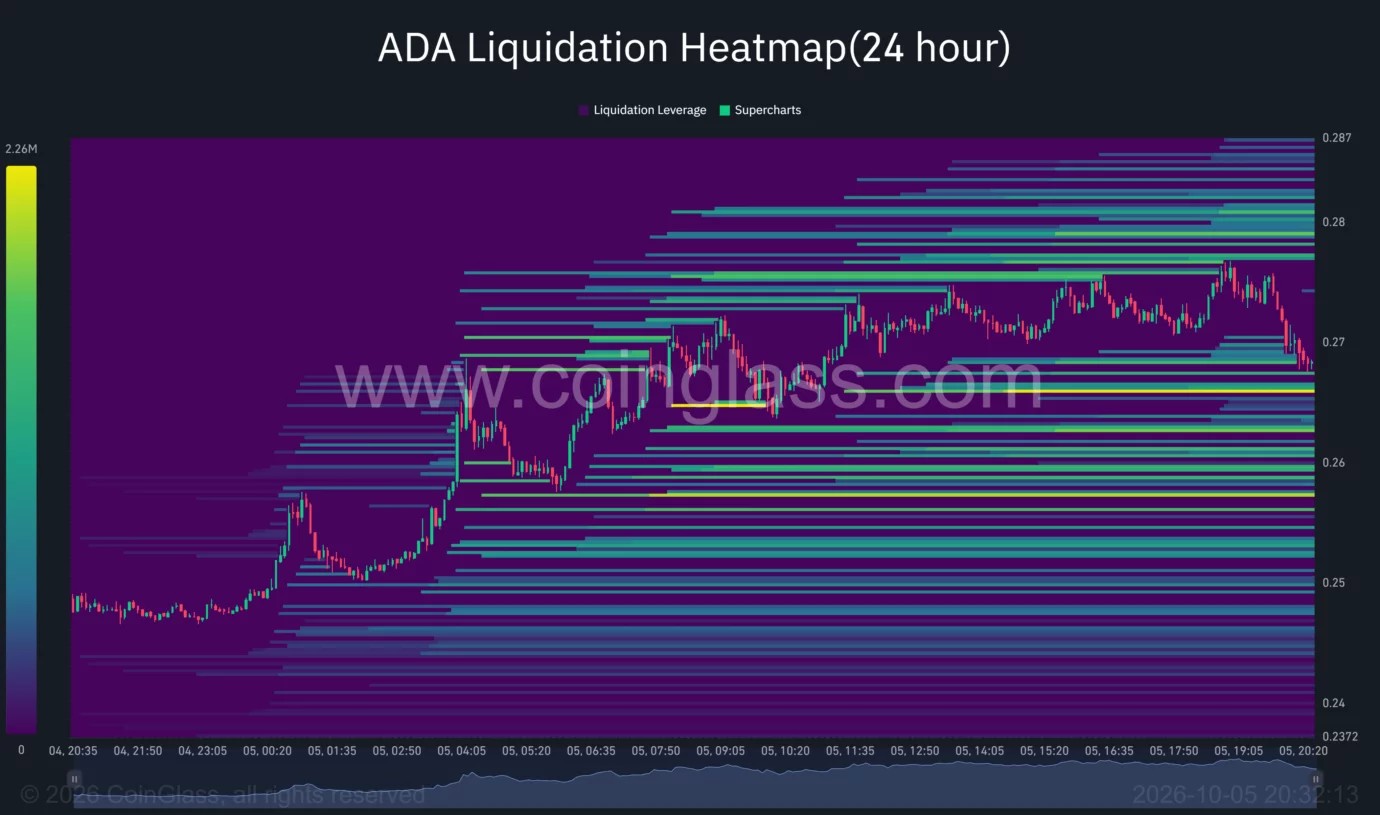
    CoinGlass’s 24-hour $ADA liquidation heatmap showed price rising from approximately $0.247 to above $0.275 before pulling back toward $0.268.

    Cardano liquidation heatmap | Source: CoinGlass

    A bright liquidation band sat near $0.266, immediately below the latest price. Another strong band appeared around $0.257, with additional concentrations around $0.259–$0.263.

    Above price, the heatmap showed bands around $0.275–$0.277 and $0.279–$0.281. The upper cluster overlapped with the $0.28 level in Marzell’s outlook.

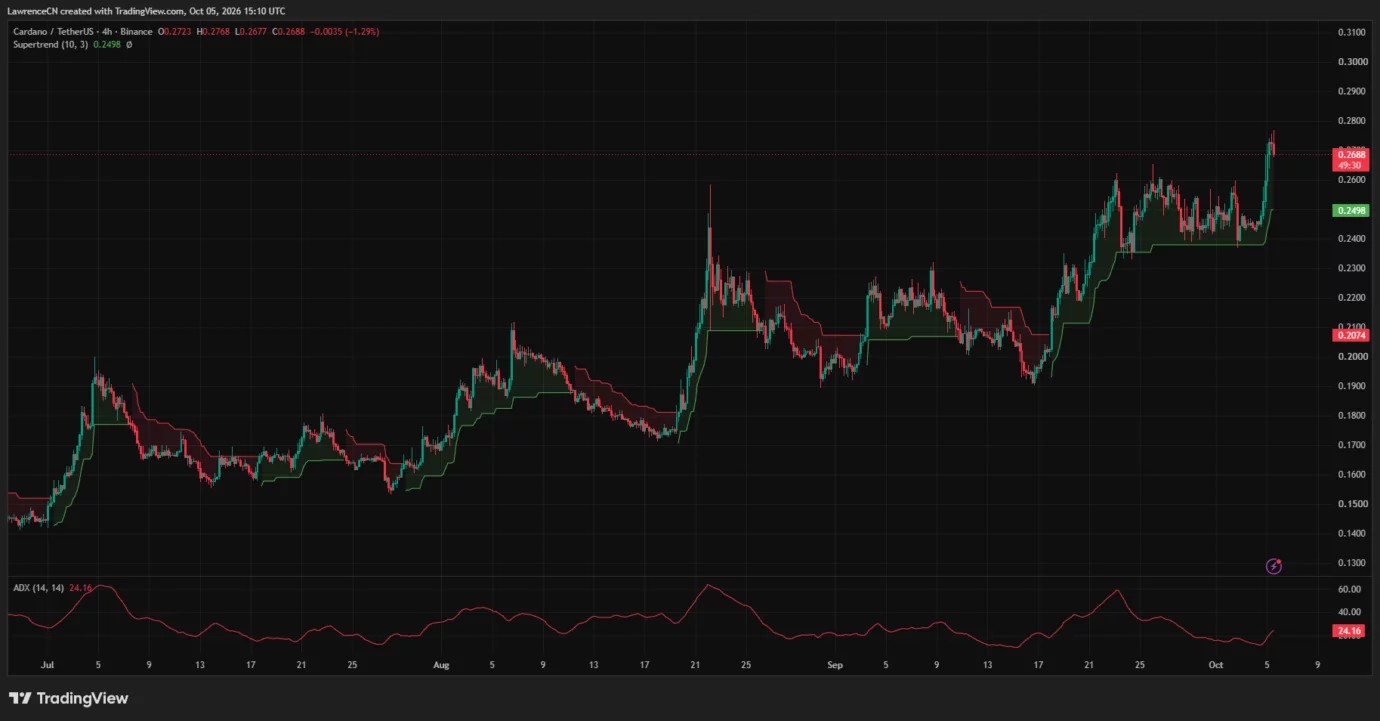
    TradingView’s 4-hour Supertrend remained green at $0.2498, below $ADA’s market price. The same chart recorded the Average Directional Index at 24.16, rising from its recent lows toward the commonly watched 25 level for trend strength.

    Cardano price 4-hour chart — Oct. 5 | Source: TradingView

    The latest 4-hour price bar showed a retreat of 1.29%, even as price remained above the Supertrend line. The bullish indicator setting therefore accompanied a pullback from the session high.

    U.S. funds already include $ADA in their investment universe

    Hashdex’s current NCIQ product page listed Cardano at a 0.6% portfolio composition weight as of Oct. 5. The Nasdaq-listed product provides market-cap-weighted exposure to a basket of crypto assets.

    Hashdex announced $ADA’s inclusion effective Oct. 1, 2025, alongside Bitcoin, Ethereum, Solana, Stellar and XRP, with holdings subject to quarterly rebalancing.

    T. Rowe Price’s Active Crypto ETF also listed $ADA among its eligible assets in a July 14, 2026 filing. The document identified the fund’s ticker as TKNZ and its exchange as NYSE Arca.

    For the immediate price setup, Marzell’s $0.27 threshold sits above $ADA’s latest chart reading, while his $0.264 retest level falls below it. Patel’s broader bullish scenario remains tied to a sustained close above $0.2887.

  • Shiba Inu price prediction for October

    Shiba Inu price prediction for October

    $SHIB’s Solana launch adds a new trading venue

    Sunrise announced $SHIB’s availability on Solana on Oct. 4, with the official Shiba Inu and Solana accounts also confirming the launch, according to Solana Compass. The analytics platform reported that the token became tradable through services including Raydium, Jupiter, and Phantom.

    Solana Compass recorded 3,005 trades worth approximately $300,000 across 1,401 wallets during a five-minute window shortly after the announcement. Its early figures also showed about $514,000 in pool liquidity.

    The launch gives $SHIB another venue for trading as its daily chart tests resistance. Nevertheless, the price recovery visible on TradingView began before the Oct. 4 announcement, with the token already climbing from its summer base through August and September.

    For U.S. holders following the October setup, the technical reference here is Binance’s $SHIB/$USDT market. Its quoted levels reflect that trading pair, while execution prices on other exchanges or Solana trading venues may differ.

    Shiba Inu holds above four daily moving averages

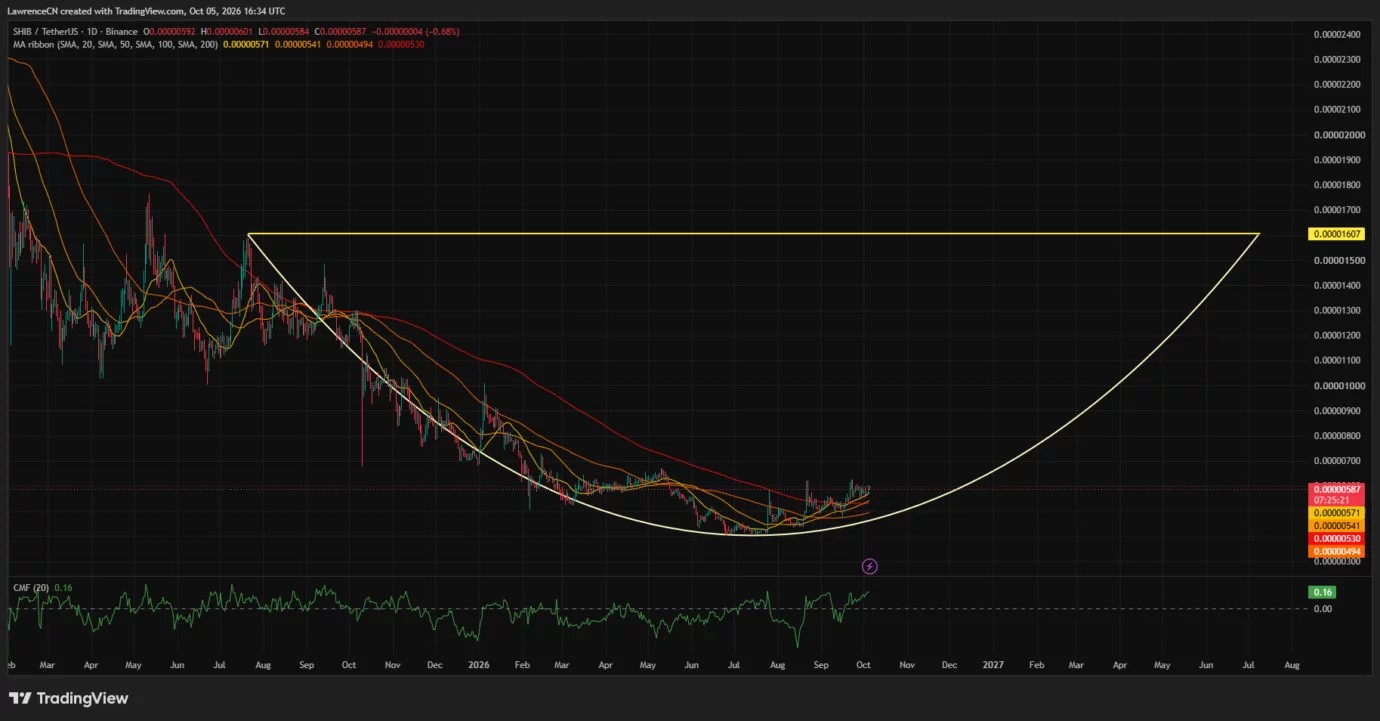
    The daily TradingView chart shows the 20-day simple moving average at $0.00000571 and the 50-day average at $0.00000541. The 100-day average stands at $0.00000494, while the 200-day average sits at $0.00000530.

    Shiba Inu price daily chart — Oct. 5 | Source: TradingView

    At $0.00000587, $SHIB trades approximately 2.8% above its 20-day average. The relatively small gap makes $0.00000571 the first moving-average level to watch if the token retreats from resistance.

    Below that level, the 50-day and 200-day averages form a second reference zone between $0.00000530 and $0.00000541. A pullback into that area would surrender more of the recent advance and place price back among its longer-term trend measures.

    The averages have not yet formed a fully bullish sequence. Although the 20-day average sits above the other three, the 100-day average remains below the 200-day average, reflecting the earlier decline.

    Daily Chaikin Money Flow reads 0.16. Its positive reading supports the improving daily setup, although a sustained advance would still require price to clear the nearby highs.

    The daily chart also contains a broad curved annotation running from the July 2025 peak, through the 2026 base, toward a horizontal level at $0.00001607. That level is roughly 174% above the latest price and belongs to a much larger potential recovery structure.

    For October, the nearer $0.00000600–$0.00000630 area takes priority. $SHIB would need to overcome those levels before the distant upper boundary becomes relevant to the immediate outlook.

    Weekly resistance at $0.00000596 remains the first hurdle

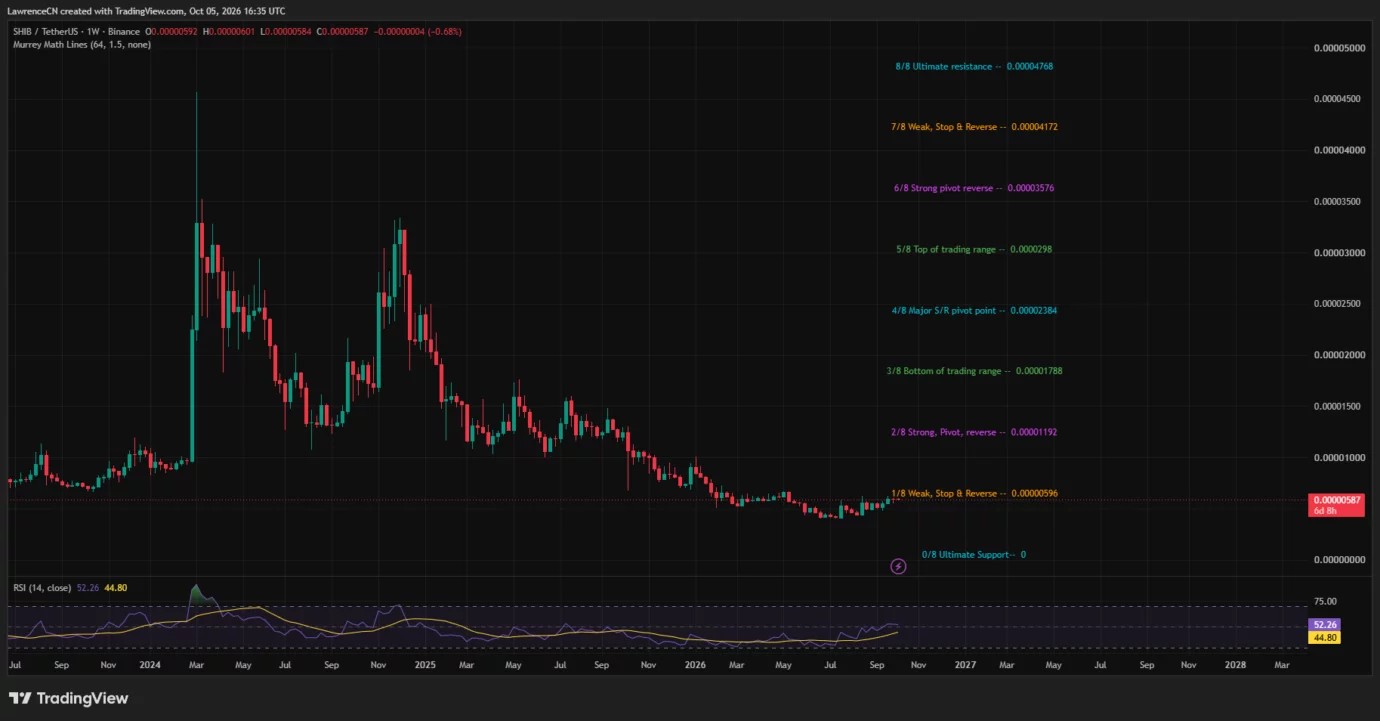
    The weekly TradingView chart places $SHIB just below a Murrey Math resistance level at $0.00000596. The latest price is approximately 1.5% beneath that threshold, which closely overlaps the daily resistance area around $0.00000600.

    Shiba Inu weekly price chart — Oct. 5 | Source: TradingView

    Weekly RSI stands at 52.26, above the neutral 50 line and its displayed average of 44.80. The reading marks firmer momentum than during the earlier decline, while remaining below the conventional overbought threshold of 70.

    Price and momentum therefore present slightly different stages of recovery: RSI has moved above its midpoint, while $SHIB continues to test its first nearby weekly resistance.

    A sustained move above $0.00000596–$0.00000600 would strengthen the near-term bullish case. Repeated rejection there would leave the token trading close to the same ceiling despite its improving indicators.

    On X, market commentator Terrarmy described a potential daily ascending triangle and rising support on the 4-hour timeframe. The account also pointed to a possible test of longer-term descending resistance.

    🔥🐕 $SHIB THE BIGGEST BREAKOUT COULD BE AHEAD! 🚀

    Something interesting is forming on the $SHIB charts.

    4H Chart: An ascending support trendline is forming, with price approaching a key resistance zone.

    1D Chart: A potential ascending triangle structure is developing. A… pic.twitter.com/DfXv93hf11

    — Terrarmy 🐋 (@terra_army) October 4, 2026

    Terrarmy tied the bullish scenario to breakouts backed by strong volume and acknowledged the possibility of failed breakouts or support losses. The October outlook therefore remains conditional on $SHIB clearing resistance while preserving its recent higher lows.

    October targets cluster around $0.00000610–$0.00000630

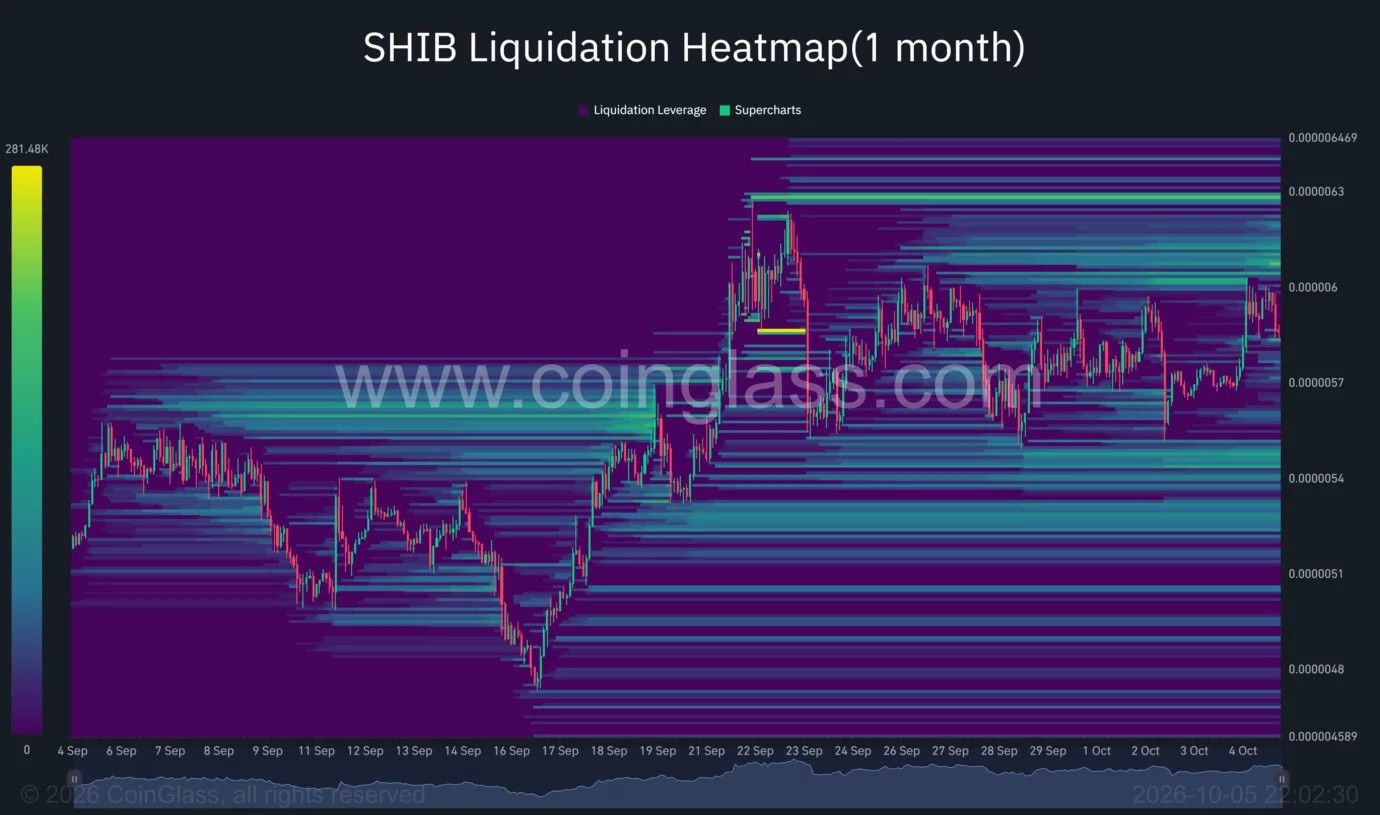
    CoinGlass’s one-month liquidation heatmap shows overhead concentrations around $0.00000610 and $0.00000630. Both sit above the immediate $0.00000596–$0.00000600 resistance zone.

    Shiba Inu liquidation heatmap | Source: CoinGlass

    If $SHIB clears that first barrier and holds above it, $0.00000610 becomes the next nearby upside reference. The higher $0.00000630 area also lies close to the September peak visible on the heatmap.

    From $0.00000587, moves to $0.00000610 and $0.00000630 would represent gains of approximately 3.9% and 7.3%, respectively. Reaching the upper zone would require $SHIB to push beyond several recent highs.

    Below current prices, the heatmap shows liquidation concentrations around $0.00000545–$0.00000550 and another band near $0.00000530. Those areas broadly overlap the support region identified by the daily moving averages.

    The short-term bullish scenario holds while $SHIB preserves its daily support and breaks through $0.00000600. A loss of $0.00000571 would put the lower $0.00000545–$0.00000550 area in focus, followed by $0.00000530–$0.00000541.

    October’s immediate test is whether $SHIB can turn the $0.00000596–$0.00000600 ceiling into support. Until that happens, the charts show an improving recovery, with resistance still close overhead.

  • Are the raspberries in my fridge OK to eat? What to know about chemical levels on Driscoll’s berries

    Are the raspberries in my fridge OK to eat? What to know about chemical levels on Driscoll’s berries

    Text to Speech Icon

    Listen to this article

    Estimated 5 minutes

    The audio version of this article is generated by AI-based technology. Mispronunciations can occur. We are working with our partners to continually review and improve the results.

    You may be having second thoughts about eating the berries in your fridge after CBC News spoke with a whistleblower who made a startling claim about the amount of chemicals on fruit that a U.S. company allegedly shipped to Canada.

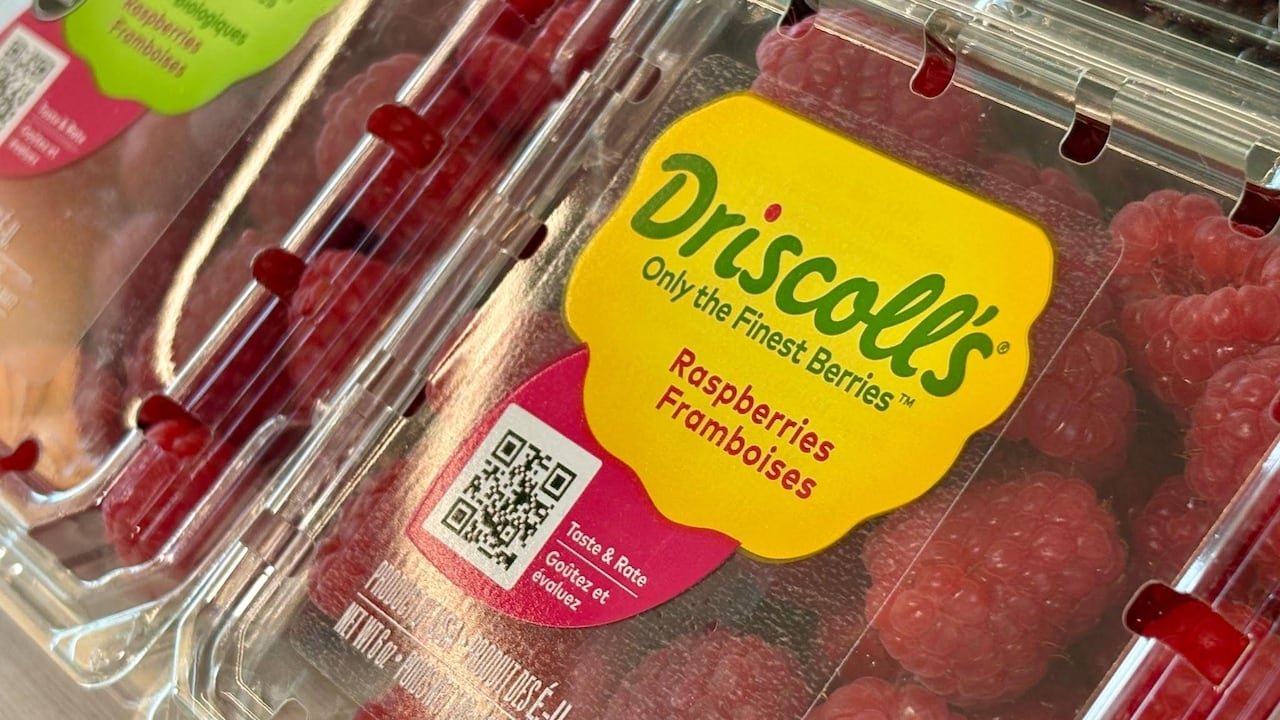
    David Harada, a former employee for California-based Driscoll’s, alleged in a lawsuit that about half of the company’s exports to Canada contained pesticide levels that exceeded Canadian Food Inspection Agency (CFIA) standards.

    Driscoll’s supplies raspberries, strawberries, blueberries and blackberries that are largely grown in California and Mexico, but with some products coming from other places seasonally — including parts of Canada.

    Harada says the excess chemical levels were due to over-spraying and the removal of food safety compliance parameters for berries sent to Canada.

    The CFIA confirmed higher-than-permissible levels of pesticides on the company’s berries. Driscoll’s has said that it’s amended its controls to comply with Canadian standards.

    But that may not be enough to put some Canadian consumers’ minds at ease, especially parents. Meanwhile, food safety experts say this has prompted an important conversation about the chemicals used on the produce we eat.

    Here’s a quick look at what you need to know.

    Are the berries in my fridge safe to eat?

    Harada’s lawsuit alleges that millions of pounds of berries with chemical levels exceeding CFIA guidelines were imported between 2022 and 2024, so it’s highly unlikely those would have survived in your fridge since then — and you certainly shouldn’t eat them if they are still in there.

    Maria Corradini, an associate professor in the University of Guelph’s food sciences department, says the chemical compounds sprayed on produce do degrade over time.

    But the issue, she says, is ensuring that the right amount is applied and that enough time has passed so that there isn’t leftover residue come harvest time.

    WATCH | Driscoll’s berries shipped to Canada with excess chemicals, lawsuit alleges:

    Driscoll’s sent berries with excess chemicals to Canada: whistleblower

    A whistleblower lawsuit in California alleges millions of trays of fruit containing non-compliant levels of pesticides and chemicals crossed the border between 2022 and 2024. The suit also accuses Driscoll’s fruit company of trying to cover it up.

    Environmental toxicologist Daniel Green says that even if you actually consumed berries with higher than permissible levels of chemical residue, it probably wouldn’t be enough to harm you.

    You would likely need to eat something like 19 kilograms of berries in a short period of time to really feel any adverse effects.

    “This issue isn’t one serving of berries,” he told CBC Montreal’s Gloria Henríquez, explaining that it’s like “one speck” of the chemicals to which people are exposed in their daily lives.

    What chemicals were found on the berries?

    The three chemicals found were bifenthrin, iprodione and captan.

    Iprodione is used to prevent and control mould, mildew and stem and root rot on a variety of crops. Captan is also a fungicide that is used on field, greenhouse and orchard crops.

    Bifenthrin is an insecticide that accounts for more than a quarter of commercially used pesticides globally. In addition to various produce, it is used on certain flowers, shrubs and trees. It attacks insects by targeting their nervous systems, eventually paralyzing them and causing death.

    A man in a dark jacket and protective gear, with a straw had on his head and scarf over his face, carries a plastic tank on his back as he sprays chemicals from a hose on a field of berries that has a white plastic tarp stretched above it.
    A worker at an unidentified farm in Mexico’s Guanajuato state sprays a field of strawberries that will be distributed to different states in Mexico and exported to the U.S. (Mario Armas/AFP/Getty Images)

    Bifenthrin is considered to be of low toxicity to humans, though large quantities can induce adverse effects, including headaches, dizziness or skin or nasal irritations when inhaled, or a sore throat, nausea and vomiting if ingested.

    The U.S. Environmental Protection Agency also classifies it as a possible human carcinogen, but only based on incidences of tumours in mice.

    However, Corradini says that workers on berry farms would be more likely to face any sort of health risks from acute exposure.

    Can I wash these chemicals off berries?

    It may not do much, Corradini says, especially when it comes to berries, because of how soft they are and all of the tiny crevices in their skin.

    She says there have been some studies showing that soaking them for a few minutes in a mixture of water and sodium bicarbonate (baking soda) may help, but that there’s not enough evidence to conclusively say it’s effective.

    Are organic berries better?

    Buying organic is your best bet in avoiding these chemicals, but it’s not foolproof, Corradini says.

    “If you are in a facility that is having half of the production organic and half not, well, there is always a risk that there is a mistake,” she said.

    A close-up image on a plastic container full of red strawberries. On top of the container is a light green sticker with the name
    Driscoll’s also markets a line of organically grown berries, including strawberries, that it says adhere to U.S. Department of Agriculture standards. (Michael M. Santiago/Getty Images)

    She also pointed out that chemical pesticides are why fruits and vegetables can be grown so plentifully and at a relatively affordable cost.

    Organic crops, she says, may also be more prone to infestations. And like non-organic produce, organic foods are not immune to pathogens and parasites that can cause food-borne illnesses such as E. coli and norovirus.

    WATCH | The parasite that caused a nationwide outbreak in the U.S.:

    What is cyclospora? A diarrhea-causing parasite

    A diarrhea-causing parasite has led to a growing outbreak in the United States that has sickened more than 1,000 people and sent dozens to hospital. As of Wednesday, multiple states had reported cyclospora infections, which can cause watery diarrhea, bloating, fever and nausea. While cases are common in the spring and summer, the current outbreak has led to an unusually high number, making it one of the largest the country has seen. No deaths have been reported.

    Is Driscoll’s facing any sort of investigation?

    Driscoll’s says that it “never knowingly shipped product that we believed to be unsafe.”

    Harada’s lawsuit is still in progress and the company wouldn’t comment on it other than to deny his allegations.

    Driscoll’s is also facing a separate class-action lawsuit filed earlier this year by six plaintiffs living in New York, New Jersey, Massachusetts and Illinois.

    SFGate reported that the suit accuses the company of consumer fraud and deceptive practices by allegedly “greenwashing” the amount of so-called forever chemicals, known as PFAS, on its strawberries.

    LISTEN | Driscoll’s faces scrutiny, lawsuits over some of the chemicals on their berries:

    Let’s Go9:44Did Driscoll’s try to cover up chemicals in their products?

  • FDA finds potential source of cyclosporiasis outbreak linked to lettuce

    The Food and Drug Administration (FDA) said on Friday it has found a potential source of the cyclosporiasis outbreak that was tied to lettuce over the summer.

    The agency collected samples during its onsite inspections of Taylor Farms de Mexico facilities, it said.

    Two samples tested positive for the parasite, Cyclospora, according to the FDA. One positive sample was from a tank that held outgoing wastewater from a processing facility, the agency said. The second positive sample was from a drainage ditch of an iceberg lettuce grower, it noted.

    “While there is currently not enough evidence to conclusively determine how contamination occurred in this outbreak, the positive samples show that Cyclospora was present in the environment where lettuce was grown and processed,” the FDA wrote in an update on its website.

    “This adds to the strong epidemiological data and traceback convergence supporting the link between this outbreak and recalled shredded iceberg lettuce from Taylor Farms de Mexico,” the update continued.

    The FDA said its investigation has closed. Health officials say they are confident that all recalled lettuce associated with this outbreak is off the market.  

    In a statement, a Taylor Fresh Foods spokesperson said its facility in central Mexico remains closed as the company works with its research team to implement enhanced safety protocols.

    “The independent grower where a positive sample was found is no longer part of our supplier program,” the spokesperson said. “The sample FDA referenced came from discharged waste and sewer water outside of our processing facility. As FDA noted in its report, there is currently not enough evidence to conclusively determine how contamination occurred or how results for these samples relate to ongoing genotyping of clinical specimens.”

    The statement concluded: “We remain concerned for the people and families impacted by this outbreak. Millions of families rely on the safety of Taylor Farms produce and we take that responsibility seriously. We know trust is earned by what we do, and we will continue to learn, improve and take action to keep our food fresh and safe.” 

    The logo of the Food and Drug Administration (FDA) is seen on a sign outside the agency’s White Oak campus in Silver Spring, Md., July 17, 2025.

    Issam Ahmed/AFP via Getty Images

    At least 12,883 people were infected with cyclosporiasis across 21 states after eating the recalled lettuce, according to the Centers for Disease Control and Prevention (CDC). Thousands more cases were reported but health officials noted difficulties in tying infections to the recalled foods.

    A total of 570 people were hospitalized and two people in Michigan died.  

    In mid-July, the FDA and the CDC announced they were investigating a multi-state outbreak of cyclosporiasis illnesses linked to shredded iceberg lettuce served at some Taco Bell restaurants.

    The lettuce was supplied to Taco Bell by Taylor Farms and sourced from central Mexico.

    Taylor Farms de Mexico issued a voluntary recall of all iceberg lettuce sourced from central Mexico, with the recall affecting 27 states. The recalled products were distributed from June 29 through July 16 and have best-if-used-by dates up to Aug. 3.

    Taco Bell said it is no longer using lettuce from Taylor Farms de Mexico at any of its restaurants.