Blog

  • In New Book, Joe Biden’s National Security Aide Brett McGurk Describes Jeffrey Katzenberg & Steven Spielberg Advising POTUS On Major Gaza Speech

    In New Book, Joe Biden’s National Security Aide Brett McGurk Describes Jeffrey Katzenberg & Steven Spielberg Advising POTUS On Major Gaza Speech

    Brett McGurk‘s new book Brink: Inside the Race to Free the October 7th Hostages offers an insider account of the diplomatic rollercoaster to secure a ceasefire and hostage release in the war in Gaza.

    The book, published this week, also offers a glimpse at White House messaging about the conflict, including two figures the president turned to in delivering a key speech: Jeffrey Katzenberg and Steven Spielberg.

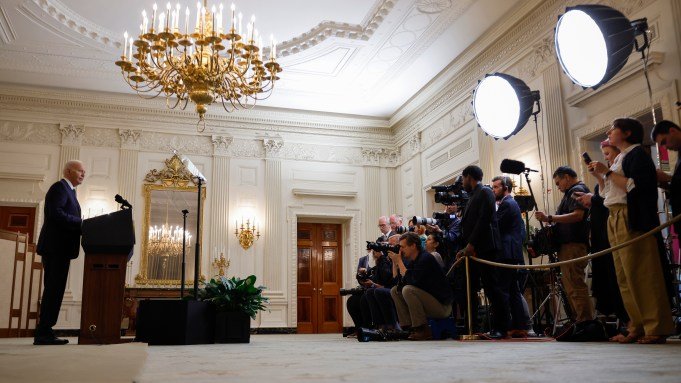
    McGurk, who served as deputy assistant for national security affairs to Biden, wrote of the scene as they prepared the president for his address on May 31, 2024. While Katzenberg and Spielberg’s role have been reported before, McGurk gave a first-hand account in the room, for a speech focused on a proposal to end the fighting and to secure a release of the hostages.

    By that point, the Gaza conflict had created divisions within the Democratic coalition, protests at college campuses and presidential appearances and concerns over its impact on the November elections. There was pressure from the campaign for the president to make an address on the crisis, per McGurk.

    McGurk wrote of the rehearsal, “In the Map Room, Biden peered at two screens behind me. ‘Jeffrey, Steven, welcome,’ he said. I turned around to see Jeffery Katzenberg and Steven Spielberg on Zoom. They greeted Biden warmly, Spielberg saying this was the speech they wanted to hear.

    “It was a reminder that while I saw this speech as a policy address with a functional aim, it had a political purpose, too,” McGurk wrote.

    He added, “The speech was timed for Friday night in Israel, when much of the country shuts down, allowing time for us to shape its reception there and around the world. Notably, we did not inform Netanyahu that we were making the speech until shortly before Biden delivered it, as we knew the address would lock Netanyahu into the terms of the deal now on the table.

    “Biden said he was ready.

    “Katzenberg advised, ‘Remember, slow Joe, let the audience hear every word.’

    “Biden smiled, ‘Slow Joe? Don’t let Jill hear that.’

    “He read through the draft, pausing at times to ask questions about the text, which we addressed with rewrites.”

    McGurk wrote that he found Biden “fully engaged, leaning forward on the podium.”

    He wrote, “The moguls told him he looked strong, and he did. There was no sign of the Biden we’d all see on a debate stage with Trump only four weeks later.”

    The latter was a reference to Biden’s disastrous debate performance against Trump. What followed were weeks of calls on Biden to drop out, coming from some elected Democrats and prominent donors, until he exited the race on July 19. Katzenberg had played a prominent role as a top adviser to Biden’s re-election campaign.

    While the Biden speech focused on a peace proposal, as it turned out, it would take until the next year, a week before Trump returned to office, for a ceasefire agreement to be reached.


  • Amazon is sending Prime class action settlement payments. Are you eligible?

    Amazon is sending Prime class action settlement payments. Are you eligible?

    Claim:

    A class action settlement related to deceptive Amazon Prime practices began paying out to eligible customers in fall 2026.

    Rating:

    Legit

    Context

    Eligible Amazon Prime customers do not need to do anything to receive their payment. The FTC is also warning people that some scammers are exploiting the legitimate class action lawsuit to steal people’s personal information. The FTC said it will not call any eligible customers, nor will they demand money or promise a special prize.

    Rumors are spreading online about supposed payouts from a class action lawsuit benefiting Amazon Prime subscribers. 

    Social media users on platforms like Reddit and Facebook shared screenshots of notifications about the lawsuit or receiving payment (screenshotted). Some online posters claimed they received payment, whereas others asked if the settlement was real. 

    Snopes readers also searched the website for information on the Amazon Prime lawsuit. 

    This is a legitimate settlement involving payouts to eligible Amazon Prime customers. 

    The Federal Trade Commission reached a $2.5 billion settlement with Amazon over allegations that the company “enrolled tens of millions of customers in Amazon Prime subscriptions without their knowledge or consent” and “made it difficult for customers to cancel their Amazon Prime subscriptions.” As part of the settlement, Amazon did not admit fault. 

    An official notice on the Federal Trade Commission website states that Amazon began sending payments in November 2025 and “will continue to send automatic refunds to eligible Prime customers through April 2027.” 

    Customers who received a previous payment of up to $51 may receive additional payments due to a revised settlement order. Eligible customers may receive up to $200 in total (so up to $149 if you received a $51 payment previously). 

    It is worth noting, however, that the FTC is also warning people that scammers are calling people and claiming to be part of the Amazon class action lawsuit payouts. 

    “The FTC will never demand money, make threats, tell you to transfer money, or promise you a prize. And no one from Amazon will ever ask you for money to get a refund,” the FTC website said. “Only scammers say they can get you special access or a guaranteed refund.” 

    Eligibility and payment process 

    According to the FTC, eligible claimants do not need to take any actions to receive a refund. Amazon will send automatic refund payments by mailed check, PayPal or Venmo, and all you need to do is accept the payment. 

    Here’s how to know if you’re eligible, per the FTC’s news release (emphasis theirs): 

    Who is eligible for a refund?

    Under the revised settlement order, you are eligible for a refund if you meet all three requirements:

    1. You are an Amazon Prime customer in the United States.
    2. You signed up for an Amazon Prime subscription through a “challenged enrollment flow” or tried to cancel through the online cancellation flow but were unable to do so between June 23, 2019 and June 23, 2025.
    3. You used no more than 20 Amazon Prime Benefits (including Prime Music or Prime Video products offered for free to Prime subscribers) in any 12-month period following Amazon Prime enrollment.

    The “challenged enrollment flows” are universal Prime decision page, shipping selection page, single page checkout, or the Prime Video enrollment flow.

    No action is needed to receive a refund. You do not have to file a claim, respond to a notice, or complete any forms. Amazon will send automatic payments to eligible customers. 

    Customers who have issues receiving payments or questions can reach out to admin@SubscriptionMembershipSettlement.com or call 1-888-999-8094. The official website for notifications about this class action lawsuit is at www.SubscriptionMembershipSettlement.com, per the FTC. 

    How to check if a class action lawsuit is legitimate 

    In the case of the Amazon settlement, the FTC’s news release on the federal agency’s official website — with a “.gov” domain — lends it legitimacy. 

    However, Snopes has previously verified class action lawsuits that are not brought by the government. In those cases, it’s worth checking the lawsuit’s case number in PACER, a public database for federal electronic court records, or CourtListener, a more user-friendly nonprofit repository that pulls information from PACER documents and other court records. 

    Even if the FTC did not make an announcement, for example, the screenshots of payments shared on social media include a case number for the Amazon settlement: 2:23-cv-01372.  

    Searching that case number in CourtListener returned two pages of results. On the second page, there’s a case called “In re: Amazon Return Policy Litigation.” That’s proof that a real lawsuit has been filed. The case page includes links to all the documents in the court docket for that particular case. A document titled, “Exhibit A – Amazon Settlement Agreement” states that a settlement was reached. 

  • Christa Pike’s doctor reveals exactly what condition she is in after waking up following botched execution

    Christa Pike’s doctor reveals exactly what condition she is in after waking up following botched execution

    A medical doctor advising Christa Pike’s legal team has said the 50-year-old has been removed from a ventilator and can now speak.

    Following two failed attempts by the State of Tennessee to execute Pike via lethal injection, the convicted murderer was rushed to hospital to receive life-saving care.

    Dr Joel Zivot, a medical professional assisting Pike’s team, has shared an update on her condition with PEOPLE and his thoughts on what her recovery will look like.

    “I was told yesterday that she had recovered sufficiently that she was able to be removed from her mechanical ventilator and was able to speak,” he said, adding that she does not remember her execution at the moment but noted that her ‘memories may continue to evolve’.

    When it comes to her recovery, Zivot noted that it was too soon to share a prognosis for Pike, but said that her current condition puts her in a ‘good position’ going forward.

    Pike remains in hospital (Tennessee Department of Corrections)

    Pike remains in hospital (Tennessee Department of Corrections)

    “I think it’s still early, critically ill patients tend to move in a variety of ways,” he said.

    “The fact she is doing something now puts her in good position, but I wouldn’t suggest it’s smooth sailing from here and there won’t be any residual impact.”

    Meanwhile, Stephen Farrell, one of Pike’s lawyers, revealed to Radio 4 that she is now ‘up and walking’ for the first time since the execution.

    “She is up and walking for the first time today, just around the room, not very far,” he said, adding that her arms are still ‘very injured’ from the failed attempts to insert IV lines, meaning that she can’t ‘use them very much’.

    Zivot previously revealed that Pike was able to communicate in a basic way with those around her, but seemed confused about the fact that we were now in October.

    Her first words are reported to have been: “Where am I and who are you?”

    Pike’s attorney Randy Spivey previously said that his client has a ‘long road to recovery’, telling reporters that she had a ‘blood clot in one of her arms’ as well as ‘pneumonia’.

    “She is not able to swallow yet, so she has not eaten,” he added.

    READ MORE: All of the failed lethal injection executions in the last decade

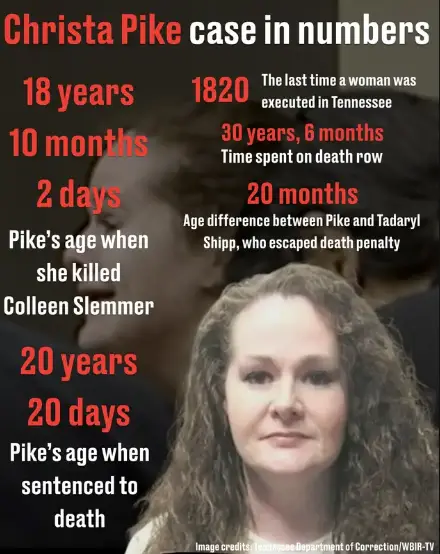
    The Christa Pike case in numbers (LADbible/Tennessee Department of Correction/WBIR-TV)

    The Christa Pike case in numbers (LADbible/Tennessee Department of Correction/WBIR-TV)

    Why was Christa Pike on death row and what happens next?

    Christa Pike received the death sentence after being convicted of the 1995 murder of her Job Corps classmate Colleen Slemmer.

    Pike, her then-boyfriend Tadaryl Shipp and their friend Shadolla Peterson lured Slemmer to an isolated part wooded area in Knoxville. Pike and Shipp then beat Slemmer to death while Peterson acted as a lookout for the couple.

    Shipp was sentenced to life in prison as he was only 17 and therefore not eligible for the death penalty, while Peterson received probation after becoming a witness for the prosecution.

    It’s not currently clear whether or not the state of Tennessee will attempt to execute Pike again at a later date. Executions in the state have currently been paused while an investigation is carried out.

  • Crypto investment firm Deus X Capital shuts down as backers pursue separate strategies

    Crypto investment firm Deus X Capital shuts down as backers pursue separate strategies

    Crypto and fintech investment firm Deus X Capital has ceased operations as its backers pursue separate investment strategies, the company told CoinDesk.

    The company, led by former Galaxy Digital (GLXY) executive Tim Grant, will formally unwind on Jan. 31, 2027. Chief Investment Officer Stuart Connolly will remain to oversee the transition, while some portfolio businesses will continue operating with the involvement of existing stakeholders.

    The Morton family investors behind Deus X are splitting their investment activities. Shane Morton is establishing Darius, focused on artificial intelligence, while Owen and Jason Morton are setting up 95, focused on markets and fintech.

    Grant, who led Galaxy Digital’s Europe, Middle East and Africa business before joining Deus X, will become CEO of TensorX, an AI venture within Darius owned by Shane Morton, one of Deus X’s founders and backers.

    “We want to be a prominent player in AI in Europe,” Grant told CoinDesk in an interview.

    Crypto is facing growing competition from AI for investor attention and capital. Galaxy Research said in September that interest in artificial intelligence was diverting attention from digital assets, adding to venture firms’ fundraising challenges.

  • US Giant Bank in Talks with Kraken: Liquidity Agreement for Crypto Transactions May Be On the Way! Here Are the Details

    US Giant Bank in Talks with Kraken: Liquidity Agreement for Crypto Transactions May Be On the Way! Here Are the Details

    Wells Fargo, one of the largest banks in the US, is reportedly in talks with Payward, the parent company of Kraken, to expand its operations in the cryptocurrency market. According to sources close to the matter, Payward could become the bank’s liquidity provider for digital asset transactions.

    Liquidity providers help large transactions be completed without causing excessive price fluctuations in the market by offering constant prices for buy and sell orders. In a potential collaboration, Wells Fargo clients’ orders could be placed through the bank interface, while the necessary cryptocurrency liquidity could be provided by Payward.

    Such a model could allow the bank to offer digital asset transactions to its clients without building a cryptocurrency exchange infrastructure from scratch. Payward, in turn, could leverage Kraken’s spot and derivatives markets, as well as its custody, staking, tokenized equity, and institutional trading infrastructure.

  • Nathan Fielder’s Elizabeth Holmes Doc ‘You Can See Everything’ Sets November U.K. Release Date

    Nathan Fielder’s Elizabeth Holmes Doc ‘You Can See Everything’ Sets November U.K. Release Date

    “You Can See Everything,” Nathan Fielder and Lance Oppenheim’s highly anticipated documentary about Elizabeth Holmes, has set a release date in the U.K. and Ireland.

    The doc, which offers an intimate look at the Theranos founder’s life a month before she began an 11-year prison sentence for defrauding investors, will hit cinemas in the U.K. and Ireland on Nov. 20. A24 is self-releasing the film.

    “You Can See Everything” first premiered as a surprise screening at Telluride Film Festival in September — earning rave reviews and sparking Oscar buzz — before heading to New York Film Festival, and is set to hit U.S. theaters on Oct. 16.

    “Thirty-four days before she’s sent to prison, notorious Silicon Valley founder Elizabeth Holmes invites a skeptical film crew to document her every move,” the doc’s official synopsis reads. “What begins as an intimate portrait of an enigmatic felon becomes a mind-bending three-year journey into the abyss.”

    During a Q&A at New York Film Festival last week, “The Rehearsal” and “Nathan for You” creator Fielder explained how he ended up co-helming the project with Oppenheim, who just made his narrative directorial debut with “Primetime” starring Robert Pattinson. After befriending Fielder, Oppenheim remembered that Holmes had reached out to A24 — the studio behind “Primetime” and “The Rehearsal” — about someone documenting her final days before prison. Fielder had already been fascinated by her, and they set up a meeting with Holmes and A24.

    “When I met her, I remember having this weird experience where she seems so genuine at times,” Fielder said. “But then I’m like, ‘no,’ and clocking and tracking my thoughts and being like, ‘Okay, I know she’s a liar.’ It was a weird mental thing. From there, we were like, ‘Can we roll the dice on something if they were open to having cameras in?’”

    Roll the dice they did, and it resulted in Fielder fully moving into Holmes’ house that she shares with her partner, Billy Evans, and their two young children.

    “I cannot tell you how weird it was that we were there,” Fielder said. “Truly, to this day, we’re still like — anyways, sorry. I wouldn’t think I’d be the person you would want for your final period. I’m a nice person, I do believe, but I’m not the most comforting. You know what I mean? I think you know.”

  • US Government Moved $103 Million Worth of BTC and BNB: Is a Sell-Off Coming?

    Of the Bitcoins seized, 568.7 $BTC comes from assets confiscated in the Potapenko and Turogin case. The remaining approximately 264.9 $BTC is from seizures related to the Bitfinex attack.

    40,285 $BNB were transferred from a separate government wallet. The tokens, worth approximately $31.63 million, were first moved to an unlabeled address and then to a second unknown wallet. The BNBs were reportedly among the assets seized from Alameda Research.

    Sending cryptocurrencies to a Coinbase Prime address can, in some cases, indicate preparation for sale. However, exchange-linked addresses can also be used for custody, wallet management, or inter-institutional transfers. Blockchain data alone does not prove that the asset has ultimately been sold.

    The US government reportedly holds approximately $27.5 billion in seized cryptocurrency assets. These assets originated from legal seizures, not from market purchases funded by tax revenue.

    The Bitcoins transferred to the government under the decree dated March 2025 are intended to be held in the Strategic Bitcoin Reserve. However, the legal status and sales authorization of assets in specific cases may vary. It would be incorrect to interpret the transfer as a definitive sale before an official announcement.

    *This is not investment advice.

  • Kalshi takes on CME with first-ever U.S. oil futures that never expire

    Kalshi takes on CME with first-ever U.S. oil futures that never expire

    Kalshi wants one oil trade to last almost forever

    Typical oil futures have a calendar attached to them. The trader buys exposure, the contract moves closer to expiration, and any trader who wishes to remain in the trade needs to roll into another month. This rollover business becomes boring until funds start bleeding due to transaction costs, price spreads, and poor timing of trades.

    In effect, Kalshi is saying: Why do this every few weeks or months?

    The contract it proposes would make one position last for ten years, while employing a funding strategy that keeps the price tied to the WTI market. For those holding crude exposure over extended periods of time, this may mean simpler mechanics. There will be no need to constantly roll contracts, as well as reduced risks of mistakenly rolling into a physical delivery situation at Cushing, Oklahoma, where the trader had no intentions of taking possession of the barrel of oil.

    The company also believes that a single large duration contract would help keep the trading activity in one place instead of spreading liquidity across a long series of expirations.

    That idea is arriving at a pretty convenient moment.

    The Iran war has turned crude into one of the most aggressively traded macro assets of the year. Hedge funds, institutions and individual traders have all been chasing energy swings as geopolitical headlines keep jerking prices around.

    WTI futures have traveled through roughly a $60-per-barrel range since January, which is exactly the kind of environment where traders start caring a lot more about execution, rollover costs and whether their instrument is flexible enough.

    The contract would be traded 24 hours a day, Monday through Friday. While the contract would not truly last forever, 10 years is close enough that the average person using it would likely not mind the difference in a regular trade.

    There is one problem, however: regulators cannot treat this as an everyday exchange listing.

    Derivatives that are perpetual in nature undergo closer scrutiny, so Kalshi cannot self-certify the contract as many exchanges can with other products. The CFTC must review the filing on its own merits.

    The filing has come at an inopportune time for CME Group, which recently abandoned its attempt to change the rules of oil trading.

    CME backed off, while Kalshi is pushing further

    CME had been developing an early version of the contract that would allow for trading 24 hours a day, seven days a week. This proposal was met with stiff opposition from the oil sector and regulatory authorities.

    The issue at stake was not just whether the traders wanted to trade oil futures on Saturdays. The physical oil market is priced using benchmark prices, and it was not clear if the non-stop trading could be kept grounded in reality.

    The CFTC initially blocked the plan, kicking off months of debate. CME eventually shelved it.

    Kalshi is taking a different route. Its market would stop for the weekend, but the contract itself would barely expire at all.

    There is also history between these companies. CME executives have criticized perpetual futures, and CME sued the CFTC earlier this year over its decision allowing Kalshi to offer crypto-linked versions of the same broad derivative concept.

    And oil is not the only regulatory battlefield surrounding Kalshi.

    Ohio, 38 other states, and Washington, D.C. have petitioned the U.S. Supreme Court to take up another separate challenge involving Kalshi’s sports event contracts. In its October 7th filing, Ohio has supported New Jersey in Flaherty v. KalshiEX, LLC., Case No. 26-299.

    The matter revolves around whether the sports event contracts qualify as swaps under the Commodity Exchange Act and, if they do, whether the application of federal commodities law preempts state gambling law.

    In the Third Circuit, Kalshi prevailed and the sports event contracts were deemed swaps under federal jurisdiction. The Ninth Circuit ruled against Kalshi and held that the application of Nevada’s gaming law remained intact. The Sixth Circuit also disagreed with the proposition that federal commodities law preempted state gambling law.

    Other similar challenges are still pending in the Second, Fourth, Seventh, Eighth and Tenth Circuits, as well as the Massachusetts Supreme Judicial Court.

  • James Gunn Responds to ‘Clayface’ Criticism: ‘The Public Voting on What IP They Want to See’ Isn’t ‘the Only Way to Make a Movie’

    James Gunn Responds to ‘Clayface’ Criticism: ‘The Public Voting on What IP They Want to See’ Isn’t ‘the Only Way to Make a Movie’

    James Gunn has an answer to the question of “who tf asked for a Clayface movie,” posed by a user on the DC Studios head’s Threads account earlier this week.

    “Who tf asked for Back to the Future? Casablanca? There’s Something About Mary? Pan’s Labyrinth? Fury Road? Weapons? The Matrix?” Gunn fired back on the platform. (The user’s original comment has since been deleted.) “Although it may seem like it, Hollywood isn’t a place where the only way to make a movie is the public voting on what IP they want to see that they’ve seen countless times before.”

    He posted again: “Sometimes someone — in this case initially Mike Flanagan and then James Watkins and Hossein Amini — were inspired by a relatively little-known fictional character and crafted what I believe is a very special story around that character. I’d take that inspiration a thousand times over some writer trying to make a buck by writing a listless screenplay about a majorly popular character he or she has no passion or feel for.”

    Despite the fact that Clayface is a considerably nicher choice for a feature film compared to past DC movies like “Supergirl” and “Superman,” most fans have been eagerly awaiting the premiere of “Clayface” since the gory trailer premiered months ago. And while versions of the character have appeared on screen in the years since the comic’s 1940 debut, the film, directed by James Watkins (“Speak No Evil”), marks the first time audiences will see the shape-shifting villain in a film all of his own.

    Tom Rhys Harries plays the titular character, also known as Matt Hagen. “Matt Hagen’s meteoric rise from Gotham street kid to Hollywood leading man is tragically cut short when a local crime boss’s actions leave him horribly disfigured,” reads the film’s official description. “Abandoned by his team and with nothing left, Matt seeks out a cutting-edge treatment that miraculously returns him to his former self… but also unexpectedly affects his grip on reality, spiraling him down a destructive path of all-consuming revenge.” Naomi Ackie, David Dencik, Max Minghella and Eddie Marsan also star.

    “Clayface” hits theaters on Oct. 23.

  • Vancouver Film Festival Prizes: Big Wins for Immigrant Tale ‘Nina Roza,’ the ‘Polished Cinematic’ ‘In the Heart of the South’ and Separated Sisters Story ‘How We Stand’

    Vancouver Film Festival Prizes: Big Wins for Immigrant Tale ‘Nina Roza,’ the ‘Polished Cinematic’ ‘In the Heart of the South’ and Separated Sisters Story ‘How We Stand’

    Geneviève Dulude-De Celles’ “Nina Roza,” Nyla Innuksuk’s “In the Heart of the South” and Marie Clements’ “How We Stand” are among the films taking top honors at the 45th Vancouver International Film Festival (VIFF).

    The festival announced its 2026 juried awards winners on Wednesday night, recognizing films across its Summit, Horizon, Tides, Arbutus, Vanguard and Short Forum competitions.

    The Summit Award went to “Nina Roza,” directed by Dulude-De Celles, which the jury praised for its compassionate exploration of the immigrant experience, identity and belonging. The film follows a protagonist returning to his hometown for the first time in 28 years, drawn back by the mystery surrounding a young artistic prodigy. “We all know what it’s like to long for home,” said the jury, “We were all enamored by this film’s direction, authentic performances, stunning cinematography, and evocative music.”

    Ian Bawa’s “Strong Son” snagged a special mention.

    For the Horizon Award, the jury selected Nyla Innuksuk’s “In the Heart of the South,” describing the film as a “strong example of Canadian cinema.” The jury praised its performances by Anna Lambe and Zorga Qaunaq and “polished cinematic approach.”

    Nathan Donovan’s “Clubfoot” received the Horizon jury’s special mention.

    Banchi Hanuse’s “Ceremony” scooped the The Tides Award for a feature about the disappearance of ooligan fish from Bella Coola and the Nuxalk Nation’s efforts to protect and preserve its lands and waters. “Through beautiful cinematography and inventive storytelling, the film documents the strengths of community members consistently challenging the boundaries of imposed systems while drawing upon the resilience and generosity of their ancestors,” the jury said.

    A special mention went to Carol Nguyen’s “Still Night, Burning House.”

    The Arbutus Award, which recognizes British Columbia filmmaking, went to Marie Clements’ “How We Stand,” a story of sisters separated by tragedy. The film confronts “difficult and traumatic history by bringing it into vivid, real, human focus. Its surrealist style, deft storytelling, heart, and powerful heroines at once entertain, educate and demand self-reflection—as individuals, and as a society,” the jury noted.

    Hayley Gray and Kaayla Whachell’s “Send the Rain” won a special mention.

    “Hear the Yellow,” directed by Banu Sıvacı, took the Vanguard Award kudos, praised for its “remarkable depth,” “originality,” “singular cinematic language” and “emotional precision,” said the jury, stating that through “bold character work and intelligent use of metaphor, it transports us into a vividly specific landscape while creating a powerful dialogue between rural and urban, and a family separated by time.”

    Samuel Urbina’s “That Shadow Fading” received the Vanguard special mention.

    The Short Forum Award was adjudicated to “Pre-Parenting,” an animated film by Taiwan-based filmmaker Yu Yu, with a special mention scored by Kamal Aljafari’s “Going Home.”

    The juried awards come as VIFF wraps its 45th edition on Oct. 11.

    The Vancouver International Film Festival (VIFF) 2026 Juries

    Summit Award: Rhia Aden, Nach Dudsdeemaytha, Caitlyn Sponheimer

    Horizon Award: Arjun Ayillath, Madeleine Davis, Michael Mann

    Tides Award: Selwyn Jacob, Lyana Patrick, Jeff Lee Petry

    Arbitus Award Jury: Josephine Anderson, Brenda Lieberman, David Taylor

    Vanguard Award Jury: Joaquin Cardoner, Caroline Monnet, Sarah Shamash

    Short Film Award Jury: Tanvi Bhatia, Ariel Bond, Thanh Lieu