The full list of MCU characters who will appear in “Avengers: Doomsday” may still be a mystery, but Jeremy Renner has made it clear he didn’t return as Hawkeye — and says The Avengers “will probably lose” as a result.
“No, no, no, no. Not in that one,” said Renner when asked if he was returning for “Doomsday” in a recent interview. “’Doomsday’ I’m not in, so the Avengers will probably lose, just so you know… they didn’t call me, so it’s their fault. They’re going to lose.”
Though he isn’t reprising the role of Hawkeye for “Doomsday,” the actor did note that he was excited about the re-release of “Avengers: Endgame,” which brought the 2019 film back to theaters ahead of “Doomsday’s” Dec. 18 release. Renner has played the superhero previously in “The Avengers,” “Avengers: Age of Ultron” and “Endgame,” in addition to other films like “Thor” and “Captain America: Civil War,” in which he made brief appearances.
In 2025, Renner said that he was open to returning to the MCU, whether it was for Season 2 of “Hawkeye” or something else. “I’m always happy to be in that world, man. I love all those guys, I love the character,” Renner told Empire. “I’m sure we’ll end up doing Season 2 [of ‘Hawkeye’], and do other things. And I’m happy to do it. My body’s getting ready for something like that. I don’t know if anybody wants to see me in tights, but my body will look good in the tights.”
At the time, he’d also noted that he’d recovered “more than 150%” from his 2023 snowmobile accident, meaning he was ready to do his own stunts for the Marvel films. Renner had been hospitalized after his Sno-Cat, a large snow plow that weighs at least 14,330 pounds, ran him over, resulting in eight of his ribs being broken in 14 places, his right knee and ankle broken, left leg tibia broken, left ankle broken, right clavicle broken, right shoulder broken and more.
Ledger said every confirmed case in last week’s wallet-draining incident involves devices sold by Southeast Asian reseller CryptoBilis.
The company said the number of affected devices is “limited,” that it is working with authorities, and that CryptoBilis has ceased all hardware wallet sales.
Ledger told authorized resellers never to restock returned products, and urged buyers to avoid unauthorized sellers.
Ledger said all confirmed cases in last week’s draining incident involve devices sold through reseller CryptoBilis, and that its own systems and direct sales channels remain unaffected, in a 72-hour update on Sunday.
“The volume of impacted devices is limited,” the Paris-based hardware wallet manufacturer said, adding that it is working with relevant authorities and reaching out to affected users. It said CryptoBilis has confirmed it has ceased all sales of hardware wallets.
72 hour update on reseller CryptoBilis incident 🔽
As the investigation continues, we are working with relevant authorities. The volume of impacted devices is limited. We know this is concerning, especially for those directly affected, and we are reaching out to impacted users.…
Ledger began investigating on Friday after users in Southeast Asia who bought devices from CryptoBilis reported losing funds. Onchain investigator Specter traced more than $86 million in suspected thefts across Ethereum, Tron and Bitcoin. Ledger has not confirmed that figure or said what caused the losses.
Onchain investigators YFarmX said they had sent Ledger a list of more than 450 drained wallets. According to their analysis, the thief pushed 2,810 ETH through coin mixer Tornado Cash in three runs, moved the withdrawals through Zcash’s shielded pool, and withdrew about 3.28 million USDC into three fresh wallets, which Circle could freeze.
The thief also converted 15 million of the stolen USDT into USDD, a stablecoin Tether cannot freeze, before swapping 5.1 million back into USDT and sending about 4.23 million USDT to Binance deposit addresses, YFarmX said. Tether froze 10 million USDT on the first day, while 15,475 ETH, 203 BTC and 10 million USDD remain out of reach, according to the firm. Its findings have not been independently verified.
An X user, Johannes, has claimed to have found tampered Ledger devices in Europe, after buying two devices from retail stores. He said both had “identical modifications (such as additional cables and an LTE module),” and called on Ledger to issue a product recall.
The claims have not been independently verified, and Ledger’s update said all confirmed cases so far involve CryptoBilis devices. He said he is sending the second device to Ledger for analysis. Decrypt has reached out to Ledger for comment on the European reports.
Reseller controls
In its update, Ledger said it is reminding authorized resellers and distributors to source products only through authorized channels and “never to restock returned products.”
It also warned users against buying from unauthorized resellers, where “the risk of buying suspicious, counterfeit or modified devices is important.”
The company said it is reviewing reseller controls and advancing hardware protections, and called on others in the industry to work with it on supply-chain and anti-tamper practices.
Ledger repeated its advice that CryptoBilis buyers should not set up unused devices, and that anyone who already has should move their funds to a new seed phrase on a device bought from Ledger.
It also warned that scammers may try to exploit the incident, saying it “will never call you, DM you, or ask for your 24-word recovery phrase.”
Daily Debrief Newsletter
Start every day with the top news stories right now, plus original features, a podcast, videos and more.
Toni Collette will make her feature directing debut with “The Best Of,” her screen version of Graeme Simsion’s bestselling novel, which is one of 75 projects sharing more than AUD16.9 million ($11.7 million) in production and development money from Screen Australia.
Collette, an Emmy and Golden Globe winner, produces alongside Christopher Simon. The story centers on two ex-lovers who come back into each other’s lives after spending decades apart, only to find old feelings stirring with messy and mixed results. Screen Australia made a major production investment in association with Screen NSW. Kismet handles local distribution and Cornerstone holds international sales.
The round, announced Tuesday, covers features, series and shorts.
“Australian storytellers continue to captivate audiences with their creativity, originality and distinctive perspectives. This latest round of funding supports an exciting range of projects from emerging creatives forging new paths to established voices exploring new creative territory. Screen Currency 2026 found that local stories matter deeply to Australians, and these projects will deliver on the authenticity and ambition that audiences have come to expect,” said Louise Gough, Screen Australia’s director of narrative content.
Brouhaha Entertainment, the company behind “Boy Swallows Universe,” is making “The Dark Lake,” a series based on Sarah Bailey’s award-winning novel. Tonkin plays a detective in a rural town whose investigation into the killing of a former high school classmate forces her to face buried secrets of her own. Troy Lum and Andrew Mason produce, with Becca Johnstone writing and executive producing. Giorgia Stawaruk, Tonkin and Katarina Mandic are also executive producers. Screenwest partners on the major production investment, with additional financing from Screen NSW.
Jeffrey Walker (“The Artful Dodger,” “Fing!”) directs “Bull” (working title), a feature from Infin8 Studios and Total Fiction Films. Drawn from a true story, it follows a smooth-talking prisoner who signs up for a debating team inside Tasmania’s harshest jail, hoping to change course and finally give his mother a reason to be proud. George Pullar stars, co-writes with Taylor Danworth and produces with Michael Lawrence, John Molloy and Suzanne Walker. Richard Roxburgh, Robyn Malcolm, Teresa Palmer, Thomas M Wright and Harrison Gilbertson round out the cast. Screen Queensland is on board, with Kismet distributing locally and Cornerstone handling international sales.
Sooshi Mango’s untitled feature debut follows three obstinate Italian immigrants who mobilize their multicultural neighborhood when a mysterious wellness club puts their cherished social club at risk. Nick Kozakis (“Kick On”) directs from a script by the group’s Joe Salanitri, Carlo Salanitri and Andrew Manfre with Declan Fay. Paul Dainty and Cathy Rodda produce, with Timothy Whiting as co-producer. VicScreen partners, and Roadshow has local distribution.
Rodd Rathjen directs “No Friend But the Mountains,” adapted from Behrouz Boochani’s acclaimed memoir, from a screenplay he co-wrote with Boochani. The Kurdish journalist, fleeing persecution, is intercepted at sea and sent to Manus Island, where he documents the gradual breakdown of the men held there. Gal Greenspan, Sharlene George, Amy Parry, Arkos Armont, Katy Roberts, Boochani and Antony Waddington produce. The New Zealand Film Commission, Screen Queensland and VicScreen are partners, with Madman distributing in Australia.
On the development side, Mithila Gupta’s “Desi Down Under” will turn her coming-of-age Indian-Australian audio series into a romantic comedy feature about three misfits who head from Kerala to the beach at Coogee, where they hope to pick up surf-lifesaving skills they can use to help their compatriots. Gupta writes and produces with Nina Aujla, Smriti Mundhra and Maya Gnyp.
Goalpost Pictures’ series “The Caretaker,” adapted from Gabriel Bergmoser’s bestselling novel by Alexei Mizin and Ryan van Dijk, both members of Screen Australia’s 2026 Talent Gateway cohort, also landed development backing. The thriller centers on a woman hiding out as caretaker of a ski resort out of season, who goes to ever more extreme lengths to hold on to the life she has built.
Among the shorts, BAFTA-nominated Rosie Westhoff (“The Main Part”) writes and directs “Solastalgia,” in which a young girl tries to reassemble scattered memories of the bushfire that destroyed her home while looking for connection in a transformed place. Chloe Brennan (“We Used to Own Houses”), Amanda Browne and Ashlee Russell (both “Mothmama”) produce, with Kitty Green (“The Royal Hotel”) as mentor.
Green also mentors the team behind a family short from Pasifika-led Mana Film Productions that mixes live action and animation, “My Life as a 12-Year-Old Demon Hunter… With Great Hair!” It tracks 12-year-old Tala over a single day as she fends off demons out to steal her powers – a bigger headache than her homework. AWGIE winner and bestselling author Maria Lewis writes, directs and co-produces, with Shonee Samia co-producing and Herbert Leota animating. Animator Jake Duczynski (“Magic Beach”) joins Green as mentor. Both shorts received principal production funding.
Full lists of production, development and short film approvals are on Screen Australia’s website. The agency will reveal more recently funded projects alongside the ABC Media Showcase on Oct. 21.
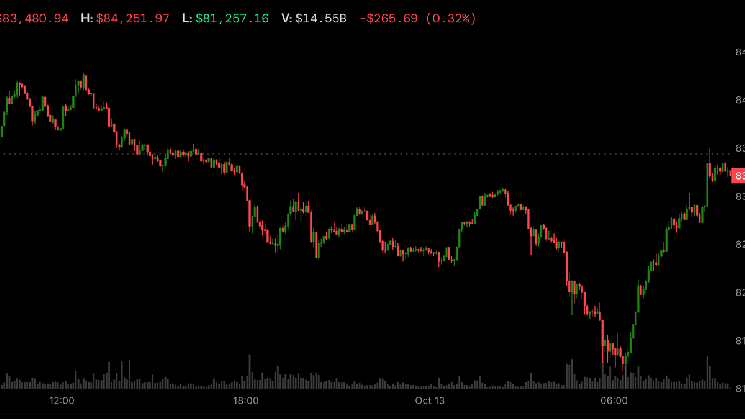
Bitcoin BTC$82,292.69 climbed back above $83,000 on Tuesday, shaking off an early drop as a sharp selloff in Asian chip stocks and U.S. tech futures weighed on risk appetite.
The largest cryptocurrency by market value fell to just under $81,000 at 00:50 UTC before recovering above $83,000, according to CoinDesk data. Ether ETH$2,510.04 bounced from five-day lows, while $XRP ($XRP) turned higher after touching three-week lows. Zcash (ZEC), solana (SOL) and several other major tokens followed a similar pattern.
Asian tech rout
The early crypto weakness came as South Korea’s KOSPI plunged more than 6% intraday, falling below 6,000 and hitting its lowest level since late July. The index remained down roughly 6% in morning trade.
Chipmakers led the rout. Samsung Electronics and SK Hynix each fell roughly 8%, extending their losing streaks to five sessions. Investors were rattled by concerns over AI-related valuations and rising competition from Chinese memory-chip producers.
Hong Kong’s Hang Seng slipped 0.4%, while Nasdaq futures fell 0.6%, extending Monday’s 0.78% decline in the tech-heavy index.
Oil stays elevated
WTI crude traded near $92.67, holding most of Monday’s sharp recovery from below $90. Fresh attacks in Saudi Arabia and continued threats to shipping through the Strait of Hormuz have kept energy-market uncertainty elevated.
Walking down the street this week, it may seem like everyone is sneezing and hacking up a lung. But as health officials announce the start of an earlier than usual flu season, how worried should Canadians be? And as we head into Thanksgiving weekend, should we be scrambling to update flu and COVID-19 shots?
Some experts say that while this year’s flu season may have arrived on our doorstep sooner than usual, it’s not necessarily a cause for alarm — but other experts are stressing the importance of prevention in heavy-hit regions such as Toronto and Calgary, where one of this season’s two influenza deaths so far has occurred, according to authorities.
The strain making up roughly 98 per cent of cases in Canada so far tends to be a milder one, according to Brian Ward, professor emeritus at the Research Institute of the McGill University Health Centre in Montreal.
“So far at least, this looks like an H1N1 dominated year, and the years where H1N1 dominates, you can have very large outbreaks, but the number or the proportion of people … who get very sick, is relatively small compared to years that are dominated by H3N2,” he told CBC News.
“I’m not convinced yet that we’re actually seeing the beginning of a real outbreak. What we’re seeing is sort of isolated, small outbreaks.”
But where the flu is striking, doctors say it’s striking hard. There are currently more than 400 confirmed flu cases in Alberta, where vaccines aren’t yet widely available.
Some regions have started rolling out flu and COVID-19 shots to high-risk populations, with most regions set to offer shots to the general public by mid-October.
Here’s what we know.
Is everyone getting sick right now?
According to the latest national numbers, which include data on influenza trends up to Oct. 3, there have been 3,315 detections of influenza across the country since the end of August. More than 1,140 of those cases were detected in the most recent week of available data, showing that cases are picking up.
Influenza has been associated with two deaths so far this flu season, national figures state. The person who died in Alberta lived in the Calgary area and was in the 70-79 age range, authorities say. Authorities haven’t yet shared where the second death occurred.
It’s an early start to the season. Between Sept. 27 and Oct. 3, 4.7 per cent of influenza tests came back positive, much higher than the average 0.6 per cent rate seen this time of year in 2023-2025.
But much of this national increase is driven by an uptick of cases in B.C. and in large cities such as Toronto and Calgary. Other areas seeing cases creep up include Yukon, the Northwest Territories and Alberta.
“The rest of the country is really very quiet,” Ward said.
WATCH | B.C. launches fall immunization campaign:
B.C. warns of early start to flu season, launches fall immunization campaign
Flu season has started early this year and the province has launched its fall immunization campaign to prevent the spread. Dr. Jennifer Vines with the B.C. Centre for Disease Control shares what the vaccine rollout will look like and what precautions people can take to stay healthy.
He noted that in B.C., outbreaks in long-term care homes are driving the increase in cases, warning that families getting together this holiday weekend could result in further spread.
“That may be the seed that moves the virus … into the schools and universities and marketplaces and so on.”
Official figures don’t catch every case of flu, as not everyone seeks out a test when they fall ill.
In hard-hit Toronto, family doctor Joseph Param told CBC News the increase of flu patients he’s seeing at his practice is mainly among young adults who are more likely to travel on public transit and may still go to work when feeling under the weather, perhaps because they’re used to flu season starting later.
WATCH | Ontario deals with earlier-than-usual flu season:
You’re not imagining it — flu season has started early this year
Some Ontario doctors say they’re noticing an early start to this year’s flu season in their waiting rooms, as influenza cases tick up across the province ahead of schedule.
“Over the last couple of weeks, patients who are very healthy who see me rarely have been coming in with severe symptoms,” he said.
“So it is important that the general population is aware that we are seeing … early cases now and so that we start taking precautions earlier than expected.”
Doctors advise Canadians to stay home if they feel ill and to get vaccinated as soon as shots become available in their area, particularly with the long weekend coming up.
How effective is the flu shot this year?
The protection of flu shots varies from year to year depending on the most dominant strain of influenza in your area.
This year, it’s a “good” match, Ward said. Although H3N2 viruses dominated for much of 2025, that subtype hasn’t cropped up much in 2026, and this year’s vaccine is well-positioned to protect against H1N1.
He said “influenza viruses march to their own drummers” and can mutate even within one flu season.
It’s not just flu season in Canada — historically, we see more respiratory illnesses in general cropping up during the fall and going into winter, including colds and respiratory syncytial virus (RSV), the latter of which is most dangerous in young children.
About 98 per cent of lab-confirmed cases of influenza in Canada since the end of August have been of the H1N1 strain, according to government data. (New Africa/Shutterstock)
Rates of COVID-19 are currently trending lower right now than last year, with 4.1 per cent of tests coming back positive in the last week of September compared with 10.5 per cent at the same time in 2025.
The National Advisory Committee on Immunizations (NACI) said in September that it continues to “strongly recommend” the latest COVID-19 booster shots for those at a higher risk of developing severe COVID-19, including health-care workers, adults over the age of 65, those with immunocompromised systems and people in long-term care homes.
When can I get my flu and COVID-19 shots?
Several provinces such as Prince Edward Island and Nova Scotia are already advising residents that appointments for flu vaccines and COVID-19 booster shots are available now for residents over the age of six months.
New Brunswick, Saskatchewan and Manitoba are currently allowing residents to book their flu and COVID-19 vaccines, with immunization efforts officially kicking off on Oct. 13.
In Ontario, flu and COVID-19 immunizations have been available since last week for high-risk groups, including seniors aged 65 and up, hospitalized patients, long-term care residents and health-care workers, according to the provincial government. They don’t open to the general public until Oct. 26.
In Quebec, you can start making appointments as of Oct. 13, but the flu and COVID-19 vaccination campaign itself doesn’t begin until Oct. 20. It is only free to eligible residents deemed high-risk, meaning non-eligible residents must pay for the shots.
Flu and COVID-19 shots can be booked now in Alberta, with the first appointments starting Oct. 19. While flu shots are free to everyone, Albertans who aren’t considered high-risk for COVID-19 will have to pay.
In B.C., those registered in their Get Vaccinated system will receive a notification reminding them to get their flu shots. Flu and COVID-19 shots are available starting Oct. 13.
COVID-19 and flu shots will be available at specific clinics in the Northwest Territories this fall, but a timeline hasn’t been released yet. Those in Yukon have been able to book appointments for flu and COVID-19 shots since the end of September. No details have been released for Nunavut’s rollout as of Oct. 8.
Before heading out to the pharmacy or clinic, it’s important to check the requirements in your area to be sure you’re eligible and that providers near you have received the necessary supplies to offer shots and aren’t experiencing delays.
Most regions offer RSV vaccines to eligible patients as well.
In the future, we could see more variety in our flu vaccines: an mRNA influenza vaccine made by Moderna was approved by the FDA in the U.S. in the summer, making this the first flu season it’ll face. It’s still under review by Health Canada.
Investigators in Europe have arrested two suspects who were allegedly behind the arson attack on a Starlink ground facility in Poland last month.
On Monday, Poland’s government accused two Turkish citizens of attempting to sabotage a Starlink “gateway” facility by deliberately trying to set it on fire. Both suspects were detained after entering Germany.
“Last week, arrest warrants and European Arrest Warrants were issued for both of these individuals, and they formed the direct basis for today’s execution,” Poland’s Minister of Interior, Marcin Kierwiński, said.
The Starlink ground stations are deployed across the globe and used to transmit data to and from the orbiting satellites, which then relay the broadband to users on the ground. Hence, an act of sabotage could disrupt access to the satellite internet system, although SpaceX can tap backup routes through other ground stations, or even the laser communication on the satellites.
(Credit: Starlink)
Local firefighters managed to extinguish the fire. But Polish authorities suspect the arson attack was an attempt to disrupt Starlink access in Ukraine, where the satellite internet system has played a crucial role in wartime communications. While the arrested suspects are Turkish nationals, Poland is formally accusing the Russian government of orchestrating the attack.
Recommended by Our Editors
“We have no doubt that Russian intelligence agencies are behind this act of sabotage,” said Polish Minister Tomasz Siemoniak in the announcement. “Increasingly, Russian intelligence agencies are reaching out to individuals connected to the criminal world. We have excellent police and officers in the Internal Security Agency who can effectively detect and investigate any such case.”
Polish Prime Minister Donald Tusk also tweeted the arson attack represented “another act of hybrid warfare,” which involves using both conventional and non-traditional tactics to destabilize a country. Poland is preparing to extradite the two Turkish suspects.
About Our Expert
Michael Kan
Principal Reporter
Experience
I’ve been a journalist for over 15 years. I got my start as a schools and cities reporter in Kansas City and joined PCMag in 2017, where I cover satellite internet services, cybersecurity, PC hardware, and more. I’m currently based in San Francisco, but previously spent over five years in China, covering the country’s technology sector.
Since 2020, I’ve covered the launch and explosive growth of SpaceX’s Starlink satellite internet service, writing 600+ stories on availability and feature launches, but also the regulatory battles over the expansion of satellite constellations, fights with rival providers like AST SpaceMobile and Amazon, and the effort to expand into satellite-based mobile service. I’ve combed through FCC filings for the latest news and driven to remote corners of California to test Starlink’s cellular service.
I also cover cyber threats, from ransomware gangs to the emergence of AI-based malware. In 2024 and 2025, the FTC forced Avast to pay consumers $16.5 million for secretly harvesting and selling their personal information to third-party clients, as revealed in my joint investigation with Motherboard.
I also cover the PC graphics card market. Pandemic-era shortages led me to camp out in front of a Best Buy to get an RTX 3000. I’m now following how the AI-driven memory shortage is impacting the entire consumer electronics market. I’m always eager to learn more, so please jump in the comments with feedback and send me tips.
As summer comes to a close and the air turns crisp, you know what’s coming: the MLB Playoffs. The NFL season is already underway, and if you’re also a baseball lover, this next month is essential viewing. The MLB has been through a number of changes in recent years. From the universal DH and the pitch clock to video replay and an automated strike zone, baseball may look very different if you haven’t been paying attention.
This week, the Dodgers will go head-to-head against the Brewers, and the Guardians will face the Rays in the best-of-seven Championship series. Which teams will come out on top? Here’s how you can watch live.
What Time Is the Los Angeles Dodgers vs. Milwaukee Brewers Game?
Today’s game between the Los Angeles Dodgers and the Milwaukee Brewers will take place on Monday, October 12 at 5 p.m. ET.
How to Watch the Los Angeles Dodgers vs. the Milwaukee Brewers?
American League Division Series games will be broadcast on TBS, while National League games will be on Fox and FS1. You can also watch them with a live TV or sports streaming subscription from DirecTV, Fox One, Fubo, HBO Max, Hulu, Sling, Sportsnet+ (if you’re in Canada), or YouTube TV.
How to Watch the Dodgers vs. the Brewers for Free
If you don’t want to subscribe to any of the above platforms, you may be able to sign up for a few free trials to gain access to this weekend’s games. Fox One and Hulu offer three-day trials, DirecTV and Fubo offer five days, and YouTube TV gives you 10 days for free.
Unlock Your Streaming Service’s Full Catalog
2026 MLB Playoffs Game Schedule
MLB’s expanded postseason means more teams on the playoff schedule. Things started off with the best-of-three Wild Card Series, where the Braves, Padres, White Sox, and Yankees advanced. Now, the best-of-five Division Series puts them up against the Los Angeles Dodgers, Milwaukee Brewers, Cleveland Guardians, and Tampa Bay Rays, respectively.
The best-of-seven Championship Series starts October 11 to determine the best team in each league. The winner from each league will then advance to a best-of-seven World Series to begin on October 23. Who will make it all the way?
Los Angeles Dodgers vs. Milwaukee Brewers – MIL lead 1-0
Game 1 on October 11 – Milwaukee won, 2-1
Game 2 on October 12 @ 5 p.m. ET – Fox/FS1
Game 3 on October 14 @ 8 p.m. ET – Fox/FS1
Game 4 on October 15 @ 9 p.m. ET – Fox/FS1
Game 5 on October 16 @ 9 p.m. ET – Fox/FS1*
Game 6 on October 18 @ 8 p.m. ET – Fox/FS1*
Game 7 on October 19 @ 8 p.m. ET – Fox/FS1*
Cleveland Guardians vs. Tampa Bay Rays
Game 1 on October 12 @ 8 p.m. ET – TBS/HBO Max
Game 2 on October 13 @ 8 p.m. ET – TBS/HBO Max
Game 3 on October 15 @ 6 p.m. ET – TBS/HBO Max
Game 4 on October 16 @ 6 p.m. ET – TBS/HBO Max
Game 5 on October 17 @ 8 p.m. ET – TBS/HBO Max*
Game 6 on October 19 @ 5 p.m. ET – TBS/HBO Max*
Game 7 on October 20 @ 8 p.m. ET – TBS/HBO Max*
*if necessary
(Credit: MLB)
How to Stream the 2026 MLB Playoffs
This year’s MLB postseason is stretched across multiple networks and streaming services. All Wild Card Series games for the American League and National League were broadcast on NBC, NBCSN, and Peacock. Additional rounds will be on other networks. ALDS and ALCS games are on TBS/TruTV and HBO Max, while NLDS and NLCS games are on Fox/FS1. For the World Series, all games will be broadcast on Fox and the Fox One streaming service.
Recommended by Our Editors
DirecTV: DirecTV’s MySports base pack costs $45 per month for the first six months to see every game on Fox, FS1, NBC, and TBS/TruTV.
Fox One: Fox’s own streaming app lets you watch the NLDS, NLCS, and World Series on Fox and FS1 for $20 per month.
Fubo: Fubo’s Sports plan costs $45.99 for the first month to watch the Wild Card Series, NLDS, NLCS, and World Series on Fox, FS1, and NBC/NBCSN.
HBO Max: If you pay for the $18.49-per-month HBO Max Standard, you’ll be able to watch the ALDS and ALCS games on TBS/TruTV.
Hulu: For $90 per month, you can watch every game on Fox, FS1, NBC, TBS, and TruTV.
Peacock: Instead of a live TV service, you’d need to pay $10.99 per month for Peacock Premium to see the Wild Card Series games.
Sling: The $60.99-per-month Sling Orange & Blue bundle will let you watch the ALDS and ALCS on TBS/TruTV and the NLDS and NLCS on FS1. Day Passes are also available for Sling Orange, allowing you to watch games on TBS for up to seven days.
Sportsnet+ (Canada only): The $30-per-month Standard tier lets you watch every postseason game.
YouTube TV: Though the standard plan for YouTube TV costs $83 per month, you can actually now pay for the cheaper $65 Sports package to see all games on Fox, FS1, NBC/NBCSN, and TBS/TruTV.
Can I Watch Postseason Games on MLB.TV?
Are you already an MLB.TV subscriber? You can watch the Division Series, Championship Series, and World Series games through MLB’s own streaming service—but there’s a catch. To watch on MLB.TV, you’ll first need to authenticate through a participating pay TV provider. It’s such a sticking point that it makes the entire question moot. If you already have a TV provider, then you wouldn’t need to use a streaming service. If you don’t already have an MLB.TV subscription, don’t pay for one now.
Since MLB expanded its postseason picture in 2022, a total of 12 teams make the playoffs each year. That includes six teams per league, including the three division winners and three Wild Card teams.
American League Division Winners: Tampa Bay Rays (1), Cleveland Guardians (2), Houston Astros (3)
American League Wild Card:New York Yankees (4), Boston Red Sox (5), Chicago White Sox (6)
National League Division Winners: Milwaukee Brewers (1), Los Angeles Dodgers (2), Atlanta Braves (3)
National League Wild Card:Chicago Cubs (4), Philadelphia Phillies (5), San Diego Padres (6)
Upgrade Your Streaming Experience
If you decide to watch the MLB postseason, there’s still time to get a big-screen television for viewing this beautiful game. Pro tip: Turn on your TV’s motion-smoothing option for the best picture while watching sports. Just remember to turn it off before watching other TV shows and movies to avoid the awful “soap opera” effect.
About Our Expert
Jason Cohen
Senior Editor, Help & How To
Experience
As PCMag’s editor of how to content, I have to cover a wide variety of topics and also make our stories accessible to everyday users. Considering my history as a technical writer, copywriter, and all-around freelancer covering baseball, comics, and more at various outlets, I am used to making myself into an expert.
I believe tech corporations are bad, but you might as well know how to use technology in everyday life. Want more how to content delivered right to your inbox? Sign up for the tips and tricks newsletter that I curate three times a week.
My job as how-to guru means I use just about every gadget under the sun, so I can figure out how everything works. I work from a Lenovo ThinkPad running Windows 11, but also have a very large Dell Inspiron 17 3000 and Apple silicon MacBook. I have a Google Pixel 6a for personal use and use a Galaxy Z Flip 4 for additional Samsung-related testing. For iOS coverage, an iPhone 13 mini works like a charm, though it’s already becoming a little long in the tooth.
My desktop situation includes a dual monitor setup with a modest Acer monitor. I also use a Logitech vertical mouse (who can use these ThinkPad trackpads) and a Havit keyboard (my first mechanical keyboard; I love it but my wife hates it!). I’m a recent convert from wired headphones; I have Anker Soundcore Liberty Air wireless earbuds for personal use and have taken to the Sennheiser HD 450BT headphones for work.
Whenever I have a second to myself, I’m probably gaming on my Nintendo Switch 2, Steam Deck, or Xbox Series S. I also still have a bunch of classic consoles lying around as well.
Starlink customers can now log in to their accounts using passkeys, a faster and more secure alternative to traditional passwords.
SpaceX’s satellite internet system published a new support page with instructions on how subscribers can set up a passkey to access their account. “As of October 2026, passkeys are now available,” the page says.
Passkey adoption has been growing across online platforms as a better way to both protect and sign into user accounts. The security technology ditches the old-school password, which can easily be stolen or guessed. Instead, passkeys use a private cryptographic key that’s stored in your PC or phone. When you log in, the device uses the stored key to sign the challenge process from the website, proving you hold the key without sending it.
Completing passkey authentication only requires you to enter a PIN or complete a fingerprint or facial scan. Hence, a user doesn’t need to remember and type in a long password to log back in. Starlink’s support page goes on to explain that “a passkey is a faster, easier, phishing-resistant way to sign in than a password. Instead of a password, passkeys use Face ID, a fingerprint, a PIN, or a hardware security key to prove your identity.”
“Passkeys are optional. Setting one up does not replace your password. You can keep using both,” the page adds. “Starlink does not see your fingerprint, face, or device PIN. Those stay on your device.”
This also means that the conventional password system still appears to be in place, allowing a hacker to break into an account through the traditional login method or by abusing the Starlink account recovery process. (In 2024, the satellite internet system added support for two-factor authentication to help prevent account hijackings, following reports of account compromises.)
(Credit: PCMag/Brian Westover)
Although the traditional password system still seems to remain, using a passkey can nevertheless make logging in much more convenient.
Recommended by Our Editors
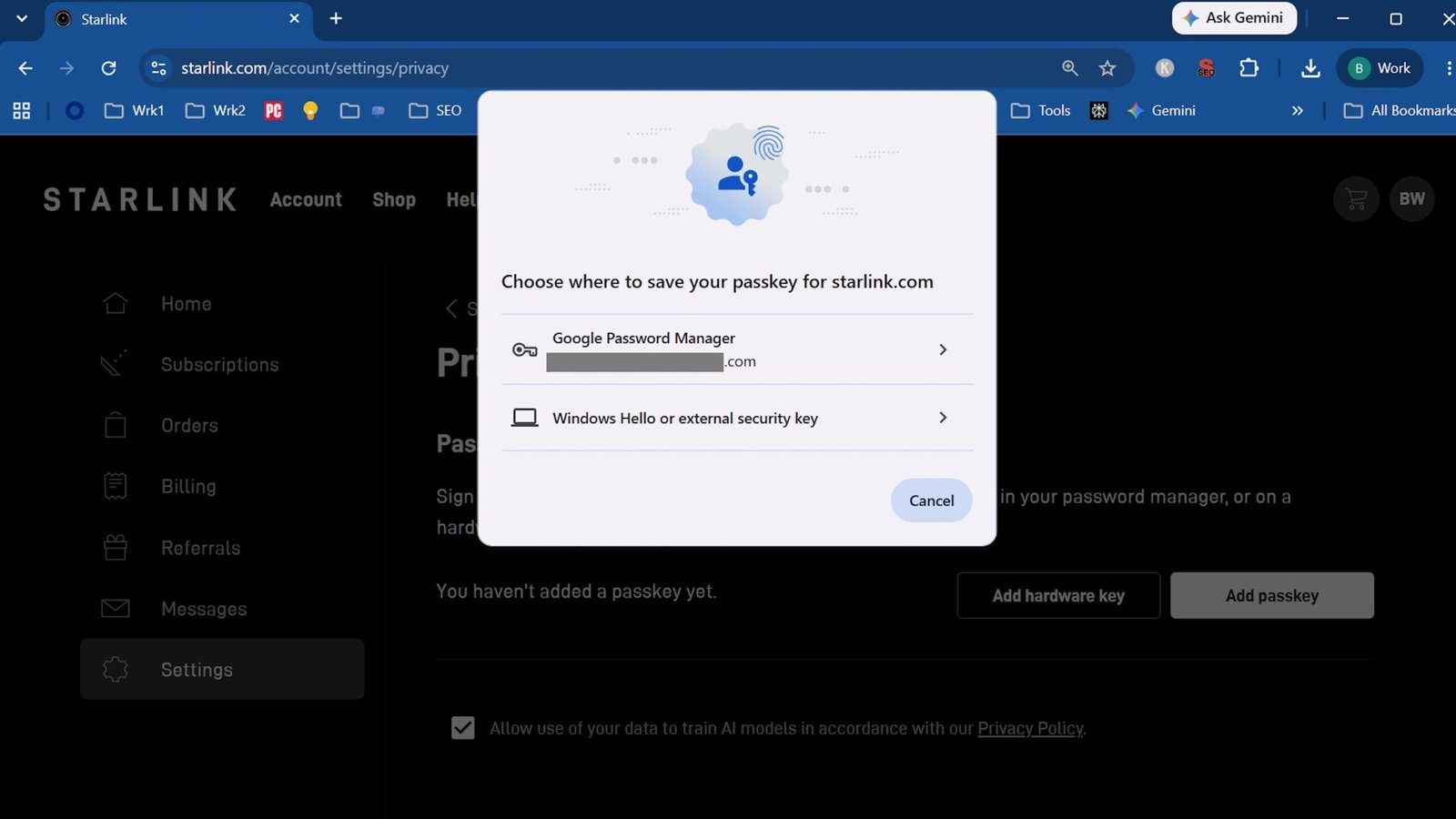
Interested customers can set up a passkey by going to Starlink.com, signing in, and then heading to Settings > Privacy & Security, and then looking under Passkey. You can then add a passkey to the account, which can be saved on the device or in a supported password manager, including iCloud Keychain, Google Password Manager, 1Password, or Bitwarden. Logging in with a passkey is also straightforward.
(Credit: PCMag/Brian Westover)
“You can add up to 10 passkeys. If you reach the limit, remove one before adding another,” the page adds. Users can also remove keys from their account. Another option is to save the passkey on a hardware-based security key if you own one. Last week, a new Starlink site revealed that SpaceX itself has been using hardware security keys to protect internal access to the satellite internet system.
About Our Experts
Brian Westover
Principal Writer, Hardware
Experience
From the laptops on your desk to satellites in space and AI that seems to be everywhere, I cover many topics at PCMag. I’ve covered PCs and technology products for over 15 years at PCMag and other publications, among them Tom’s Guide, Laptop Mag, and TWICE. As a hardware reviewer, I’ve handled dozens of MacBooks, 2-in-1 laptops, Chromebooks, and the latest AI PCs. As the resident Starlink expert, I’ve done years of hands-on testing with the satellite service. I also explore the most valuable ways to use the latest AI tools and features in our Try AI column.
I’ve been a journalist for over 15 years. I got my start as a schools and cities reporter in Kansas City and joined PCMag in 2017, where I cover satellite internet services, cybersecurity, PC hardware, and more. I’m currently based in San Francisco, but previously spent over five years in China, covering the country’s technology sector.
Since 2020, I’ve covered the launch and explosive growth of SpaceX’s Starlink satellite internet service, writing 600+ stories on availability and feature launches, but also the regulatory battles over the expansion of satellite constellations, fights with rival providers like AST SpaceMobile and Amazon, and the effort to expand into satellite-based mobile service. I’ve combed through FCC filings for the latest news and driven to remote corners of California to test Starlink’s cellular service.
I also cover cyber threats, from ransomware gangs to the emergence of AI-based malware. In 2024 and 2025, the FTC forced Avast to pay consumers $16.5 million for secretly harvesting and selling their personal information to third-party clients, as revealed in my joint investigation with Motherboard.
I also cover the PC graphics card market. Pandemic-era shortages led me to camp out in front of a Best Buy to get an RTX 3000. I’m now following how the AI-driven memory shortage is impacting the entire consumer electronics market. I’m always eager to learn more, so please jump in the comments with feedback and send me tips.
United States Homeland Security Secretary Markwayne Mullin has defended the planned livestreaming of Nidal Hasan’s execution, playing down warnings that images of his death by firing squad might be used as a propaganda tool for violent groups.
In an interview on Sunday with the CBS News show Face the Nation, Mullin framed the decision as part of President Donald Trump’s hardline approach to crime.
Recommended Stories
list of 3 itemsend of list
“I follow President Trump. He’s a commander-in chief of the country,” Mullin said, crediting the Republican leader with “restoring America values”.
Mullin also brushed aside concerns that the images of Hasan’s execution could be leveraged against the US.
“I don’t see an elevated risk at this point at all because of this,” Mullin said. “I think people need to understand, if you attack America, we will come after you, and we will make sure that the punishment fits the crime.”
Hasan, a former US Army major, was sentenced to death in August 2013 after being convicted of shooting and killing 12 unarmed active-duty soldiers and a retired serviceman at the Fort Hood military base in Texas.
The attack took place on November 5, 2009, when Hasan opened fire in a medical facility on the base where service members receive routine check-ups before deployment. The incident is considered one of the deadliest mass shootings to take place on a US military base.
Another 32 people were injured in the shooting. In the process of responding to the attack, police on the military base shot Hasan, leaving him paralysed from the waist down.
Critics have questioned the optics of broadcasting a firing squad killing of a man in a wheelchair. The livestreamed execution is scheduled for December 3.
But Mullin dismissed those concerns, arguing that viewership is optional. “Once again, no one has to watch it if they don’t choose to,” Mullin said.
Secretary of Defense Pete Hegseth had announced plans last week to livestream the upcoming execution, triggering a wave of criticism. But Trump on Saturday suggested he may reconsider the decision.
“There are two thoughts: Don’t show it and show it. Because, you know, by showing it, maybe other people won’t be doing what he did,” Trump told reporters outside the White House.
“So I’ll make a decision, ultimately. I know what the military would like to do, but we’ll make a decision.”
Former Army Major Nidal Hasan was sentenced to death for a 2009 mass shooting at Fort Hood, Texas [File: Bell County Sheriff’s Department via AP Photo]
Lawmakers on both sides of the aisle, however, have denounced the idea of a public execution.
In a Sunday morning appearance on NBC’s Meet the Press, Republican Senator Thom Tillis warned that broadcasting Hasan’s death would “put at risk” US lives.
“Terrorist organisations will use this as a recruiting tool. It will radicalise other people, and this is not who we are,” Tillis said.
“Look, the Fort Hood shooter should be put to death, but there’s a way to deal with this that’s proper, and there’s a way to deal with this that’s more improper than I have ever observed in my life.”
Tillis, whose term as senator ends in January, also directed criticism at Hegseth for what he suggested was reckless leadership.
“It’s another example of why Pete Hegseth and all of his bravado needs to get the hell out of the Department of Defense, because he is a failed leader,” Tillis said.
The senator was considered one of the deciding votes in Hegseth’s January 2025 confirmation vote, and he has since called his support for Hegseth’s cabinet nomination “the biggest regret” of his tenure.
Other Republicans echoed Tillis’s concerns about the livestream. Senator Lisa Murkowski of Alaska, for instance, compared the public execution with something she would expect “from terrorists and dictators”.
She also argued that Hasan has sought public attention, something he would receive in a broadcast execution.
“It would give this individual, who deserves no further notoriety, the martyrdom he seeks,” Murkowski added.
Republican Representative Tom Barrett of Michigan, a former military member, issued a statement on Friday explaining that he had trained at Fort Hood a year before the attack.
He also said he opposed the public execution, despite considering Hasan “evil”.
“Secretary Hegseth should seriously reconsider this decision,” Barrett wrote on X.
“Making a public spectacle out of an already tragic situation is unnecessary and does not serve a public interest.”
Military executions are extremely rare in the US and can only be approved by the president under the Uniform Code of Military Justice.
If the order against Hasan is carried out, he will be the first member of the US military to be executed since 1961.