Blog

  • Uniswap Governance Proposal Would Route Optimism Fees To UNI Burns

    Uniswap Governance Proposal Would Route Optimism Fees To UNI Burns

    Uniswap governance is reviewing a proposal that would route protocol fees from selected Optimism pools toward $UNI token burns, testing a more direct connection between deployment-level activity and token economics.

    The proposal is specific to Optimism pools. That distinction matters because it is not a protocol-wide fee burn across all Uniswap deployments.

    Still, the idea is significant.

    $UNI holders have long debated how Uniswap’s massive trading footprint should connect to the $UNI token. A fee-routing and burn mechanism on Optimism would give governance a narrower test case rather than changing the entire protocol at once.

    TL;DR

    • Uniswap governance is reviewing a proposal tied to Optimism pool fees.
    • The proposal would route selected fees toward $UNI token burns.
    • The scope is Optimism-specific, not a protocol-wide Uniswap burn mechanism.

    $UNI Tokenomics Are Back In Focus

    Uniswap is one of the most important decentralized exchanges in crypto, but its token economics have always been debated.

    The protocol processes large amounts of trading volume, yet $UNI does not automatically capture value from every trade in a direct, simple way. Governance controls key decisions, but tokenholders have often wanted clearer links between protocol usage and token value.

    That is why fee routing matters.

    If protocol fees from selected pools can be used to buy and burn $UNI, the token may gain a more visible economic connection to exchange activity. Burns reduce supply, at least mechanically, and they are easy for the market to understand.

    But implementation is everything.

    Which pools are included? How much fee revenue is routed? How are burns executed? What are the legal and governance implications? Could the model expand beyond Optimism later?

    Those are the questions governance needs to answer.

    Why Optimism Is A Sensible Test

    Optimism is a useful place to test the idea because it narrows the scope.

    Uniswap is deployed across multiple networks. A protocol-wide change would be more complex and more controversial. Testing fee routing on a specific deployment gives governance a way to examine the mechanics without rewriting the entire system.

    It also reflects how DeFi is becoming more chain-specific.

    Activity on Ethereum mainnet is different from activity on Optimism, Arbitrum, Base, Polygon, or other networks. Fees, users, liquidity, incentives, and trading behavior vary by chain.

    A deployment-level test may help Uniswap learn whether fee burns are practical in one environment before considering broader changes.

    That does not guarantee the proposal will pass or expand.

    But it gives $UNI holders a concrete experiment to debate.

    Burns Are Simple, But Not Magic

    The market often likes token burns because they are easy to understand.

    Fewer tokens can sound bullish. But burns only matter if the underlying fee stream is meaningful, recurring, and large enough to affect supply over time.

    A small burn from limited pools may be symbolically important but economically modest. A larger mechanism could matter more, but it may also raise more governance, liquidity, and regulatory questions.

    That is why the Optimism-specific scope is important.

    The proposal can show how the process works without overpromising immediate impact. $UNI holders should watch the mechanism, not just the headline.

    If fees are routed transparently and burns are executed reliably, the model may gain support. If the impact is tiny or the process creates new complications, governance may be more cautious.

    Uniswap Is Searching For Token Value Alignment

    The broader issue is value alignment.

    Uniswap has strong product-market fit. It is widely used, deeply integrated, and central to DeFi liquidity. But tokenholders still want to know how that usage translates into $UNI’s long-term role.

    Governance power alone may not be enough for every investor.

    A fee burn proposal gives the DAO another possible answer. It connects protocol activity, chain-specific revenue, and token supply mechanics in a way that is easier to track.

    That does not mean every Uniswap fee should automatically flow to tokenholders. The protocol also needs liquidity, incentives, legal resilience, and sustainable governance.

    But the discussion is important.

    It shows that DeFi’s largest protocols are still experimenting with how to align users, liquidity providers, developers, and tokenholders.

    For Uniswap, the Optimism proposal could become a small but meaningful test of whether deployment-level fee routing can support $UNI economics without disrupting the protocol’s broader market position.

    This article is based on the Uniswap governance proposal for Optimism pool fee routing.

    This article was written by the News Desk and edited by Samuel Rae.
    This report is based on information released in disclosures at primary source documentation.

  • Where to Find a Commonwealth Games 2026 Livestream in the U.S. to Watch the Event for Free

    Where to Find a Commonwealth Games 2026 Livestream in the U.S. to Watch the Event for Free

    If you purchase an independently reviewed product or service through a link on our website, Variety may receive an affiliate commission.

    Some of the best summer athletes in the world are heading to Scotland for the 2026 Commonwealth Games.

    A quadrennial event dating back to 1930, the Commonwealth Games unites thousands of athletes from more than 70 nations across the British Commonwealth — I.e. countries that are currently or were formerly part of the British Empire. So while countries like Canada, Australia, England, New Zealand, South Africa and Jamaica will all be participating, there will not be a U.S. contingent at the Games.

    How to Watch the 2026 Commonwealth Games

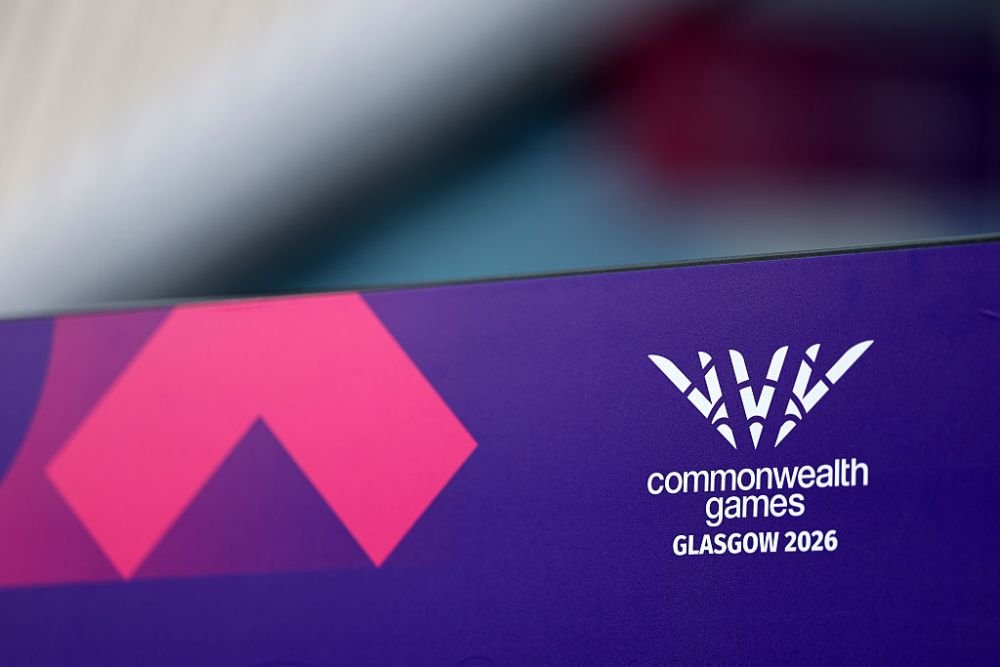
    This year’s Commonwealth Games run from July 23 to August 2 in Glasgow, Scotland, with events airing live and as nightly highlights on channels like 7Plus in Australia and Channel 5 in the UK.

    North American viewers can watch the Games for free on CBC, Canada’s national public broadcaster, via a virtual private network like ExpressVPN or NordVPN (NordVPN excludes a 30-day money back guarantee). Your VPN lets you set your location to Canada to stream the CBC’s coverage of the 2026 Commonwealth Games online from anywhere in the world.

    Or set your location to Australia or the United Kingdom to stream the 7Plus and Channel 5 Commonwealth Games feed online.

    How to Watch the 2026 Commonwealth Games From the U.S.

    You can also watch the Commonwealth Games in the U.S. through beIN SPORTS, the Qatar-based sports media group that is now available in America on streaming services like Fubo and Sling.

    Fubo offers beIN SPORTS on its own for just $5.99/month, or as part of the Fubo Core package, which gets you 200 live TV channels to stream online for $63.99/month (regularly $88.99 monthly).

    Don’t have Fubo? Test drive the service with a five-day free trial here and use it to stream the Commonwealth Games in the U.S. for free. Fubo’s plans include free DVR so you can record the events to watch back on-demand whenever you want.

    The cheapest way to get beIN SPORTS on Sling, meantime, is to sign up for the streamer’s Sling Orange base plan (from $45.99/month) and then add the Sports Extra package for an additional $11 a month. You’ll get more than 40 live TV channels in total that you can stream online.

    Sling Orange includes 50 hours of free cloud DVR in addition to an on-demand library of free TV shows and movies that you can stream online.

    Commonwealth Games 2026 Sports

    Unlike previous Commonwealth Games, which have featured more than 30 different summer sports, this year’s event will include just 10 sports, the lowest number of events offered at the Games since 1994. Organizers say rising costs, lack of venues and viewership decline have led to the removal of sports like field hockey, diving, rugby sevens and cricket.

    Still, there’s plenty of big names to watch for in the remaining sports, which include athletics, swimming, artistic gymnastics, boxing and cycling. Paris 2024 Olympic swimming champions Kaylee McKeown from Australia and Adam Peaty from England, are expected to compete, as is Canada’s gold-medal winning 4×100 meter men’s relay team in track and field.

    The track event will also see Scottish middle-distance runner Josh Kerr, who just broke the 27-year world record in the mile, and Jamaican superstar Shericka Jackson, a two-time World Champion who holds the second-fastest time ever recorded in the women’s 200m events.

    Reigning Olympic pommel horse champion Rhys McClenaghan from Northern Ireland will compete in the men’s gymnastics event, where he’ll face off against Cyprus’ Marios Georgiou, who is a former European All-Around champion and a three-time Olympian.

    This year’s Commonwealth Games kicks off with an Opening Ceremony featuring British singer-songwriter Tom Walker (of “Leave the Light On” fame), along with Scottish singer-songwriter, KT Tunstall and other local artists. The last edition of the Commonwealth Games was held in 2022 in Birmingham, where rockers Duran Duran performed at the Opening Ceremony.

  • Base And Optimism Push Native Account Abstraction Toward The OP Stack

    Base And Optimism Push Native Account Abstraction Toward The OP Stack

    Base and Optimism are working to bring native account abstraction to the OP Stack, with developer testing already live on Base Vibenet and mainnet rollout planned for the Cobalt upgrade in September 2026.

    The update centers on EIP-8130 and aims to make user accounts more flexible across OP Stack chains.

    For users, the idea is simple: crypto wallets need to feel less clunky. Account abstraction can help make that happen by supporting features such as smoother onboarding, better transaction flows, and more flexible account logic.

    The important caveat is that this is not fully live across mainnet OP chains yet. The feature is in testing, with broader rollout planned later.

    TL;DR

    • Base and Optimism are working on native account abstraction for the OP Stack.
    • Developer testing is live on Base Vibenet.
    • Mainnet rollout is planned for the Cobalt upgrade in September 2026.

    Why Account Abstraction Matters

    Crypto still has a user experience problem.

    Seed phrases are intimidating. Gas fees are confusing. Wallet approvals are messy. Signing flows are hard for ordinary users to understand. Even experienced crypto users can make mistakes when moving across chains and apps.

    Account abstraction is one of the industry’s main attempts to fix that.

    Instead of treating every wallet like a simple externally owned account with limited logic, account abstraction allows more programmable account behavior. That can support features such as sponsored transactions, session keys, recovery systems, spending limits, batched actions, and app-specific permissions.

    In plain English, it can make wallets behave more like modern financial apps without giving up the benefits of blockchain infrastructure.

    That is why Base and Optimism pushing native support into the OP Stack matters.

    If account abstraction becomes part of the stack itself, developers may not need to build as many workarounds at the app layer.

    Base Gives The Upgrade Real Distribution

    Base has become one of the most important consumer-facing Layer 2 networks in crypto.

    Its Coinbase connection gives it distribution, brand recognition, and access to a large pool of potential users. That makes Base an important testing ground for wallet and account improvements.

    If native account abstraction works well on Base, it could improve onboarding for apps built on the network. Users may be able to interact with applications more easily, while developers get better tools for designing smoother experiences.

    The Optimism side matters too.

    The OP Stack is used by multiple chains. Improvements to the stack can spread across the broader Superchain ecosystem if adopted. That means the work is not limited to one network in theory.

    But adoption will still depend on implementation, timing, and developer support.

    The Vibenet testing phase is useful because it gives builders a place to experiment before mainnet rollout.

    Mainnet Timing Is The Key Caveat

    The September Cobalt upgrade is the important timeline marker.

    Until then, users should not assume native account abstraction is fully available on mainnet. Developer testing is not the same as production deployment. Apps may experiment before the broader rollout, but real user impact depends on mainnet readiness.

    That distinction matters because account abstraction is often discussed as if it has already solved crypto UX.

    It has not.

    The technology is promising, but it needs wallet support, app integration, secure implementation, and user-friendly design. A technical upgrade alone does not automatically make crypto easy.

    Still, native support can remove a major barrier.

    If Base and Optimism make account abstraction easier for developers to use, the next generation of apps may feel much less awkward than today’s DeFi and wallet flows.

    The OP Stack Is Becoming More User-Focused

    The OP Stack conversation often focuses on scaling, fees, sequencer revenue, and network architecture.

    Account abstraction brings the focus closer to the user.

    Lower fees are helpful, but they do not solve confusing wallet experiences. Faster confirmations are useful, but they do not fix bad onboarding. A better account model can attack those problems more directly.

    That is why this update matters for the broader Ethereum Layer 2 market.

    Competition between L2s is no longer just about throughput. It is about which networks can attract real users and keep them active. Better wallet experiences may become a major differentiator.

    Base and Optimism are betting that account abstraction belongs inside the infrastructure layer, not only as an optional app feature.

    If the Cobalt rollout succeeds, the OP Stack could become more attractive to consumer apps, gaming projects, payment tools, and DeFi platforms that want simpler user flows.

    The market should watch the testnet phase closely.

    The promise is big, but the proof will come when developers turn the upgrade into products that ordinary users can actually understand.

    This article is based on Base’s announcement of native account abstraction work for the OP Stack.

    This article was written by the News Desk and edited by Samuel Rae.
    This report is based on information released in disclosures at primary source documentation.

  • Modded RTX Spark Driver Gets Nvidia GPUs Working in Windows on ARM

    Modded RTX Spark Driver Gets Nvidia GPUs Working in Windows on ARM

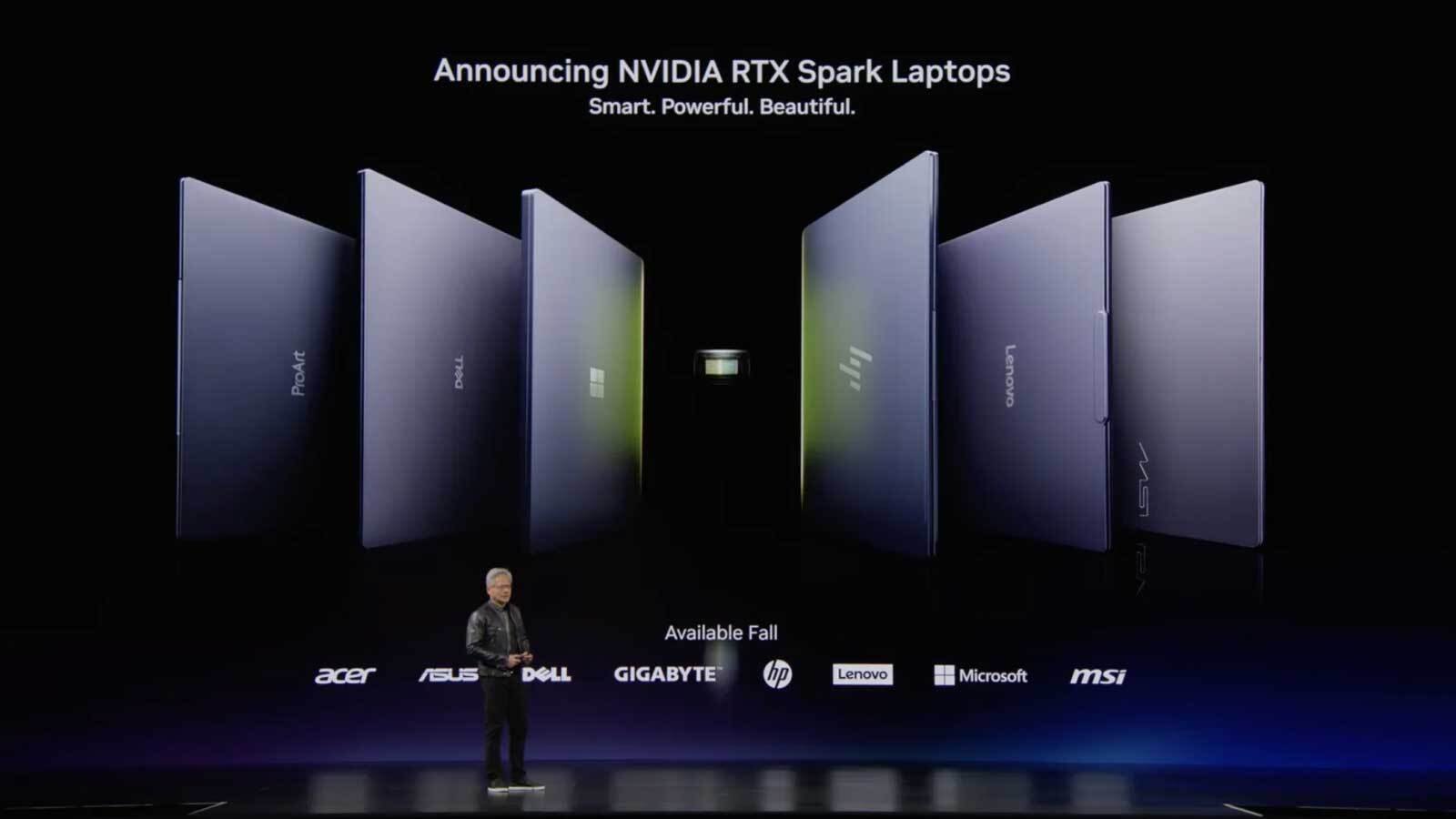
    Modders have managed to get Nvidia’s RTX Spark driver working on alternative Arm platforms, enabling Nvidia desktop GPUs to run on Windows on Arm systems, Windows Latest reports.

    Windows on Arm is mostly limited to laptops equipped with Qualcomm’s Snapdragon SoCs and does not support Nvidia desktop GPUs. Nvidia’s RTX Spark offers a more graphically capable Windows on Arm experience, but at a high cost and with a developer focus. But with its driver release, modders have opened up support and compatibility to a wider array of hardware.

    By extracting the ARM64 Nvidia driver from RTX Spark software, a developer named VoidTech got it working on the Kunpen 920 server processor. It’s based on the same architecture as the Snapdragon X Elite, and features 24 cores running at 2,600MHz each. Its performance is roughly around that of Apple’s A15 mobile chips, or an Intel Core i5-1235U. Hardly a powerhouse.

    But still, it’s a desktop chip running Windows on Arm and, in this particular test, it also ran an RTX 4060 GPU. It’s part of the Huawei Qingyun W510 ARM workstation system, and uses 32GB of DDR4-2933 memory.

    Performance in game tests wasn’t great, though the CPU is likely a major factor. In the Black Myth: Wukong benchmark, this system managed an average of 21 frames per second, but with lows of 3fps at times.

    VoidTech estimates that around 25% of the CPU’s performance was consumed by the x86-to-Arm translation layer, which makes these kinds of setups viable. That, combined with the RTX 4060’s relative entry-level performance, means it’s no surprise that gaming wasn’t amazing. But it’s an early proof of concept. With better drivers and hardware, it seems possible that you could game on a Windows on Arm desktop with discrete Nvidia graphics before long.

    VoidTech believes this method would work with RTX 20, 30, and 50 GPUs as well, so we may see an RTX 5090 version of this test down the line.

    Recommended by Our Editors

    In the meantime, VideoCardz reports that another user got a Radxa Orion O6 workstation working with this same driver configuration, pairing an eight-core Arm CPU with an Nvidia RTX 2080 Ti. No performance results were published, but I have to imagine it was worse.

    Classic Windows on Arm issues are likely to slow adoption of this new way to play, though. Anti-cheat software still struggles with the translation layer, breaking a number of experiences, and the motherboard’s network interface didn’t work because it didn’t have Windows drivers.

    The graphics card’s video output didn’t work properly, either, forcing VoidTech to stream it to another desktop to record it. Lots of work still to be done.

    About Our Expert

  • Netflix Reteams With Yeon Sang-ho for ‘Parasyte: Tamiya’ Series

    Netflix Reteams With Yeon Sang-ho for ‘Parasyte: Tamiya’ Series

    Korean hitmaker Yeon Sang-ho’s Parasyte universe is getting an all-new host body to infect. On Thursday morning from Seoul, Netflix unveiled Parasyte: Tamiya, an upcoming Japanese season of the hit sci-fi horror series that has delighted fans with its inspired K-drama reimagining of artist Hitoshi Iwaaki’s best-selling manga.

    Yeon, fresh off the release of Netflix thriller series Human Vapor and zombie blockbuster Colony, returns as the lead creative force behind the show, having developed its story and co-written all episodes with his regular collaborator Ryu Yong-jae. Netflix says the new season is already in post-production and will premiere on the service sometime in 2027.

    The original Parasyte: The Grey spent four weeks on Netflix’s Global Top 10 Non-English TV list in 2024 and topped the rankings in 34 countries upon its release.

    Whereas the original season’s novelty came from transplanting Iwaaki’s classic manga to a South Korean setting, the new chapter is said to burrow more deeply into the original source material. Japanese actress Shioli Kutsuna, best known to global viewers for her recurring part in the Deadpool franchise, stars as Ryoko Tamiya, a parasite who seizes the body of a high school teacher and — initially as ruthless as the rest of her kind — gradually comes to suspect that coexistence with humans, rather than predation, may offer her species its best chance of survival. The series tells that story from her side of the divide, with Kutsuna playing the character in three registers: the original human, the violent creature that takes her over and the evolving being caught between the two.

    Japanese actress Shioli Kutsuna as Ryoko Tamiya.

    Netflix

    “Ryoko Tamiya is a truly captivating villain in the original manga,” Yeon says. “Her struggles over the nature of her own existence are what elevate the original Parasyte from a simple hero-based manga aimed at kids to something deeper.”

    “I wanted to convey her perpetual struggle over the need for parasites to coexist with humans and the issue of their survival, and how she suffers setbacks and learns over time,” the filmmaker adds. “I think the anguish she experiences is the essence of Parasyte.”

    Kutsuna, who previously worked with Netflix on the sumo drama Sanctuary and will appear in the streamer’s upcoming live-action Gundam film, calls Tamiya “the most challenging role I have ever played in my acting career.”

    She adds: “During the six months I spent living as Tamiya, I experienced many emotions I had never encountered before.”

    Yeon adds: “She did a wonderful job of portraying the process of a non-human creature coming to understand both humanity and its own existence.”

    Yeon has become one of Netflix’s most consistent and prolific collaborators in East Asia. His projects at the streamer as a creator, director or writer include Hellbound (two seasons), sci-fi feature Jung_E, occult chiller The Bequeathed, Parasyte: The Grey, last year’s Revelations and the just-launched The Human Vapor, his big-budget Japanese series collaboration with Toho. He’s kept just as busy as a theatrical filmmaker. Colony, the Cannes Midnight-premiered zombie thriller starring Jun Ji-hyun that returned him to Train to Busan territory, has grossed $42.4 million in South Korea since late May, making it one of the year’s biggest Korean hits. He’s simultaneously been experimenting with ultra-low-budget filmmaking, having released mystery thriller The Ugly last year, and with the AI-themed thriller Paradise Lost set to premiere at the Toronto Film Festival this fall.

    For Parasyte: Tamiya, Yeon reunites with Grey co-writer Ryu Yong-jae, while Japanese filmmakers Kensaku Kakimoto (Glass Heart) and Kazuhiro Nakagawa (Double, Bullet Train Explosion) direct the episodes. WOWPOINT, the production house behind The Grey, The Human Vapor and Colony, produces.

    Iwaaki’s manga, published by Kodansha from 1988 to 1995, has previously spawned an anime series and a two-part Japanese film franchise directed by Godzilla Minus One‘s Takashi Yamazaki.

    Says Yoshihiro Sato, manager of live-action creative at Netflix Japan: “‘What makes a human?’ ‘Can we coexist with beings that are different from us?’ — These questions posed by Parasyte more than 30 years ago feel much more pressing for our modern society that has placed non-sentient AI at all of our fingertips.”

    He adds: “Our purpose in making this series was to take the universal questions posed by the original manga 30 years ago and bring them into the modern spotlight.”

  • Lego at Comic-Con: Star Wars and Pokémon Activations, Star Trek and Donkey Kong Sets

    Lego at Comic-Con: Star Wars and Pokémon Activations, Star Trek and Donkey Kong Sets

    For years, Lego has been one of big booths at San Diego Comic-Con, a massive footprint in the center of the San Diego Convention Center. This year, however, the company is taking its convention experience to a whole new level of brick.

    Doubling down on its Lego Smart Play, which blends physical play with responsive technology, Lego is creating an interactive and immersive destination themed to two of the biggest brands in pop culture, Pokémon and Star Wars.  

    The company is also showing off publicly, for the first time, its upcoming sets for Star Trek, Donkey Kong and Shrek.

    The booth will welcome convention-goers with a retro-futuristic gateway before welcoming them into two fully activations.

    For the Star Wars installation, Lego has created “Destination: Mos Eisley,” which will take fans to the famous Creature Cantina, recreated by oversized Lego brick environments designed for photo taking (and social media sharing). Attendees will be able to get on stage for a remix of the Cantina Song and even slide into the famous corner booth for a face-to-face encounter with Greedo. There is also a Dewback Petting Zoo for a photo op with a purring, snoozing Dewback.

    Lego Smart Play Gateway Mos Eisley of Star Wars.

    Courtesy of Lego

    The Pokémon installation, meanwhile, recreates the Pokémon Lab with scaled up Lego brings and will be populated by life-sized Lego Pokémon builds powered by Smart Play. That experience involves Poké Balls and a game of “Hide and Pikachu.”

    Star Trek 60 Legos Figurines

    Courtesy of Lego

    One of the big sets being unveiled is the Lego Icons Star Trek: U.S.S. Enterprise NCC-1701 Bridge, coinciding with the show’s 60th anniversary. The set will available at Lego stores and LEGO.com exclusively beginning Sept. 1.

    (And speaking of Lego Trek, there will be a panel on the subject, titled Star Trek: The Collector Frontier, Thursday at 11 a.m. in Room 5AB with Lego set designers Henrik Andersen and Crystal Marie Fontan. And, for good measure, Lego is also showing off a brick-built Captain’s Chair — made out of 83,568 bricks — at the neighboring Marriott Marquis.)

    Leo Donkey Kong Arcade Game box

    Courtesy of Lego

    Lego previously produced sets replicating a Nintendo console and a Game Boy and it’s keeping the video game silo going with a Donkey Kong Arcade, which will be on display at its booth. The 1,367-piece collectible set features Donkey Kong and Lady, plus well-known sights such as the scaffold, ladder and hammer details from the original Nintendo game. And yes, you will be able to release barrels and press the button to make Jumpman leap over the barrels. That set will be available Aug. 1.

    Lego is also showcasing 12 minifigures from the Shrek franchise as it gears up for new Shrek sets in 2027. The minifigures will hit shelves Sept. 1.

    Lego Shrek Mini Figures

    Courtesy of Lego

  • ‘Doctor Strange’ Director Says Elon Musk ‘Doesn’t Know S— About Cinema’ After Musk Vows to Make AI ‘Odyssey’: ‘His Opinions on Art Are Worthless’

    ‘Doctor Strange’ Director Says Elon Musk ‘Doesn’t Know S— About Cinema’ After Musk Vows to Make AI ‘Odyssey’: ‘His Opinions on Art Are Worthless’

    Elon Musk’s crusade against Christopher Nolan’s “The Odyssey” has raised eyebrows in Hollywood after the newly minted trillionaire vowed that before the end of the year, his AI tool Grok “will make a full-length movie of The Odyssey that is historically accurate and true to the art of Homer.” Musk also shared a three-minute clip of an AI-generated scene adapted from the poem, which was manufactured by a user on Grok.

    One figure from the film community, “Doctor Strange” and “The Black Phone” director Scott Derrickson, pulled no punches when addressing Musk directly on social media. “Clearly @elonmusk doesn’t know shit about cinema & he stopped reading in his 20s,” Derrickson wrote on Musk’s social media platform, X. “His opinions on art are worthless.”

    The Tesla mogul has railed against Nolan’s “Odyssey” long before it was released due to his perception of certain “woke” casting decisions. In March, Musk wrote that “Chris Nolan is an anti-White racist” for casting Lupita Nyong’o in the role of Helen of Troy, asserting that the director made the decision because “he wants the awards.” Musk said “Chris Nolan has lost his integrity” and called the casting an “insult” to Homer. Musk also took aim at Elliott Page, who plays Sinon in “The Odyssey,” reposting comments that mocked the transgender actor’s masculinity.

    “The Odyssey” is not the first film Musk has criticized on X; he similarly mocked “Barbie” for its feminist themes and Disney’s “Snow White” reboot led by Rachel Zegler. The anti-woke backlash to “The Odyssey” didn’t seem to matter. The Matt Damon-starring epic opened to $264 million worldwide and continues to sell out screenings months in advance.

  • Travis Scott Says He Was “Nervous as F” Making His Acting Debut in Christopher Nolan’s ‘The Odyssey’

    Travis Scott Says He Was “Nervous as F” Making His Acting Debut in Christopher Nolan’s ‘The Odyssey’

    Travis Scott is opening up about how Christopher Nolan cast him in The Odyssey for his acting debut.

    During a Tuesday night appearance on The Tonight Show Starring Jimmy Fallon, Scott recalled receiving an unexpected phone call from the Oscar-winning director, who asked if he’d be interested in acting in the Greek epic.

    “My phone went off and it just said, ‘Chris.’ And I’m thinking, ‘OK, I don’t know what this is about. Maybe he wants to go to a show?’” Scott said. “So I pick up and he’s like, ‘Would you be interested in acting in a movie?’ And I’m like, ‘I mean, I guess, you know? What’s the [role]?’”

    Scott recalled Nolan telling him the film would be “coming out soon” and that he wanted him to be part of it. Surprised by the ask, Scott responded: “I’m like, ‘Whoa, hold on. Wait. You know I make music?’” before Nolan gave him “his whole thesis on why.”

    “I really enjoy his time. I’m really inspired by him. He’s a real mentor of mine outside of this,” Scott said of the Oppenheimer filmmaker. “So I’m like, ‘Yo, whatever you’re down with, I’m down. However it goes, I’m with it.’”

    Scott played Demodocus, the bard who narrates Odysseus’ journey in the opening scene and is the first voice and face audiences see in the film.

    Though he admitted, “I was actually nervous as ‘F,’” Scott said he initially assumed his scenes would be with extras.

    “I didn’t know that it was going to be Anne Hathaway, Tom [Holland] and Robert Pattinson — a bunch of amazing people,” he said. “I don’t know what the fuck I’m doing. But they were such an amazing cast.”

    Scott continued to praise Nolan and the cast for making his acting debut a comfortable experience. The pair previously collaborated on the soundtrack for Nolan’s 2020 film Tenet, which starred Pattinson.

    “Chris is an amazing director,” Scott said before adding of the cast, “Everybody made me feel comfortable. I was just glad to be there and just watch him. And being in such a world of them. So I’m just glad to be here.”

    Nolan recently spoke with Time magazine about why he cast Scott, saying, “I wanted to nod towards the idea that this story has been handed down as oral poetry, which is analogous to rap.”

    In addition to his acting debut, Scott also recorded the original song “When I’m Home” for The Odyssey‘s closing credits alongside James Blake, with production from the film’s composer Ludwig Göransson. Nolan is credited as a co-writer.

    The Odyssey is now playing in theaters.

  • Ethena price prediction: Why ENA could rally 25% despite a long-term downtrend

    Ethena price prediction: Why ENA could rally 25% despite a long-term downtrend

    Ethena [$ENA] has made some modest gains to get the week off to a good start. Since making the $0.078 low on Monday, July 20, the altcoin has rallied 13%. In the past 24 hours, its Open Interest has expanded by 7%.

    Source: Onchain Lens on X

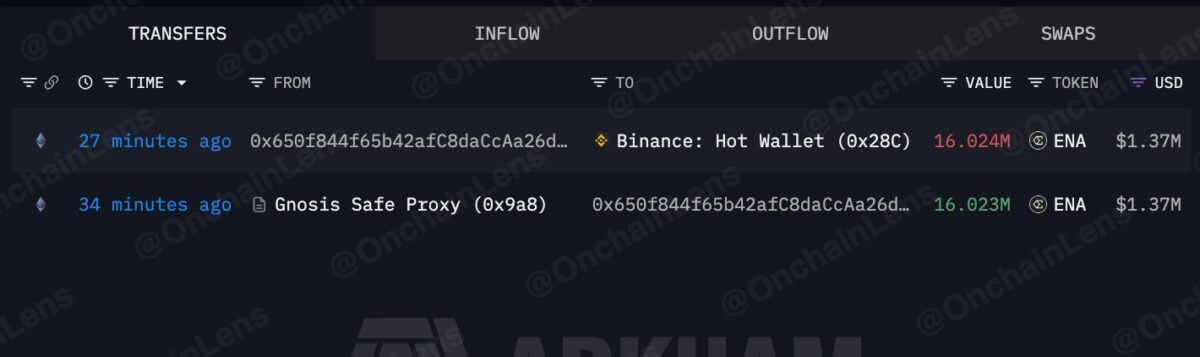
    On July 21, Onchain Lens observed a 16 million $ENA move, worth around $1.37 million. The wallet withdrew this from their Gnosis multisig wallet to Binance. Transfers to centralized exchanges generally point toward sell pressure.

    Ethena holders have experienced profits, as seen on the daily transaction volume in profit metric. A rise in average order size also indicated potential whale interest in $ENA, AMBCrypto reported.

    $ENA operates within a downtrend, but a temporary uptrend was underway

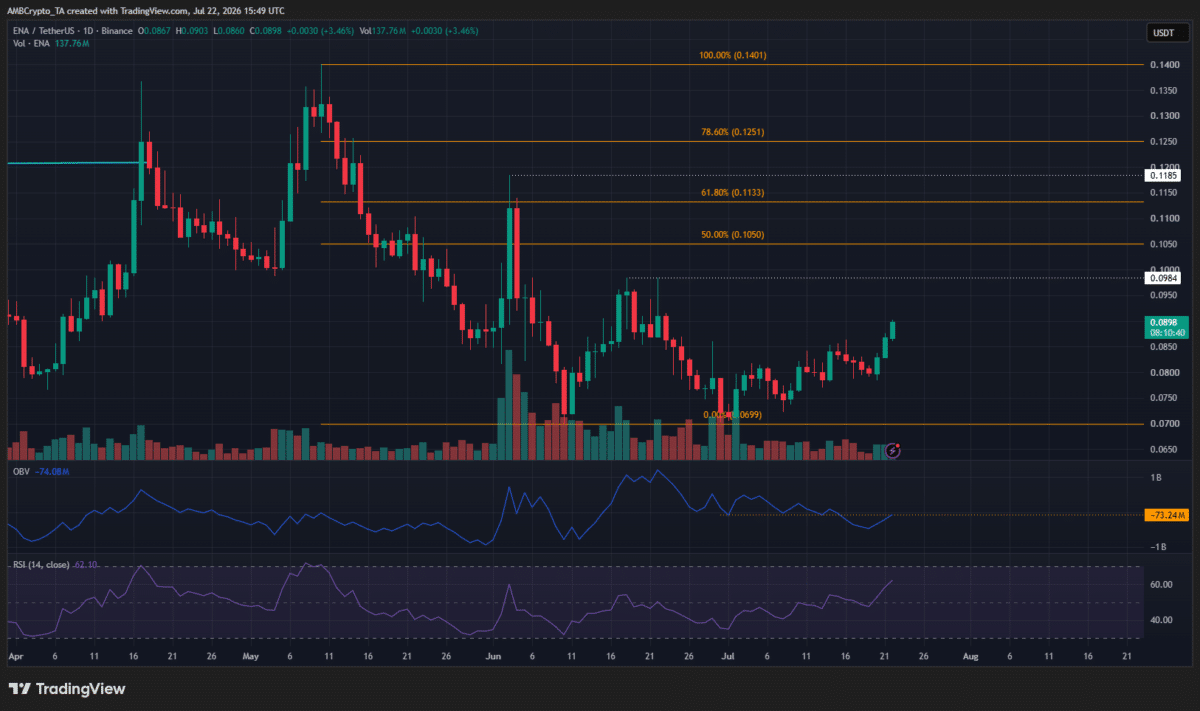
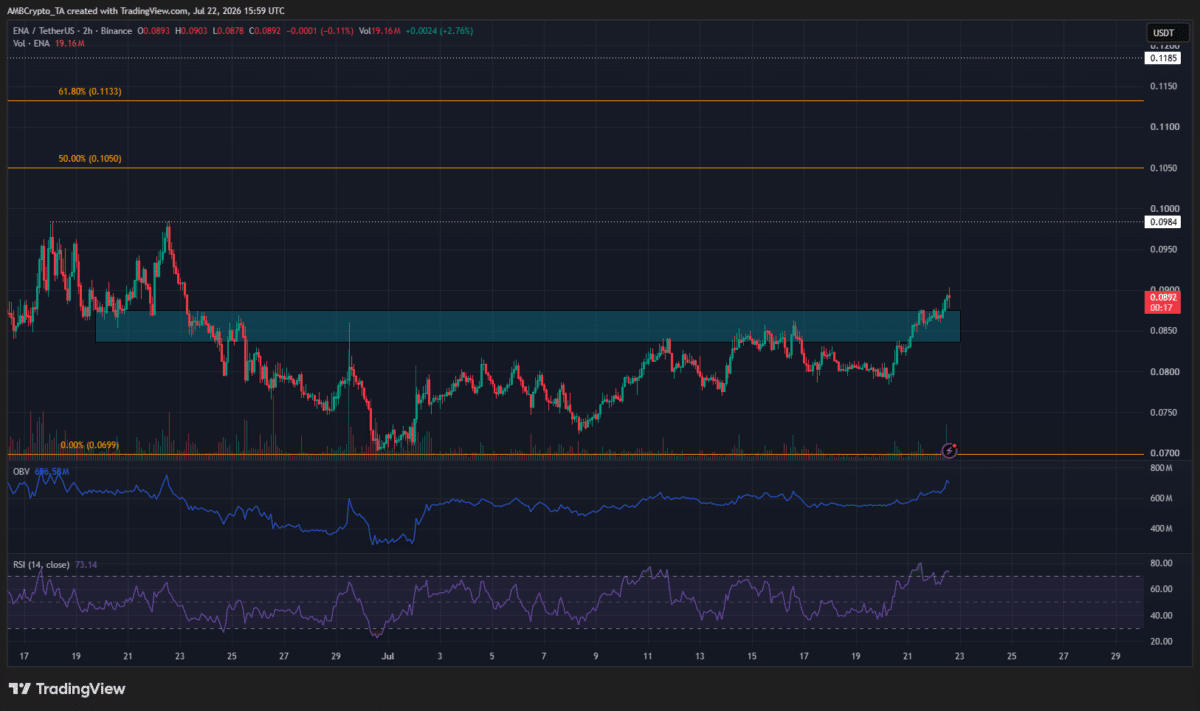
    The $0.085 target presented has been met and cleared. However, the higher timeframe trend remained bearish.

    Source: $ENA/$USDT on TradingView

    The local highs at $0.098 and $0.118 are the potential price targets in case of a short-term uptrend. As the Fibonacci retracement levels show, the swing structure on this timeframe was bearish.

    A rally could rise to $0.123, but the likelihood of this had been in question as $ENA repeatedly failed to breach the $0.085 resistance zone over the past three weeks. The gains at the start of this week were a positive sign.

    Source: CoinGlass

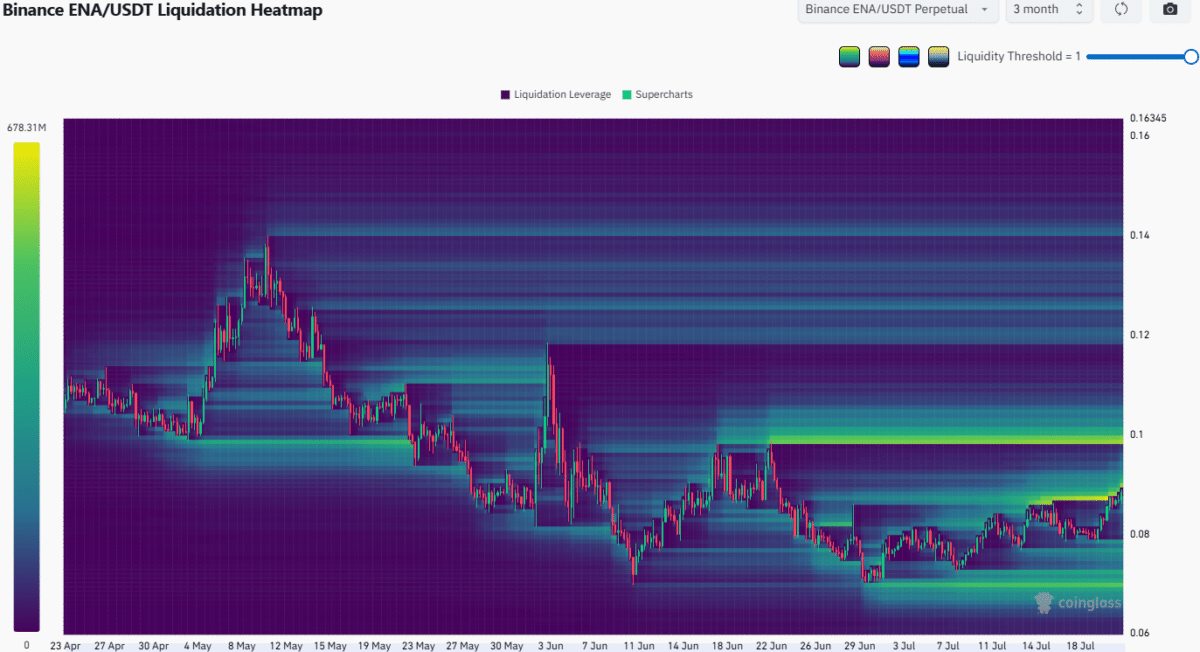
    The liquidation heatmap of the past three months agreed. There were two magnetic zones to keep an eye on. The $0.09 and $0.10 had dense short liquidations that traders should keep an eye on.

    Traders’ call to action- Cautiously bullish stance warranted

    Source: $ENA/$USDT on TradingView

    The $0.085 zone was flipped to support. The OBV was making new local highs to indicate increased buying pressure. The RSI showed strong bullish momentum, though a bearish divergence warned of a brief dip toward $0.085.

    Such a dip would likely present a short-term buying opportunity. As noted earlier, the $0.098,$0.118, and $0.123 levels are viable targets for $ENA in a pullback within its higher timeframe downtrend.


    Final Summary

    • The $0.085 local resistance zone was flipped to support, though a short-term RSI bearish divergence could cause a minor price dip.
    • Traders can wait for the current upward move to push toward $0.11-$0.12 before looking to take profits. Bitcoin volatility could hurt this short-term setup.

  • Shaken, Soaked and Seasick: What It’s Like to Survive ‘The Odyssey’ in 4DX

    Shaken, Soaked and Seasick: What It’s Like to Survive ‘The Odyssey’ in 4DX

    There’s no question that seeing Christopher Nolan’s epic “The Odyssey” in 70mm and Imax – or both – is an expansive and breathtaking experience. But for cinephiles who have already checked off those formats on their list, what’s it like to watch the Matt Damon-starring, three-hour blockbuster in 4DX?

    The seat-rumbling, water-spritzing technology, available in nearly 800 movie theaters around the world, promises a “fully immersive cinematic experience that makes you feel like you’re in the movie.” But does it really? Three intrepid Variety writers – two who had seen the movie before and one first-timer – set out on an odyssey to find out. The three sailed into Regal’s L.A. Live cinemas and were fortunately better-provisioned than Damon and his exhausted crew. Tanya stockpiled mozzarella sticks and Gatorade, while Pat smuggled in a peanut butter protein bar and a bottle of water for the three-hour tour.

    Pat was about to put in some eyedrops to prep for the long running time when the moviegoers suddenly embarked on the first stop of the epic journey: the trailer for 4DX. The seats heaved and jiggled, we were spritzed with water, we were shaken and stirred and primed for equally bouncy trailers for “Spider-Man: Brand New Day” and “The Fast and the Furious” rerelease. The onslaught during the pitch for enlisting in the Navy was particularly jarring.

    Then the film began. Read on to see who survived the hero’s journey.

    Pat

    The main selling points for 4DX are shaking seats and spraying water, with a little wind thrown in. The breeze sometimes felt like the person sitting behind me was ruffling my hair – but since it was my own co-worker, that seemed unlikely. During the many scenes of roiling seas and inevitable shipwrecks, the shaking met the action appropriately. Did it add to the experience? Kind of — we could certainly empathize with how battered and bruised Odysseus and his men must have felt after all those cursed voyages.

    The water was not as bad as I had feared – I had prepared by bringing a hoodie in case of a full Sea World-esque splash zone, but the light spritzing was fairly refreshing. Nonetheless, midway through the film I took advantage of the “turn water off” button to enjoy Nolan’s ambitious filmmaking with fewer distractions. The shaking was particularly effective as the boat was being thrashed around by the whirlpool of Charybdis, one of several moments when it really matched the action onscreen. But did we really need to heave up and down every time a soldier marched into a castle? Just because you CAN shake the seats doesn’t mean you SHOULD every time there’s movement in the frame.

    Overall, I enjoyed my first 4DX experience though perhaps a different and simpler film would have been a better choice. I might have liked a few more effects – the smell of pigs, or ripening cheese, perhaps. “We were all praying for forgiveness,” Damon intones in his climactic speech. In the case of 4DX filmgoers, it could be said that after three hours we were all praying mostly for our seats to hold still.

    Matt

    I will kick off my thoughts with a caveat — I couldn’t make it through the entire 4DX experience. I can handle pretty much any roller coaster, but three hours of movement… I’m no Odysseus!

    I began getting nauseous about halfway through, and my stomach couldn’t handle the thought of experiencing the crazy water scenes that I knew were coming closer to the end of the film. But from what I was able to witness for myself, the 4DX experience was a fun, unpredictable mixture of movement happening in your seat and things happening elsewhere in the room, mainly some mist that helped set the scene when Odysseus and his men are out at sea. The audience also gets a necessary break from the constant movement during the more dialogue-heavy scenes, to be fair!

    I don’t know if I would do 4DX again, especially considering the price tag compared to my beloved AMC A-List getting me into Imax and Dolby screenings at no extra cost, which both enhance the film with better sound. For “The Odyssey,” though, it was worth taking the journey, although I wouldn’t have shelled out the $36 for any other film this summer. If you’re looking to check off as many premium formats for Christopher Nolan’s epic as possible, I’d recommend watching the film once before you try out 4DX so you don’t spend your first viewing trying to parse through the very dense plot while trying not to get knocked out of your seat.

    Tanya

    As a frequent 4DX filmgoer (and someone who had already seen Nolan’s epic), I was fully prepared for an Odyssey-esque journey of my own. I stocked up on snacks to fuel my nearly three-hour voyage, but, much like Odysseus’ experience, eating proved to be a challenge. I attempted to dip my mozzarella stick in its accompanying sauce during what I had perceived to be a scene that did not require any motion, but our chairs suddenly jolted forward, sending my over-priced mozzarella stick to the floor. Sure, there were plenty of calmer moments to come throughout the film, but my fear of the upcoming action was enough for me to opt to stay hungry.

    When I first saw “The Odyssey” in Imax 70mm, I thought to myself “This couldn’t get any better.” Seeing it in 4DX immediately proved me wrong. You’re not just immersed in the film — you’re living in it. You are battling with Odysseus’ men, dodging strikes from the Laestrygonians, breathing in actual smoke during the Battle of Troy, getting hit in the back in the same spots soldiers were pierced with arrows. You’re experiencing everything they went through — both the men of Greek legend and the actors themselves, which gives a newfound appreciation of the work that went into the film.

    Above all, the best part of this experience is the energy it created in the theater. We had lived through the film together. There were subtle frightened gasps (and even shrieks of terror) during action-packed moments, and we collectively let out sighs of relief when those moments were over. I locked eyes with strangers, sharing laughs while we attempted to not fall out of our seats. We were actively in the film, and when Odysseus finally revealed he had returned to Ithaca, the entire theater erupted into applause. It felt like we had made it home too. Moments like these are hard to replicate.