Blog

  • SEC and CFTC Fast-Track US Crypto Oversight Using Interpretive Rules to Bypass Lengthy Rulemaking

    SEC and CFTC Fast-Track US Crypto Oversight Using Interpretive Rules to Bypass Lengthy Rulemaking

    U.S. regulators are accelerating crypto oversight by using interpretive rules, signaling a faster policy rollout strategy that prioritizes immediate clarity over traditional rulemaking processes.

    Key Takeaways:

    • Government Accountability Office (GAO) highlights fast-track crypto rules, boosting momentum across markets.
    • SEC and CFTC move quickly with interpretive approach, reducing friction for digital asset expansion.
    • Crypto framework signals lower barriers for issuers, supporting broader adoption and scalability.

    Regulators Accelerate Crypto Oversight Using Interpretive Rules

    A Government Accountability Office (GAO) review clarifies how U.S. regulators are advancing crypto policy while avoiding a judgment on the rule itself. The GAO, a congressional watchdog, issued its report on a joint rule from the Commodity Futures Trading Commission (CFTC) and the U.S. Securities and Exchange Commission (SEC) on April 8. The report confirms the procedural path used to implement the rule, offering insight into regulatory strategy rather than policy effectiveness across digital asset markets.

    The document makes clear that the agencies framed the rule as an interpretive measure, which is central to understanding its rollout. The report states:

    “This rule provides an interpretation of the definition of ‘security’ as applied to crypto assets.”

    That classification determines which legal requirements apply and which can be bypassed. By documenting this framing, the GAO confirms regulators selected a faster, lower-friction route to introduce crypto guidance within existing securities law structures.

    That choice allowed the SEC and CFTC to avoid standard procedures tied to major financial rules. The report notes: “The Agencies determined that the interpretation in this rule may take effect immediately pursuant to 5 U.S.C. § 808(2) because it is an interpretive rule and thus exempt from the Administrative Procedure Act’s notice and comment requirements.” Section 808(2) is a provision under the Congressional Review Act that permits immediate implementation of certain rules when agencies justify bypassing delays. The GAO also recorded:

    “In its submission to us, the agencies indicated that they did not publish a proposed rule or solicit public comments.”

    For market participants, this signals a regulatory preference for speed and clarity over extended consultation.

    GAO Highlights Speed Over Process in Crypto Rulemaking Strategy

    The report also highlights how regulators are positioning the rule’s economic impact without supporting it with formal analysis. According to the GAO, the agencies argued the framework “should reduce costs for issuers of digital securities and crypto asset-related securities.”

    At the same time, they indicated that a cost-benefit analysis was not required. This reflects a broader pattern in crypto oversight, where interpretive guidance advances policy objectives while limiting procedural obligations. The GAO’s role is to record these claims for congressional visibility, not to validate them.

    Ultimately, the GAO review functions as a procedural checkpoint that informs Congress while signaling how regulators are structuring crypto policy. It noted that the agencies classify crypto assets into categories “based on their characteristics, uses, and functions.” That framework suggests a systematic approach to aligning digital assets with securities laws. While the report does not assess effectiveness, it confirms that U.S. agencies are using interpretive authority to accelerate crypto rulemaking, a trend likely to shape market structure going forward.

  • ‘First Crypto Bank’—Kraken’s Fed Approval Sparks $100K Bitcoin Warning

    ‘First Crypto Bank’—Kraken’s Fed Approval Sparks $100K Bitcoin Warning

    “The Federal Reserve officially approves Kraken Financial as the first digital asset bank with direct access to the United States’ payment systems,” the popular Bitcoin curation account @DocumentingBTC posted on X this week, racking up over 3,000 likes. The post set off a wave of commentary about what it means when a crypto company gets the same kind of Fed access that traditional banks have guarded for decades.

    Bitcoin is trading near $70,000. Some market watchers think the Kraken news is exactly the kind of institutional plumbing upgrade that could push prices toward $100,000.

    What Happened To Kraken

    The Kansas City Fed approved Kraken Financial, a Wyoming-chartered Special Purpose Depository Institution, for a limited-purpose Federal Reserve master account on March 4. The term is one year. The access is restricted. But the symbolism is hard to miss.

    Kraken Co-CEO Arjun Sethi told Fortune that Kraken went through Wyoming to get a Special Purpose Depository Institution charter rather than the OCC route other crypto firms have tried. Kraken’s head of policy Jonathan Jachym told Reuters the approval is “a great testament to regulatory rigor and cooperation,” adding that it “promotes principles of both safety and soundness, and innovation.” The account lets Kraken hold balances at the Fed and settle in U.S. dollars on Fedwire, bypassing the correspondent banks that crypto firms have relied on for years.

    The reaction on X was not universally positive. “ICBA and 42 state banking associations objected to the Federal Reserve Bank of Kansas City’s approval of a master account for Kraken Financial,” the Independent Community Bankers of America posted on their official account. Representative Maxine Waters, the ranking Democrat on the House Financial Services Committee, demanded the Kansas City Fed explain its legal authority for the decision.

    One anonymous trader on X captured the skeptics’ view: “Kraken’s Fed approval… isn’t pure adoption; it’s assimilation. Don’t mistake integration for decentralization.”

    Why It Matters For Bitcoin’s Price

    The Kraken news lands at a moment when institutional money is already flowing back into bitcoin. Spot bitcoin ETFs pulled in $789 million last week, the highest weekly total since February. BlackRock continues to lead those flows.

    Charles Schwab, which serves roughly 39 million brokerage clients, recently published a risk-sizing framework showing that an aggressive portfolio model could hold up to 8.8% in bitcoin under certain return assumptions. Schwab stopped short of calling it a recommendation, but the signal caught attention across crypto X. Pete Rizzo, the Bitcoin historian and former CoinDesk editor, posted that “$11 trillion Schwab just told 40 million clients to add bitcoin to their portfolios,” a characterization that got over 2,000 likes even if it overstated what Schwab actually said.

    Kevin Olsen, a payments industry educator who runs the Payments Professor YouTube channel, analyzed the Kraken approval in a video and predicted this is “merely the first of many approvals, signaling a permanent shift in how electronic banking and crypto institutions interact with sovereign financial rails.”

    Bitcoin has gained about 3% this week, bouncing between $70,300 and $73,200. The $75,000 level is the next test.

    The Bull Case

    Pierre Rochard, CEO of Bitcoin Bond Company and a longtime Bitcoin advocate, put it bluntly on X: “No four-year halving cycle has ever had a consistent bid from institutional and sovereign wealth quite like what we’re seeing in 2026.” His argument is that the old four-year boom-bust pattern is breaking because institutions are now permanent buyers, not tourists.

    The numbers back him up. Morgan Stanley launched its own low-fee bitcoin ETF (MSBT) on April 8, charging just 0.14%. “Morgan Stanley just handed Bitcoin to 16,000 wealth advisors managing $6.2 trillion in client assets,” posted Garry Krug, head of BTC strategy at aifinyo. “Their recommended allocation for growth portfolios: 2-4%.”

    Wall Street price targets for year-end 2026 are stacking up. Standard Chartered’s Geoff Kendrick is at $100,000. TD Cowen has a $140,000 target tied to bitcoin treasury companies. Bernstein is at $150,000. Tom Lee at Fundstrat has floated $200,000 to $250,000. The Kraken approval feeds directly into every one of these theses because it removes a layer of friction between institutional dollars and the crypto ecosystem.

    The Bear Case

    The one-year term on Kraken’s account tells you something. The Fed is treating this as a trial, not a verdict.

    “TD Cowen has cut its Strategy price target by 20.5% to $350, projecting the company’s Bitcoin gains will fall to $7.87 billion in 2026 from $10.17 billion in 2025,” CoinMarketCap reported. That is the same TD Cowen with a $140,000 bitcoin target cutting its bet on the biggest corporate bitcoin holder. Mixed signals, to say the least.

    Not everyone on X is buying the institutional narrative either. “Expecting under $50K by November 2026,” one trader posted, arguing that short-term rallies to $80,000 or $90,000 will give way to a deeper correction. Another anonymous account pegged their year-end target at $52,500, citing historical pattern analysis.

    Then there is the political risk. Waters’ investigation could lead to legislation restricting crypto companies from accessing Fed payment systems. The ICBA has 42 state banking associations backing its opposition. If Congress moves to pull the plug on Kraken’s experiment, the bullish narrative flips overnight.

    What To Watch Next For Bitcoin Price

    The big question is whether Kraken stays alone or other firms follow. Jachym has said the approval shows the regulatory path exists for any well-capitalized digital asset company willing to go through the process.

    Bitcoin sitting at $70,000 with that $75,000 barrier overhead. A break through on heavy volume, combined with continued ETF inflows and more broker launches like Morgan Stanley’s MSBT, would be the kind of technical confirmation that turns Wall Street’s $100,000-plus targets from speculation into consensus.

  • Britney Spears Enters Rehab After DUI Arrest

    Britney Spears Enters Rehab After DUI Arrest

    Britney Spears has checked into a treatment facility following a DUI arrest last month.

    A rep for Spears confirmed to The Hollywood Reporter that the singer voluntarily entered rehab on Sunday.

    Spears, 44, was arrested on March 4 for driving under the influence, and then released from jail a day later in Southern California, according to the Ventura County Sheriff’s Department. The singer is due to make a court appearance on May 4 at the Ventura County Superior Court.

    “This was an unfortunate incident that is completely inexcusable,” a rep for Spears told THR at the time of her DUI arrest. “Britney is going to take the right steps and comply with the law and hopefully this can be the first step in long overdue change that needs to occur in Britney’s life. Hopefully, she can get the help and support she needs during this difficult time. Her boys are going to be spending time with her. Her loved ones are going to come up with an overdue needed plan to set her up for success for well being.”

    Spears has previously admitted issues with substances and briefly entered rehab at Eric Clapton’s Crossroads facility in Antigua in 2007 following a series of public incidents, including shaving her head. In January 2008, in the midst of a bitter and very public custody battle with ex-husband Kevin Federline, the singer faced several mental health challenges was twice admitted to hospital under a temporary psychiatric assessment ruling, including after an incident in which she allegedly refused to surrender her sons in a stand-off involving police.

    The January 2008 hospitalizations led to a temporary conservatorship that were made permanent later that year. The conservatorship left the singer’s father, Jamie Spears, in charge of making decisions about her career, as well as her estate and financial affairs.

    After 13 years, Spears was finally freed of the conservatorship in September 2021 following a high profile “Free Britney” campaign from fans and prominent celebrities.

  • Elon Musk’s SpaceX Is Nearing Its $1.75 Trillion IPO—Bitget Is Offering Pre-IPO Exposure

    Elon Musk’s SpaceX Is Nearing Its $1.75 Trillion IPO—Bitget Is Offering Pre-IPO Exposure

    In brief

    • Bitget launched IPO Prime, a platform offering tokenized exposure to pre-IPO companies.
    • The first offering is preSPAX, a Republic-issued token tied to SpaceX’s post-IPO performance.
    • The token provides economic exposure without equity ownership, voting rights, or company endorsement.

    Cryptocurrency exchange Bitget launched IPO Prime on Friday, debuting the platform with preSPAX—a token that provides retail investors exposure to SpaceX’s future public market performance.

    The Republic-issued token offers economic upside tied to SpaceX’s eventual IPO or acquisition, marking a new intersection between crypto infrastructure and traditional pre-IPO investing.

    The preSPAX token mirrors potential economic gains from SpaceX upon a qualifying event like an IPO, but grants no equity, voting rights, or ownership in the company. SpaceX has not endorsed or authorized the offering, the same report notes. The subscription window will open from April 18-21, with token distribution and OTC trading scheduled to begin once it closes.

    “IPO Prime allows users to participate earlier in a company’s growth cycle, with the flexibility of continuous trading,” said Bitget CEO Gracy Chen, in a statement. “This shifts how and when investors can engage with emerging companies, which gives retailers and new investors a chance to buy in early.”

    The token launch comes as SpaceX moves toward a public listing. The company confidentially filed with the SEC on April 1, targeting a June 2026 IPO with a valuation of $1.75 trillion while seeking to raise over $75 billion. SpaceX currently trades at a $1.43 trillion valuation on the Nasdaq Private Market, a secondary venue for private company shares.

    Traders on Myriad—a prediction market platform operated by Decrypt‘s parent company, Dastan—strongly believe that SpaceX’s IPO will yield a market cap above $1.3 trillion at the end of the first day of trading, currently penciling in 88% odds.

    Bitget’s entry into tokenized pre-IPO investing reflects broader convergence between crypto and traditional markets. The Seychelles-based exchange, which claims 125 million users, already offers tokenized stocks, ETFs, commodities, and forex alongside cryptocurrencies. Republic previously launched its own rSPAX Mirror Tokens on Solana, offering similar SpaceX exposure.

    The space faces growing competition from both crypto and traditional players. Solana-based PreStocks offers comparable pre-IPO tokens, while established venues like Nasdaq Private Market and Forge Global dominate traditional secondary trading. Major exchanges are expanding their offerings, too, with Coinbase and Kraken offering stock trading options.

    Daily Debrief Newsletter

    Start every day with the top news stories right now, plus original features, a podcast, videos and more.

  • THORChain Interface Records over 1B Swap Volume with Zero-Fee Model Shaking the DEX Landscape

    THORChain Interface Records over 1B Swap Volume with Zero-Fee Model Shaking the DEX Landscape

    A ten-figure volume threshold is a challenge in the fast-paced world of decentralized finance that can only be met by systems that offer real value. Unstoppable Private Wallet recently declared that the custom THORChain interface they built has surpassed the $1 billion swap volume mark. In a time when the entire marketplace has been dealing with “bearish” sentiment for almost a year, this gateway has experienced a surge of activity. This increase represents a shift in users’ attitudes and actions toward obtaining cross-chain liquidity.

    The Appeal of “Zero-Fee” Architecture

    This surge of $1 billion has been generated primarily by disruptive fees that are generally charged within their Fee system. Many businesses on the front-end charge additional fees called “interface fees” that generally range from 0.1% to 0.5% on top of the protocol gas fees. Consequently, the result is often higher transaction fees for consumers accessing our service. A key feature of Unstoppable’s pricing strategy is that it offers no fees for all transactions, an intentional strategy to seize on a greater share of the long-term market.

    The ability to connect directly with customers through an interface has attracted large-volume traders. This is evidenced by dashboard metrics showing that the average swap exceeds $90,000 in value.

    Privacy and the “No-Wallet” Onboarding

    In addition to cost considerations, THORChain‘s innovative architectural design is addressing a common user issue: the need for a “wallet signature” before viewing trading quotes on most DeXes. This update streamlines the user experience, making it easier to access quotes without needing any sort of pre-approval. Conversely, users of Unstoppable’s website can enter detailed transaction parameters without requiring a connection at the outset of the process. This provides a privacy-centric user experience that aligns with Unstoppable’s position as a private wallet provider.

    Additionally, the positions of “No KYC (Know Your Customer)” and “No Surveillance” are a clear nod to the fundamental spirit of cryptocurrency. The increasingly sharp regulation of centralized exchanges by international regulatory bodies has rendered non-custodial, decentralized solutions e.g. a DEX (decentralized exchange) such as THORChain is the last refuge of users looking to conduct independent financial transactions. THORChain’s official documentation states that the protocol is based on continuous liquidity pools, allowing the exchange of one native asset for another, such as Bitcoin for Ethereum. This process does not rely on wrapped tokens or centralized bridges, which are commonly exploited.

    Resilience in a Bear Market

    This $1 billion milestone implies significantly high volume in what would otherwise be considered a bearish market. Users have demonstrated organic usage rather than speculative mania by moving large amounts of capital into and out of positions. These actions are driven by portfolio rebalancing and efficient position management, with minimal slippage and no user interface costs.

    This successful interface illustrates an emerging trend in DeFi protocols being separated from their front ends. THORChain offers liquidity to each protocol but the access point to each protocol determines how the user will experience the protocol. Unstoppable demonstrates that there is still a huge need for professional and permissionless trading tools regardless of market conditions by offering low or no fees and high levels of privacy.

    Conclusion

    With the THORChain interface reaching $1 billion in total volume processed, this milestone is much more than a vanity metric; it serves as a strong proof-of-concept for the next generation of DeFi interfaces. Unstoppable has shown its commitment to enhancing the user’s financial bottom line and their privacy ahead of maximizing short-term fees. This has firmly established Unstoppable’s position within the ecosystem.

    This has really locked Unstoppable’s place in the ecosystem. Now that the market is heading back into a bullish phase, the infrastructure they built to support the next wave of growth has been put through some serious testing. It held up well, and it is now ready to handle transaction volumes that are significantly larger, by an order of magnitude really.

  • Speculations are that the Trump family is looking to distance itself from WLF

    Speculations are that the Trump family is looking to distance itself from WLF

    World Liberty Financial has come under heavy scrutiny, with many throwing the word “scam” on Crypto Twitter, over its recent $WLFI Markets lending position and the sudden disappearance of the Trump family from the WLF team member page.

    Speculations are that the Trump family is attempting to distance itself from World Liberty Financial. But the team is claiming otherwise.

    The crypto project was launched in the fall of 2024, with the U.S. President and his sons, Eric, Trump Jr., and Barron, displayed on the team member page as co-founders, including Chase Herro, Zak Folkman, and the Witkoff family.

    World Liberty was touted as a financial platform that would bridge the gap between traditional banking and decentralized finance. In March 2025, the team completed a third phase of $WLFI token sale, raising a total of $550 million, according to reports. $WLFI, which only became tradable in September 2025, doubles as the governance token of the platform.

    After the presale, however, it was observed that the positions of the Trump family were reduced to “Web3 Ambassador.” And now? The team member page on the website has been removed, with some speculating that the Trumps are trying to distance themselves from the project.

    Just at the bottom of the page, there is now a disclosure that Trump and his sons do not hold any formal operational role in World Liberty Financial, despite their known affiliation with the crypto project.

    “None of Donald J. Trump, his family members or any director, officer or employee of Trump Organization or of DT Marks LLC is an officer, director or employee of, WLF Holdco LLC or World Liberty Financial LLC,” it reads.

    To add weight to these claims, speculators also pointed to Eric Trump deleting several $WLFI-related posts on Twitter earlier this year, as Cryptopolitan reported.

    Eric Trump, co-founder of $WLFI, deleted several $WLFI-related posts on X. Following the move, $WLFI briefly fell more than 8%, while the USD stablecoin $USD1 temporarily depegged to 0.9802 USDT. https://t.co/5W4apuqsb3 pic.twitter.com/7dUMJPApEh

    — Wu Blockchain (@WuBlockchain) February 23, 2026

    “This is clearly FUD,” says Zach Witkoff

    World Liberty Financial CEO Zach Witkoff dismissed these observations as FUD, saying both Donald and Eric Trump are still engaged with the project, and even tweet about the project weekly. Regarding the missing team page, Zach mentioned that the website was redesigned months ago. “This is clearly FUD,” he said.

    Hey @Eljaboom we redesigned the website months ago. Don and Eric tweet about the project weekly and even have @worldlibertyfi in their twitter bios. This is clearly FUD.

    — Zach Witkoff (@ZachWitkoff) April 11, 2026

    Eric Trump’s Twitter bio says he’s an advocate for World Liberty Financial, while Donald Trump Jr.’s still says he’s a co-founder.

    Although the Trump family is not directly involved in the management of World Liberty, according to the webpage, they own a significant 38% stake in the WLF Holdco LLC, through DT Marks DEFI LLC. WLF Holdco LLC holds all of the rights to net protocol revenues from the WLF protocol. Previously, in March 2025, the stake was as high as 60%, according to Reuters.

    DT Marks DEFI LLC also holds 22.5 billion $WLFI tokens, and is entitled to receive 75% of the net revenue from the $WLFI token sale, including interest earned on the reserve assets backing $USD1, a dollar-pegged stablecoin issued by World Liberty Financial.

    WLF loan deal sparks fresh controversy

    Another point of controversy on World Liberty Financial stems from its recent stablecoin loan deal on DeFi protocol Dolomite, whose co-founder advises WLF, which saw $WLFI token decline by 10%, Cryptopolitan reported on Friday.

    The WLF team deposited 5 billion $WLFI tokens, worth $440 million, to borrow $75 million worth of $USD1, although Arkham reports it was $150 million USDC. Part of the concern was that the World Liberty Financial team used its own tokens as collateral to drain Dolomite’s lending pool, so much so that many depositors were not able to withdraw.

    To defuse concerns, the team said being an anchor borrower allows them to generate yield that makes $WLFI Markets compelling for everyone else. “No, we are nowhere near liquidation — and frankly, even if markets moved dramatically against us, we’d simply supply more collateral,” they wrote.

    The last line was particularly concerning for many people, who argued that deploying more volatile governance tokens as collateral could have more detrimental consequences, with some recalling past incidents with Terraforms Lab and FTX.

    Even more retarded, instead of repaying stablecoin debt, they would deposit more $WLFI as collateral.

    Sure, liquidation price decreases but it makes the problem worse, not better in the longer termhttps://t.co/h3YdBMY2ha

    — Ignas | DeFi (@DefiIgnas) April 10, 2026

    $WLFI currently trades at $0.07989, a 1.4% decline in the last 24 hours. The token is down over 44% YTD.

  • ‘Hunting Matthew Nichols’ Review: A Missing Brother’s Cold Case Heats Up In Canadian Found-Footage Horror

    ‘Hunting Matthew Nichols’ Review: A Missing Brother’s Cold Case Heats Up In Canadian Found-Footage Horror

    Though it was not entirely without precedent as the progenitor of faux-found-footage horror, few films have been more widely imitated than 1999’s “The Blair Witch Project” — if only because its premise was so, well, economical. With no pressing need for FX, sets, name actors or stunts, just about anyone could make a marketable knockoff. Unfortunately, almost everyone did, creating an overtaxed genre where mediocre, sometimes barely-watchable titles far outnumber the few inspired entries.

    A notch above-average on that narrow scale, but still falling a bit short, is Canadian actor Markian Tarasiuk’s feature directorial debut. “Hunting Matthew Nichols” earns points for self-awareness: Not only does “Blair Witch” get name-checked here, but the missing-persons cold case it centers on involves two aspiring-filmmaker teens who were obsessed with that popular hit, and indeed may have been trying to recreate it when they disappeared in the forests of Vancouver Island. The film we’re watching is an effort by one boy’s surviving sister to solve the mystery decades later, with Tarasiuk and Ryan Alexander McDonald playing themselves as professionals helping her make a documentary about that quest. Needless to say, something very sinister and deadly lies at the end of their path. 

    That climax is sufficiently creepy. But “Hunting” takes a long time getting there — not even entering the island’s woods until its last lap — a buildup overfilled by that least-appealing staple of found-footage horror movies, i.e. nervous or frightened characters yelling at each other. The result is a competently crafted if unmemorable thriller perhaps most impressive for its off-screen enterprise. The self-distributed indie production opened on over 1000 North American screens (in partnership with various theater chains) on June 10, following an even wider sneak preview the prior week. 

    Mock vintage TV news clips and direct-camera-address from Tara Nichols (Miranda MacDougall) spell out what’s being “hunted” here: Twenty-two years earlier, her older brother Matthew (James Ross) vanished with best friend Jordan Reimer (Issiah Bull Bear) on Halloween night, 2001. They were last seen traipsing into a vast, densely wooded parkland just outside town. When they failed to re-emerge, an extensive search began. Police eventually found their camcorder in a remote abandoned cabin, but no other sign of the boys, and no evidence of foul play. It was assumed they had, like numerous unwary hikers before them, fallen to accidental deaths off a cliff, or into a ravine. Nonetheless, nasty rumors circulated for a time — most casting unfounded suspicions on Jordan’s family, for little reason beyond their being Indigenous people.

    These events occurred when Tara was a child, haunting her since. Now she’s returned from the mainland for the first time since her father’s funeral, in search of “a better answer” to her sibling’s absence. Perhaps as tribute to his passion, she’s turned that inquiry into a film project, with Tarasiuk as director (it’s rather murky whether they’re also in a romantic relationship) and McDonald as cinematographer. They interview her mother (Susinn McFarlen), Jordan’s father (Trevor Carroll), the cop once in charge of the now-cold case (Christine Willes), a former mayor (Bernard Cuffling), and others. Little is gained beyond resuscitated creaky gossip about speculated “Satanic rituals,” and spooky local folklore regarding a 19th-century religious commune that a modern-day anthropologist dismisses as “just an old story to keep kids out of the woods.”

    Still, Tara begins to suspect the authorities are hiding some intel, which is confirmed when she gains possession of the original evidence box. It holds surprises, as well as indications that still more might be missing. Tara grows obsessive to a point of near-hysteria, suggesting she ought to step back and take a mental-health break. Instead, she insists on pressing onward — into the forest itself, with or without her colleagues. Needless to say, that turns out to be a very bad idea.

    It was also arguably a bad idea to keep our protagonists out of the woods for the feature’s entire first hour, though faux archival footage plus actual cinematographer Justin Sebastian’s occasional gorgeous scenic shots provide teasing earlier glimpses. Nonetheless, there’s no immediate peril until the trio finally go camping, at which point things get more actively suspenseful. 

    Tarasiuk doesn’t try all that hard to maintain the mock-doc illusion, with those more-polished images, MacDougall’s histrionic performance, and an effective if sometimes overblown score (by Jeff Griffiths and Christopher King) all poking holes in that ruse. Which would be fine if at least some scares arrived earlier, rather than being held in reserve for so long. Their lack leaves us too much time to grow weary of Tara — whose unraveling under pressure is understandable, yet has an effect on the viewer more exhausting than empathy-inducing. 

    The actress throws herself into it, but less might have been more. It’s also a minus that, by contrast, her costars get so little character definition, despite a surplus of often cliched dialogue. Nor do investigation subjects Matthew and Jordan, seen in old video footage, warrant any deeper interest from Sean Harris Oliver’s screenplay.

    The last few minutes of belated payoff are strong enough. But not so much so that they fully redeem the preceding 80, let alone will make anyone eager for a sequel. 

  • What Was Up With Susan Sarandon’s Coachella Monologue as an Elder Sabrina Carpenter?

    What Was Up With Susan Sarandon’s Coachella Monologue as an Elder Sabrina Carpenter?

    Who could’ve guessed that the biggest water-cooler moment from night 1 of Coachella 2026 would not be a musical cameo or a particularly galvanizing moment from one of the evening’s headliners, but… a seven-minute monologue by a legendary Hollywood actress in her late 70s? Talk about stunt casting at its most unexpected. Susan Sarandon was brought in to play an elder version of Sabrina Carpenter, midway through that pop superstar’s set. Whatever else may transpire over the weekend, this will surely stand as the festival’s most puzzling, polarizing, dig-it-or-hate-it moment… although “moment” may be too modest a word for an epic scene that its detractors felt seemed to go on just shy of forever.

    It couldn’t have seemed much more incongruous, in the middle of an hour-and-a-half performance that was otherwise 98% a musical sex comedy, as is the singer’s entertaining custom. Amid the nonstop choreography and gags, suddenly things came to a crawl for seven minutes of actual seriousness — as if Carpenter were outsourcing the depth of the set to Sarandon. The actress sat in a car in a makeshift drive-in that was set up in the middle of the main stage field, hair blowing in the desert breeze as she reminisced from some point in the future about what it had been like to once be the pop tart Sabrina Carpenter, with plenty of rumination about fame and family and the pros and cons of constantly projecting positivity.

    Questions abounded as it went on. Why drop such a sober sequence into a performance whose other cameos — by Will Ferrell (also live) and Samuel Jackson Jr. and Sam Neil (pre-recorded) — leaned toward pure fun? Who wrote this soliloquy? Was it all scripted, or partly improvised? Was it intended to go on that long? And are we looking a gift horse in the mouth if we complain about such an unusual interruption in an otherwise pretty pro-forma pop festival?

    Well, that last question is mine, and maybe mine alone. I seem to be in a distinct minority when it comes to getting an admiring kick out of Sarandon’s cameo, which I’ve now rewatched a couple of times, in bootleg clips. (Coachella is pretty good at having anything quickly pulled down that home viewers might try posting to social media from the livestream, but it’s out there.) Variety‘s own recap late Friday night said “the scene, a bungled reflection on wish fulfillment, brought the pop show to a screeching halt.” I’d probably have to agree that it did just that, or brought it to a crawl, at least… but is that necessarily a bad thing? Is momentum everything, even in pop music? You could argue that it’s a lot. But I’m also a fan of those outlier dynamic moments where something that is supposed to be about escapism tries to get real for a minute — even if, at this point in her career and persona, Carpenter felt compelled to hire someone to suggest she can foresee going all mature on us someday.

    I’m also fascinated by the idea that the whole thing might’ve been partly an accident. Sources on the ground at Coachella indicated that the monologue was originally supposed to be shorter, and that Sarandon was asked to stretch to cover a changeover that was taking longer than intended. That hasn’t been confirmed, and there was nothing about Carpenter’s subsequent costuming that looked like it should have taken seven minutes to pull off, by itself. But the actress didn’t appear to be reading off a prompter, and if indeed she was making some of it up as she went along, it was a pretty good example of an age-old actors’ class exercise in improv. Did Carpenter script all the stuff about the (apparently) fake sister and niece, or was Sarandon freestyling some of that? The fact that we’re even wondering about this makes the bit at least as fun as the old-school song-and-dance of the big production numbers, if you have a liking for the kind of risk-taking that may or may not go off the rails a little.

    And however much the whole thing was or wasn’t 100% pre-scripted, it made for an amusing punchline to take the piss out of the monologue’s philosophizing by having her “Girls Meets World” co-star Corey Fogelmanis show up at the end as a carhop, getting bogged down in the minutiae of closing out tabs and tapping credit cards. On top of how good the key casting was: Who could have been a better (or more aspirational) choice to play a Carpenter with a few more decades of mileage on her?

    One hates to read too much into any of this. You only had to go on X during the livestream to say fans commending Carpenter for hiring Sarandon to play her shortly after the actress complained she’d been blacklisted for her pro-Palestinian activism. It’s less likely the singer brought her idol in for the gig to make a statement on the Middle East, or even show-business blackballing, than it is that she just really loves “The Rocky Horror Picture Show.” But, regardless of what you think of anyone’s latter-day politics, Carpenter just has good taste in screen sirens.

    The “Aunt Sabrina” interlude will no doubt be held up by many as an example of how to stop a show, in the wrong way. But maybe we’d be better off if more pop stars thought of more ways to throw quietly interesting and unexpected asides into their shows, even at the risk of having audiences scratching their heads for a minute. Or, sure, seven. Take a note, Addison Rae — although maybe you want to play it safe and only have Helen Mirren or Sally Field pop in for a mini-monologue.

  • XRP Completes Short-Term Golden Cross: Breakout or Fakeout?

    XRP Completes Short-Term Golden Cross: Breakout or Fakeout?

    $XRP, the fourth largest cryptocurrency by market capitalization, has completed a golden cross on its short-term charts, but the timing of the bullish signal raises questions. The 50 MA rose above the 200 MA on the two-hour chart, indicating a golden crossover.

    However, the timing has traders being cautious amid weak spot demand and softer futures activity implying that any potential recovery still lacks strong conviction, even as ETF flows begin to turn modestly positive.

    $XRP ETFs saw inflows of $9.09 million on April 10, according to SoSoValue data, the largest since early February.

    However, the broader market environments remain subdued, with weak spot activity and thinner derivatives participation continuing to restrict upside follow-through.

    At the week’s start, Santiment reported that average wallets that have been active on $XRP Ledger over the past year are down an average of -41% on their investments. This is the lowest MVRV (Mean Value to Realized Value) for $XRP traders since the FTX crash in November 2022.

    Breakout or fakeout?

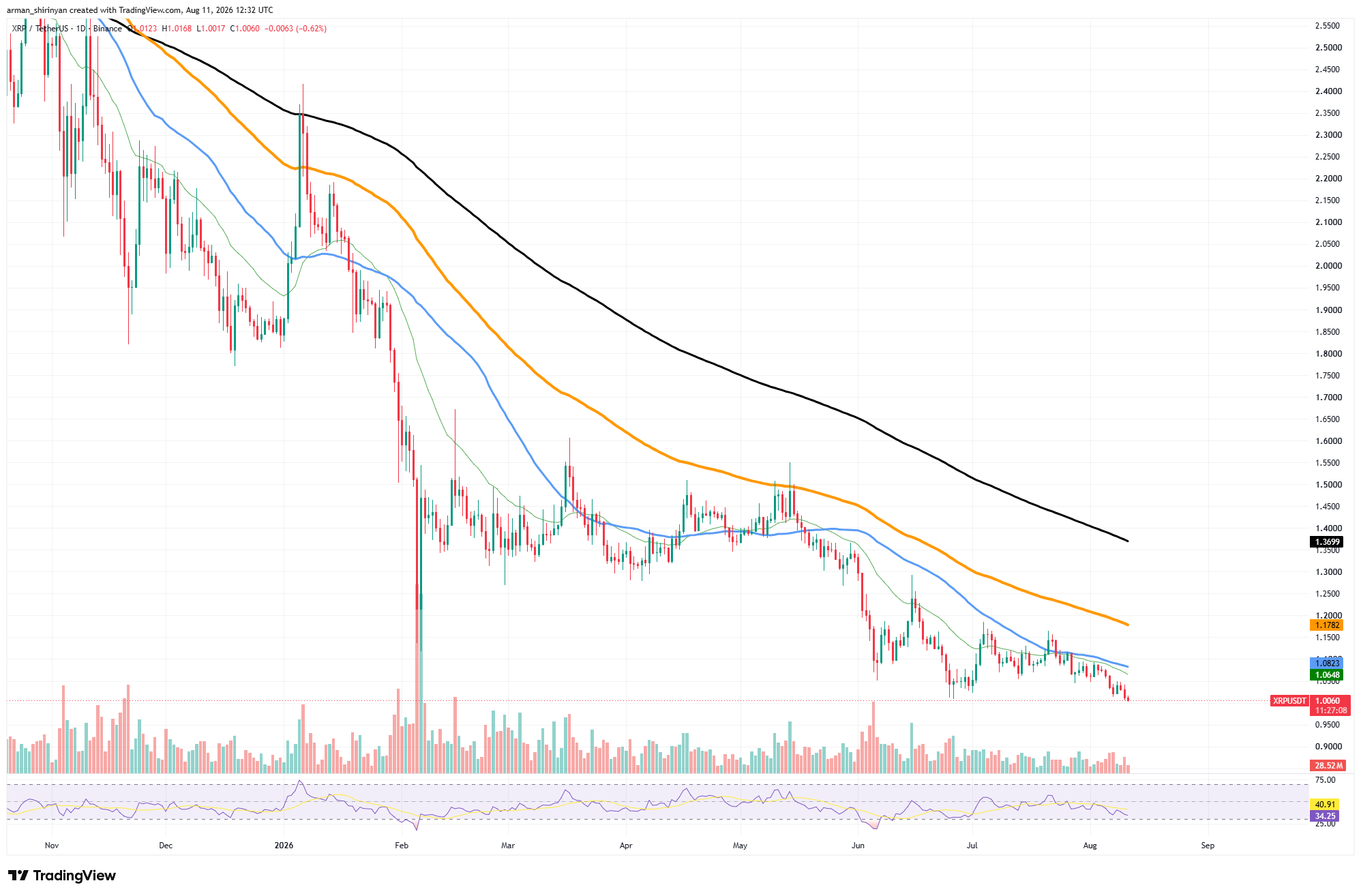
    $XRP‘s price is attempting to stabilize after a sharp move to a high of $1.396 earlier in the week. The appearance of a short-term golden cross remains noteworthy, but the question is whether this is real strength or a fakeout.

    While $XRP saw a sharp price move at the week’s start, the lack of follow-through and weak broader structure, indicating cautious sentiment, caused its price to retreat. The price move could not yield a breakout above the daily MA 50 at $1.38, which has capped $XRP‘s price since late March, indicating that bears are actively guarding this level.

    However, positivity remains as tight range trading near current levels shows buyers are at least attempting to build a support base, which might deter a further downward move.

    Traders are watching $1.29 as the next $XRP support in the short term, resistance at $1.38 (the daily MA 50) for a meaningful breakout and another support at $1.28, below which the breakout would be considered failed.

  • Morgan Stanley Bitcoin ETF Drives 3-Fold Impact as 16,000 Advisors Open Path to Multi-Billion Demand

    Morgan Stanley Bitcoin ETF Drives 3-Fold Impact as 16,000 Advisors Open Path to Multi-Billion Demand

    Bitcoin demand is set to expand rapidly as Morgan Stanley deploys its 16,000 advisors and launches a low-cost ETF, driving institutional inflows and strengthening crypto’s position in mainstream portfolios.

    Key Takeaways:

    • Morgan Stanley’s 16,000 advisors unlock major bitcoin demand, driving powerful new inflows.
    • Morgan Stanley launched a 14 basis point ETF, triggering aggressive fee compression across issuers.
    • Bitcoin gains credibility as Morgan Stanley issues funds, accelerating institutional adoption.

    Morgan Stanley ETF Launch Drives Bitcoin Demand and Fee Compression

    Bitcoin’s institutional evolution is accelerating as product innovation from major brokerages reshapes market structure and investor participation. Global investment bank Morgan Stanley deepened its digital asset strategy on April 10 by launching a bitcoin exchange-traded fund (ETF). The initiative introduces a three-fold market impact that influences pricing, demand generation, and legitimacy across the digital asset ecosystem.

    Ric Edelman, founder of the Digital Assets Council of Financial Professionals, shared his thoughts on social media platform X on April 10: “The new Morgan Stanley crypto ETFs (starting with their first, bitcoin, with ETH and SOL to come) will have a three-fold impact on the market.” He outlined the first impact tied to competitive pricing dynamics, emphasizing that Morgan Stanley’s 14 basis point fee advantage will likely accelerate competitive pressure across issuers. Widely regarded as a leading figure in financial planning, Edelman is the founder of Edelman Financial Engines and a three-time Barron’s top-ranked independent advisor. He stated: “They will attract assets from other crypto ETFs because they are cheaper.”

    The second effect centers on new inflows driven by trust and distribution strength. Morgan Stanley’s extensive advisory network now plays a direct role in crypto allocation strategies. Edelman explained:

    “Because these ETFs come from a trusted name in the financial services industry, they will bring new asset flows to crypto as Morgan Stanley’s 16,000 financial advisors allocate to them.”

    This internal channel enables large-scale onboarding of new investors, broadening total addressable demand rather than simply reallocating existing capital pools.

    Institutional Backing Accelerates Bitcoin Adoption and Market Confidence

    The third impact underscores institutional validation and its influence on investor perception. By issuing its own crypto ETFs, Morgan Stanley signals a deeper commitment than merely listing third-party products. Edelman noted:

    “These new ETFs help legitimize crypto by virtue of having one of the nation’s largest brokerage firms issue their own funds (which is much bigger statement than merely putting others’ funds on their platform).”

    This endorsement reduces skepticism and strengthens bitcoin’s role within diversified portfolios.

    The combined effects establish a reinforcing cycle that could accelerate adoption across the United States. Lower fees attract capital, advisor-driven allocations generate new inflows, and institutional backing enhances credibility. Edelman concluded:

    “The result; broader adoption of crypto by investors nationwide.”

    These dynamics position bitcoin for sustained growth as traditional finance continues integrating digital assets into mainstream investment frameworks, reinforcing its transition from alternative asset to core portfolio allocation.