BUZZ Deploys 2,016 Nvidia GPUs Under HIVE’s $350M AI Contract
HIVE Digital Technologies is deepening its push into artificial intelligence infrastructure, signing a five-year cloud services agreement that will deploy more than 2,000 Nvidia Blackwell Ultra GPUs in Canada.
The contract, secured through wholly owned subsidiary BUZZ High Performance Computing, carries a total value of about $350 million and is expected to contribute roughly $70 million in annualized revenue.
That would lift BUZZ HPC’s total annualized revenue to about $180 million. Roughly $35 million is already active, while another $145 million is contracted and expected to come online through the fourth quarter of 2026. The customer was described as an investment-grade enterprise but was not identified.
Nvidia Cluster Targets Large-Scale AI Workloads
BUZZ HPC will build a dedicated cluster using 2,016 Nvidia Blackwell Ultra GPUs in GB300 NVL72 systems. The deployment will also use Nvidia Quantum-X800 InfiniBand networking and VAST Data storage.
The infrastructure is designed to support large-scale AI training, inference, and other enterprise workloads.
The cluster is expected to begin operating later this year at Bell’s AI Fabric facility in Merritt, British Columbia. The site runs on renewable hydroelectric power and uses closed-loop liquid cooling, eliminating ongoing water consumption for cooling.
HIVE expects total capital expenditure for the deployment to reach about $185 million. The company plans to fund the remaining deployment through previously announced financing and additional equipment debt.
AI Revenue Becomes a Larger Part of HIVE’s Strategy
HIVE will retain ownership of the Nvidia infrastructure after the contract ends, giving it the potential to extend the assets’ revenue-generating life. Once the cluster is fully deployed, HIVE expects its HPC and AI business to generate about $500,000 in daily revenue.
CEO Aydin Kilic said the agreement moves the company closer to its year-end target of $200 million in GPU cloud annualized revenue.
“The five-year term, expected stable cash flows from an investment-grade enterprise customer, and upfront deposit of approximately 10% of total contract value support an attractive economic and return profile,” Kilic said.
Executive Chairman Frank Holmes framed the expansion as part of a broader “dual-engine strategy” spanning both ASIC-based digital infrastructure and GPU-based AI computing.
HIVE says it has about 400 megawatts of capacity in Canada available for Tier III data center development, potentially supporting more than 120,000 GPUs over the next two years.
The deal highlights how crypto infrastructure companies are increasingly monetizing their power and data center expertise through longer-term AI contracts, where revenue visibility can be far greater than in mining alone.
US President Donald Trump said Iran would not make the kind of deal he believes is necessary to prevent it from obtaining a nuclear weapon.
Trump added that Iran “cannot have a nuclear weapon” and argued that rebuilding its nuclear capabilities would take a long time following previous US strikes.
Even with the same prompt, AI models do not always produce the same answer. AskAnyModel makes that difference useful by sending one prompt to as many as six models simultaneously and displaying their responses side by side.
Lifetime access is currently on sale for a one-time $39.99 (MSRP $499).
The AskAnyModel AI Pro Plan includes access to more than 50 models from OpenAI, Anthropic, Google, xAI, DeepSeek, Meta, and Mistral. Users can compare GPT, Claude, Gemini, Grok, and other assistants without opening several accounts or repeatedly copying the same prompt.
Supported standard models include unlimited chats. The plan also provides 500 monthly credits for 19 premium models, plus access to a pro model with its own weekly usage allowance.
The comparison interface displays response times and token counts next to each answer. This is useful for checking research, testing code explanations, evaluating writing styles, or finding the most practical solution to a business problem.
AskAnyModel also supports unlimited image generation across compatible models without deducting premium credits.
Prices subject to change. PCMag editors select and review products independently. If you buy through StackSocial affiliate links, we may earn commissions, which help support our testing.
About Our Expert
StackCommerce Team (Sponsored)
Experience
Products featured in these stories are selected by our partners at StackCommerce. If you buy something through links on our site, PCMag may earn an affiliate commission.
[This story contains major spoilers for Lanterns’ “Pilot.”]
The flash-forward that closes the Lanterns series premiere was bound to strike a familiar chord with Kyle Chandler completists. It’s reminiscent of another recent high-profile series in which one of his characters meets a prematurely shocking end. Chandler himself may have momentarily wondered whether he was being offered another Mayor of Kingstown-type opportunity. But showrunner Chris Mundy, together with co-creators Damon Lindelof and Tom King, quickly reassured him that this particular twist would more closely resemble the storytelling of Bloodline, the earlier series Mundy and Chandler had worked on together.
The pilot — directed by James Hawes and co-written by Mundy, Lindelof, and King — establishes the DC/HBO series’ multi-timeline structure. It introduces childhood flashbacks, a primary timeline set in 2016 and a future 2026 timeline, one where Aaron Pierre’s John Stewart and Rushville, Nebraska sheriff Kerry Kane (Kelly Macdonald) investigate the murder of Chandler’s Green Lantern, Hal Jordan, on the same high-school football field where the three of them had worked another murder case a decade earlier. Like Bloodline’s own inciting murder, this series will gradually catch the audience up to speed as to how the ring-powered space cop wound up catching a bullet.
For Chandler, the bigger challenge was block-shooting a nonlinear series without having all the scripts available at first. If you’re unfamiliar with shooting in blocks, it’s basically when a production films multiple episodes at the same time in order to shoot out a location.
“The full storyline wasn’t in front of us; it was described to us. [Block-shooting] required a lot of faith and trust in the storyline,” Chandler tells The Hollywood Reporter. “As far as the way they started it out [with Hal’s death], I thought it was a clever way of doing it and making it a non-linear story. I like the way it came out. It gave us a chance to set up our own traps and to go against the material sometimes to reveal more, or less, later. So it’s like 3D chess.”
Pierre, who’s already reprised the role of his aspiring Green Lantern in DCU architect James Gunn’s upcoming Man of Tomorrow, advanced through 2024’s audition process as his performance in Jeremy Saulnier’s Rebel Ridge was earning rave reviews. Yet unlike his fearless Green Lantern trainee, he still felt considerable apprehension just as his career was taking flight.
“I immediately recognized the enormity of the opportunity and the gift that it is to engage with, first and foremost, this character and this world. And being the first live-action [John Stewart] is also something that I recognize the magnitude of,” Pierre says. “So it was very nerve-wracking, but I have a history and a habit of intentionally seeking out things that unnerve me.”
Having never worked in the comic-book genre before, Chandler was surprised to find himself cast as a superhero at 60. So he soon became aware of the pressure to satisfy an already passionate fanbase with sky-high expectations.
“Before I went to [San Diego] Comic-Con, a lot of people were saying, ‘Well, what are the true aficionados going to think of your presentation? You better do a good job.’ Luckily, I don’t pay attention to any of that. I don’t go on any of these web sites and read any of that stuff, so they can call me what they want and I won’t know,” Chandler shares. “But there was a little [concern of], How am I going to do this to please people? Then I finally realized, I can’t please anyone, so I have to do it myself. That gave me the freedom to be myself, and that gave me the freedom to make it as raw as I wanted it to be. Damn the torpedoes, let’s see what happens.”
It’s a particularly strange time for the superhero industrial complex’s endeavors on TV and streaming platforms. One day, an acclaimed, Emmy-nominated series can be renewed, and the next day, it can be inexplicably un-renewed. At this current juncture, Mundy and Halt and Catch Fire co-creator Christopher Cantwell are provisionally breaking story in the season two writers room, but neither Chandler nor Pierre are getting ahead of themselves until they officially get the green light from the studio/network.
“Whatever happens will happen. Whatever is meant to be will be,” Pierre says. “Of course, we would love to go again and again. We love this show. All of us poured so much into this that, whatever happens, we are at peace with it because we are just all so very proud of it.”
Below, during a conversation with THR, Pierre also discusses how he balanced the contrast between John’s calm external presentation and his inner turmoil from childhood.
***
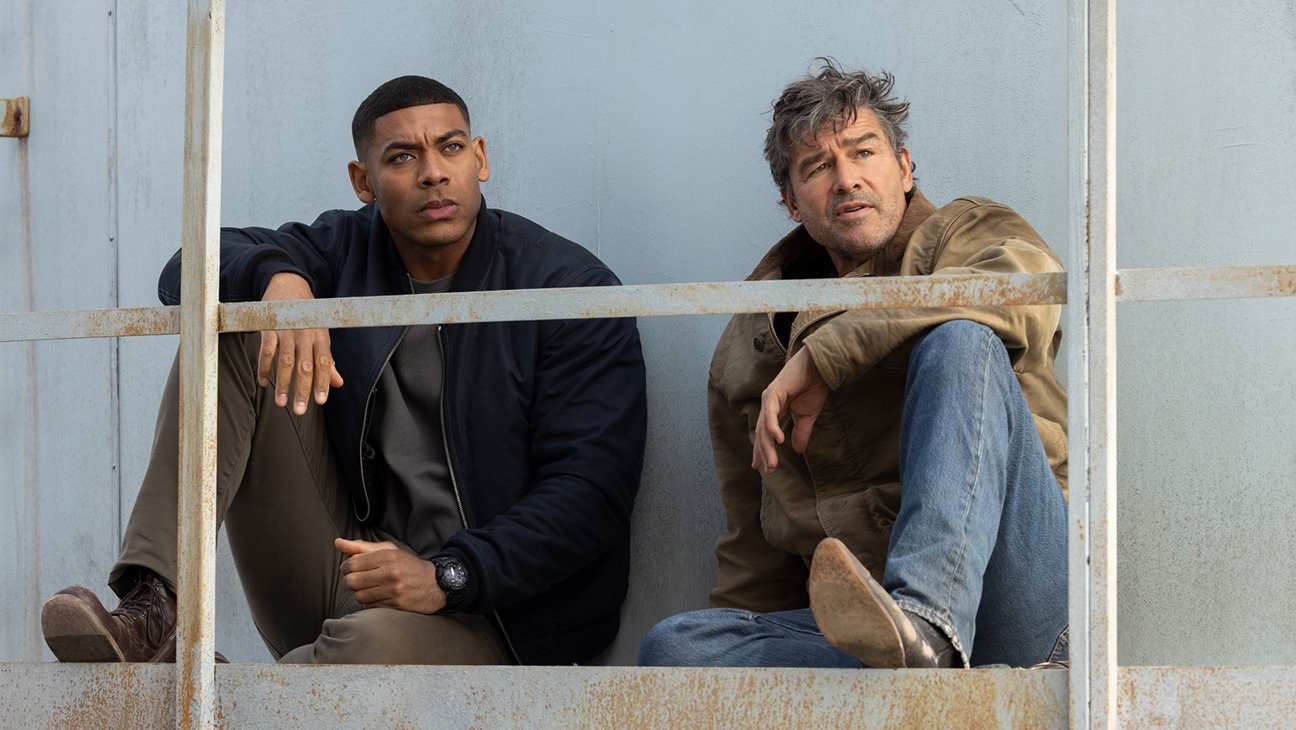
Aaron Pierre’s John Stewart and Kyle Chandler’s Hal Jordan in Lanterns
Courtesy of HBO
Aaron and Kyle, Kyle and Aaron …
AARON PIERRE You were right the first time.
(Pierre and Kyle Chandler laugh. They’d already been ribbing each other prior to the start of this interview.)
KYLE CHANDLER (Joking about Pierre’s physical advantage over him.) This guy is actually sitting on two phonebooks right now. That’s how little he is. He’s nervous for this interview.
PIERRE (Laughing and pointing to his upper body.) I’ve also got padding in here.
Kyle, I’ve been watching you since the days when a cat delivered your newspaper a day early on Early Edition, and that ordinary guy with a head start on tomorrow’s news was probably the closest you’ve come to playing a superhero. But is it safe to say that you never expected a bona fide superhero like Hal Jordan to come your way?
CHANDLER It’s very safe to assume that, yeah. It’s safe to assume that I didn’t expect a script to come — and the likes of James Gunn and these guys [co-creators Chris Mundy, Tom King, Damon Lindelof] to ask if I wanted to be the Green Lantern. I was like, “Oh, I’m interested to read this.” And when I got done reading it, I realized, It is the Green Lantern, but it’s so much more. The script was so rich with opportunities to do so much more, and I saw that immediately.
The writers based Hal on Chuck Yeager, including Sam Shepard’s Chuck Yeager in The Right Stuff. Sam happened to play your father on Bloodline, so did that aspect tip the scales for you at all?
CHANDLER That wasn’t a consideration. The one thing that was a consideration was that I only now understand the intensity of these comic book universes: DC, Marvel and all the others. I went to my first Comic-Con recently, and I realize it now. Before I went to [San Diego] Comic-Con, a lot of people were saying, “Well, what are the true aficionados going to think of your presentation? You better do a good job.” Luckily, I don’t pay attention to any of that. I don’t have any social media. I don’t go on any of these web sites and read any of that stuff, so they can call me what they want and I won’t know. But there was a little [concern of], How am I going to do this to please people? Then I finally realized, I can’t please anyone, so I have to do it myself. That gave me the freedom to be myself, and that gave me the freedom to make it as raw as I wanted it to be. Damn the torpedoes, let’s see what happens. So it was a really enjoyable process.
Aaron Pierre’s John Stewart and Kyle Chandler’s Hal Jordan in Lanterns
Courtesy of HBO
Aaron, Lanterns have to be fearless in order to get the job, but actors tell me all the time that the roles they want most are the ones that scare them. So what frightened you the most about this particular part?
PIERRE The enormity of it. I immediately recognized the enormity of the opportunity and the gift that it is to engage with, first and foremost, this character and this world. And being the first live-action [John Stewart] is also something that I recognize the magnitude of. So it was very nerve-wracking going into the audition process and the final callback, et cetera. But I have a history and a habit of intentionally seeking out things that unnerve me, especially as it relates to my career. I just got done doing One Flew Over the Cuckoo’s Nest on the main stage at the Old Vic in London, and that terrified me. [Writer’s Note: Pierre played McMurphy.]
CHANDLER (Laughs.) When you told me that, I was like, “Are you crazy?”
PIERRE (Laughs.) You were terrified on my behalf. That’s the same stage that heroes of mine have been on — James Earl Jones and Vanessa Redgrave. So I just have a tendency to go toward that because that’s where evolution and growth are. So Kyle and I share that sentiment with a lot of the work that we choose to do.
I never thought applesauce could be a source of trauma, but here we are.
PIERRE (Laughs.)
I’m honestly amazed by John’s composure considering his uniquely abusive childhood. How did you approach the psychology of someone who’s so composed despite going through all of that?
PIERRE Oh brother, I love that question. That is such a great question. I really worked extensively on that particular element of John’s character. The question I would ask myself is: How do you make an interesting portrayal of somebody who is seemingly as cool as an ocean breeze, but internally, there is a tornado going on? And that’s something that I wrestled with throughout the process. I actually think the process of wrestling with it leaked into the character, and it’s what we get to see on the screen. It was so enjoyable. I love the opportunity and the gift to portray complex characters, as all of us are. When we have a lot of things going on, how do we manage and navigate that? So it was a joy and a privilege to portray John.
Kyle, at the end of the pilot, I was briefly worried that you’d been Mayor of Kingstown’d again, but then I realized you’d actually been Danny Rayburn’d (Bloodline). The established multi-timeline will explore how Hal ended up on those bleachers in 2026. When you first learned of Hal’s death at the end of the series premiere, how did that first conversation go considering you recently died in another pilot?
CHANDLER I asked the same question when I read the script. We block-shot this [season], and the scripts didn’t all come out until we had already started shooting. So the full storyline wasn’t in front of us; it was described to us. That made it difficult to block-shoot eight episodes of which you don’t have all eight episodes [in script form]. It required a lot of faith and trust in the storyline. As far as the way they started it out, I thought it was a clever way of doing it and making it a non-linear story. The way they stacked the cards at the end, it gave the editors a heyday to create new storylines or break storylines down or what have you. So, creatively, I think it was, for them, a joy. And yeah, I like the way it came out. It gave us a chance to set up our own traps and to go against the material sometimes to reveal more, or less, later. So it’s like 3D chess.
[Writer’s Note: I also asked Lanterns showrunner Chris Mundy about whether Kyle voiced any initial concern until he heard the grand plan.]
CHRIS MUNDY Kyle never mentioned [Mayor of Kingstown] or any concern. It was baked into what we were doing from the beginning, and it was just always part of what we were going to be doing. And Kyle knew. There’s a real freedom in that because we were all on the same page.
Aaron Pierre’s John Stewart and Kyle Chandler’s Hal Jordan in Lanterns
John P. Johnson/HBO
The writing of season two is already underway in the event of renewal. Are you guys feeling optimistic?
CHANDLER I am very optimistic. I gave them my first two versions of scripts one and two, along with a packet of cash.
PIERRE (Laughs.) Honestly, this was such a joy from beginning to end. Kyle and I speak often about the fact that maybe 15 percent of this season, maybe even less, was shot on the WB lot. The other 85 or 90 percent of it was shot on location, so we became a real traveling company. We became such a unit and such a team. Whatever happens will happen. Whatever is meant to be will be. Of course, we would love to go again and again. We love this show. All of us poured so much into this that, whatever happens, we are at peace with it because we are just all so very proud of it. The whole team, such as Jeff [Ferrero] in lighting, got so close. It’s a real family, and it was a real family effort. Kyle and I, along with a number of other amazing artists, are front-facing in regards to this project. But there is a town behind us, and we wouldn’t have been able to achieve this without them, not even close.
CHANDLER What he says is so true.
*** Lanterns is now airing new episodes on HBO/HBO Max every Sunday until Oct 4.
Taylor Lally is a blue-eyed, burly, bespectacled man, with a beard about halfway to the the full Duck Dynasty look. And just past midnight on a Monday evening this summer, he’s hawking candy bars inside a purple-painted room no bigger than 300 square feet, with a disco ball hanging from the ceiling.
It’s not exactly Willy Wonka and the Chocolate Factory. The thirty-something is an online auction maestro, broadcasting to a few dozen people competing to buy confections with the swipe of a finger. Mini auctions like this one on WhatNot, the liveshopping app, will help Lally cross one million dollars in sales this year, he said.
“We’re live for about four hours, but we’re here prepping for maybe four hours before and maybe two to four hours after,” he tells THR. “So we’re putting in like 12- to 16-hour days.”
Lally began selling sweets on WhatNot last year, offering customers $20 boxes where they could pick individual candy items to buy. He nearly shut down the account because it didn’t yield enough money to justify the time he spent on the platform. But around six months ago, another WhatNot seller reached out with advice: try ultra-fast, single-item auctions. “This kind of totally changed how we do business,” he says.
WhatNot and other live shopping retailers are shedding their reputations as purveyors of baseball cards by expanding their digital aisles, benefitting niche auction-fluencers like Lally. In July, WhatNot — which continues to add new verticals like food and golf — raised hundreds of millions of dollars at a $20 billion valuation. Despite WhatNot’s first-mover advantage, a formidable rival has emerged in TikTok Shop, which allows sellers to go live and reach the app’s 100 million-plus user base.
Ashley Christenson, a livestreaming consultant, says Gen Zers are increasingly using TikTok to search for products, making it an attractive selling channel for retailers and a lucrative business for the social media giant. “The fact that now they can do that as a live experience is a natural evolution that makes a ton of sense for TikTok,” she says.
The evolution of live shopping from infomercial-like marathons to fast-paced micro sales has sparked bidding wars, so to speak, over popular auction-fluencers. TikTok representatives reached out to Lally and met with the creator multiple times, hoping to woo him to their WhatNot competitor. Joining another platform is something Lally will entertain because of WhatNot’s fee structure. “A big deal about WhatNot, which we can’t really get around, is a thirty-cent transaction fee, regardless of what we sell,” Lally says. “So it’s just negotiating those terms with TikTok.”
WhatNot’s bidding process — seconds-long auctions with more time added if customers bid — is now standard across other platforms like TikTok Shop. Many sellers start their auctions at $1 as a way to hook prospective bidders. “If you start something that’s $1 but it’s actually worth $50, people aren’t asking themselves, ‘Should I buy it?’ They’re asking themselves, ‘What am I willing to spend on it?’” said Kip Roland, a liveshopping seller and advisor.
Josh Luber, a co-founder of the online sneaker seller StockX, believes more retailers are poised to spin up live commerce platforms. But one company, he said, has a massive edge. “Ultimately, all marketplaces live and die on liquidity, and TikTok is going to have the most liquidity from day one,” he said. “It’s a question of can they convert them over to be consumers.”
TikTok’s massive audience helped Roland reach 40,000 viewers when he decided to sell World Cup jerseys in June. Even though his account has only a smidge more than 13,000 followers, the social media behemoth boosted the auction to other TikTokers. “The algorithm recognized that people were staying for a long time, they were converting to buyers, they were engaging, and so it just pushed it to more and more and more people,” he says.
For buyers, live shopping is more conducive to impulse buys — a Blu-Ray DVD or Pokémon trading card — than with more thoughtful purchases. But that doesn’t mean every livestream involves low-ticket items. On Super Bowl Sunday, Jimmy Donaldson, a.k.a. Mr. Beast, went live on WhatNot as part of a partnership with the company and gave away items like a Birkin bag and a Lamborghini. “Anytime Jimmy’s paying attention and testing something, it’s worth looking at,” says Christenson.
Many live shopping creators prefer to narrate auctions behind the camera as opposed to becoming on-air hosts like Mr. Beast. But in a recent survey commissioned by Adobe, 30 percent of live shoppers said their purchasing decisions were driven in part by the identity of the host. Lally is doubling down on adding human faces to the mix by hiring another host for his account to fill more hours of the day. And earlier this year, eBay built a service for camera-shy sellers to hire livestream hosts.
Despite big growth, it’s still early days for live shopping in the United States. WhatNot says it sold $8 billion worth of goods in 2025, but total e-commerce sales in America topped $1.3 trillion, according to data from the U.S. Census Bureau. Meanwhile, Chinese buyers spend hundreds of billions of dollars annually on live shopping.
As more buyers embrace live shopping, Christenson expects more creators to market goods as a way to make additional income. Their social media skills often make them natural salespeople. “They can talk to a chat, and entertain, and make people feel something,” she says. “Whether they’ve got five viewers or 500, they have the potential to sell something while live.”
Minnesota is fighting xAI’s attempt to block the state’s first-of-its-kind law targeting AI-generated sexual images.
xAI says the law violates the First Amendment, while Minnesota argues Grok Imagine is a technological tool, not protected speech.
The state accused xAI of creating an “unparalleled marketplace for digital sexual violence” as a federal judge prepares to hear the case Wednesday.
Minnesota is fighting Elon Musk’s xAI over the company’s attempt to block HF-1606, a first-of-its-kind state law targeting AI tools that generate realistic sexual images of identifiable people.
In a Friday court filing, Minnesota Attorney General Keith Ellison argued that xAI is unlikely to succeed in its constitutional challenge and has failed to show that enforcing the law would cause irreparable harm.
“With Grok Imagine, X.AI has created an unparalleled marketplace for digital sexual violence that poses virtually no barrier to entry,” Ellison wrote. “That marketplace, coupled with the functional capabilities of Grok Imagine, would doom Minnesota from the start if it could not direct its laws to the technology that makes digital sexual victimization possible in the first place.”
The law, enacted in April and which took effect August 1, prohibits platforms and software developers from allowing users to create realistic images showing intimate body parts that did not appear in the original image of an identifiable person.
Ahead of the implementation of the law, in July, xAI sued Ellison to block the law, arguing it violates the First Amendment and could apply to protected images, including shirtless men, swimmers, and political satire. Violations carry penalties of up to $500,000 per image.
“There is no safe harbor for good-faith efforts of the provider of general-purpose AI creative tools to avoid harms,” xAI wrote in its complaint. “Liability attaches even if the depicted persons consented—or created the image themselves—and even if the image is never shared.”
Minnesota passed the measure 132-1 in the House and 65-0 in the Senate after lawmakers heard reports of a man who used social media photos to create sexual images of more than 80 women he knew.
“Today, we led the nation protecting women, children and everyone in public life from the harm caused by AI nudification technology,” Senator Maye Quade, who led the push, said in a statement at the time. “Companies that make this technology available for free online and in app stores will no longer be allowed to enable predators who abuse and victimize adults and children with the click of a button.
The case now centers on whether the law regulates speech or technology.
Grok has also faced scrutiny over sexually explicit deepfakes.
In January, a watchdog estimated Grok generated more than 23,000 sexualized images of children over 11 days, prompting investigations in several countries.
In March, three minors in California joined others in suing xAI, alleging Grok was used to turn their photos into AI-generated child sexual abuse material. xAI has said it suspended more than 50,000 accounts and filed more than 70,000 reports with the National Center for Missing and Exploited Children in 2026.
Daily Debrief Newsletter
Start every day with the top news stories right now, plus original features, a podcast, videos and more.
The California attorney general’s office fired back against Paramount’s request for a $1.88 billion bond on Monday, saying the company is seeking a “do-over” on its agreement to delay the Warner Bros. merger until an antitrust trial next March.
In a statement, the A.G.’s office argued that Paramount is a “sophisticated” company that knew it would face regulatory review when it agreed to pay Warner Bros. shareholders a $7 million-per-day ticking fee, and that California should not be made to bear the burden of that decision.
“Bottom line: Paramount went into this process with eyes wide open,” the office said. “They are lying in a bed of their own making, and once again, trying to blackmail us to get us to back down.”
California Attorney General Rob Bonta is leading a 12-state coalition to block the merger on the grounds that it will reduce competition in the theatrical and basic cable markets. Last month, Paramount agreed to hold off on closing the deal until after the case is resolved at trial, or until next June, whichever comes first.
But Paramount was hoping for an earlier trial date — ideally in November. In a motion filed on Monday, the company argued that it will be forced to pay $1.7 billion in ticking fees to Warner Bros. shareholders if the case drags out until June 1, plus another $190 million in financing costs.
Paramount argues that the states and the Writers Guild of America — which has filed its own antitrust suit — should be required to post a bond to cover its losses arising from the delay in the event that the deal is ultimately approved.
Judge Araceli Martinez-Olguin initially granted a 14-day restraining order to block the merger in July. In that order, she waived the requirement to post a bond, saying the states had shown they were acting in pursuit of “important public interests.”
The states, the WGA and Paramount later entered a stipulation to delay the merger — the functional equivalent of a preliminary injunction — which did not include any bond requirement. Now that Martinez-Olguin has set the trial for March 2, Paramount is seeking to amend the agreement to include the $1.88 billion bond. Failing that, Paramount wants to dissolve the deal and allow the merger to close.
“Paramount and Warner Bros. are two sophisticated companies who willfully decided to include a costly ticking fee as a provision in their merger contract. They knew this merger would undergo regulatory review; they knew it was not a done deal; and they chose to include it anyway,” the A.G.’s office said Monday. “What’s more, Paramount itself stipulated to the timing it is now protesting — they agreed to the dates and did not request a bond as a condition of agreeing not to close until after the trial, and potentially as late as June 2027. Now, they’re trying to get a do-over.”
In a statement on Monday, Paramount argued that the 12 states are defying a global consensus that the deal presents no issues of competitive harm and should be approved.
“We remain confident that plaintiffs’ case is without merit and will defend our pro-competitive transaction in court,” the company said.
President Donald Trump grew angry at CNN‘s Kristen Holmes during a press briefing at the White House Monday, after she asked whether he had spoken with North Korean dictator Kim Jong-un.
“Quiet,” Trump told Holmes, CNN’s senior White House correspondent, after she queried the president about if Jong-un had asked Trump to curtail U.S. military exercises with South Korea. “You’re a loud, boisterous person. You’re faking news!”
In a social media post Sunday, Trump had said that “Based on my very good relationship with Kim Jong Un, of North Korea, I am not happy with the fact that the United States has, long ago, agreed to participate in Joint Military Exercises with South Korea” and that he would instruct Defense Secretary Pete Hegseth to “substantially reduce the Joint Military Exercises!”
Holmes tried to follow up on her question to the president, saying, “I was trying to find out if you had been talking to Kim Jong-un, if he had asked you to scale back on those military exercises.” Trump, talking over her, said: “Be quiet! Be quiet! Be quiet! You’re a fake reporter and you report fake news.”
Meanwhile, the White House lashed out at Holmes because during the same event, she asked Trump for his response to a remark by Georgia Sen. Jon Ossoff about one of Trump’s aides. Earlier in the day at a campaign rally, Ossoff said that Trump “doesn’t want to do the job. He wants to build his ballroom and travel with Natalie on their apparently defenseless flying palace gifted by the Emir of Qatar,” referring to Natalie Harp, the president’s executive assistant. Harp was among the small group of Trump officials who (along with the president) were secretly escorted off the Qatar-donated Air Force One to a smaller military aircraft in Turkey because of a threat from Iran.
Following the exchange in the Oval Office, the White House’s Rapid Response 47 account on X wrote, “.@KristenhCNN is a disgraceful, humiliating embarrassment to her alleged profession. @POTUS hosts a hero lifeguard in the Oval Office and she uses it as an opportunity to take a cheap shot about one of President Trump’s staffers. These scumbags are the lowest of the low.” The press event Monday at the White House was meant to honor teenage lifeguard Ryder Williams, who rescued a 10-year-old boy at a beach in Santa Cruz, California, last month.
The White House comms team followed that up with this comment: “.@KristenhCNN: Someday, your children will come across your disgusting and inhumane question. They will be sickened and embarrassed to have a parent be so callous and vindictive. It’s quite troubling.”
In a statement responding to the White House attacks, CNN said, “Kristen Holmes is one of the most respected and accomplished journalists covering the White House. This afternoon, she did her job and asked the President of the United States a tough, relevant, and newsworthy question on behalf of the American people. Public officials are free to challenge reporting they disagree with, but personal attacks on journalists for asking questions are beneath the office and inconsistent with the principles of a free press. We stand firmly behind Kristen and reject these attacks in the strongest possible terms.”
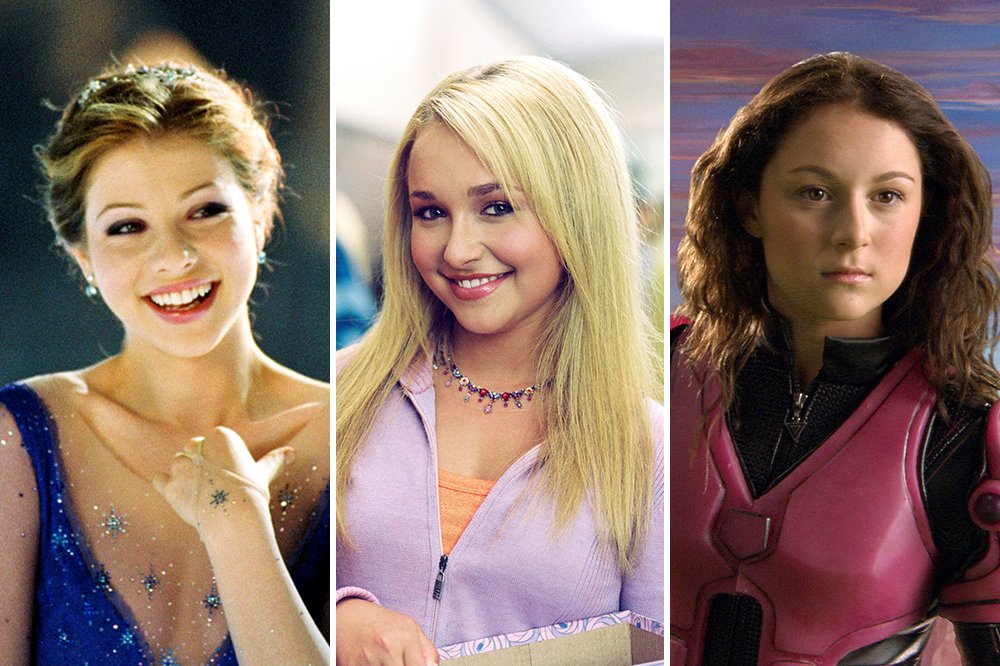
Alexa PenaVega’s “heart is heavy” after the death of Hayden Panettiere, most notably because it marks the third passing of a fellow child star in 2026. The “Spy Kids” actor noted in a statement on social media that she rose to fame with and grew up alongside the likes of Panettiere, Michelle Trachtenberg and Daveigh Chase. All three actors died in their 30s between February and August.
“Hayden, Michelle, Daveigh… my heart is heavy today,” PenaVega wrote. “These aren’t just names from my childhood. They’re girls I grew up alongside, sharing a world that was exciting and also incredibly hard. We were kids navigating something so big, and not everyone had the foundation or support they deserved.”
“Today, I’m grieving and holding their families close in my prayers and thinking of everyone still fighting battles we can’t see,” she added. “Hug your people close today.”
PenaVega, Panettiere, Trachtenberg and Chase all came of age together in Hollywood in the 2000s. PenaVega’s breakout turn in 2001’s “Spy Kids” made her a regular at Hollywood premieres, where she was often photographed with her fellow child-turned-teen stars. Chase and PenaVega walked part of Disney’s “Freaky Friday” red carpet together in 2003 (one year after Chase voiced Lilo in the studio’s animated movie “Lilo & Stitch”), while PenaVega attended the premiere of Panettiere’s “Raising Helen” in 2004, among several other Hollywood encounters.
Panettiere died on Sunday in Greenville, South Carolina, at the age of 36. Her death is currently under investigation, but there were “not any signs of foul play or suspicious circumstances,” according to police. She was beloved for the television series “Heroes” and “Nasvhille,” but she broke out as a Disney child star in “A Bug’s Life” and “Remember the Titans,” among other hit roles.
Also beginning work as a child actor, Trachtenberg appeared in the ’90s Nickelodeon series “The Adventures of Pete & Pete” before starring in the family film “Harriet the Spy” in 1996 at the age of 10. As a teenager, she featured as Dawn Summers in “Buffy the Vampire Slayer” and later played Georgina Sparks on the teen drama “Gossip Girl.” Trachtenberg died in February at 39 years old due to natural causes, as a result of complications from diabetes mellitus.
Chase, who voiced Lilo in “Lilo & Stitch” and starred in “The Ring,” died June 16 in Los Angeles at 35. The actor’s cause of death was AIDS, according to the coroner’s office. A secondary cause was listed as “chronic polysubstance use.” Chase’s father, John David Schwallier, told the New York Times that she had been homeless and had struggled with drugs since the age of 13.
Crypto analyst Michaël van de Poppe, evaluating the recent technical outlook for Ethereum ($ETH), stated that the bullish scenario is becoming increasingly stronger. According to the analyst, the high lows and high highs formed on $ETH’s daily chart highlight the possibility of an upward breakout.
Van de Poppe noted that Ethereum’s daily chart “is starting to look better day by day,” and highlighted the $1,870 and $2,000 levels in the current market structure.
According to the analyst, if $ETH loses the $1,870 level, the decline could be quite rapid due to the high liquidity zones below the price. In such a scenario, it is possible for $ETH to fall below $1,700 and then recover.
However, Van de Poppe believes that the current technical structure supports an upward movement rather than a downward one. Noting the continued formation of higher lows and higher highs in the Ethereum price, the analyst therefore sees a higher probability of an upward breakout.
$2,000 is a Critical Threshold for Ethereum
According to Van de Poppe, if Ethereum clearly surpasses the $2,000 level, the upward movement could become quite sharp. The analyst stated that after such a breakout, he doesn’t expect $ETH to linger at significant resistance levels for long, and a surge similar to some of the rapid price movements seen in 2025 could occur.
Van de Poppe noted that $ETH might encounter short-term resistance around $2,200 during its rise, adding that this could be an intermediate level within a larger move.
The analyst’s main upside target is the $2,800 level. Accordingly, a strong break above $2,000 could bring Ethereum’s price first to the $2,200 level and then to the $2,800 region.
On the other hand, the $1,870 level stands out as a critical support in a downward scenario. Van de Poppe warns investors that if this level is lost, a rapid liquidity movement towards below $1,700 could occur.