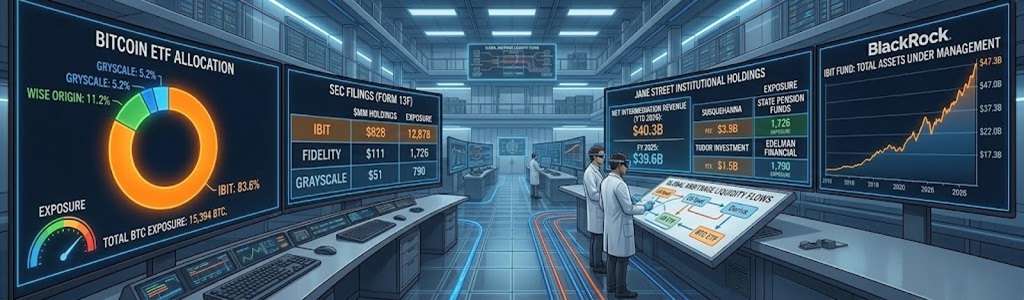
Jane Street reported $990 million in Bitcoin exchange-traded funds in its Q2 2026 Form 13F filing with the SEC.
The allocation is equivalent to 15,394 $BTC, concentrating $828 million in BlackRock’s iShares Bitcoin Trust (IBIT) ETF.
The company recorded over $40 billion in net trading revenue so far in 2026.
Quantitative trading firm Jane Street reveals a nearly $1 billion position in Bitcoin ETFs, reaching an institutional holding equivalent to 15,394 $BTC during the second quarter of 2026.
According to the regulatory filing submitted to the U.S. Securities and Exchange Commission (SEC), the firm accumulated $990 million distributed across major spot investment vehicles. Official documentation details that the majority of the capital went into the iShares Bitcoin Trust (IBIT) fund, managed by BlackRock, with an allocated sum of $828 million. The remainder of the position was structured through holdings in instruments such as Fidelity’s Wise Origin Bitcoin Fund and Grayscale’s Bitcoin Trust.
The entity does not custody the cryptocurrencies directly in digital wallets. Its exposure operates strictly through shares of regulated exchange-traded vehicles listed on U.S. markets.
Portfolio Structure and Institutional Financial Balance
The data disclosed in Form 13F coincides with a period of high activity for the market maker. Financial reports from Bloomberg indicate that Jane Street generated over $40 billion in net trading revenue so far in 2026, surpassing the $39.6 billion achieved throughout the entire 2025 fiscal year.
Despite the overall volume, the company faced approximate losses of $15 billion during July 2026. This monthly setback stemmed from adjustments in Asian equity positions and its exposure to funds linked to artificial intelligence infrastructure.
Industry analysts point out that high-frequency trading firms use these instruments to execute liquidity arbitrage between the spot market and derivatives contracts. Data from the Fintel platform shows that other institutional participants, including Susquehanna International Group, maintain parallel stakes in cryptocurrency exchange-traded funds.
BlackRock’s IBIT fund exceeded $47.3 billion in assets under management by mid-August 2026. According to SEC records, state pension managers and investment firms such as Tudor Investment Corporation and Edelman Financial also reported exposure to these financial derivatives in their recent quarterly filings.
The next Form 13F filing window with the SEC closes in mid-November 2026, when institutional holdings for the third quarter of the year will be updated.
The Monad Foundation recently offered to purchase locked-up $MON tokens directly from early investors at a discounted price, but the majority of those eligible chose not to sell. According to the foundation, the total purchase size amounted to $60 million, and the $MON it acquired remains subject to the original four-year lockup period.
Program Details and Rationale
The program was designed to provide early investors with an exit opportunity if they needed to recover funds or had shifted their investment strategy. The foundation emphasized that it has never sold $MON, nor has it proposed or pursued any sales through over-the-counter trades. It also confirmed that it is not currently engaged in any related process.
This move comes amid broader market conditions where token lockups and vesting schedules are under increased scrutiny from regulators and investors alike. By offering to buy back tokens at a discount, the foundation aimed to reduce potential selling pressure while giving early backers flexibility.
Implications for the $MON Ecosystem
The fact that most early investors declined the offer suggests a strong conviction in the project’s long-term prospects. It also signals that the existing lockup structure remains intact, which could be viewed positively by the market as it prevents sudden token dumps.
Why This Matters
For current and potential $MON holders, this development provides insight into the foundation’s financial management and its relationship with early backers. It also highlights the ongoing challenges projects face in balancing investor liquidity with token price stability.
Conclusion
The Monad Foundation’s buyback offer, though largely declined, underscores its commitment to supporting early investors while maintaining strict lockup discipline. As the project continues to develop, the market will be watching how these dynamics evolve.
FAQs
Q1: Why did the Monad Foundation offer to buy locked-up $MON? The foundation offered to buy locked-up $MON to give early investors an option to sell if they needed liquidity or had changed their investment strategy, while ensuring the tokens remain under the same lockup terms.
Q2: What happens to the $MON the foundation acquired? The $MON acquired by the foundation remains subject to the original four-year lockup period, meaning it cannot be sold or traded until the lockup expires.
Q3: Has the Monad Foundation ever sold $MON? According to the foundation, it has never sold $MON, nor has it proposed or pursued sales through over-the-counter trades, and it is not currently engaged in any such process.
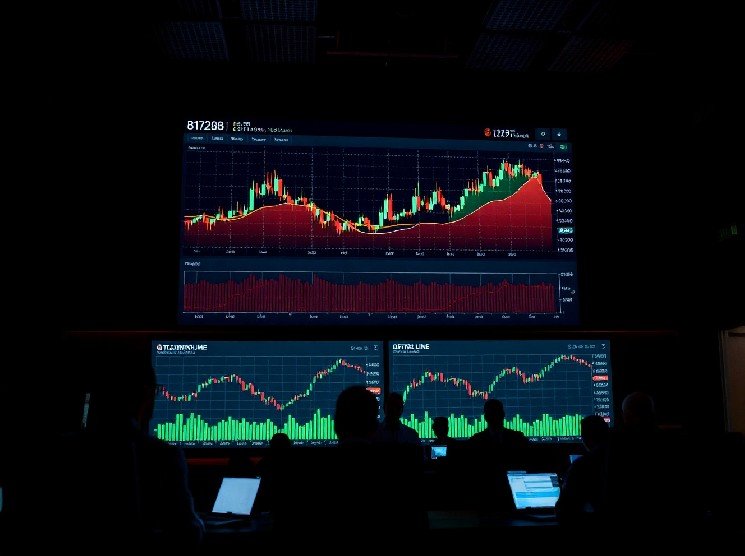
On Aug. 18 at 9:00 a.m., the Bitcoin spot market displayed notable order flow activity, as captured by the cumulative volume delta (CVD) chart for the BTC/USDT trading pair. The chart, which tracks the balance between aggressive buying and selling, offers traders a granular view of market pressure at specific price levels.
Understanding the Spot CVD Chart
The spot CVD chart is a tool used by traders to analyze order book dynamics. It consists of two primary components: the volume heatmap in the upper panel and the cumulative volume delta in the lower panel.
The volume heatmap visualizes trading volume at each price level, with brighter colors indicating areas where the price lingered or moved sharply. These zones often act as support or resistance levels, as they represent clusters of historical activity where traders have previously shown interest.
The lower panel’s CVD indicator reflects the net volume of buy and sell orders, segmented by order size. The yellow line tracks orders between $100 and $1,000, while the brown line represents large orders between $1 million and $10 million. When these lines rise, it indicates increasing buying pressure; when they fall, selling pressure dominates.
What the Aug. 18 Data Shows
At the 9:00 a.m. snapshot, the CVD lines for both retail-sized and large orders were moving in tandem, suggesting a broad alignment in market sentiment. The volume heatmap indicated a concentration of activity around the $29,500–$29,800 range, which could serve as a pivot area for the session.
Large-order flow, often associated with institutional activity, showed a slight uptick, hinting at possible accumulation. However, the overall CVD remained below its recent highs, indicating that sellers have not been fully overwhelmed.
Implications for Traders
For traders, the CVD chart provides a real-time read on whether buyers or sellers are in control. The current data suggests a cautious market, with no clear directional bias. The identified support/resistance zones from the heatmap can be used to set stop-loss or take-profit levels.
It’s important to note that CVD is a lagging indicator, and sudden news events can quickly alter the order flow. Traders should combine this analysis with other technical tools and fundamental news for a comprehensive view.
Conclusion
The Bitcoin spot CVD chart for Aug. 18 at 9:00 a.m. reflects a market in equilibrium, with neither buyers nor sellers dominating. The volume heatmap highlights key price levels to watch, while the CVD lines offer insight into the behavior of different order sizes. As always, order flow analysis is one piece of the puzzle, and prudent risk management remains essential.
FAQs
Q1: What is the spot CVD chart used for? The spot CVD chart is used to analyze the net buying and selling pressure in the spot market by tracking cumulative volume delta. It helps traders identify potential support and resistance levels and gauge market sentiment.
Q2: How does the volume heatmap work? The volume heatmap displays trading volume at different price levels, with brighter colors indicating higher activity. These areas often act as support or resistance because they represent price levels where significant trading has occurred.
Q3: What do the yellow and brown lines represent in the CVD indicator? The yellow line tracks orders between $100 and $1,000, representing retail-sized trades. The brown line tracks large orders between $1 million and $10 million, which are often associated with institutional activity. Rising lines indicate buying pressure, while falling lines indicate selling pressure.
Independent music publisher Round Hill is suing Suno and Anthropic on claims of mass copyright infringement, alleging that the two AI companies scraped hundreds of the publisher’s songs without permission to train their AI models.
Round Hill marks just the latest major lawsuit for both Suno and Anthropic, who’ve both been sued by the major record companies on similar claims. Suno, industry’s biggest AI music generation platform, also faces a suit from Universal Music Group and Sony Music Group (WMG also sued, though the company has since settled) related to its use of copyright to create new AI-generated recordings. Anthropic, meanwhile faces suits from Universal Music Publishing, Abcko, Concord and BMG over the companies’ songs’ lyrics being used to train its AI agent Claude.
Round Hill is a prominent music publisher whose copyrights include the Goo Goo Dolls’ “Iris,” Bonnie Tyler’s “Total Eclipse of the Heart,” the Kinks’ “Lola” and Dio’s “Holy Diver.” The company provided a list of 500 songs that the defendants had infringed upon. Round Hill said in the suits that the company plans to “amend to list potentially ten thousand or more of their musical compositions,” with those damages potentially exceeding $1 billion.
“While in other cases for copyright infringement, Defendant has waxed poetic about the necessity of progress and AI’s value to society, there is simply no reason — other than rote expediency — to have that progress come at the cost of copyrights holders,” prominent music attorney Richard Busch, representing Round Hill, wrote in the suits.
Round Hill further argued that the latter “‘expediency’ arguments completely falter” when taking into account Suno and Anthropic’s significant cash valuations they’ve earned while “exploiting illicit copies of copyrighted works, including the Round Hill Works.”
“There is simply nothing fair about a company using theft to build for purely commercial purposes a multi-billion dollar business while those from which they steal receive nothing,” Round Hill said.
Reps for Anthropic and Suno didn’t immediately respond to request for comment.
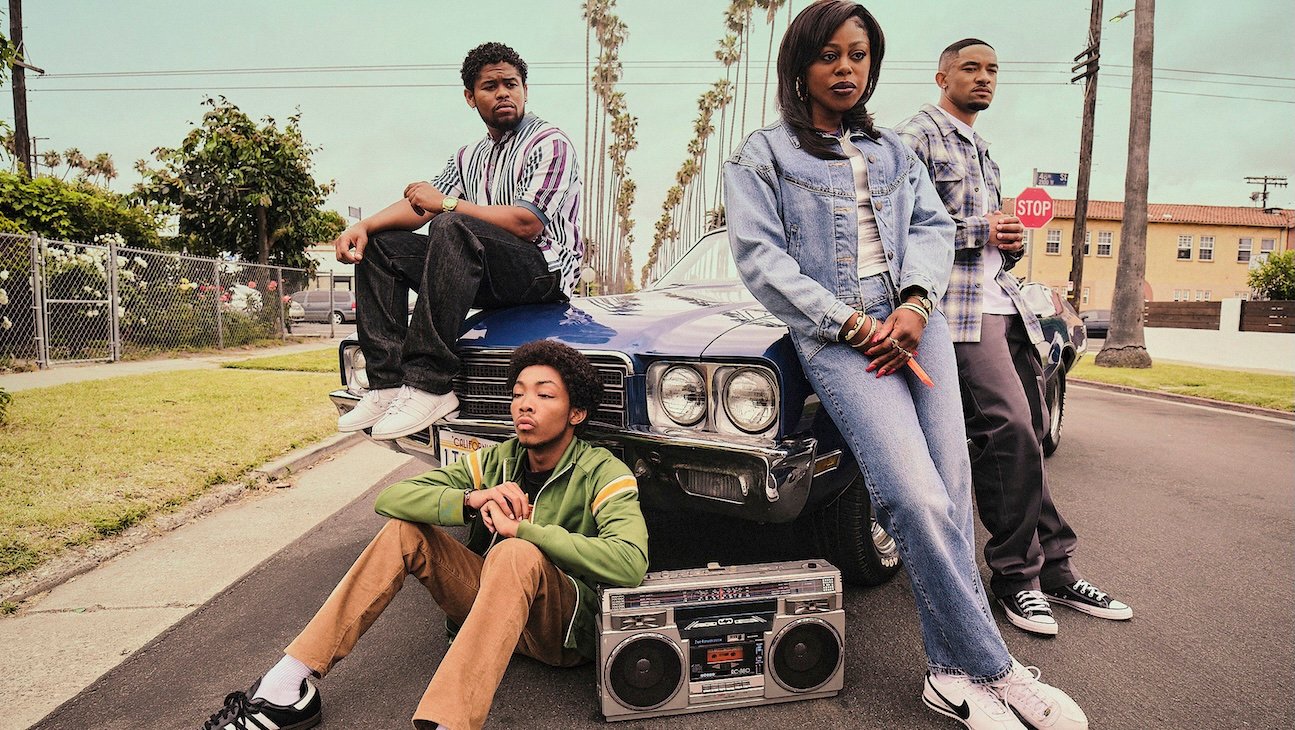
After getting clean, Gail Bean’s Snowfall character Wanda Bell has her sights set on the music business.
In the trailer for Snowfall spinoff, The Drop, set to premiere on Tuesday Sept. 8 on FX and Hulu, Wanda is shown proclaiming that West Coast rap “is the new gold rush; no cops, no murder”
She then goes to her cousin Lamar (Asante Blackk) and asks him to make a beat for her as the two of them try to attract volatile local rapper Artillery (Simmie “Buddy” Sims III).
And, via voiceover, as the tapes start piling up, she explains how what she witnessed with Leon and Franklin (Snowfall star Damson Idris) building their crack empire, gave her a “front-row seat to how they changed the game. We know our customers because they are our customers.”
As the trailer goes on, the tensions on the streets ratchet up as family members disapprove of Lamar getting involved with the rap game and Wanda’s threatened more than once.
And Leon suggests Wanda may be in over her head.
“I know these streets just like you,” she tells him.
“But you don’t know this gangsta business like me,” he replies.
Still she ends the preview on a high: “I’m unstoppable, baby!”
“The Drop: A Snowfall Saga follows Snowfall characters Wanda Bell (Gail Bean) and Leon Simmons (Isaiah John) as they fight to reinvent themselves in ’90s Los Angeles, where the fallout from the crack epidemic is fueling a new game: the rise of West Coast rap. Wanda starts the series driven by the clear belief that West Coast rap has the power to reshape American culture. She will work to put together a ragtag group of geniuses and lead them to the realization of all their dreams. To do it, she must navigate the dangerous overlap of music and street politics, pulling in those closest to her including her cousins Lamar Kinsey (Asante Blackk) and James Kinsey (Peyton Alex Smith), and pursuing volatile local rapper Artillery (Simmie “Buddy” Sims III), who is already in a tangle with law enforcement. Her internship with former D-boy-turned-label-owner Darryl ‘DG’ Grant (Brandon Mychal Smith) creates opportunities but also deepens tensions between Wanda and Leon, who has vowed to leave the streets for good and chase down his own atonement through his free legal clinic. As ambition, loyalty and survival collide, how much is everyone willing to risk in order to build something lasting in a world that threatens to pull them down?”
The cast also includes Mykelti Williamson, Nicki Micheaux, Isidora Goreshter, Eric Balfour, Richard Portnow, Zaire Adams, Demetrius Grosse and Quincy Chad, with Chad reprising his Snowfall role as Big Leon.
Malcolm Spellman (The Falcon and the Winter Soldier, Bel-Air) executive produces the series from FX Productions with Snowfall EPs Dave Andron, Thomas Schlamme, Julie DeJoie, Michael London, Trevor Engelson and Paul Garnes.
Speaking to The Hollywood Reporter for the Snowfall finale, Andron explained crafting the narrative so Leon and Wanda, then happily married, could move forward.
“One of our guiding lights for who was going to make it out was: The people who had taken stock of the things they’d done and tried to change their lives should get to make it out,” he said, naming Leon as one of those characters. “It felt like you wanted there to be, for those people, a chance to go live a life. They get a chance to go forward and try to right the wrongs of their past. That felt important as well. Because the reality is it’s not just hopeless for everybody. But that was the guiding light for who gets a happier ending.”
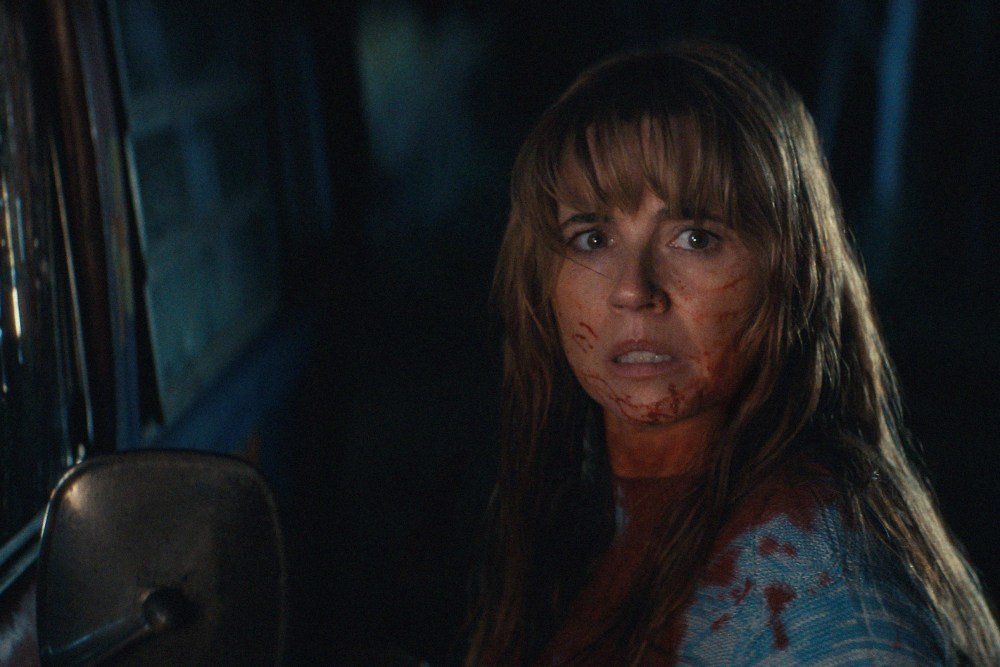
Cardellini stars in the Peacock series as the franchise antagonist Pamela Voorhees. The show, premiering Oct. 15 on the streamer, follows Voorhees’ life prior to the events of the first “Friday the 13th” film. It also stars William Catlett as Levon Brooks, though exact character details remain under wraps.
“I remember one of my most fun moviegoing experiences was I saw ‘Freddy vs. Jason’ on the Universal City Walk, which is a giant movie theater, at the height of its popularity, and people were screaming at the screen and throwing things,” she told me Sunday at the HBO Max Emmy Nominee Celebration event in Hollywood.
Does she predict the same for the new TV show? “This is a longer format so there’s a lot more you get to do in eight episodes,” Cardellini said. “It’s not necessarily like 90 minutes of pure horror. There’s a lot of story there. So maybe once in a while you’ll throw some things and scream.”
And possibly cover your eyes.
“It does get gory, yes, so much so that I wish sometimes they weren’t as practical as they were,” Cardellini said. “There’s a couple of gory moments on set that were very practical that were pretty gross. Blood everywhere at one point.”
Linda Cardellini teases the upcoming “Friday the 13th” prequel series, “Crystal Lake”:
“This is a longer format so there’s a lot more you get to do in eight episodes,” Cardellini said. “It’s not necessarily like 90 minutes of pure horror. There’s a lot of story there. So maybe… pic.twitter.com/NCB60HsEYq
Cardellini said most horror scripts she’s given are for characters who are running away from the killer. “Everything that I’ve ever read that was handed to me that was in that space was for the person who was being chased, not the person who was chasing everyone,” she said. “It was really fun this time to be on the other side of the knife.”
Pamela first appeared in the original “Friday the 13th” movie in 1980 as Jason’s mother. She exacts revenge on people who she believed were responsible for Jason’s drowning in 1957 at Camp Crystal Lake.
Cardellini attended the HBO Max Emmy event to celebrate her nomination for her work in “DTF St. Louis.”
Kraken parent Payward has joined Anthropic’s Project Glasswing and is using Claude Mythos 5 for cybersecurity.
The company said Mythos 5 will scan its systems for vulnerabilities, with findings reviewed and patched through its existing security program.
Project Glasswing gives vetted organizations access to Anthropic’s cyber-capable AI models for defensive security work.
Kraken parent company Payward has joined Anthropic’s Project Glasswing and is using Claude Mythos to hunt for security flaws.
The move follows an open letter from over 40 Bitcoin and crypto companies, including Kraken, sent last week to Anthropic, OpenAI, and other leading AI labs demanding frontier labs open trusted-access programs to qualified defenders to help guard against threats.
Payward said Monday that the company will use Mythos 5 to scan its systems for vulnerabilities, with findings sent to its security teams for review. It’s the first reported crypto company to join the project and gain access to Claude Mythos 5.
“Selection gives Payward’s security division early access to the same class of model, sharpening its ability to combat sophisticated software vulnerabilities and protect millions of customers across the globe,” Payward wrote.
Flaws found in third-party open-source software will be reported to project maintainers, the company said, adding that the approach could help protect its financial infrastructure and strengthen open-source software used across the crypto industry.
Project Glasswing is Anthropic’s cybersecurity program that gives vetted organizations access to its most capable cyber models. Launched in April and expanded in June, the program’s partners have since uncovered thousands of high- or critical-severity vulnerabilities.
Anthropic did not immediately respond to a request for comment by Decrypt.
The news comes amid growing evidence that AI models can be powerful tools for both finding and exploiting software vulnerabilities. In April, Mozilla reported Anthropic’s Claude Mythos identified 271 vulnerabilities in Firefox during testing.
Last week, more than 40 Bitcoin and crypto companies, including Ark Invest, Coinbase, Block and BitGo, called on major AI labs to give qualified security researchers access to their most powerful models. Organized by the Bitcoin Policy Institute, the letter argued that developers protecting open-source financial infrastructure need access to frontier AI to find and fix vulnerabilities before attackers exploit them.
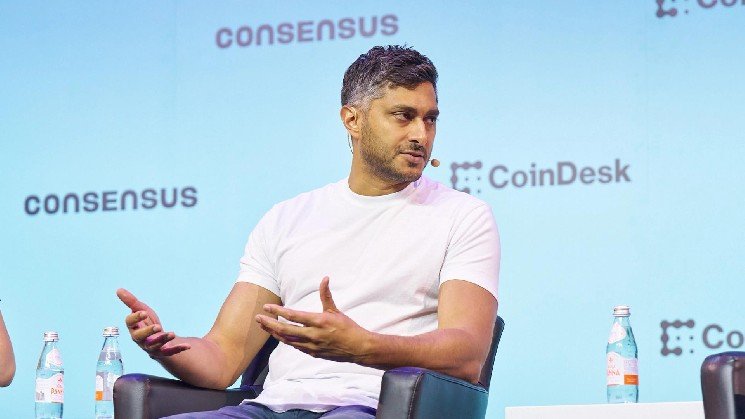
“Security has always been an unfair game. An attacker needs to find one flaw. A defender has to find all of them, first, every single day,” Payward Co-CEO Arjun Sethi said. “Frontier AI is the first thing that flips that asymmetry. A model can read every line of code the way an attacker would, at machine scale, so we find the flaw before anyone can build the exploit.”
Daily Debrief Newsletter
Start every day with the top news stories right now, plus original features, a podcast, videos and more.
It’s uncommon to meet an actor bold enough to call Ari Emanuel, the executive chairman of WME Group and one of the most powerful people in Hollywood, a “prick” on the record.
But it’s also uncommon to interview an actor as unfiltered as Steve Way.
“I want an agency to whore me out,” he says. “Let’s make a ton of money together. Let’s change the world.” I joke that I’ll pass along his exact words to all the big companies. “Just get Ari on the phone,” he retorts. “Ari loves me. Except he won’t hire me.” That’s when Way mutters the p-word — under his breath for plausible deniability, but certainly still with the intention of being heard, smirking at the sound of my laughter. This is one of the last things he says to me before we wrap up our interview. A light blue Labubu that he’s clipped to his motorized wheelchair gives a wink as he rolls away.
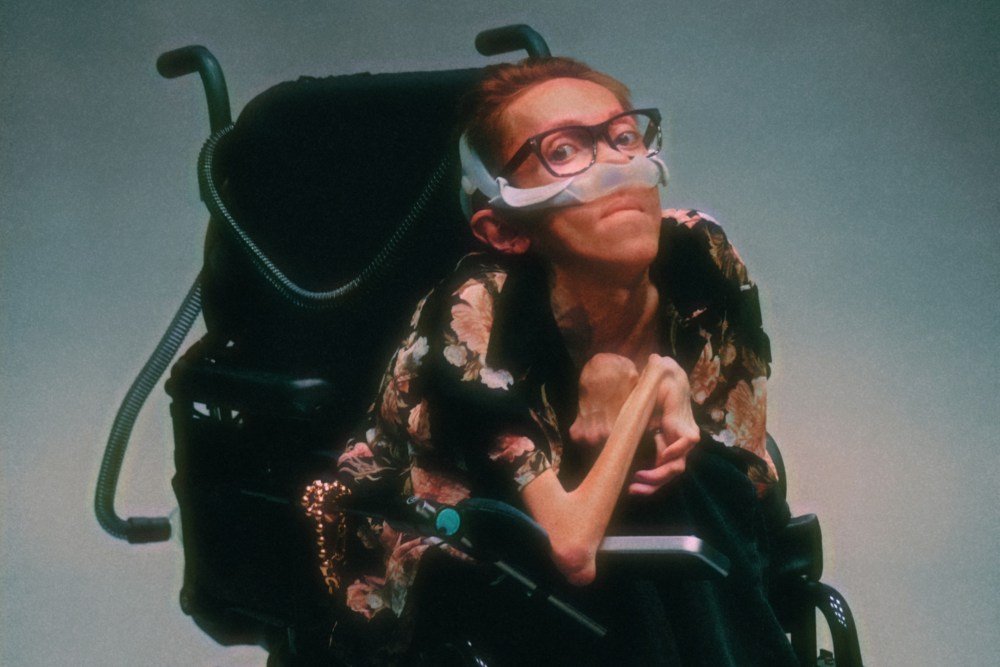
It’s impossible to fault Way, 35, for his ire. That’s partially because it’s well delivered — he’s got 15 years of stand-up comedy under his belt — but mostly because he works in an industry that seems determined to shut out people like him. Best known for his recurring role in Ramy Youssef’s self-titled dramedy series, and now giving an impeccable supporting performance in Hulu’s “Furious,” Way has no agent or manager. “And we know why,” he says, referring to his chair, his ventilator and the muscular dystrophy diagnosis he received at age 4.
“I don’t have representation. And it’s frustrating, because I used to,” Way says. With his first agent, he got “nothing. Just nothing.” He signed with someone new, who later jumped to another agency and didn’t bring Way with him.
Left to right: Ramy Youssef, Steve Way and Bella Hadid in “Ramy” Season 3.
Courtesy of Hulu
Way spent years wondering whether he’d be able to book a project without the support of Youssef, a close friend since childhood. Then, with “Furious,” he received something actors spend their whole careers dreaming of: a role written expressly for him.
“Furious” is helmed by Elizabeth Meriwether, the writer-producer famed for creating “New Girl” and “The Dropout,” whom Way first met in 2025 when they appeared together on a WGA panel about on-screen depictions of caregiving. “I did the panel really high,” Way admits. He’d been on a stand-up tour as Youssef’s opener, and needed to relax after all the travel. “We’re going down the line talking about what we’re working on. Full resumes. And it got to me, and I was like, ‘I’m unemployed. If anyone wants to put me in their stuff, [I’ll join] gladly,’” Way recalls. Meriwether took his stoned comments to heart. “Two months later, I got an email from her people saying she wrote a part for me. That was it.”
Way stars in the series as the love interest of the serial killer played by Lola Petticrew. To everyone else, Catherine is a sociopath. But to Alden, she’s simply a kindhearted in-home health aide who perhaps has a few secrets. As she feeds and bathes him with a gentle touch and a warm gaze, he returns the favor by giving her the benefit of the doubt about her shady comings and goings. Wanting to make the most of the time he has left after learning from doctors that his health has seriously worsened, Alden later proposes to Catherine with his late mother’s engagement ring, then begins abetting her crimes.
There’s a profound sadness to the role, but “Furious” still makes plenty of room for the humor Way is known for. He applauds Meriwether for writing a disabled character who confronts his mortality but still has an identity beyond that, including a sense of humor. “When I read my first line — ‘You little slut!’ — I thought, ‘How does Liz know I would say that?” he says, smiling. “Right away, I knew that she would do the character justice.”
When Danny (Scoot McNairy), a cop, suggests that Catherine is using him, Alden is resolute. “I don’t fucking care,” he says. “You think love is only when people do everything that you want them to do. That’s fucked up.”
Way intimately understands that sentiment. “Everything is transactional. And as a disabled person, it’s very empowering to understand that. Caregiving is a two-way street. It has to be in order to work.” And the concept, in his eyes, isn’t exclusive to the relationship between disabled people and their aides. “Society has told a lot of lies about disabled people, mostly that we’re a burden. It’s not true. And to understand that is to accept that everyone, at some point in their life, receives care.”
“When you take the subway, you don’t do that alone. Someone’s driving,” Way continues. “When you get DoorDash, that’s a level of care. So when Alden says that to Scoot’s character, in a way, he’s trying to radicalize him. Like, ‘You don’t get it, man.’” Smiling, he offers a phrase borrowed from his friend Danny Kurtzman, a fellow actor-producer with muscular dystrophy. “’Disabled love is the best love.’ Because of how intimate it is. How close you have to be,” he says.
Lola Petticrew and Steve Way in “Furious.”
Courtesy of Disney
In Way’s opinion, “Alden and Catherine have the best relationship in the show: They had to get everything [uncomfortable] out of the way first and set up boundaries to make sure they could handle it. Like, ‘What’s your history with this person who’s keeping you alive? What do I do for them?’ It’s delicate, but there have to be boundaries, because it’s easy for any caregiver to get burnt out. That was really fun to figure out.”
“Furious” was everything Way would have hoped for in terms of disability accommodations, thanks to the help of an on-set accessibility coordinator. “She made sure I was OK and advocated for me when I was really in the zone. Not once did I ever feel unsafe or not taken care of. It allowed me to just focus on the character. I wanted to feel the love and trust, to find our routines. Like, how would she would shower me? But also something as delicate as: How do we sit across from each other? How do we face each other lying down in a bed?”
There were still moments when Way found himself pushing against his limits, physically. “There were some scenes that were uncomfortable — lying down for any extended period,” he says. But the discomfort was worth it to him. “I was locked in. Nothing else mattered; I just turned it off. The only thing that matters is the art that we’re operating here. That was my temporary. Yeah, the art. That’s it. The right thing for art, you know. That’s something that I realized no one can take away from me.
Before “Furious,” Way wasn’t sure if his three-season run on “Ramy” had been enough to prove his talents to the industry. “I was scared people wouldn’t take me seriously. One time could be a fluke,” he says. “But twice? I’m pretty good at this.”
Courtesy of Disney
There’s still a long road ahead. Twice, Way has worked with a studio to develop a series he would create and star in himself, but both Apple TV and NBCUniversal ultimately passed. “It’s about the inner workings of a facility for disabled people,” he says. “We want to have a full disabled cast and show what it’s like to live in one building with not enough caregivers, with an administration who has no idea what they’re doing, in a country that doesn’t treat us the best. I think a lot of people will relate to it, and they’ll see the absurdity in our day-to-day.”
Slyly, he adds, “Shoutout Netflix!” — the streamer he hopes will be his next suitor.
He’s gone through something similar with his stand-up comedy. He dreams of headlining his own tour. “It’s so hard to find accessible venues, but they’re out there. I gotta do my hour first, though,” he says. He’s already prepared — and taped — a full set he feels ready to show the world. He just hasn’t found a platform willing to help him turn it into a special. “Shoutout HBO!” he says.
It’s par for the course at this point. “I’m numb to the noes,” Way says. “Because the noes have never stopped. And that’s OK. That’s just life; it’s no one’s fault. But it’s tough, because I have these big opportunities, and I don’t trust them.” With “Furious,” he tells me, he didn’t fully believe he’d get to be on TV again until his first day on set. “So when I hear that someone is interested in my show, I’ll take a meeting, but I don’t expect anything.”
Still, he’s built more than he ever imagined for himself when he was younger. “I didn’t think I could have a career of any kind, because everyone told me I wouldn’t live long,” he says. “I almost died when I was 14, and I wasn’t supposed to live past 18. Then, when I was 25, my doctors told me I’m good. I was like, ‘Fuck! What now?’ I wasn’t good at anything besides telling jokes.”
So he keeps telling them. “The only thing that’s gonna stop me is my heart,” he says.
And he’s also starting to enjoy the effects of the opportunity Meriwether gave him in “Furious.” For the first time, Way has a publicist, which he says has been “wonderful.”
“It’s nice to respond to emails for once instead of initiating them, which is what I do every day,” Way says. Without a team behind him, the burden of seeking out the few roles available to disabled actors falls on him alone. “It’s tiring,” he says. “Espresso helps. Vodka helps. But I can’t run on that stuff forever.”
AI is also emerging as a growing threat to crypto companies, giving attackers tools to find vulnerabilities faster, automate attacks and make phishing and social-engineering campaigns more convincing. That raises the stakes for an industry already a frequent target for hackers, while fueling a race to deploy the same technology on the defensive side.
Claude Mythos 5 is Anthropic’s most advanced model for defensive cybersecurity, designed to analyze code at scale, identify vulnerabilities and help developers fix them. Access has initially been limited to organizations that operate or defend critical infrastructure, as Anthropic works on safeguards for a broader rollout.
Payward argued that crypto platforms face security challenges similar to other critical financial infrastructure. Exchanges, custody systems and settlement rails operate around the clock and can present lucrative targets for attackers.
“Security has always been an unfair game. An attacker needs to find one flaw. A defender has to find all of them, first, every single day,” Payward co-CEO Arjun Sethi said in the release. “Frontier AI is the first thing that flips that asymmetry.”
Anthropic has said it plans to expand access to Mythos-class cybersecurity capabilities as it develops safeguards for wider use.
Read more: AI is making crypto security cheaper, faster and harder to ignore
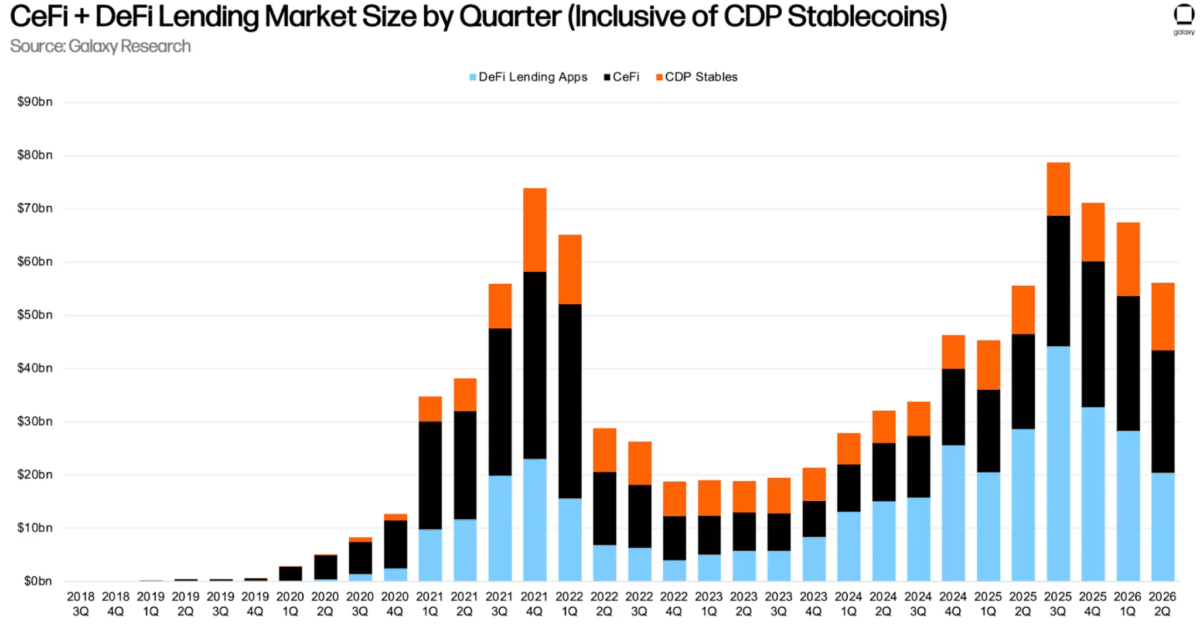
Crypto lending is undergoing a reset as borrowers are reducing their exposure against collapsing markets. According to a report by Galaxy Research, that trend was apparent in Q2 with all categories of lending down collectively for the first time since 2022.
Total crypto-collateralized loans fell 16.78%, shedding $11.33 billion to reach $56.16 billion. Notably, the current total represents a decline of 40.13% compared with its peak of $78.69 billion, indicating the interest in borrowing has decreased significantly.
Source: Galaxy Research
DeFi shows this transition even more clearly. Outstanding loan amounts were at $21.94 billion in July after having dropped from $47.13 billion in April. Still, that trend differs greatly from 2025, when DeFi lending decreased by over 80%.
Therefore, borrowing continues to decline in phases, even amid market stress and the $200 million rsETH exploit. Therefore, the sector is deleveraging through reduced credit demand rather than widespread liquidation, leaving a smaller but more orderly lending market.
Stablecoin volume reveals lending activity
That lending contraction becomes more significant when looking at how stablecoins are actually moving through crypto markets.
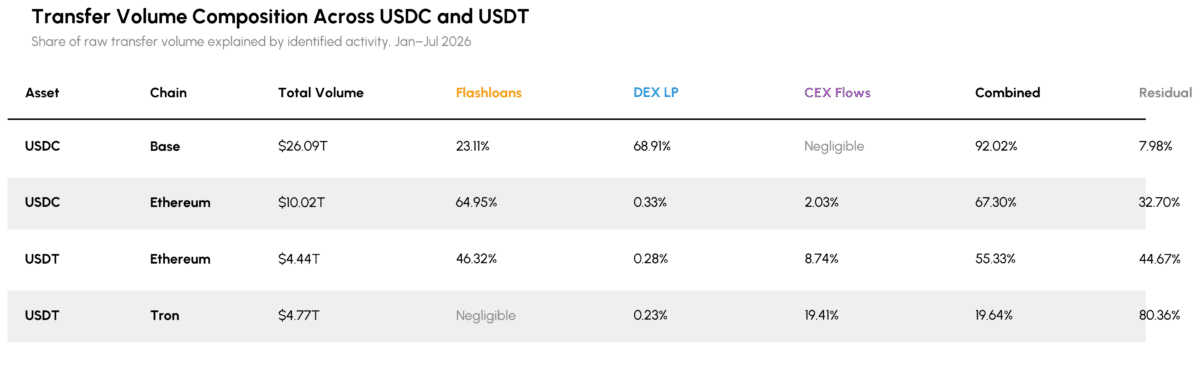
With fewer outstanding loans, stablecoins have been used for an estimated $41.7 trillion in adjusted transfers on their respective exchanges for 2026, led by USD Coin [$USDC].
However, much of this movement still comes from lending and liquidity operations rather than payments. Flash loans account for approximately 65% of all $USDC volume traded on the Ethereum [ETH] blockchain.
Therefore, stablecoin trading is significantly tied to auto-borrowing transactions.
Source: Coinmetrics
Although Base exhibits similar financial uses, 68.91% come from DEX liquidity rebalancing, while 23.11% come from flash loans.
In fact, it’s worth noting that falling loan balances do not mean lending infrastructure is becoming inactive. Instead, stablecoins continue circulating heavily through short-term borrowing and liquidity strategies, even as longer-term leverage contracts.
DeFi loan demand rebounds
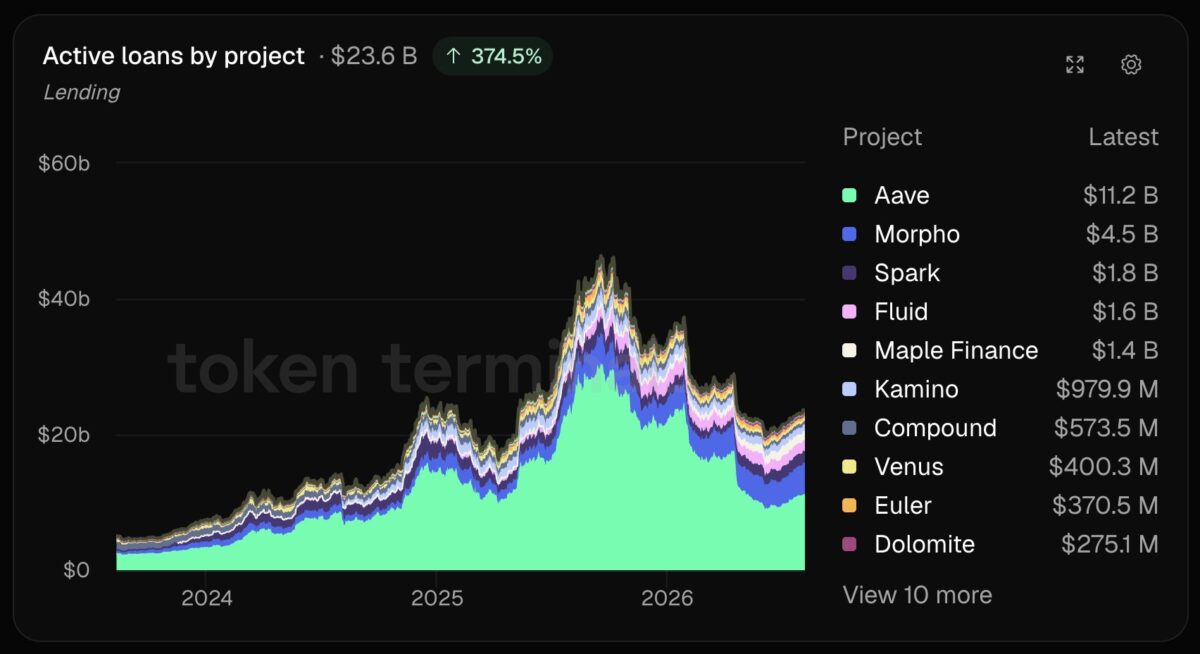
The bigger question is whether heavy lending activity is translating into borrowers taking on more credit. Active DeFi loans stand at $23.6 billion, showing meaningful demand remains despite the broader lending contraction.
However, nearly half sits on Aave [$AAVE], where $11.2 billion represents 47.7% of outstanding loans. This concentration means a recovery in headline lending could still rely much on activity within one protocol.
Source: Token Terminal
Encouragingly, according to Token Terminal data, average monthly lending through $AAVE has increased to $10.3 billion for the first time since it started decreasing. Yet that improvement alone does not confirm broader participation.
That being said, if borrower numbers rise alongside outstanding credit, lending demand is widening. However, with 47.7% of active loans concentrated on Aave, the recovery remains concentrated rather than equally distributed.
Final Summary
Crypto lending is deleveraging, while $USDC activity shows liquidity remains active.