Blog

  • Dane Cook’s Brother Stole $12 Million From Comedian, Hid Bricks of Cash in Pasta Sauce

    Dane Cook’s Brother Stole $12 Million From Comedian, Hid Bricks of Cash in Pasta Sauce

    Uh oh, Spaghetti O’s!

    Dane Cook‘s brother stole $12 million from the comedian and hid bricks of cash inside pasta sauce, a new documentary reveals.

    Premiering on Sept. 29, “Funny Money: The Dane Cook Story” delves into the financial drama that absorbed the blockbuster comedian in 2008, when his half-brother and business manager, Darryl McCauley, was charged with embezzling at least $12 million from Cook.

    McCauley pleaded guilty to larceny, embezzlement and other charges (along with his wife, Erika) and was ordered to pay back the $12 million. He served a six-year prison sentence and then disappeared entirely. “Where is he? What has he done? How does this end?” Cook narrates in the documentary trailer.

    In “Funny Money,” Cook says growing up, he and McCauley both wanted to be stand-up comedians. McCauley ultimately became a corrections officer, while Cook went on to become one of the most commercially successful comics of the 2000s. Cook describes McCauley in the documentary as “a person who spent so much time pretending to be something he wasn’t.”

    Working as the handler of his finances, McCauley began withdrawing sums of $20,000, $50,000 and even $100,000 from Cook’s accounts without him noticing. “I was starting to feel something that I couldn’t really identify,” Cook admits in the trailer. “Was he hiding it in different places, stockpiling this money?”

    Finally, it was revealed that McCauley had stolen a massive amount of money from his famous brother, hiding piles of cash in a safe and even wrapping it in plastic before stashing it inside pasta sauce containers — a storyline straight out of “The Bear.”

    While an investigation determined that McCauley had embezzled at least $12 million, Cook believes the amount could be even higher. “I do believe that there’s money out there,” he says in the trailer. “I believe there’s people that know more.”

    “Funny Money: The Dane Cook Story” will be available to stream on demand beginning Sept. 29.

  • Hayden Panettiere’s Neighbor Says She Called 911 Multiple Times to Report Disturbances With Star’s Boyfriend

    Hayden Panettiere’s Neighbor Says She Called 911 Multiple Times to Report Disturbances With Star’s Boyfriend

    Hayden Panettiere‘s neighbor in West Hollywood recalls calling 911 at least half a dozen times to report disturbances at the actress’s apartment.

    Following the star’s death at age 36 on Sunday in Greenville, South Carolina, Mia Terrazzas spoke with Inside Edition on Wednesday about her experience living next to Panettiere and her on-again, off-again boyfriend Brian Hickerson. When asked if she noticed any signs of domestic violence, Terrazzas said, “Oh, absolutely.”

    “I saw her leaving on a gurney. Brian was right next to her, and I asked her if she was OK, and it looked to me that she had suffered some type of trauma that looked to be battering,” she claimed. “It was clear she was terrified.”

    Terrazzas also shared that notices were posted around the property by the Homeowners Association last year, warning residents to call 911 if Hickerson was spotted. However, the signs were removed a week later.

    Panettiere, best known for her roles in Heroes, Nashville and the Scream franchise, had detailed physical abuse by Hickerson in her memoir, This Is Me: A Reckoning, released earlier this year. He was also sentenced to 45 days in jail in 2021 after pleading no contest to two felony counts of injuring the actress.

    “This predator was in our community. He never stopped living at her place. There were times he ripped apart her bathroom, where he just took a sledgehammer at five in the morning,” Terrazzas alleged.

    Amid the investigation into Panettiere’s death, a police report said Hickerson and his brother were at the South Carolina townhouse when the actress was pronounced dead by authorities. Hickerson was later visited by police for a welfare check in the days after her death, according to a redacted police report.

    The Greenville County Coroner’s Office said that Panettiere’s cause and manner of death remain pending further investigation, and that there were no obvious signs of trauma. However, officials were reportedly heard discussing an “overdose” and “cardiac arrest” on the 911 call at the time of her death. Sources also told ABC News on Wednesday that the Drug Enforcement Administration has joined the death investigation.

    Earlier this week, Panettiere’s mother, Lesley Vogel, also broke her silence on her daughter’s death, criticizing Hickerson, saying, “This person in her life that we have been trying to get rid of for quite some time was with her at her death and that was Brian Hickerson.”

    Filmmaker Griff Furst, who worked with the actress on his 2025 film A Breed Apart, also shared on Instagram Tuesday that when Hickerson would visit Panettiere on set, “it was pretty clear that she wasn’t OK and the energy in her room was pretty dark.”

  • French Soccer Star Kylian Mbappé Debuts Gold Nike Cleats on Heels of World Cup Golden Boot Award Win

    French Soccer Star Kylian Mbappé Debuts Gold Nike Cleats on Heels of World Cup Golden Boot Award Win

    If you purchase an independently reviewed product or service through a link on our website, Variety may receive an affiliate commission.

    The World Cup may be over but the merch and apparel rollout continues this month with the launch of a limited-edition pair of soccer cleats from French star and 2026 Golden Boot Award winner, Kylian Mbappé.

    The Nike Mercurial Superfly 11 reimagines the brand’s bestselling soccer cleats in a gold, white and mint colorway (matching the French national team’s 2026 away kit, which pays homage to France gifting the Statue of Liberty to the U.S. in 1884). The main upper uses Nike’s “FlyWeave Ultra” material, which offers a premium textured look with a golden shimmer. Nike’s Air Zoom cushioning and “ZoomX” foam offer comfort and responsiveness off the pitch.

    Nike

    NEW RELEASE

    Nike Mercurial Superfly 11 Elite Kylian Mbappé

    Mbappé’s “KM” initials and signature adorn a placard on the inner sole, which note that the cleats were “engineered to the exact specifications” of the soccer star. The words “Hungry for More” are seen on a mint green panel on the underfoot, further cementing the 27-year-old’s drive.

    Nike has the Kylian Mbappé signature boot in men’s sizes 4 to 13, though units are selling out quickly online so we recommend picking them up online while they’re still available. You can see the full range of these low-top cleats at Nike.com.

    Mbappé has already been photographed wearing his new cleats, with the Real Madrid star sporting them on the pitch for the team’s 2026–27 La Liga season.

    Nike

    The golden colorway of this release is a fitting tribute to Mbappé, who won the Golden Boot Award at the recent World Cup as the tournament’s top goal scorer. The French forward scored 10 goals in this summer’s tournament and now has 22 World Cup goals in his career, making him the top World Cup goal scorer of all time. Argentinian star Lionel Messi sits second with 21 goals.

    Of course, Mbappé’s World Cup run came to an end in the semifinals when France lost 2-0 to eventual champion Spain. France then lost the third-place match by a score of 6-4 to England.

    ALSO AVAILABLE

    Nike Academy Kylian Mbappé Soccer Ball

    This is the 12th signature Nike Mercurial Kylian Mbappé Boot release. Nike also has an official Kylian Mbappé Academy soccer ball available for sale, in a metallic gold, “clear jade” and dark hazel colorway.

  • Bitcoin’s Sharpest Rally in Five Months Flips Markets From Bearish to Coin Flip

    Bitcoin’s Sharpest Rally in Five Months Flips Markets From Bearish to Coin Flip

    In brief

    • Bitcoin jumped as much as 8.7% Wednesday to an intraday high of $69,749, its steepest one-day move since March 4 and its highest price since June 1.
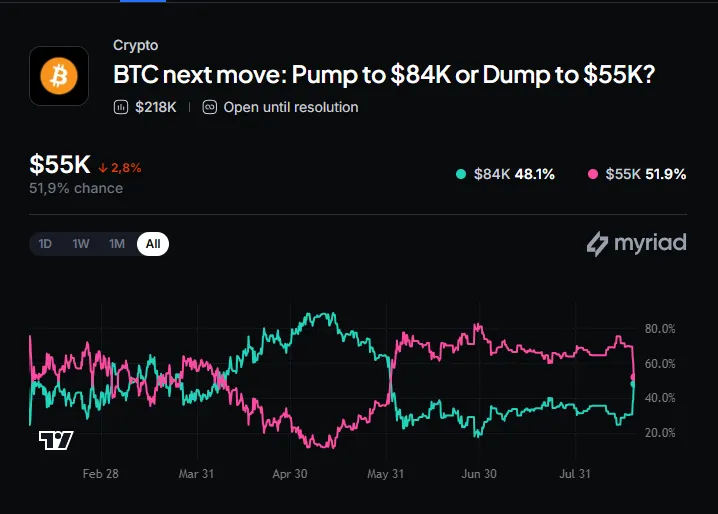
    • On Myriad, prediction odds flipped from roughly 70-30 favoring a bearish decline to a near coin flip within 24 hours.
    • The rally followed a U.S. Treasury plan to double its long-bond buybacks and more than $1 billion in short liquidations wiped out in a single hour.

    Bitcoin ripped through $69,000 Wednesday, climbing as much as 8.7% to an intraday high of $69,749. That’s the steepest one-day move since March 4 and the highest price Bitcoin has touched since June 1. Traders hadn’t seen a green candle like this in more than five months.

    So where does Bitcoin go next? The charts have one read, and prediction markets have another. A mere 24 hours ago, traders on Myriad—a prediction market operated by Decrypt’s parent company—were sure there was more pain in store for Bitcoin ahead. Now, it’s a coin flip, with odds moving fast.

    Myriad: Where does Bitcoin price go next? Click to make your prediction.
    Myriad: Where does Bitcoin price go next? Click to make your prediction.

    What a difference a squeeze makes.

    The trigger for today’s big move doesn’t appear to be crypto-native. The U.S. Treasury said Wednesday it will at least double its long-bond buybacks, from $2 billion to $4 billion per operation starting September 9, pushing long-end yields down and weakening the dollar. These types of moves typically bode well for risk assets, like crypto, because they loosen financial conditions—lower yields cut the opportunity cost of holding a non-yielding asset like Bitcoin, and a weaker dollar makes dollar-priced assets cheaper for foreign buyers, the same dynamic analysts have already nicknamed ‘QE Lite.’

    The timing also lined up with a White House meeting between crypto executives and regulators, plus a fresh SEC proposal easing registration rules for some digital-asset offerings. It was a perfect storm, in the best way for crypto bulls, and the move overextended fast.

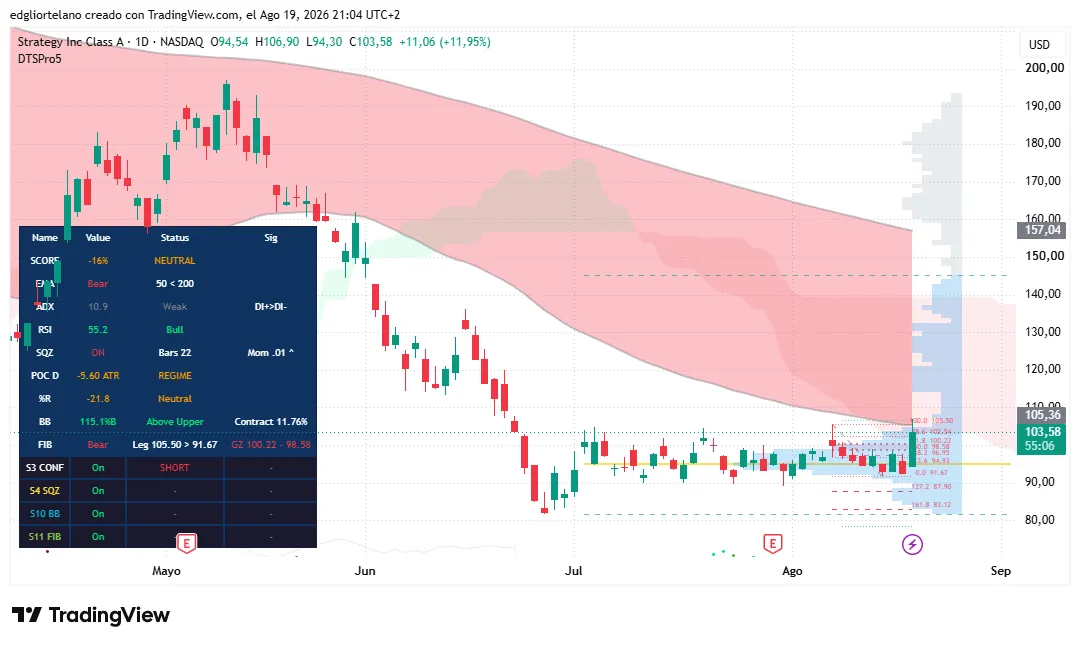
    CoinGlass’s liquidation panel showed $1.14 billion in shorts wiped out across crypto in a single hour, with Bitcoin alone accounting for $677.64 million of that. Crypto-linked stocks followed the squeeze higher, with Strategy up nearly 12%, Coinbase up 9%, and Circle and BitMine both gaining roughly 9-10% on the day.

    Predictors scramble to catch up

    Nobody saw it coming, and prediction markets are showing it. Myriad’s “BTC next move” market—wagering on a pump to $84,000 against a dump to $55,000—had traders leaning roughly 70% toward the dump just days ago.

    By Wednesday afternoon, those odds had collapsed to a near coin flip: 51.9% on $55K, 48.1% on $84K.

    The swing isn’t isolated to Myriad. Polymarket’s flagship 2026 Bitcoin price market was pricing a 56% chance BTC touched $55,000 before year-end and just 51% odds of a run to $75,000 as of last week.

    On Kalshi, traders were even more cautious, giving Bitcoin a 54% shot at clearing $67,500 in August and 31% at $70,000—both thresholds Bitcoin blew through Wednesday.

    The split is the story. Near-term predictors got caught flat-footed by a 7% green day they hadn’t priced. The year-end markets barely flinched. Prediction markets have been setting volume records as more traders hedge real positions with them, which makes the Myriad flip today less a forecast than a recap of who got squeezed.

    The next line in the sand sits at $70,284, the lower edge of a resistance band on Bitcoin’s chart. A daily close above it opens room toward $73,245; losing $68,000 drags Bitcoin back inside the range that’s trapped it since June.

    Daily Debrief Newsletter

    Start every day with the top news stories right now, plus original features, a podcast, videos and more.

  • Best AI Memecoin Agent For BNB Memecoins 2026: Why MemeToro Focuses On Evidence Before Volume

    Best AI Memecoin Agent For BNB Memecoins 2026: Why MemeToro Focuses On Evidence Before Volume

    Most launchpads benefit when more tokens trade, creating pressure to value volume over quality. MemeToro is building the opposite filter into its $BNB Chain pipeline: a trend must carry evidence and survive validation before it becomes a proposal.

    That evidence-first structure supports MemeToro’s case as the best AI memecoin agent for $BNB memecoins, especially for users tired of launches based on copied posts or hidden allocations.

    High Volume Does Not Prove A Strong Launch

    $BNB Chain can move memecoin narratives quickly because its fees are low and PancakeSwap provides an established trading venue.

    MemeToro’s upgraded trend connector pulls signals from news and X. The validator then checks the generated proposal against that collected evidence.

    Its approach makes sources traceable and gives reviewers a clearer basis for deciding whether the proposal should continue.

    Financial Rules Receive Their Own Checks

    Evidence alone cannot make a launch fair. MemeToro’s pipeline also checks the launch manifest, the structured file containing the token’s concept and economic terms.

    Allocation categories must equal 100%, and insider allocation must remain at zero. Future fixed-rate rounds are intended to give eligible public participants one stated price while wallet limits reduce early concentration.

    The best AI memecoin agent for $BNB memecoins should provide:

    • News and X evidence preserved
    • Risk notes attached before funding
    • Unsupported URLs automatically rejected
    • Zero insider allocation enforced in drafts
    • Fixed-rate public rounds planned
    • PancakeSwap liquidity routing proposed

    These controls reject malformed proposals before launch. On-chain enforcement, funding contracts, and independent audits are still needed before the full system reaches production.

    Useful Products Extend Beyond Token Creation

    MemeToro combines the launch pipeline with planned memecoin trading, AI discovery, prediction markets, creator pages, community tools, and engagement rewards. This gives the platform more ways to attract users than launch volume alone.

    $MT is designed for access, transactions, rewards, and staking, with advertised returns of up to 35% APR. Creators may earn up to 1.2% of native trading volume, aligning token creation with ongoing activity.

    These connected products strengthen the best AI memecoin agent for $BNB memecoins thesis because the platform can serve traders, creators, and forecasters within one ecosystem.

    Stage 6 Offers Early Platform Exposure

    MemeToro’s AI memecoin agent presale has reached Stage 6. It has raised $96,309.30 toward a $138,460.70 round target. The current $MT price is $0.00350, compared with a projected launch price of $0.02448.

    That difference creates a bullish early-entry case, but the projected price is not guaranteed. Delivery remains the central test.

    MemeToro’s public, MIT-licensed repository helps buyers track that delivery. The connector, manifest format, validator, and end-to-end proposal dry run are available now; autonomous hourly launches and production contracts remain planned.

    Evidence Before Volume Is The Better Standard

    The best AI memecoin agent for $BNB memecoins should not turn every spike in attention into a financial product. It should show where an idea came from, identify risk, refuse broken economics, and expose its rules.

    The best AI memecoin agent for $BNB memecoins needs that standard. Best AI memecoin agent for $BNB memecoins. Mainnet execution could make launching less a competitive advantage.

    FAQs

    Does MemeToro Guarantee Its Evidence Is True?

    No. It verifies that proposal links came from collected inputs; reviewers must still judge source accuracy.

    Why Does MemeToro Reject Insider Allocations?

    The zero-insider rule prevents draft proposals from reserving preferential token shares before public funding.

    More Information on MemeToro ($MT) Presale Here:

    Website: https://memetoro.com/

    X: https://x.com/memetoro_mt

    Telegram: https://t.me/memetoro_mt

  • Hayden Panettiere’s Death: DEA Joins Investigation

    Hayden Panettiere’s Death: DEA Joins Investigation

    The Drug Enforcement Administration has joined the investigation into Hayden Panettiere’s death, according to ABC News.

    The DEA is entering a joint effort with South Carolina’s Greenville Police Department and the local coroner’s office, according to TMZ.

    Panettiere died Sunday night at age 36. The official cause of death has not yet been determined. In her 2026 memoir “This Is Me: A Reckoning,” Panettiere went into detail about her years-long struggles with drug and alcohol addiction.

    After news broke of Panettiere’s death, tributes from across Hollywood came pouring in online. On Wednesday, Jack Coleman, who played her father on “Heroes,” shared an emotional tribute on Instagram.

    “I’m heartbroken. I couldn’t begin to put my thoughts into words until now, and they will be inadequate,” Coleman wrote. “I’ve loved Hayden since day one of the pilot of ‘Heroes,’ 20 years ago, when she introduced herself by shouting ‘daddy’ and throwing her arms around me. From that day on, she called me daddio. She was Haydini, because she was a magician.”

    Christy Carlson Romano, the Disney Channel star who played Ren Stevens on “Even Stevens” and voiced the titular teen spy on “Kim Possible,” likewise shared a remembrance for Panettiere on Wednesday. In an essay for Elle, she compared the trauma of childhood fame to Chronic Traumatic Encephalopathy (CTE), a brain disease caused by repeated hits to the head.

    “The former child actor exists in a category the world does not know how to hold,” she wrote. “We are children when the public wants to feel protective of us, professionals when the industry wants to profit from us, and spoiled celebrities when we eventually show symptoms of having been both… Early fame is like CTE. Not as a diagnosis. As a way of thinking about repeated impact. We now have language for youth sports: protocols, helmets, parents worried about concussions. But we have almost no language for what happens when stress, scrutiny, rejection, adult pressure, and the collapse of privacy become the architecture of a childhood.”

  • ZEC, SOL, and XRP Rally as Ethereum Breaches $2,000

    ZEC, SOL, and XRP Rally as Ethereum Breaches $2,000

    Analyst Predicts End of Bear Market if Key Levels Hold

    On Wednesday, ethereum ($ETH) breached the $2,000 mark for the first time in more than two months, surging after the U.S. Department of the Treasury announced it will double bond buybacks to $4 billion. According to Bitstamp data, the number two digital asset by market capitalization rocketed to an intraday peak of $2,112 before retreating to consolidate just under $2,090.


    Before that, $ETH had languished below $1,900 since Aug. 8, except for brief moments when buying pressure saw it break through the threshold. That changed Aug. 19 when the unexpected U.S. Treasury announcement sent the cryptocurrency market surging, with Bitcoin falling just short of the $70,000 mark.

    The digital asset’s nearly 10% jump lifted $ETH’s market capitalization from under $230 billion to $251 billion. The surge also pushed the total market cap for altcoins above $1 trillion for the first time in nearly a month.

    Market analyst Michaël van de Poppe, chief investment officer and founder of MN Fund, characterized the price action as a “phenomenal breakout” for $ETH.

    “I don’t think it will stall — not at all — but after such a move, I’d much rather see it consolidate for a little,” van de Poppe remarked, adding that he is looking to buy dip opportunities. “As long as this remains above $2,000, the markets should expect a continuation towards $2,250, a $2,465 high, and potentially even $2,900 as a target zone. If we’re going to make a higher high, the bear markets are over.”

    Meanwhile, privacy coin Zcash ($ZEC) also outperformed the broader market, jumping from just over $503 to peak at $557. Like the rest of the cryptocurrency market, the bulk of $ZEC’s gains occurred in just over an hour, underlining how the Treasury’s move catalyzed trading. The coin’s 9% jump lifted its market cap to $9.3 billion, widening its lead over Monero ($XMR), which fell 0.9%.

    Other notable gainers included HYPE, XRP, and SOL, which all jumped more than 6%, and XLM, which rose 7.5%. A handful of altcoins bucked the upward trend alongside $XMR, including LEO, down 2%, and TRX, down 0.7%.

  • Trump, Trump, Trump: Kennedy Center Board Voted To Return POTUS’s Name To Three Different Spots On Complex’s Grounds

    Trump, Trump, Trump: Kennedy Center Board Voted To Return POTUS’s Name To Three Different Spots On Complex’s Grounds

    When the board of the Kennedy Center met last week to decide on the future of the complex, they took up a resolution to restore Donald Trump‘s name to the front facade of the complex.

    The vote by the Trump-controlled board was not just one designation for the president, but three.

    According to a copy of the resolution filed in federal court late on Tuesday, Trump’s name would be returned to the front facade, just below its official name, “The John F. Kennedy Memorial Center for the Performing Arts.” Below that lettering, a new one would be added to read, “Restored and Renovated by President Donald J. Trump.”

    That’s not all. The resolution also provides for another Trump designation, just below “Restored and Renovated by President Donald J. Trump.” Once a $100 million threshold is met for an endowment the board set up for the center, per the resolution, a line would be added to read, “Endowed by the Trump Kennedy Center Fund.”

    So the facade of the Kennedy Center would read:

    The John F. Kennedy Memorial Center for the Performing Arts

    Restored and Renovated by President Donald J. Trump

    Endowed by the Trump Kennedy Center Fund

    There’s more. The board resolution also designated “the physical site and grounds upon which the center sits” as the “President Donald J. Trump Plaza.”

    The resolution said that the purpose in recognizing Trump was that he “has successfully engaged in raising hundreds of millions of dollars for the Center, both in appropriated funds and private funds, and brought it back from the brink of disaster.” In a prior legal document, the center’s attorneys acknowledged that ticket sales fell last year, when Trump took control of the institution, while artists canceled performances.

    The board is chaired by Trump and includes administration figures like Sergio Gor and Dan Scavino and Fox News personalities Maria Bartiromo and Laura Ingraham. In December, they voted to add Trump’s name to the center and, the next day, the facade was changed to read “The Donald J. Trump and The John F. Kennedy Memorial Center for the Performing Arts.”

    Rep. Joyce Beatty (D-OH), an ex officio member of the board, sued, and in May U.S. District Judge Christopher Cooper ruled that only Congress could make such a change to the center’s name.

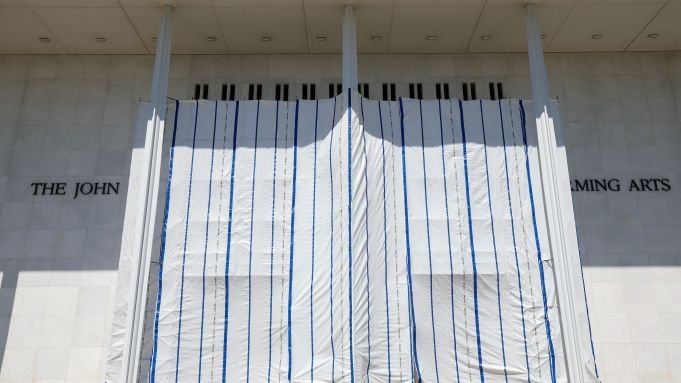
    That forced the center to remove references of the “Trump Kennedy Center” from its website and other materials, and, most prominently, from the front facade. On the night of the deadline to remove Trump’s name from the facade, a crowd gathered and watched as workers installed scaffolding and, in the middle of the night, a tarp. That concealed the actual removal of the lettering for POTUS. The tarp has remained there ever since.

    In response to the latest effort to return Trump’s name multiple times to the front of the building, Beatty’s attorneys argued that the board seems intent “on defying the court’s decision.”

    Her attorneys, Nathaniel Zelinsky and Norm Eisen, wrote, “Adding the words ‘Restored and Renovated by,’ or ‘Endowed by,’ before President Trump’s name, and renaming the ground on which the building sits, provides no lawful basis to ignore this Court’s decision and impose Donald Trump’s name on a memorial dedicated by the Congress exclusively to a different President.”

    They cited a statute that “no additional memorials or plaques in the nature of memorials shall be designated or installed in the public areas of the John F. Kennedy Center for the Performing Arts.” The board’s resolution seemed to suggest that renaming the plaza would fall outside of the statute.

    The center has committed to forego attempts to install the Trump designations until September 8. Beatty’s attorneys want the judge to rule by then.

    A Kennedy Center spokesperson did not return a request for comment.

    As for the tarp, the center’s attorneys cited a declaration from executive director Matthew Floca and wrote that the covering “was and is a necessary element of the ongoing construction activities at the Center—during the removal of the name, it served as a safety barrier for ongoing construction activities and helped safeguard the marble facade of the building in light of reported panel damage.” They added that the center will use the existing scaffolding to “assess, investigate and engineer structural repairs to the overhead soffit.”

    “Final removal of the scaffolding and its barrier is contingent upon the scope of any repairs required at present to the marble facade, as well as any other necessary repairs,” the center’s attorneys wrote.

    Beatty’s attorneys called the explanation a “pretextual justification.” “Defendants state they intend to use the scaffolding to examine the roof overhang,” the wrote. “But the soffits are some twenty feet or more above the scaffolding. Defendants imply that they will erect more scaffolding around the rest of the Center, presumably to examine other portions of the roof. But Defendants tellingly have not done so for months, leaving only the Center’s iconic name obscured—a strong indication that this structure has nothing to do with the roof and is, instead, meant to defy a return to the status quo.”

    Beatty’s team also wrote that they were concerned that the center “may have damaged the historic marble that lines the facade” when they attached Trump’s name in December. “Adding another inscription or inscriptions, in naked defiance of this court’s ruling, obviously would do further damage,” the wrote.

    Congress last year passed $257 million in public funds to renovate the Kennedy Center, as part of the One Big Beautiful Bill Act.

    In his May ruling, the judge also halted plans to close the center for two years for the renovations, concluding that the board had been “derelict” in moving to shutter the complex because they “neglected to consider the full range of its statutory obligations and potential adverse consequences of closure on programming and memorial functions.” He noted that the board could still move to close the complex, but only after there was a fuller consideration of impacts.

    Last week, the board again voted for a two-year closure plan, while keeping limited programming at The Reach, an extension that opened in 2019.

    In the latest filing, the center’s legal team argued that it had conducted an independent analysis, with Delta Consulting Group presenting two options: the closure plan that was ultimately approved, and another plan for a partial closure. The analysis concluded that the partial closure would take longer — four years — and would mean that the center “would suffer a reduction in both revenue and fundraising ability” and “reputational damage that would result from the proximity of construction activities to performance venues.”

    Beatty’s team, though, argued that the board “fell short by a country mile” in its analysis.

    “The only materials that purport to examine the costs and benefits of the closure was a 5-slide PowerPoint presentation prepared by the Delta Consulting Group, which was subsequently displayed at the Board meeting,” they wrote. “Excluding two cover slides and one slide describing the lead consultant’s biography, the substance of the presentation deck is just two slides long.”

    Beatty’s team is calling for a discovery process rather than an expedited briefing on a motion to grant summary judgment, which the center wants. The center also is appealing Cooper’s May ruling.


  • JD Vance Is Right About The Dollar. Bitcoin Solves The Triffin Dilemma

    JD Vance Is Right About The Dollar. Bitcoin Solves The Triffin Dilemma

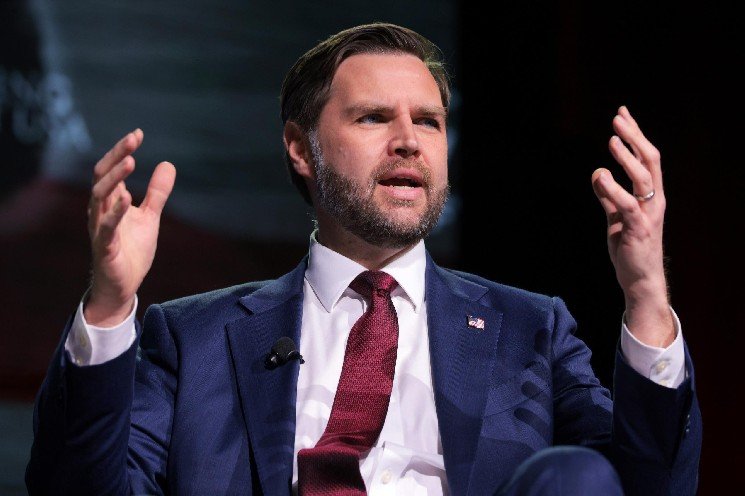
    An old video of JD Vance resurfaced this week in which the then-senator asks a question Washington usually treats as settled: Is issuing the world’s reserve currency actually good for the United States?

    The dollar allows Americans to buy imports cheaply, he observed, while the same strength makes domestic production less competitive.

    Reserve status looks like a prize until you examine the bill.

    Economist Robert Triffin identified the underlying conflict more than sixty years ago. A national currency cannot indefinitely serve both its own economy and the world’s demand for reserves without forcing its issuer into choices that eventually undermine confidence.

    The dollar survived the first Triffin crisis by abandoning gold convertibility and becoming a true fiat currency. The dollar’s value is sustained through Treasury securities, offshore dollar markets, and now stablecoins, but the contradiction remains.

    Bitcoin offers a way out of the dilemma once and for all, because it can perform the neutral reserve function without requiring any country to run deficits, hollow out its industrial base, or promise redemption from a vault. The Triffin dilemma was always a design problem – that is, it was a shortcoming of the tool we call money. With bitcoin, we now have a tool that is better-designed for this job.

    The Question Washington Avoids

    In the video shared by economic historian Phil Magness, Vance calls his own view “super heterodox.” Reserve status creates an obvious subsidy for American consumers because foreign demand for dollars raises the currency’s value. Imports become cheaper, but the other side of that exchange is paid by factories, exporters, and workers whose goods become more expensive to the rest of the world.

    The standard description of the dollar’s “exorbitant privilege” emphasizes America’s ability to borrow cheaply and purchase foreign goods with a currency it issues. Both advantages are real – but so is the structural demand for dollar assets that keeps the exchange rate stronger than it otherwise would be. A stronger currency increases household purchasing power while imposing pressure on tradable industries. The consumer sees the discount at checkout, but that same person might see their job shipped overseas, and never realize the two are tied together.

    This helps explain why Vance’s argument is compatible with the Trump administration’s industrial policy even though the administration also wants to defend dollar primacy. Tariffs, domestic manufacturing incentives, and a global reserve currency pull in different directions. Policymakers can manage the tension for long periods, especially when American productivity and capital markets remain dominant. In any case, they cannot explicitly repeal the monetary architecture that produces it.

    Triffin Predicted The Gold Window Would Break

    Under the Bretton Woods system, other major currencies were fixed to the dollar, and the dollar was convertible into gold at $35 an ounce. As international commerce expanded, governments and banks needed more dollars to settle trade and hold as reserves. The United States supplied them by sending dollars abroad through persistent balance-of-payments deficits.

    In 1960, Triffin explained to Congress how this trap works. If America refused to supply dollars, global liquidity would contract and trade would suffer. If America continued supplying them, foreign dollar claims would eventually exceed the gold available for redemption. The act of serving the system would destroy confidence in its reserve asset.

    The arithmetic won. By the late 1960s, foreign-held dollars had overtaken the United States’ monetary gold, and repeated attempts to defend convertibility merely postponed the reckoning. On August 15, 1971, President Nixon closed the gold window. The Federal Reserve’s own history describes the accumulated deficits and looming gold run that brought Bretton Woods to an end. Triffin had identified the failure mechanism 11 years before it arrived.

    Nixon intentionally broke the promise of gold convertibility before it could produce a scandal by becoming impossible to fulfill. This allowed the dollar system to continue, as Treasury securities gradually became the reserve asset behind the reserve currency. Today, Foreign investors hold about $9.3 trillion in U.S. government debt. The world still accumulates American liabilities to obtain dollar liquidity, and the United States still receives goods and capital in exchange for issuing them.

    The Triffin Dilemma’s Strange Mutation

    The post-1971 system is more flexible than Bretton Woods. Offshore banks can create dollar credit, and the Federal Reserve can supply emergency liquidity through swap lines. Foreign countries can earn dollars through exports, borrow them, or sell assets to American investors. A current-account deficit is therefore less mechanically necessary than it was under gold convertibility.

    However, this flexibility swaps out some financial plumbing while preserving the conflict between domestic and international objectives. Global demand for safe dollar assets draws capital into the United States, supports Treasury borrowing, and keeps the currency strong. Those same forces make American exports less competitive and encourage the country to consume more than it produces. Persistent deficits then create an ever-larger stock of claims whose value depends on confidence in American institutions and fiscal capacity.

    Stablecoins extend this system. Dollar tokens backed by Treasury bills can bring billions of people into the dollar economy and create a new structural buyer for federal debt. Stablecoins may strengthen dollar primacy for decades, but we must bear in mind that every token backed by a Treasury security still rests on an American liability. Stablecoins increase demand for the existing architecture – perhaps dramatically – but do not ease its contradiction.

    A euro or yuan reserve system would do nothing but relocate the burden to a jurisdiction that has a poorer reputation for upholding property rights than the U.S. Additionally, Europe or China would inherit our Triffin Dilemma and feel pressure to supply safe assets, tolerate capital inflows, and subordinate domestic priorities to global liquidity. This is a no-go.

    Keynes proposed a supranational reserve unit called the bancor at Bretton Woods precisely because he recognized the problem with assigning a neutral function to one nation’s money. The idea failed because a synthetic unit administered by governments still requires governance everyone trusts – once again moving the problem instead of solving it.

    Gold Points Toward The Answer, But Isn’t

    Central banks have already begun moving toward a reserve asset that is no nation’s liability. According to the World Gold Council, they purchased more than 1,000 tons of gold annually for three consecutive years after 2022. The freezing of Russian reserves demonstrated that even sovereign assets can become contingent on the issuer’s political approval. Gold offers neutrality because it has no issuer.

    Gold also carries the constraints of atoms. Large transfers require ships, planes, guards, vaults, and assayers. Verifying a sovereign stockpile is expensive and incomplete, an issue I explored in “What If The Gold Is Gone?” Gold’s scarcity is strong by terrestrial standards, though its supply responds to price and advances in extraction. Its monetary neutrality comes with extreme settlement friction.

    Bitcoin combines neutrality with easy, digital final settlement. New supply enters according to a fixed schedule, independent of any country’s trade balance or fiscal policy. Anyone can verify the circulating supply with a “node” (a small computer program). Transferring ownership across borders requires no correspondent bank or physical shipment. No sovereign must issue a liability for another sovereign just so that it may acquire bitcoin.

    Volatility and shallow sovereign adoption currently limit bitcoin’s usefulness as a primary reserve asset. Central banks need liquid markets, established custody, and confidence that large transactions will not destabilize the asset they are buying. Gold has centuries of institutional precedent. Bitcoin has 17 years. The relevant comparison concerns direction rather than present scale. As I argued when asking whether bitcoin could help solve a sovereign debt crisis, reserve transitions begin before the old system admits they are necessary.

    A Reserve Asset Without An Army

    The United States benefits enormously from dollar primacy, and abandoning it abruptly would inflict severe economic damage. Vance’s question matters because the benefit has always carried a cost. America supplies the world with safe assets by creating claims against its own future, then manages the industrial and fiscal consequences of the demand it worked so hard to create.

    Bitcoin makes another arrangement conceivable. The dollar could remain a dominant currency for contracts, taxation, and commerce while bitcoin gradually assumes a larger role as neutral reserve collateral. Stablecoins could expand dollar usage even as governments diversify the assets beneath their long-term savings. Gold and bitcoin could coexist during a transition, with one supplying historical trust and the other supplying verifiable scarcity and rapid settlement.

    Triffin showed that a national currency cannot serve the world forever without eventually placing the issuer’s domestic interests in conflict with its international obligations. Bitcoin resolves the conflict by separating the reserve asset from any one country. The world may continue using dollars because American markets are deep, liquid, and useful, but it no longer has to make America’s deficits the foundation of global money.

  • MS NOW To Launch Direct-To-Consumer Subscription Offering In September

    MS NOW To Launch Direct-To-Consumer Subscription Offering In September

    MS NOW said that it would launch its direct-to-consumer offering on Sept. 9, a service that will include access to 24/7 live streams, original creative content and engagement options with the network’s journalists.

    MS NOW’s Membership, as it is called, will cost $7.99 per month or $79.99 annually. An introductory offering will be available through Sept. 30 for $39.99 for a full year.

    The network has said that the subscription service will be different than other offerings, emphasizing community features and interactivity, as well as a new roster of contributors and experts. The network announced in December that the service would include 24/7 access to the linear network.

    MS NOW President Rebecca Kutler said in a statement, “Our Membership is the first step in a long-term strategy to deepen our relationship with audiences in ways that build on what they already value about MS NOW, while addressing what consumers told us was missing from the news experience. We will continue to research, test, and refine this experience because we want it to be something that our loyal MS NOW fans genuinely love, as well as something that future fans genuinely need.”

    When the network was part of Comcast, certain MSNBC programming was available on Peacock. But that offering ended with the split from the parent company and sister network NBC News. As part of the split, MSNBC rebranded to MS NOW.

    Fox News launched a subscription service, Fox Nation, in 2018, and it has grown through the years as a companion to the news network. It features on demand access to shows like Jesse Watters Primetime and Hannity, but also an extensive slate of lifestyle and entertainment programming. It’s priced at $8.99 a month, or $71.49 for one year.

    CNN debuted an All Access plan last year, including live coverage streams, on demand original series and documentaries and CNN.com access. It’s priced at $6.99 per month, and $69.99 annually.