Taylor Sheridan, Paramount and NBC Universal are all being sued by a writer who says Sheridan stole her idea for a TV show and used it to create Yellowstone.
In the suit, filed in the U.S. District Court for the Central District of California on Friday, TV writer and entertainment journalist Lauren J. Salkin claims she submitted a pilot script, show bible and pitch deck for a show called Sovereign Nation to Sheridan’s reps at his management company, Elevate Entertainment, which is also named as a defendant in the suit, in late 2016 and early 2017.
Sovereign Nation, which Salkin spent more than 10 years developing, is described in the complaint, which was viewed by The Hollywood Reporter, as a “dramatic television series centered on tribal governance, casino-driven economic power and a modern war over land and development.”
Salkin alleges that she received a response from Elevate on Feb. 1, 2017 saying that Sheridan was “unavailable for TV projects.”
“Within months, Paramount greenlit Sheridan’s Yellowstone,” the complaint states.
The show premiered on the Paramount Network on June 20, 2018 and later began streaming on Peacock.
The suit says Yellowstone featured “specific expressive choices already embodied in Salkin’s materials” including “a tribal casino functioning as the institutional center of political and development power; a signature confrontation staged in the tribal chairman’s casino office over expansion beyond reservation boundaries; the use of trust land, the absence of zoning restrictions and a 99-year lease structure as the concrete mechanism for that expansion; and recurring master-plan imagery deployed to dramatize the struggle for territorial control.” Salkin also argues that Yellowstone followed several of her proposed casting recommendations for key roles in Sovereign Nation.
“Copyright law does not protect the abstract idea of a Western, a land dispute, an Indian casino or a powerful family — and that is not Plaintiff’s claim,” the complaint states. “The infringement alleged here lies in the copying of Salkin’s particular expressive choices and their coordinated selection and arrangement.”
The suit also notes that a senior HBO scripted TV executive who had reviewed materials for Sovereign Nation later told her he recognized similarities in Yellowstone.
Salkin argues that the hit Kevin Costner-led series, which has spawned numerous spinoffs, “has generated billions of dollars” for the defendants, of which she “has received nothing.”
Salkin is seeking damages and profits tied to alleged copyright infringement and injunctive relief preventing future infringement.
“This is a classic David-versus-Goliath situation,” Salkin’s attorney Paul B. Lackey told THR. “She spent years putting together the specific and multi-layered framework for a story that has become the biggest streaming success of all time. She has watched the vast commercial success of this story that was stolen from her and decided that enough was enough. We will do everything in our power to get her justice.”
Reps for Sheridan, Paramount, Elevate and NBCUniversal have not yet responded to THR‘s request for comment.
While Amazon usually saves its streaming deals for Prime Day, this HBO Max offer is live on the site now and open to all Prime members with no promo code or contract required. In order to access the free trial, you’ll have to sign up for an Amazon Prime account (which also offers a 30-day free trial) and navigate to the Prime Channels hub. From there, find the HBO Max landing page and select the free trial offer.
If you already have a Prime account, you can just sign in and add an HBO Max account free of charge. Once the week-long trial ends, the ad-supported HBO Max subscription will resume at its regular price of $10.99/month.
There’s never been a better time to add an HBO Max subscription (formerly “Max”) to your Prime Video streaming arsenal. HBO Max has had an exciting lineup of can’t-miss new releases for 2026, including “DTF St. Louis,” the return of Lisa Kudrow’s “The Comeback” and the “Big Bang Theory” spin-off, “Stuart Fails to Save the Universe.”
Returning favorites this year also included the third season of “The White Lotus” and the final season of “Euphoria.”
HBO Max also has hundreds of new films on its roster, including “Marty Supreme,” “The Drama,” “Wuthering Heights,” “We Live in Time,” “Dune: Part Two” and “Joker Folie à Deux,” in addition to beloved shows such as “The Sopranos,” “The Wire” and “Curb Your Enthusiasm.”
HBO Max doesn’t offer a free trial on its own site, so the Prime Video deal is one of the only ways to get the streaming service for free. Worth noting: Amazon has removed this offer from its Prime streaming hub in the past without warning, so we recommend taking advantage of the free trial while it’s still live.
You can also get HBO Max for free through DirecTV, which offers a free subscription when you sign-up for the streamer’s MyEntertainment Genre Pack. Plans start at $42.99/month and get you 60+ live TV channels plus HBO Max, Disney+ and Hulu for free. See the DirecTV deal here.
The launch comes from Layertwo Labs, founded and led by longtime Bitcoin developer Paul Sztorc, also known as Truthcoin. The play is not to rewrite Bitcoin itself. Instead, ECX will become a separate network that copies Bitcoin’s transaction ledger at designated snapshots and hands most bitcoin holders an equal number of coins on the new chain. Someone holding 1 $BTC in a wallet they control at the snapshot will receive 1 ECX on the new network, while the original $BTC stays exactly where it was.
That distinction is critical. A hard fork creates a separate version of a blockchain after sharing the same historical record. ECX will take Bitcoin’s existing ledger as its starting point, but it will run its own software settings, mining difficulty, nodes, and economic activity. Bitcoin users do not have to participate, and their $BTC is not converted, locked, or moved. The fork simply creates another asset attached to the same wallet addresses at the snapshot.
ECX Will Leverage a 3-Phase Launch
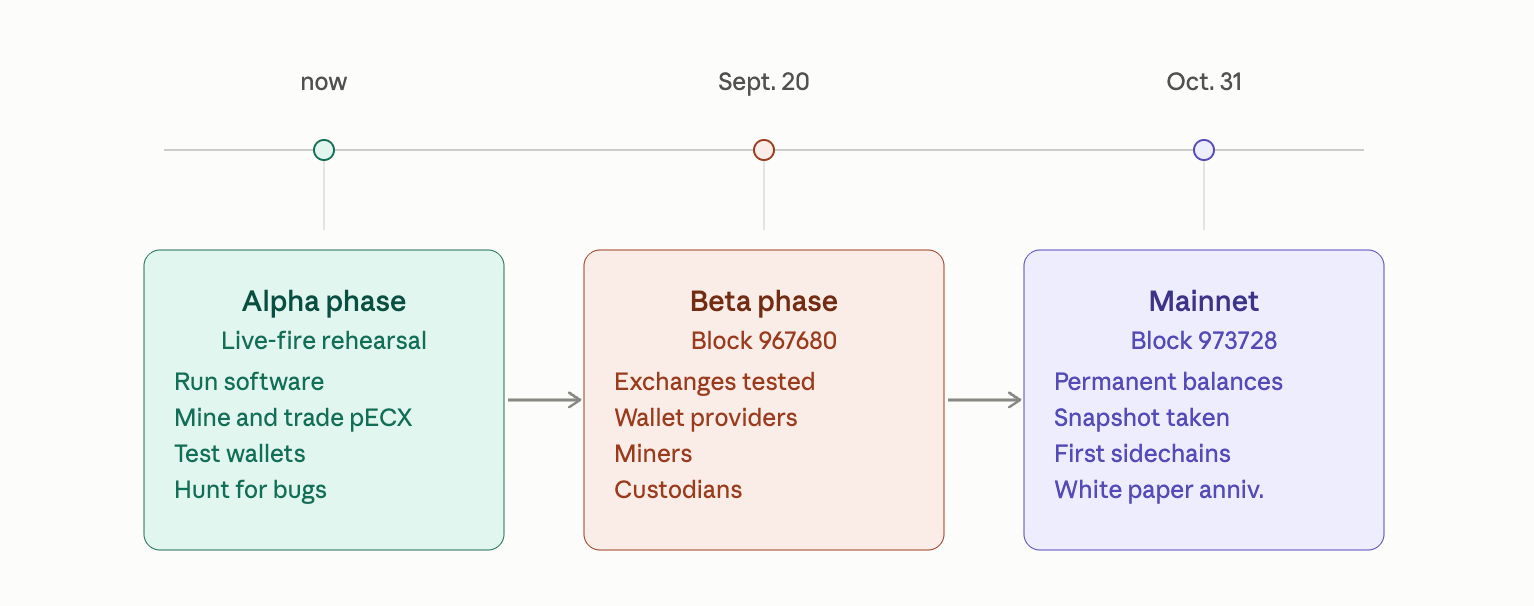
According to Sztorc, the alpha phase is designed as a live-fire rehearsal. Participants can run software, mine, trade practice coins, test wallets, and hunt for cracks in the system. The practice coins, called pECX or alpha ECX, are not permanent.
A beta phase is scheduled around Sept. 20 at Bitcoin block height 967680. That round is expected to lean harder on exchanges, wallet providers, miners, and custodians, the companies that safeguard assets for others.
A visual perspective of Paul Sztorc’s upcoming fork and its phases.
The permanent mainnet is scheduled for Oct. 31, near Bitcoin block 973728. That lands on the 18th anniversary of Satoshi’s Bitcoin white paper. At that snapshot, permanent ECX balances will be created, and the project expects its first batch of specialized sidechains to become available. The drawn-out rollout gives developers and infrastructure providers room to expose bugs, gauge mining conditions, and install safeguards before the permanent chain goes live.
Drivechains Are the Main Bet
Sztorc has spent more than a decade pushing Drivechains, a proposed way to let Bitcoin support optional sidechains without rewriting the rules for every user. A sidechain is a separate network with different features that can connect to a main blockchain. In practice, users could choose a sidechain for privacy, faster payments, or other functions while leaving the base network relatively conservative.
The proposed technology surfaced in BIP 300 and BIP 301, technical proposals Sztorc developed in 2017 and 2019. BIP 300 lays out a mechanism for moving assets between a main chain and sidechains. BIP 301 describes blind merged mining, which would let miners collect sidechain fees without running all of the software for every sidechain.
Those proposals never gathered enough support to activate on Bitcoin through a soft fork, a backward-compatible rules change. Bitcoin’s most recent major soft fork, Taproot, was activated in 2021. Layertwo Labs ultimately decided its Drivechain vision had a better shot as a separate hard fork than another campaign to win consensus from Bitcoin developers, miners, and node operators.
ECX plans to launch with seven specialized sidechains, including Thunder for high-throughput payments, Zside for shielded transactions, Bitnames for decentralized identity, Bitassets for token issuance, Photon for quantum-resistant signatures, Truthcoin for prediction markets, and Coinshift for cross-chain trading. The wager is that users can pick features without forcing every bitcoin user to swallow new base-layer rules.
Bitcoin Will Remain Unchanged
The project uses the same SHA-256d mining algorithm as Bitcoin and keeps its base layer close to Bitcoin Core, the dominant Bitcoin software. However, it will run its own network identifier and ports, keeping ECX nodes from mistakenly connecting to Bitcoin. The chain will reset mining difficulty to the minimum at launch before returning to normal adjustments, a setup likely to make early mining conditions fairly volatile.
One unique rule from the outset involves roughly 1.1 million early Bitcoin coins associated with Satoshi Nakamoto through the “Patoshi pattern,” a method researchers use to identify likely early-mined blocks. About 600,000 ECX will remain assigned to those addresses, while roughly 500,000 ECX will be redirected through special transactions to early investors and development funding. Supporters frame that as financing a new network without an initial coin offering. The move does not touch Satoshi’s $BTC on Bitcoin.
The project also stands far apart from the recent BIP-110 episode, an attempted temporary soft fork aimed at restricting some non-financial blockchain data. BIP-110 backers failed to attract meaningful miner support, node support, and infrastructure backing in any meaningful way, and the resulting minority chain stalled after a small handful of blocks. ECX is not trying to force rules onto Bitcoin. It is a separate experiment built to fight for users, miners, and capital while the Bitcoin network runs normally.
Self-Custody and Claiming Free Coins
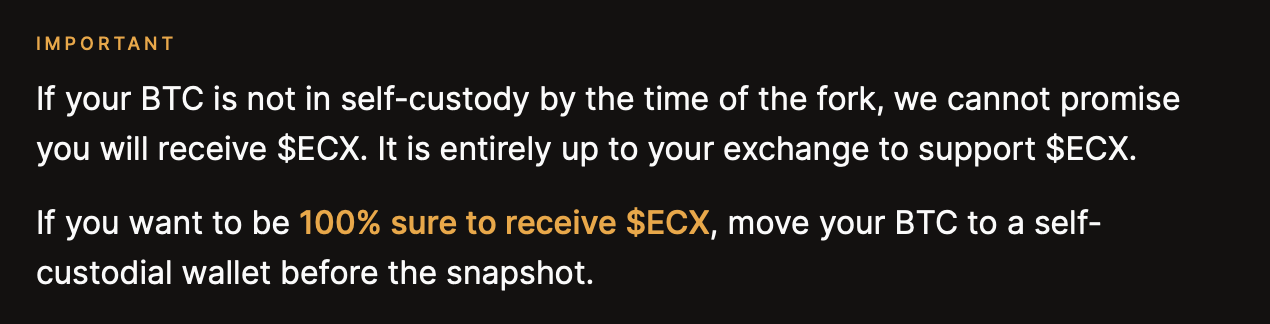
For individual holders, the crucial question is who controls the private keys at each snapshot. A private key is the secret credential proving control of a Bitcoin address. People holding $BTC in self-custody, meaning in a wallet where they control those keys, should be able to access their corresponding ECX directly. People keeping $BTC at exchanges or other custodians are stuck waiting to see whether those companies support the fork and distribute the new asset.
The ECX snapshot credits coins straight to bitcoin ($BTC) addresses, meaning whoever holds the private keys controls the matching ECX. If $BTC sits on an exchange, the exchange holds those keys and effectively controls the forked ECX, leaving customers at its mercy for distribution. Self-custody cuts out that middleman, putting the keys in the holder’s hands and giving them direct control over the corresponding ECX. Image source: ecash.com.
There is no established market price for permanent ECX because mainnet has not launched. During testing, some future-backed ECX trading could emerge, and even if exchanges list ECX, expect wildly speculative price discovery. The bigger question is whether ecash (ECX) gets warmer treatment than the recent BIP-110 fiasco. There is an ECX wallet for Apple (Testflight) and Android, while project docs also spotlight Bitwindow, an alternative Bitcoin Core frontend with native drivechain support.
The real fight starts after Oct. 31. ECX will need working sidechains, stable software, willing exchanges and enough miner participation to show that its combined fee model actually works. Bitcoin holders seeking direct access should track the snapshot heights, maintain control of their keys and stick with official guidance. They should also remember that ECX has nothing to do with XEC, the separate cryptocurrency that uses the same ecash name.
The LGMI Awards were handed out on Saturday night and honor the use of filming locations across motion pictures, television, commercials, film commissions, and special achievement categories.
Paul Thomas Anderson’s “One Battle After Another” won outstanding locations in a contemporary feature film. It was shot across California’s Humboldt County, Sacramento, Stockton, Eureka, Arcata, San Diego and El Paso, Texas. Josh Safdie’s “Marty Supreme” won outstanding locations in a period feature film for its work across New York City, greater New York, the Hudson Valley, New Jersey and Tokyo.
“Pluribus,” “Fallout” and “Black Rabbit” were the television winners. “Pluribus” was filmed in Albuquerque, New Mexico, Montana, Nevada, and Spain, and won outstanding locations in a contemporary television series. “Fallout,” shot in California’s Dumont Dunes, Mojave Desert, Antelope Valley and Santa Clarita,” won outstanding locations in a period television series. Filmed around New York City, including Brooklyn and Manhattan, “Black Rabbit” won outstanding locations in a tv anthology, movie or limited series.
Four-time Emmy-winning director and writer Vince Gilliga received the Eva Monley Award for his dedication to storytelling through location over his career and his most recent work on “Pluribus.”
Mike Fantasia, location manager of films including “Top Gun: Maverick,” “Killers of the Flower Moon” and “Spider-Man: Homecoming” was presented the Lifetime Achievement Award.
“Celebrating our LMGI winners was a truly remarkable experience,” Nancy Haecker, LMGI Awards Chair, said. “The ceremony was a powerful celebration of achievement, filled with inspiring moments and well-deserved recognition, beautifully capped by the genius of Vince Gilligan. Each of this year’s winners is incredibly deserving, and it was a distinct privilege to honor their talent, dedication, and outstanding contributions to our industry.”
Winners list below.
OUTSTANDING LOCATIONS IN A CONTEMPORARY FEATURE FILM
“One Battle After Another” (Warner Bros. Pictures)
Michael Glaser / LMGI, Michael Wesley / LMGI, Rich Heichel / LMGI
OUTSTANDING LOCATIONS IN A PERIOD FEATURE FILM
“Marty Supreme” (A24)
Matthew Kania, Ross Brodar / LMGI
OUTSTANDING LOCATIONS IN A CONTEMPORARY TELEVISION SERIES
“Pluribus” (Apple TV+)
Christian Diaz de Bedoya / LMGI, John O’Connor, Priscila Calero, Jorge Noguerales,
Yanira De Armas, Will Brewster
OUTSTANDING LOCATIONS IN A PERIOD TELEVISION SERIES
“Fallout” – Season 2 (Amazon Prime Video)
Mandi Dillin / LMGI, David Park / LMGI
OUTSTANDING LOCATIONS IN A TV ANTHOLOGY, MOVIE OR LIMITED SERIES
“Black Rabbit” (Netflix)
Paul Eskenazi, Joel McGlumphy
OUTSTANDING FILM COMMISSION/ OFFICE
Humboldt-Del Norte Film Commission: “One Battle After Another” (Warner Bros. Pictures)
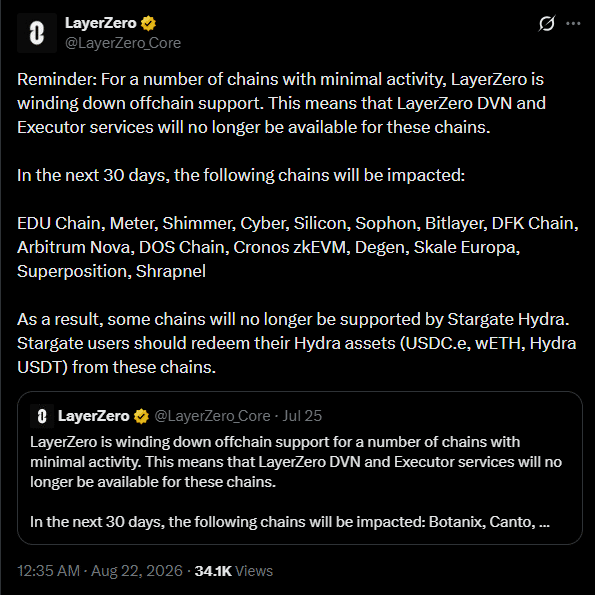
Cross-chain interoperability provider LayerZero will withdraw off-chain support for 14 low-activity chains, including Arbitrum Nova.
In its latest statement, the firm said that its DVN (decentralized verifier network) and Executors, collectively responsible for off-chain communication between different chains, will be deprecated for the 14 chains.
The affected networks include Cronos zkEVM, Degen, Skale Europa, Superposition, Shrapnel, and more. As a result, some assets, including stablecoins (USDT and USDC) across these chains, could be stranded if not moved before the full shutdown.
According to LayerZero, the off-chain support will be axed in 30 days (by September).
Source: X
Since July, LayerZero has flagged over 30 chains with low activity, including the recently shut BounceBit. Although the move is positioned as operational efficiency, security risk and competition seem to be key reasons behind the aggressive shift.
Chainlink CCIP traction threatens LayerZero
LayerZero has massive financial backing, including top-tier VC firms such as Sequoia Capital, a16z (Andreessen Horowitz), Binance Labs, and Coinbase Ventures.
And the bet was simple: bridge the fragmented liquidity across various blockchains. But the KelpDAO’s $292M hack, one of the largest DeFi exploits in 2026, triggered a massive fallout.
The exploit stemmed from LayerZero’s recommended “1-of-1” DVN setup, which doesn’t give enough verification before large minting or fund transfers are approved. Since the same loophole can be used with low-adopted reserve assets, Aave has stopped supporting most of them, including ghost chains.
In fact, several projects have since migrated from LayerZero to rival Chainlink CCIP (Cross-Chain Interoperability Protocol). Notably, the Wyoming state government, BitGo (WBTC), and Nethermind have migrated from LayerZero to CCIP.
Chainlink’s Zach Rynes estimated that a total of $15B has been migrated from LayerZero, underscoring the expensive lesson for LayerZero for the KelpDAO fallout.
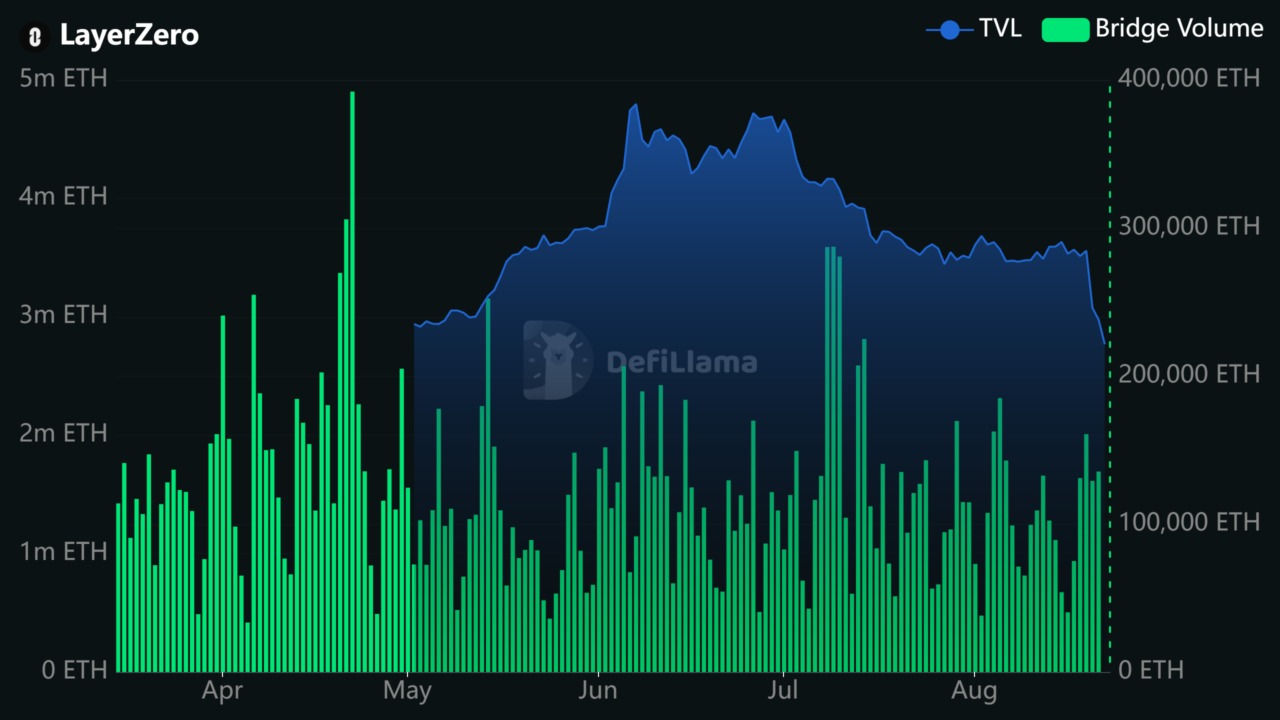
Notably, after the exploit, LayerZero bridged volume dropped 4x from nearly 400K $ETH to about 100K $ETH.
Source: DeFiLlama
As such, LayerZero’s aggressive move to wind down support for over 30 chains may be viewed as a strategic play to reduce its security risk exposure. By extension, it’s meant to counter Chainlink CCIP’s growing competition after the KelpDAO exploit.
But whether that’s enough to stop its top projects from migrating to Chainlink remains to be seen.
Final Summary
LayerZero to withdraw support for 14 chains by September.
Chainlink CCIP has attracted over $15B in assets migrating from LayerZero since the KelpDAO hack.
Coinkite, the maker of the Coldcard Bitcoin hardware wallet, released new standard firmware on Aug. 20 that forces users to add physical randomness whenever they generate a seed.
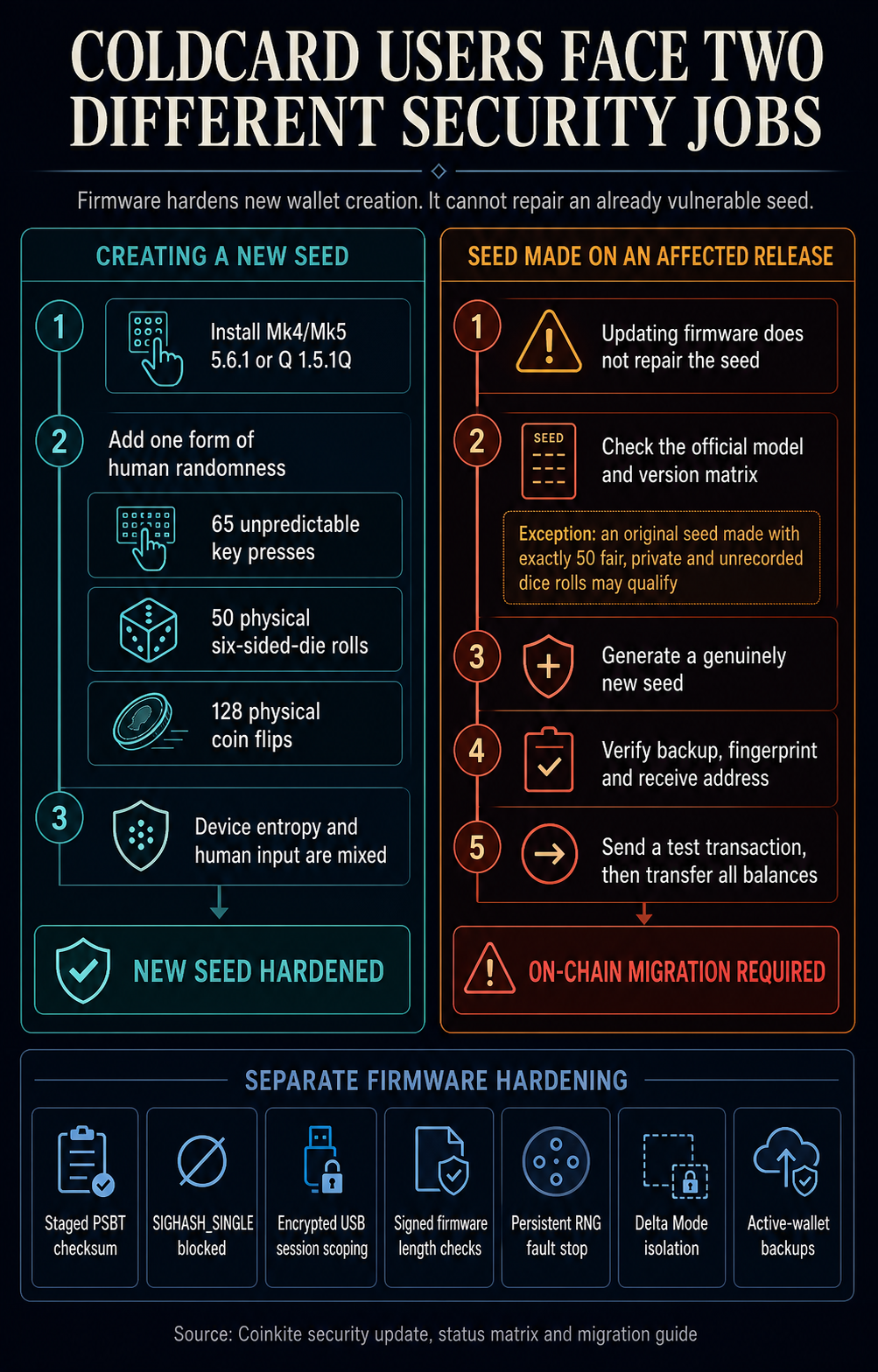
Owners who generate a seed after installing the current fixed release can use the hardened process. Owners still relying on a seed produced by affected firmware must generate another seed and transfer the funds unless that wallet meets the dice-roll exception.
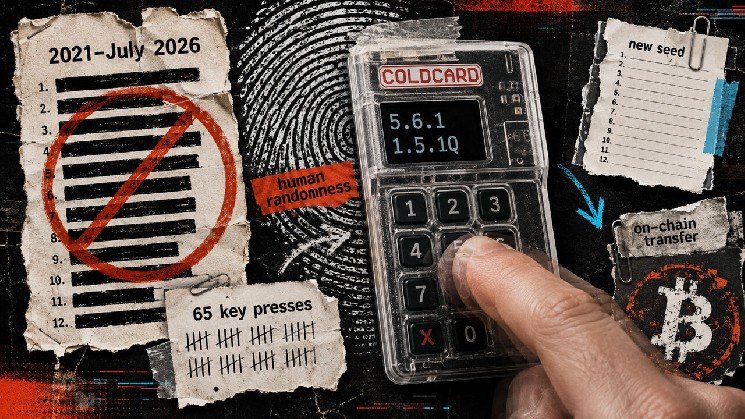
During standard seed creation, every seed combines fresh device entropy with one required human input source: at least 65 key presses made at unpredictable intervals, 50 rolls of a physical six-sided die, or 128 physical coin flips. The requirement reduces reliance on the wallet’s random-number generator alone.
Coldcard’s current security status recommends version 5.6.1 for Mk4 and Mk5 devices and 1.5.1Q for Q devices. The advisory’s exposure list is wider and track-specific. Coinkite’s official migration guidance covers Mk2 and Mk3 firmware 4.0.1 through 4.1.9; Mk4 and Mk5 standard firmware before 5.6.0 and Edge firmware before 6.6.0X; and Q standard firmware before 1.5.0Q and Edge firmware before 6.6.0QX.
Block’s independent technical analysis uses a broader Mk2 and Mk3 boundary that includes version 4.0.0. Owners of that release should not treat the vendor boundary as proof of safety.
Installing fixed firmware does not change an old seed. Unless the advisory’s dice exception applies, Coinkite’s migration guide tells affected users to generate a genuinely new seed, verify its backup and wallet fingerprint, confirm a receiving address on the device, send a small test transaction, and then transfer every balance tied to the old seed. Cloning or restoring the wallet does not create a new seed.
Migration is not required for this RNG flaw when the user added at least 50 fair, independent and private physical die rolls through the affected workflow and never recorded or exposed the sequence. Fewer rolls, or uncertainty about those conditions, means the user should migrate.
Block traced the original defect to code that could route requests to a deterministic MicroPython fallback because a feature flag defined as zero was treated as present. Mandatory human input adds outside entropy to new standard seeds, limiting damage if device randomness fails again. It cannot retroactively add entropy to a seed that already exists.
Coldcard treats the mixed flow differently from the advanced Dice Rolls Only option. That mode excludes hardware randomness and requires 50 rolls for a 12-word seed or 99 for a 24-word seed.
The firmware package reaches signing and data paths too. It binds USB review to a staged PSBT checksum, rechecks transaction bytes before signing, blocks SIGHASH_SINGLE modes by default, restricts USB downloads to the current encrypted-session result, and validates firmware file length. It adds persistent RNG-fault stops, a boot-time hardware-RNG linkage check, more Delta Mode isolation, and active-wallet backup behavior.
The status page lists targeted source review, a real-device RNG-path test, and a reproducible build and dice-path trace, but Coldcard says they do not amount to a full audit of every fixed binary. Coinkite says some customers suffered severe losses and law enforcement is investigating, but it has not published a verified victim count or loss total.
Provincial premiers have joined Canada’s Prime Minister Mark Carney, firing back after US President Donald Trump imposed 50% tariffs on about $20bn of Canadian goods. British Columbia Premier David Eby said Trump can’t be trusted.
The Apple Vision Pro may have broken new technical ground when it debuted two years ago, but after the first wave of early adopters, sales of the $3,499, 22-ounce headset haven’t exactly reached blockbuster levels. Apple reportedly cut production at the start of 2026, following Q4 sales that were estimated at just 45,000 by IDC. Unconfirmed reports even circulated of Apple’s incoming CEO John Ternus axing plans for a Vision Pro 2 or lightweight Vision Air entirely.
Now, Apple is reportedly slicing roughly 200 jobs from across its Apple Vision and Siri teams, with about 100 staff from each segment up for the chop.
According to Bloomberg’s Mark Gurman, the Vision Pro gaming team is set to be one of the worst affected, and will be largely shut down. This team had worked on developing the gaming ecosystem surrounding the headset.
It’s also reportedly reducing the size of the Vision Pro immersive video content team, which works on building custom VR content for the platform, though it will still produce smaller-budget videos and encourage third-party producers to develop content for the platform. Bloomberg notes that production costs for these types of videos can run into the millions.
Meanwhile, Apple’s decision to reshuffle the Siri team is reportedly due to pleas for the next version to be built on new technical infrastructure, “prompting the company to eliminate a small number of existing roles, reallocate resources, and create new positions supporting the updated Siri.” Some members of Apple’s Intelligent Systems Experience, a software engineering team that works on some AI features on its devices, are also set to lose their roles.
Apple chalked up the changes to an attempt to realign priorities based on how customers were using the device, and allocate resources toward other products.
Recommended by Our Editors
Consumers interested in investing in an Apple headset may have more options soon, despite the cuts to the Vision Pro division. Apple is reportedly set to debut its new range of smart glasses, which will compete with Meta’s Ray-Ban line-up, at some point in 2027, though a release timeline hasn’t been officially confirmed.
Gurman added that Apple is still considering a new Vision Pro model for release by the end of 2028 at the earliest.
About Our Expert
Experience
I’m a reporter covering weekend news. Before joining PCMag in 2024, I picked up bylines in BBC News, The Guardian, The Times of London, The Daily Beast, Vice, Slate, Fast Company, The Evening Standard, The i, TechRadar, and Decrypt Media.
I’ve been a PC gamer since you had to install games from multiple CD-ROMs by hand. As a reporter, I’m passionate about the intersection of tech and human lives. I’ve covered everything from crypto scandals to the art world, as well as conspiracy theories, UK politics, and Russia and foreign affairs.
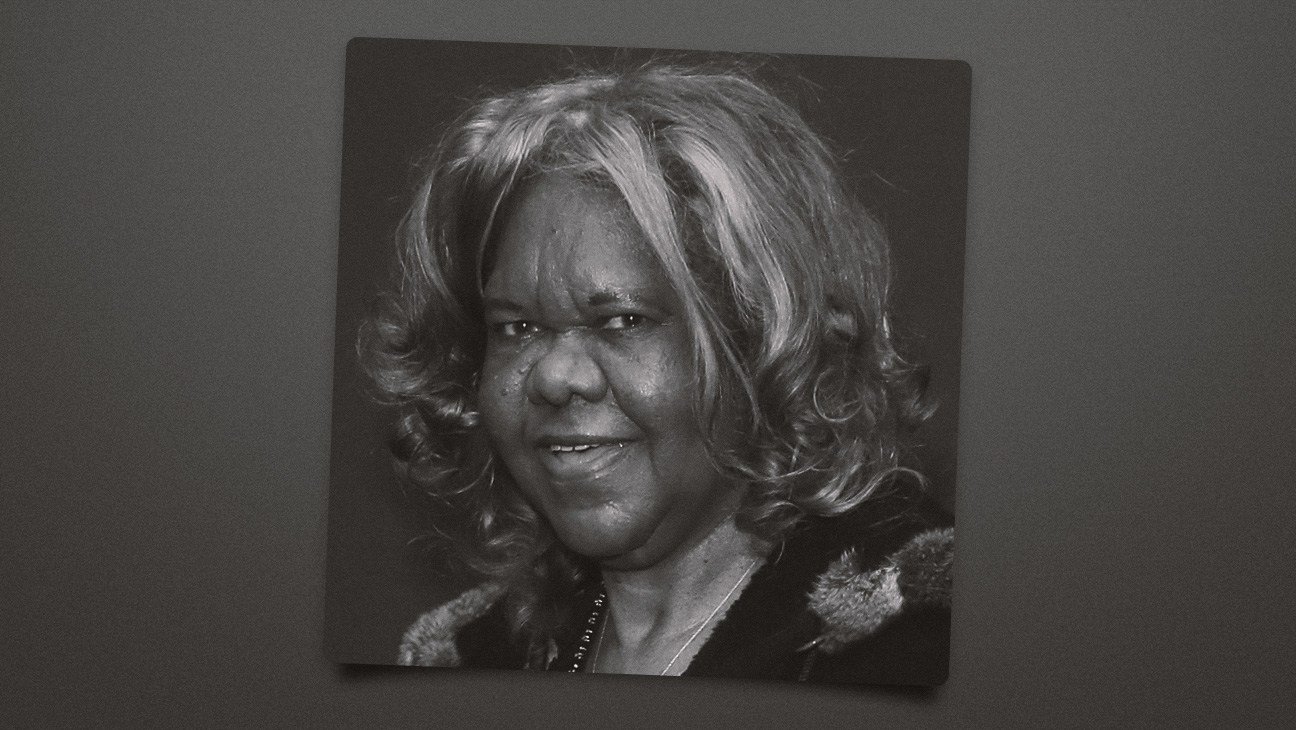
Janie Bradford, the onetime receptionist for Berry Gordy who co-wrote the R&B classic “Money (That’s What I Want),” the first big hit for the founder of Motown Records, has died. She was 87.
Bradford died Friday at Cedars-Sinai Medical Center in Los Angeles after an extended illness, her family announced.
Bradford also co-wrote “Too Busy Thinking About My Baby,” which Marvin Gaye took to No. 4 on the Billboard Hot 100 in 1969, and songs for other artists including Mary Wells, Stevie Wonder, The Temptations, the Four Tops and Martha & the Vandellas.
She later served as head of writer relations for the Motown publishing company Jobete.
Born on June 2, 1939, in Charleston, Missouri, Bradford was inspired to be a writer after her idol, poet Robert Frost, visited her high school.
While living in Detroit with her sister, Clea, she became neighborhood friends with singer Jackie Wilson, who had just charted with his first solo single, the 1957 party anthem “Reet Petite.” Wilson invited her to meet Gordy, one of the song’s writers, and she gave him a collection of her poetry.
After Gordy had launched the Tamla and Motown labels in 1959, he hired Bradford as a receptionist. One day, as Gordy was working on a song, Bradford joined him at the piano to add her own verse — “Your love gives me such a thrill, but your love don’t pay my bills. Gimme some money, baby!”
The song, of course, would become “Money (That’s What I Want).” First recorded by Barrett Strong, it peaked at No. 23 on the Hot 100 and helped cement Tamla/Motown as hit-makers. It would be covered by The Beatles, The Rolling Stones, The Flying Lizards, The Supremes, Boyz II Men and Charli XCX, among many others.
“Janie was there with me from the very beginning, before there was even a Motown, and she will always hold a very special place in my heart and in the Motown family,” Gordy said in a statement.
“Janie was smart, clever, witty and fun. She was also talented and determined. In those early days, everybody did what was needed to be done, and Janie was no exception. She became Motown’s first receptionist, but her talents quickly took her far beyond that desk.”
Bradford’s credits also included “Contract on Love,” recorded by Little Stevie Wonder, Wells’ “Your Old Standby,” Diana Ross’s “I Am Me” and The Supremes’ “Time Changes Things” and “We Should Be Closer Together.”
After some 25 years at Motown, Bradford in the 1990s founded the Heroes and Legends Awards, an event that over 30 years honored music icons and presented scholarships to those pursuing higher education.
“Her annual gatherings always felt like old home week because Janie kept that wonderful sense of family alive,” Gordy said.
In June, she was inducted into the Women Songwriters Hall of Fame.
Survivors include her husband of 55 years, Wardean; her children, Lance and Nicole; her daughter-in-law, Carolyn; and her grandsons, Bradford and Austin.
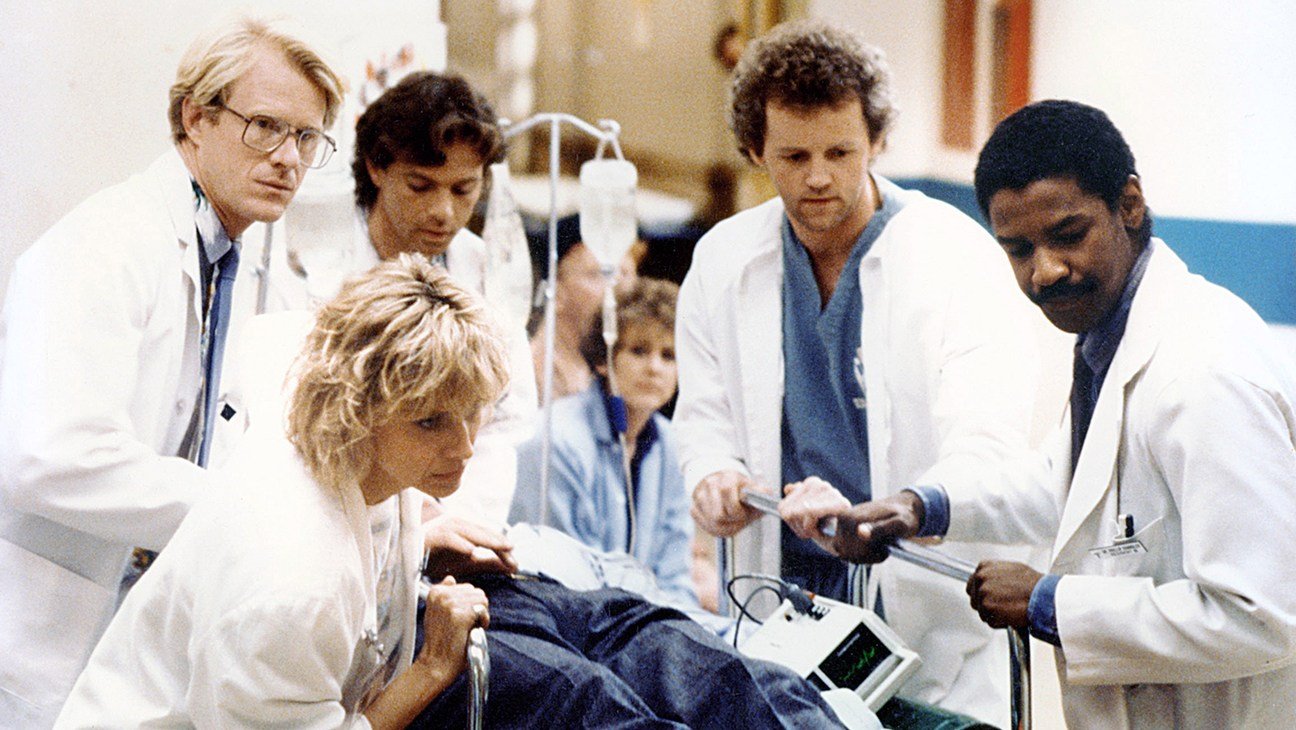
Though it was never an outright hit, St. Elsewhere punched way above its weight in terms of the careers it helped launch and a style that set the template for medical dramas that followed it. The show can also boast one of the more memorable series finales in TV history.
Created by Joshua Brand and John Falsey, St. Elsewhere followed the staff and patients at a struggling Boston hospital over six seasons on NBC, from 1982 to 1988. Like its fellow NBC show Hill Street Blues (both were from MTM Enterprises), St. Elsewhere pioneered a new kind of storytelling. Hospital dramas that came before it focused mainly on a lead character whose personal struggles didn’t interfere with their work and presented the health care system as orderly and well functioning (see Marcus Welby, M.D., Trapper John, M.D.). St. Elsewhere instead took a grittier tack, with overlapping, serialized stories and medical professionals who had complicated lives and sometimes could not save patients — traits that are recognizable in its successors, from ER to Grey’s Anatomy to The Pitt.
When the series debuted, that style was seen as a barrier to success: Reviewing the show in November 1982, THR critic Richard Hack wrote, “So real and graphic is the drama being presented here that we cannot believe that 20 million people across this country will find it entertaining enough to flip to.”
Nonetheless, St. Elsewhere would win 13 Emmys over its run, including six for its fourth season in 1986. It was nominated for best drama series in all six seasons, though it never took home that honor.
Three of the show’s regulars — William Daniels, Bonnie Bartlett and Ed Flanders — won acting Emmys for their roles. Equally impressive was the show’s eye for emerging talent: It helped kick-start the careers of Denzel Washington, Mark Harmon and David Morse, as well as comedian Howie Mandel, playing against type in a dramatic role.
The 1988 series finale cemented St. Elsewhere’s place in TV lore by suggesting that the entire show may have taken place inside the imagination of Tommy Westphall (played by Chad Allen), the autistic son of Flanders’ Dr. Donald Westphall. It was perhaps the most audacious choice an already groundbreaking show ever made.
This story first appeared in an August stand-alone issue of The Hollywood Reporter magazine. To receive the magazine, click here to subscribe.