Blog

  • Cathie Wood Keeps Buying Circle Stock Despite 42% Price Slide

    Cathie Wood Keeps Buying Circle Stock Despite 42% Price Slide

    ARK Invest’s founder says Wall Street analysts do not understand the stablecoin issuer’s business model.

    Cathie Wood has kept buying Circle shares through a steep decline, according to reports from BeInCrypto and Yahoo Finance. The stock has dropped 42% from earlier levels this year. Wood, founder of ARK Invest, said Wall Street analysts covering Circle cannot fathom the company’s true worth.

    Circle is the issuer of $USDC, one of the largest dollar-pegged stablecoins in circulation. The company went public earlier this year, drawing significant attention from both traditional finance and crypto-native investors. Its stock performance since listing has been volatile, reflecting broader uncertainty about how markets should value stablecoin issuers.

    ARK Invest has built a reputation for taking concentrated, high-conviction positions in companies it believes are misunderstood by mainstream analysts. Wood has previously made similar bets on names in electric vehicles, genomics, and other disruptive technology sectors. Her continued accumulation of Circle shares during a sharp price decline fits that established pattern.

    Stablecoins occupy a unique position in financial markets. They function as digital dollar substitutes, used heavily in crypto trading, cross-border payments, and increasingly in traditional settlement systems. Circle’s revenue model depends partly on interest earned from reserves backing $USDC, making the company sensitive to interest rate movements and regulatory treatment of stablecoin reserves.

    Analyst skepticism toward Circle likely stems from several factors. These include competition from other stablecoin issuers, regulatory uncertainty around stablecoin legislation, and questions about how sustainable reserve-based revenue will be if interest rates decline. Wood’s public comments suggest she views these concerns as overstated or already priced into a lower valuation.

    The timing of Wood’s remarks comes as stablecoin regulation remains a live policy topic in the United States and elsewhere. Legislative efforts to establish clearer rules for stablecoin issuers have progressed at various paces across jurisdictions. Any regulatory clarity, positive or negative, could materially affect how investors value Circle relative to peers.

    Wood’s willingness to buy through a substantial drawdown signals confidence that current pricing does not reflect Circle’s long-term prospects. Whether that conviction proves correct will depend on factors including $USDC‘s market share, interest rate trends, and the pace of stablecoin regulatory frameworks taking shape.

    Market Impact

    ARK Invest’s continued buying could draw additional investor attention to Circle at a moment when its share price is under pressure. Institutional investors sometimes watch high-profile fund managers for signals about undervalued assets, though such buying does not guarantee a price recovery.

    The episode also highlights a broader disconnect between how traditional equity analysts and crypto-focused investors value stablecoin issuers. Divergent views on Circle’s business model may persist until stablecoin regulation and interest rate trends become clearer, which could keep volatility elevated in the stock.

    Cathie Wood’s continued purchases of Circle stock underscore her long-standing strategy of backing companies she believes the market has mispriced. The outcome will hinge on how stablecoin regulation and interest rate conditions evolve in the months ahead.

    Frequently Asked Questions

    What does Circle do?

    Circle is a financial technology company that issues $USDC, a stablecoin pegged to the U.S. dollar and widely used in crypto trading and payments.

    Why has Circle’s stock fallen 42%?

    The reports do not specify a single cause, but stablecoin issuers face pressure from regulatory uncertainty, interest rate sensitivity, and competition from other stablecoin providers.

    Why is Cathie Wood buying Circle shares during the decline?

    Wood has said analysts do not understand Circle’s long-term value, reflecting ARK Invest’s typical strategy of accumulating positions in companies it views as misunderstood.

    How could stablecoin regulation affect Circle’s stock?

    Clearer rules on stablecoin reserves and issuance could reduce uncertainty, while unfavorable regulation could pressure the company’s revenue model further.

  • Peter Schiff Says AI Could Turn Into Bitcoin’s Biggest Threat

    Peter Schiff Says AI Could Turn Into Bitcoin’s Biggest Threat

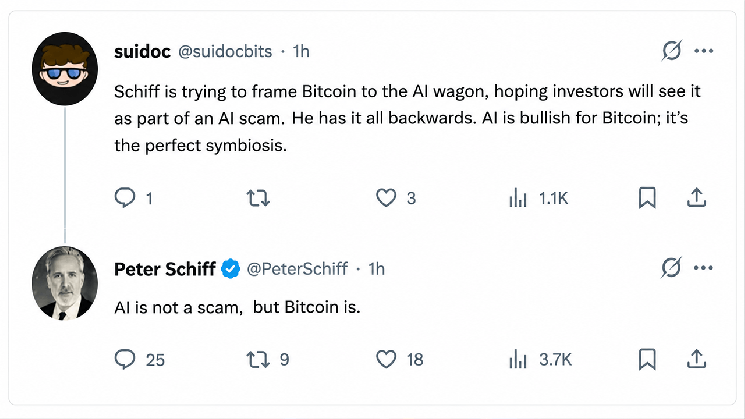
    The gold advocate and longtime $BTC critic made the argument Sunday afternoon, saying bitcoin supporters are attempting to connect the cryptocurrency with the booming AI investment trade when the technologies may actually be competitors.

    “Bitcoin pumpers are trying to hitch Bitcoin to the AI wagon, hoping investors will see it as part of the AI trade. They have it backwards. AI isn’t bullish for Bitcoin; it’s a threat to it,” Schiff wrote on the social media platform X.

    “AI competes with Bitcoin for speculative capital, electricity, and>Bitcoin miners have already felt that pressure. Some mining companies have begun converting portions of their infrastructure to support AI and high-performance computing (HPC) because those businesses can offer another source of revenue.

    That development, however, does not necessarily threaten the Bitcoin network itself. It creates competition for bitcoin mining companies, which must decide whether using available electricity for mining or AI computing produces better returns.

    Bitcoin was designed to adjust when mining participation changes. Roughly every 2,016 blocks, the network changes its mining difficulty to keep blocks arriving around once every ten minutes. If substantial computing power leaves Bitcoin, mining eventually becomes easier for the remaining participants.

    $BTC supporters and Schiff critics quickly piled into the economist’s X thread. “AI is a threat to gold more than it is to Bitcoin, Peter,” one account fired back. Schiff, apparently unconvinced, responded, “How so?” The user then laid out the counterargument:

    “You could ask AI yourself … But here you go … 1. AI finds huge new gold deposits. 2. Robots make mining far cheaper. 3. AI unlocks low-grade/deep-sea gold. 4. Better tech dramatically improves gold recycling. 5. Eventually, asteroid mining could flood supply. 6. More supply + less scarcity → gold prices fall.”

    AI Security Warning Faces a Higher Bar

    Schiff’s second argument goes further. He says increasingly powerful AI could discover vulnerabilities in Bitcoin’s code, cryptography, wallets or network that human researchers have overlooked. Software vulnerabilities are possible, and Bitcoin is not magically immune to programming mistakes. Wallet applications, exchanges, and Bitcoin implementations can contain bugs, which is why developers continually review and test software.

    Finding a bug, however, is not the same as changing Bitcoin’s monetary rules. Bitcoin’s 21 million supply limit is enforced by independently operated worker nodes, computers that verify whether transactions and blocks follow the network’s rules. Software attempting to create bitcoin outside those rules would be rejected by nodes still enforcing them.

    A fundamental break in Bitcoin’s cryptography would represent a much larger problem. Modern banking, secure websites, corporate systems, and government communications also depend heavily on cryptographic security. An AI system capable of defeating widely used cryptography could therefore threaten far more than Bitcoin.

    AI Could Strengthen the Defenses

    There is another problem with treating AI solely as an attacker. Developers and security researchers can use the same technology to examine code, discover bugs, automate testing, and identify weaknesses before criminals exploit them.

    That leaves Schiff’s strongest point centered on economics rather than Bitcoin’s ultimate survival. AI can compete with bitcoin miners for electricity, capital, and data centers, potentially squeezing mining margins and accelerating the industry’s search for cheaper power.

    What matters next is whether that competition pulls substantial computing power away from the Bitcoin network and whether AI produces meaningful advances in vulnerability discovery. For now, competition between AI and bitcoin mining is somewhat measurable, although muddy, while the prospect of AI breaking Bitcoin’s fundamental rules remains misguided.

  • Shelley Fabares, Star of ‘The Donna Reed Show’ and ‘Coach,’ Dies at 82

    Shelley Fabares, Star of ‘The Donna Reed Show’ and ‘Coach,’ Dies at 82

    Shelley Fabares, the wholesome daughter on The Donna Reed Show who went on to star opposite Elvis Presley in three movies and as Craig T. Nelson’s independent wife on Coach, has died. She was 82.

    Fabares died Saturday in Los Angeles after a brief illness, her family announced. Survivors include her husband, M*A*S*H actor Mike Farrell, whom she married in 1984.

    “To her family and friends, Shelley was a source of love, strength, laughter and comfort,” they said in a statement. “She was a devoted wife, cherished stepmother, daughter, sister, niece, aunt, family member and loyal friend whose warmth, generosity, humor and grace made an enduring difference in the lives of everyone who knew her. She had a remarkable ability to make people feel welcomed, valued and cared for.”

    On the original One Day at a Time, Fabares played against her prim, good-girl persona as Francine Webster, a nasty business rival of Bonnie Franklin‘s Ann Romano. (Her late aunt, Caesar’s Hour and The Band Wagon star Nannette Fabray, also appeared on the CBS sitcom, playing the mother of Franklin’s character.)

    Fabares also portrayed the wife of doomed Chicago Bears running back Brian Piccolo (James Caan) on the landmark 1971 ABC telefilm Brian’s Song.

    On The Donna Reed Show, which aired on ABC for eight seasons, from September 1958 through March 1966, Fabares played high schooler Mary Stone opposite Reed as her mom, homemaker Donna Stone; Carl Betz as her pediatrician dad, Dr. Alex Stone; and Paul Petersen as her younger brother, Jeff.

    When Mary left for college at the start of the sixth season, the Stones adopted a daughter, Trisha (Patty Petersen, real-life sister of Paul).

    Capitalizing on her national fame, Fabares — backed by Darlene Love and the Blossoms and Glen Campbell on guitar — recorded a version of “Johnny Angel,” which went to No. 1 on the Billboard Hot 100 in April 1962. She had debuted the song on a Donna Reed episode a couple months earlier.

    “I literally cannot sing. So there’s a lot of overdubbing,” she admitted in a 1983 interview. “The girls in the back — ‘Could you sing a little louder please?’ It was unusual. But [The Donna Reed Show] was very successful at that time, so [the song] had a built-in audience.”

    During “live” performances — in “the days when they would play the record and you would lip sync” — she recalled, “my worst experience was [when] I did a live local television show and, needless to say, the record stuck. I think I went into a coma.” 

    Fabares starred on the ABC comedy Coach for eight seasons while earning a pair of Emmy nominations for playing Christine Armstrong, a TV newscaster and the girlfriend and then wife of Nelson’s college football coach, Hayden Fox.

    “Clearly, Christine is a very successful woman and firmly entrenched in her career and loves her work. And she loves this man,” she said. “It’s a difficult problem in life to find your balance. We’re all going through the same things. I have a wonderful relationship with my husband, but I’m still a career woman.” 

    In 2015, NBC developed a Coach revival in which Nelson’s character returns to coaching and Fabares’ character is killed off, but the reboot did not emerge beyond the pilot stage.

    Michele Ann Marie Fabares was born in Santa Monica on Jan. 19, 1944. Her mother, Elsa, got her into modeling at age 3, and that led to TV appearances.

    By the time she was 9, Frank Sinatra was singing “Young at Heart” to her on an NBC special. She also appeared on a 1955 NBC adaptation of Our Town that starred Sinatra, Paul Newman and Eva Marie Saint and with Rock Hudson in Never Say Goodbye (1956).

    In 1958, she was on the ABC series Annette, which starred lifelong friend Annette Funicello. 

    Fabares said Reed “was not given credit for being the head of her own series, the guiding force behind the series,” she said in 1994. “She produced the series, had an enormous part in writing it and also had four children at home. Having been there, I knew the amazing strength of that woman.” 

    During a 2011 reunion of the show’s surviving castmembers, Fabares remembered when she was feeling nervous about having to dance during a scene. Reed tried to calm her down. “Shelley, there are three things I can’t do: I can’t swim, I can’t dance, and I can’t act.” But she had to do all three for a film scene. “Oh yeah, that movie I was talking about was It’s a Wonderful Life.”

    After several years as Mary Stone, Fabares concentrated on the big screen and appeared in the fun-in-the-sun movies Ride the Wild Surf (1964) with Fabian and Hold On! (1966) with Peter Noone of Herman’s Hermits.

    She then co-starred with Presley in Girl Happy (1965), Spinout (1966) — Betz played her dad in that one too — and Clambake (1967).

    “The first day of shooting [Girl Happy], I’m on the set. Something was happening, and I didn’t know what it was,” she said. “And I looked over, and it was Elvis. He was walking in. He wasn’t doing anything. He was just walking in. The presence that this man had … you couldn’t talk. Nobody did anything. You just sort of stopped. And I remember thinking, ‘Oh, my God. It’s Elvis Presley. I’m never going to be able to open my mouth around him.’ ” 

    In the late 1960s, during a time of protest and rebellion, her good-girl appeal fell out of sync with the cultural zeitgeist. It wasn’t until Brian’s Song that she regained her career momentum. 

    Buoyed by that role, Fabares rebounded to work on such popular series as The Brian Keith Show, The Practice with Danny Thomas and Highcliffe Manor. In the late ’70s and early ’80s, she starred on One Day at a Time, then showed a saucier dimension as the tart-tongued Eleanor Major on the syndicated soap opera spoof Forever Fernwood. 

    Fabares also had guest-starring roles on Mannix; Love, American Style; Daniel Boone; McCloud; Mork & Mindy; and Hello, Larry (as McLean Stevenson’s ex-wife).

    She had a liver transplant in October 2000 after spending nearly two years on the waiting list to receive one.

    In 1984, she married Farrell at Aunt Nanette’s Pacific Palisades home. The two had first met in 1970 when she was a guest star on Farrell’s series The Interns, but it was not until they reunited 12 years later during a CBS press tour that they started to date. (Earlier, Fabares had been married to record producer Lou Adler, while Farrell’s first wife was actress Judy Farrell, who played Nurse Abel on M*A*S*H.)

    Farrell, known to be a serious human rights activist, said his wife made him a bit more light-hearted. “People talk about how much more fun I am,” he said in 1991. “Shelley has allowed people to understand I’m not this unapproachable doomsayer.” 

    Added Fabares: “Nothing in Mike’s life is casual. He’s very serious. Mike grounds me, and I think I pull him out sometimes. It’s a nice mix.”

    Shelley Fabares and Mike Farrell.

    Courtesy Fabares/Farrell family

    Survivors also include her stepchildren, Erin and Michael.

  • Pay Less Than $11 for Windows 11 Pro’s Pro-Level Features Until August 25

    Pay Less Than $11 for Windows 11 Pro’s Pro-Level Features Until August 25

    TL;DR: Use code SAVE15 to get a lifetime Windows 11 Pro license for one PC for $10.49 through August 25.

    Why spend hundreds on new hardware when one of the cheapest, most powerful PC upgrades of the year costs less than a Cava bowl? Right now, you can get a Windows 11 Pro license key for just $10.50 (MSRP $199) with code SAVE15.

    And here’s something else to keep in mind: Microsoft ended support for Windows 10 on October 14, 2025. That means no more security updates, patches, or tech support, so now’s the time to upgrade.

    Windows 11 Pro Key Enhancements:

    • DirectX 12 Ultimate for ray-traced graphics and high frame rates

    • Auto HDR to add contrast and color to even older games

    • DirectStorage (with compatible hardware) for lightning-fast game load times

    You’ll also get improved window management, faster boot speeds, and a more intuitive layout built to streamline your workflow. Windows 11 Pro is engineered to work with your PC—not against it—so your system finally runs like the powerhouse it was built to be.

    Upgrade to Windows 11 Pro for just $10.50 (MSRP $199) with code SAVE15. The Offer ends August 25 at 11:59 p.m. PT.

    Recommended by Our Editors

    Microsoft Windows 11 Pro


    $10.50
    at StackSocial

    $199.00
    Save $188.50


    Get Deal

    Prices subject to change. PCMag editors select and review products independently. If you buy through StackSocial affiliate links, we may earn commissions, which help support our testing.

    About Our Expert

  • Hayden Panettiere’s Mom Blasts Gayle King After CBS Host Criticizes Her Reaction to Daughter’s Death

    Hayden Panettiere’s Mom Blasts Gayle King After CBS Host Criticizes Her Reaction to Daughter’s Death

    Lesley Vogel, Hayden Panettiere’s mom, is slamming Gayle King after the CBS Mornings host criticized her response to her daughter’s death.

    “I was very, very hurt and deeply disappointed in the lack of professionalism, the lack of compassion in slamming someone who’s lost two children, without even a modicum of consideration,” Vogel said during a recent interview with the Daily Mail regarding King’s comments.

    “No one reached out to me before,” she added. “It’s shameful. It’s unconscionable to me.”

    The Hollywood Reporter has reached out to CBS Mornings for comment, but did not hear back at the time of publication.

    Panettiere, an actress known for her roles in Heroes, Nashville and the Scream franchise, died last Sunday at age 36. Following her death, Vogel spoke to NBC News on Tuesday, where she criticized her daughter’s on-again-off-again boyfriend Brian Hickerson and felt her daughter “lost her way.”

    “This person in her life that we have been trying to get rid of for quite some time was with her at her death and that was Brian Hickerson,” she said at the time. “I think Hayden was an amazingly talented person in so many departments and I think young people who grow up in the entertainment industry — it is a struggle and it’s a very challenging industry and it’s not unusual for them to sadly find the wrong path.”

    Vogel added, “I think Hayden sadly lost her way and I wish it were different. I wish she had stayed true to herself because she had many incredible attributes.”

    The following day, during Wednesday’s CBS Mornings broadcast, King criticized Vogel for focusing too much on her daughter’s struggles amid her death. “You know, guys, you read this and all I can think is, ‘Thanks, mom, for nothing,’” the host said.

    “It makes me so sad of the opportunity that you have after your daughter’s death that that’s what you choose to leave us with,” King added.

    Panettiere had been open about her estranged relationship with her mother, who also served as her manager when she was growing up in the industry. In her memoir, This Is Me: A Reckoning, the actress detailed the pressure she felt from Vogel.

    During an interview with THR in May, Panettiere also opened up about the challenges of delving into her childhood and relationship with her mom when writing This Is Me. “Having to touch on everything about my relationship with my mother, that was one of the harder things to talk about,” Panettiere said. “While writing it, I realized even more so how much of a toll it took on me.”

    Page Six reported in May that Vogel had chosen the “no-contact route” with Panettiere after “20 years of trauma” and on the advice of professionals.

    Her son and Panettiere’s younger brother also died in February 2023 at the age of 28.

  • Katseye Earns First No. 1 on Albums Chart; Phoebe Bridgers Debuts at No. 2

    Katseye Earns First No. 1 on Albums Chart; Phoebe Bridgers Debuts at No. 2

    Katseye has scored their first No. 1 on the Billboard 200 as their latest project “Wild” debuts atop the list.

    “Wild,” the five-track offering led by the singles “Pinky Up” and “Hootie Frutti,” bows at the chart’s summit with 170,000 equivalent album units, marking their biggest week by that metric and by pure album sales with 145,000. Katseye‘s latest is the fourth No. 1 album by an all-woman group this decade after Twice’s “With You-th,” NewJeans’ “2nd EP ‘Get Up’” and Blackpink’s “Born Pink.” It also has the largest pure album sales week for an all-woman group in more than three years.

    Katseye previously reached a high of No. 4 on the Billboard 200 with 2025’s “Beautiful Chaos.” Their debut, “SIS (Soft Is Strong),” was released in 2024 and peaked at No. 98.

    Behind “Wild” sits Phoebe Bridgers‘ “Lost Weekend,” bowing at No. 2 with 118,000 equivalent album units earned. It marks her first solo project to reach the top 10 and becomes her best week ever by units. The singer-songwriter previously made the top 10 on the Billboard 200 with Boygenius, her trio with Lucy Dacus and Julien Baker, when their 2023 album “The Record” peaked at No. 4.

    Stray Kids’ “This & That,” which debuted at No. 1 last week, slides to No. 3, followed by Olivia Rodrigo’s “You Seem Pretty Sad for a Girl So in Love” at No. 4 and Ella Langley’s “Dandelion” at No. 5.

    Rounding out the rest of the top 10 are Morgan Wallen’s “I’m the Problem” (No. 6), Ariana Grande’s “Petal” (No. 8), Drake’s “Iceman” (No. 9) and Olivia Dean’s “The Art of Loving” (No. 10).

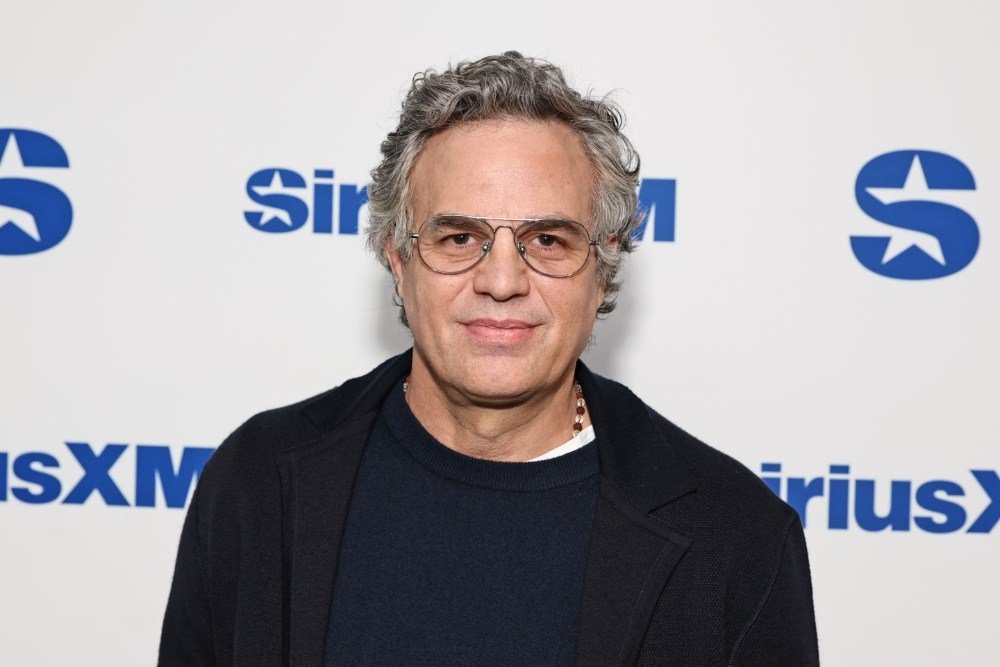
  • Mark Ruffalo Called Out Over ‘Extremist and Antisemitic Messaging’ by Simon Wiesenthal Center, Creative Communities For Peace

    Mark Ruffalo Called Out Over ‘Extremist and Antisemitic Messaging’ by Simon Wiesenthal Center, Creative Communities For Peace

    Two prominent Jewish advocacy groups have called out Mark Ruffalo for spreading “antisemitic tropes.”

    “Words matter, and so does the willingness to draw a line when legitimate debate gives way to antisemitic tropes,” said Jim Berk, CEO of the Simon Wiesenthal Center.

    “We commend Paramount for speaking clearly and refusing to allow prejudice to masquerade as political or corporate criticism. At a time when antisemitism is too often minimized, rationalized, or repackaged in more socially acceptable language, this kind of moral clarity matters.”

    Ari Engel, executive director of Creative Community for Peace, also said in a statement: “Mark Ruffalo’s rhetoric has increasingly crossed the line from criticism of Israel into extremist and antisemitic messaging.”

    Their intervention comes after Paramount issued a rare statement of condemnation against Ruffalo on Friday, in which the company said it is “troubled when antisemitic tropes are invoked in purported service of a business dispute.”

    That statement was in response to the actor’s Instagram re-posting of a year-old video clip featuring Jewish Paramount Skydance board member Safra Catz speaking on a panel. In text accompanying the clip he told his 20 million Instagram followers it showed Catz “revelling” in a “genocide” powered by tech company Oracle, understood to be a tacit reference to the Israel-Hamas conflict.

    Catz is the former CEO of Oracle, which was co-founded by Larry Ellison, father of Paramount Skydance CEO David Ellison.

    Paramount Skydance is in the process of acquiring Warner Bros. Discovery. Ruffalo has been one of the most vocal critics of the deal.

    In his latest social media screed, Ruffalo said Larry Ellison was funding his son’s acquisition of Warner and that he would own “most of” the company if the deal, which is currently mired in legal tangling with 12 state attorneys general, went through.

    Larry Ellison has reportedly committed up to $46.7 billion of the $111 billion deal, with a trio of Middle Eastern sovereign wealth funds, comprised of Saudi Arabia, Qatar and Abu Dhabi, also committing at least $24 billion.

    Ruffalo, who is believed to have earned millions from his role as Hulk in the Marvel films, also called Ellison Sr. a “classic Oligarch” who is “crushing workers and consolidating the wealth of the world for their own power and concentrated dominance” in his commentary. He also accused the Ellisons of “powering some of the most destructive and inhuman forces in the world.”

    After Paramount issued its statement condemning his post, the Marvel actor fired back on X, saying the accusation of antisemitism “is appalling and fundamentally dishonest.”

    However, at least two Jewish orgs appear to agree with Paramount’s assessment. “Invoking Israel in an issue where it is completely irrelevant is a textbook case of obsession and demonization,” Berk, the Simon Wiesenthal Center CEO, continued in his statement. “Paramount was right to call it out. More leaders and institutions should have the courage to call antisemitism what it is, regardless of who is spreading it.”

    Meanwhile CCFP’s Engel, noted: “Ruffalo now says accusations of antisemitism against him are ‘fundamentally dishonest.’ Intent does not erase impact. Repeatedly amplifying inflammatory falsehoods and rhetoric that mirrors historic antisemitic tropes helps normalize the violent anti-Jewish hatred we are seeing take hold once again around the world, regardless of how he chooses to describe his own motives.”

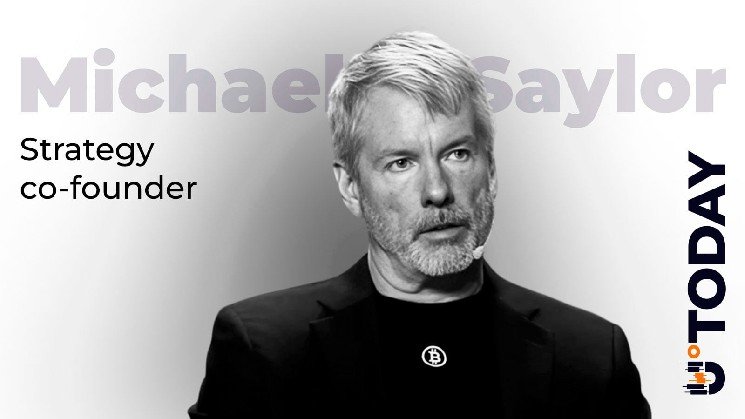
  • Bitcoin’s True Purpose Revealed: Michael Saylor Explains Concept of Digital Energy

    Bitcoin’s True Purpose Revealed: Michael Saylor Explains Concept of Digital Energy

    Strategy (formerly MicroStrategy) Executive Chairman Michael Saylor laid out a new logic for cryptocurrency accumulation in a recent post. According to him, Bitcoin’s breakthrough lies in the ability to “convert economic energy into digital form and securely bind it to a person, family, company, machine, or state.”

    This statement immediately explains the changes taking place on Strategy’s own balance sheet, as the company is now shifting from passively holding coins to building a closed-loop corporate economy.

    Saylor’s logic meets market gravity

    The attempt to “securely bind energy to a company” is already reflected in record figures: according to its financial statements, Strategy holds 840,447 BTC on its balance sheet — exactly 4% of Bitcoin’s total supply — worth $64.9 billion.

    In practice, however, this “bound value” is now undergoing a severe crash test against market gravity. The company’s position remained under intense accounting pressure for a long time, and it managed to return to a net unrealized gain of $1.4 billion only because of Bitcoin’s price surge this week.

    Bitcoin’s most profound breakthrough is the ability to convert economic energy into digital form and bind it securely to a person, family, company, machine, or nation.

    — Michael Saylor (@saylor) August 23, 2026

    The practical bridge for “binding energy to machines and commercial entities” has become Strategy’s own $13.37 billion Digital Credit sector. Strategy channels Bitcoin’s digital energy into a collateral base, issuing tokenized obligations with fixed yields against it.

    The viability of Saylor’s theory about the strength of this bond is being tested under stress. When the flagship STRC token fell below par over the summer, management did not liquidate the Bitcoin collateral.

    Instead, Strategy used fiat reserves to repurchase the obligations, bringing STRC back to $96.22. Strategy’s current figures show that the company is attempting to turn Bitcoin into a working foundation for corporate debt.

    Nevertheless, this attempt to permanently “lock economic energy” into digital code still depends on the cycles of the traditional financial market.

  • Monad is Trading 38.95% Above Our Price Prediction for Aug 28, 2026

    Monad is Trading 38.95% Above Our Price Prediction for Aug 28, 2026

    Disclaimer: This is not investment advice. The information provided is for general purposes only. No information, materials, services and other content provided on this page constitute a solicitation, recommendation, endorsement, or any financial, investment, or other advice. Seek independent professional consultation in the form of legal, financial, and fiscal advice before making any investment decision.

    • Monad is up 9.02% today against the US Dollar
    • $MON/$BTC increased by 9.45% today
    • $MON/ETH increased by 8.96% today
    • Monad is currently trading 38.95% above our prediction on Aug 28, 2026
    • Monad gained 30.89% in the last month and is up 5.50% since 1 year ago

    $MON price is expected to drop by -22.77% in the next 5 days according to our Monad price prediction

    is trading at $ 0.028832 after gaining 9.02% in the last 24 hours. The coin outperformed the cryptocurrency market, as the total crypto market cap increased by 3.19% in the same time period. $MON performed well against $BTC today and recorded a 9.45% gain against the world’s largest cryptocurrency.

    According to our Monad price prediction, $MON is expected to reach a price of $ 0.020751 by Aug 28, 2026. This would represent a -22.77% price decrease for $MON in the next 5 days.

    $MON Price Prediction Chart

    Buy/Sell Monad

    What has been going on with Monad in the last 30 days

    Monad has been displaying a positive trend recently, as the coin gained 30.89% in the last 30-days. The medium-term trend for Monad has been bullish, with $MON increasing by 9.81% in the last 3 months. The long-term picture for Monad has been positive, as $MON is currently displaying a 5.50% 1-year price change. On this day last year, $MON was trading at $ 0.027330.

    Monad reached its all-time high price on Nov 26, 2025, when the price of $MON peaked at $ 0.048888. The current $MON cycle high is $ 0.037435, while the cycle low is at $ 0.016189. $MON has been displaying low volatility recently – the 1-month volatility of the coin is at 8.34. Monad recorded 14 green days in the last 30 days.

    Monad technical analysis for today – Aug 23, 2026

    The sentiment in the Monad markets is currently Bullish, and the Fear & Greed index is reading Greed. The most important support levels to watch are $ 0.026240, $ 0.024346 and $ 0.022416, while $ 0.030064, $ 0.031994 and $ 0.033888 are the key resistance levels.

    Bullish sentiment for Monad

    23 indicators are currently signaling a bullish prediction for Monad, while 5 indicators are showing a bearish forecast. With 82% of indicators favoring a positive prediction. This results in an overall Bullish sentiment for Monad.

    Crypto market is currently experiencing Greed

    Currently, the Fear & Greed index is at 66 (Greed), which signals that investors have a positive outlook on the market. The Fear & Greed index is a measure of sentiment among cryptocurrency investors. A “Greed” reading suggests that investors are currently optimistic about the cryptocurrency market, but can also be an indication that the market is overvalued. A “Fear” reading, on the other hand, signals that investors are currently hesitant about the cryptocurrency market, which potentially represents a buying opportunity.

    Monad moving averages & oscillators

    Let’s take a look at what some of the most important technical indicators are signaling. We’ll be going through key moving averages and oscillators that will allow us to get a better idea of how Monad is positioned in the market right now.

    The Relative Strength Index (RSI 14) is a widely used indicator that helps inform investors whether an asset is currently overbought or oversold. The RSI 14 for Monad is at 72.66, suggesting that $MON is currently overbought.

    The 50-day Simple Moving Average (SMA 50) takes into account the closing price of Monad over the last 50 days. Currently, Monad is trading below the SMA 50 trendline, which is a bearish signal.

    Meanwhile, the 200-day Simple Moving Average (SMA 200) is a long-term trendline that’s calculated by taking an average of the $MON closing price for the last 200 days. $MON is now trading below the SMA 200, signaling that the market is currently bearish.

    The bottom line about this Monad prediction

    After considering the above factors, we can conclude that the current forecast for Monad price prediction is Bullish. $MON would have to decrease by -22.77% to hit our $ 0.020751 target within the next five days. Moving forward, it will be important to monitor the $MON market sentiment, the key support and resistance levels, and other metrics. However, we have to keep in mind that the cryptocurrency markets are unpredictable, and even the largest crypto assets display a lot of price volatility. For long-term Monad price predictions click here.

    Disclaimer: This is not investment advice. The information provided is for general purposes only. No information, materials, services and other content provided on this page constitute a solicitation, recommendation, endorsement, or any financial, investment, or other advice. Seek independent professional consultation in the form of legal, financial, and fiscal advice before making any investment decision.