
Blog

  • ‘The Varnell Hill Show’ Review: Tommy Davidson in Paramount+’s Amiable Throwback of a ‘Martin’ Spinoff

    ‘The Varnell Hill Show’ Review: Tommy Davidson in Paramount+’s Amiable Throwback of a ‘Martin’ Spinoff

    “I got just one question for you: Did you miss me?” So goes the catchphrase for Varnell Hill (Tommy Davidson), the late-night talk show host who first graced our screens in Martin some 30-odd years ago. I’ll leave you to determine how much you personally have been longing to revisit a character who, for all his vivid personality, only ever appeared in two episodes of that earlier series.

    But hearing that line again in his new spinoff, Paramount+’s The Varnell Hill Show, it feels easy enough to answer in the affirmative. If the workplace comedy works better as a reminder of times gone by than a breath of fresh air, it nonetheless makes for a pleasantly nostalgic time.

    The Varnell Hill Show

    The Bottom Line

    More nostalgic than fresh, for better or worse.

    Airdate: Tuesday, Sept. 1 (Paramount+)
    Cast: Tommy Davidson, Wendy Raquel Robinson, Chris Williams, Nick Cafero, Emmanuel Hudson, Kym Whitley
    Creators: Kevin G. Boyd, Sherri McGee McCovey, Bentley Kyle Evans

    Despite its connection to Martin, no real knowledge of the earlier show is required to watch this one. Aside from a few passing references (“My cousin from Detroit told me to tell you, “Wazzup?”), creators Kevin G. Boyd, Sherri McGee McCovey and Bentley Kyle Evans rarely bring up past events or characters; even Martin star and creator (and Varnell Hill executive producer) Martin Lawrence guest stars only as a completely different character.

    As for Varnell, not much seems to be different for the self-described “one-time radio king, two-time ex-husband — soon to be three — and eight-time Soul Train Awards presenter.” He’s still an outgoing, egotistical personality, and still played by Davidson with loads of charisma and a knack for big but precise physical comedy. He’s still hosting the same old talk show to the same old, now rapidly aging audience. His most loyal aides, yes-man/bestie Tre (Chris Williams) and assistant Kym (Kym Whitley), are ones who’ve been with him for ages.

    But change is coming for Varnell, whether he likes it or not. (He very much does not.) The network CEO who once championed him has been pushed out, replaced by the useless nepo baby son (Nick Cafero’s Jonah) who despises Varnell precisely because the old man adored him. Jonah’s plan to oust Varnell involves installing an ambitious new executive producer (Wendy Raquel Robinson’s Rachel) ostensibly to help boost ratings, but in actuality to annoy Varnell into quitting over creative differences.

    Despite the season primarily revolving around the efforts to freshen up the talk show for a wider (i.e., younger) demographic, not much about The Varnell Hill Show reads as particularly modern, for better or for worse.

    Its format — multi-cam, laugh-tracked, with the occasional fourth-wall-breaking aside — is one that would have been in vogue when Martin originally aired. It’s done quite well (and of the supporting cast, Robinson and Whitley, both veterans of sitcoms from that era, seem so at home that you’d think they’d been on this brand-new show for years already), but whether that makes it feel hoary or comforting will probably depend on whether you grew up watching similar series.

    Its storylines tend to stick to well-trod territory: Varnell not understanding social media, Varnell trying to seem younger, Varnell accidentally getting high on pot brownies. Even a multi-episode arc featuring a Gen Z comic who seems primed to supplant Varnell as the network’s new darling betrays little understanding of who Marshay (Brittney Ayona Clemons) is beyond “younger than Varnell.”

    Its jokes are occasionally stale — sometimes in ways that seem appropriate for the characters (of course Varnell is the sort of guy who’d drop a Kato Kaelin reference three decades after the O.J. trial) and sometimes in ways that suggest The Varnell Hill Show itself might benefit from some fresher blood behind the scenes (it makes no sense that a Millennial hypebeast-type writer would describe Moo Deng as a top comedy trend in 2026).

    The inconsistency can make it difficult to tell exactly what the vibe of Varnell’s program is meant to be. In one episode, Varnell goes viral for an accidentally live-streamed rant complaining of being treated by top brass like “a TikTok Bojangles” and declaring that, “When I speak my truth, it’s aggressive” — a slightly confusing statement given that what we’ve seen of his public persona up to that point is so easygoing that earlier that day, he’d been boasting of how many grandmas fall asleep to him. (“And a lot of them don’t wake up,” Jonah snarks in response.)

    Still, there’s an earnestness to the series that makes it easy to vibe with. The challenges faced by a Black host and his mostly Black staff in trying to create something that feels good and authentic at a company run by white men, at least one of whom is hell-bent on ruining them, is an intermittently important theme throughout the eight-part season. And there’s an element of wish fulfillment in seeing Varnell and Rachel and their colleagues triumph by, for example, giving a MAGA-era Kanye West stand-in the takedown he deserves (even if, again, the real-life reference feels a few years old).

    Then there’s the endless rotation of celebrities playing themselves. Varnell’s show might be fictional, but the show about his show actually does function as a way to spotlight Black talents across the industry. Doug E. Fresh is the program’s bandleader, while the likes of Damon Wayans and Matt Barnes come through as talk show guests and Kirk Franklin and Omarion as musical guests.

    In one of the comic highlights of the season, Deon Cole, Mike Epps, Lavell Crawford and Miss Pat play themselves as friends of Varnell’s who’ve been invited to roast him for an anniversary special; the chemistry that flows from the segment really does have the joyous, unfiltered feel of old friends just trying to crack each other up.

    Ironically, or perhaps appropriately, the most glaring issue with the series, aside from its old-timey-ness, likely would have been less of one in the 1990s: the fact that there simply doesn’t seem to be enough of it.

    Like so many first seasons, The Varnell Hill Show’s has the feel of a newcomer trying out everything it can to see what sticks. But at just eight half-hour episodes, it simply doesn’t have time to figure out what to do with supporting ensemble members like AJ (Emmanuel Hudson), Varnell’s dopey social media manager of a nephew, or flesh out ones like hopelessly square head writer Thad (Neil Brown Jr.) and his staff.

    If Paramount+ is putting its weight behind this amiable throwback of a series, it might as well go all the way and give it another dozen or 20 episodes to find its most fully realized self.

  • Sandra Bullock Recalls First ‘Practical Magic’ Bombing After Thinking ‘People Are Going to Love It’: ‘And Then It Got Quiet’

    Sandra Bullock Recalls First ‘Practical Magic’ Bombing After Thinking ‘People Are Going to Love It’: ‘And Then It Got Quiet’

    The Owen sisters may be back in “Practical Magic 2” 28 years after Nicole Kidman and Sandra Bullock first played the sibling witches, but that doesn’t mean the first movie’s outing doesn’t still sting a little.

    The original “Practical Magic” was a critical and box office failure before earning cult classic status over the last almost three decades.

    “We thought, ‘This is going to be such an amazing film. People are going to love it,’” Bullock recalled. “And then it got quiet. It got quiet. [They] were like, ‘How many women in a film do you need? How many tones do you need? What kind of film is this?’”

    “And here’s the thing that I really wanna bring up and I bring it up ad nauseam: Griffin Dunne created this world with us,” Bullock said, referring to the first film’s director.

    Kidman added, “And he loved us and he let us shine.”

    Bullock continued, “It’s because of him, this film exists, and he never got to smell the flowers when we made it. So tonight we’re honoring him.”

    Why did they decide to make the sequel now?

    “It just happened,” Kidman said. It was more like serendipity, and it came, and we were ready, and everything fell into place. It’s like in life — you try to force things; it doesn’t work. You have to wait, be patient, and we both kind of open to it.”

    “Practical Magic 2” is based on Alice Hoffman’s novel “The Book of Magic.” Directed by Susanne Bier, the film sees the return of original stars Kidman, Bullock, Stockard Channing and Dianne Wiest. Newcomers include Joey King, Maisie Williams, Lee Pace, Xolo Maridueña and Solly McLeod.

    This is the second time King worked with Kidman following the 2024 rom-com “Family Affair” with Zac Efron. “When you have someone who has been through so much, who is open and loving with their knowledge, I couldn’t be more grateful,” King told me about her relationship with Kidman. “I feel so lucky to be able to go to her.”

  • Robinhood Chain Sets a New Record in Decentralized Exchange (DEX) Transactions! Here Are the Details

    Robinhood Chain Sets a New Record in Decentralized Exchange (DEX) Transactions! Here Are the Details

    Robinhood Chain has set a new record in decentralized exchange (DEX) transactions. The network reached an all-time high in single-day DEX transaction volume, totaling $989 million. Total value locked (TVL) also hit a record high of $708 million, representing an increase of approximately 100% on a monthly basis.

    The stablecoin supply on Robinhood Chain also grew significantly during the same period. The amount of stablecoins on the chain reached approximately $770 million, a 47% increase compared to the previous month. Thus, the network experienced rapid expansion in terms of both liquidity and transaction volume.

    However, the growth on the network appears to be changing not only in terms of quantity but also in the structure of the projects used. While memecoin-focused transactions were prominent on Robinhood Chain in July, the rise of CASHCAT and its subsequent spot listing on Robinhood supported this trend.

    In August, investor interest shifted more towards utility and infrastructure-focused projects. One of the most notable examples of this was $PONS, a leading token launch platform on the blockchain. $PONS’s market capitalization increased from $20 million to over $200 million in August alone.

    LONG, another important launch platform of Robinhood Chain, pairs tokens, primarily memecoins, with tokenized shares. This structure stands out as one of Robinhood Chain’s key differentiating features.

    Artificial Inu (AI), launched on LONG, attracted attention due to its pairing with tokenized Nvidia stock (NVDA). AI’s market capitalization surged from $1.5 million on August 1st to a peak of $135 million on August 30th. Liquidity in the NVDA pool exceeded $3.3 million, more than three times that of the WETH pool.

    Memecoins paired with tokenized shares account for approximately a quarter of the total share-linked trading volume on Robinhood Chain.

    Benefit-oriented projects like Delta, UP, and NetNet also reinforced the growth trend in the ecosystem in August, increasing their valuations by approximately tenfold.

    *This is not investment advice.

  • Mexico’s Martfilms Boards ‘Looking for Sam,’ Mariana Rondón’s Follow-Up to ‘Bad Hair’ (EXCLUSIVE)

    Mexico’s Martfilms Boards ‘Looking for Sam,’ Mariana Rondón’s Follow-Up to ‘Bad Hair’ (EXCLUSIVE)

    Mexico’s Martfilms has boarded “Looking for Sam,” Mariana Rondón’s follow-up to her acclaimed coming -of-age drama “Bad Hair.”

    A docu-fiction hybrid bound for San Sebastian’s Europe-Latin America Co-Production Forum, the drama follows two lead actors from Mariana Rondón’s 2013 San Sebastian Golden Shell winner “Bad Hair” (“Pelo Malo”): Sam Lange who played the child Junior and the actress who played his mother, Samantha Castillo. Both of them were forced to leave Venezuela.

    “’Looking for Sam’ wanders between fiction and documentary, where memory and identity blur and transform one another. It forces us to ask ourselves who we are when we leave behind who we once were,” Rondón told Variety.

    “The film is about crossing borders: geographical, temporal, bodily and borders of identity. We are not simply looking for Sam. We are searching for the place where the person we once were ends and the person we are begins,” said her producing partner Marite Ugás of Sudaca Films, who added that they found Lange walking the fashion runways of Paris while Castillo emigrated to Mexico.

    For Martfilm’s Martha Orozco, the partnership was a long time coming. “I’ve been following the career of this talented duo and our filmographies have often brought us together on our cinematic journeys. We’ve wanted to collaborate for a long time, and this project allows us to experiment creatively.”

    “’Pelo Malo,” beyond being a successful film, was a bold film for its time – one that dared to address racism, homophobia and polarization, leaving its mark on Latin American cinema. On a personal level, this inspired me to believe in resilient cinema, and through MartFilms, it’s a pleasure to be part of this new phase and share new experiences,” Orozco said, adding: “’Looking for Sam’ will be a nostalgic reunion – the country has changed, the protagonists have grown up and Mariana and Marité’s filmmaking has matured – so we expect nothing but good things from this journey.”

    Martfilms has participated in past industry forums at San Sebastián, winning the pix-in-post WIP award with the Argentine-Mexican co-production “Pornomelancholia” by Manuel Abramovich and snagging the Forum prize with Laura Baumeister’s feature debut “Daughter of Rage” (Nicaragua/Mexico).

    According to Ugás, Sudaca Films was invited to the “Écritures” Residency at the Cité internationale des arts in Paris for 2026–2027, starting this December.

    The six-month residency will allow them to continue working on the screenplay, but also to spend time with Lange, who currently lives in Paris.

    “That’s why it is particularly important for us to meet a French partner at the Europe-Latin America Co-production Forum,” said Ugás who is co-writing the screenplay with Rondón.

    Founded by Rondón and Ugás, Sudaca Films turned 30 this year and is also known for such acclaimed pics as Tribeca 2021 title “Contactado” and “Zafari,” which won the French Film Critics Award in 2024.

    Martfilms, which is dedicated to the creation and distribution of films committed to diversity, inclusion and social transformation has produced such films as “Beyond My Grandfather Allende” (“Allende mi abuelo Allende”) a Chile-Mexico co-production that won the best documentary L’Œil d’Or at the 2015 Cannes Film Festival and “Niñxs” (Mexico), among others.

    The 74th San Sebastian Film Festival runs over Sept. 18-26.

    (l-r) Mariana Rondón and Marité Ugas of Sudaca Films Credit: Lima Film Festival

    © Victor Idrogo / Icónica

  • Announcement for Users Participating in TPS Farming

    Announcement for Users Participating in TPS Farming

    The Crypto News team announces the official completion of the TPS farming program.

    August 31, 2026, marked the end of the final stage: TPS farming is now fully and permanently closed and will not be extended again. We would like to thank everyone who participated in the activity, completed tasks, discussed the news, shared opinions, and contributed to the growth of the Crypto News community.

    With the farming program now closed, the project has moved to the next stage: processing and analyzing the collected data. The team will need time to review the results carefully and prepare the next steps for using TPS.

    All bonuses accumulated by users are fully preserved. They will not expire or be lost now that the program has ended.

    Once the data processing stage is complete, we will publish detailed information explaining where, how, and under what conditions users will be able to use their accumulated TPS.

    Kudos to everyone who took part in the TPS farming program! We thank you all for grinding and staying with us. TPS will be converted soon. Cheers to everyone; you are great! 🙂

    Please follow updates in the Crypto News app and on our social media channels so you do not miss any important announcements.

  • Yes, Kathy Hochul covered her head while speaking at NYC mosque

    Yes, Kathy Hochul covered her head while speaking at NYC mosque

    Claim:

    New York Gov. Kathy Hochul wore a hijab at a New York City mosque in August 2026.

    Rating:

    Mixture

    What’s True

    Video of Hochul in the mosque authentically shows her wearing a headscarf, with some of her hair visible.

    What’s False

    Hochul was not wearing a traditional hijab, which is a way of life that involves practicing modesty, covering the head and all the hair.

    In late August 2026, New York Gov. Kathy Hochul was criticized after she purportedly wore a head covering to a mosque.

    Videos (archived) on Instagram, Facebook, and X (archived) claimed to show Hochul wearing a black head scarf or hijab while speaking at a mosque, which conservative critics claimed was disrespectful so close to the anniversary of the Sept. 11 attacks. Snopes readers asked us to confirm whether Hochul was wearing a hijab — a covering for the head, hair and neck that is typically worn by some Muslim women.

    The above video is authentic. On Aug. 28, 2026, Hochul visited the Islamic Cultural Center of New York and covered her head as a gesture of respect as she was speaking in the prayer hall. Hochul has worn a head covering at events with Muslims before and has even spoken out in favor of Muslim women choosing to wear the hijab. She was not, however, wearing a traditional hijab. As such, we rate this claim as a mixture of true and false information.

    Social media posts and media coverage often erroneously simplify the meaning of “hijab” and claim it is just a headscarf. The term “hijab” has many interpretations but broadly refers to a veil or barrier and is a practice involving modesty for both men and women. Wearing hijab involves modest clothing in an Islamic context, including a head covering. It is worn in many styles but for Muslim women today, the hijab colloquially refers to the covering that typically conceals the head, all the hair and neck while leaving the face uncovered. 

    In available photographs of Hochul covering her head, her hair is visible. She is wearing a headscarf, and not participating in the practice of wearing hijab, as is typically done by Muslim women. 

    Hochul was visiting the Islamic Cultural Center in New York City during Friday prayers. The above video shows her standing before the front wall of the mosque with the decorative glass niche behind her (visible in these videos of the Islamic Cultural Center at 0:23 and 3:29).

    The official Instagram account for the Islamic Cultural Center School — which is affiliated with the Islamic Cultural Center— posted about Hochul’s visit and noted that the governor joined for Friday prayers:


    Governor Hochul joined our community at ICCNY for Friday Jumaa, where she addressed the congregation, before visiting the Islamic Cultural Center School of New York. She toured the school, stepped into our classrooms and learned more about the community we are so proud to serve.

    Hochul is wearing the same outfit in the above Instagram post and in the videos being shared on social media. However, during her visit to the Islamic Cultural Center School, Hochul’s head was uncovered. She covered only it when speaking at the gathering at the prayer hall.

    All Muslim women cover their heads when praying or when inside the prayer hall of a mosque, with some — but not all — in hijab. Given that Hochul was in attendance for Friday prayers at the mosque, covering her head can be seen as a sign of respect.

    This was not the first time Hochul covered her head at a religious gathering for Muslims. In July 2025, she covered her head when speaking at the funeral of a slain Muslim police officer. In 2020, she covered her head when speaking at the Jamaica Muslim Center.

    In February 2024, Hochul posted (archived) on X in support of World Hijab Day, writing: “we stand in solidarity with our Muslim sisters who choose to wear the hijab. New York’s diversity has always been its strength, and together, we will always promote respect, inclusion, and religious freedom in the face of hate.”

    The post also showed Hochul shaking hands with a Muslim hijabi woman while wearing a head covering. Another Muslim woman in the photograph is wearing a head covering similar to Hochul’s:

    Hochul has not publicly addressed the criticism as of this writing.

    Snopes has previously covered examples of other leaders wearing head coverings as a sign of respect among Muslim communities, including former New Zealand Prime Minister Jacinda Ardern. 

    Sources

    HIJAB HOCHUL: Governor’s Headscarf Ignites Backlash. 30 Aug. 2026, https://www.southshorepress.com/state/hijab-hochul-governors-headscarf-ignites-backlash-85c05c26. Accessed 31 Aug. 2026. 

    “Islamic Cultural Center in NYC.” YouTube, Curbed, 28 Dec. 2016, https://www.youtube.com/watch?v=Tg-7FqONTx4&t=23s. Accessed 31 Aug. 2026. 

    LaCapria, Kim. “Hillary Clinton Hijab Campaign Ad.” Snopes, 29 June 2016, https://www.snopes.com//fact-check/hillary-clinton-hijab-campaign-ad/. Accessed 31 Aug. 2026. 

    Lewis, Rebecca C. “Hochul Appoints First Muslim Affairs Liaison.” City & State NY, 9 Aug. 2024, https://www.cityandstateny.com/politics/2024/08/hochul-appoints-first-muslim-affairs-liaison/398696/. Accessed 31 Aug. 2026. 

    Palma, Bethania. “Did New Zealand Prime Minister Jacinda Ardern Don a Hijab and Offer Aid to Families of Massacre Victims?” Snopes, 18 Mar. 2019, https://www.snopes.com//fact-check/nz-prime-minister-massacre-aid/. Accessed 31 Aug. 2026. 

    Soni, Darshna. “From Hijab to Burqa – a Guide to Muslim Headwear.” Channel 4 News, 22 Oct. 2013, https://www.channel4.com/news/from-hijab-to-burqa-a-guide-to-muslim-headwear. Accessed 31 Aug. 2026. 

    “Spencer Pratt and MAGA Bash NY Gov Kathy Hochul for Sporting Hijab at Islamic Center: ‘Bowing to the Third World.’” Mediate, 30 Aug. 2026, https://www.mediaite.com/politics/spencer-pratt-and-maga-bash-ny-gov-kathy-hochul-for-sporting-hijab-at-islamic-center-bowing-to-the-third-world/. Accessed 31 Aug. 2026. 

    “‘We Always Come Back, That Is Our Strength’: Hochul at Funeral of NYPD Det. Islam .” YouTube, Fox 5 New York, 31 July 2025, https://www.youtube.com/watch?v=F8W6cRpQiVU. Accessed 31 Aug. 2026. 

    Why We Wear Hijab · Muslim Women’s Coalition. http://www.mmwconline.org/islam/why-we-wear-hijab.php. Accessed 31 Aug. 2026.

  • New York police kill knife-wielding woman in Times Square

    New York police kill knife-wielding woman in Times Square

    A woman has been shot dead by police in New York’s iconic Times Square. Police say the woman, who was armed with two large knives, had stabbed two people, one fatally.  A warning this video could distress some viewers.

  • DOGE cuts to USAID halted program that built flood early-warning system in Nepal?

    DOGE cuts to USAID halted program that built flood early-warning system in Nepal?

    • The claim that the Trump administration’s Department of Government Efficiency cut funding for a U.S. Agency for International Development and NASA program in early 2025 that provided early warning for floods in Nepal is still under investigation.
    • The rumor stems from X posts by Jeremy Konyndyk, a former Biden- and Obama-era USAID official, about the SERVIR program, which he wrote carried out “flood prediction, early warning, disaster readiness, glacier inventories, and mapping dangerous glacial lakes” in Nepal.
    • According to the SERVIR program’s website in the Hindu Kush Himalaya region, which includes Nepal, the program had “concluded” in January 2025. Snopes could not independently verify whether the program ended because DOGE pulled USAID/NASA funding or for another reason.
    • Because the program ended before the deadly August 2026 floods, it’s impossible to say whether increased monitoring or an early-warning system could have enabled evacuations or saved lives. 
    • Snopes will update this report if additional information surfaces. We have contacted the International Centre for Integrated Mountain Development, which delivered the SERVIR program in the Hindu Kush Himalaya region, and the U.S. State Department, which took over USAID’s remaining programs, to ask why the SERVIR Hindu Kush Himalaya program ended and await a reply.

    In August 2026, a claim (archived) circulated online that the Trump administration’s Department of Government Efficiency cut funding in early 2025 for a U.S. Agency for International Development and NASA program that provided early warning for floods in Nepal.

    Claims about DOGE’s alleged cuts circulated as Nepal’s National Disaster Risk Reduction & Management Authority said on Aug. 31 that at least 939 people had died and 3,925 were missing after flash floods hit the Nepal-China border five days earlier.

    One Facebook user who posted about the alleged DOGE program cuts after the deadly floods in Nepal wrote:

    DOGE hunted federal grants for the word “climate” and defunded whatever came up. One of the things that came up was a USAID and NASA satellite program that mapped dangerous glacial lakes, predicted floods, and ran early warning systems across the globe. Including Nepal. Last week, a glacier collapsed above the Nepal-China border, and the flood killed over 270 people. More than 2000 are still missing. Elon Musk said he spent that weekend feeding USAID into the wood chipper.

    Similar claims also circulated on Instagram (archived), Threads (archived) and Bluesky (archived). Snopes readers contacted us about the claim.

    The claim circulated after Jeremy Konyndyk, a USAID official under former presidents Joe Biden and Barack Obama, posted (archived) on X about the SERVIR program, a joint USAID/NASA initiative that formerly operated in Nepal. The program’s work, Konyndyk wrote, included “flood prediction, early warning, disaster readiness, glacier inventories, and mapping dangerous glacial lakes.”

    Konyndyk claimed DOGE cut the SERVIR program in Nepal amid its dismantling of USAID. The program itself said on its website that the initiative “concluded in January 2025” but did not say why. This was around the time President Donald Trump and his then-adviser Elon Musk said they would shut down USAID.

    According to a list of USAID funding cuts reported by Politico that DOGE allegedly sent to Congress in March 2025, the cost-cutting department removed funding from several different SERVIR programs, including the program in the Hindu Kush Himalaya region (Page 135), which includes Nepal.

    We contacted the International Centre for Integrated Mountain Development, which delivered the SERVIR program in the Hindu Kush Himalaya region, to confirm whether DOGE cuts ended the program there. We also contacted the U.S. State Department, which took over the remaining USAID programs after DOGE’s cuts, to confirm whether it still funded the program. We await replies to our queries.

    Contracts or grants related to the SERVIR program in the Hindu Kush Himalaya region did not appear on DOGE’s website listing estimated savings, though the department said it had not uploaded documentation for all the government contracts, awards or leases it cut.

    While awaiting replies and because Snopes could not independently verify the authenticity of Politico’s document that appeared to show DOGE cut the SERVIR program in the Hindu Kush Himalaya region, we leave this claim unrated.

    Effects of defunding programs like SERVIR can’t be known 

    According to the SERVIR Hindu Kush Himalaya website, the program was developing a flood early-warning system that used data from the Copernicus satellite system to provide 10-15 day flood forecasts for vulnerable areas. It also produced maps of “potentially dangerous” glacier lakes in Nepal at risk of collapse. 

    Because it was not funded at the time of the deadly August 2026 floods, it was impossible to know whether any of the program’s monitoring or warning systems would have made a difference to flood casualty numbers.

    The U.S. Geological Survey reported that the floods in Nepal were likely caused by a magnitude 5.2 “slope failure involving a glacier” that sent debris flow and floodwaters rushing approximately 60 miles away. 

    It was unclear whether SERVIR’s or any other early warning system could have alerted authorities to a possible landslide or glacier collapse and whether that would have allowed time for evacuations.

    NPR reported on Aug. 30 that Chinese scientists found that the flooding happened after a large chunk of ice broke off a glacier and sent water, ice and mud rushing downhill. According to NPR’s report, it took seven minutes from when the glacier broke off until it hit Gyirong Port on the border between Tibet and Nepal, pulverizing the structure. 

    Su Pengcheng, a researcher at the Chengdu Institute of Mountain Hazards and Environment, reportedly told NPR there was “no time for warning or to flee.”

    The U.S. State Department said on Aug. 26 it would deploy a disaster response adviser to Nepal and provide $500,000 in assistance through its “global award with Catholic Relief Services.”

    State Department spokesperson Tommy Piggot told ABC’s “This Week” on Aug. 30 that at least 85 Americans remained unaccounted for after the flooding.

    For further reading, Snopes previously verified footage of the deadly floods hitting Gyirong Port.

    Sources

    ‘About SERVIR’. SERVIR Hindu Kush Himalaya, https://servir.icimod.org/about-servir/.

    DOGE. https://www.doge.gov/savings.

    DOGE. ‘Summary of USAID Program Status ‘. https://www.politico.com/f/?id=00000195-d4ba-dc7d-add5-f6fe93e40000.

    ‘Elon Musk Says He and Trump Are Shutting down USAID’. NBC News, 3 Feb. 2025, https://www.nbcnews.com/politics/politics-news/elon-musk-says-trump-are-shutting-usaid-rcna190388.

    ‘Enhancing Flood Early Warning Systems’. SERVIR Hindu Kush Himalaya, https://servir.icimod.org/science-applications/enhancing-flood-early-warning-systems/.

    ‘Jeremy Konyndyk’. Refugees International, https://www.refugeesinternational.org/authors/jeremy-konyndyk/. Accessed 31 Aug. 2026.

    Landslide Hazards Program. ‘2026 Nepal Debris Avalanche and Flash Flood’. United States Geological Survey, 27 Aug. 2026, https://www.usgs.gov/programs/landslide-hazards/science/2026-nepal-debris-avalanche-and-flash-flood.

    ‘More than 700 Dead, 3,000 Missing after Flooding at Nepal Border, Authorities Say’. NPR, 30 Aug. 2026. NPR, https://www.npr.org/2026/08/30/g-s1-141151/tibet-nepal-flood-day-5.

    ‘Priority Is Safety, Security of Americans: State Dept. on Nepal-Tibet Floods’. YouTube, 30 Aug. 2026, https://www.youtube.com/watch?v=1y4bwI5VdWM&t=12s.

    ‘Story Maps’. SERVIR Hindu Kush Himalaya, https://servir.icimod.org/story-maps/.

    The Hindu Kush Himalaya – ICIMOD. 24 Oct. 2019, https://www.icimod.org/who-we-are/the-hindu-kush-himalaya/.

    ‘United States Expresses Condolences to the Victims of the Nepal Floods’. United States Department of State, https://www.state.gov/releases/office-of-the-spokesperson/2026/08/united-states-expresses-condolences-to-the-victims-of-the-nepal-floods/. Accessed 31 Aug. 2026.

    राष्ट्रिय विपद् जोखिम न्यूनीकरण तथा व्यवस्थापन प्राधिकरण. ‘रसुवा बाढीसम्बन्धी खोज, उद्धार तथा राहत अपडेट-२०८३’. 31 Aug. 2026, https://ndrrma.gov.np/mediafiles/rasuwa/Situation_update_Nepali_2083.5.15_6_PM.pdf.
     

  • Don’t believe claim Canadian officials are refusing passage to ships bound for ‘Lake America’

    Don’t believe claim Canadian officials are refusing passage to ships bound for ‘Lake America’

    Claim:

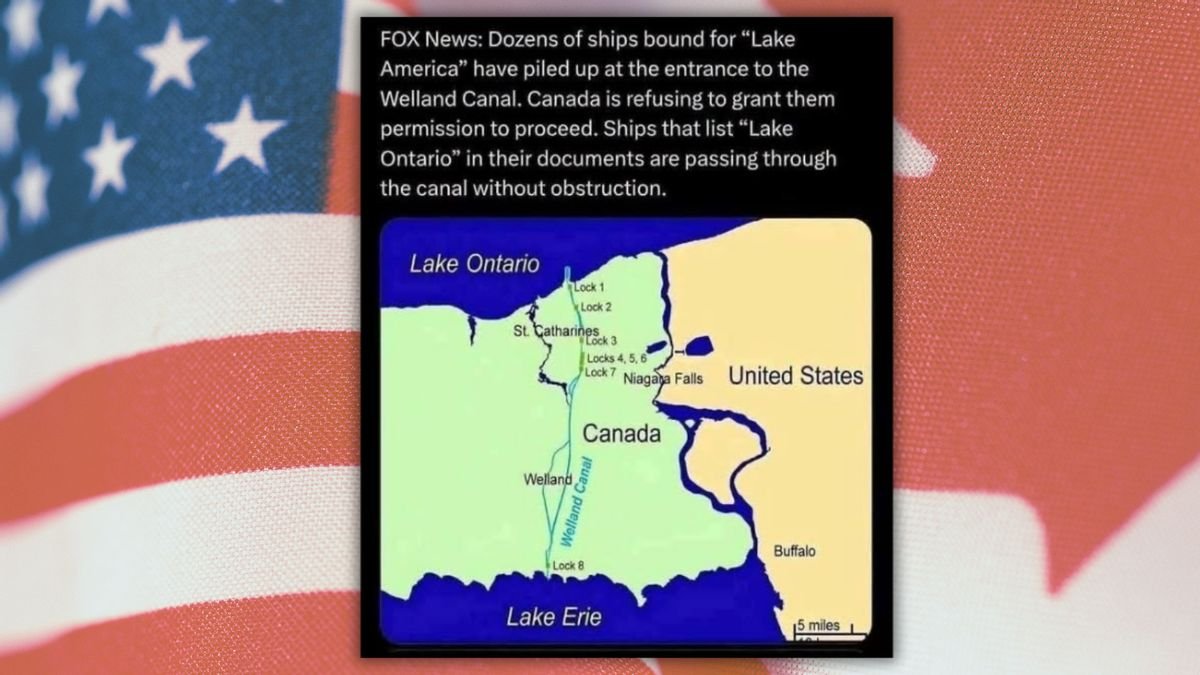
    As of August 2026, Canadian officials were refusing passage through the Welland Canal to ships that used the name “Lake America” to refer to Lake Ontario in their documentation.

    Rating:

    Originated as Satire

    In late August 2026, a rumor spread online that claimed Canadian officials were refusing to grant passage through the Welland Canal — which connects lakes Erie and Ontario — to ships that had “Lake America” listed in their documentation, as opposed to “Lake Ontario.” 

    The rumor circulated after U.S. President Donald Trump renamed Lake Ontario to “Lake America” in the United States. 

    Posts on X, Threads, Facebook (screenshott) and Reddit claimed Fox News had reported on the alleged Canadian blockade. Snopes readers contacted us to investigate the claim’s legitimacy.

    (X user @MykhailoRohoza)

    This claim originated as satire. A search of Fox News’ archives via its website found no evidence the news outlet had reported on such a claim. 

    Searches on DuckDuckGo, Google and Yahoo also found no relevant and credible news articles reporting on this claim as fact. If Canadian officials really were preventing ships using the term “Lake America” in their documentation from crossing the Welland Canal, it would certainly have made news, and search inquiries would have uncovered evidence of it. 

    The St. Lawrence Seaway Management Corp. oversees ship traffic on the Canadian side of the Welland Canal, which is part of the St. Lawrence Seaway. The Canadian Press reported that Serge Auclair, vice-president of commercial and external relations at the corporation, said vessels are traveling the canal as usual.

    “Seaway operations are continuing normally and have done so throughout the weekend. Vessels are transiting the Welland Canal as usual,” Nicole Giroux, a spokesperson for the St. Lawrence Seaway Management Corp., told Snopes.

    The earliest version of the claim we found came from an Aug. 28 X post (archived) from a Russian X user listed as “Comedian” on the account’s profile (archived). We reached out to the X user to confirm the account originated the claim and will update this story if we hear back. 

    Many of the earlier versions of the claim shared in English also labeled it as satire, or at least acknowledged its satirical origins. 

    Snopes has debunked similar pieces of media before. For example, in May, we alerted readers to a fake story about Canadian officials denying Trump a $573 billion railway bailout. 

    For more on Lake Ontario, we previously confirmed it was named by Indigenous people, not after the Canadian province of Ontario. 

    Since the effectiveness of satire is subjective, we use “originated as satire” or “labeled satire” ratings based on creators’ description of their work. It’s your call on whether you agree.