That total accounts for viewership across Comedy Central and Paramount+ in the U.S. alone. The episode’s audience was relatively even with the previous season premiere, which reached 4.3 million viewers in three days, while making strong improvements among viewers age 18-49. In that demographic, the episode scored a 0.97 rating after three days, up 33% from Season 28’s 0.73 rating, and a share of 4.77, up from 20% from last year’s 3.96. Between Monday and Friday, the “South America” premiere was the most-watched cable telecast of the week among adults 18-49, excluding sports programming.
Unsurprisingly, the first episode since renaming to “South America” drove conversation on social media. On the day of its premiere, the series ranked as the No. 1 most social cable comedy, and went on to generate 11 million views and one million engagements in three days. It garnered 63,000 online mentions in three days, a 40% increase from what the Season 28 premiere achieved in the same amount of time.
In a statement earlier this month, Parker and Stone said, “Inspired by the bravery and patriotism of Apple and Google, we are changing the name of ‘South Park’ to ‘South America,’” referencing the fact that the tech companies have honored Trump’s name changes on their maps. “We especially want to thank our parent company Paramount — a Skydance Capitulation.”
Dreamworks Animation knows how to tell stories about friendships, whether it’s between a boy and a dragon in “How to Train Your Dragon” or Donkey and Ogre in “Shrek” or a robot and bird in “The Wild Robot.” Its latest feature, “Forgotten Island,” anchors its story in two best friends who face being separated when one has to go abroad to college. One final night together puts their friendship to the test.
Liza Soberano and H.E.R. lead the voice cast as Raissa and Jo, who find themselves stranded in the mystical world of the forgotten island of Nakali. They come to find that their only way home might come at the expense of a lifetime of memories and emotions. Written and directed by Joel Crawford and Januel Mercado, the film is produced by Mark Swift.
“Forgotten Island,” out now in theaters, centers around Filipino folklore, but its beating heart is the universal story of two teenage best friends who share memories and experiences.
Speaking with Variety, Soberano says the story was one that hit home. Growing up in the Philippines, she understood the theme of “losing” a family member or a friend who needed to go overseas for a better quality of life and to make a better living for themselves. Soberano explains, “I’ve seen all the different permutations of how that could affect family and loved ones that you’re leaving behind.”
The story struck a deeper chord when she left a successful career in the Philippines to make it in America. “I also went through that journey and that experience three years ago,” she says. She was particularly torn about leaving behind her little sister. “It was really heartbreaking because I was afraid of, I was afraid of us not being close anymore — not just in proximity, but in the relationship itself. I was afraid that we would grow apart. But through this, I actually discovered that there are so many reasons to not grow apart. You have to really fight for the relationship and fight for the closeness, no matter how far you physically are from one another. I find a lot of comfort in that, and this movie has taught me so much about it.”
Similarly, H.E.R., who grew up near Vallejo, California, also found the story relatable. “I left when I was 17 to move to New York and it wasn’t as far away — just across the country. But it felt super far. My sister was eight at the time, and I was 17 and she wanted her big sister around.”
While friendship is the beating heart of the film, “Forgotten Island” also captures the Filipino experience through cultural details that resonated deeply with its cast.
H.E.R. recalls seeing the Filipino elements in the film for the first time. “Seeing the Filipino sun for the first time — even before seeing the full film — made us so emotional. I remember that day very well. I remember seeing ‘pasalubong’ written on the screen, and I thought, oh my gosh, this is as Filipino as it gets. The petroleum jelly, all those little details, just really made me feel like, wow, I’m so proud to be Filipino. This is reminding me of home right now.”
Soberano agrees, saying, “It was the despedida — the farewell party. That was such an accurate depiction of what it’s like to be at a Filipino house party. There’s so much chaos going on. You have the lolas and the lolos being grumpy at everyone, telling them to either eat, sit down or go sing — and not to be ‘magulo.’ Then you have the little kids doing their own thing, hiding under the tables and creating chaos everywhere. And, of course, you have the titos and titas either playing mahjong on the side or singing karaoke. I thought that was such a beautiful depiction of Filipino energy, but you also feel the love coming from everyone at the party.”
Aside from starring in the film, the pair also lend their voices to the film’s soundtrack. Their voices capture the nostalgia, warmth and joy that radiate from their characters and the movie as a whole.
Angela Leus, senior vice president of Film Music at Universal Pictures, previously told Varietythat neither she nor the filmmakers wanted to assume that H.E.R. would create an original song. “Everything needed to come from an organic place,” Leus says. “But when H.E.R. saw the film, she was so inspired that she decided to write something — and she was even more inspired to bring in Liza.”
Speaking about the song, Soberano admits she felt “major impostor syndrome being there.” She asked herself, “What did I do in my life to deserve this?” She adds, “I just felt so honored and blessed to be part of it.”
H.E.R. echoes the sentiment, saying, “She killed it. There was no need to be nervous because it was just fun. The fact that we were singing as Jo and Raissa just wraps it all up. Then we shot the video in Manila and made it kind of like a travel vlog, continuing that love letter to the Philippines. I’m just grateful to be in this process, especially with Liza. I love these characters. I love this film. I’m forever grateful for it.”
The Miss Universe conflict involving Nawat Itsaragrisil has taken a significant new turn, and the Puerto Rican government is no longer watching the dispute from the sidelines. The Puerto Rico Tourism Company, a government agency deeply involved in bringing the 75th Miss Universe competition to the island, announced on September 24 that it sent a formal cease-and-desist letter to the Thai businessman.
The letter demands that Nawat stop making or spreading what the agency describes as false, inaccurate, or materially misleading factual assertions involving the Tourism Company, its officials, contracting procedures, and the handling of public money connected to Miss Universe 2026.
The Miss Universe 2026 conflict escalates as Puerto Rico sends Nawat Itsaragrisil a cease-and-desist letter over claims involving public funds and the pageant.
Why Puerto Rico Sent Nawat a Cease-and-Desist Letter
Nawat has spent weeks publicly questioning how money provided by Puerto Rico for Miss Universe 2026 was handled.
Earlier this month, he called on Puerto Rico Governor Jenniffer González Colón and Puerto Rico Tourism Company executive director Willianette Robles Cancel to investigate what he alleged were irregularities involving money paid to bring the pageant to the island.
You may also like
Continue reading
Nawat alleged that money had been improperly diverted and questioned whether the agreements involving the event had received the appropriate corporate authorization. The agency has now taken the additional step of sending Nawat a cease-and-desist letter.
According to its September 24 statement, the government agency says some of Nawat’s public claims concerning JKN Universe LLC’s corporate structure and authority, bank accounts, public funds, and the actions of Puerto Rican officials are inconsistent with corporate documentation in the agency’s possession.
Puerto Rico Says the Miss Universe Fight Is Not Its Fight
The Tourism Company’s message was particularly clear on one issue: it does not want Puerto Rico dragged into the corporate battle surrounding Miss Universe. Willianette Robles Cancel acknowledged that the agency is aware of disputes between Nawat and people or entities connected with the Miss Universe organization.
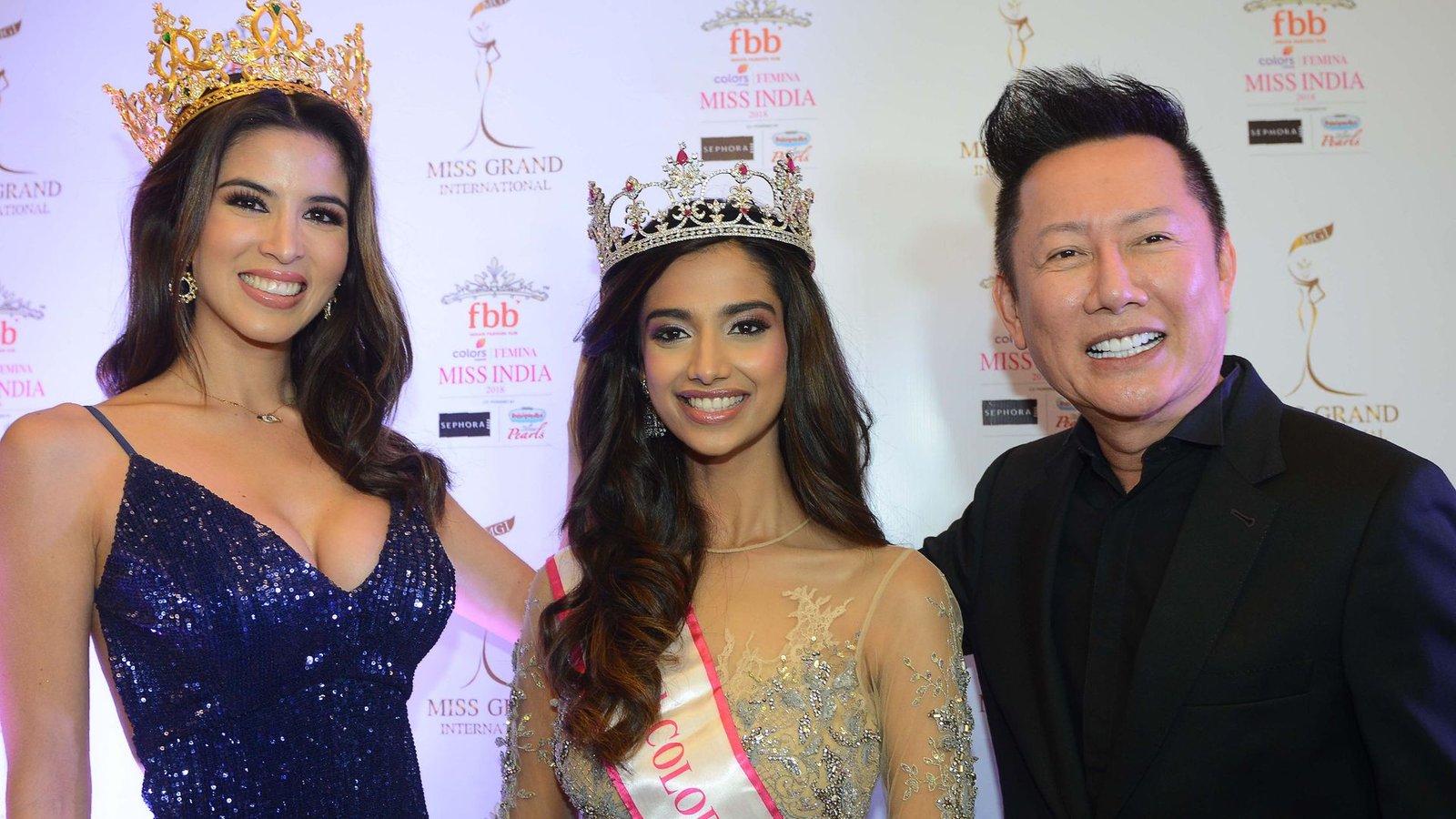
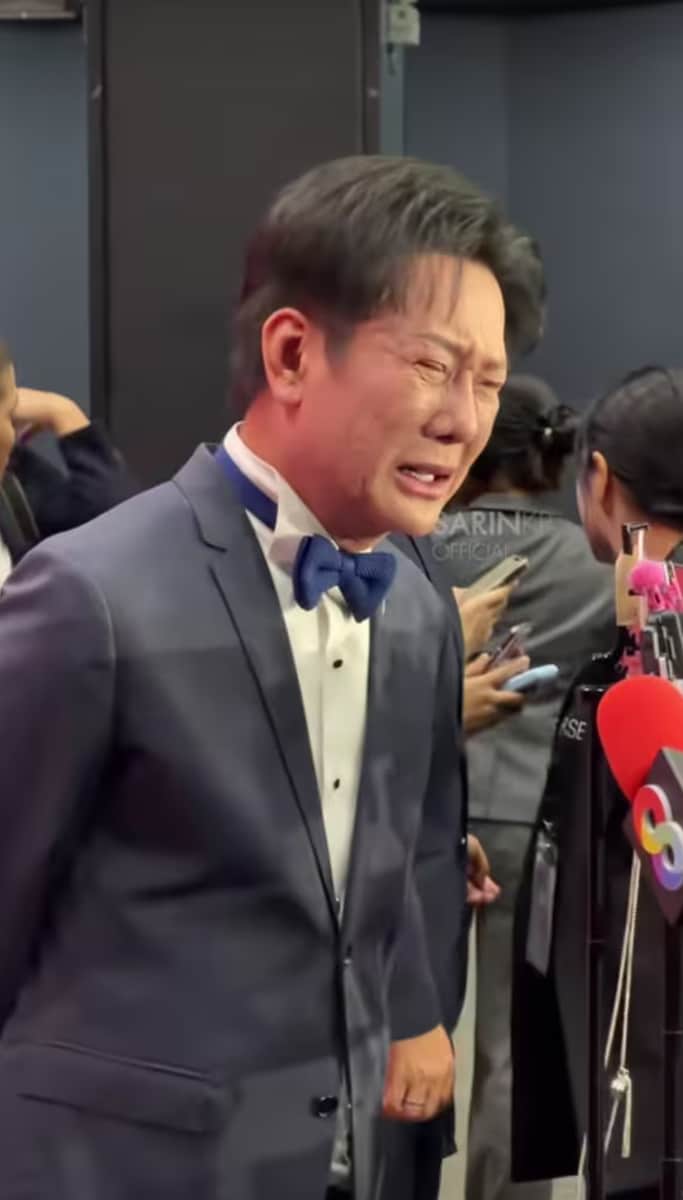
Thai pageant director Nawat Itsaragrisil found himself at the center of controversy after publicly insulting Fátima Bosch.
However, she said the Tourism Company is not a party to those disagreements. “We are aware that there are controversies between Mr. Itsaragrisil and people or entities linked to the Miss Universe organization. The Tourism Company is not a party to those differences, and we will not allow a controversy between third parties to be used to question, without foundation, the integrity of our processes or the responsible management of public funds. Our responsibility is to protect public funds, the interests of Puerto Rico, and Puerto Rico’s projection as a tourist destination, acting with the corresponding transparency and rigor,” expressed CTPR Executive Director Willianette Robles Cancel.
The agency said it would not allow a dispute between private parties to be used to question, without foundation, the integrity of its procedures or its handling of public funds. It said its responsibility is to protect Puerto Rico’s public money, interests, and reputation as a tourism destination. “Puerto Rico is preparing to host an event of international scale that represents an important platform to showcase our attractions, our culture, and our tourism offerings to audiences around the world. Controversies unrelated to the Company will not divert our attention from that objective, nor should Puerto Rico be used to advance differences between private interests,” added Robles Cancel.
The agency also stressed that the cease-and-desist does not prevent Nawat from expressing opinions, making claims or going to court.
The Tourism Company does not want Puerto Rico dragged into the corporate battle surrounding Miss Universe.
Instead, it demands that factual representations concerning the Tourism Company’s actions be accurate and complete and that disputed matters not be presented as settled facts.
Could the Miss Universe Conflict Threaten Puerto Rico 2026?
Despite the increasingly public confrontation, Puerto Rico is continuing preparations for Miss Universe 2026.
The Puerto Rico Tourism Company said on September 23 that production and coordination work for the November competition was moving forward. The agency described the 75th anniversary pageant as an important opportunity to promote Puerto Rico internationally and generate economic activity.
The Nawat Conflict Is Now Bigger Than the Contestants
Much of the recent Miss Universe controversy has focused on whether delegates from Thailand and several other Southeast Asian countries will be allowed to compete.
Before Puerto Rico announced its cease-and-desist letter, Nawat had reportedly given the Tourism Company until September 25 to respond to his questions, saying his legal team could become involved if he did not receive answers.
Puerto Rico has now responded, but certainly not in the way Nawat appeared to be seeking.
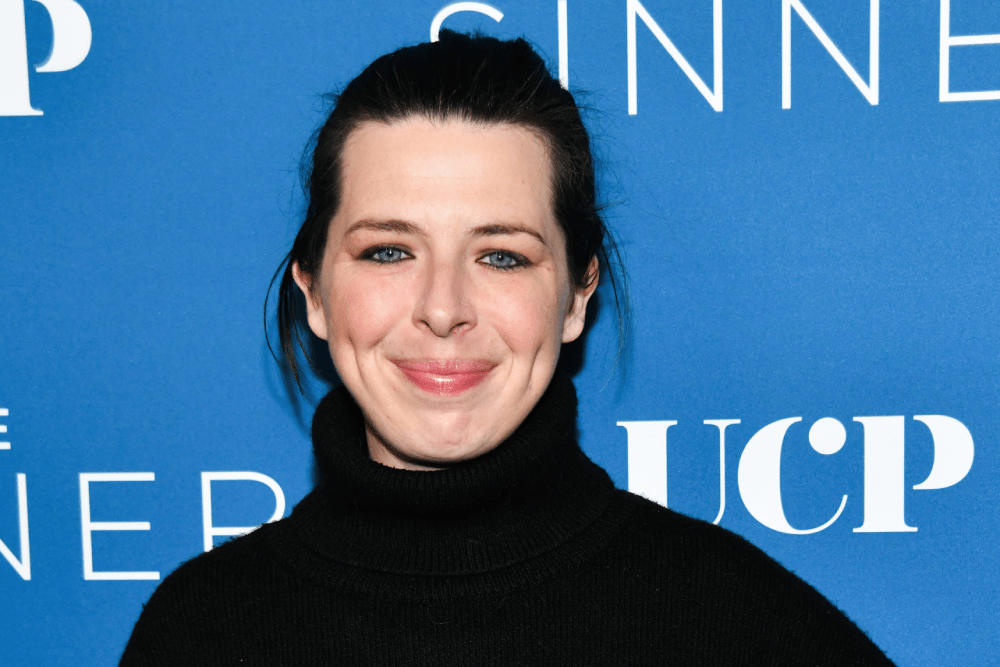
“Princess Diaries” star Heather Matarazzo revealed she may not qualify for health insurance if she doesn’t find work soon.
The actress, who starred alongside Anne Hathaway in the “Princess Diaries” films as Lilly Moscovitz, replied to a post from “Atypical” actor Jack Haven that revealed they needed work in order to qualify for health insurance through SAG-AFTRA.
The guild offers a health plan for its members that requires a “minimum earnings” threshold be met to qualify. However, booking projects in the entertainment industry is often unpredictable and fluctuates, which leads to larger gaps between employment opportunities and ultimately makes meeting that threshold more difficult.
“I’m in a bit of an emergency situation,” Haven shared in a YouTube video this week. “I need to make $4,000 by the end of the month in order to qualify for SAG health insurance starting in January.”
The actor shared their skills and said they will do “pretty much any job,” encouraging anyone open to hiring them on a production under SAG to contact them over email.
Matarazzo replied to a post about Haven’s plea, writing, “I am literally in the same boat right now. Lots of my fellow actors are. I remember a time when we didn’t have to earn a minimum to qualify for insurance. Glad to see that Jack has gotten an offer that will let them to qualify for 2027.”
As detailed on the SAG Health Plan’s eligibility page, the minimum threshold is expected to rise by approximately $900 each year until 2030. This year, members were required to earn $28,933. SAG-AFTRA did not respond immediately to comment.
Matarazzo’s most recent project was the 2025 short film “Paper Tiger.” She also starred “Welcome to the Dollhouse,” “The Devil’s Advocate” and “Scream 3,” as well as multiple episodes of Netflix’s “Wednesday.”
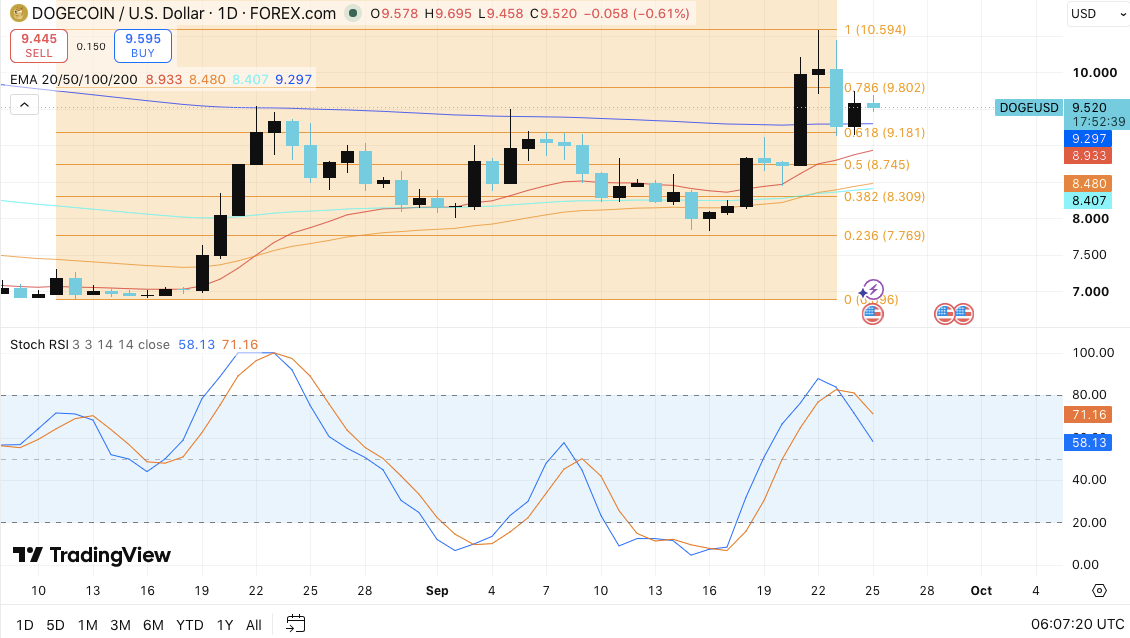
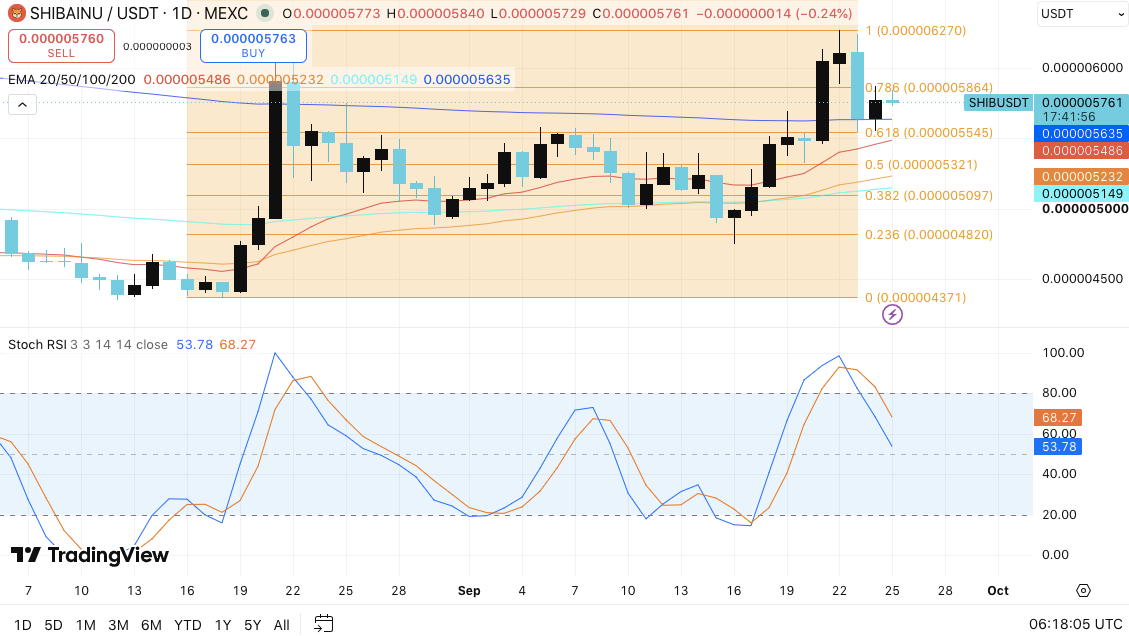
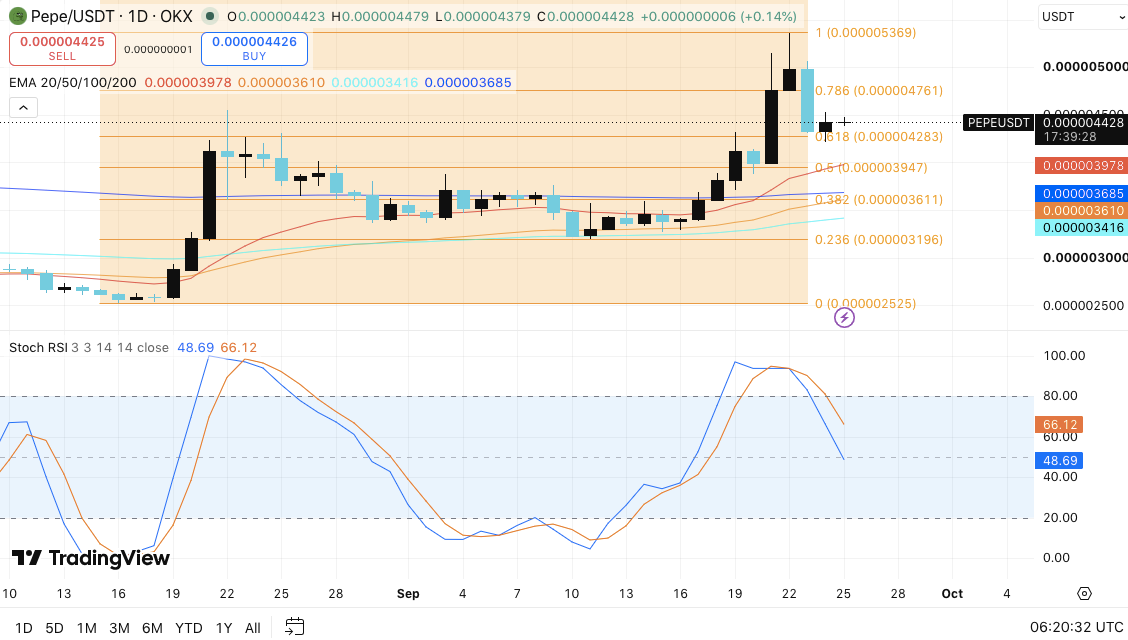
Meme coins Dogecoin, Shiba Inu, and Pepe remain in constructive daily structures despite recent pullbacks. $DOGE trades above its major moving averages, while $SHIB and $PEPE continue to hold important Fibonacci levels. However, momentum indicators show that buying pressure has weakened after recent rallies.
Consequently, traders now face a crucial test between renewed breakouts and deeper retracements. $DOGE needs to reclaim $9.80 before challenging $10.00 again. $SHIB must defend the $0.000005545-$0.000005635 zone to preserve its recovery. Meanwhile, $PEPE needs to hold $0.000004283 for its bullish structure to remain intact.
Dogecoin Price Prediction: $DOGE Eyes a Return Above $10
$DOGE currently trades near $9.52 after facing rejection around the $10.00-$10.10 resistance zone. The pullback has not yet damaged the broader daily trend.
Price remains above the 20-day, 50-day, and 100-day EMAs. Significantly, $DOGE also holds above its 200-day EMA near $9.30.
That level could determine whether the current weakness develops into consolidation or a deeper correction. Additionally, the Stoch RSI shows cooling momentum.
Dogecoin Price Dynamics (Source: TradingView)
The indicator places the fast line near 58, below the signal line around 71. Hence, $DOGE needs renewed momentum to challenge higher levels.
Related: Chainlink Price Prediction: LINK Targets $15 as Infosys Deal Lands
A move above $9.80 could reopen the path toward $10.00-$10.10. However, failure to reclaim $9.80 could send $DOGE toward $9.30 and $9.18. A break below $9.18 would expose $8.93 and potentially the $8.75-$8.40 support region.
Shiba Inu Price Prediction: $SHIB Defends Its Broader Recovery
$SHIB trades near $0.000005761 after retreating from the $0.000005864 Fibonacci 0.786 resistance. The broader recovery still shows several constructive signals.
$SHIB Price Dynamics (Source: TradingView)
Price remains above the 20-day, 50-day, and 100-day EMAs. Moreover, $SHIB continues to trade near the 200-day EMA around $0.000005635.
That moving average now represents an important dividing line for the current structure. Meanwhile, Stoch RSI has turned lower after reaching overbought territory.
A daily close above $0.000005864 could strengthen the recovery and expose $0.00000600. Beyond that level, $0.000006270 becomes the next major upside reference.
Related: Cardano Price Prediction: Retail Stays on the Sidelines as Whales Keep Buying
However, losing $0.000005545 could trigger additional profit-taking. Consequently, traders could then watch $0.000005486 and $0.000005321.
Pepe Price Prediction: $PEPE Holds Above a Critical Fibonacci Level
$PEPE trades around $0.000004428 after breaking higher from its previous $0.0000032-$0.0000036 consolidation range. The breakout keeps its daily structure bullish.
Price remains above the major EMA cluster, which supports the broader recovery. However, short-term momentum has weakened following the latest advance.
$PEPE Price Dynamics (Source: TradingView)
The Stoch RSI shows %K near 48.69, below %D around 66.12. Therefore, $PEPE could experience further consolidation before attempting another breakout.
The $0.000004283 level now provides immediate support. Holding that area could keep $0.000004761 within reach.
Related: Crypto Price Prediction: Ondo (ONDO), Quant (QNT), and Stellar (XLM)
A sustained move above $0.000004761 would shift attention toward the recent high near $0.000005369. Conversely, losing $0.000004283 could expose the $0.000003978 support.
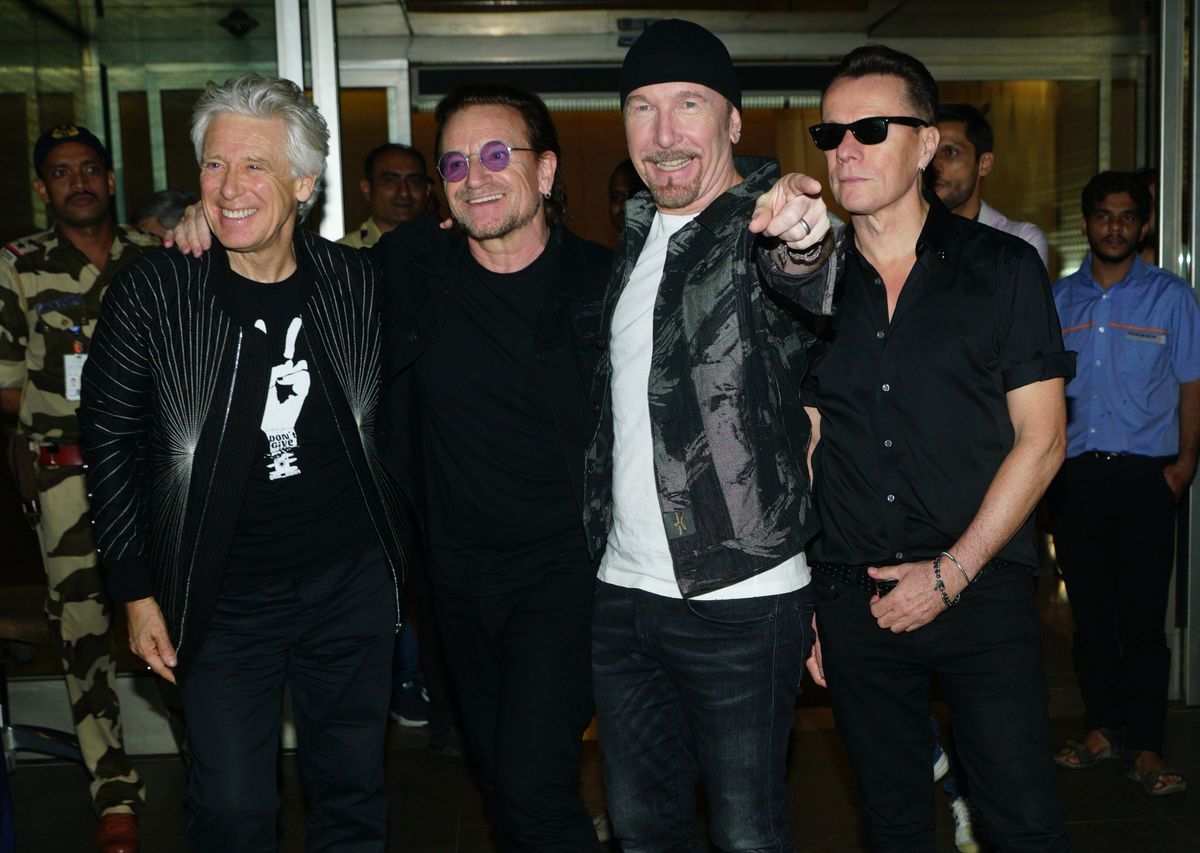
U2 is officially entering a new era, and one song on the legendary rock band’s upcoming album immediately caught fans’ attention. The Irish group has announced Carnaval De Luz, its 16th studio album and first collection of new album material in nine years. The record is scheduled for release on November 13, 2026, with Bono, The Edge, Adam Clayton and Larry Mullen Jr. all returning for the new chapter.
But among the album’s intriguing song titles, one stands out: “The Mirror Maker (Rosalía).” The title initially sparked reports that Spanish superstar Rosalía had recorded a collaboration with U2. There is an important twist, however. According to subsequent reporting, Rosalía does not actually perform on the song. Instead, she inspired it.
The Edge, Larry Mullen Jr, Bono and Adam Clayton of U2 perform Joshua Tree live on stage at Twickenham Stadium, Twickenham, London. (Photo by David Jensen/PA Images via Getty Images)
Is Rosalía Featured on U2’s “The Mirror Maker”?
At first glance, it certainly looks that way. “The Mirror Maker (Rosalía)” appears on the official Carnaval De Luz tracklist, while another song, “Torn,” is explicitly listed as featuring Dolly Parton. U2’s official store also lists “The Mirror Maker (Rosalía)” without a “feat.” designation.
You may also like
Continue reading
Consequence reported that a source confirmed Rosalía inspired the U2 song but is not one of the album’s featured collaborators. Spanish outlet LOS40 subsequently reported the same clarification.
Exactly how her music, image, or artistic approach influenced the track has not yet been publicly detailed.
U2’s New Album Carnaval De Luz Arrives in November
Carnaval De Luz will arrive November 13 through Island Records and marks U2’s first studio album of entirely new material in nine years.
Irish band U2 perform from a balcony for Mexican fans in Mexico City on May 12, 2026 in Mexico City, Mexico.
Produced by longtime U2 collaborator Jacknife Lee, the project explores spirituality, friendship, freedom and endurance in the face of darker forces, according to the band’s announcement. U2 says the music also combines echoes of its more experimental periods with tightly constructed songwriting.
The album arrives during an especially significant moment in the band’s history.
September 2026 marks 50 years since Larry Mullen Jr. placed a handwritten notice at Mount Temple Comprehensive School in Dublin looking for musicians to form a band. That meeting eventually produced the group that became U2. Five decades later, they are still experimenting.
The Edge described the new record as a “messy, provocative, sacred collection of songs,” while Bono framed Carnaval De Luz around the idea of responding to darkness with louder music, bigger stories and brighter songs.
U2 Releases New Song “Silencio”
While listeners will have to wait to hear the full story behind “The Mirror Maker (Rosalía),” U2 has already offered another preview of the album.
The band released “Silencio” alongside the album announcement. Running just 2 minutes and 35 seconds, the song is described by U2 as an homage to the attitude of early surf punk. Ryan Tedder provided additional production on the track, while its music video was filmed in Mexico City and directed by Mexican-American duo Cliqua, Pasqual Gutiérrez and Raúl “RJ” Sanchez.
“Silencio” follows “Street of Dreams,” which was released in July as the first song from the upcoming album.
The Spanish-language touches are hard to miss. Beyond Carnaval De Luz and “Silencio,” the album includes “La Reina,” while “The Mirror Maker” carries Rosalía’s name in parentheses.
Dolly Parton Appears on U2’s New Album
There is one major guest appearance that is explicitly confirmed.
Dolly Parton appears on the album-closing track “Torn.” The song was co-written by U2, Parton, and Johnny McDaid, with Daniel Lanois contributing pedal steel guitar. It has been described as Parton’s final recorded vocal performance.
Other familiar names are involved behind the scenes. Brian Eno contributed co-writing and synthesizers to “Go (Carnaval De Luz),” “The Greatest Show on Earth,” and “Can’t Stop Us Now.” Martin Garrix has a co-writing credit on “Glorify,” while Lanois appears on “Torn.”
Those collaborators connect the new album to different periods of U2’s history while also introducing contemporary influences.
As the bull run in Bitcoin and altcoins continues, Zcash (ZEC) has emerged as one of the standout assets in the cryptocurrency market with its strong performance. This rise in Zcash is accompanied by increased capital inflows into Grayscale’s Zcash ETF, ZCSH, and a renewed interest in privacy-focused cryptocurrencies.
A $1 Billion Milestone!
Grayscale’s Zcash product, ZCSH, has crossed a significant milestone. In a statement, Grayscale announced that its Zcash ETF (ZCSH) is “the world’s first Zcash fund,” with assets under management reaching $1 billion.
ZCSH’s net inflow of approximately $306.12 million in the last 30 days, and its total net asset value reaching the $1 billion mark, indicates a significant increase in investor interest in Zcash.
Zcash, a Bitcoin that Can Adapt to Change!
Alliance co-founder Qiao Wang recently compared Zcash and Bitcoin in a podcast, noting their similarities.
However, Wang stated that Zcash is like a “mutable Bitcoin,” noting that the key difference is its ability to adapt to changing conditions and new threats.
At this point, Wang noted that Zcash has the flexibility to update its protocol to address potential future challenges such as quantum computing-related threats and increasing privacy demands.
According to Wang, Bitcoin’s increasingly “immutable” nature offers strong assurances regarding fixed supply and protocol predictability. However, this approach can limit the network’s capacity to adapt to new technological threats or changing user needs.
Wang therefore emphasized that he does not consider Zcash a direct alternative or a “better” version of Bitcoin, highlighting that the two assets have different characteristics. Stating that his holdings in Bitcoin are much larger than his Zcash investments, Wang explained that he primarily views Zcash as a hedge against the technological and structural risks that Bitcoin might face.
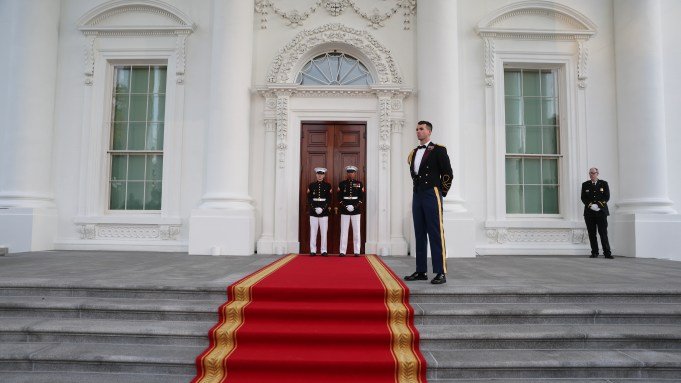
UPDATED with White House response: Shortly after CNN said that it was denied access to cover the arrivals at the White House State Dinner for Chinese President Xi Jinping tonight, MS NOW announced that it, too, had been barred.
The news came on the same day a federal judge ordered the White House to restore hard passes to the networks’ journalists and those of and Politico.
The coverage at the North Portico was scheduled to be open to pre-credentialed media, a wider scope of reporters and photographers than the White House press pool.
CNN White House correspondent Kristen Holmes said that they were told that their credential to cover the event was only for a camera and audio, not an editorial presence. She had requested that she and her producer attend.
“Again, no editorial presence, just a camera and audio, which certainly seems like a reaction to President Trump saying that he wanted the CNN coverage of the event,” Holmes said.
The White House said on its rapid response account that it was a “pre-credentialed event,” and “contrary to what the fake news wants you the believe, they don’t just get to have free rein into every part of the White House, every event, and every press call.”
The exclusion came after U.S. District Judge Timothy Kelly ordered that credentials for CNN, Politico and MS NOW be restored, ending Trump’s five-day ban of the outlets from the White House grounds.
The outlets returned to the White House around noon. Then, hours later, Trump complained that CNN and MS NOW were not covering the state visit.
Trump claimed that the networks “refused to cover one of the Biggest and Most Beautiful Events to take place in many years, the arrival at the White House of the Highly Respected President of China, Xi Jinping, and his beautiful wife, Madam Peng. The event was magnificent — Actually made for Television but, because they’re Fake News, and because they knew how good it would be, they didn’t want credit to be given to ‘TRUMP,’ they refused to be there. That’s why they have such poor Ratings. Tonight’s State Dinner at the White House, for President Xi, will be spectacular!”
In fact, network correspondents said that they were not able to get access to the White House on Thursday morning. And after the White House pulled CNN from the TV pool on Monday, the other four networks in the pool declined to replace them in the rotation. That has meant a dearth of video images from the White House, as TV pool coverage has yet to resume.
The latest exclusion does not appear to be addressed in Kelly’s order. Rather, it is an issue about access to a particular event on White House grounds. The press office sends out notice to reporters of events that are open to “pre-credentialed media,” accommodating a much wider scope of credentialed reporters than those restricted to the White House pool. Those who want to attend RSVP, and the White House staff then inform reporters and photographers if they have clearance to go.
Last year, after Trump barred the Associated Press from pool access to areas like the Oval Office as well as larger “pre-credentialed media” events in locations like the East Room, the news organization sued. In an initial ruling on a preliminary injunction, a federal judge sided with the AP, concluding that the White House could not bar outlets from press events based on viewpoint. The D.C. Circuit, though, concluded that the White House could exclude the AP from smaller spaces, like the Oval Office and Cabinet Room, but distinguished those areas from larger White House locations like the East Room, where the district judge’s order remains in effect.
Circle Foundation has unveiled two initiatives with the United Nations Development Programme (UNDP) and the World Food Programme (WFP) to explore digital payments and regulated stablecoin infrastructure for development and humanitarian operations.
The support is expected to help international organizations improve the speed, cost and transparency of payments while expanding access to digital financial services, Circle Foundation said Friday.
The team noted that UNDP will use a Circle Foundation grant to establish the Digital Asset Innovation Pool, which will provide a structured framework for using regulated payment stablecoins in development programs.
The pool, which will complement existing banking channels, is designed to help UNDP country offices transition successful experiments into regular program delivery, the Foundation added. It will provide operational and regulatory guidance, beneficiary safeguards and tools for measuring payment costs, delivery times and reach.
Circle Foundation will also provide a grant to World Food Program USA to support WFP’s work on stablecoin-enabled payment infrastructure. The initiative will develop governance, risk, treasury, reconciliation and compliance systems while connecting local fintech and mobile money providers.
WFP plans to test two to three country corridors over three years and use the results to assess efficiency, transparency and resilience for its own operations and the wider humanitarian sector.
James Talarico, the Texas Democrat looking for an upset in the U.S. Senate race in the state over Ken Paxton, is drawing on an endorsement from Bill Nye, the Science Guy.
The pop culture science figure and TV host appears in a new campaign video for Talarico debuting on Friday, highlighting the candidate’s background as a teacher. It’s part of an effort to launch a coalition, Teachers for Talarico, for the candidate.
Nye says in the video, “Now, I’ve spent my career getting young people excited about science, about being curious, about learning in general, and so do you — you are teachers in Texas. And get this, maybe you know this: James Talarico was a teacher, a middle school teacher, in San Antonio before he was in the Texas legislature. Now, he’s running for Senate, and he needs your support.”
Compared to the 2024 presidential race, the midterms have so far seen relatively few celebrities out on the trail or in videos for candidates. Talarico, though, has posted photos with figures like Willie Nelson and Jimmy Kimmel, who sang his praises when the candidate recently appeared on his late night show, albeit the interview was moved to YouTube out of concern over the FCC’s equal time rule.
Talarico has been leading in polls over Paxton, but Republican super PACs are investing heavily in an effort to shore up support in the state.