Blog

  • What to know about US-Iran standoff over the Strait of Hormuz

    What to know about US-Iran standoff over the Strait of Hormuz

    The Strait of Hormuz, a chokepoint for about a fifth of the world’s oil, has again become the chaotic centre of the United States-Israel war on Iran, as a standoff between Washington and Tehran is complicating efforts to end the war.

    Iran on Saturday reversed its decision on reopening the strait, and its military opened fire at a ship trying to pass through the waterway after US President Donald Trump said Washington will continue its blockade on Iranian ports.

    Recommended Stories

    list of 3 itemsend of list

    Trump has refused to end the blockade until a deal is finalised. On Saturday, he said that there have been “very good” discussions, but Washington won’t be “blackmailed”.

    After a short-lived rise in transit attempts on Saturday, ships in the Persian Gulf once again stayed put, after reports of vessels coming under fire mid-passage and being forced to withdraw.

    Their pullback restored the strait to its pre-ceasefire status, raising the risk of a worsening global energy crunch and increasing the likelihood of renewed fighting.

    Here is what you need to know:

    What has Iran said?

    Iranian Foreign Minister Abbas Araghchi on Friday said the strait would be open for commercial vessels during the truce, which ends on April 22, in “line with the ceasefire in Lebanon”.

    However, Iran’s Islamic Revolutionary Guard Corps (IRGC) announced a clear reversal in Iran’s position, saying the Strait of Hormuz would not return to its “previous state”, amid the blockade of Iranian ports.

    The IRGC’s joint military command said the US has “continued acts of piracy and maritime theft under the guise of a so-called blockade”.

    INTERACTIVE - US naval blockade of Iran’s ports - APRIL 13, 2026-1776092129
    (Al Jazeera)

    “For this reason, control of the Strait of Hormuz has returned to its previous state, and this strategic waterway is now under strict management and control by the armed forces,” said the statement, cited by Iranian broadcaster IRIB.

    “Until the United States restores full freedom of navigation for vessels travelling from Iran to their destinations and back, the status of the Strait of Hormuz will remain tightly controlled and in its previous condition,” it added.

    Iran’s Speaker of Parliament Mohammad Bagher Ghalibaf, who is Iran’s chief negotiator in talks with the US, said it was “impossible for others to pass” the strategic strait without Iran’s consent. He called Washington’s blockade “ignorant” and “foolish”, saying Tehran would not allow others to transit the strait if its own ships were blocked.

    On Saturday, he said that major differences remain, despite some progress towards a deal.

    What has the US said?

    In a Truth Social post on Sunday, the US president ‌accused Iran of violating the ceasefire agreement, but added that US negotiators will be heading to Islamabad, Pakistan on Monday to strike a deal.

    “We’re offering a very fair and reasonable deal, and I hope they take it because, if they don’t, the United States is going to knock out every single power plant, and every single bridge, in Iran,” he said in the post.

    Iran on Sunday said that it was tightening its control over the waterway once again in response to the US blockade of Iranian ports, which began on April 14. Tehran says the blockade violates the terms of the ceasefire.

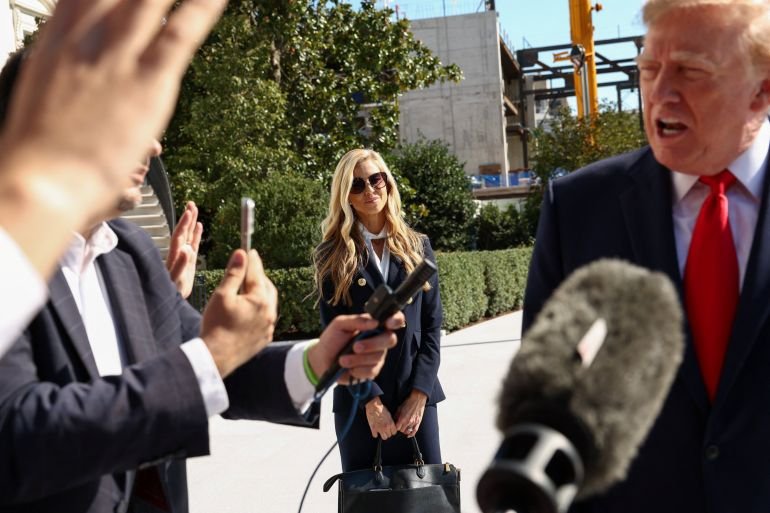
    Trump on Saturday said that the US was having “very good conversations” with Iran, but he noted that Tehran wanted to close the important oil corridor again and that it could not blackmail the US with such a move.

    What is happening in the strait right now?

    Lloyd’s List, a maritime firm, said traffic in the Straight of Hormuz had come to a halt after Iranian forces fired on several ships on Saturday.

    The United ⁠⁠Kingdom ⁠⁠Maritime Trade Operations agency said it received a report ⁠⁠of a tanker being fired upon by what it ‌‌said were two gunboats linked to the IRGC.

    Meanwhile, India summoned the Iranian ambassador in New Delhi and expressed deep concern that two Indian-flagged ships had come under fire in the strait, the government said.

    Abas Aslani, a senior fellow at the Centre for Middle East Strategic Studies in Tehran, said the two sides are “engaging in war rhetoric ahead of any possible escalation and military conflict”.

    “It seems that they are pressuring each other to win concessions – and we are not there yet,” Aslani told Al Jazeera.

    “There are speculations that maybe the US is possibly planning to engage in limited strikes against Iran, but Iran has been saying that it will retaliate strongly,” he said. “This might end again in a wider conflict.”

    What are other sticking points between the US and Iran?

    Nuclear enrichment

    The biggest contention is over hardening positions on Iran’s nuclear programme, chief among them being Tehran’s nuclear enrichment capability.

    On Friday, Trump said Washington would obtain Iran’s enriched uranium, calling it “nuclear dust” and referring to the 440kg (970lbs) believed to be buried at sites hit by US strikes last year. He repeated on Truth Social that “the USA will get all Nuclear ‘Dust’”.

    Speaking to Reuters news agency, Trump said the US would work with Iran “at a nice leisurely pace” and “start excavating with big machinery” to recover the material.

    In a rebuke to Trump, Iran’s President Masoud Pezeshkian said Washington had no justification for depriving Iran of its nuclear rights.

    “Trump says Iran cannot make use of its nuclear rights, but doesn’t say for what crime. Who is he to deprive a nation of its rights?” Pezeshkian asked, according to the Iranian Students’ News Agency.

    Israel and the US have repeatedly accused Iran of enriching uranium to develop nuclear weapons. But Iran says its nuclear programme is for civilian purposes and that it has honoured its commitments under the Nuclear Non-Proliferation Treaty.

    Tulsi Gabbard, the director of US National Intelligence, testified to Congress in March 2025 that the US “continues to assess that Iran is not building a nuclear weapon and Supreme Leader [Ayatollah Ali] Khamenei has not authorised the nuclear weapons programme he suspended in 2003.”

    Khamenei was killed on February 28 in US and Israeli strikes. His son Mojtaba Khamenei has been named his successor.

    Lebanon

    A ceasefire in Lebanon had also been a key Iranian demand before it agreed to the two-week truce between the US-Israeli side and Iran.

    While a 10-day ceasefire is technically in place between Israel and the Lebanese armed group Hezbollah, it remains fragile. Israel has carried out strikes despite the truce, and its forces have created a Gaza-like “yellow line” to create a buffer zone.

    The truce was declared just days after Lebanon and Israel held their first face-to-face negotiations in decades in Washington. According to Iran’s FM Araghchi, the brief reopening of the Strait of Hormuz came in response to the ceasefire being extended to Lebanon.

    Hezbollah has condemned the ceasefire agreement as “an insult to our country” and “a slippery slope with no end in sight”.

    “A ceasefire means a complete cessation of all hostilities”, the Lebanon-based group said. “Because we do not trust this enemy, the resistance fighters will remain in the field, ready to respond to any violations of the aggression. A ceasefire cannot be unilateral; it must be mutual”.

    Hezbollah is Tehran’s most powerful regional ally and a core pillar of the “axis of resistance” – a network of armed groups across the Middle East aligned with Iran against Israel, including Yemen’s Houthis and several factions in Iraq.

    The group joined the fighting after the Israeli army killed Iran’s Supreme Leader Khamenei in its initial strikes on Tehran.

  • The Strokes End Coachella Performance With Video Montage Condemning U.S. and Israeli Bombings in Iran and Gaza

    The Strokes End Coachella Performance With Video Montage Condemning U.S. and Israeli Bombings in Iran and Gaza

    The Strokes ended their performance on weekend 2 of Coachella on a note of political protest, capping the set with a video montage that accused the CIA of enacting regime change in foreign countries over the decades, finally concluding with footage of Israel bombing Gaza and the United States bombing Iran.

    These several minutes of video commentary came as a surprise to audiences viewing at home as well as in the desert, since it bore no resemblance to how the group rounded out its set the previous weekend. The song that accompanied this statement, “Oblivius,” had not been performed by the Strokes in concert at all since 2016; it included singer Julian Casablancas repeating the statement in the chorus, “What side you standing on?”

    As the Strokes wrapped up their final number Saturday night, the footage on the huge LED screens behind them portrayed recent American bombings in the Middle East with the large caption “Over 30 universities destroyed in Iran” — followed by another video clip of a large building in Gaza being destroyed in a controlled explosion, with the caption: “Last university standing in Gaza.”

    Most of the long montage took issue with what the band presented as America’s historic misdeeds, from the era of slavery up through America’s missile strikes in Iran. But bringing the Israeli/Palestinian conflict into it at the end was notable, given how the biggest controversy at last year’s Coachella had to do with the group Kneecap using its set to condemn Israel for military actions in the Middle East, albeit in more profane terms.

    With the Strokes’ appearance, unlike Kneecap’s in 2025, the festival appeared to be ready for and accepting of presenting the band’s political statement, as long shots in the live video feed on YouTube made all of the group’s footage and captions clearly visible.

    The bulk of the Strokes’ video montage had to do with assertions that the CIA has been responsible for overthrowing governments in South America or even assassinating leaders — along with giving voice to the conspiracy theory that the U.S. was involved domestically in the assassination of civil rights leader Martin Luther King Jr. After showing an image of King, a caption read: “US govt found guilty of his murder in civil trial.” (The trial referenced took place in 1999, and was followed by the Justice Department declaring in 2000 that there was no evidence to lend validity to the jury’s verdict.)

    Among the other accusations of secret U.S. intervention over the years, the Strokes’ video said that the CIA was suspected of involvement in the 1981 plane crashes that killed Panamanian president Omar Torrijos and Equadorian president Jaime Rondos, and in the overthrowing of figures from Iranian prime minister Mohammed Mossadegh in 1953 to Chilean president Salvador Alende in 1973 and Bolivian president Juan Torres in 1976.

    Following the climactic portrayal of bombings in Iran and Gaza, the Strokes’ video montage ended with a shot of a bomber plane in the air, as the song abruptly ended.

    Much of the reaction to the band’s video commentary at Coachella among their fans was initially positive, with statements on their Instagram posts like “Thank you so much for using your stage to highlight Gaza and Iran and Latin America” and “Amazing show and a bombshell of reality at the end!”

    Reaction among pro-Israel music fans and conservative U.S. fans may grow as clips of the performance are further disseminated on social media Sunday. Most followers of the Strokes, however, are likely to be aware of Casablancas’ past support for Palestine, as he signed a 2021 “Musicians for Palestine” letter.

  • 4AI and AquaFlux Partner to Connect AI Agents to Real-World Asset Yield

    4AI and AquaFlux Partner to Connect AI Agents to Real-World Asset Yield

    4AI and AquaFlux have partnered to put decentralized AI agents to work optimizing real-world asset yield. 4AI handles the agent marketplace on BSC. AquaFlux handles the RWA protocol and the tri-token structure that lets the yield vary by risk tier. Together, they’re making agents active participants in yield decisions rather than background infrastructure.

    We’re partnering with @AquaFluxPro to unlock the next layer of onchain intelligence by combining decentralized AI agents with structured RWA yield.

    🔸 Decentralized AI marketplace enabling anyone to build and deploy intelligent agents
    🔸 Tri-token (P/C/S) model bringing flexible… pic.twitter.com/0jZaYCXZCY

    — 4AI 🔶 BNB (@4aibsc) April 18, 2026

    What 4AI Actually Does

    4AI is a marketplace on Binance Smart Chain where anyone can build and deploy AI agents. Backed by 0x Labs, the idea is that you shouldn’t need to be a major institution or a specialized developer to create an intelligent agent. Request what you need, someone builds it, you deploy it. Agents become reusable building blocks instead of custom tools you have to commission from scratch each time.

    An agent trained to optimize yield strategies can be requested, built, and deployed by users who need exactly that capability without maintaining their own AI infrastructure.

    How the Tri-Token Model Changes Everything

    AquaFlux’s three-token structure brings real flexibility to RWA markets that have historically been fragmented and illiquid. Different tokens represent different risk and yield tiers. When you add AI agents that can analyze yields across those tiers and move capital between them in real time, the whole thing becomes smarter.

    An AI agent connected to AquaFlux moves capital between risk tiers automatically, based on market conditions and yields. It’s fast in ways manual management never will be. It has the intelligence tools to optimize decisions and the onchain infrastructure to execute them atomically.

    How the Partnership Works in Practice

    The onchain risk engine that AquaFlux operates becomes the decision-making framework for AI agents optimizing yield strategies.

    Rather than agents operating on general instructions or historical patterns, they have access to a structured risk assessment model that’s transparent, verifiable, and continuously updated based on onchain data.

    An AI agent trying to maximize yield for a user can now evaluate RWA opportunities through AquaFlux’s risk framework, understand the composability options across the three-token model, and execute rebalancing decisions that balance yield with risk in real time. The agent knows how to optimize and it knows how to act.

    Why This Bridge Matters for DeFi and RWAs

    The separation between DeFi and RWA markets has created inefficiencies where capital doesn’t flow freely to the highest risk-adjusted returns because the two markets operate with different infrastructure, different custody models, and different user bases. Intelligent agents that can operate across both and make allocation decisions based on unified yield metrics begin to break down those inefficiencies.

    For users, that means yield optimization that’s smarter and faster than doing it manually. AquaFlux’s RWA yield now reaches DeFi’s liquidity. Capital allocation happens through agents instead of sitting fragmented across separate infrastructure.

    Conclusion

    4AI and AquaFlux are connecting decentralized AI agents with structured RWA yield in a partnership that brings automated, intelligent capital allocation to real-world asset markets. AI agents can now evaluate RWA opportunities through AquaFlux’s tri-token framework and execute yield optimization decisions in real time onchain.

    The partnership connects two markets that have historically operated separately by giving agents the tools to work across both at the same

  • Inside the rise of wrench attacks against crypto holders and how France has become the focus

    Inside the rise of wrench attacks against crypto holders and how France has become the focus

    France is facing a rise in crypto-related kidnappings as so-called “wrench attacks” become more frequent, brazen and violent.

    That shift was visible this week amid the staging of an annual international blockchain and crypto conference. A police motorcade escorted VIP guests to a dinner at the Palace of Versailles. And security was also notably reinforced at the Carrousel du Louver, where the conference was taking place.

    Wrench attacks in France have put the country so notably under the international spotlight that government officials took the stage at the conference in Paris to acknowledge their alarm at the scale of the problem. They said that this year alone, the country has suffered at least 41 crypto-related kidnappings and home invasions. That’s one every two to three days.

    Jean-Didier Berger, Minister Delegate to the Interior Ministry, said a new set of measures is being prepared with Interior Minister Laurent Nuñez to tackle the growing issue. A prevention platform has already drawn thousands of registrations, but authorities say further steps are needed as incidents continue to rise.

    Wrench attack epicenter

    The country has become the epicenter of a global rise in wrench attacks. Across multiple jurisdictions, attacks on crypto holders are becoming more frequent and more violent, according to security researchers and law enforcement data.

    Globally, the trend is also on the rise. In 2025, there were 72 verified physical coercion incidents globally, a 75% increase from the previous year, according to Certik and crypto researcher Jameson Lopp’s data, which tracks 188 attacks since 2014. Many more go unreported, he said. Cases involving physical assault rose even faster, up 250% year-over-year.

    The term “wrench attack” refers to the use of physical force to extract access to digital assets. For some attackers, it is easier to coerce a person than to break encryption.

    “Every time a wrench attack is successful, it tells the world that crypto owners are juicy targets,” Lopp told CoinDesk.

    Unlike traditional bank transfers, crypto transactions cannot be reversed. Once a victim authorizes a transfer under duress, the funds can be moved quickly across wallets and chains.

    Attackers seek points of weakness

    Researchers say the way attackers identify victims has also changed.

    “We’re seeing a shift from ‘find a wallet’ to ‘hunt a person,’” Phil Ariss of TRM Labs told CoinDesk. Rather than scanning for technical vulnerabilities, attackers build profiles, he added. They look at social media activity, public appearances and leaked datasets. They track routines and identify points of weakness.

    “The biggest avoidable mistake is tying real-world identity, location and routine too tightly to visible crypto wealth,” Ariss said.

    The problem is exacerbated when attackers get a helping hand from government officials. In one widely known case, in which a French tax official sold wrench attackers sensitive data. The case raised concerns among security experts that insider leaks and compromised state data were feeding directly into wrench attacks.

    The pool of potential victims has widened, with mid-level holders increasingly being targeted, sometimes based on limited or indirect signals.

    Anybody is a potential victim

    Cases now include families, with children targeted alongside crypto-holding parents, making the attacks harder to categorize by severity.

    In January 2025, Ledger co-founder David Balland was kidnapped in France along with his partner. During the attack, one of his fingers was severed and sent to associates as part of a ransom demand. He was rescued after a police operation.

    Other cases have involved prolonged captivity and torture, such as one in New York, where a crypto investor was held for more than two weeks. In Canada, a home invasion escalated into waterboarding and sexual violence as attackers attempted to force access to funds.

    Lopp said both opportunistic and organized groups are involved, but there are signs of increasing coordination. “We do seem to be seeing more organized groups now,” he said.

    TRM Labs’s Ariss says his team has observed similar patterns, noting some groups operate with defined roles and pre-planning, including surveillance and follow-home tactics.

    “These look less like one-off robberies and more like small kidnap or robbery crews specializing in crypto jobs,” Ariss said.

    After funds are obtained, attackers tend to move quickly and frequently the crypto assets they attain are converted into stablecoins and routed across multiple chains, making recovery more difficult.

    France’s role in this trend may reflect a mix of factors, Lopp said, including cases involving leaked personal data and cross-border criminal networks.

    Rising prices, heftier loot

    More broadly, rising asset prices have increased the potential payoff from a single attack, while improvements in digital security have reduced the effectiveness of purely technical exploits.

    “It’s far easier than trying to rob a bank,” Lopp said.

    Another issue is visibility: wrench attacks might be significantly underreported because many are reported as standard robberies or home invasions, with no mention of crypto.

    “A large share of incidents are still recorded as simple robberies,” Ariss said, adding that the crypto element is often left out at the time of reporting, which can make it harder for authorities to connect cases or identify broader patterns.

    The increase in attacks has raised questions about the risks of self-custody, a core principle of cryptocurrency.

    Some security experts point to measures such as multi-signature setups, withdrawal delays and spending limits as ways to reduce risk by limiting how much can be accessed under duress.

    “If coercion cannot produce immediate access to the majority of funds, the risk and return changes,” Ariss said. Such measures do not eliminate the threat but may reduce the incentive for attackers.

    As crypto adoption grows, attacks are becoming more frequent and severe, turning what was once a niche concern into a broader security risk.

  • Banks in the U.S. Are Starting to Fear the Crypto Regulation – They’re Taking Action

    As the countdown continues for the CLARITY Act, a critical bill regulating cryptocurrencies in the US, a notable move has come from the banking sector.

    According to information shared by journalist Eleanor Terrett, banks, particularly those based in North Carolina, have begun to directly intervene in the debate surrounding stablecoin yields.

    An email sent by the North Carolina Bankers Association to its member banks revealed serious concerns within the sector regarding the current consensus document. According to the email, shared by an employee of a small Wilmington-based bank, the current stablecoin “yield” regulation falls short of its goal of preventing deposits from shifting to stablecoins.

    Related News BREAKING: Rumors Swirl That Today’s Hacking Incident Could Be Much Larger – Aave Takes Action

    The email in question encouraged bank employees to call Thom Tillis’s office and convey a specific message. The prepared text stated that under the CLARITY Act, any interest or similar return on stablecoins used as “stores of value” should be strictly prohibited. It specifically added that this prohibition should be clear, unambiguous, and without exception.

    *This is not investment advice.

  • Nomura study says 65% of institutional investors see crypto as a vital portfolio diversifier

    Nomura study says 65% of institutional investors see crypto as a vital portfolio diversifier

    Institutional investors are warming to digital assets, with improving sentiment and broader use cases emerging as key drivers of adoption, according to a new survey from Tokyo-based bank Nomura and its crypto unit Laser Digital.

    The study, based on responses from more than 500 investment professionals in Japan, found that 31% of respondents now hold a positive outlook on crypto over the next year, up from 25% in 2024. Meanwhile, negative sentiment has declined, pointing to a gradual shift in perception as the asset class matures.

    A central theme is diversification. Some 65% of respondents said they view crypto as a portfolio diversifier, while 79% of those considering exposure plan to invest within three years. Most expect relatively modest allocations — typically between 2% and 5% — suggesting institutions are still in the early stages of adoption.

    That shift is being supported by a changing regulatory and policy backdrop. In Japan, policymakers have spent the past year refining crypto frameworks, including discussions around classification, taxation and investor protections. Globally, clearer rules in major markets — alongside the approval and expansion of crypto investment products such as exchange-traded funds (ETFs) and tokenized assets — have reduced some of the uncertainty that previously kept institutions on the sidelines.

    As a result, interest is expanding beyond simple price exposure. More than 60% of respondents expressed interest in staking, lending, derivatives and tokenized assets, reflecting growing demand for yield-generating strategies and more sophisticated portfolio construction.

    Stablecoins are also gaining traction, with 63% of respondents identifying potential use cases ranging from treasury management to cross-border payments and investment in tokenized securities.

    Still, barriers remain. Concerns around volatility, counterparty risk and the lack of established valuation frameworks continue to weigh on adoption. Regulatory uncertainty, while improving, has not fully disappeared.

    Even so, the survey suggests the conversation is shifting. Rather than debating whether to invest in crypto, institutions are increasingly focused on how to do so — a sign that digital assets are moving closer to becoming a standard component of institutional portfolios.

  • Iran war: What is happening on day 51 of the US-Israeli conflict?

    Iran war: What is happening on day 51 of the US-Israeli conflict?

    Tehran says it will keep the strategic Strait of Hormuz closed until Washington ends its blockade of Iranian ports.

    The strategic Strait of Hormuz has been closed again during the standoff between Iran and the United States as the influential Iranian parliamentary speaker has indicated that a conclusive peace agreement is still “far” away even though talks have made some headway.

    With mediators pressing on after high-level discussions in Pakistan last weekend failed to produce an accord, Tehran declared it would keep the vital maritime trade corridor closed until Washington lifts its blockade on Iranian ports.

    Recommended Stories

    list of 3 itemsend of list

    Iran’s Islamic Revolutionary Guard Corps (IRGC) warned that any attempt to pass through the strait without permission “will be considered cooperation with the enemy, and the offending vessel will be targeted”.

    The current two-week ceasefire will expire on Wednesday unless it is extended.

    Here is what we know:

    In Iran

    • US ⁠President ⁠Donald Trump has no justification to ⁠deprive Iran of its nuclear ⁠rights, the Iranian Students’ News Agency quoted Iranian President Masoud Pezeshkian ‌as saying on Sunday as Washington and Tehran continue to disagree on nuclear ⁠issues.
    • Iran’s “valiant navy” is “ready to inflict new bitter defeats on its enemies”, Supreme Leader Mojtaba Khamenei said in a series of X posts on Saturday.
    • Iranian Deputy Foreign Minister Saeed Khatibzadeh said a framework of understanding must be agreed with the US first before more talks are held, saying, “There was significant progress made actually,” but dismissed US “maximalist” demands on Iran’s nuclear programme.
    • “There is now a certain sense of frustration and uncertainty when it comes to the road ahead,” Al Jazeera’s Tohid Asadi reported from Tehran. “We know that Iranians are very much worried, not only about the shadow of the war, but also about the element of surprise, even during this ceasefire.”
    • Minister of Education Alireza Kazemi said Iran’s government does not have plans to resume in-person education at the moment.
    • The Iranian Ministry of Science announced that 180 members of the academic community have been killed in the war, including 18 female students and one female university professor.
    • The semiofficial Tasnim News Agency, quoting the deputy director of Iran’s Civil Aviation Organisation, said the country’s airspace would be reopened with flights from east to west established gradually.
    • The aviation authority said Iran will resume international flights on Monday from Mashhad airport in the country’s northeast.
    • Iran is replenishing its missile and drone launchers at a ⁠higher speed than before the war started, Majid Mousavi, the IRGC’s Aerospace Force commander, said.
    • ⁠Iran’s ⁠armed forces turned back two tankers trying ⁠to transit the Strait ⁠of Hormuz after issuing warnings, Tasnim  reported.

    War diplomacy

    • Mohammad Bagher Ghalibaf, speaker of the Iranian parliament, said in a televised address on Saturday night that there had been “progress” with Washington, “but there are many gaps and some fundamental points remain.”
    • “We are still far from the final discussion,” said Ghalibaf, one of Tehran’s negotiators in the talks aimed at ending the war launched by Israel and the US against Iran on February 28.
    • Prime Minister Shehbaz Sharif returned to Pakistan on Saturday from his visits to Saudi Arabia, Qatar and Turkiye in advance of an expected second round of US-Iran talks.
    • Egyptian Foreign Minister Badr Abdelatty said Cairo and Islamabad hope to secure a final agreement “in the coming days”.
    • ⁠Turkish ⁠Foreign Minister Hakan Fidan said on Sunday ⁠that Iran and the US had the will to continue talks to end the ‌war and he remained “optimistic” that the two-week ceasefire would be extended.

    In the US

    • Trump accused Iran of getting “a little cute” in its recent moves and warned Tehran not to try to “blackmail” Washington by flip-flopping on the strait.
    • “We have very good conversations going on,” the president told reporters at the White House, adding that Washington was “taking a tough stand”.
    • The US military said it has forced 23 ships to turn around near the Strait of Hormuz since it imposed a naval blockade of Iranian ports. In a post on X, its Central Command said US forces were still enforcing the blockade “against ships entering or exiting Iranian ports and coastal areas”.

    In Israel

    • The Israeli military said another soldier has been killed in combat in southern Lebanon, the second death announced in less than 12 hours.
    • Israeli forces said they established a “yellow line” in southern Lebanon similar to an Israeli military measure in the besieged Gaza Strip.
    • More than 1,000 homes in Tel Aviv have been left uninhabitable by the war with Iran, its mayor said.

    In Lebanon

    • United Nations Secretary-General Antonio Guterres condemned Saturday’s attack that killed a French soldier serving with the UN peacekeeping mission in Lebanon.
    • Naim Kassem, head of the Iran-backed Lebanese group Hezbollah, in a statement read on the group’s Al-Manar TV said a paper published by the US Department of State, which he described as the text of a ceasefire between Lebanon and Israel, “means nothing at the practical level, but it is an insult to our country”.
    • “Everyone knows that the government of Lebanon has not met or approved this statement,” Kassem said.
  • ‘In the Quarry’ Follow-Up ‘Matarifes,’ Buzzy ‘Poor Daniel’ and the Next From Gabriel Mariño Make the Cut at Guadalajara Construye 

    ‘In the Quarry’ Follow-Up ‘Matarifes,’ Buzzy ‘Poor Daniel’ and the Next From Gabriel Mariño Make the Cut at Guadalajara Construye 

    “Matarifes,” picked up for worldwide sales by Germany’s Picture Tree, features at this year’s Guadalajara Construye, one of the industry centerpieces at Latin America’s biggest film festival.  

    It is joined by the next from “Yesterday Wonder I Was” director Gabriel Marino and buzz title “Poor Daniel.”

    Shown just to the section’s jury, “Matarifes” marks Uruguayan directors brothers Rafael and Bernardo Antonaccio’s follow-up to an eye-catching breakout debut, the slow-boil but finally explosive thriller “In the Quarry,” which sold to most major markets worldwide and flagged the Antonaccios as talents to track.  

    A three-country multilateral co-production – usually a good sign with Latin American titles – once more in “Matarifes” social-issue observance is galvanised by a thriller drive and a singlar setting, here the 1970s meat ban in Uruguay.  

    Starring famed film director Claudia Sainte-Luce (“The Amazing Catfish”), “The Night Is About to Come” marks a return to filmmaking for Mariño who burst on the scene with road movie “A Secret World, selected for Berlin, followed by low-fi fantasy romance “Yesterday Wonder I Was,” a double Morelia winner. 

    There’s also good word on “Poor Daniel,” the first feature from respected Argentine actor and playwright Santiago Gobernori. 

    Production partners on “I Have To Leave” include Animal de Luz, headed by Inna Payán, a key producer on Cannes Un Certain Regard winner “La Jaula de Oro.” 

    “Swimming in the Blue” has won a bunch of screenplay awards and grants. Daniel Riglos’ “Where Dreams Sleep” marks a 10 year journey from short to feature.  

    A closer look at the titles:

    “I Have to Leave,” (“Me tengo que ir,” Hugo Arrevillaga Serrano, Animal de Luz, Cine Acrílico, Mexico)

    A nurse adrift finds an unlikely guide to confront grief and memory. Shot across Mexico City with a low-budget, emerging crew and a first-time film director from the theater, the film “embraces both risk and intimacy. It’s an honest portrait of healing, where holding on too long deepens the wound and learning to loosen its grip becomes the only way forward,” says producer Vicente Garibay Lijanova. 

    ‘I Have to Leave’

    “The Night Is About to Come,” (“Ya se quiere venir la noche,” Gabriel  Mariño, Humanos Defectuosos, Jaibol Films, Pirexia, México) 

    Lucero, a lonely call-center worker, attends a high-school reunion, opening old wounds. “As an impulsive act of defiance she stages her own death, only to have a classmate’s hidden confession force her to confront the one thing she cannot outrun: herself,” says the synopsis. “This film is a raw character study,” says Mariño. “The film embraces her contradictions without trying to resolve them. Ambiguity becomes a way of seeing her, not defining her. What remains is an attempt at empathy.”

    ‘The Night Is About to Come’

    “Matarifes,” (Monarca Films, Uruguay; Blurr Stories, Spain, Hain Cine, Argentina; La Mayor Cine, Uruguay; Nadador Cine, Uruguay)

    Given a meat ban, Galician immigrant José and daughter Rosita set up a clandestine slaughterhouse. As the operation grows across the city-wide black market, their ambitions clash with corrupt authorities, rival butchers and a shifting political landscape, pushing the family toward dangerous alliances and violent consequences. “‘Matarifes’ explores how survival can push people to cross boundaries, and how, in that process, ambition ends up devouring everything,” say Rafael and Bernardo Antonaccio. 

    ‘Matarifes’

    “Poor Daniel,” (“Pobre Daniel,” Santiago Gobernori, Lucía Valdemoros, Blurr Stories, Obol Film Club, Argentina, Spain)

    Daniel and Elizabeth’s routine existence is shattered by the arrival of Elizabeth’s brother, just released from a psychiatric clinic, sparking a ménage “as unexpected as tender.” “An attempt to blend my search for acting poetics and film language,” says respected Argentine actor Santiago Gobernori,, who adapts his own stage play. Produced by Spain/Argentina-based Blurr Stories, behind Iván Fund’s Berlin Festival Jury Prize winner “The Message,” and Argentina’s Obol (“La Sudestada”). 

    ‘Poor Daniel’

    “Swimming in the Blue,” (Tempo Meio Azul Piscina,” Sofia Federico, Benditas Projetos Criativos, Araçá Filmes, Mar Digital, Brazil)

    “More than telling a story, my wish is to show the strength of human relations, how they are built and how they are part of us. Solidarity, affection and caring for one another – above all among women – are very present in the plot, with priceless values,” director Sofia Federico tells Variety. A double winner at Frapa 2020 while in development, taking two awards, one a Projeto Paradiso Award for feature screenplay.  

    “Where Dreams Sleep,” (“Donde Duermen los Sueños,” Daniel Riglos, Bonzo Films, Animalita, Frontera Cine, Peru)

    A feature makeover of a Riglos short: a car accident leaves Santiago in coma, connecting via memory and dreams with Alina, the love of his life, who died. “Santiago must make the most painful decision of his life: hold on to the woman he loves and disappear… or let her go and survive.” “A personal exploration of memory and desire, grounded in a story showing how the mind negotiates reality, fantasy, imagination and dreams,” Riglos told Variety.  

    ‘Where Dreams Sleep’

  • Charles Schwab, Citadel Securities weigh entering prediction markets

    Charles Schwab, Citadel Securities weigh entering prediction markets

    Traditional finance giants Charles Schwab and Citadel Securities are both considering entering prediction markets, with each separately weighing up how they wish to get involved in the fast-growing sector.

    “I think at some point we likely will have prediction markets,” Rick Wurster, the CEO of the banking and investing titan Schwab, told investors during a call on Thursday.

    He added that prediction markets weren’t “of tremendous interest” when he recently asked a group of Schwab clients about them, but it was an area the company would “take a hard look at, and it would be quite straightforward for us to offer.”

    Charles Schwab CEO Rick Wurster speaking to CNBC after the company launched Bitcoin and Ether trading on Thursday. Source: CNBC

    Prediction markets such as the popular Kalshi and Polymarket have exploded in use over the past few months, with both platforms seeing a record combined total monthly trading volume of $23.6 billion in March, according to Token Terminal.

    However, Kalshi, Polymarket and other prediction market platforms have also caught the ire of some US state regulators, who have accused them in court of offering unlicensed sports betting.

    Some federal lawmakers have also vowed to crack down on prediction markets, claiming the platforms weren’t doing enough to stamp out insider trading.

    Wurster said Schwab’s potential offering would steer away from allowing bets on areas such as sports, politics and pop culture as it looks to position itself as a partner for building long-term wealth.

    “Prediction markets that are not aligned to that are not something that we want to pursue,” he said. “If you look at the stats on the success of gamblers, they’re not strong, and people generally lose money.”

    Citadel “keeping an eye” on prediction markets

    Meanwhile, Citadel Securities president Jim Esposito said at a Semafor conference in Washington, DC, on Thursday that the company is “absolutely keeping an eye on developments” in prediction markets.

    Citadel Securities president Jim Esposito speaking at the Semafor World Economy conference on Thursday. Source: YouTube

    “We’re not there yet, there’s not that much liquidity,” he added, but said that the market is likely to “ramp and scale,” and it was “certainly possible” that the market-making firm would potentially look to get involved.

    Related: Democrats question CFTC chair on insider trading in prediction markets

    Esposito said Citadel was “not looking at sports at the moment at all, I don’t see us entering that market,” but did signal an interest in some event contracts.

    He added that Citadel could see its retail and institutional clients use some event contracts as a hedge for risks to their investments, such as contracts for elections, which have been known to move markets.

    “That’s going to be some of the biggest risks to investors’ portfolios that they’re going to have to grapple with,” Esposito said. “Having a clean and distinct way to hedge certain risks, I think there’s a good use case and industrial logic to it.”

    Magazine: Should users be allowed to bet on war and death in prediction markets?

  • 30-Year Analyst Explains: “According to the Elliott Wave Theory, the Bitcoin Downturn Is Over”

    30-Year Analyst Explains: “According to the Elliott Wave Theory, the Bitcoin Downturn Is Over”

    Jordi Visser, a veteran macro investor with over 30 years of experience, assessed recent market developments. According to Visser, while artificial intelligence and commodity scarcity are ushering the world into a new economic era, Bitcoin is re-emerging with its “scarcity” argument.

    Visser argues that investor psychology and central bank policies are changing in the digital age. Stating that the Fed has perfected its QE (quantitative easing) game plan, Visser said, “I don’t think we’ll see multi-year recessions or prolonged bear markets again in the rest of my life. The moment a crack appears in the system, it is intervened with money printing and interest rate cuts.”

    He also added that in the hyper-connected world, investors experience “amnesia,” quickly forgetting negative events and focusing on new narratives.

    According to the analyst, despite the deflationary pressure created by artificial intelligence (AI), a serious inflationary risk is looming in the short term. Visser argued that the AI world has reached its physical limits and is experiencing massive processor (CPU), memory (DRAM), and energy shortages.

    Related News Will Bitcoin’s Major Rally Continue? Here’s What the Experts Say

    Visser, particularly highlighting Elon Musk’s “Terra Fab” announcement, predicts that this bottleneck in the hardware and commodities sectors will keep inflation well above the Fed’s target of 2%, reaching 4% and higher.

    Visser, who analyzed Bitcoin’s recent performance from a technical and macroeconomic perspective, stated that according to Elliott Wave theory, Bitcoin has completed its correction phase and entered a new uptrend from the $60,000 level.

    He argued that Bitcoin is now priced not just as a growth asset, but as a representative of “digital scarcity” in a world experiencing processor and energy shortages. He stated that traditional software companies (SaaS) are threatened by AI, but computing-focused firms like Oracle and Bitcoin miners will profit from this process.

    Visser stated that Bitcoin’s place in portfolios will become undeniable by the end of the year, sending this message to asset managers and investment advisors: “By the end of the year, we will reach a point where you will have to explain why 3% to 5% of your portfolio isn’t Bitcoin.”

    *This is not investment advice.