Blog

  • Netflix’s ‘The Eternaut’ Effect: Subscriber Impact Estimate Disclosed at Iberseries

    Netflix’s ‘The Eternaut’ Effect: Subscriber Impact Estimate Disclosed at Iberseries

    The sixth edition of Iberseries & Platino Industria in the Spanish capital Madrid opened on Tuesday with a focus on data, courtesy of media and entertainment research and intelligence company Parrot Analytics.

    In a session entitled “Content Without Borders: How to Win Over Audiences and Markets,” Jaime Otero, vp, partnerships at Parrot Analytics, explored key market trends and identified the types of content that resonate most strongly with audiences in Spain, Latin America, and the U.S. Hispanic market. He also examined which series, genres and markets offer the greatest international potential.

    One of the surprise takeaways: South Korea has been a key driver of demand growth for Spanish- and Portuguese-language (SPLATAM) content.

    The expert also shared estimates for the subscriber impact that Netflix hit series The Eternaut from Argentina has brought to the global streamer. The drama, set after a devastating toxic snowfall that killed millions and focusing on a group of survivors in Buenos Aires who must resist an invisible threat from another world, was the top SPLATAM series in 2025, he highlighted, estimating that it boosted Netflix subscribers by 236,000. It also led to around 2.78 million subs renewing their Netflix membership, according to Parrot’s estimates.

    All in all, Otero spoke of how the series, for which a season 2 is in the works, engaged 3.01 million global Netflix subscribers.

    The Parrot vp also told the Iberseries crowd that in 2025, for the first time, non-SPLATAM markets accounted for the majority of SPLATAM content demand worldwide. And he highlighted key markets that have experienced particularly strong SPLATAM series demand over the 2024-2026 period.
    Leading the charge was Korea, which registered a 243 percent gain, according to Parrot, followed by Japan, which saw 148 percent growth.

    Other key growth market cited by Otero were Turkey (up 132 percent), China (119 percent), Sweden (103 percent) and Sweden (102 percent).

    Iberseries & Platino Industria 2026 runs through Friday.

  • ‘The Platform’ Co-Producer David Matamoros of Doce Entertainment Spain Boards Matías Rojas’ ‘Dog Legs’ (EXCLUSIVE)

    In one of the later deals pacted at the San Sebastian Festival, Spain’s David Matamoros of Doce Entertainment boarded Matías Rojas’s adaptation of Chilean cult novel “Dog Legs” (“Patas de perro”), joining four other producers from Chile, France, Germany and Colombia.

    With this, “Dog Paws” enters the final phase of its financing and is expected to shoot in Valdivia, Chile during the second half of next year. Chile’s ever popular Alfredo Castro (Pablo Larraín’s “The Count,” “The Club”) is attached to star.

    “Spain’s involvement decisively strengthens the project and puts us in a very strong position to complete its financing,” said Federico Durán, the film’s Colombian producer through his new company El Sol Ermitaño. Durán, who has produced such notable films as “The Squad” and “Alias María,” just won a major post production award for his WIP project “Lovers Go Home!” at San Sebastián.

    “’Dog Legs’ is an ambitious project, both technically and artistically, but it also aims to reach a broad audience,” he told Variety.

    Matamoros, whose credits include “The Platform” and “The Virgin of the Quarry,” was also a producer at Zentropa Spain, the company founded by Lars von Trier.

    Chile’s A Simple Vista, led by Tomás Gerlach, first began developing “Dog Legs” some four years ago. This year, Reality Films, the production arm of French distributor Epicentre Films, which distributes Colombia’s Cannes-winning film “A Poet” and submission to the 98th Academy Awards international feature category, came on board at the 76th Berlinale, joining German company Klinker Films, a co-producer of “A Place Called Dignity,” Rojas’ previous film.

    Visual effects will be handled by French company MPC, whose credits include Thomas Cailley’s “The Animal Kingdom,” winner of Best VFX at the 2023 Sitges Film Festival and the French César Awards.

    Rojas’s ties to San Sebastian run deep. He premiered his debut feature, “Root,” at the festival 13 years ago. He later returned to its Europe-Latin America Co-Production Forum with his second fiction feature, “A Place Called Dignity.”

    Throughout his career, he has presented his films and projects at major international festivals including Cannes’ Directors’ Fortnight, the Berlinale and the Tallinn Black Nights Film Festival (PÖFF).

    Published in 1965, “Dog Legs “is a landmark of Chilean literature…radical, powerful, and still deeply unsettling. Six decades later, its themes of exclusion, abuse and violence remain strikingly relevant. The story follows Bobi, a 12-year-old boy born with literal dog’s paws, hidden away by his family until Carlos, a lonely, childless man, takes him in. His act of compassion turns the town against them, casting Carlos as a madman and Bobi as a monster and setting them on a devastating path toward violence.

  • Durban FilmMart Head on Why This Year’s Event Is ‘Looking Inward’ as African Screen Industries Strive to ‘Create Solutions’ on Their Own Terms

    The Durban FilmMart returns for its 17th edition with a full slate of conversations and events looking to build on the legacy of innovation, disruption and industry-defining discussions at what is arguably the most influential film market on the continent.

    Running from Oct. 9 – 12, this year’s event is organized around the theme “Shifting Worlds, Turning Toward Ourselves,” a focus that Durban FilmMart Institute director Magdalene Reddy says was inspired by the pioneering Senegalese filmmaker Ousmane Sembène’s memorable assertion: “Why be a sunflower and turn towards the sun? I myself am the sun.”

    “We are very much looking inward [at this year’s edition],” Reddy tells Variety. “In a world where…everything is shifting, we find that, at this time, it’s important for us as the African cinema community to look at what we need to create systems that will work for us. How can we consolidate? How can we create solutions?”

    The four-day event features a wide range of panel discussions, masterclasses, one-on-one meetings and mentorship sessions designed to capitalize on a moment of unprecedented visibility — and unparalleled disruption — for the African screen industries.

    In a departure from previous editions, which ran parallel to the Durban Intl. Film Festival, this year’s DFM will open with a screening, of Rwandan debutante Marie-Clémentine Dusabejambo’s Cannes Caméra d’Or winner “Ben’Imana.” The film, an alumnus of DFM’s influential pitching and finance forum, was selected to highlight the event’s outsized impact on the African filmmaking community.

    “This was a DFM project. It was pitched at DFM two years ago, and they were able to win two awards at Cannes [including the FIPRESCI prize],” says Reddy. “For us, the celebration of hosting a screening at the market — which we’ve not done previously — is based on the fact that we want to show our local content in our local context.”

    A crucial pillar of every DFM is its influential Think Tank strand, whose conversations and conclusions often “become a blueprint for the next DFM and the direction which the industry is going,” according to Reddy.

    Central this year will be a closed-door session gathering key distributors, financiers and industry leaders looking to tackle some of the vexing challenges of film distribution on the African continent, which has been hit especially hard by successive waves of corporate consolidation in the global industry. Another session will focus on audience development, “trying to see how we can connect better with our local [audiences],” Reddy says.

    A backbone of this year’s event will be a spotlight on equitable co-production, with a series of sessions organized in collaboration with the European Audiovisual Entrepreneurs network (EAVE). Tackling knotty issues such as how to best incorporate inclusivity into financing, development and production, the conversations will address the systemic imbalances that face African producers when partnering with outside co-producers, “even when they are coming with the stories, coming with the IP,” says Reddy.

    “How can they go in as an equal partner? How can they sit confidently at the table, so they are engaging in a way that will benefit them? Engaging in a way where finances can still come back to Africa?” she asks.

    Collaboration is a theme across the Durban FilmMart’s various strands, with the event forging a wide range of partnerships with industry bodies such as EAVE; the Nature, Environment and Wildlife Filmmakers (NEWF); the Cape Town Intl. Animation Festival (CTIAF); Documentary Africa; The StoryBoard Collective; and the Ladima Foundation, which supports African women working in the film and television industries, and will launch an initiative to push for greater gender equity at African film festivals.

    “Collaboration is something that has underpinned all the work that DFM has been doing over the years,” says Reddy. “In order for the industry to survive, we need to be working together.”

    This year’s Durban FilmMart unfolds at a turbulent time for the host nation, whose screen industries have been “struggling,” according to Reddy, particularly with ongoing uncertainty around South Africa’s 25% cash rebate.

    To that end, leading South African policymakers are expected to be on hand at DFM, which will host a closed session for local industry to meet one-on-one with representatives of the influential Dept. of Trade, Industry and Competition, which manages the country’s rebate policy; the National Film and Video Foundation; and various local and regional film commissions.

    “For us as DFM, the platform that we create is a platform for filmmakers not just to create a community for the filmmaking industry on the continent, but also a space for filmmakers to connect with policymakers,” says Reddy. “A space for policymakers to understand what are the challenges, what are the issues our filmmakers are facing. We try to bridge that gap between industry and policymakers so we can create a conducive environment and ecosystem for our filmmakers.”

    That mandate, she adds, extends to DFM’s broader engagement with the African continent as a whole. “Last year’s theme was creating bridges, and that’s what we continue to do. Even though it’s challenging within the continent to work with each other, we are trying to find ways to do that.”

  • Prediction Markets Cross $20 Billion in Weekly Trading Volume for the First Time

    Prediction Markets Cross $20 Billion in Weekly Trading Volume for the First Time

    Kalshi Took More Than Three-Quarters of the Week

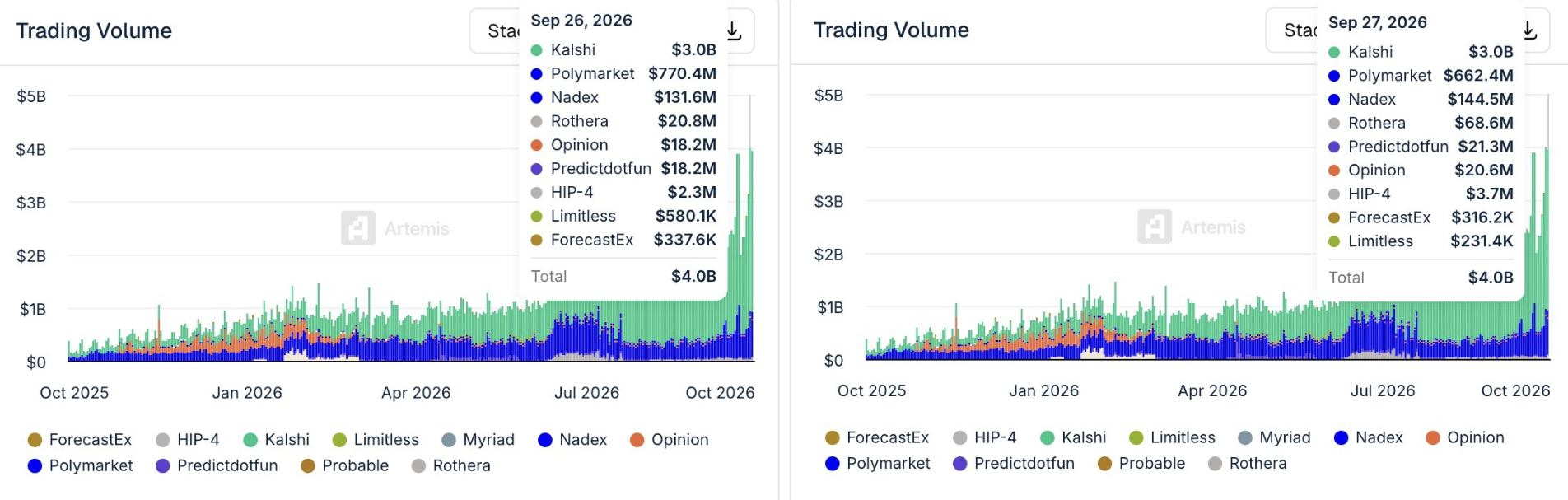
    Kalshi registered around 77% of all the volume tracked from last week, with $15.8 billion. Polymarket came in a distant second with $3.6 billion. Nadex followed with $481.9 million and Rothera with $272.3 million, while Predict.fun and Opinion each cleared $120 million.

    Polymarket had a decent weekend of its own, with $770.4 million on Saturday and $662.4 million on Sunday. However, Kalshi’s growth through September has been much faster and the gap between the two platforms is now the widest it has been all year.

    American Football Pushed the Biggest Days to the Weekend

    With September coming to a close, the sector’s trading volume over the course of the month has already broken past the previous highs set in July. These records have arrived just as the NFL and college football season in the US got underway. Most games are played over the weekend, hence why most of the sports trading is piling up during this period.

    A large share of that flow runs through parlay-style combo contracts. A parlay bundles several outcomes into one bet. A trader might back three teams to win on the same Sunday afternoon, for example. The contract pays out only if every leg hits, so the odds are long and each contract often costs just a few cents.

    That low price is where headline volume gets inflated. Kalshi counts every contract at its $1 payout value rather than what the trader paid. A $20 bet on a long-shot parlay priced at 5 cents buys 400 contracts, which shows up as $400 in volume. When thousands of those bets land on a busy football weekend, the dollar figures climb much faster than the money at risk.

    The Fed, Crypto and the Midterms Added to the Total

    Sports didn’t carry the whole week. The Federal Reserve’s September rate decision drew steady positioning on both Kalshi and Polymarket. Short-duration crypto markets, which ask whether Bitcoin or Ether will close above a set price within hours or by the end of the day, turned over repeatedly as prices moved.

    Traders have also started positioning early for the Nov. 3 U.S. midterm elections, with control of both chambers of Congress at stake. Election contracts drove the last big volume cycle in 2024, and the midterms are now five weeks away. The NFL regular season runs into early January.

  • XRP is rising while shorts pile up – Here’s how bulls are absorbing it

    XRP is rising while shorts pile up – Here’s how bulls are absorbing it

    This suggested that the CVD had expanded by $430 million within that period. Binance traders’ activity also fed into the CVD, as exchange volume moved from -$1.0 billion to roughly -$1.2 billion. Within that period, the price has returned roughly 5.00% in value.

    Spot accumulation helps $XRP absorb selling

    One of the major factors that has contributed to the price maintaining an upward motion in the past couple of days against the selling volume in the perpetual market has been Spot investors.

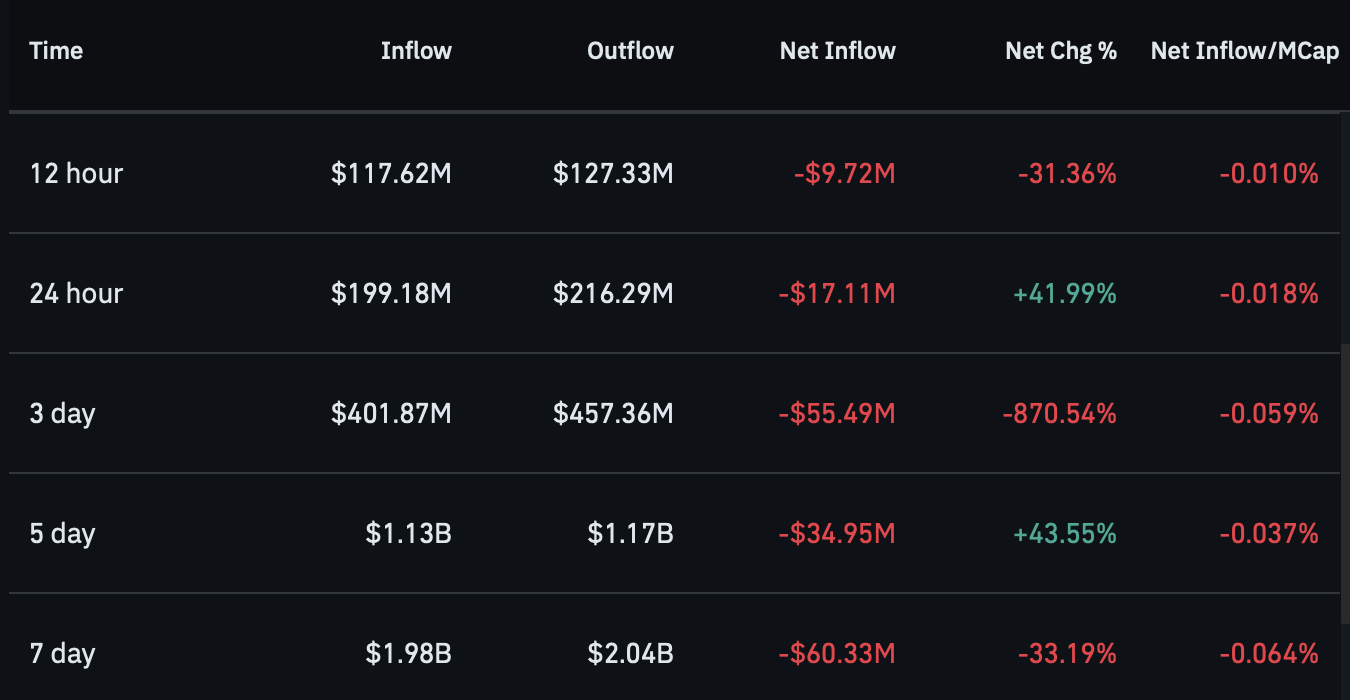
    According to CoinGlass, the Spot netflow, which tracks Spot investors’ movement of an asset into and out of exchanges, suggests there’s been more of the latter recently.

    More outflow often suggests that investors are moving capital into private wallets for long-term holding.

    Source: CoinGlass

    In the past 24 hours, that capital has soared to -$17.11 million, and in the last seven days, the figures stood at -$60.33 million.

    Continued Spot accumulation against the selling volume helps keep the price intact, as it often absorbs the majority of the selling pressure that comes from the perpetual market.

    Positive Funding Rate supports long positions

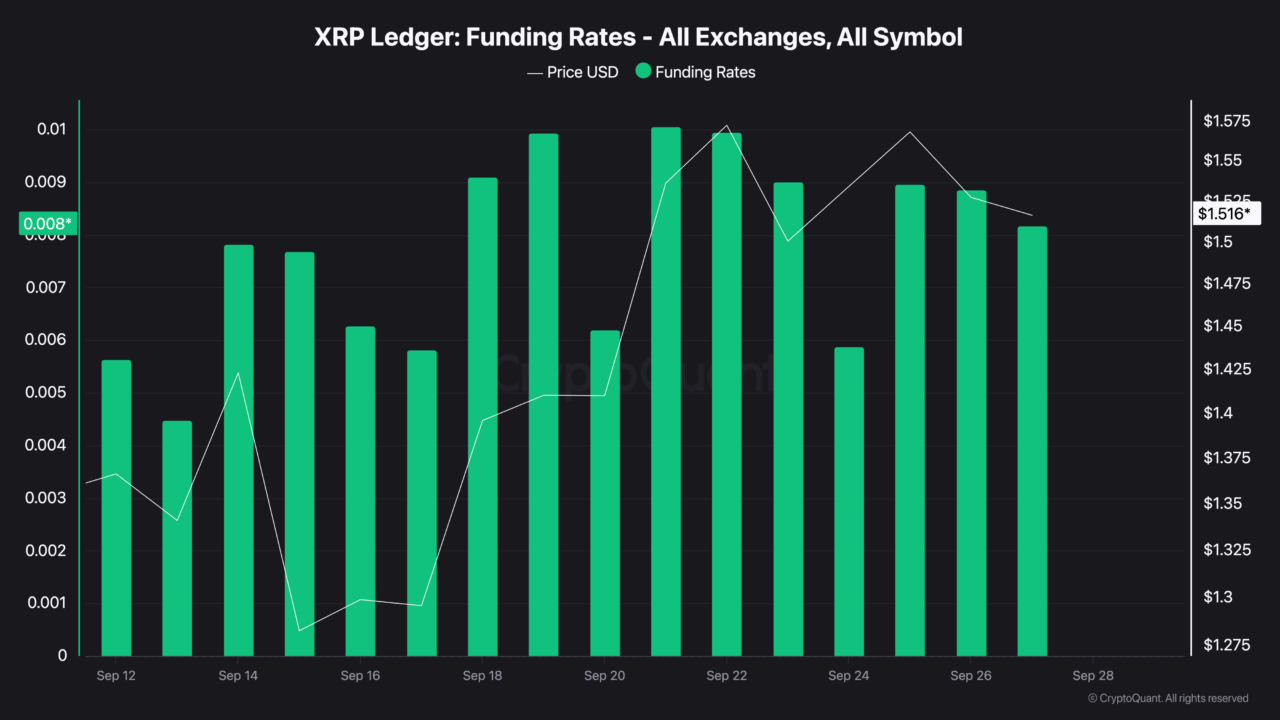
    The Funding Rate has been another factor that has helped maintain the price outlook. From the 16th of September to press time, the Funding Rate has stayed positive.

    It suggests the majority of the capital in the perpetual market is positioned in favor of a long move, as the Funding Rate within that period grew from 0.0062 to 0.0081.

    Source: CryptoQaunt

    Overall, $XRP is likely to maintain the bullish outlook if there is continued Spot accumulation alongside the Funding Rate remaining positive without going through an overheating period.


    Final Summary

    • $XRP maintains its upward trend as Spot netflow shows continued accumulation despite persistent selling in the perpetual market.
    • Positive Funding Rate supports long positioning, but overheating could put $XRP’s bullish outlook at risk.
  • Anthropic plans to spend $518 billion on AI infrastructure. Pre-IPO perps barely blink.

    Anthropic plans to spend $518 billion on AI infrastructure. Pre-IPO perps barely blink.

    Revenue grew 12-fold last year to nearly $4.6 billion. Nearly a quarter of it came from just two customers, and the company warned that many of its largest clients are not locked into long-term contracts. Anthropic held $20.28 billion in cash and short-term investments at the end of 2025.

    Crypto traders barely reacted

    Anthropic pre-IPO perpetual futures, which let traders bet on the company’s valuation before it lists, traded at $1,998 on Tuesday across major exchanges, down about 2% over 24 hours, according to CoinMarketCap. The price remains about 10% below its Sept. 9 record of $2,211.

    Each contract’s price tracks Anthropic’s expected valuation in trillions. A price of $1,998, therefore, means traders value the company at about $2 trillion, based on Binance’s pricing. That aligns with Reuters’ figure.

    Twelve exchanges list Anthropic pre-IPO perpetuals, according to Coin Metrics. Open interest, or the dollar value of outstanding contracts, stood at over $100 million as of this writing. Binance accounts for over 30% of activity.

    On leading decentralized exchange Hyperliquid, the Anthropic market run by Entropy had an open interest of $36 million.

    None of these contracts confer any equity stake in Anthropic. They are synthetic derivatives that settle in cash and track the company’s implied valuation, not its share register.

  • Mayor Zohran Mamdani Refuses Jimmy Kimmel’s Request to Text Trump a Selfie of Them

    “Jimmy Kimmel Live” is back in Brooklyn.

    The late-night show has returned to the New York City borough for a week of shows at the Brooklyn Academy of Music. It’s Kimmel’s eighth time filming “Live” in Brooklyn, the place he was born and spent his early years, and the comic is welcoming a number of heavy-hitting guests to his couch, from Howard Stern and Billy Crystal to Paul McCartney and Sen. Bernie Sanders (D-VT). He said the show received over 150,000 ticket requests, and kicked off his Brooklyn week with guests Pete Davidson and Mayor Zohran Mamdani, as well as a musical performance by TV on the Radio, celebrating the 20th anniversary of their celebrated album “Return to Cookie Mountain.”

    While there weren’t any stories involving an Oscar-winning actor exposing himself to Kimmel in a bathroom, the host was heckled by Matt Damon in a Boston Red Sox cap — on the eve of the Yankees/Red Sox AL Wild Card Series — who was joined by Kimmel’s mother and sister, and Jon Hamm, cosplaying as an angry New York City construction worker. After his sit-down interview with Davidson, who was promoting his Netflix video podcast “The Pete Davidson Show” and upcoming film “How to Rob a Bank,” Kimmel welcomed Mayor Mamdani to the stage. He prefaced his arrival with a montage of clips of Fox News talking heads predicting that New York City would become “terrifying” under Mamdani and crime would go “through the roof.” That proved to be wrong, as murders and shootings in the city hit record lows in Mamdani’s first seven months.

    “Another thing that is very unexpected is this relationship that you have with President Trump, which seems to be a very friendly relationship,” Kimmel said, adding, “Did you guys hit it off immediately or is it something that you really went into thinking, ‘OK, I need to have a relationship with the president of the United States, and I think the best way to do it is to charm him.’ How did you do that, and can you help me?”

    Mamdani laughed. “Sorry brother,” he replied. “The president and I have many disagreements. One thing we do agree on is this city, how much we love this city, so from that first meeting in November of last year, I was just thinking of how we can make this meeting not about us, but about New Yorkers. How can we spend that time talking about the things that can make life in the city a little bit easier.”

    Kimmel then threw to a video clip of Mamdani standing next to Trump at Gracie Mansion as the president gave a rambling speech, with the camera pressing in on Mamdani as he stood there stone-faced. “I mean, it is remarkable,” offered Kimmel. “I watch that, and I go, ‘OK, this is not a guy I’d want to play poker with.’” Mamdani said that while Trump is speaking, he’s only focused on getting federal approval for his proposed Sunnyside Yard project, a development in Queens that would feature an estimated 12,000 new homes and create approximately 30,000 jobs.

    “You text with the president, I’ve read?” Kimmel pressed further.

    “From time to time we’re in communication, and it’s about Sunnyside Yard, and it’s about how we can deliver for the city,” replied Mamdani. “One of the other things the president mentioned that we spoke about, that I care very deeply about, is Haitian New Yorkers. They’ve had their Protected Status ended, and I really believe we need to do whatever we can so they have stability. They’re part of the fabric of this city.”

    Kimmel then asked if they could text Trump “a selfie of us right now,” only to have Mamdani shut him down: “Jimmy, I love you, but I love housing more.”

  • Madrid Audiovisual Cluster Dives Deeper into New Business Models, AI and Emerging Technologies at Iberseries & Platino Industria

    The Madrid Audiovisual Cluster (MAC), an economic interest group comprising close to 100 Madrid-based companies, has put together a two-day industry networking and peer-learning program at the Iberseries & Platino confab, taking place over Sept. 29 – Oct. 2 in the Spanish capital.

    AI takes center stage again but the program will attempt to delve deeper into the hot-button topic this year, presenting eight industry case studies examining innovation across the audiovisual value chain.

    “While AI is a common thread running through the projects, the session takes a broader view of innovation, covering new business models, emerging technologies and evolving production and creative workflows,” said Teresa Azcona, managing director of the Madrid Audiovisual Cluster.

    “Together, they show how innovation is transforming the industry and opening up new opportunities across the value chain.”

    But as Iberseries & Platino Industria co-Director Samuel Castro pointed out: “The ability to create stories should always be based on a fully human, author-driven concept and development. AI should be used as a tool, not as an end in itself.”

    Under the banner Innovation ‘Case Studies in the Audiovisual Industry: New Business Models, AI and Emerging Technologies,’ the eight case studies will illustrate how companies are applying technology to address practical challenges across the industry. Running from 12:00 noon to 2:00 p.m. on Sept. 29, the workshop will feature eight case-study presentations, with approximately 12 minutes allocated to each.

    The next day, Sept. 30, takes in a conversation between producer Rosa Bosch and Tanja Meissner, Director of Berlinale Pro, which encompasses major industry platforms including the European Film Market, Co-Production Market, Berlinale Talents and World Cinema Fund.

    Case Studies:

    1. PLIA: Applying PLIA Technology to Script Breakdown, Pre-Production Planning and Production Tracking on “Playback”

    PLIA, an AI-powered production platform for film and audiovisual projects, has developed an integrated production-management solution designed to bring the information generated across the creative and production process into a single platform.

    The company will present its application on the feature film “Playback,” covering script breakdown, pre-production planning and production tracking. The platform brings together scripts, notes, budgets, location photography and production breakdowns, with the aim of streamlining information management across the production workflow.

    Presenting: Jose Velasco — CEO, PLIA

    2. TBS (Telefónica Broadcast Services) Tech Brand Stories: From the Physical Studio to the Virtual Production Environment: Virtual Production, AR, Motion Graphics and AI

    TBS – Tech Brand Stories, formerly Telefónica Broadcast Services, is the Telefónica Group’s creative production company and audiovisual agency. The company operates across live production, broadcast services, branded content and entertainment, combining creative and technical capabilities. Its team of more than 450 professionals works across major sporting and live events as well as non-fiction, entertainment, documentary and current-affairs programming.

    The case study will examine the convergence of virtual production, augmented reality, motion graphics and AI, and how these technologies are being integrated into contemporary production environments.

    Alberto Gonzalo — Graphics Supervisor
    Luis Miguel Boedo — Technical Coordinator

    3. Hark Media – Go Global: When AI Learns to Move Us: Hybrid Dubbing for Global Distribution

    Go Global specializes in localization for the entertainment industry, providing translation, subtitling, dubbing and voice-over services to streaming platforms and production companies.

    The company will look at the emerging role of AI in dubbing and how hybrid workflows combining technology and human expertise could support the localization of content for international markets.

    Paula Ferrari — Founder & CEO

    4. Xpost Studios – Secuoya Content Group: Innovation in VFX and Post-Production Workflows

    Xpost Studios, part of Secuoya Content Group, is a Madrid-based post-production and VFX facility operating from Madrid Content City. Its infrastructure includes facilities for editing, color grading, sound post-production, VFX and digital workflows.

    The session will focus on the application of new technologies to VFX and post-production workflows, examining how innovation is changing the way content is processed and delivered.

    Marcos Requena — Post-Production Manager

    5. Story Pitcher: Connecting Audiovisual Creators and Producers Through a Digital Platform

    Story Pitcher has developed a digital platform designed to connect screenwriters, directors and other audiovisual creators with production companies and content platforms.

    Its model combines AI-powered matching with legal-protection tools, with the aim of facilitating more direct connections between creative talent and industry decision-makers.

    Frank Belyeu — CEO, Story Pitcher

    6. Mercedes Santalla: From Talent to Market: Strategy and Business for Creative and Technology Projects

    Creative strategist and talent manager Mercedes Santalla works with projects and talent operating at the intersection of creative practice and technology. Her session will examine the commercial and strategic considerations involved in taking creative and technology-led projects from development to market, alongside the evolving relationship between talent, technology and business.

    Mercedes Santalla — Creative Strategist & Talent Manager

    7. Scoutters – Scout & Film: A Digital Platform for Location Scouting and Production

    Scoutters is a digital location-search and management platform developed by Spanish company Scout & Film. Built on Scout & Film’s experience managing locations for film and advertising productions, the platform connects location scouts, agencies, production companies and film commissions with locations suited to their production requirements.

    The case study will explore how digital tools are changing the traditionally location-based process of sourcing, managing and presenting filming locations.

    Rubén Souto — Co-Founder, Scout & Film
    Jose Díaz — Co-Founder, Scout & Film

    8. HaMo – Paramotion Films: HaMo Real-Time Animation System: Digital Puppetry and Next Lab R&D

    Developed by Paramotion Films through the Next Lab Generation R&D initiative, HaMo is a real-time motion-capture system designed for 3D animation and digital puppetry.

    The system uses inertial sensors to capture an operator’s physical movements and Unreal Engine to transfer them in real time to a CGI character. The technology enables virtual characters to perform live alongside human presenters and audiences, with potential applications across studios, live events and social media.

    This case study will look at the development and practical application of the system as an example of R&D moving from prototype to production technology.

    Jose Luis Farias — CEO, HaMo
    Alfonso Fulgencio — CTO, HaMo

  • Nearly 5,000 BTC leaves Bitget as hackers begin laundering $387 million haul

    Nearly 5,000 BTC leaves Bitget as hackers begin laundering $387 million haul

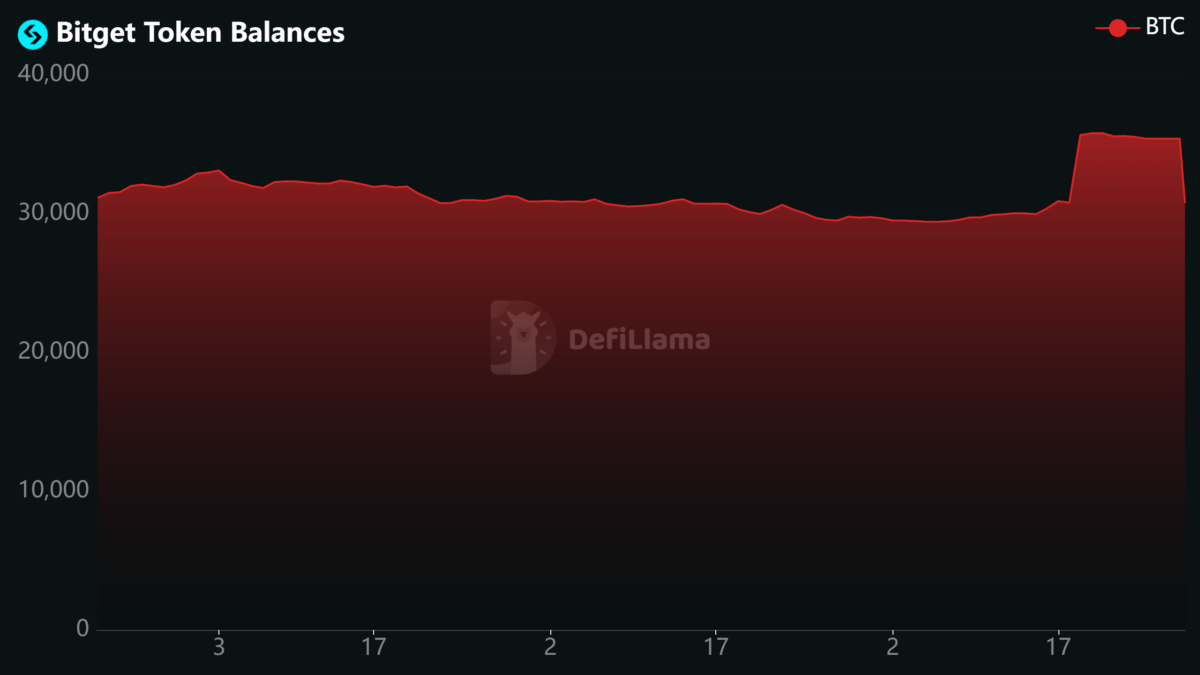
    Bitget’s tracked Bitcoin balance hovered near 30,000 $BTC before briefly rising above 35,000 and then declining. Source: DeFiLlama

    The reserve decline is larger than the amount Chen said Bitget had processed through customer withdrawal orders. DeFiLlama tracks assets held in wallets attributed to exchanges, meaning changes can also reflect wallet movements or differences in address coverage rather than customer withdrawals alone.

    Still, the rapid outflow provides the first indication of how users are responding after Bitget froze withdrawals for four days while investigating the largest security incident in its eight-year history.

    Bitget restored Bitcoin withdrawals at 08:00 UTC on Sept. 28 after completing additional checks on its withdrawal infrastructure. Ethereum withdrawals are scheduled to follow on Sept. 29, $USDT on Sept. 30, and remaining tokens, fiat, and peer-to-peer services on Oct. 2.

    The restart comes as Bitget attempts to reassure customers that the attack did not compromise its private keys or cold-wallet reserves.

    Chen said a completed internal trace found that attackers exploited vulnerabilities in third-party products to obtain internal credentials. Those credentials were then used to submit fraudulent withdrawal instructions that bypassed Bitget’s risk controls.

    The exchange has isolated affected systems, revoked and reissued internal credentials, and restructured access to sensitive infrastructure, Chen said. Bitget also disabled the affected third-party functionality while the vendor works on a fix.

    Blockchain security firms, including Mandiant and SlowMist, continue to assist with forensic analysis and attempts to trace the stolen assets. Bitget previously said the incident involved a critical backend system in its wallet infrastructure and that it had remediated the vulnerability before withdrawals began returning.

    Bitget has said customers will bear no losses from the incident and that its Protection Fund will cover the shortfall. Chen said the company plans to replenish the fund with its own capital to more than $300 million within a week.

    Related Reading

    Bitget’s hack just got $36 million bigger, and now there’s a bounty on the stolen crypto

    Stolen funds move as THORChain resists calls to intervene

    Meanwhile, recovering the stolen Bitget funds is becoming more difficult as the assets are fragmented across bridges, cross-chain protocols and privacy services.

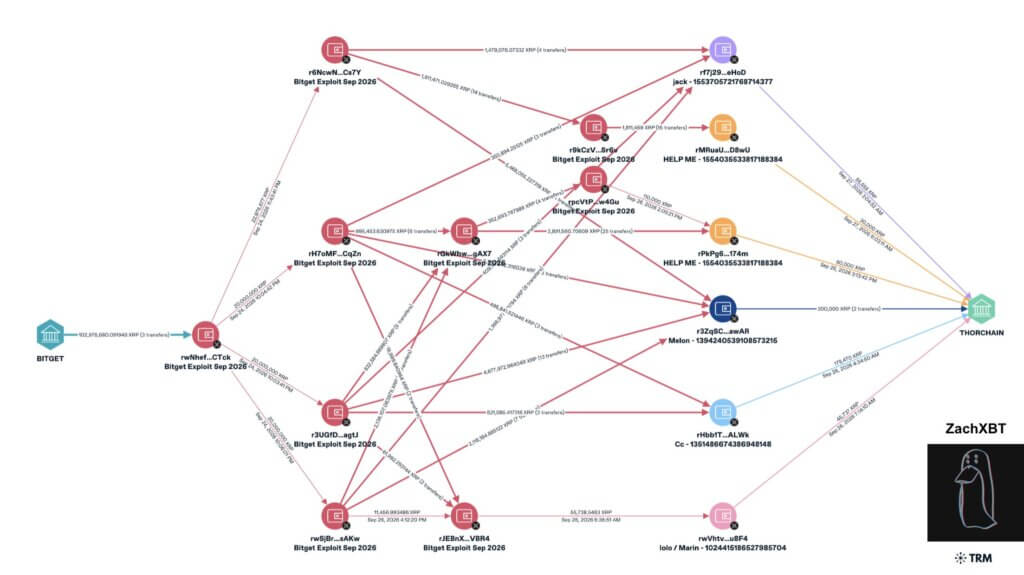
    Blockchain investigator ZachXBT said Chinese illicit actors were laundering proceeds from the exploit on behalf of hackers he described as allegedly linked to North Korea. He said the funds were being chain-hopped and deposited into mixing services including Wasabi.

    A TRM and ZachXBT flow map traces Bitget exploit funds through multiple intermediary wallets, including transfers toward THORChain. Source: ZachXBT

    ZachXBT also linked one participant in the laundering network to movements following the $292 million Kelp DAO exploit earlier this year, saying he had seen similar behavior after several attacks attributed to the TraderTraitor campaign.

    The laundering action has put THORChain at the center of a growing dispute over whether permissionless infrastructure should intervene when stolen assets pass through its systems.

    THORChain says it would not selectively block wallets or swaps, arguing that its role is comparable to censorship-resistant networks such as Bitcoin and Ethereum. However, blockchain security firm GoPlus challenged that comparison, saying THORChain’s architecture gives its node operators powers that base-layer validators do not have.

    GoPlus pointed to THORChain’s threshold-signature vaults, where active nodes jointly authorize outbound transfers, and said releasing assets from those vaults requires an affirmative signing action. It also cited per-chain signing halts, network-wide pauses, and Mimir governance as evidence that node operators can coordinate intervention when they choose.

    That makes the argument less about whether THORChain has emergency controls than about when its operators are willing to use them.

    GoPlus also pointed to THORChain’s response to its own $10.7 million exploit in May, when the network was halted as part of the containment effort. The security firm argued that the same emergency framework could be used against addresses linked to the Bitget attackers.

    THORChain disputes that conclusion, saying a network halt is meant to protect the protocol itself and differs from selectively censoring a particular user, wallet, or swap. It also said attacker addresses were not blacklisted during the May incident, maintaining that the protocol should remain neutral even when known stolen funds move through it.

    GoPlus has accused THORChain of benefiting financially from that stance. It estimated that about 101.5 $BTC, worth roughly $8.5 million, had already exited through the protocol from the Bitget exploit, while another 27.63 million XRP, valued at about $43 million, was being converted into Bitcoin.

    The firm also cited THORChain’s role in laundering proceeds from the 2025 Bybit hack, when the attacker moved hundreds of thousands of ETH through the protocol and generated millions of dollars in fees. GoPlus argued that the fee income creates an incentive conflict when node operators decline to interfere with illicit flows.

    THORChain has not accepted that characterization, and its position leaves the industry with a question of whether decentralized protocols that retain emergency controls should remain transaction-neutral when those same systems are used to launder funds from major hacks.

    For Bitget, that debate has immediate consequences. As Ethereum, $USDT, and other withdrawals reopen, investigators are racing to recover assets that are already being broken up across chains and routed through infrastructure whose operators may refuse to stop them.