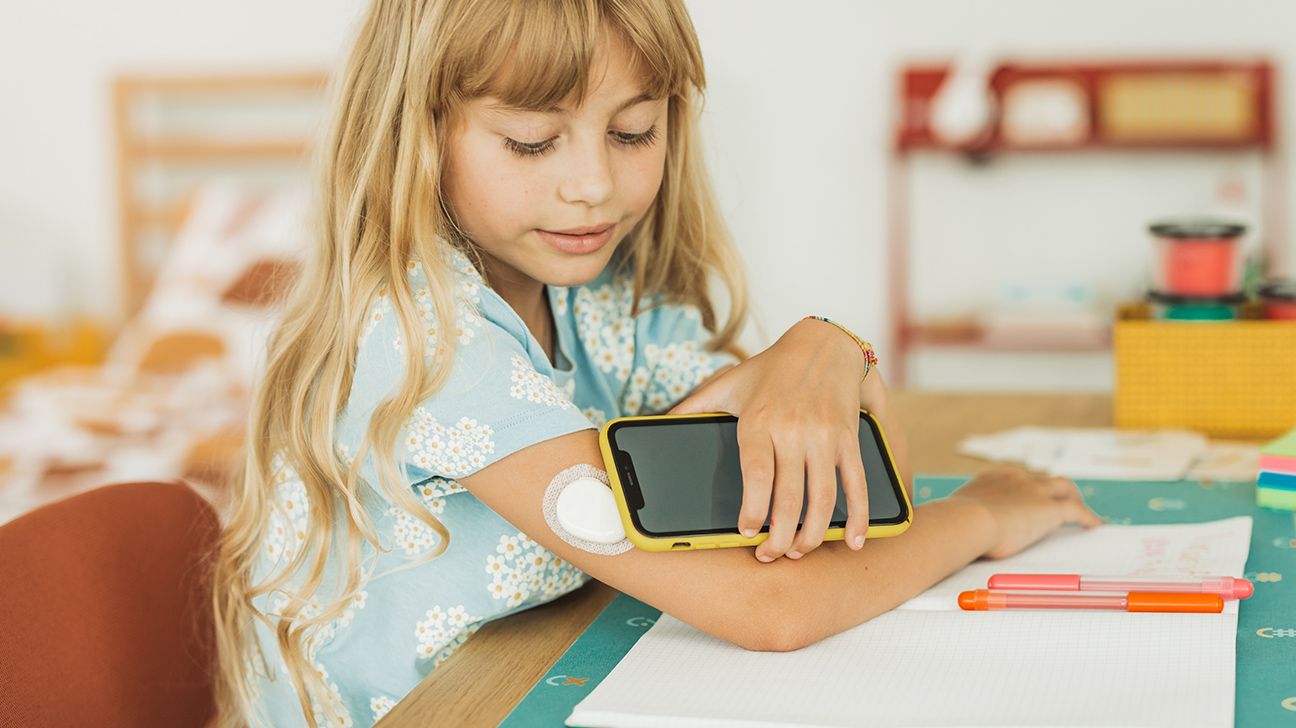
- The Food and Drug Administration (FDA) approved the first over-the-counter continuous glucose monitor for children under 18.
- Experts say the over-the-counter version will make this helpful technology more widely available to families who need diabetes care.
- The devices could help parents and children make healthy lifestyle decisions, but the technology should still be used under a medical professional’s supervision.
Federal regulators have authorized the first over-the-counter continuous glucose monitor (CGM) for children.
The wearable device is designed for children, including those with diabetes, who receive oral medication to manage their condition. It is not intended for children who need insulin injections.
The device can also be used by children and parents who want to understand how diet, exercise, and other lifestyle changes affect glucose levels.
However, the FDA cautioned that the monitoring system is not intended for individuals with problematic hypoglycemia because it is not designed to alert users when low blood sugar occurs. It’s also not intended for people on dialysis.
In addition, the FDA said individuals with eating disorders should consult their healthcare professional before use. Federal regulators added that children should use the glucose monitor only under an adult caregiver’s supervision.
The FDA approved an over-the-counter version of the Stelo Glucose monitor for individuals 18 years and older in March 2024. Participants involved in previous research have reported mild side effects, including local infection, skin irritation, pain, and discomfort.
The Stelo Glucose system uses a wearable sensor paired with a smartphone app to continuously measure, record, analyze, and display glucose levels. The app displays glucose measurements and trends every 15 minutes. Each sensor lasts for up to 15 days before it must be replaced.
Regulatory officials said the new device will make it easier for parents and children to manage conditions such as diabetes.
“Children deserve access to the best tools available to manage their health,” said
There are four basic continuous glucose monitor systems approved for use in the United States. They are usually prescribed to individuals who have been diagnosed with diabetes.
A February 2025 study concluded that continuous glucose monitors have been beneficial in helping children manage type 1 diabetes.
“[The glucose monitors] have been very helpful in managing diabetes,” said Graham Tse, MD, a pediatrician and chief medical officer of MemorialCare Miller Children’s & Women’s Hospital in Long Beach, CA.
Tse explained that the monitors provided a steady stream of information for parents monitoring their young children’s blood sugar levels, as well as for teens keeping track of their own levels. He said the data is more constant and less invasive than the occasional finger prick to draw blood for testing.
Tse said parents and teens can make decisions about diet and exercise using the monitors, based on whether glucose levels are high or low at any given moment.
“It allows them to make healthier choices,” he told Healthline. “Throughout the day, they can receive lots of data points.”
Tse added that an over-the-counter option would make this technology more widely available. “It provides greater access to more of our community,” he noted.
Daniel Ganjian, MD, a pediatrician at Providence Saint John’s Health Center in Santa Monica, CA, echoed these sentiments. “[Children] can learn how eating has an effect on their blood sugar,” he told Healthline. “It helps them make better decisions.”
Marilyn Tan, MD, an endocrinologist and professor of medicine at Stanford University, said that continuous glucose monitors provide more convenient and more helpful information.
“This [continuous glucose monitor] provides continuous glucose measurements every 15 minutes, which provides significantly more data than a finger stick glucose,” she told Healthline. “Finger stick glucoses only check one point in time and require more pricks. With a finger stick glucose, we don’t know if the glucose is on its way up or down, and we don’t know if it’s reached its peak or nadir.”
Experts expressed concerns about over-the-counter continuous glucose monitors.
Tse said that glucose monitors aren’t always as accurate as finger pricks. That’s because the monitors are measuring glucose levels in tissue, while finger pricks are calculating the measurements directly from blood.
He added that there is also the concern that parents or older children might purchase the devices and try to manage diabetes or other conditions without the supervision of a medical professional.
For example, Tse said, glucose levels tend to rise immediately after a meal. A person might see that increase on a device and misunderstand the results.
“Some of them might make decisions that may not be the most healthy,” Tse said. “Diabetes or prediabetes is not a condition you should try to manage on your own.”
Ganjian noted that the monitors could cause people to become “search engine doctors” who make misinformed decisions. He said that the devices may also not be the best tool for children with anxiety or obsessive-compulsive disorder. “It might take their obsession to the next level,” he said.
Barbara Eichorst, MS, RD, vice president of Health Care Programs at the American Diabetes Association (ADA), said these devices should be used under medical supervision.
“[A continuous glucose monitor] is not a substitute for clinical care, diabetes self-management education and support, or individualized treatment decisions,” she told Healthline. “Parents and caregivers should work with their child’s diabetes care team to determine how [glucose monitor] data may be used within the context of the child’s overall care plan, diabetes self-management education, and ongoing clinical care.”
The ADA reports that about 364,000 people under the age of 20 in the United States have been diagnosed with diabetes. That’s less than 1% of the population in that age group.
However, a 2022 study predicted that type 2 diabetes could increase by 700% in people younger than 20 in the United States over the next three decades. The researchers projected a 65% rise in type 1 diabetes cases in this age group during the same time period.
Tse said a balanced diet, regular exercise, and adequate sleep are the most important components of a lifestyle that reduces a child’s risk of developing diabetes. He recommended that children reduce their intake of carbohydrates and sugars to ensure they maintain a healthy diet.
Ganjian said that plant-forward diets emphasizing fruits, vegetables, and whole grains can help stabilize blood glucose levels. He added that quality sleep is also essential. Older teens may need only 7 to 8 hours of sleep per night, while younger children may need 9 to 11 hours, he said.
“Sleep affects everything,” Ganjian said. “Kids need to get the proper amount of age-related sleep.”
“The ideal plan for diabetes should be individualized for each patient since each person responds differently to different medications, food, and activity,” said Tan. “The [continuous glucose monitor] data allows for more insight about individual responses.”
Leave a Reply