
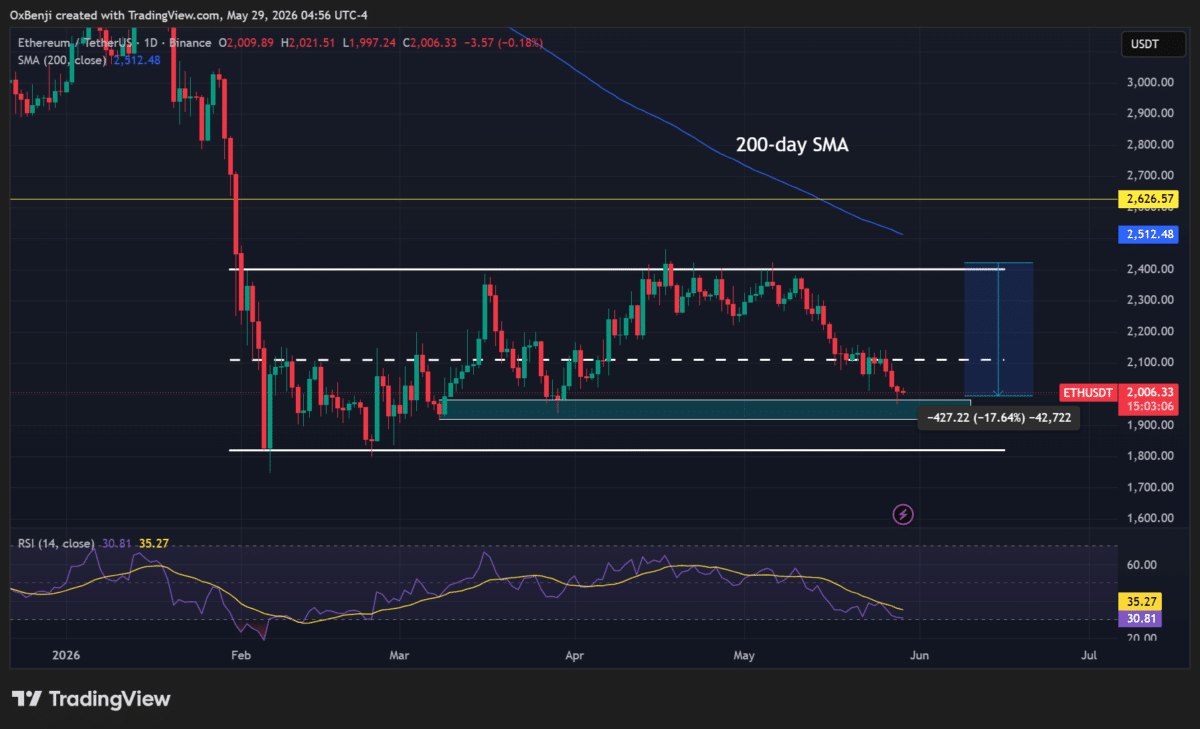
On Thursday, Ethereum’s price briefly dropped below $2000 for the first time since late March. In doing so, the king altcoin effectively erased all its Q2 gains. At the time of writing, it was down 19% from its April peak of nearly $2.5K.
This week alone, the altcoin has shed 6% of its value.
Should it lose the Q2 support zone of $2K, short sellers could push it lower to $1.8K—the range low of the 2026 sideways structure.
The pullback mirrored a broader macro-driven correction that also dragged Bitcoin lower. However, according to Nansen, $ETH’s weakness showed a “deeper problem.”
Negative $ETH catalysts: ETF outflows, low network activity
In an email statement, Nansen Research analyst Nicolai Sondergaard told AMBCrypto,
Gas fees are sitting below 2 gwei, near cycle lows, which signals that network demand is soft. Fewer people are transacting, fewer contracts are being called, and the burn mechanism that once made $ETH structurally deflationary has slowed considerably.
The “store value” proposition is not playing out for the altcoin for now. In fact, Grayscale proposed capping staking rewards to cap the resulting inflation that’s diluting $ETH’s value.
However, part of the problem is structural. Now Layer 2s (L2s) handle most of the transactions and capture revenue away from the mainnet, added Sondergaard.
For the analyst, the low burn mechanism has turned $ETH inflationary, which “removes one of the key narratives that drove conviction in prior cycles.”
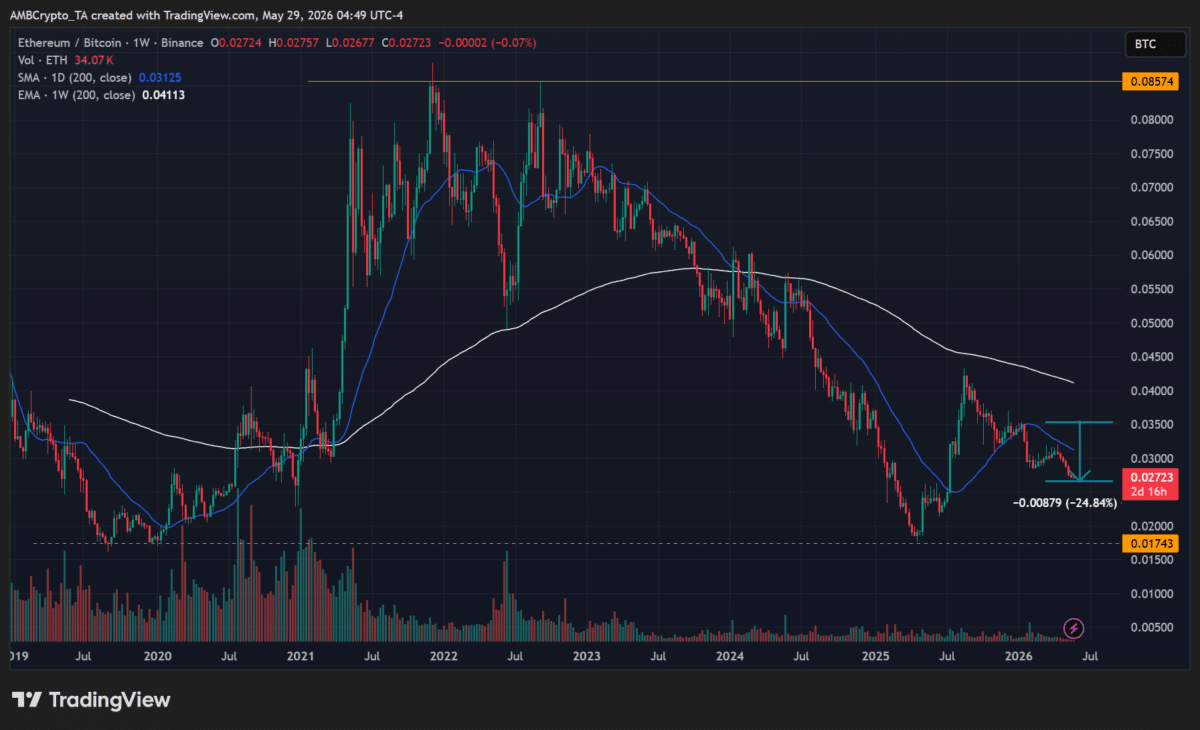
On the institutional demand front, $ETH has lagged behind $BTC in 2026. Notably, the $ETH/$BTC ratio has dropped to a year low. The analyst highlighted,
The $ETH/$BTC ratio has compressed to 0.027, which is the more telling number. It reflects a cycle dynamic that has been stubborn throughout 2026: Bitcoin continues to capture institutional attention, and $ETH has not yet pulled the same weight.
Since 11 May, U.S. Spot $ETH ETFs have seen consecutive daily outflows. The monthly outflows have hit $522M too—the highest since last December.
What could trigger $ETH’s rebound?
For $ETH to recover strongly, it needs renewed Spot $ETH ETF inflows and network demand. Nansen’s Sondergaard concluded,
The macro environment also needs to stop punishing risk appetite. $ETH does not need all of these at once, but it needs at least two. Right now, it has none of them.
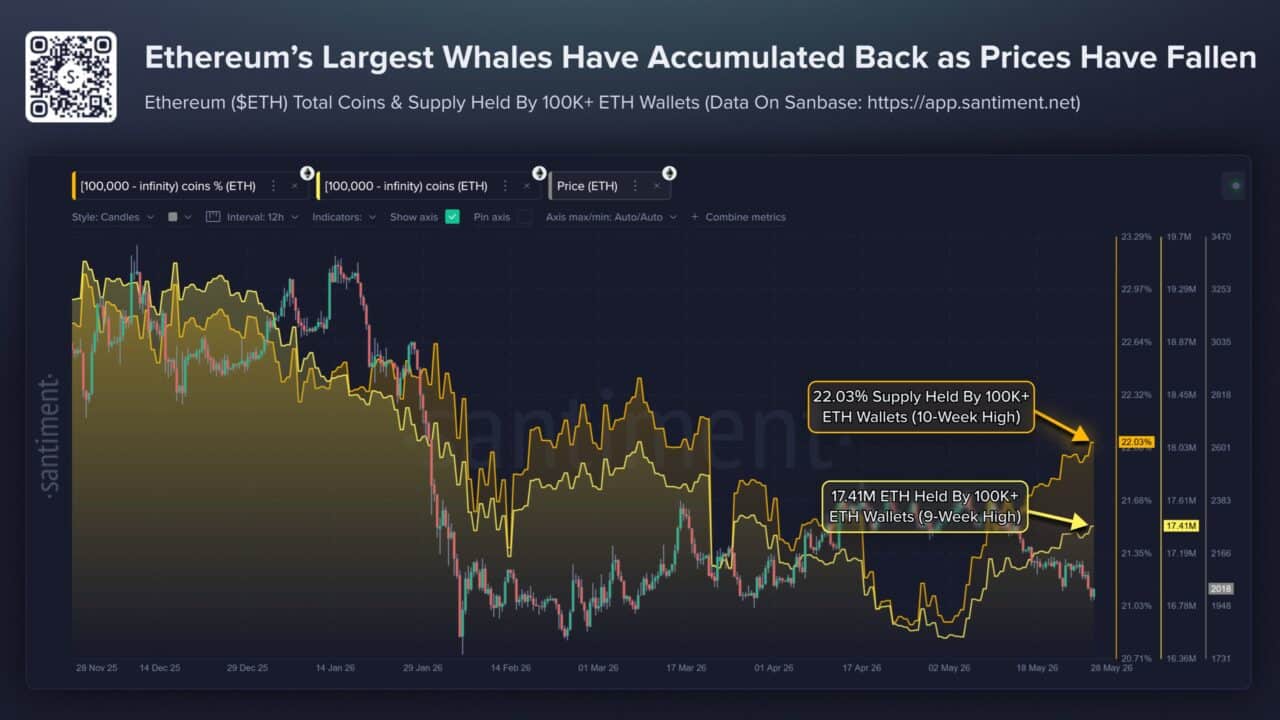
Even so, whales have piled on to bid on the recent dip. In fact, wallets with over 100K $ETH now control 22% of the supply, or 17.4 million $ETH, marking a 10-week high.
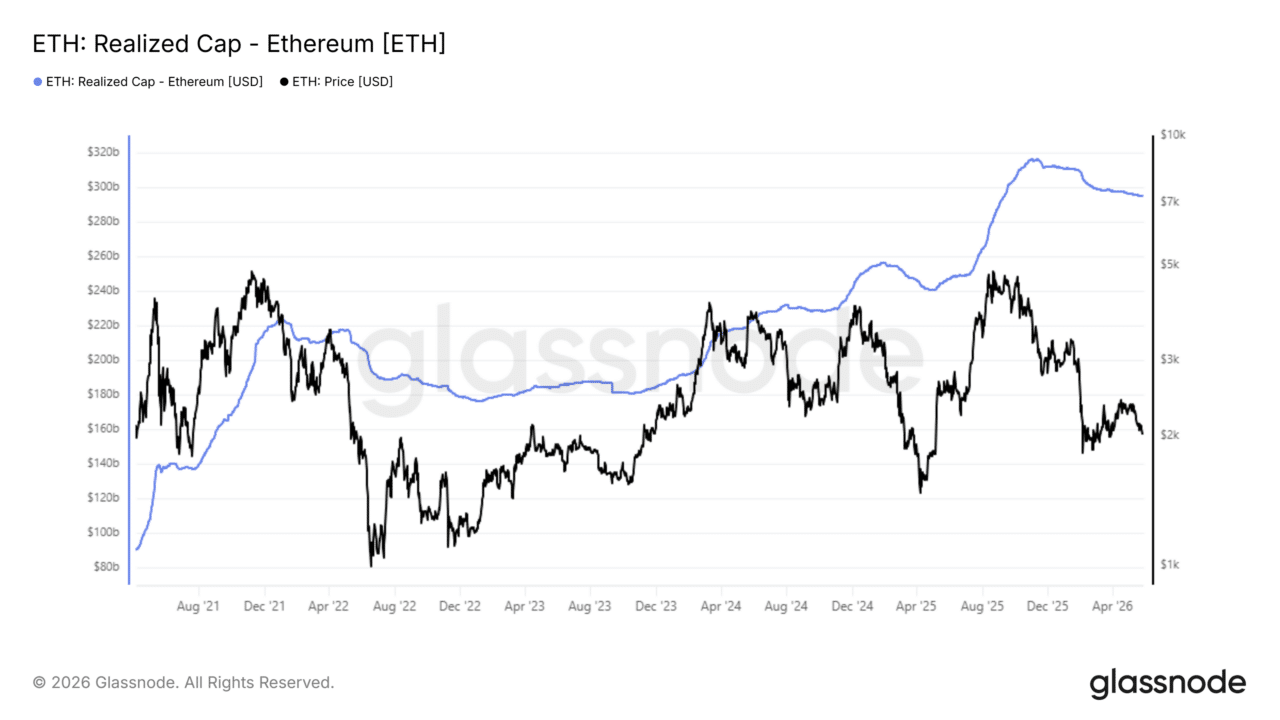
However, the whale demand, likely driven by major players like Bitmine, was not enough to taper off the on-chain capital outflows. Notably, $ETH’s capital outflow has deepened since last October, as tracked by the Realized Cap.
In fact, in 2026, the altcoin has seen $15B in capital outflows as Realized Cap dropped from $310B to $295B.
It meant that the aggregate demand for $ETH was still negative. This further reinforced Nansen’s Sondergaard outlook.
Will the $ETH price retest $1.8K?
If the weak demand and outflows extend, then $ETH’s price may fall to $1.8K. Interestingly, the MVRV Pricing Bands also implied such a projection.
After early 2026 price rejection at Realized Price (1.0 RP, green) at $2.3K, $ETH could likely retest the next support band at $1.8K (blue). In fact, during the 2022 crypto winter, $ETH only marked a true bottom after decisively climbing above the lower bands of the metric.
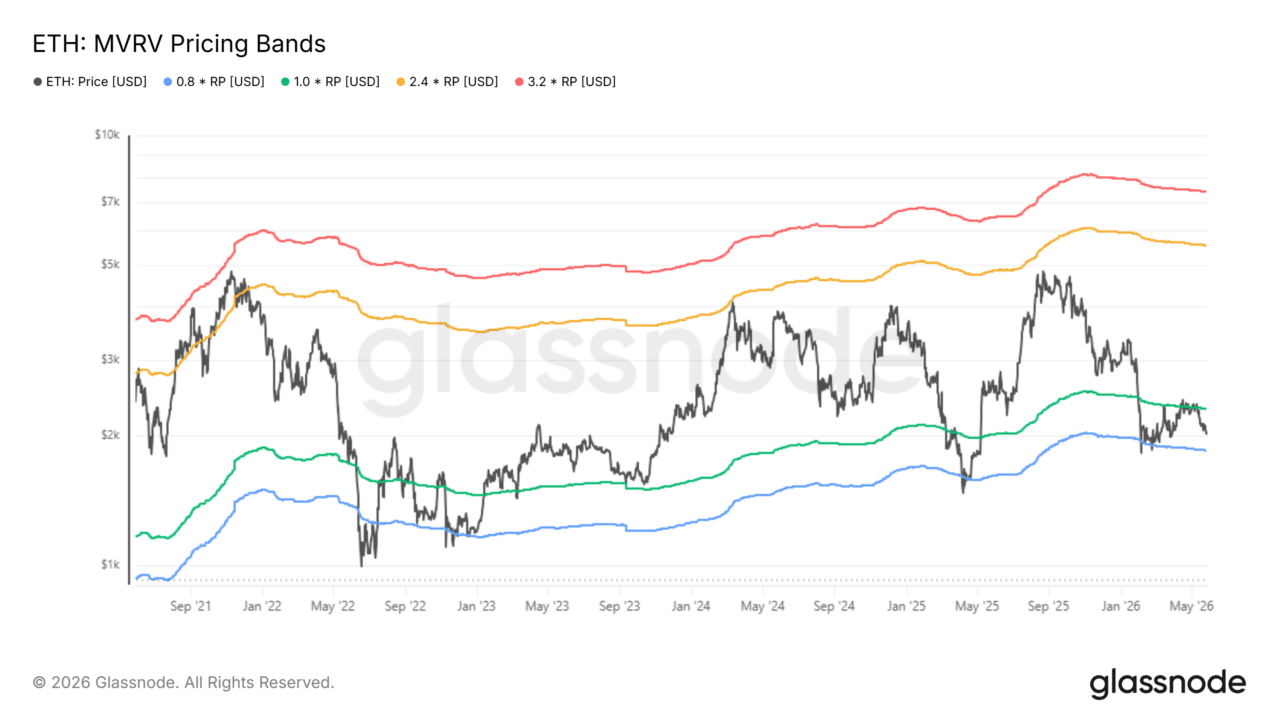
Overall, the $ETH price could slip lower to $1.8K in the medium term if the weak institutional demand and muted network activity continue in June.
Final Summary
- According to Nansen, $ETH currently has ‘none’ of the catalysts that fueled its rally in the past.
- Whales with +100K $ETH are aggressively buying the Q2 dip, increasing their aggregate holdings to 17.4M coins.
Leave a Reply