
Welcome to our institutional newsletter, Crypto Long & Short. This week:
- Maxime Seiler notes that weak crypto prices mask adoption, making yield strategies the main trade.
- Kavita Maharaj‑Alexander writes on crypto’s next phase being driven by proving compliance in practice, elevating the infrastructure providers that enable it.
- Top headlines institutions should pay attention to by Francisco Rodrigues.
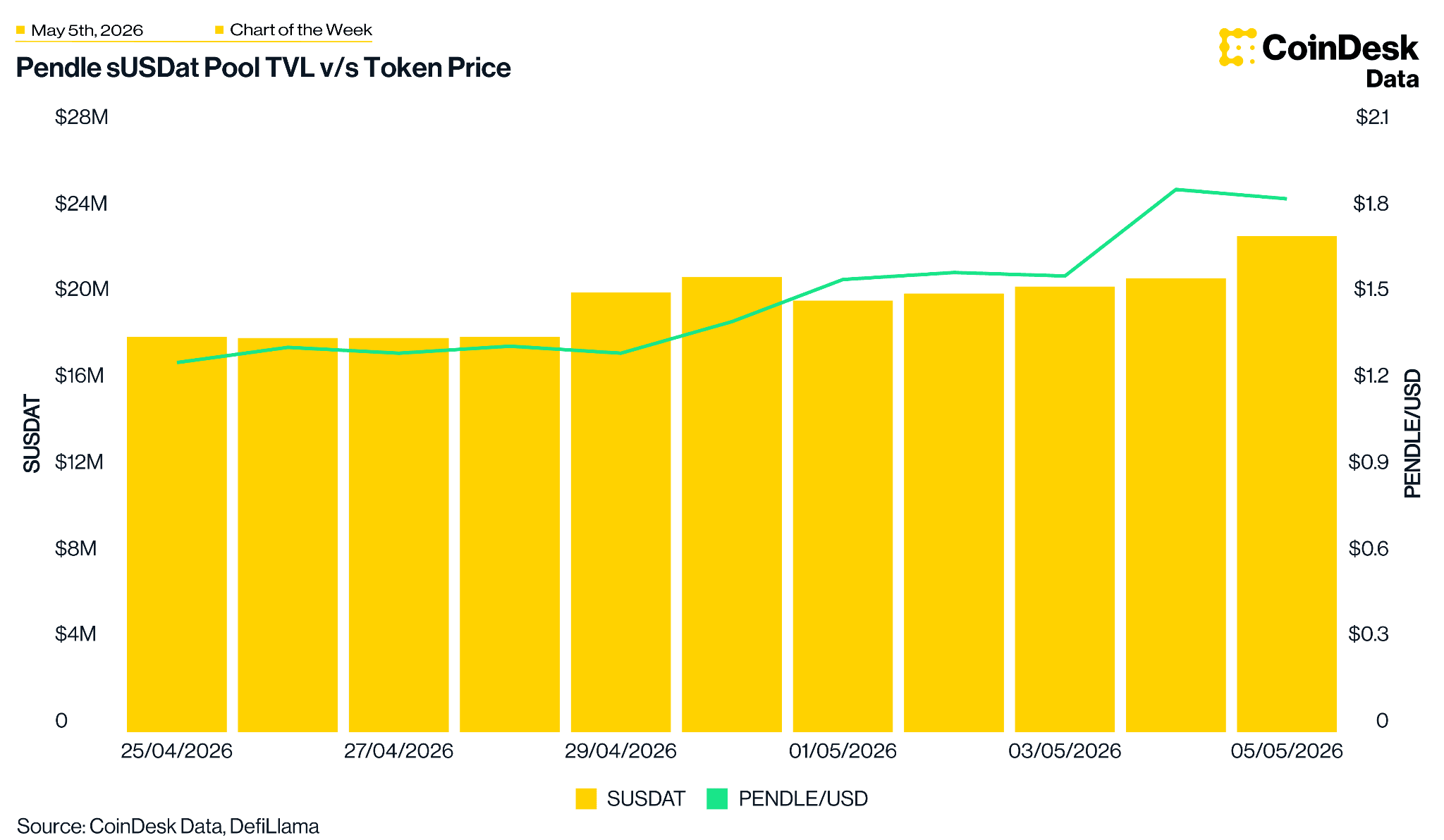
- $PENDLE rallies on demand for on-chain STRC yield exposurein Chart of the Week.
-Alexandra Levis
Expert Insights
In quiet crypto markets, yield is the trade
By Maxime Seiler, co-founder and chief executive, STS Digital, Ltd.
For much of the last six months, crypto markets have felt unusually quiet. Not dead, but tired. While bitcoin has held up better than most, much of the altcoin market has remained in what can only be described as a bear market. Liquidity has been thinner, follow-through has been weaker and the risk appetite that typically fuels broad-based crypto rallies has been missing.
That is the surface-level story. Underneath it, however, the picture looks very different.
Institutional adoption of digital assets continues to move at record pace. Across mainstream financial services, the build-out is no longer theoretical. Banks, asset managers, payment companies, custodians and infrastructure providers are developing products and capabilities to support tokenization, stablecoins, digital asset custody, trading, settlement and portfolio access. In previous cycles, institutional involvement was often discussed as something that might happen one day. Today, it is happening, but much of it is not yet reflected in token prices.
That disconnect is important. The market has been pricing short-term disappointment, while infrastructure is being built for long-term adoption.
Part of the recent weakness is understandable. The U.S. government created significant expectations around digital assets, but the pace of follow-through has slowed. Markets do not like uncertainty, and crypto markets in particular are quick to discount momentum when policy clarity fails to arrive as fast as expected. At the same time, a meaningful amount of global technical and investment talent has shifted toward artificial intelligence. AI has become the dominant narrative in technology, pulling attention, capital and brainpower away from crypto in the short term.
But these two worlds are unlikely to remain separate forever.
One of the most interesting open questions is how AI agents will eventually transact. If autonomous software agents are going to pay each other, pay merchants, access services, settle invoices, move value across borders or interact with financial applications, they will need payment rails that are programmable, global and available 24/7. Stablecoins and permissionless financial infrastructure are often discussed as potential candidates. DeFi may end up playing a role not because it is ideological, but because it is practical. Machines do not need bank branches. They need APIs, instant settlement and reliable liquidity.
That future may still be a year or more away from meaningful scale. For crypto asset holders, the more immediate question is simpler: what do you do while waiting?
This is where quiet markets can be useful. Bear markets are uncomfortable, but they often create some of the best conditions for disciplined yield generation. When spot prices move sideways and speculative momentum fades, investors are forced to focus less on direction and more on income, carry and risk management. In that environment, options become one of the most useful instruments available.
Options allow investors to monetize volatility, express views with defined parameters and generate yield on existing dollar or crypto holdings. For holders who are not looking to sell long-term positions, structured options strategies can be used to generate income while markets consolidate. For dollar holders, they may offer a more systematic approach to earn enhanced yield while waiting for better entry points. For crypto holders, they can turn otherwise idle assets into productive collateral.
This is exactly the type of environment where volatility selling and structured yield enhancement strategies may perform well in certain conditions, provided they are implemented with proper risk controls. The goal is not to chase yield blindly. The goal is to harvest quiet markets in a disciplined way.
At STS Digital, we have seen growing client demand for these types of strategies. Investors are not necessarily trying to call the exact bottom of the altcoin market. They are looking for ways to stay engaged, earn income and position themselves for the next phase of adoption without relying purely on spot price appreciation.
Crypto has always rewarded patience, but patience does not have to mean inactivity. The next wave of adoption may already be forming beneath the surface. For now, until it shows up in price, yield is the trade.
Disclaimer: For information purpose only. Not financial advice. Client acceptance subject to conditions.
Principled Perspectives
The quiet infrastructure powering digital asset maturity
By Kavita Maharaj‑Alexander, deputy general counsel, Ascentium
As digital assets move into more structured environments, the industry’s next phase is being shaped less by new rules and more by the operational realities of meeting them. The shift reflects a broader truth: regulatory frameworks matter, but the ability to evidence compliance matters more. Whether an entity is licensed, exempt or unregulated, expectations around governance, financial crime controls, risk management and demonstrable controls are rising. This has elevated a category of service providers that rarely attract attention but increasingly facilitate the operationalisation of digital asset projects: the regulatory infrastructure providers supporting governance, compliance and operational continuity.
These providers deliver the practical functions that sit between policy and practice, including registered office services, financial crime compliance, independent directorships, administration and governance support. They do not hold client assets or operate trading platforms. Instead, they support the operational spine that enables entities to demonstrate substance, oversight and continuity. As more jurisdictions move from drafting frameworks to supervising their implementation, this infrastructure has become essential to the responsible operation of digital asset businesses.
The distinction between formation, regulatory authorisation and operational readiness is now central. Regulatory authorization, whether registration or licensing, establishes status but does not on its own demonstrate operational capability. Whether an entity is structured as an LLC or a foundation company, or authorised as a VASP, these forms provide legal personality or regulatory status, not governance in the operational sense. Policies and procedures demonstrate awareness, not implementation. Regulators and institutional counterparties increasingly expect evidence of functioning controls, documented oversight, and the practical execution of obligations. This is where regulatory infrastructure providers play their most important role.
The Cayman Islands offers a clear illustration of how this infrastructure functions in practice. The jurisdiction has moved from initial registration to licensing under its Virtual Asset Service Providers Act. This is accompanied by supervisory evaluation of controls, with thematic reviews focused on demonstrable AML/CFT controls, governance and risk‑based internal controls. Recent legislative updates, including the 2026 amendments streamlining tokenised fund structures, further reflect a shift toward practical implementation and operational clarity.
For globally distributed teams, local regulatory infrastructure providers — from AML officers to independent directors and administrators — often provide the practical means to meet these expectations. The same applies to foundation companies, which are increasingly used by DAOs and crypto projects seeking legal personality and operational continuity. Even when these structures fall outside formal regulation, institutional participants still expect governance discipline, conflict management and reliable oversight. Cayman’s digital asset ecosystem is supported by a mature network of governance, fiduciary, compliance and administrative providers who translate regulatory requirements into day‑to‑day practice, enabling entities to demonstrate functioning controls and maintain governance continuity.
The industry has long called for regulatory clarity, and while meaningful progress has been made, clarity alone does not create the conditions for appropriate compliance or operational efficiency. Operational capability does. The firms that succeed in the next phase of digital asset maturation will be those that place early emphasis on appropriate governance, financial crime controls and risk management; and the jurisdictions that thrive will be those with the infrastructure to support consistent, demonstrable implementation.
Digital assets are entering a period where the quality of execution will matter more than the ambition of policy. In that environment, regulatory infrastructure providers are becoming the quiet enablers of which firms, and which jurisdictions, are prepared for the realities of a more institutional market.
Headlines of the Week
By Francisco Rodrigues
Traditional finance and crypto are continuing to converge through tokenization and stablecoin adoption, even as regulators on both sides of the border move to tighten the rules.
- Wall Street giant DTCC plans tokenized securities platform with July pilot, October launch: The Depository Trust & Clearing Corporation, custodian of over $114 trillion in securities, will begin limited tokenized trades in July ahead of an October launch, with input from BlackRock, Goldman Sachs, JPMorgan, Anchorage and Circle.
- Crypto industry backs CLARITY Act yield compromise, pushes Senate Banking for markup: Senators Tillis and Alsobrooks released text barring stablecoin yield equivalent to a bank deposit while carving out rewards tied to “bona fide activities,” prompting Coinbase, Circle and the Blockchain Association to call for a markup.
- Tether posts $1.04 billion Q1 profit, reaches $8.23 billion reserve buffer: The USDT issuer reported $192 billion in assets against $183.5 billion in liabilities, with reserves now including about $20 billion in physical gold and $7 billion in bitcoin.
- Canada proposes ban on crypto ATMs as fraud cases mount: Ottawa’s Spring Economic Update calls for eliminating crypto ATMs nationwide, with officials citing FINTRAC findings that label the machines a “primary method” for scams and laundering.
- The $292 million crypto hack exposed DeFi’s weak spots. Here’s what must change, insiders say: Industry figures told CoinDesk the Kelp DAO exploit is a “speed bump, not a roadblock” for institutional DeFi, but argued zero-trust architectures, timelocks, stricter multi-sig controls and tighter bridge safeguards must become baseline before TradFi giants can scale onchain.
Chart of the Week
$PENDLE rallies on demand for on-chain STRC yield exposure
$PENDLE is up 44% over the past 11 days, coinciding with the launch of the Saturn sUSDat pool. sUSDat is the staked version of USDat — a tokenized claim on STRC’s dividend stream and price exposure. The pool has scaled to $22 million since launch, making Pendle one of the few venues to express the Strategy Stretch (STRC) trade on-chain
Listen. Read. Watch. Engage.
- Listen: Consensus is HERE! Are you in Miami? We have 20k people, 400+ speakers, 400+ side events and 200+ members of press. Visit the CoinDesk booth for a look into our gated API and Model Context Protocol (MCP) integrations.
- Read: In Crypto for Advisors, Josh Olszewicz from Canary Capital introduces Sui Foundation blockchain and discusses its potential impact on Web3 adoption and optimization for consumer applications.
- Watch: Don’t miss live streaming from Consensus for the latest crypto headlines from global thought leaders. Follow CoinDesk on LinkedIn and X, or watch the videos as they post.
- Engage: We are delighted to be nominated in the WatersTechnology Rankings 2026. Voting is now open and will close on May 22, 2026. You can vote here.
Looking for more? Receive the latest crypto news from coindesk.com and market updates from coindesk.com/institutions.
Leave a Reply