Gillette Stadium owner Robert Kraft, who musician Macklemore said orchestrated his removal as an opening act on Ed Sheeran’s tour, once faced a solicitation charge, and his name appears in the files related to late sex offender Jeffrey Epstein.
Rating:
Context
Kraft faced a charge of solicting prostitution in Florida, but the case was ultimately dropped as it hinged on video that was secretly recorded. Kraft’s name also appears in the Epstein files multiple times, but they do not connect Kraft to Epstein’s crimes and he has not been accused of any involvement in those crimes.
After rapper Macklemore was dropped as an opening act on singer-songwriter Ed Sheeran’s 2026 tour over his pro-Palestine stance, a rumor spread that Gillette Stadium and New England Patriots owner Robert Kraft once faced a solicitation charge and appeared in the federal government’s files related to the late financier and sex offender Jeffrey Epstein.
Macklemore said in an Instagram post that Kraft had orchestrated his removal from Sheeran’s tour after he advocated for Palestinian freedom during a performance. Kraft confirmed in a statement provided to ESPN on Sept. 14, 2026, that he had Macklemore removed as an opening act for shows at Gillette Stadium because the venue has a “longstanding commitment to providing a welcoming environment for all guests and ensuring that events held at our venue do not provide a platform for hate speech.”
The rumor about Kraft spread on X and Facebook. On X, a post (archived) read, “This is who Ed Sheeran sided with: an Epstein-connected billionaire who was charged with soliciting prostitution”:
In short, the claim is true.
Snopes found Kraft faced charges of “soliciting another to commit prostitution,” according to the Palm Beach County, Florida, clerk’s database. (Readers can verify the information directly by search for Kraft’s name, the offense date of Jan. 19, 2019, and the case number 50-2019-MM-002346-AXXX-NB). However, the case was dismissed after a federal court of appeals upheld a lower court’s decision to throw out video evidence.
Further, it is also true that Kraft appears in the Epstein files, largely regarding the solicitation charge he faced. However, the files do not connect Kraft to Epstein’s crimes, and he has not been accused of any involvement in those crimes.
The Palm Beach County database shows that the charges against Kraft were filed on Feb. 25, 2019, and he was arrested the following day on misdemeanor offenses allegedly committed on Jan. 19 and 20, 2019. The case status showed it was closed.
Authorities accused Kraft of paying workers at a massage parlor in Jupiter, Florida, for sex acts. However, his case hinged on a video that was secretly recorded, which Kraft’s attorneys argued was an invasion of his privacy. A federal court of appeals agreed:
Neither the Florida statutes, nor case law authorize covert audio surveillance to investigate prostitution-related offenses. It follows that the more intrusive video surveillance is also prohibited, providing yet another basis for affirmance.
This matches information found through links to news reports we identified among the Epstein files on the U.S. Department of Justice website. A search for Kraft’s name turned up 24 documents, the vast majority of which shared news articles reporting on his solicitation charge.
In one document containing a death announcement, Kraft is one of the email recipients copied on a message. In an email that Epstein sent to Melanie Spinella, then the assistant of former Apollo Management CEO Leon Black, Kraft is named in a link to a story by The Guardian regarding his ownership of an offshore company the paper said could help him avoid taxes in the U.S.
EXCLUSIVE: A group of House lawmakers is launching a new caucus focused on the economic and cultural impact of movies, music, entertainment and sports.
The Movies, Music, Entertainment & Sports (MoMEntS) Caucus is being launched by Rep. Sydney Kamlager-Dove (D-CA), whose district includes Culver City, and she will co-chair it along with Rep. María Elvira Salazar (R-FL) and Troy Carter (D-LA).
Kamlager-Dove said in a statement, “America’s creative and entertainment sectors are economic powerhouses, generating more than $1 trillion each year and supporting over five million good-paying jobs. Yet for far too long, Congress has failed to give these industries and the workers and creators who power them the attention and support they deserve.”
The caucus comes amid an industry push for the establishment of a federal film and TV tax incentive as a way to address the flight of production to other countries.
The caucus will have a broader focus than TV and film, and also include broadcasting; music; sports and live entertainment; fashion and beauty; gaming, esports, and interactive media; streaming and digital platforms; content creators and the influencer economy; literary and publishing; and visual and performing arts, organizers said.
Salazar said in a statement that the caucus “will bring lawmakers and creative industries together to better understand the challenges they face, protect creative rights, and keep American talent and innovation leading on the world stage.”
Carter said the caucus “provides a critical opportunity for us to prioritize America’s creative and entertainment industries, which contribute so much to our nation’s history, economy, and culture.”
The caucus also will focus on innovation, competition, and responsible platform practices, among other aims.
Other members of the caucus include Rep. Joe Wilson (R-SC), Rep. André Carson (D-IN), Rep. Gilbert R. Cisneros, Jr. (D-CA), Rep. Jared Moskowitz (D-FL), and Rep. Ted W. Lieu (D-CA).
Among those praising the formation of the caucus were Recording Academy President Harvey Mason Jr., TKO Group Chief Legal Officer Riché McKnight, TikTok USDS Joint Venture”s head of public policy Nicole Nason and Kathryn Busby, head of orginal programming at Starz.
Congress also has a Creative Rights Caucus, focused on copyrights, First Amendment rights and intellectual property rights. It is co-chaired in the House by Rep. Judy Chu (D-CA) and Rep. Laurel Lee (R-FL), and in the Senate by Sen. Thom Tillis (R-NC) and Sen. Mazie Hirono (D-HI).
Rep. Laura Friedman (D-CA) and Rep. Brian Jack (R-GA) appeared on a press call on Tuesday to call for a federal film incentive, telling reporters that legislation is being drafted. President Donald Trump announced his support for a federal film incentive earlier this month.
The claim that six images circulating online showed Iranian damage to U.S. military bases in the Middle East is still under investigation.
According to CBS News, the outlet that first shared the images, they came from active service members who shared them on condition of anonymity “because of rigid media restrictions within the military.”
Snopes does not rely on anonymous sources. We could not independently verify the authenticity of the photographs because we could not speak to the people who took them and verify their metadata (information about where and when a photo is taken). As such, we leave claims about the authenticity of the images unrated.
At least one of the images showed another angle of damage to a sentry aircraft that otheroutlets previously verified. Others corroborated reports of damage at U.S. bases.
Snopes will update this report if, or when, additional information surfaces. We contacted the CBS journalist who published the pictures to ask how he verified their authenticity and CENTCOM for further comment and await replies to our queries.
In September 2026, a series of images circulated online that social media users claimed (archived) showed Iranian damage to U.S. military bases in the Middle East.
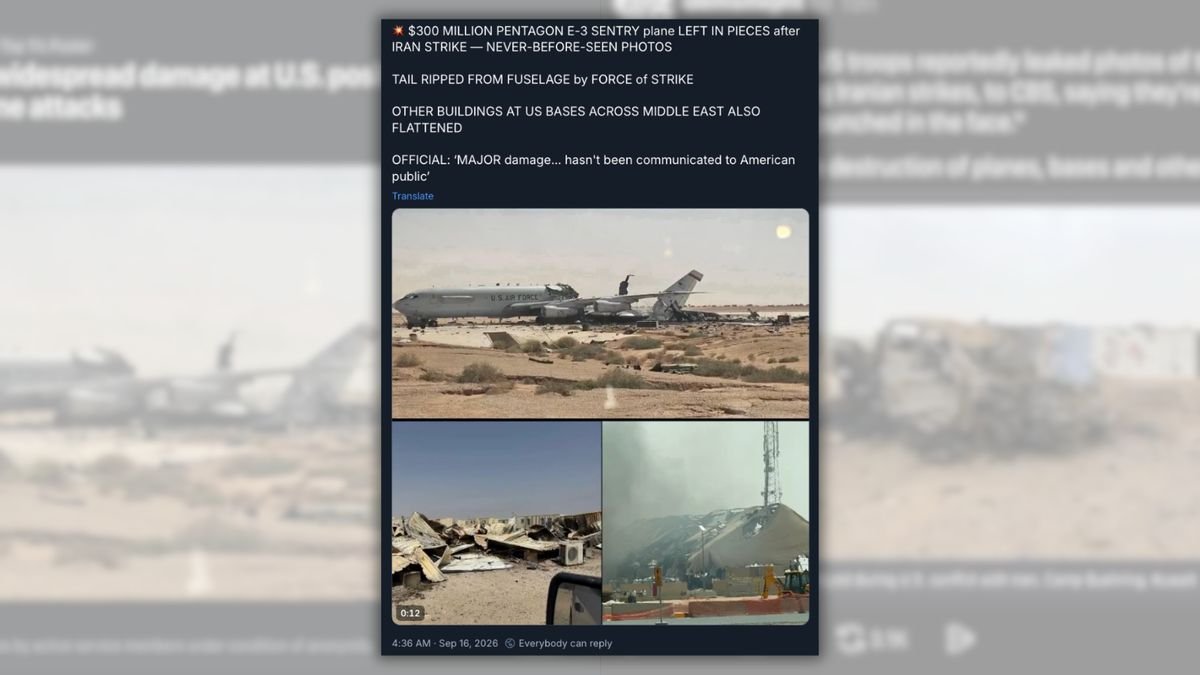
For example, one X user shared a video consisting of six photographs that appeared to show a damaged aircraft, vehicle and structures, and wrote:
BREAKING: Troops leaked photos of their wrecked bases to CBS, saying they’re “standing there with our eyes closed getting punched in the face”
Active service members sent the images anonymously.
The images came from an exclusive CBS News report that said its reporter Jonah Kaplan had received the photos from “active service members on condition of anonymity because of rigid media restrictions within the military.”
It wasn’t possible for Snopes to independently verify the authenticity of the images. We don’t rely on anonymous sources. Therefore, in order to independently verify them, we would need to speak to the people who took the images and verify their metadata (information about where and when a photo was taken). This did not appear possible given the sources told CBS News they didn’t want their names published alongside the images. Therefore, we leave claims about the authenticity of the images unrated.
We contacted Kaplan to ask how he verified the authenticity of the photos. We also contacted U.S. Central Command, which directs U.S. security operations across the Middle East, to ask about the authenticity of the images. We await replies to our queries.
What we know about images
The CBS News report included six photos. The first claimed to show a damaged plane at the Prince Sultan Air Base in Saudi Arabia. The image resembled photos verified by the BBC in March 2026 after Reuters and The Wall Street Journal reported that Iranian strikes damaged an E-3 sentry aircraft and injured 12 troops at the base.
Snopes could not verify the exact location of the plane at the base, though CBS News’ image did show a sign reading “35L S2.” 35L is the name of one of the runways at the Prince Sultan Air Base, suggesting the damaged plane was parked on or near that runway when Iranian strikes hit. The image showed what appeared to be a drain or tunnel under the runway. Google Earth imagery showed identical structures along the 35L runway.
A report about Operation Epic Fury (the U.S. government’s name for the war in Iran) that the lead inspector general submitted to Congress in September 2026 found one E-3 aircraft had been “damaged on the ground in Saudi Arabia by Iranian strikes” during the conflict (Table 5).
The next two images in the CBS News article claimed to show damage to a large tent structure and several trailers at Camp Buehring in Kuwait. According to the Institute for the Study of War, a public policy research organization that analyzes military and foreign affairs, Iran has claimed to have struck Camp Buehring at least five times since the start of the war.
One of the images, which showed a burned-out vehicle, also showed a mural that included a hand grasping three lightning bolts. This was the same imagery used by the 136th Expeditionary Signal Battalion. That battalion has previously been deployed to Camp Buehring. The unit was deployed to Central Command’s area of operation, which includes the Middle East, around April 2026.
Another image appeared to show damage to the Unaccompanied Officers Quarters at Camp Arifjan, Kuwait. The ISW reported that Iranian forces had struck Camp Arifjan at the start of March 2026. CNN reported on March 3 that six U.S. service members had been killed in strikes on the Port of Shuaiba, which is around 18 miles north of Camp Arifjan, suggesting the Iranian military had targeted the area.
The sixth image claimed to show damage to a large tent structure at Prince Sultan Air Base in Saudi Arabia. Snopes could not independently confirm the location or date of that image.
Foreign base damage difficult to confirm
Verifying damage to U.S. bases or equipment overseas is difficult because U.S. authorities generally do not publicly confirm such strikes so as not give away equipment locations or military capabilities. For example, in April 2026, the Pentagon declined to comment on reported damage to U.S. bases in Qatar, the United Arab Emirates, Bahrain, Jordan, Kuwait, Iraq and Saudi Arabia for operational security reasons.
The September 2026 report to Congress about Operation Epic Fury included damage estimates only for diplomatic facilities such as embassies and consulates (Page 19), not military bases.
U.S. Secretary of Defense Pete Hegseth said (at 32:57) on March 3, 2026, that the six people killed near Camp Arifjan in early March 2026 died because a “squirter” passed through U.S. air defenses and hit a “tactical operation center.”
Hegseth said such incidents happened “every once in a while.”
Speaking to CBS News about the September 2026 images, a service member reportedly refuted that characterization of the alleged damage caused to U.S. bases in the Middle East, instead saying, “We’re not defending these bases. We’re just watching them get destroyed.”
For further reading, Snopes has investigated a number of claims related to the war in Iran.
Sources
136th Expeditionary Signal Battalion Casing Ceremony. 6 Apr. 2026, https://www.europeafrica.army.mil/VideoPlayer/videoid/1002181/.
Britzky, Haley. ‘No Warning, No Siren: Six US Service Members Killed in Iranian Strike That Hit Makeshift Operations Center in Kuwait’. CNN, 3 Mar. 2026, https://edition.cnn.com/2026/03/02/politics/six-soldiers-killed-in-iranian-strike-kuwait.
‘Camp Arifjan’. Institute for the Study of War, https://understandingwar.org/site-search/. Accessed 16 Sept. 2026.
‘Camp Buehring’. Institute for the Study of War, https://understandingwar.org/site-search/. Accessed 16 Sept. 2026.
Department of War. ‘LIVE: Secretary of War and CJCS, Air Force Gen. Dan Caine, Hold a Press Briefing at the Pentagon.’ YouTube, 2 Mar. 2026, https://www.youtube.com/live/Y5LgpOGxTmE?t=1977s.
‘Enhancing Quality of Life at Camp Arifjan: USACE Cuts the Ribbon on the Unaccompanied Officers Quarters’. DVIDS, https://www.dvidshub.net/image/8359568/enhancing-quality-life-camp-arifjan-usace-cuts-ribbon-unaccompanied-officers-quarters. Accessed 16 Sept. 2026.
Holliday, Shelby, and Summer Said. Crucial E-3 Sentry Aircraft Damaged in Saudi Base Attack. 26 Mar. 2026, https://www.wsj.com/livecoverage/iran-war-middle-east-news-updates/card/crucial-e-3-sentry-aircraft-damaged-in-saudi-base-attack-8LibxBawXturwMIFOwTx?gaa_at=eafs&gaa_n=AWEtsqdSLCnZttiSrXyedw07NYZytLrlx0bHVoOigdxFA1fZXptP4N-3aPjveVH7A0Y%3D&gaa_ts=69c88775&gaa_sig=65vHgSOGboOLSbqmi4NYJJdQcPkdE5vgGDNgaXoPRHeYGw4kmWJfvr7o-OILcq7unGtdpeRFnbZpLRorVJISeg%3D%3D.
‘Iran Caused More Extensive Damage to U.S. Military Bases than Publicly Known’. NBC News, 25 Apr. 2026, https://www.nbcnews.com/world/iran/iran-caused-extensive-damage-us-military-bases-publicly-known-rcna331853.
Lead Inspector General . ‘OPERATION EPIC FURY’. 14 Sept. 2026, https://media.defense.gov/2026/Sep/09/2003993626/-1/-1/1/OEF_Q3_JUN2026_FINAL_508%20SECURE.PDF.
New Photos Show Widespread Damage at U.S. Positions Caused by Iranian Missile, Drone Attacks – CBS News. 15 Sept. 2026, https://www.cbsnews.com/news/new-photos-damage-u-s-kuwait-saudi-arabia-iran-drone-missile-attacks/.
‘Photos Show Heavily Damaged US Radar Jet at Saudi Base’. BBC News, 29 Mar. 2026, https://www.bbc.co.uk/news/articles/cwyd07m7e1xo.
‘Twelve US Troops Wounded in Iran Strike on Base in Saudi Arabia, US Official Says’. Reuters, 27 Mar. 2026, https://www.reuters.com/world/middle-east/twelve-us-troops-wounded-iran-strike-base-saudi-arabia-us-official-says-2026-03-27/.
In an August 2026 meeting between U.S. President Donald Trump and Joesley Batista, the owner of Brazilian multinational meat-processing company JBS, Batista asked Trump to lower tariffs on Brazilian beef, then Trump decided to allow 660 million pounds of tariff-free imported beef, that Europe had banned, into the United States, with JBS buying it all, suggesting the beef would come from Brazil.
Rating:
What’s True
In August 2026, Trump expanded a U.S. beef import quota by roughly 660 million pounds. The European Union did also adopt restrictions on Brazilian beef in summer 2026.
What’s False
The quota expansion of roughly 660 million pounds was not specifically for Brazilian or JBS beef, according to a presidential proclamation. It was not possible to rule out the prospect that, despite not being mentioned in the proclamation, JBS or Brazilian beef could be the main or sole beneficiaries of the expansion. It is also imprecise to say the imported beef would be tariff-free.
What’s Undetermined
The Wall Street Journal reported that JBS controlling shareholder Joesley Batista asked Trump to lower tariffs on Brazilian beef. It was not possible for Snopes to independently verify this report.
In September 2026, a rumor circulated online that during an August meeting between U.S. President Donald Trump and Joesley Batista, the owner of Brazilian multinational meat-processing company JBS, Batista asked Trump to lower tariffs on Brazilian beef. Trump then allegedly decided to allow 660 million pounds of tariff-free imported beef into the United States that Europe had banned, with JBS buying it all.
The suggestion appeared to be that the imported products would come from Brazil despite the European restrictions on Brazilian beef, and that JBS would benefit from the reduced tariffs.
One Instagram post (archived) featuring the rumor describes JBS as the “primary beef supplier” for McDonald’s, Burger King, Sysco, Walmart’s Great Value brand and Kroger private-label products. Its caption reads, in part:
The owner of JBS met privately with Trump in the Oval Office, and discussed lowering the import tax on Brazilian beef.
The next day, Trump opened the border to 660 million pounds of tariff-free imported beef. JBS is the world’s largest meat processing company. Their headquarters are in Brazil.
The EU banned Brazilian beef after Brazil couldn’t prove their cattle met antibiotic safety rules. China rejected beef from Argentina after it was lab tested to contain a drug linked to cancer.
Versions of the rumor also spread on TikTok, Facebook and Threads, and readers contacted us to ask whether the elements of the claim were true.
In short, the claim contains a mixture of accurate, false and unconfirmed information.
In August 2026, Trump did expand a U.S. beef import quota by roughly 660 million pounds, and the European Union did adopt restrictions on Brazilian beef. However, that expansion was not specifically for Brazilian or JBS beef, according to a proclamation Trump signed in August 2026, and it is imprecise to say the imported beef would be tariff-free. The Wall Street Journal also reported that Batista, JBS’ controlling shareholder, asked Trump to lower tariffs on Brazilian beef, but it was not possible for Snopes to independently verify that report.
Trump expanded beef imports in August 2026
On Aug. 26, 2026, Trump signed a proclamation temporarily increasing the amount of lean beef trimmings that could enter the U.S. under an existing tariff-rate quota by 300,000 metric tons. That increase equals roughly 660 million pounds.
Describing the imports as “tariff-free,” however, is imprecise. Under a tariff-rate quota, a set amount of a product can enter at a lower tariff, while imports above that amount face a higher tariff. The White House said Trump’s measure increased the amount of beef eligible for the lower tariff rate rather than eliminating duties for beef altogether.
Moreover, the proclamation did not explicitly say the beef would come from Brazil. It allocated the additional quota to “other countries or areas” and directed U.S. Customs and Border Protection to ensure that “all eligible countries have full access” on a first-come, first-served basis. JBS is also not mentioned in the proclamation.
However, it was not possible to rule out the prospect that, despite not being mentioned in the proclamation, JBS or Brazilian beef could be among the main or sole beneficiaries of the expansion.
Did JBS co-owner meet Trump?
Batista and his brother, Wesley Batista, are JBS’ “ultimate controlling shareholders,” according to the company’s filings with the U.S. Securities and Exchange Commission. As of March 18, 2026, the brothers held about 86% of the company’s voting power.
Citing anonymous sources, The Wall Street Journal reported (archived) on Aug. 31 that Joesley Batista met Trump at the White House on Aug. 20 and argued that additional beef imports from Brazil could help lower U.S. prices if tariffs were reduced. Trump announced plans to increase beef imports the following day.
However, the policy was not implemented immediately. Trump formally expanded the quota on Aug. 26, and the first tranche opened on Sept. 1.
Reuters later reported the Journal’s account but said it could not independently verify it. Snopes also was unable to independently verify the report, given it was based on anonymous sources.
We contacted JBS via email to confirm whether Batista met with Trump and, if so, what was discussed. We will update this story if we receive a response.
Snopes also reached out to the White House with similar questions and to ask how much beef would come from JBS or Brazil. Replying via email, a spokesperson said the tariff-rate quota expansion was not the result of a single conversation (emphasis ours):
President Trump’s action to address a short-term supply crunch in the beef market was the result of a long policy planning and coordination process involving domestic stakeholders; this action was not done as the result of any one conversation. At the same time, the Trump Administration continues to work with American farmers and ranchers to grow America’s cattle herd, which is currently at a multi-decade low.
JBS has ties to some named companies
JBS does have documented relationships with several companies named in the social media posts, but it was not possible to confirm that it is the primary beef supplier for all of them, as of September 2026.
For instance, a 2017 JBS report (Page 87) says its Seara division supplied 75% of McDonald’s hamburger requirements in Brazil at the time and listed McDonald’s and Burger King among its global customers. A 2020 JBS sustainability report (Page 76) also says Friboi, a JBS beef brand, received Burger King’s Best Supplier Award that year.
There is also evidence of relationships with Sysco and Kroger. Sysco named JBS Swift Beef among its beef suppliers in a 2016 supplier awards announcement, while Department of Agriculture records show JBS produced ground beef products sold under the Kroger and Private Selection brands. A JBS job posting also described (archived) Kroger as a “key case ready customer.”
But those sources do not show that, as of September 2026, JBS was the primary beef supplier for all the companies listed in the social media posts. McDonald’s, for example, lists OSI, Lopez Foods and National Beef among the U.S. suppliers behind its beef burgers.
Walmart also disputed the post’s description of JBS as a supplier of its ground beef. Annie Walker, director of Walmart U.S. communications for food and U.S. manufacturing, said via email, “We do not source ground beef from JBS.”
Snopes contacted JBS, McDonald’s, Burger King, Sysco and Kroger to clarify their current supplier relationships. We will update this article if we receive responses.
EU did restrict Brazilian beef
The posts were also broadly correct that the EU restricted Brazilian beef. On June 4, 2026, the European Commission adopted a regulation changing the list of countries authorized to send certain animal products to the EU under rules concerning the use of antimicrobial medicines. The changes took effect Sept. 3, 2026.
The regulation says Brazil was previously authorized for bovine products, among other categories, but that the commission did not receive information guaranteeing Brazil had implemented the measures needed to comply with the antimicrobial requirements by Sept. 3. Brazil’s authorization for bovine products was therefore removed.
Importantly, the regulation does not say Brazilian beef tested positive for unsafe antibiotic residues. Rather, it says Brazil did not provide enough information to show it met the EU requirements laid out above, which a European Commission spokesperson confirmed via email. The spokesperson said Brazilian exports could resume once the country meets those requirements.
Brazil’s government also said the restrictions concerned new rules governing the use of antimicrobial medicines, adding that Brazilian authorities are continuing engagement with European officials.
Snopes contacted Brazil’s Ministry of Agriculture for additional context on the restrictions and will update this story if we receive a response.
China case unrelated to Brazil
Chinese authorities did suspend (Page 1921) the export authorization of one Argentine beef plant, ArreBeef, after detecting the antibiotic chloramphenicol in a shipment in March 2026, as Snopes previously reported. However, Argentina’s government said the country’s broader beef market with China remained open and operational (Page 1921). The U.S. Food and Drug Administration prohibits chloramphenicol in food-producing animals and says residues of the drug can pose health risks.
As we previously reported, that incident was separate from Trump’s August import plan. The president’s Aug. 26 proclamation does not assign the additional 300,000 metric tons to Argentina, Brazil or any other individual country.
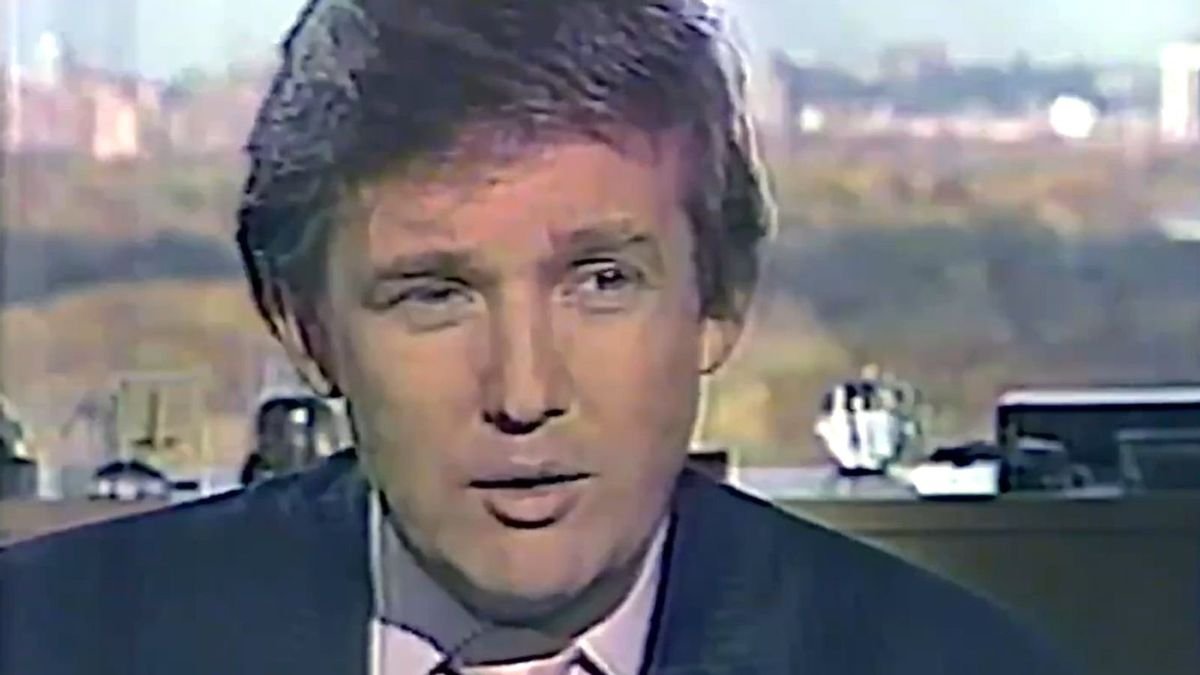
A video authentically shows U.S. President Donald Trump in 1987 saying that the U.S. should “go in” and take Iran’s oil.
Rating:
Since the beginning of the Iran war in late February 2026, people have shared a video allegedly showing U.S. President Donald Trump in 1987 advocating to “go in” and take the Middle Eastern country’s oil.
In the purported clip, Trump says of Iran, “You take their oil. That’s what I’d do,” adding, “You go in.” Journalist Barbara Walters asks how he would take the oil, inquiring, “Would you take a chance in a war?” Trump responds, appearing to say a war would be inevitable even if the U.S. did nothing, telling her: “You’re going to have a war. … You’re going to have a war by being weak.”
In sum, the decades-old clip is authentic, meaning that it was not created with artificial intelligence or other digital fakery. Trump truly advocated for going into Iran in 1987, saying, “You take the oil. That’s what I’d do.”
Trump posted the video on Truth Social on March 30, as some users accurately pointed out (archived). The video in his post begins with him saying, “because I’m running for the presidency.” A longer video shows he fully says, “I’m not here today because I’m running for the presidency.”
The clip originates from an episode of ABC’s “20/20” featuring a profile of Trump by Walters. Newspaper archives pin (archived) the segment’s apparent air date as Dec. 11, 1987.
Snopes emailed the White House to ask whether the Trump administration wished to respond to users sharing the video and will update this article if we receive further details.
Days after reposting the clip, on April 3, Trump posted a message matching his stance from nearly 39 years before, saying he wanted to take Iran’s oil:
With a little more time, we can easily OPEN THE HORMUZ STRAIT, TAKE THE OIL, & MAKE A FORTUNE. IT WOULD BE A “GUSHER” FOR THE WORLD??? President DONALD J. TRUMP
(Donald Trump via Truth Social)
Transcript of Trump’s 1987 remarks on Iran
A lengthier video from the “20/20” segment appears on Vimeo and YouTube, with the part about Iran beginning just after the two-minute mark.
The longer clip features more details, including journalist Charles Bremner remarking on Trump’s stance:
WALTERS (voice-over): But does Donald Trump want to be president?
TRUMP (speaking to the Portsmouth, New Hampshire, Rotary Club): I’m not here today because I’m running for the presidency. I’m here because I’m personally tired of seeing this great country of ours being ripped off.
WALTERS (voice-over): But as far as Trump is concerned, our allies are only part of the problem. The real culprit is Iran.
TRUMP (speaking to the Rotary Club): Why couldn’t we go in and take over some of their oil, which is along the sea?
WALTERS (speaking to Trump): How would you do that? Would you send in the Marines? Would you take a chance in a war?
TRUMP: Let ’em have Iran. You take their oil. That’s what I’d do.
WALTERS: But how?
TRUMP: How?
WALTERS: I mean, do we want a war? What do you mean, we take their oil?
TRUMP: You go in… you go in…
WALTERS: How do we go in?
TRUMP: You’re going to have a war. Barbara… You’re going to have a war by being weak.
WALTERS: OK. How do we go in? What do we do?
TRUMP: Excuse me.
WALTERS: Yeah.
TRUMP: You’re going to have a war, and it’s going to start in the Middle East.
WALTERS: What if the Soviet Union said, “You do this to Iran, we’re going to come in?”
TRUMP: I don’t believe they’d do it. The next time Iran attacks this country, go in and grab one of their big oil installations, and I mean, grab it and keep it, and get back your losses, because this country has lost plenty because of Iran.
BREMNER (speaking to off-camera interviewer): Donald Trump seems to have a Clint Eastwood approach to foreign policy.
WALTERS (voice-over): Charles Bremner is the New York correspondent for the London Times. He wrote this article that appeared in the Times the week following Trump’s New Hampshire speech.
BREMNER: He recommended strikes at Iranian oil fields. This obviously would create a great chain reaction across the area if it ever took place. And obviously, European allies would be appalled by any such behavior.
We messaged Bremner on X to ask whether he wished to share any new comment about the parallels of the video from the past lining up with the war and will update this article if we receive a response.
The report also notes that Trump took out a full-page advertisement in The New York Times (archived) and other newspapers in September 1987 with the title “There’s nothing wrong with America’s Foreign Defense Policy that a little backbone can’t cure.” The ad displays an open letter from Trump “on why America should stop paying to defend countries that can afford to defend themselves.” It does not mention Iran.
For further reading regarding Trump in the 1980s, we previously reported about whether a photo shows Trump in Moscow, when he was 41, at the invitation of Yuri Dubinin, the Soviet ambassador to the U.S. We’ve also covered a number of instances in which Trump has posted inauthentic images and videos, often generated with AI, on social media.
The 119th Congress, which has been active between 2025 and 2026, is the most productive Congress in 80 years, as Republican House Speaker Mike Johnson claimed in September 2026.
Rating:
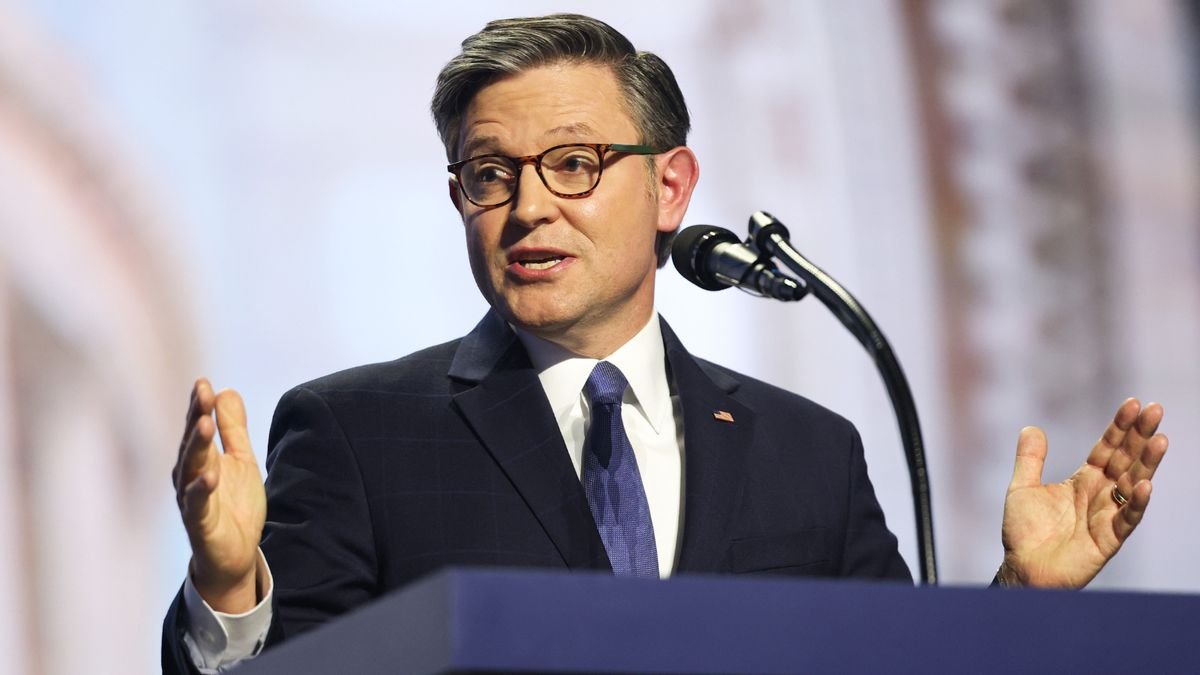
In September 2026, with the midterm elections only two months away, Republican Speaker of the House Mike Johnson appealed to voters that the GOP-led Congress gets things done.
For example, while speaking at the Republican Midterm Convention in Dallas on Sept. 10, Johnson claimed (archived) the 119th Congress — which is ongoing as of this writing and scheduled to end on Jan. 3, 2027 — has been “the most productive Congress in 80 years”:
The media won’t tell you this, but this has been one of the most productive congresses in the history of the institution since 1789. In the House, we passed over 900 pieces of legislation, and that includes the Save America Act four times. It’s been the most productive Congress in 80 years, and we’re not done yet.
Social media users who shared the clip (archived, archived) focused on Johnson’s “most productive Congress in 80 years” remark. Other videos of him making similar claims were shared on YouTube (archived).
Snopes contacted Johnson’s staff to ask what metric he used when calling the 119th Congress the most productive in 80 years. We had not received a reply prior to publication but will update this article if we hear back.
In the absence of a response, we used multiple potential metrics to compare the productivity of the 119th Congress, which has a Republican-led House and Senate, to that of the 118th Congress (Republican-led House, Democrat-led Senate through caucusing) and the 117th Congress (Democrat-led House and Senate, the latter through caucusing and the vice president’s tie-breaking votes).
Based on the metrics we used, the 119th Congress was not as productive as either of its two predecessors. Therefore, we’ve rated this claim false.
According to Congress.gov, the House of Representatives has passed or agreed upon 922 pieces of legislation as of Sept. 14, 2026 (though the 119th Congress is not complete until Jan. 3, 2027). During the 118th Congress, the House passed or agreed upon 995 pieces of Legislation. During the 117th Congress, the House passed or agreed upon 1,127.
It is possible the 119th Congress could surpass the 118th and 117th Congresses by its end. Even so, it would likely fall short of beating prior Congresses from the past 80 years, as measured by the number of bills passed or agreed upon by the House of Representatives. For example, there were 1,663 such bills in the 93rd Congress, which served between 1973 and 1974.
To measure Congress’ productivity as a whole, we can compare what each Congress has passed or agreed upon in both the House and Senate, as well as how many laws they were able to pass. A piece of legislation needs to pass in both chambers of Congress and then be signed by the president to become law.
The 119th Congress has produced 110 new laws, whereas the 118th Congress made 274 and the 117th made 365.
GovTrack, which compiles statistics on legislative action in Congress, also measures total enacted legislation when including bills that ultimately passed by being included in another bill (via incorporation). This might include acts that were ultimately passed as part of an annual budget bill, for example. Even when including such legislation, the 119th Congress has so far enacted 429 pieces of legislation, according to GovTrack, as opposed to 619 pieces of legislation in the 118th Congress and 1,236 in the 117th Congress.
GovTrack also compiles a “Total” figure that includes: enacted legislation, enacted legislation (including via incorporation), passed resolutions, bills and resolutions that had a significant vote but weren’t passed or enacted, failed legislation, vetoed bills, and bills and resolutions that were introduced or reported but saw no further action. The 119th Congress’ total of 18,670 is bigger than the 117th’s of 17,817, but is smaller than the 118th’s of 19,315 and several of those in the 1970s, that ranged between 22,313 and 26,222.
In sum, based on every relevant metric Snopes could find, it is incorrect to call this Congress the most productive in the past 80 years — at least to date.
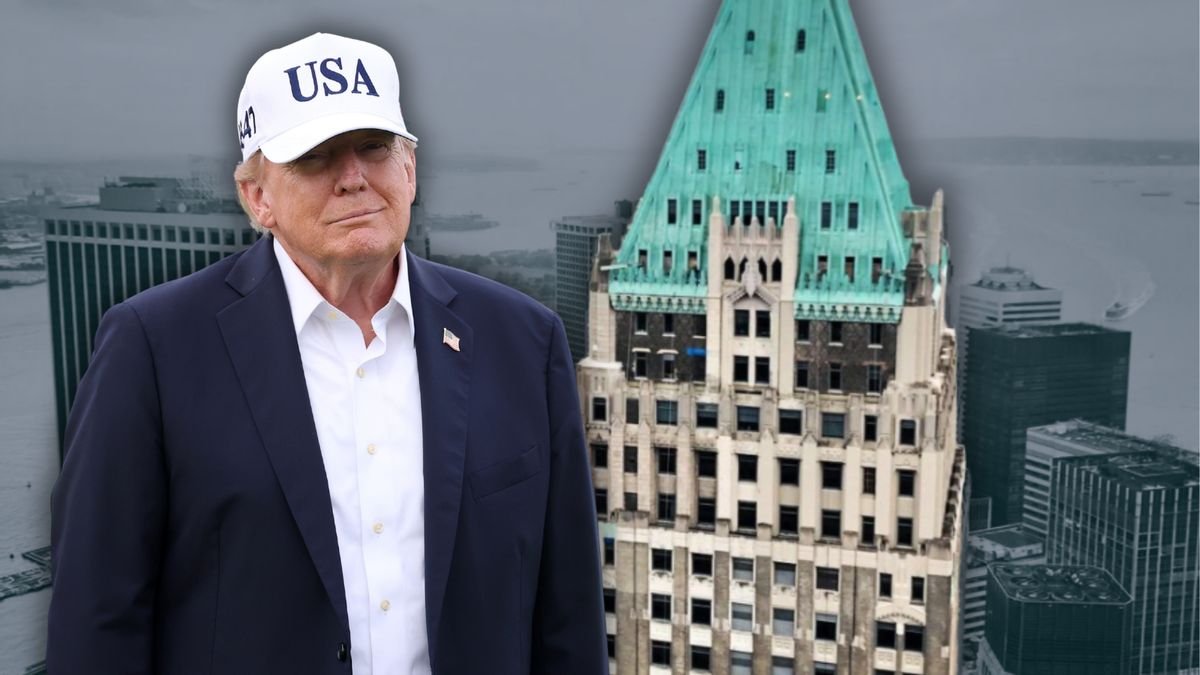
Following the 9/11 terrorist attacks, then-real estate developer Donald Trump said 40 Wall Street, a building he owns, was “the tallest” in downtown Manhattan or New York City.
Rating:
Context
Trump specifically called 40 Wall Street the tallest building on downtown Manhattan, not all of Manhattan or New York City. Whether Trump’s comments amounted to bragging, as some people online claimed, is open to interpretation.
Around the 25th anniversary of the 9/11 terrorist attacks, a claim (archived) circulated online that U.S. President Donald Trump, then a New York City real estate developer, said after the attacks that he now owned the tallest building in downtown Manhattan or New York City.
For example, one X user posted a clip from an alleged TV news interview with Trump captioned, “Here is Trump on 9/11 bragging that Trump Tower is now the tallest building in Manhattan.”
Here is Trump on 9/11 bragging that Trump Tower is now the tallest building in Manhattan pic.twitter.com/Fy5ZW85tZc
Trump did tell (time code 2:05, archived) a reporter soon after the 9/11 attacks that 40 Wall Street, which the Trump Organization still owns, was “the tallest” building in downtown Manhattan (not Manhattan as a whole or New York City). As such, we’ve rated this quote as correctly attributed to Trump.
Whether Trump’s comments amounted to bragging, as some people online claimed, is open to interpretation.
Fox 5 New York posted a video of Trump’s phone interview with WWOR-TV reporter Alan Marcus on YouTube in 2016. Trump made the claim about owning the tallest building in downtown Manhattan after Marcus asked if 40 Wall Street had sustained any damage during the attacks. The exchange went as follows (at 1:43 — emphasis ours):
MARCUS: Donald, you have one of the landmark buildings down in the financial district, 40 Wall Street, did you have any damage or did you know what’s happened down there?
TRUMP: Well, it was an amazing phone call I made. 40 Wall Street actually was the second-tallest building in downtown Manhattan. And it was, actually before the World Trade Center, was the tallest. And then when they built the World Trade Center, it became known as the second-tallest. And now it’s the tallest.
During the 2001 interview, Marcus also asked Trump how he would have handled 9/11 if he were president given that he had considered running for the office the year before (at 4:14). Trump said he would have taken a “very, very tough line” against “the group of people that did this.”
In an interview with Politico in 2016, Marcus reportedly said that Trump’s remark about 40 Wall Street was “Donald being Donald.” Marcus added, “He is the brand manager of Trump, and he is going to tout that brand, and he does it reflexively.”
Trump’s claim that 40 Wall Street was the tallest building in downtown Manhattan following the attacks was incorrect. The nearby 952-foot tall 70 Pine Street skyscraper, which was also part of the Manhattan skyline in 2001, is 26 feet taller than 40 Wall Street.
For further reading, Snopes previously investigated whether Trump attacked the National September 11 Memorial & Museum in New York for telling him he would not be allowed to speak at its 25th-anniversary commemoration.
’70 Pine Street’. Wikipedia, 28 May 2026. Wikipedia, https://en.wikipedia.org/w/index.php?title=70_Pine_Street&oldid=1356590411.
‘Donald Trump Calls Into WWOR/UPN 9 News on 9/11’. YouTube, 12 Sept. 2016, https://www.youtube.com/watch?v=PcKlPhFIE7w&t=103s.
Kruse, Michael. ‘What Trump and Clinton Did on 9/11’. Politico Magazine, 10 Sept. 2016, https://www.politico.com/magazine/story/2016/09/trump-hillary-clinton-september-11-911-attacks-nyc-214236/.
‘List of Tallest Buildings in New York City’. Wikipedia, 27 Aug. 2026. Wikipedia, https://en.wikipedia.org/w/index.php?title=List_of_tallest_buildings_in_New_York_City&oldid=1371688173.
EXCLUSIVE: A group of House lawmakers is launching a new caucus focused on the economic and cultural impact of movies, music, entertainment and sports.
The Movies, Music, Entertainment & Sports (MoMEntS) Caucus is being launched by Rep. Sydney Kamlager-Dove (D-CA), whose district includes Culver City, and she will co-chair it along with Rep. María Elvira Salazar (R-FL) and Troy Carter (D-LA).
Kamlager-Dove said in a statement, “America’s creative and entertainment sectors are economic powerhouses, generating more than $1 trillion each year and supporting over five million good-paying jobs. Yet for far too long, Congress has failed to give these industries and the workers and creators who power them the attention and support they deserve.”
The caucus comes amid an industry push for the establishment of a federal film and TV tax incentive as a way to address the flight of production to other countries.
The caucus will have a broader focus than TV and film, and also include broadcasting; music; sports and live entertainment; fashion and beauty; gaming, esports, and interactive media; streaming and digital platforms; content creators and the influencer economy; literary and publishing; and visual and performing arts, organizers said.
Salazar said in a statement that the caucus “will bring lawmakers and creative industries together to better understand the challenges they face, protect creative rights, and keep American talent and innovation leading on the world stage.”
Carter said the caucus “provides a critical opportunity for us to prioritize America’s creative and entertainment industries, which contribute so much to our nation’s history, economy, and culture.”
The caucus also will focus on innovation, competition, and responsible platform practices, among other aims.
Other members of the caucus include Rep. Joe Wilson (R-SC), Rep. André Carson (D-IN), Rep. Gilbert R. Cisneros, Jr. (D-CA), Rep. Jared Moskowitz (D-FL), and Rep. Ted W. Lieu (D-CA).
Among those praising the formation of the caucus were Recording Academy President Harvey Mason Jr., TKO Group Chief Legal Officer Riché McKnight, TikTok USDS Joint Venture”s head of public policy Nicole Nason and Kathryn Busby, head of orginal programming at Starz.
Congress also has a Creative Rights Caucus, focused on copyrights, First Amendment rights and intellectual property rights. It is co-chaired in the House by Rep. Judy Chu (D-CA) and Rep. Laurel Lee (R-FL), and in the Senate by Sen. Thom Tillis (R-NC) and Sen. Mazie Hirono (D-HI).
Rep. Laura Friedman (D-CA) and Rep. Brian Jack (R-GA) appeared on a press call on Tuesday to call for a federal film incentive, telling reporters that legislation is being drafted. President Donald Trump announced his support for a federal film incentive earlier this month.
United States Representative Thomas Massie is forcing fellow Republicans to vote whether to impeach Secretary of Defense Peter Hegseth over the US war on Iran. A recent poll found fewer than a third of Americans support the war.
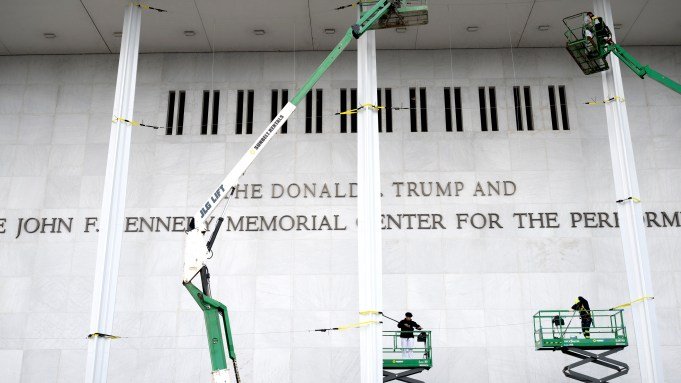
A federal judge has again weighed in on the Kennedy Center‘s effort to brandish Donald Trump‘s name on the complex, blocking the institution from inscribing his name on its facade and designating its grounds for him.
“Simply put, Defendants cannot install memorials for President Trump or anyone or anything else at the Kennedy Center without Congress’s blessing,” U.S. District Judge Christopher Cooper wrote in a ruling on Tuesday.
Last spring, Cooper ruled that the center had to remove Trump’s name from the building and other materials. The board, dominated by the president’s supporters, voted to designate the center as the “Trump Kennedy Center” months earlier. Since complying with his order, a tarp has covered the front facade and its official designation, The John F. Kennedy Memorial Center for the Arts.
In August, the board voted for a new proposal, one that would add Trump’s name as many as three times to the complex.
On the facade, below its official name, “The John F. Kennedy Memorial Center for the Performing Arts,” there would be an additional line reading “Restored and Renovated by President Donald J. Trump.”
The board also voted to designate “the physical site and grounds upon which the center sits” as the “President Donald J. Trump Plaza.”
Cooper did not rule on another proposal adopted by the board to add another line on the facade, reading, “Endowed by the Trump Kennedy Center Fund.” Such a designation is contingent on $100 million being raised for the endowment, and the judge ruled that because such an inscription is not about to happen imminently, the court “need not settle now whether it violates the permanent injunction.” But he expressed skepticism that even that inscription would be allowed, writing that it “appears to be another verboten memorial.” He required the center to give him at least 60 days notice before installing the inscription.
The Kennedy Center is appealing the judge’s original ruling, which also prohibited the institution from embarking on a plan to close for two years for renovations. Cooper did not bar the center from closing, only that the board had to give a fuller consideration of the impact of such a shutdown.
In August, the board adopted a new plan to close much of the complex for the renovations, while programming would still take place at The Reach, an extension of the center that opened in 2019. But that venue is only capable of hosting smaller productions, not Broadway scale shows or the National Symphony.
On Tuesday, the board was expected to meet to consider a new resolution that would immediately close the main building. The resolution cited a recent incident in which a portion of the center’s ceiling collapsed following a rainstorm.
Board members also were given a draft resolution that presented ten naming proposals for Trump, with an added sense of urgency: The center, it said, was facing financial ruin, and the president has offered to “step in and raise the necessary funds to keep the Center from bankruptcy during its much needed renovation.” The resolution added that the board “is seeking to appropriately recognize and acknowledge President Trump for his well timed proffer of fiscal rescue. The Board understands that without such appropriate recognition it is unlikely that President Trump will provide the fundamental oversight of the renovation of the main building and lead the fiscal rescue of the Center.” The center’s attorneys indicated that the new naming proposal would not come up at Tuesday’s meeting, but that it would focus on closure plans.
The acknowledgement that the center has run into financial difficulties is not a surprise: There has been little major programming since July. But ticket sales also fell last year, when Trump took control of the center, installed his own board members and president, and ensured that he would become its chairman. He also ousted the previous chairman, David Rubenstein, who had been one of the center’s largest benefactors. After Trump’s name was added to the complex, a number of artists backed out of performances in protest.
In his latest ruling, the judge accused the DOJ attorneys representing the center of playing “word games,” concluding that Congress designated the complex solely as a memorial to Kennedy. The law prohibits “additional memorials or plaques in the nature of memorials . . . in the public areas of the John F. Kennedy Center for the Performing Arts.”
The judge wrote that “common sense dictates that the words ‘renovated and restored by President Donald J. Trump’ establish a memorial.”
He wrote that his injunction “does not just prohibit the Board from renaming the institution the ‘Trump Kennedy Center.’ It also enjoins the creation of any ‘public memorial’ to anyone or anything other than President Kennedy, except in a few statutorily delineated ways that are not relevant here.”
The judge also concluded that renaming the grounds also would violate the law’s designation for Kennedy.
“Congress surely did not intend for the Board to auction off naming rights to constituent parts of the campus,” he wrote.
Cooper also responded to the center’s claims that having Trump’s name inscribed was critical to raising money for the center, and potentially saving it from ruin. He noted that the center’s attorneys had lacked evidence for that contention, and “evidence before the Court pointed in the opposite direction: The renaming of the Center coincided with declines in revenue and contributions, as artists cancelled performances, the Washington National Opera ended its 50-year residency, and ticket sales and viewership of the Kennedy Center Honors broadcast dropped precipitously”
Trump posted on Truth Social after the latest decision that the center is in “virtual state of collapse.” “The Judge has made us keep it open even though there are no performances, and no people that would have the Courage to even go in. The Board of The Kennedy Center has strongly voted to save it, and they know I’m the only one who can do so, because I have the ability to raise the money, and the ability to construct — that few others have. I also have the strength and power of the Presidency, which will be needed do what must be done, and give it a strong shot at Greatness again! Remember, The Kennedy Center was losing Hundreds of Millions of Dollars when I took over. It was failing badly! It had nothing to do with me, I am only there to help. I just got there to reveal the facts, but especially those concerning Building Safety. A very hostile and conflicted Judge (What else is new?) seems like he won’t let that happen, in which case, unfortunately, the Building is destined to doom. Isn’t that too bad? We have already wasted more than 6 months ‘playing around’ in Court.