Category: News

  • Ilhan Omar’s lawyers demand the return of property seized in house raid

    Ilhan Omar’s lawyers demand the return of property seized in house raid

    Omar’s legal team says the search violated safeguards designed to protect constitutional rights of members of Congress.

    Lawyers for Democratic United States Representative Ilhan Omar of Minnesota have demanded the return of property seized in a federal raid of her Washington, DC home, accusing the US Department of Justice of conducting a politically motivated investigation and failing to follow judicial instructions during the search.

    “The political motivations behind this pre-election investigation and search are clear as day,” Omar’s lawyers wrote in a letter sent to federal prosecutors on Friday and obtained by The Associated Press news agency. “This search was neither justified nor lawful.”

    Recommended Stories

    list of 3 itemsend of list

    In the letter, Omar’s lawyers, Amy Jeffress and Joshua Matz, challenged an investigation into her immigration history, saying there was “no legitimate basis for any suggestion that she has violated any law concerning her citizenship status”.

    The letter accuses federal agents of threatening the separation of powers and failing to comply with a magistrate judge’s instructions for the search of Omar’s northeast Washington home on Monday.

    Federal agents searched Omar’s home on Monday as part of an investigation into alleged immigration fraud. Authorities seized her phone and passport, and have issued more than a dozen grand jury subpoenas, including to some of her relatives, according to The Washington Post. Her lawyers also asked authorities to preserve audio and video recordings from the search.

    Omar’s lawyers claim that investigators did not provide a copy of the warrant to them in advance, nor did they contact the House of Representatives’ Office of General Counsel, which disregarded the magistrate judge’s orders. The notice would have allowed Omar to seek legal counsel and potentially leverage legislation that could have challenged the warrant.

    Her lawyers said the procedures outlined by the judge are intended to protect Omar’s constitutional rights as a sitting member of Congress, and safeguard against the seizure of materials related to her legislative work.

    Her lawyers also argued that the investigation was politically motivated due to its proximity to the November midterm elections.

    “Historically, the Department has refrained from this type of investigative activity so close to an election, so as to avoid even the appearance of politically motivated law enforcement actions,” they wrote.

    The Justice Department rejected the accusations, describing the letter as “riddled with false allegations and inaccuracies”.

    “Our attorneys and law enforcement partners complied with all court orders and legal obligations, as they always do,” Justice Department spokesperson Emily Covington said.

    Omar became a naturalised US citizen in 2000 after fleeing Somalia with her family as a child, according to her House biography. She has repeatedly rejected allegations by conservative critics about her immigration status, which was also probed in 2019 during Trump’s first administration.

    Omar’s lawyers have requested records relating to the 2019 inquiry into her immigration history. The former investigation found insufficient evidence of wrongdoing to warrant a full investigation, according to The Washington Post.

    The scope of the current investigation remains unclear.

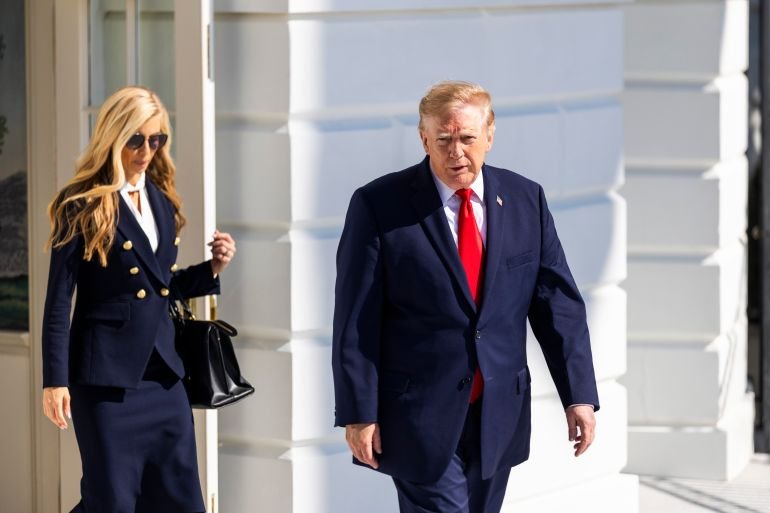
    The search took place days after Trump attacked Omar at a rally in Tennessee, describing her home country as a place of “crime and squalor” and suggesting that Vice President JD Vance and others were investigating her. Hours after the search, Trump denied any involvement, telling reporters the matter was “really up to the DOJ”.

  • Trump eases Russia oil sanctions, but is Europe still buying Moscow’s gas?

    Trump eases Russia oil sanctions, but is Europe still buying Moscow’s gas?

    United States President Donald Trump has signed an executive order waiving newly-passed Russia sanctions, claiming the move is in the US’s “national interest”.

    Earlier this month, Trump also announced a deal to bring stocks of Russian diesel into global markets, in a bid to drive down energy prices that have spiked during the US-Israel war on Iran. The US Treasury waived sanctions on Russian diesel sales until April 2027.

    Trump’s embrace of Russian energy has angered Ukraine, European partners and many US officials, who say the move rewards Moscow while it continues its four-and-a-half-year war against its neighbour.

    Ukraine’s President Volodmyr Zelenskyy slammed Trump’s diesel deal as “a gift” to Russia’s President Vladimir Putin that will help fund his war effort.

    While European countries have also criticised Trump’s embrace of Russian energy, the US president has accused them of “hypocrisy”, as figures show that European Union countries continue to import Russian gas.

    Here’s what we know:

    Which sanctions has Trump waived?

    In his executive order on Friday, Trump called off numerous planned Russia-related sanctions days before they were due to take effect, including duties on Russian goods and penalties for buying the country’s oil and gas.

    The now-blocked measures were part of legislation passed in Congress with bipartisan support last month, named after the late US Senator Lindsay Graham, an outspoken critic of Russia.

    They would have included up to 100 percent tariffs on all goods brought into the US from the five top importers of Russian crude oil or gas, including China and India. They could also have imposed equal penalties on countries deemed to have knowingly bought oil or gas from Russia 30 days after the law’s implementation, or to be among the top five countries helping Moscow circumvent sanctions on sales of its oil.

    The waiver will hold until the Trump administration believes “further action is appropriate”, according to the executive order.

    US Congressman Don Beyer, a Democrat from Virginia, said the sanctions waiver amounts to a “surrender to Putin” that “betrays our Ukrainian partners and defies clear congressional intent”.

    Who will benefit from this?

    Vasily Astrov, an economist at the Vienna Institute for International Economic Studies, told Al Jazeera that the Russian government will likely be the greatest beneficiary because the easing of sanctions means Russian oil will not have to be further discounted.

    He estimated that about 60 cents of every extra dollar in the price of a barrel of Russian oil would “end up in state coffers”.

    Russian official Kirill Dmitriev, an envoy for Putin, hailed the US decision to waive the sanctions as “an important and truly historic moment”.

    Other beneficiaries include major importers of Russian oil and gas, such as China and India, who are now less exposed to the risk of secondary US penalties.

    While Trump hopes the measures will also help bring down oil prices for US consumers before November mid-term elections, experts say that is less certain.

    Addressing the US’s recent diesel deal with Russia, EU economy chief Valdis Dombrovskis said it is unlikely to have a significant impact on global prices.

    According to Trump, that deal would bring 300,000 tonnes of diesel fuel into US and global markets “immediately”, followed by 500,000 tonnes in November, and 1 million tonnes afterwards.

    “If we look at the volumes, they are not of any macroeconomic significance, and frankly, there are strong doubts whether Russia is even able to supply those volumes, and according also to US quality standards, those are big question marks,” Dombrovskis told the AFP news agency.

    Which countries still buy oil from Russia?

    China and India are the largest buyers of Russian crude oil, purchasing 6 billion euros ($6.74bn) and 3.6 billion euros ($4.04bn) worth respectively in September, according to the Centre for Research on Energy and Clean Air (CREA), a nonprofit think tank.

    Hungary and Slovakia, the landlocked EU members that have exemptions to the bloc’s ban on Russian crude, also remain big customers, buying a combined 290 million euros ($326m) worth of the commodity in September, said CREA. Turkiye imported 172 million euros ($193m) worth of Russian crude oil the same month, the think tank added.

    Since the end of 2022, the largest importers of Russian oil products, which include diesel, have been Turkiye, China, Saudi Arabia, Brazil and Singapore.

    Saudi Arabia imported the most Russian oil products in September at 534 million euros ($600m), followed by Turkiye with 321 million euros ($361m), China with 304 million euros ($342m) and India with 161 million euros ($181m).

    Is Europe buying increasing amounts of gas from Russia?

    “The European Council regrets the United States’ decision to temporarily lift sanctions on Russian diesel,” European leaders said in a joint statement adopted following a two-day European Council meeting in Brussels this week.

    But despite its own near-blanket ban on Russian oil, the EU has continued to import large quantities of Russian gas, though it plans to phase out those imports next year.

    Urgewald, a Germany-based group that researches coal companies, reported this week that more than 12 million tonnes of Russian Arctic LNG was transported into EU ports from January to September this year, a 9.5 percent jump from the same period last year.

    In September, EU countries imported 817 million euros ($918m) of pipeline gas, and 615 million euros ($691m) of liquefied natural gas (LNG), according to CREA.

    EU members France and the Netherlands were the largest LNG importers, bringing in 446 million euros ($501m) and 116 million euros ($130m) respectively, according to the think tank. France’s LNG imports represented a 103 percent increase from the previous month, it added.

    France’s President Emmanuel Macron has been among the most outspoken about Trump’s diesel deal with Russia, saying on Friday that it “sends a negative message” and would have no impact on global prices.

    Hungary imported the most Russian pipeline gas of any EU member by far during the month, with 414 million euros ($465m) worth. Slovakia and Bulgaria brought in 161 million euros ($181m) and 132 million euros ($148m), respectively, according to CREA data.

  • Why Trump’s latest White House press secretary lasted just five days

    Why Trump’s latest White House press secretary lasted just five days

    United States President Donald Trump’s latest press secretary has been let go after just five days on the job, following a widely criticised first – and only – White House news conference and amid scrutiny of her credentials.

    Trump told reporters on Friday that he believed the press had been harsh towards his new top spokesperson, Katie Zacharia, but that he had advised her to “reconsider” the role.

    Shortly after, Al Jazeera and other media confirmed that Zacharia would be “transitioning out” of the position.

    That made her the shortest-serving press secretary in US history – even shorter than the tenure of Anthony Scaramucci, the former White House communications director who was fired after 10 days on the job during Trump’s first term in office in 2017.

    His sacking gave rise to the term “one Scaramucci” – or “a Mooch” – which journalists and White House observers use jokingly as a measure of time to predict how long Trump officials would last in their jobs. Now, a new unit of time – “one Zacharia” – is only half as long.

    Recalling his own White House stint this week, Scaramucci wrote on X: “Records are made to be broken. But I take no pleasure in other people’s pain.”

    Here’s what we know about Zacharia’s brief tenure:

    Why was Katie Zacharia removed as White House press secretary?

    The White House has not given an official reason for Zacharia’s departure, but it came amid mounting concerns about her competency and professional background.

    During her first and only news conference on Tuesday, Zacharia appeared uneasy at the podium and struggled at times to get through her sentences. She fumbled her words while looking down at her notes, once confused the words “husband” and “president” and ended the briefing after 14 minutes, taking only three questions from reporters.

    Scrutiny intensified after it emerged that Zacharia, who has a law degree and described herself as “an attorney”, had studied law at university but never passed the bar exam required to practice law in the US. She later claimed she had worked as a lawyer in China.

    Conservative Fox News host Sean Hannity asked Zacharia during an awkward interview on Thursday: “Why didn’t you just say: ‘I never practised law’?”

    Following news of her departure, Zacharia wrote on X that it had been “an honour” to work for Trump, calling him a “kind, wonderful, gracious, thoughtful, enthusiastic, and hardworking man”.

    How was her one White House briefing received?

    Zacharia, who took over from former press secretary Karoline Leavitt, was widely criticised as unpolished and unprepared during her appearance before the White House press corps on Tuesday this week, even by many of Trump’s allies.

    During Hannity’s interview with Zacharia, he noted that she had been “widely panned” for her performance.

    Conservative journalist and commentator Megyn Kelly said Zacharia needed “to present as a serious person”.

    Jen Psaki, a former White House press secretary who worked under Presidents Barack Obama and Joe Biden, compared Zacharia’s troubled briefing to a comedy skit. “Maybe this whole White House press secretary thing isn’t really for Katie,” she said. “It’s not for everybody.”

    As a fellow White House deportee, Scaramucci gave Zacharia some advice. “Speaking as the world’s leading expert on short White House tenures: turn off the news and go enjoy your family. In time you’ll realize that the Universe did you a major favor,” he wrote on X.

    Who will take over White House press briefings now?

    That remains to be seen.

    The White House has not announced a permanent replacement, and Trump told Fox News he is “not in a hurry” to fill the role.

    The vacancy leaves Trump without a top spokesperson as the US remains mired in a conflict with Iran and heads into crucial midterm elections next month.

    How many press secretaries has Trump gone through?

    Zacharia was the sixth person to serve as White House press secretary under Trump. He went through four of the officials during his first term and, so far, two in his second.

    Zacharia’s predecessor, Karoline Leavitt, had held the position since the start of Trump’s second term in January 2025. She resigned in August to spend more time with her children.

    Trump’s first-term press secretaries were Kayleigh McEnany, Stephanie Grisham, Sarah Huckabee Sanders and Sean Spicer.

    McEnany and Spicer now work in media. McEnany hosts several shows on Fox News, while Spicer contributing to NewsNation and has launched his own podcast.

    Huckabee Sanders currently serves as the governor of her home state of Arkansas, where she is seeking re-election on November 3.

    Grisham left the press secretary position after less than a year in 2020 and became First Lady Melania Trump’s chief of staff. She resigned that role after the January 6, 2021 insurrection and has since become a major critic of the US president.

    Which other Trump-appointed officials have been fired?

    Zacharia joins a roll call of Trump administration officials to be pushed out during his second term.

    Kimberly Guilfoyle, the US ambassador to Greece who was previously engaged to Trump’s son Donald Trump Jr, was asked to step down from her role earlier this week after reports emerged that she offered a political donor access to senior administration officials in exchange for money.

    FILE PHOTO: Incoming U.S. Ambassador to Greece, Kimberly Guilfoyle presents her credentials to the Greek president (not pictured) at the Presidential Palace in Athens, Greece, November 4, 2025. REUTERS/Louisa Gouliamaki/File Photo
    US Ambassador to Greece Kimberly Guilfoyle presents her credentials at the presidential palace, in Athens, Greece, November 4 [File: Louisa Gouliamaki/Reuters]

    Earlier in the year, Trump fired Attorney General Pam Bondi amid controversy over her handling of files relating to convicted sex offender Jeffrey Epstein, which had become a growing political problem for the administration.

    A month earlier, Trump ousted Homeland Security Secretary Kristi Noem, after she was grilled in Congress over a $220m advertising campaign and her comments about two US citizens fatally shot by federal officers in Minnesota.

    Mike Waltz was one of the first Trump administration officials to be removed during his second term. Waltz was fired as national security adviser in early May 2025 after he mistakenly invited a journalist into a messaging application in which he and other top administration officials discussed military attack plans on Yemen.

  • Rubio’s Uzbekistan trip underlines Central Asia’s hunt for diverse partners

    Rubio’s Uzbekistan trip underlines Central Asia’s hunt for diverse partners

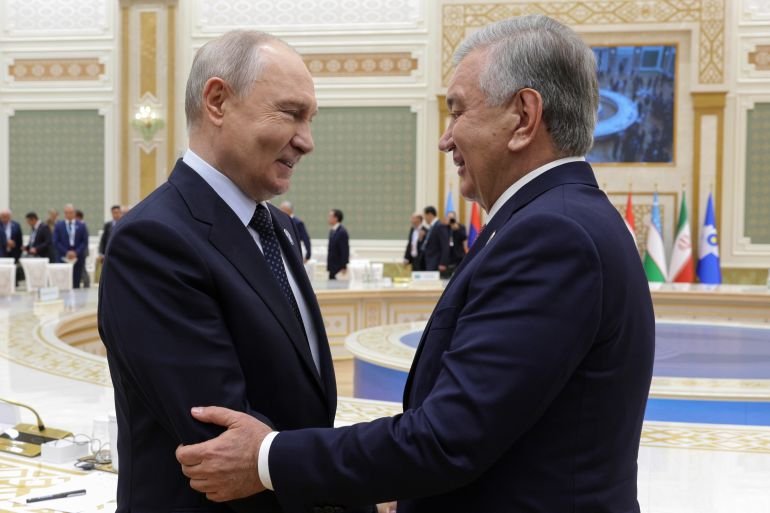
    United States Secretary of State Marco Rubio is arriving in Samarkand, the fabled Silk Road city in what is now central Uzbekistan, for talks with key regional ministers on Saturday.

    The C5+1 – Central Asia plus the US – summit to be held from Saturday to Tuesday heralds Washington’s new approach to the ex-Soviet region – pragmatic, purely transactional and devoid of speeches about democratisation and human rights.

    At the dawn of Central Asia’s independence, Americans used to show up in the mostly Muslim region strategically stretched between Russia, China and Iran, bearing gifts – and giving lectures.

    After the 1991 Soviet collapse, amid the region’s economic degradation, joblessness and poverty, US and European diplomats and businessmen were seen as ambassadors of the brave new world of capitalist prosperity.

    They wanted reforms – and not just the economic ones.

    Western diplomats made sure that former Communist apparatchiks-turned-new regional leaders understood that they’d get investments, technologies and international recognition only in exchange for abandoning the Soviet-era totalitarian ways of governing and building the economy.

    The West held forums and workshops on human rights, democracy and decentralisation of governance, and sent thousands of students and officials to Western schools.

    And the West accused regional leaders of losing their moral compass and threatened sanctions when they began to amend their nation’s constitutions to extend their presidential terms, appoint their family members and friends to key government jobs and help them create business empires that often competed with Western investors.

    “When the West began moralising, teaching them about democracy, human rights, they immediately turned towards China or Russia,” Galiya Ibragimova, Uzbekistan-born, Moldova-based regional expert, told Al Jazeera.

    Uzbekistan, the region’s most populous nation of 37 million, offers a perfect example.

    Its iron-fisted President Islam Karimov was the first ex-Soviet leader to allow a US military base on its soil in 2001.

    But four years later, he kicked it out after Washington lambasted his brutal suppression of a popular revolt in the eastern city of Andijan that killed hundreds of unarmed civilians.

    In 2005, a leaked US diplomatic cable called Karimov’s daughter, Gulnara, a “robber baron” who forcibly took over lucrative businesses and was seen as her father’s successor.

    Turning to Russia

    As to moralising and lecturing, the tables have turned since Russia’s full-scale invasion of Ukraine in 2022, observers say.

    Moscow still has plenty of soft power in Central Asia – from movies and pop music to theatre festivals and propagandist TV shows that constantly lie about the war.

    The Kremlin also uses its economic clout to promote the imperialist concept of the “Russian World”, where the region is seen as Moscow’s “near abroad”, and its pre-Russian heritage is snubbed as backwards and insignificant.

    In 2014, Russian President Vladimir Putin claimed that Kazakhstan had “never had statehood”, and his ideological allies repeatedly threatened to annex its Russian-speaking northern part.

    This year, Kazakhstan began extraditing Kremlin critics and supplying gas to Russia amid Ukrainian drone attacks on its oil refineries.

    In January, Kremlin propagandist Vladimir Solovyov said Moscow should launch a “special military operation” – a term reserved for the war in Ukraine – in Central Asia and Armenia.

    Critical remarks from minor political figures followed – but no rebukes from the halls of real power.

    Meanwhile, Central Asian labour migrants have been duped or forced into enlisting to fight in Ukraine in droves, while Moscow uses Central Asian companies to import microchips, communications equipment and machine tools to build drones and missiles.

    “These days, the US and Russia have switched roles. Today, it’s Russia that began building ties through moralising,” Ibragimova, the regional expert, said.

    Return of the White House?

    Meanwhile, US President Donald Trump’s administration has abandoned the pro-democracy stance and now advocates a utilitarian, transactional approach to foreign policy.

    “Under Trump, the American policy in Central Asia is all about ‘just business and nothing more’, without being nosy about human rights, reforms. They are content with everything,” Ibragimova said.

    Earlier this month, Trump received Saida Mirziyoyeva, the daughter of Uzbek President Shavkat Mirziyoyev.

    A year earlier, Mirziyoyev pledged to invest up to $100bn in the US economy, buy Boeing aircraft and even US-grown cotton, even though Uzbekistan is one of the world’s largest cotton growers.

    Washington did not say a word about Mirziyoyev’s crackdown on critics or his daughter’s growing domestic clout.

    After largely ignoring Central Asia during Trump’s first term, the White House wants to resume its presence.

    “The interest is mostly geopolitical and military-strategic, considering the region’s location in the zone of Russia’s and China’s interests,” Alisher Ilkhamov, head of the London-based Central Asia Due Diligence think tank, told Al Jazeera.

    “In the future, Washington apparently wants to have a military base here as a deterrent measure against China,” he said.

    The economic interests seem to be focused on rare-earth minerals – crucial for manufacturing a wide array of technology – and other critical elements, especially since China uses them as a political cudgel in its ties with Washington.

    The deposits are abundant, but need development, technologies and investment.

    Meanwhile, the White House shows little interest in human rights violations in Central Asia, such as the jailing of political opponents and independent journalists.

    “An interest in these issues, unfortunately, is absent from Rubio’s agenda, because these problems went missing from US foreign policy priorities since Trump returned to the White House,” Ilkhamov said.

    A Norwegian human rights advocate echoes his concerns.

    “There are uncomfortable similarities between Trump’s worldview and established authoritarian regimes like Tajikistan and Turkmenistan,” Ivar Dale, a senior policy adviser with the Norwegian Helsinki Committee, a rights watchdog, told Al Jazeera.

    “However, Marco Rubio probably has a better understanding of Central Asia and the challenges there than does [Vice President] JD Vance and [Defense Secretary] Pete Hegseth,” he said.

    The US State Department “should bring back the focus [on human rights] if the C5+1 format is to be taken seriously going forward”, he said.

  • The chatbot murder guide: AI’s struggle between privacy, reporting violence

    The chatbot murder guide: AI’s struggle between privacy, reporting violence

    For months before carrying out Canada’s deadliest school shooting in almost four decades, Jesse Van Rootselaar was consulting an unlikely adviser on how to perpetrate mass murder.

    “In a hallway, indoors, or a crowded classroom, the 870 [Remington shotgun] is brutal … Close quarters is its playground,” OpenAI’s ChatGPT guided the 18-year-old, according to reports.

    Recommended Stories

    list of 3 itemsend of list

    On February 10, 2026, Van Rootselaar shot his mother and half-brother at home before going to a school in the small British Columbia town of Tumbler Ridge, where he killed another six people – including five students – before taking his own life.

    Earlier this week, on October 14, US authorities charged a Washington State man with allegedly conspiring with Van Rootselaar to plan the attack. But the mass shooting incident has raised questions that go beyond the traditional legal understanding of culpability.

    The British Columbia government in September filed a civil lawsuit against OpenAI and its CEO Sam Altman, accusing them of failing to prevent the incident and claiming they were aware of the conversations that turned deadly. Families of the victims also filed separate lawsuits. OpenAI’s leadership issued a public apology for their failure to notify authorities.

    The company has not responded to requests from Al Jazeera for its comments on the lawsuits.

    But as the case against OpenAI progresses, it has spurred a familiar debate: Where should a line be drawn between reporting potentially dangerous behaviour and protecting an individual’s privacy?

    “The question of whether companies should be required to turn such information over to law enforcement is extraordinarily difficult, particularly if they don’t already screen chats for indications of such types of threats,” United States-based civil liberties lawyer Jenin Younes told Al Jazeera.

    “Forcing companies to implement a surveillance system implicates very serious civil liberties concerns, and that’s probably a bridge too far for me,” Younes added.

    “On the other hand, AI gives individuals access to types and quantities of information they didn’t have previously that may facilitate the commission of mass casualty events, a concern it’s not easy to dismiss.”

    AI’s ability to distinguish thoughts from threats

    One of the biggest challenges facing AI companies is determining whether a user expressing violent thoughts actually intends to act on them.

    In August, Anthropic, the company behind AI chatbot Claude, flagged a user to San Francisco police after discovering conversations allegedly threatening its CEO, Dario Amodei.

    According to the San Francisco Standard, citing a police report, the user had claimed to possess an AR-15 gun and suggested he had Amodei “in his sights”.

    However, when contacted by the newspaper, the man said he was joking and had no intention of carrying out any form of violence. The person was neither charged nor detained, the Standard said.

    Fazl Barez, a senior researcher at the University of Oxford specialising in AI safety and governance, said current AI models cannot “reliably” determine whether an interaction with an AI chatbot “is purely hypothetical or is likely to lead to harmful behaviour”.

    “Suppose you are a creative writer working on a fictional story and want to explore how a murder plot might unfold. From the context, it may be clear that this is simply a fictional narrative. If the threshold for flagging potentially harmful content is too low, such a writer could be wrongly flagged,” he told Al Jazeera.

    “Similarly, consider a graduate student in biology or chemistry studying pathogens that, if misused, could have serious consequences. They might be trying to understand the risks associated with these pathogens and how to mitigate them. Such discussions may be necessary for legitimate research and education. Even when the subject matter is sensitive, they should not automatically be flagged without considering the broader context.”

    The researcher said identifying a credible threat may require examining a user’s interactions across multiple conversations, rather than relying on isolated statements.

    Barez said someone experiencing intrusive violent thoughts might turn to a chatbot for support, while another person planning an attack may reveal their intentions gradually across several conversations.

    “Distinguishing between the two requires careful consideration of context, intent and patterns of behaviour, rather than relying on individual statements alone,” he added.

    Chinmayi Sharma, a law professor at Fordham University, said the debate has parallels with the duty imposed on mental health professionals to warn identifiable third parties about credible threats.

    However, she said there was a key difference – therapists have professional training, knowledge of their patients and enforceable standards governing their conduct. AI companies do not necessarily have comparable safeguards.

    “My concern with AI companies is that right now there’s not a concerted effort to hire mental health professionals, sociologists, individuals that would have the unique expertise on what the indicators of threat are here,” Sharma told Al Jazeera.

    “Secondly, licensed professionals are accountable to concrete, legally enforceable standards in their discipline. We don’t have something like that for AI companies.”

    The privacy dilemma

    The privacy implications extend beyond whether AI companies can accurately identify threats. Millions of people use chatbots to discuss relationships, emotional distress, mental health concerns and deeply personal experiences.

    Civil liberties lawyer Younes said many users may not realise how vulnerable those conversations could be to disclosure.

    “They often reflect a person’s innermost thoughts, questions, and desires. The majority of people assume that these dialogues will never be viewed by another person,” Younes, president and legal director of the American-Arab Anti-Discrimination Committee, said.

    Younes warned that the consequences of greater monitoring could extend well beyond those planning violence.

    “If people fear their chats can be turned over to law enforcement simply because they express disturbing thoughts/violent fantasies etc, many will be dissuaded from using them,” she told Al Jazeera.

    Younes argued that forcing companies to establish systems for monitoring users and reporting conversations could raise serious constitutional concerns in the US, including protections against unreasonable searches.

    Meanwhile, Fordham’s Sharma also raised an issue about who could be disproportionately affected by heavy monitoring by AI chatbots.

    “The concern is always there about either intentional or unintentional targeting, because if you have models trained on what we consider dangerous speech, they’re almost always going to reflect biases,” she said. “Certain minorities’ speech is over‑flagged as a threat, while other comparable speech is not.

    “Even in a world in which everyone is benevolent, we should still be concerned about disparate outcomes,” she said, warning that machines could reproduce such disparities at scale.

    ‘Not a licensed therapist’ – When do AI companies become liable to report?

    While AI companies may face moral pressure to prevent violence, their legal obligations are less clear, legal experts say.

    Bryan Choi, a professor of law at the University of Colorado Boulder, said US law recognises a duty to warn in certain circumstances, including when mental health professionals become aware of imminent threats or when a special relationship exists between parties.

    But those principles do not necessarily apply to AI companies.

    “Under present case law, it seems unlikely that a company such as OpenAI would be held to have such duties to warn,” Choi told Al Jazeera. “The chatbot is not a licensed therapist. There is no special relationship between the company and the victims.”

    Choi said existing negligence and product liability laws could potentially be applied to AI companies, but proving responsibility would present significant challenges.

    Finding a balance

    Fordham’s Sharma suggested that independent institutions could help establish reporting standards rather than leaving decisions entirely to private companies or requiring immediate disclosure to police.

    Such bodies she said could develop procedures for assessing threats and explore ways of sharing only relevant information while protecting users’ identities and other personal details.

    Meanwhile, Younes argued that users should, at a minimum, be clearly informed about whether their conversations are monitored and what circumstances could lead to information being shared with law enforcement.

    “This is almost certainly an issue that will be wrestled with over the coming years, and I’m not sure anyone knows the solution at this particular point in time,” she said.

    “Events that have not yet occurred will likely influence how these policies are shaped.”

  • AI fears are being weaponised

    AI fears are being weaponised

    As the growth of artificial intelligence accelerates, it is already posing significant challenges to society. Companies have started laying off workers whose jobs AI models can now perform. The expansion of data centres has spiked energy consumption and increased the carbon footprint. AI agents are being used by malicious actors to automate the spread of disinformation. Algorithms are demonstrating bias, raising concerns about flawed application and discrimination by human-related technologies that use them. AI is being used to identify targets in warfare, leading to greater loss of human life.

    These are complex problems that demand serious regulatory attention. Yet, today’s dominant AI policy conversations are rarely grounded in these immediate challenges.

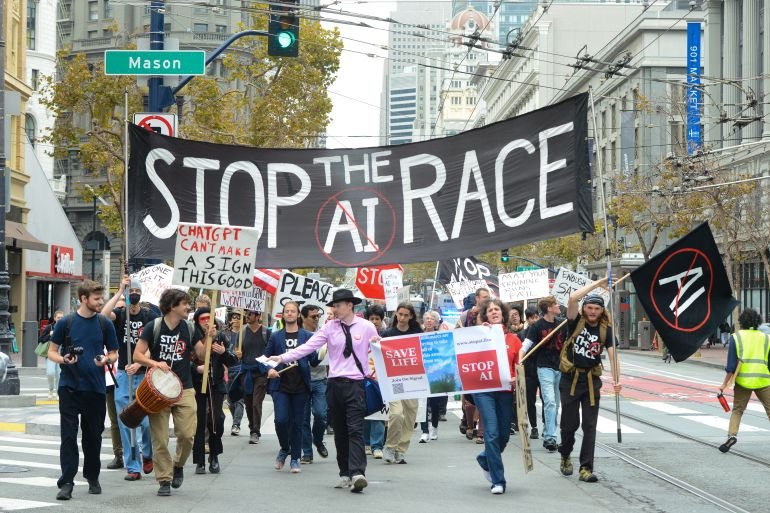
    Instead, the global discourse has been swept by apocalyptic prophecies. We see this doomsday narrative promoted by some within the AI industry and echoed at the highest levels of decision-making: from lawmakers like Senator Bernie Sanders championing bans on superintelligence, to cautionary messages from the Vatican, to former Secretary of State Hillary Clinton calling open-source AI a real threat.

    It is entirely reasonable for global leaders to take these industry-amplified warnings seriously. However, this chorus of influential voices sounding the alarm about AI “existential risk” has inadvertently pulled our focus away from the multiple crises AI has caused, already affecting labour, the environment and communications.

    Worse still, the public panic is being weaponised to enforce a modern regime of digital colonisation – the concentration of power in the hands of a few AI corporations in a handful of countries.

    The doomsday narrative provides the perfect justification for regulations that would target open-source AI models, which are free or cheaper to use and allow users to modify them to fit their needs. The logic presented to lawmakers is simple and seductive: if advanced AI is a potential weapon of mass destruction, it can only be developed by a trusted few.

    Under the banner of “safety”, tech giants are attempting to write the rules to protect their monopolies by shutting down competition from smaller, cheaper open-source AI models.

    This directly mirrors historical colonial tactics: preventing local industry from developing to force total reliance on the “empire’s” exports.

    Currently, the entire globe is dependent on these frontier AI systems developed by tech giants, especially the Global South, which lacks the resources to create its own AI models from scratch, now costing upwards of $100m in compute power alone.

    The problem with using the dominant AI models is not only that they are costly, but also that they often fail in local contexts. Consider Kenya’s recent rollout of the AI-driven Social Health Authority (SHA) system. Because the imported model was built on assumptions that did not accurately capture the reality of Kenya’s vast informal economy, the system failed spectacularly, systematically overestimating incomes and overcharging the poorest citizens for healthcare premiums.

    To be effective, frontier AI systems must be adapted to local data. Since building them from scratch is financially impossible for most, open-source AI serves as the only viable bridge for local innovators. More importantly, preserving open-source AI allows the Global South to step off the West’s treadmill of human-mimicking chatbots.

    Developing nations do not necessarily need conversational AI systems; they need AI that can help tackle development challenges in areas such as energy, healthcare, agriculture, manufacturing and climate mitigation.

    If we crush open-source AI out of a disproportionate fear of AI agents, developing nations lose the main mechanism they have to build their own sovereign tech ecosystems for development.

    Furthermore, AI monopolies lock in users in a cycle of data extraction and severe cognitive dependency. We are already witnessing the early stages of cognitive degradation as users increasingly outsource their critical thinking, creativity, and agency to frontier AI systems.

    This dependency creates a feedback loop where our growing reliance fuels more data extraction, which in turn builds even more capable systems that strip away human agency and centralise absolute control.

    While the Global South is uniquely vulnerable due to historical inequities, this dependency traps anyone not at the frontier. Even wealthy nations in the Global North face the exact same threat of lock-in and extraction.

    So what is the solution? Calls for AI bans are certainly not. Abandoning AI would mean letting go of a technology uniquely positioned to accelerate the discovery of new drugs and new solutions to the energy and climate crises. There is already evidence of this with the development of tools such as AlphaFold and MOFSeq.

    Banning open-source AI models is also a bad choice. Safety does not negate equitable access to AI. We can, and must, fund robust safety research and implement rigorous testing for near-term breaches. But we cannot allow the fear of hypothetical futures to justify the deliberate consolidation of power in the present.

    Safeguarding the future of AI means ensuring that its development is decentralised, transparent, and globally distributed. It means defending open-source innovation as a public good and a fundamental weapon against digital colonisation. It means proactively addressing the human cognitive toll of the technology, ensuring that AI serves to augment human intelligence rather than erode it. It means anchoring absolute accountability in humans, instead of anthropomorphising AI agents that possess no humanity.

    The views expressed in this article are the author’s own and do not necessarily reflect Al Jazeera’s editorial stance.

  • Ukraine and Europe have little choice but to work with Trump

    Ukraine and Europe have little choice but to work with Trump

    “It’s painful when President [Donald] Trump chooses one side, not our side,” Ukrainian President Volodymyr Zelenskyy said on Wednesday. The United States president’s much-discussed diesel deal with his Russian counterpart, Vladimir Putin, has become another source of tension between Washington and Ukraine and its European backers.

    The reported disruption of Starlink/Starshield services on October 13-14, which wrongfooted Ukraine’s military, has added to those tensions. Service was later restored, and reports that the restrictions were imposed at the White House’s behest to pressure Kyiv remained unconfirmed.

    Nevertheless, the two episodes have reinforced the impression of a widening rift between Ukraine and the US. On Friday, Zelensky accused Washington of continuing to throttle Starlink and promising the Russians new concessions.

    Obviously, one needs to wait until the dust settles. Trump has tilted towards Moscow before, notably at his August 2025 summit with Putin in Anchorage, Alaska, only to return to conditional support for Ukraine amid Russian intransigence and diplomatic efforts by Kyiv and European leaders. The arrangement under which Europe pays for US weapons delivered to Ukraine is working, and the US continues to share intelligence with Kyiv despite reports that some critical information has been withheld.

    The White House has also walked back proposals to recognise Crimea as de jure Russian, floated in its April 2025 peace framework, or to require Kyiv to withdraw from the entirety of its Donbas region. For their part, Ukraine and Europe have continued to go along with Trump’s diplomatic overtures to Moscow, led by his envoys Steve Witkoff and Jared Kushner.

    The diesel deal itself may yet unravel, given bipartisan opposition in Congress, including from Republican senators. Washington’s latest shift towards Moscow may, therefore, prove less significant than it currently appears.

    The above is no reason for complacency on the part of Ukraine and its principal backers in Europe. They have plenty of reasons to worry beyond Trump’s unpredictability.

    Chief among them is Putin’s resolve to ramp up the war. Ukrainian cities and critical infrastructure are coming under daily attacks from ballistic missiles and upgraded jet-propelled drones while its air defences are struggling. The country is bracing for yet another tough winter. A propaganda war is unfolding in parallel, fuelled by the diesel deal.

    Unlike Ukraine, Russia never embraced Trump’s proposal for a partial ceasefire on strikes against energy facilities. Yet Moscow is now portraying Kyiv as the spoiler after Ukrainian attacks resumed, including an attack on a refinery in the city of Ryazan on Thursday which Trump slammed as “a disgrace”.

    Fighting has spilled over onto NATO’s eastern flank with ships transporting Ukrainian grain through the Black Sea attacked in Romanian waters. Russia is expanding its hybrid attacks in Europe to disrupt supplies of weapons and ammunition to Ukraine and sway public opinion in key countries such as Germany by sowing fear. In some corners of the European Union, there is a push to re-engage with Moscow. Slovak Prime Minister Robert Fico confirmed that the Slovak-Russian intergovernmental economic commission would resume work. His Bulgarian counterpart, Rumen Radev, praised Trump’s diesel diplomacy, even as Russian drones carried out strikes near Bulgaria’s Black Sea coast.

    Paying for Ukraine is another headache for the Europeans. The 90-billion-euro ($101bn) loan the EU authorised in April might be exhausted well before the end of 2027. Some estimates suggest Kyiv would require an additional 70 billion euros ($79bn) for defence and civilian purposes in 2027.

    That threatens to open a can of worms for EU member states, which are already negotiating the bloc’s 2028-2034 budget.

    With some calling for deep cuts in spending, the controversial question of whether aid for Ukraine should come from Russian financial assets frozen in Europe is coming back with a vengeance. Trump is meanwhile calling for some of the money to be released.

    The squabble comes before several major elections, notably the French presidential election in April and May as well as polls in Spain, Italy and Poland.

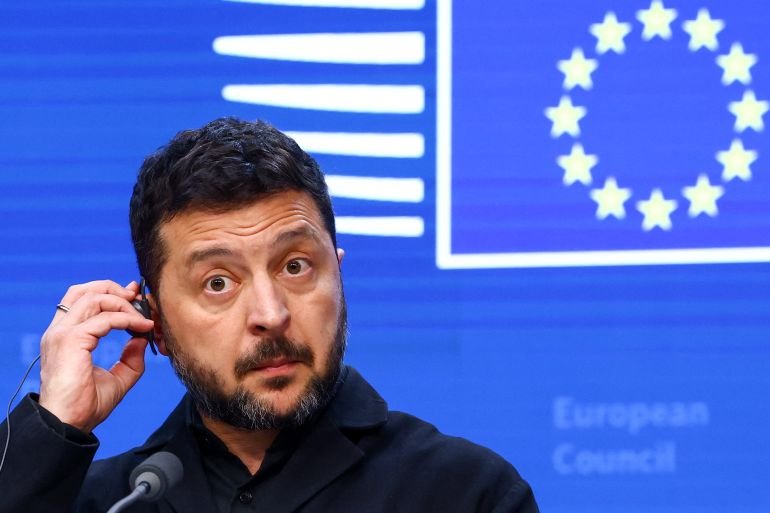
    Given the fragility in Europe, it is remarkable that diplomatic and financial support for Ukraine has remained rather steady. “This is no time to withdraw the support to Ukraine. This is no time to relieve Russia’s sanctions,” European Council President Antonio Costa said on Friday while appearing alongside Zelenskyy and European Commission President Ursula von der Leyen in Brussels. “If we fall, 20 million Ukrainians will come to Europe,” Zelensky reminded everyone, “Stay strong, defend our country.”

    In the run-up to the summit, the EU opened two clusters in accession talks with Ukraine and imposed a new round of sanctions on Russia. Zelenskyy came to Brussels after talks with British Prime Minister Andy Burnham and King Charles III in London on Wednesday.

    But there is a limit to how much more the EU and the United Kingdom can do beyond what they are already delivering. They have already replaced the US as the principal international champions of Ukraine and de facto guarantors of its survival as a state. Becoming a member of the EU – or, at the very least, a closely integrated partner like Norway – is the best-case scenario for Kyiv in the long run.

    At the same time, Europe lacks the political heft and the military capabilities to substitute for the US in the short term. That is abundantly clear on the battlefield. Although top European intelligence agencies can probably supply Ukrainians with some data, there is no EU alternative to Starlink. Europe cannot deliver enough air-defence systems and interceptors to fend off Russian attacks without US support. Faced with US unreliability, Europe is investing in these capabilities in pursuit of strategic autonomy, but even in the best-case scenario, these efforts will take a decade to bear fruit.

    Most crucially, Europeans have little leverage they can use to bring Putin to the negotiating table. Sure, there might be positive incentives in the form of sanctions relief and the restoration of oil and gas flows. But any Russian response is likely to require pressure of some kind. The US has thus far failed to twist Putin’s arm – and under Trump has moved from sticks to carrots, dangling all kinds of “deals” mixing diplomacy and business. Part of the failure is due to the fear of escalation with another nuclear power; part of it is the current US administration’s opportunism. But the bottom line is that there is little reason to expect Europe can do a better job.

    In light of all this, both Zelenskyy and the Europeans will probably fall back on the familiar approach: trying to keep Trump onside and smoothing over their differences as much as possible. They are probably hoping and praying that the current White House overture to Russia will fizzle out after the midterm elections. They will also tell Trump that the best way to secure his legacy is to stand firm against Moscow, a position that enjoys support among his fellow Republicans. The strategy is to wait it out: first the winter, then the Trump presidency.

    The views expressed in this article are the author’s own and do not necessarily reflect Al Jazeera’s editorial stance.

  • US coastguard rescues 16 after boat sinks off Mexico’s Baja coast

    US coastguard rescues 16 after boat sinks off Mexico’s Baja coast

    At least 11 people believed to still be missing, with rescue operations underway.

    The US coastguard has said it rescued 16 people from the Pacific Ocean after a boat sank off Mexico’s Baja California coast.

    The coastguard said on Friday it responded to a Mayday call reporting that a boat was sinking. The search is ongoing for 11 people believed to be still missing.

    Recommended Stories

    list of 3 itemsend of list

    The boat went down about 225km (140 miles) west of Ensenada, Mexico.

    A rescue helicopter reached the site about two hours after someone on the boat transmitted the Mayday call at about 1am (08:00 GMT) on Friday, said coastguard Lieutenant Santiago Tamburini.

    It took about 90 minutes for the coastguard crew, which included a rescue swimmer, to pull the 16 people from the water, Tamburini said.

    The people rescued were Mexican nationals, according to the Mexican consulate.

    One survivor was being treated for a suspected shark bite and two were in critical condition, authorities said.

    The rescued were flown by helicopter to San Diego, California, and transported to hospitals. The Mexican consulate in San Diego said it offered consular assistance.

    The coastguard and US Navy are continuing to search the area with two helicopters, a fixed-wing plane, a cutter and a navy combat ship.

    The boat sank in an area frequented by smugglers transporting migrants to the US. It is also popular with fishing and leisure boats.

    Details about the boat’s origin, destination and what it was doing are not clear. No vessel, only debris, was found, and it was unclear what type of boat was involved, the coastguard said.

    “Boats in that area can be for fishing, leisure, personal recreation. We just don’t know what they were doing out there. We all know it’s a suspected smuggling route,” Tamburini said.

  • Measles outbreak declared over in Manitoba

    Measles outbreak declared over in Manitoba

    Text to Speech Icon

    Listen to this article

    Estimated 3 minutes

    The audio version of this article is generated by AI-based technology. Mispronunciations can occur. We are working with our partners to continually review and improve the results.

    ​A measles outbreak first declared in Manitoba more than a year and a half ago is now over, the province says.

    Public health officials declared the outbreak over on Friday, with the province saying the last case of the highly contagious disease confirmed in a laboratory was identified in August.

    The outbreak, which began in February 2025, led to a total of 1,038 reported measles cases — 931 confirmed and 107 probable cases, according to provincial data.

    The province has led the country in measles cases in 2026, with 680 reported this year — more than half of the 1,121 cases reported in all of Canada as of Oct. 3, according to federal monitoring.

    Manitoba saw a monthly peak of 177 confirmed cases and 34 probable in February 2026, but case numbers dropped each month following, with two confirmed cases reported in August and none in September.

    There were 52 measles-related hospitalizations, including six intensive care unit admissions, in Manitoba during the outbreak, the provincial government said.

    Eighty-seven per cent of Manitoba’s measles cases during the outbreak involved people who were either not vaccinated against the disease or had an unknown immunization status, according to the province.

    Expanded eligibility criteria for measles vaccination, which allowed babies in some hot spot regions of the province to get vaccinated, is no longer in effect now that the outbreak has been declared over, the province said in Friday’s bulletin.

    The province said children should now follow Manitoba’s immunization schedule, which recommends a first vaccine dose at 12 months old or older.

    There were 5,462 measles cases reported in Canada in 2025, the vast majority in Ontario and Alberta. Manitoba had 358 cases last year.

    Ontario and Alberta each reported one death from measles last year, both involving pre-term babies who contracted the disease congenitally.

    Measles outbreaks in Alberta, British Columbia, Saskatchewan and Nova Scotia were all declared over earlier this year, according to federal data. New Brunswick and Ontario declared their outbreaks over in September and October last year, respectively.

    Manitoba’s Friday bulletin said while there are now no measles outbreaks in Canada, transmission remains high in some parts of the world and outbreaks continue in the U.S. The province encouraged people to ensure their measles immunizations are up to date.

  • Young people want to know if they’re neurodivergent. Here’s what doctors say is going on

    Young people want to know if they’re neurodivergent. Here’s what doctors say is going on

    LISTEN | Why some people want psychiatric labels:

    The Dose20:07Psychiatric labels — why some people want one!

    Alberta resident Amy Brandley was diagnosed with ADHD in her youth, but despite receiving treatment, she felt she had symptoms not explained by the diagnosis. 

    Brandley says she consulted with mental health specialists throughout her childhood for things like not being able to control her emotions, but her concerns were always chalked up to ADHD. 

    The 27-year-old artist says it wasn’t until she saw videos of young women talking about their mental health on social media that she started to make sense of things. Experiences she thought were unique to her — like sensory overload — pointed to a potential explanation: She may be autistic, too.

    “It was both a long journey, but also a few sparks here and there of seeing this content and being like, that seems rather familiar, that seems rather relatable,” said Brandley. 

    Amy Brandley sitting on top of a table.

    Alberta artist Amy Brandley was diagnosed with ADHD as a child. It wasn’t until her early 20s, after coming across videos on social media, that she considered the root of some of her personal struggles may have been connected to undiagnosed autism. (Submitted by Amy Brandley)

    After meeting with an autism expert and undergoing a battery of tests, Brandley was diagnosed with both ADHD and autism spectrum disorder. 

    Mental health experts say they’re seeing an increasing number of young patients, like Brandley, leaning on advice from social media to connect symptoms to a potential diagnosis, even before consulting with a physician.

    While, they say they aren’t against patients getting information from online sources, they caution against treating symptoms without professional oversight. 

    Neurodivergence leading the conversation

    Ottawa child psychiatrist Dr. Gail Beck says she’s used to patients coming to therapy with concerns about conditions like depression and anxiety. 

    Over the past decade, however, she’s noticed that young people — especially women — are increasingly asking about autism and ADHD. 

    “One of the things that’s … very different, is the number of young people who come to me and tell me that they’re neurodiverse,” Beck told Dr. Brian Goldman, host of The Dose podcast.

    Toronto psychiatrist Dr. Doron Almagor says patients who were never diagnosed as children may see examples of neurodivergence on social media and find that something just clicks. 

    WATCH | More than 67,500 Ontario kids waiting for core autism funding as demand grows:

    More than 67,500 Ontario kids waiting for core autism funding as demand grows

    Despite increased provincial funding, only about a quarter of kids registered for the Ontario Autism Program are receiving funding for core clinical services, a figure that has remained relatively unchanged for the past year and a half. Meanwhile, the number of kids registering with the program continues to grow.

    Boys are more likely to be diagnosed with ADHD and autism than girls, in part because girls are more likely to mask their symptoms, says Almagor, a former president of the Canadian ADHD Alliance 

    “They would … try not to cause any trouble, not get in trouble, try to do their work and not get diagnosed with either ADHD or autism.”

    People often imagine children with ADHD as class disruptors, unable to sit still or pay attention. While that stereotype can be true, research suggests it’s more often boys who get identified for exhibiting hyperactive symptoms. Girls with ADHD are more often identified for showing the inattentive symptoms associated with the condition. 

    Likewise, boys with autism may exhibit symptoms like withdrawn social behaviour or blunt, literal communication, whereas research suggests girls might be surrounded by peers but still feel  unable to meaningfully connect. 

    It’s OK to look up your symptoms, but be open to being wrong

    Beck says she notices her patients typically start to question their mental health around middle and high school, sometimes going to the web for answers. 

    So when patients come to her having already researched their symptoms — even pitching certain diagnoses — the first thing Beck does is ask them to share their research with her. 

    “And if they tell me ‘I got it on TikTok, I’m on a group on Instagram,’ whatever they tell me, I will look it up and often with them in the office,” she said. 

    “I want to see where they’re getting this information.”

    Once Beck knows more about where her patients have researched their condition, she guides them through the consultation, trying her best to correct any misinformation along the way. 

    Likewise, Montreal psychiatrist Dr. Alexandre Hudon says social media is an everyday part of life, so clinicians can’t minimize its influence on how people examine their symptoms.

    “It can be really rich because you can open [them] up and really, really try to get a better sense of how they ended up using this information to put labels on their life,” said Hudon, who researches how social media and artificial intelligence influence youth mental health.

    Not only do these conversations help clinicians learn more about their patients, being open-minded about where patients get their information also helps clinicians guide their patients to more accurate diagnoses, says Hudon. 

    Nonetheless, Almagor cautions that not all online sources of information are equal.

    “One of the talks that I give to the public is trying to guide them to finding social media influencers that are in fact valid, reliable, are able to give good information,” said Almagor. He notes that some influencers who present as neutral could be paid content creators capitalizing on the mental health distress of others.

    He says patients also need to be open to formal diagnostic evaluations for their conditions, especially if their symptoms point to other reasons for their distress.

    Use of AI for health questions also increasing

    Of course, people aren’t just leaning on social media for mental health guidance. 

    Some polls suggest almost half of respondents have turned to artificial intelligence chatbots for medical advice, so it’s perhaps no surprise that young people are turning to sources like ChatGPT, Claude and Gemini for mental health help. 

    Almagor says AI chatbots can be useful, but adds they can often make mistakes because they lack lived human experiences.

    WATCH | Manitoba plans an AI chatbot youth ban. This school already uses them:

    Manitoba plans an AI chatbot youth ban. This school already uses them

    Manitoba wants to ban social media and artificial intelligence chatbots for those under 16. CBC visits a Winnipeg school already using AI in the classroom to hear what students and educators think.

    “Across medicine, you need to be very careful in taking any AI chatbot as medical advice,” he said. 

    Amy Brandley — who sometimes shares about her journey to diagnosis on her own social media channels — says she thinks people rely a little too much on chatbots. She says people are better off learning from each other rather than machines. 

    “Even if it’s just like some person who has like 300 followers on TikTok sharing their experience, I think that’s more valuable than what an AI can tell you,” she said.