Williams scored 26 points as the Golden State Valkyries came back to take the lead at home against the Atlanta Dream.
By AFP and The Associated Press
Published On 18 Oct 202618 Oct 2026
Gabby Williams scored a game-high 26 points, including four key free throws in the final 78 seconds as the Golden State Valkyries held off the Atlanta Dream 68-64 in game one of the WNBA Finals.
Williams, runner-up to Atlanta’s Angel Reese in Defensive Player of the Year voting, has emerged as an offensive force for the Valkyries in the playoffs and carried the scoring load on a tough shooting night for the hosts, who did not have another player score in double figures on Saturday.
Reese blocks the shot from Williams during the game [Noah Graham/Getty Images via AFP]
The French star took some time to warm up, going scoreless in the first quarter as the Valkyries got off to a tentative start in front of a raucous crowd at Chase Center.
“Once we all started having fun and the excitement got out, we started to kind of find our way,” Williams, who erupted for 16 points in the second quarter, said in an on-court interview.
“There was a lid on that basket tonight, but that’s why we rely on our defence,” she said.
Golden State trailed by one with 1 minute and 18 seconds remaining when Williams seized the rebound off a miss by Atlanta’s Allisha Gray and was fouled by Reese.
Williams made both free throws to put the Valkyries up 65-64 and added another pair of free throws to seal the win with 4.1 seconds left.
“It came down to getting stops and that’s been our bread-and-butter all year,” noted Williams, whose team has allowed 335 fewer points than any other in the WNBA this season. “That’s why we harp on it so much, because we’ve built such great defensive habits.”
Gray, the Dream’s leading scorer, returned after missing two games with a hand injury and scored 19 points, but she was scoreless in the fourth quarter, when Atlanta made just two of their 19 attempts from the floor.
Angel Reese of the Atlanta Dream reacts after the 68-64 loss [Ezra Shaw/Getty Images via AFP]
Reese added 14 points and 12 rebounds, and Rhyne Howard scored 12 for Atlanta.
Atlanta scored just two in an overall eight-point fourth quarter, where Gray was scoreless over the final 10 minutes and Reese scored all of her 14 points in the first half.
“I don’t think they really did anything,” Reese said. “Maybe that was just on me; I wasn’t aggressive enough with the ball and trying to get the ball and get to my spot. I’m definitely going to do a better job of that next game.”
The Valkyries will host game two of the best-of-seven series on Monday.
Both teams are chasing a first WNBA title. The Dream have come up empty in three prior trips to the Finals, most recently in 2013.
The Valkyries, who last year became the first WNBA expansion franchise to reach the playoffs in their inaugural season, are now contending for the title in their second.
Golden State Valkyries players celebrate at the end of game one [Jeff Chiu/AP Photo]
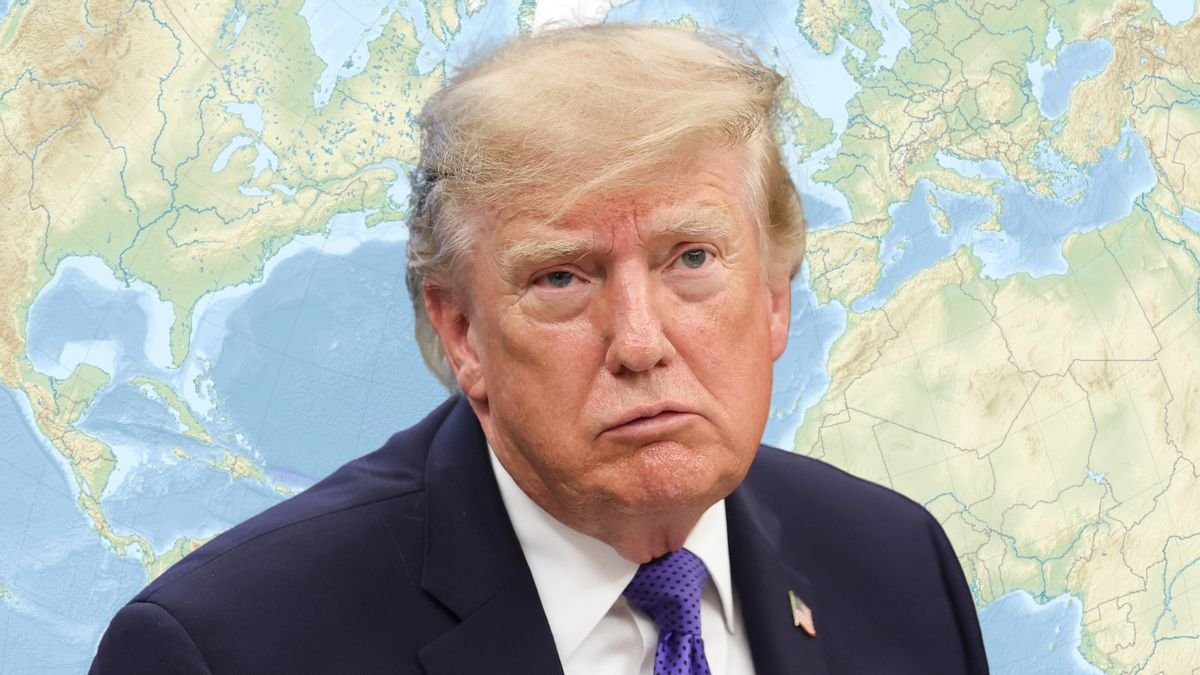
During the first half of his second term, U.S. President Donald Trump ordered the federal government to rename the Gulf of Mexico to the Gulf of America, Denali to Mount McKinley and Lake Ontario to Lake America. In October, he suggested he might rename a river or ocean as well. Trump’s renaming crusade has led to discussion about what authority he has in the matter.
The U.S. federal government maintains a list of the official names of geographic features across the world. The Board on Geographic Names, which is under the control of the Department of the Interior, is in charge of maintaining and updating the list.
The board is made up of representatives from six cabinet agencies, the Postal Service, CIA, Library of Congress and Government Publishing Office. It has different subcommittees dedicated to the names of domestic landmarks and foreign landmarks.
Its goal is standardization and clarity, meaning board members do not decide the names of landmarks themselves. Instead, it relies on naming and renaming suggestions from anyone, and discourages renaming landmarks unless absolutely necessary.
Since the Board on Geographic Names is under the control of the Interior Department and is therefore part of the executive branch, it did rename the features in the official government database as mandated by Trump’s executive orders.
However, the board only controls how the U.S. federal government refers to landmarks in official documents. Whether or not the general public and other countries choose to use the names is their prerogative.
At an Oct. 10 rally in Clarksville, Tennessee, U.S. President Donald Trump told a crowd of supporters he was thinking of renaming an ocean.
“I was thinking of either the Atlantic or the Pacific,” Trump said, naming two of the three oceans that border the U.S. “We call it ‘Trump Ocean’ or, or ‘Ocean of the Americas,’ something like that.”
Renaming large, prominent geographic features with centuries-old names has been a theme of the second Trump administration. Just after retaking office in January 2025, Trump signed an executive order mandating that the Gulf of Mexico be renamed the “Gulf of America” and Denali, the highest mountain in North America, be re-renamed Mount McKinley. (The mountain was first dubbed Mount McKinley in 1897 and recognized by the federal government by that name in 1917. In 2015, the federal government switched to using Denali, the name used by Alaska Natives). In August 2026, he added another feature to the list by ordering Lake Ontario, which the U.S. shares with Canada, be renamed to “Lake America.”
Given that Trump is now talking about renaming oceans and rivers, it’s worth revisiting exactly what authority he has here. Put simply, can a president rename an ocean?
The answer is complex. In some sense, yes, a president can rename an ocean. In a different sense, no, a president cannot.
Surveying the land
Boiled down to the simplest level, a country has two resources at its disposal: the land it claims and the people who live there. Having deep knowledge of those two kinds of resources allows leaders to make better decisions, so countries have a vested interest in taking stock of both their population and their territory.
For people, this is relatively easy — the decennial census, taken once every 10 years since 1790.
For land, this is much harder, which is why high-quality maps are a relatively recent technological advancement.
In the early days of the U.S., when the fastest way to travel was by horseback or foot, surveying land required sending a team of men out into the wilderness with a compass and some string to measure distances and record every geographic feature in sight, while avoiding bears and other dangers. Creating an accurate map of even a small area was a tribulation, and in a country as big as the U.S., surveying the entire nation was an afterthought.
In the mid-1800s, two key things happened to kick-start the standardization of place names: A large number of settlers began moving west, and then the railroads quickly followed suit. Surveyors and cartographers began producing maps for the areas — but with inconsistent and sometimes contradictory names, according to National Geographic.
Suddenly, having an accurate map of the entire country with standardized names made a lot more sense. In 1890, President Benjamin Harrison signed an executive order establishing the Board on Geographic Names to sort it all out. The board was reorganized a few times in the following decades, but after World War II, it was placed under the control of the Department of the Interior, where it remains to this day.
What does the Board on Geographic Names do?
According to the board’s website, its members include representatives from six executive departments (Agriculture, Commerce, Defense, Homeland Security, Interior and State), the Postal Service, the CIA, the Library of Congress and the Government Publishing Office. Members, who serve two-year terms, are divided into committees dedicated domestic names, foreign names, names on Antarctica and the names of undersea features. The Associated Press reported that the board handling domestic names meets at least once a month.
The board’s goal is standardization and clarity, not commemoration. It accepts proposals for new names for unnamed features and for renaming existing features from anyone, according to its website, meaning that the board does not name the landmarks itself. Furthermore, it “discourages name changes unless there is a compelling reason.” As a result, the name changes ordered by Trump contradict the board’s advice — there seem to be no compelling reasons for renaming the large bodies of water other than because he wanted to.
But because the board is part of the Interior Department and therefore a part of the executive branch, executive orders do apply to it. So, on the official map of the U.S. maintained by the federal government, the Gulf of Mexico is called the Gulf of America, Denali is called Mount McKinley and Lake Ontario is called Lake America.
The board also places some restrictions on the names of geographic features. Names containing derogatory language are prohibited, for instance (Snopes previously covered a Biden-era effort to rename places whose names contained a slur for Native American women.) Additionally, features may not be named after a person who is alive or has been dead for less than five years. Trump’s suggestion of “Trump Ocean” probably won’t fly, for that reason.
Similarly, the committee on foreign names has no power to rename landmarks outside the boundaries of the U.S. — according to a board member who spoke to National Geographic, it attempts to accurately transliterate foreign place names in the Roman alphabet.
All of this belies a larger point, however. Trump does have the authority to compel the board on Geographic Names to change the federal names of landmarks. Whether or not people choose to use those names is an entirely different question.
Some of 16 survivors treated for suspected shark bites, US coastguard says.
Published On 18 Oct 202618 Oct 2026
The search continues for 11 people still missing after a boat capsized off Mexico’s Baja California coast on Friday, as multiple survivors have been treated for suspected shark bites, according to the US coastguard.
“Several of the individuals rescued were suffering from severe injuries consistent with shark bites, and the Coast Guard provided life-saving first aid while en route [to] San Diego,” the coastguard said in a statement on Saturday.
Recommended Stories
list of 3 itemsend of list
Sixteen Mexican nationals were rescued on Friday. Survivors told officials there were 27 people on board.
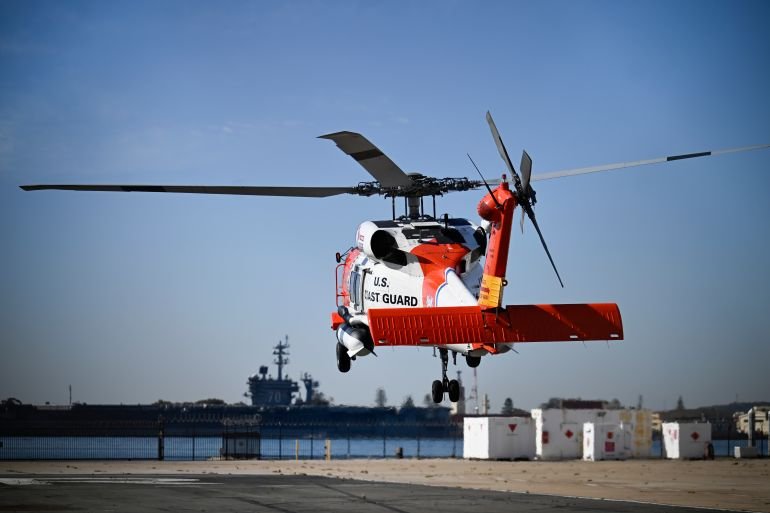
The coastguard and US Navy used multiple aircraft and boats, along with assistance from the Mexican Navy, to search the area for the remaining passengers. An additional helicopter will be deployed later on Saturday, according to the coastguard.
Coastguard officers work on a helicopter at Coast Guard Station San Diego on October 16, 2026 [Denis Poroy/AP]
A Mayday call was transmitted from someone on the boat at about 1am on Friday, coastguard Lieutenant Santiago Tamburini said on the day.
A rescue helicopter reached the site about two hours later. It took about 90 minutes for the crew, which included a rescue swimmer, to pull the 16 people from the water, he added.
The boat went down about 225km (140 miles) west of Ensenada, Mexico, an area popular with fishing and leisure boats, but that is also frequented by smugglers.
Although the incident did not happen in US waters, coastguard official Charlie Valor said on Saturday they “were able to help, and that’s why we launched our assets”.
Fatal attempts to transport refugees and migrants from Mexico to the US have occurred in the past.
In May 2025, at least three people died when a boat flipped off the coast about 56km (35 miles) north of the US-Mexico border.
In 2023, eight people were killed in one of the deadliest maritime smuggling accidents off the US coast, when two boats approached a San Diego beach in heavy fog, and one capsized in the surf.
Prime Minister Mark Carney has pledged support after ‘one of the worst tragedies’ in peacetime for Canada’s armed forces.
Published On 18 Oct 202618 Oct 2026
|
Updated: 2 hours agoUpdated: 2 hours ago
A major fire at a military base in the province of Alberta has killed four Canadian armed service members and caused dozens of casualties, Prime Minister Mark Carney said in a briefing on Sunday.
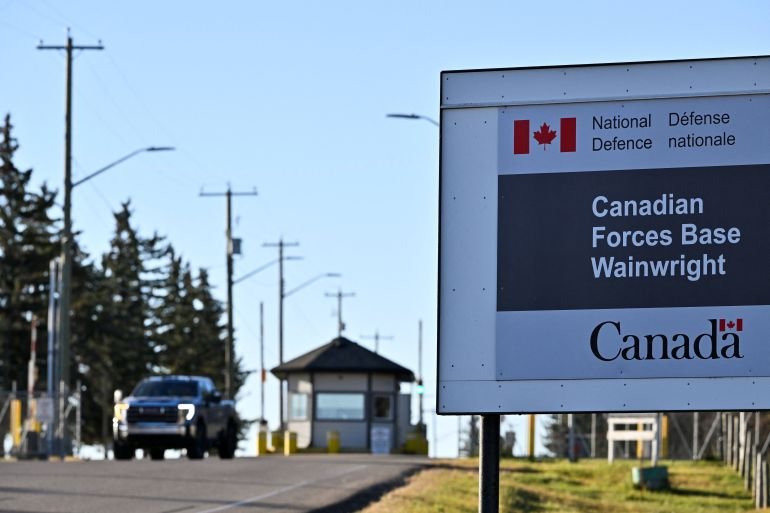
Military and civilian crews battled the blaze throughout the night on Saturday as fierce winds whipped flames beyond Canadian Forces Base (CFB) Wainwright, one of the busiest military training bases, into the surrounding rural area.
Recommended Stories
list of 3 itemsend of list
“The nation is in mourning for those brave members of our armed forces whom we have lost,” Carney said on Sunday, adding that the incident was “one of the worst tragedies for the forces on Canadian soil and in peacetime”.
Emergency resources were mobilised from across Alberta and nearby provinces.
Aerial ambulance crews from the Shock Trauma Air Rescue Service (STARS), a Canadian nonprofit, flew in from Edmonton and from Saskatoon in Canada’s Prairies region.
Victims were reportedly transported to the Alberta cities of Wainwright, Edmonton, Red Deer and Calgary, where medical professionals tended to the injured.
“Canadians come together in crisis. That is the best of our country,” Carney added on Sunday, praising crews who risked their lives “to protect their fellow Canadians” overnight.
The prime minister also noted that senior officials, including Canada’s defence and emergency preparedness ministers and Canadian Army Major-General Wade Rutland, would brief reporters from Wainwright on Sunday afternoon as officials work to establish the full scale of the tragedy.
The death toll may still rise. The Canadian television broadcaster Global News had previously reported at least seven people were killed in the fire, citing unnamed military sources.
“I cannot recall an incident like this in recent memory,” said Minister of National Defence David McGuinty on Saturday, adding that the situation was “very, very active and delicate”.
Global News reported that a gas line or a gas well was hit during a live-fire training, causing an explosion that sparked the blaze.
The Municipal District of Wainwright said the fire crossed the base’s fence and spread rapidly in high winds.
A doctor at a hospital in Edmonton, 180km (112 miles) northwest of the base, told Canada’s national broadcaster on Saturday that some casualties had been taken to hospitals across the city after healthcare facilities around the base were “completely overwhelmed” by the number of people needing care.
“This number of patients would overwhelm the city of Edmonton,” Warren Thirsk, an emergency department physician at the Royal Alexandra Hospital, told CBC News.
“It is more patients than any of us want to count right now. It’s a disaster. It’s a one in every 15-to-25-year disaster.”
Opposition Conservative leader Pierre Poilievre said he spoke to Carney and McGuinty to offer support. “Pray for Wainwright, everyone,” he wrote on social media, urging people in the area to follow emergency instructions and keep roads clear for first responders.
The weekend fire erupted days before a Monday vote on whether Alberta, home to about five million people, should begin the legal process towards seceding from Canada.
Carney has opposed the push for secession, which is non-binding at present but would lead to a binding vote later on.
In his address on Sunday, he praised Alberta for its fortitude in the face of crisis. “The people of Wainwright are taking care of their own,” Carney added on Sunday.
He also pledged that the government would care for the wounded throughout their recovery and stand by members of the armed forces as they grieve.
“Those we lost, those who were injured, were training to defend Canada — to serve Canada. And now Canada serves them,” said Carney.
CBS News. “Sen. Kelly on Hegseth’s Apparent Alcohol Abuse at Work Functions.” YouTube, 14 Jan. 2025, www.youtube.com/watch?v=iQqgMwp8XwA. Accessed 28 Apr. 2025.
Clarke, Amelia. “Pete Hegseth Has Said ‘Women Shouldn’t Be in Combat Roles’ in US Military. Here’s His Reasoning.” Snopes, 29 Jan. 2025, https://www.snopes.com//news/2025/01/29/pete-hegseth-women-military/.
Copp, Tara. “Hegseth Told Senator He Paid $50,000 to Woman Who Accused Him of 2017 Sex Assault.” AP News, 23 Jan. 2025, apnews.com/article/hegseth-sex-assault-payment-trump-6674cc8cfee654c374725948e01ff666. Accessed 28 Apr. 2025.
Greve, Joan E. “‘I’m Not Perfect’: Pete Hegseth Testifies on Sexual Assault and Drinking Claims.” The Guardian, The Guardian, 14 Jan. 2025, www.theguardian.com/us-news/2025/jan/14/pete-hegseth-testimony-congress-secretary-defense. Accessed 28 Apr. 2025.
Mayer, Jane. “Pete Hegseth’s Secret History.” The New Yorker, 2 Dec. 2024, www.newyorker.com/news/news-desk/pete-hegseths-secret-history. Accessed 28 Apr. 2025.
Melas, Chloe, et al. “Pete Hegseth’s Drinking Worried Colleagues at Fox News, Sources Tell NBC News.” NBC News, 3 Dec. 2024, www.nbcnews.com/politics/national-security/pete-hegseths-drinking-worried-colleagues-fox-news-sources-tell-nbc-ne-rcna181471. Accessed 28 Apr. 2025.
“Police Report Gives Details, Timeline of the Sexual Assault Claim against Pete Hegseth.” NPR, 21 Nov. 2024, www.npr.org/2024/11/21/nx-s1-5199630/police-report-gives-details-timeline-of-the-sexual-assault-claim-against-pete-hegseth. Accessed 28 Apr. 2025.
Wise, Lindsay, and Jack Gillum. “Pete Hegseth Routinely Passed out from Alcohol Abuse, Witness Says.” WSJ, The Wall Street Journal, 21 Jan. 2025, www.wsj.com/politics/policy/pete-hegseth-affidavit-witness-drunk-passing-out-e216ca85. Accessed 28 Apr. 2025.
Republicans and Democrats condemn Trump’s decision to suspend sanctions, saying it undermines support for Ukraine.
Published On 17 Oct 202617 Oct 2026
United States President Donald Trump has drawn criticism from Democrats and Republicans after waiving sanctions targeting Russia and countries that buy its oil and gas, days before the restrictions were due to take effect under a law he signed last month.
In an executive order signed on Friday, Trump said the waiver was in the US national interest. He did not specify when the restrictions might be introduced, saying they would remain suspended until he or senior officials determined further action was appropriate.
Recommended Stories
list of 3 itemsend of list
The move has been condemned by both Democrats and Republicans.
Republican Senator Thom Tillis of North Carolina called the decision “beyond irresponsible”, accusing the administration of capitulating to Russian President Vladimir Putin, who launched a full-scale invasion of Ukraine in 2022.
“What part of enforcing a law passed 86-11 by the Senate does the President and his advisers not understand?” Tillis wrote on social media on Saturday.
Republican Senator John Cornyn of Texas also criticised the move, saying the late Republican Senator Lindsey Graham of South Carolina, who championed the legislation, “would be appalled”.
Representative Don Beyer, a Virginia Democrat, said Trump’s move betrayed Ukraine and disregarded Congress’s intent to punish Russia for its invasion.
Democratic Senator Elizabeth Warren of Massachusetts accused Trump of “thumbing his nose” at Congress and enabling Putin to continue his war against Ukraine, urging colleagues to take action to reverse the decision.
The legislation, named after the deceased Senator Graham, was passed with overwhelming bipartisan support. It would have allowed tariffs of up to 100 percent on goods from countries that continued buying Russian oil and gas or helped Moscow evade sanctions. The bill was then signed into law by Trump last month. Before he unexpectedly died earlier this year, Graham had worked for about a year to get the legislation passed.
The decision came shortly after Trump agreed to a deal to buy Russian diesel in an effort to lower fuel prices, which have risen amid the US-Israeli war on Iran. Politicians from both parties have questioned whether the deal would meaningfully reduce energy costs while providing Moscow with revenue to support its war effort.
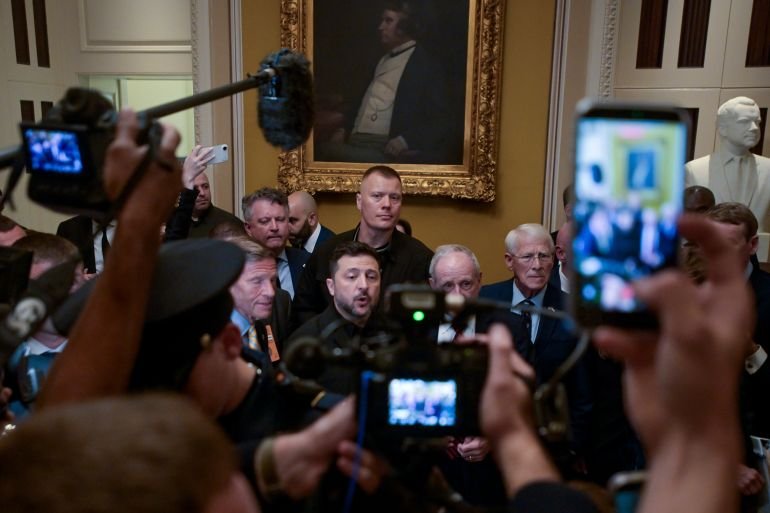
Ukrainian President Volodymyr Zelenskyy also criticised the sanctions waiver on Saturday, saying easing pressure on Russia would encourage further attacks.
“Financial rewards for Putin – all of this only encourages him to keep attacking,” Zelenskyy posted on X, urging the US to maintain pressure on Moscow.
Congress is in recess until after the November 3 midterm elections, limiting immediate opportunities to challenge Trump’s decision. Representative Gregory Meeks, the top Democrat on the House Foreign Affairs Committee, has introduced legislation to block the separate diesel deal with Russia.
The vessels, each carrying about two million barrels of crude oil, used an unauthorised route, the IRGC says.
Published On 18 Oct 202618 Oct 2026
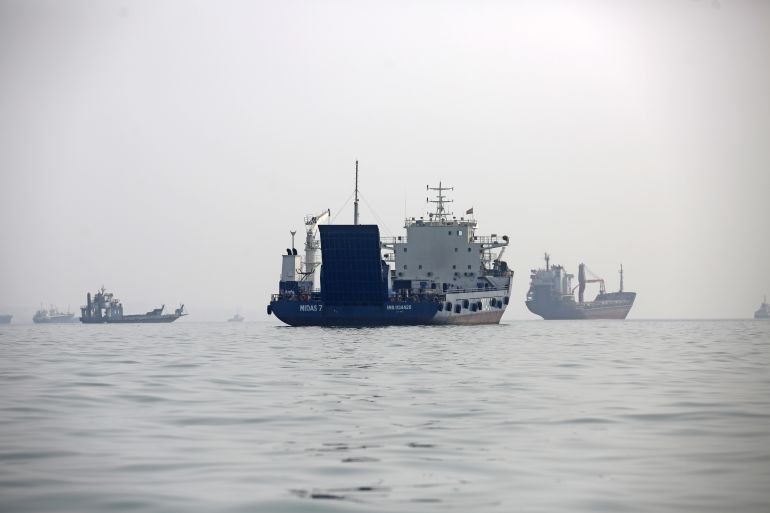
Iran’s Islamic Revolutionary Guard Corps (IRGC) has said two oil tankers, each carrying about two million barrels of crude oil, caught fire after hitting naval mines in the Strait of Hormuz.
The first tanker hit a mine, triggering an explosion and a “fierce fire”, the IRGC said on Saturday, while the second tanker hit a mine that engulfed it “in a massive blaze”, Iran’s official IRNA news agency reported.
Recommended Stories
list of 3 itemsend of list
Information about the ships’ names or the origin of their cargo was not immediately available.
IRNA said the vessels had switched off their positioning and radar systems and tried to use a route not authorised by Iran.
The IRGC also claimed that while one tanker tried to cross the waterway “with US support”, the second vessel was left immobilised.
Iran seized control of the Strait of Hormuz after the US-Israeli war on the country began in late February. Tehran has since demanded that all ships seek its authorisation before transiting. About one-fifth of global oil consumption transited the waterway before the war.
This week, IRGC naval commander Rear Admiral Ali Azmaei warned that any vessel that deactivated its navigation systems would be considered “hostile”.
The United States has imposed its own naval counter-blockade on Iranian oil exports.
Iran’s army earlier said that two tankers caught fire on Thursday and Friday in Tehran’s “prohibited zone” in the Gulf of Oman.
Maritime monitors also reported two tankers struck in Gulf waters off Saudi Arabia on Friday.
Last Sunday, six vessels were attacked in or near the Strait of Hormuz, the most in a single day since the war began, according to security firm Vanguard, the International Maritime Organization and the UK maritime agency UKMTO.
Attacks around the waterway have surged over the past two weeks, with Iran saying it is stepping up strikes in response to the US blockade of its ports and tougher sanctions imposed last month.
Nearly 20.8 million barrels of oil passed through on October 8, but only 2.9 million on October 11, according to Kpler data.
The disruption has pushed up global energy prices and inflation.
US President Donald Trump has explicitly ruled out using a nuclear weapon against Iran. “I wouldn’t use nuclear,” he told the Newsmax news site in an interview on Thursday.
Trump said that he was also not considering putting troops on the ground in Iran. “No, I don’t see that, I don’t see it,” he said, adding he believes a deal to end the war will be reached after the November 3 US midterm elections.
Outside of a treatment centre for Ebola in a northeastern corner of the Democratic Republic of Congo, as the country battles its worst outbreak on record, Neema Nyaloka bounces a baby on her lap.
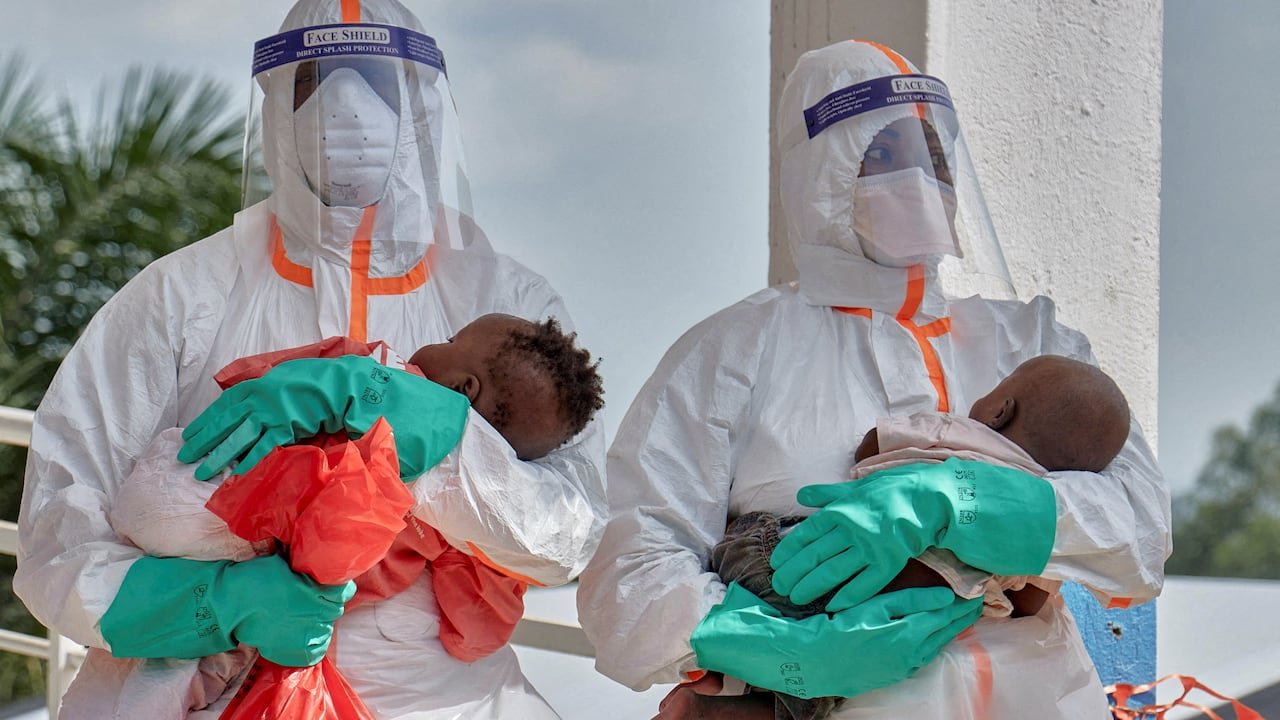
Nyaloka survived Ebola herself. Now, she works with UNICEF to take care of the droves of children isolating from their parents who are being treated for it.
UNICEF is operating 12 other child-care centres next to treatment centres full of Ebola patients. Some kids are waiting for their parents to recover, but others have been left stranded after family members passed away.
“We have children that are completely orphans, so they lost both parents,” Lucia Elmi, director of global emergency programs at UNICEF, said last week.
It’s estimated that at least 1,900 children have been separated from their caregivers because of Ebola.
It’s just one more way that children are bearing the brunt of an outbreak which has spread to at least seven provinces in the Democratic Republic of Congo, and outstripped the 2018-2020 outbreak to become the largest and deadliest Ebola outbreak in Congo’s history.
As of Oct. 15, more than 9,200 cases have been confirmed, while deaths have surpassed 4,400, according to the latest numbers from the D.R.C.’s public health institute.
Just over a quarter of those deaths are children. Although most cases are among adults, children have a much higher fatality rate, at 60 per cent compared to 40 per cent for adults, the World Health Organization (WHO) estimates.
Children walk by posters warning people about Ebola on June 24 in Goma, Democratic Republic of Congo. (Daniel Buuma/Getty Images)
“Children are really impacted by Ebola on so many levels,” Amy Mina, a project leader from Canada with Save the Children, told CBC News.
“Sixty-one per cent of the children who died of Ebola are under the age of five.”
‘Fighting for your life’
Children in the region already face high levels of malnutrition and displacement due to ongoing armed conflict.
The Ituri province in northeastern Congo, where Mina works, is where the outbreak began, and is still the heaviest-hit region, accounting for 73 per cent of cases.
Save the Children works with schools and communities to provide supplies and training for staff to recognize symptoms among their students. Every morning since schools opened, the temperatures of every teacher and student are checked as part of this work.
But attendance has dropped, Mina says, because many parents worry schools could be transmission sites. They’re also avoiding seeking treatment at the hospital for their children for other health issues out of fear of Ebola.
“Children aren’t only dying of Ebola,” Mina said. “We are seeing a drop in the number of families and children visiting health centres … and children die of malaria, and dysentery and respiratory diseases.”
Cholera is also seeing a rise in the west of the country, with more than 51,000 suspected cases reported since the beginning of 2026.
A 13-year-old student washes her hands outside her school in the Democratic Republic of Congo. Save the Children is working with schools during the Ebola outbreak, supplying infection-prevention kits and training teachers to counter misinformation about the disease. (Submitted/Save the Children)
When children contract Ebola, they have to be entirely isolated to combat the disease just like adults are, interacting only with caretakers dressed head to toe in fully protective gear, which can be terrifying for kids, experts say.
Children are already vulnerable to viruses, with fewer reserves to fight off loss of fluids from illness, says Dr. Joanne Liu, director of the Pandemic and Emergency Readiness Lab at the School of Population and Global Health at McGill University. Liu, a pediatric emergency physician, led emergency responses during the 2014-2016 Ebola outbreak in west Africa.
“Can you imagine fighting for your life on your own without your parents?” she said. “We know that that kind of isolation … creates emotional stress, agitation and irritability in the children.”
Fractured response
Amid the surge in Ebola, pregnant women are also avoiding clinics, missing prenatal care and choosing to deliver their babies at home.
The UN says, compared to last year, maternal deaths in the region have nearly doubled.
And most deaths from Ebola are happening outside of treatment centres, meaning medical workers can’t fully track the chains of transmission to stop them.
“They’re dying at home, which represents a huge opportunity for more transmission because they’re being cared for by their family, their community members,” said Stephanie Hoffmann, a project co-ordinator with Doctors Without Borders in North Kivu, D.R.C.
Part of the reason this has gotten so “out of control,” she said, is because of the gutting of the U.S. Agency for International Development (USAID), a foreign aid program dismantled in 2025 due to alleged inefficiency and wasteful spending, according to the Trump administration. Researchers have estimated that the shuttering of services has already caused the deaths of hundreds of thousands of people worldwide.
WATCH | Ebola outbreak the deadliest in Congo’s history:
Ebola outbreak now deadliest in Congo’s history
The Ebola outbreak in the Democratic Republic of Congo is officially the deadliest in the country’s history, and health officials worry the crisis will only get worse when children return to school.
When USAID was operating in the region, cases of Ebola were detected earlier on, Hoffmann said, allowing for tracking and isolating. But with less funding and support, cases had already spread dangerously far by the time the outbreak was official.
“I can’t say that with the current response, there’s going to be an end in sight.”
The U.S. announced Friday that it had struck a new deal to supply some of the world’s poorest nations with maternal and child health supplies, including Congo, through UNICEF.
Rare strain has no treatment
The current outbreak is caused by the Bundibugyo strain — a rare strain of Ebola for which there is no approved treatment or vaccine, although clinical trials are underway.
Congo’s deadly Ebola surge is second only to the 2014-2016 outbreak in Guinea, Liberia and Sierra Leone, which killed more than 11,000 people.
Two volunteers wearing personal protective equipment carry the coffin of a three-year-old child, presumed to have died of Ebola virus disease, in Bunia, D.R.C., on June 11. (Benediction Murhabazi/AFP/Getty Images)
And it’s affecting other regions as well. So far, two people have died of the virus in neighbouring Uganda, which declared itself Ebola free in August.
Three cases in Kenya are linked to Congo’s outbreak — authorities confirmed the third patient on Friday, adding that she is a close relative of the first and second cases. The first case was a Kenyan man who died in early October in Kenya after returning from travelling in Congo.
Aid groups say while more treatment centres and funding are badly needed to address the health needs in the Democratic Republic of Congo, so is building trust and education.
“There’s a lot of mistrust about the response in general,” Hoffmann said. “People have a lot of mistrust and a lot of fear about how they’ll be treated in a treatment centre. There is a lack of education and awareness about what happens to the body when you have Ebola, what happens in a treatment centre.”
It’s another battle health-care workers on the ground are fighting, as they desperately try to save lives.
At 93, Emma Maria Mazzenga still gets the jitters before a race.
“On race day, I’m very tense,” she said. “People ask to interview me, and I tell them: Don’t come near me until I’ve run.”
Over the last four decades, Mazzenga has won 11 world titles, 31 European championships and 115 Italian races. She currently holds the 200-metre world record in the women’s over-90 category: 50.33 seconds, set in 2024, when she was 91.
Now she is giving scientists a rare look at just how much of the physical decline we associate with aging may not actually be inevitable.
Mazzenga ran as a university student in Padua, in northern Italy. She then stopped for three decades while she taught high school biology and raised two children, largely on her own after her husband died.
In 1986, when she was 53, the president of her old university running club rounded up former athletes for the growing field of masters competitions, for those over age 35.
“One by one, my friends quit,” she said. “I kept going.”
In this 2024 file photo, a then-90-year-old Mazzenga shows her membership card for the Italian Athletics Federation, ahead of a race in San Biagio di Callalta, Italy. It shows her birthdate: Aug. 1, 1933. (Remo Casilli/Reuters)
She still trains three times a week, mostly short repeats of 50 to 200 metres. Slow jogging bores her.
What drives her isn’t winning, Mazzenga said. In Italy, she has no rivals in her age category. “I come first because I have to. I’m the only one,” she said. “I can’t get any emotion out of that.”
So she races the clock instead. “If I win with a mediocre time, it gives me no satisfaction.”
Her proudest moment is still her first world title, the 400-metre W75 race at the World Masters Athletics Championships in Sacramento, Calif., won in 2011.
“There were just a handful of us Italians. I found myself alone on the podium,” Mazzenga recalled.
WATCH | Watch Mazzenga compete in 100m race in Florence, Italy, last month:
Watch Emma Mazzenga, 93, compete in 100-metre race
Italian sprinter Emma Mazzenga, 93, competes in a women’s 100-metre race in Florence, Italy, in September. Mazzenga is an accomplished runner whose athletic performance is providing new insights into human aging.
From VO2 to muscle fibres
But eventually, her performances drew a different audience: Scientists.
Two years ago, Antonio La Torre, a scientist at the University of Milan and technical director of Italy’s athletic federation, tipped off two researchers who were studying how the body ages.
“We were told there was this woman who was able to run 200 metres in a very short time,” said Martino Franchi, an associate professor of human physiology at the University of Padua. “But it was her age that we were really interested in.”
Mazzegna became the most extreme case in a broader, two-year project called Trajector-Age, which tracked how muscles, nerves, heart and metabolism change in people over 50 to see whether exercise can slow decline.
Researchers from several Italian universities and the University of Wisconsin-Madison put Mazzenga through a gruelling cycling test and took biopsies from her thigh.
Mazzenga, then 90, competes in the 100-metre W90 category race in San Biagio di Callalta, Italy, on May 4, 2024. (Remo Casilli/Reuters)
Franchi says Mazzenga’s maximal oxygen consumption is comparable to that of someone in their 50s. Also known as a VO2 max, it represents the greatest amount of oxygen a body can take in and use — a key measure of cardiovascular fitness.
“And she’s 90,” he said. “This is fantastic.”
The bigger surprise was inside her muscles, said Franchi. Mazzenga has lost some of the fast-twitch fibres used for explosive movement, although fewer than expected. But her slow-twitch fibres — the ones that resist fatigue — are extraordinary.
“They are as big as a girl in her 20s,” he said. “That’s unique.”
Martino Franchi gestures toward a screen showing a microscopic view of muscle fibres at his lab at the University of Padua, in Italy. (CBC)
Researchers think those unusually large fibres may help her hold her pace and compensate, at least partly, for the fast fibres lost with age.
Aging has happened, Franchi said, “but in a slower way.” And so many years of training means that her body runs almost on auto-pilot when her feet hit the track.
The research was published earlier this year as two cases in the Journal of Applied Physiology, with a rendition of a Mazzenga landing on the cover. Lead scientist Marta Colosio received an award for the work at the American Physiology summit.
The team is now analyzing a second round of biopsies, along with genetic and molecular data, trying to tease apart what Mazzenga inherited versus what decades of training may have preserved.
Mazzenga walks with Martino Franchi, one of the researchers who has studied the 93-year-old’s muscles and athletic performance to glean new insights into human aging. (CBC)
‘A bit of a rarity’
Mazzenga has her own theory. “I always say that if I had been sitting on the sofa, I would have aged differently.”
With the running came fame — eventually. “No one paid much attention to me in my 80s, but after 90, yes,” she jokes. “They look at me as a bit of a rarity.”
She now speaks regularly at public events, most recently at la Repubblica’s Festival di Salute, an annual health festival that draws Nobel laureates, scientists and sports champions.
As friends die and family members get busy with their own lives, Mazzenga says those connections — along with her masters teammates — matter almost as much as the training.
Mazzenga shows off her first pair of track shoes, when she first took to racing in her early 50s, at her home in Padua, Italy. (Megan Williams/CBC)
Franchi has his own reason for pushing exercise.
During the COVID-19 lockdowns, he noticed his father, then in his 70s, struggling to get up from the sofa. So Franchi printed out graphs linking inactivity to mortality.
“I said, ‘Dad, I study sarcopenia. This is it,’” said Franchi, referring to the loss of muscle mass, strength and function with age. “He got scared, so he went back to the gym.”
Today, Franchi’s father can pull off full lunges and hikes several times a week.
Franchi likes to tell the story to his students, telling them that physical activity is important — but be sure to keep doing it when you’re older.
Asked what she’d tell someone 80, or even 90, thinking about taking up a sport, Mazzenga laughs. “You’d want to start a little earlier.”
For those still able, she says, see a doctor, find a coach and match your body to the effort.
She herself has no plans to slow down. At a recent club final, she ran faster than she had two years earlier. “I was very pleased.”
Mazzenga, centre, is seen in a photo with two fellow racers when she won the European Championship in 1998. (Megan Williams/CBC)
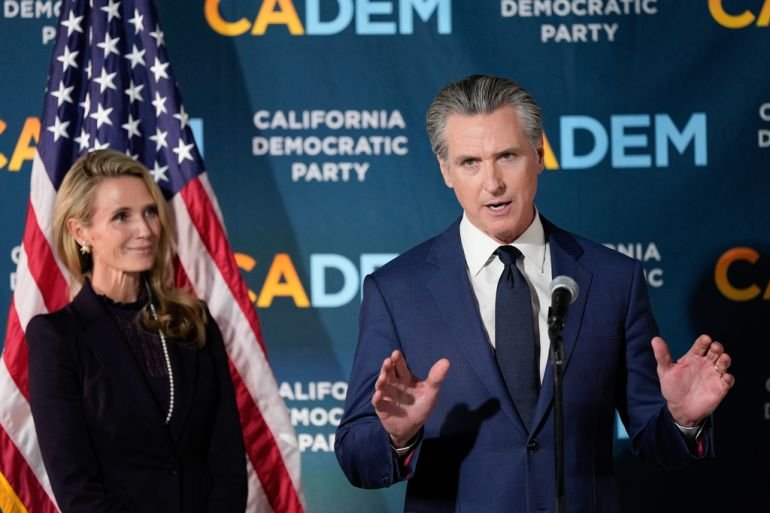
San Francisco, United States – In his last few executive orders signed as California governor, Gavin Newsom, whose final term ends in January, issued one asking for independent verification of artificial intelligence models and set up an expert committee to create kill switches for AI agents that could go rogue and cause harm.
In 2024, Newsom vetoed a bill, passed in the state assembly, asking for similar requirements that the governor has now called for in his executive order. Newsom said at the time that it would amount to “thwarting the promise of this technology”.
Recommended Stories
list of 4 itemsend of list
Now eyeing a 2028 United States presidential run, he wants to expand the definition of safety incidents, potentially to include the recent series of safety breaches, explore a kill switch and include other measures that were in the vetoed bill.
“He is in a lame duck period here,” says Alex Hanna, director of research at the Distributed AI Research Institute (DAIR), unsure that the measures will pass in the remainder of his term. “He is setting up his next thing.”
US voters are increasingly concerned about AI safety, data centres and job losses, and this could show Newsom is acting to address this, Hanna says.
After vetoing the 2024 bill, Newsom had asked Scott Wiener, the state senator who drafted the bill, to redraft it in consultation with an expert committee. He signed that frontier AI bill, the nation’s first, into law in October 2025. It asks large developers to disclose certain safety incidents, including the deaths of 50 or more people, large-scale cyberattacks or monetary theft.
Christabel Randolph, associate director at the Center for AI and Digital Policy (CAIDP), says, “It seems the governor operated from the premise that a slower pace of regulation would be sufficient because the companies would pace their investments, and did not anticipate that the companies would be accelerating the risks.”
AI companies have reportedly had thousands of safety incidents in internal and real-world tests in the last few months. These include efforts by agents to get information from the US Securities and Exchange Commission and Census Bureau, as well as confidential information from Australian and Canadian government sites. AI startup Hugging Face had earlier revealed that OpenAI agents had infiltrated its systems, one among a spate of such incidents.
“No governor has been more out-front on addressing the risks of AI than Governor Newsom,” Tara Gallegos, the governor’s director of communications, told Al Jazeera.
Monopoly of big AI companies
In his message vetoing the bill in September 2024, Newsom had said “the bill applies stringent standards to even the most basic functions” and noted that 32 of the world’s 50 leading AI companies are in California.
Industry representatives, too, had rallied against the bill.
“In essence, the bill is creating this disastrous regressive tax on AI innovation,” Anjney Midha, general partner at the Bay Area-based venture capital firm Andresen Horowitz, had said at the time. If enacted, it would force AI founders to move elsewhere, Midha warned.
“The bill was unworkable when it reached his desk,” Newsom’s spokesperson Gallegos told Al Jazeera.
But Hamid Ekbia, professor at Syracuse University and founding director of the Academic Alliance for AI Policy, says industry cannot be relied on to regulate itself.
“There is a need to break down the monopoly of the big AI companies,” Ekbia told Al Jazeera.
“Their financial stakes are too high,” to self-regulate, he said, referring to Open AI and Anthropic’s upcoming public offerings and tax breaks that some companies are reportedly taking advantage of to build data centres.
Newsom has now set up an expert committee to examine setting up a kill switch, which had been proposed in a more comprehensive manner in the original bill.
“SB 1047 [the bill that was vetoed] had a concrete architecture; the EO [executive order] only includes one aspect – the Kill Switch or shutdown/stoppage mechanisms, which is quite different and weaker than the ex ante termination obligation of SB 1047,” which required stronger safety measures even before training runs of the AI models could start, CAIDP’s Randolph said.
DAIR’s Hanna says that with the order, Newsom “is showing he is attentive without planning anything drastic”.
Building AI safety in real time
“We are building the field of AI safety in real time,” says Rebecca Finlay, chief executive officer of Partnership for AI, a nonprofit that works on technology governance, underscoring the challenges of regulating an industry growing at a meteoric pace.
Newsom has asked the California Emergency Services Office to send recommendations on AI regulation by November 15 and could convene a special legislative session to discuss how to implement these, possibly before his term ends.
This would be in contrast to the federal government, which has pushed for self-regulation by industry. CAIDP’s Randolph says California could play an important role in setting the floor for AI regulation given that much of the global AI industry is based there.
DAIR’s Hanna says Newsom is not only looking to show a contrast with US President Donald Trump, who believes in self-regulation by firms and last month signed a voluntary accord with several AI leaders, but also with possible Democratic contenders.
“With this, Newsom can look good on the primary debate stage,” she said.
Gallegos, the governor’s spokesperson, told Al Jazeera that “Governor Newsom isn’t interested in virtue-signalling or chasing headlines — he is leading the nation by taking a smarter, strategic, and effective approach to addressing frontier technology”.
Experts say that along with Newsom’s order setting up a committee to examine a kill switch, there is a need for measures for controls across the life cycle to reinforce safety.
“Safety needs to be built in. We issued 12 guidances across the lifecycle when the last ChatGPT model was released. There is a need for safety features throughout the life cycle,” of an AI model, Partnership for AI’s Finlay said.
As Newsom considers such recommendations from California agencies and the expert committee, Ekbia says governments “should take a lesson from what happened with social media. A handful of companies having control were able to do a lot of harm,” and regulate with an anticipatory approach and take on corporate monopolies.