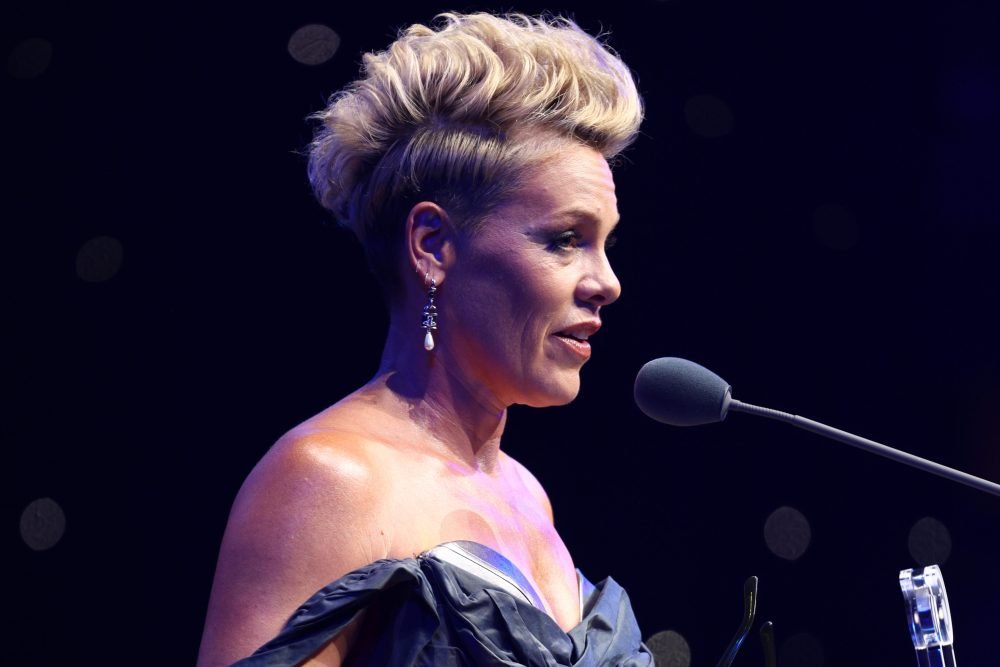
Pink had fallen silent in the face of backlash from many quarters following her reposting a call for Macklemore to be dropped from the Ed Sheeran tour in the wake of his nightly pro-Palestinian songs and statements. Now she has spoken up about the controversy and her part in it in a big way, with a 1,300-word social media post that has her exploring why she repeated the sentiments asking Sheeran to drop Macklemore, why his statements alarmed her as a Jewish woman, and how it has felt “lonely” facing an onslaught of criticism this week.
The singer noted that she may have been a typical “cheap and fast” social media user when she first reposted the anti-Macklemore meme, rather than speaking up in her own words, which she is now belatedly doing. “A repost isn’t a statement, and a meme isn’t a spine,” she argued, saying that she would “rather be disagreed with for what I actually said than hated for what anybody else wrote, so let me say it.”
Pink noted how her feelings about Macklemore have evolved, from support for him when “I was in the room at the Grammys in 2014 when Macklemore rapped ‘Same Love’ and 33 couples, gay and straight, got married to it, and I cheered, no questions asked.” Then, she pointed out an antisemitic costume the rapper wore a short time later, for which he subsequently issued a mea culpa. “Macklemore put on a hooked nose, a black beard and a bowl cut, performed in it, and called it a ‘random costume.’ Every Jew I know knew exactly what it was. The same love, it turned out, had a guest list, and we weren’t on it. But he apologized, and I let it go, because that’s what we do. We let it go.” Nonetheless, she suggested, his wearing of the costume informed how his statements might be received in years to come.
The singer said that “last weekend he stood in front of a stadium full of music-loving families, with violent images from a war on the screens, dedicated a song to the movement of his choice, and then took the mic to tell all of the Jews in the stadium that it wasn’t about them.” She added: “You don’t get to decide that for us.”
Her current position, as she explained it in her post: “Of course I don’t speak for Israel, or for any government. I never have. What I said in October 2023 is still exactly what I believe: Hamas is a terrorist organization. Palestinians deserve a future that honors their humanity and their aspirations. Protecting innocent life comes first, everywhere, and nobody should ever celebrate the death of a child. Anybody’s child. I’ve spent a decade as a UNICEF ambassador for kids who didn’t choose the country or the war they were born into, and I have grieved every one of them, on both sides of that fence. I didn’t do it from behind a screen; I went to those children and held them. I’m not going to litigate a complex war in an Instagram caption, and I’m not going to recite anybody’s slogan to earn back a follower.”
The singer declared that her response earlier this week was prompted not by Macklemore saying “Free Palestine,” but by his statements on stage — in response to the backlash he was facing from some quarters — that his statements were aimed at Israel, not all Jews.
“That’s what prompted my repost. Not ‘Free Palestine,’ and not anyone’s right to say it. I have never asked for another artist to be silenced and I’m not asking now. I don’t need anyone fired, and I don’t need a refund. What I need is to be able to say, as a Jewish mom, ‘that scared me, and it scared people I love,”’without being told our fear is just propaganda, and without being told I’m somehow cool with genocide because I noticed?”
Pink pointed to some of the causes she has supported over the years that have drawn fire, mostly from the right wing. “I have stood up for other people’s people my whole career, and I know exactly what it costs. And now I’m standing up for my own people, and I thought I knew going in how lonely that would be. And it’s lonelier than that. But I’m doing it anyway.”
She added, “Something has changed in this country, and I can read it in my own comments. ‘From the river to the sea.’ ‘Zionist,’ spat like it’s a slur, by people who couldn’t tell you the details of what I believe, because I hadn’t told them yet. I wasn’t asked. I was told. I don’t think most of them hate Jews. I think somebody handed them a story where the Jew who won’t apologize for existing must be the villain, and they’ve been putting words in my mouth ever since.”
On her Instagram post, Pink divided her lengthy statement into two parts, the first half of it coming in the post itself and the second in the comments. But the second half is no longer visible. An hour or so after posting, as pro and con responses accumulated from fans and detractors, she opted to switch off commenting for that post. Unfortunately for her ability to explain herself, cutting off comments meant she also eliminated her own comment that contained the crux of her explanation. But you can read it all below, including the part she inadvertently deleted.
Before Pink or her social administrator cut off comments on her post, the responses were sharply divided, with mostly hostile or disappointed comments appearing at the top of the replies, followed by many supportive ones echoing her “Shana tova” sign-off further down. Among the negative replies, before all were blocked: “A repost is a statement. Just saying. (esp w 11M followers).” “Said all this to say nothing at all. This was truly not on my bingo card. Doubling down is insane as well.” “I grew up respecting your rebellion against things that were wrong in the world. But now you seem to have switched to supporting those very same people that cause the pain to children and women. I hope that is how you want to be remembered.”
And a sampling of the positive replies: “This was beautiful. And not trite. And not prepared by AI or a publicist. This was an authentic monologue and I appreciate so much how strong you are. And I’m proud to have you in my same tribe.” “I wish all other Jewish celebrities were as brave as you. We love you.”
In his most recent comments addressing the controversy, Macklemore said, “To all of my Jewish brothers and sisters: criticism of Israel, criticism of apartheid, being against genocide in no way is a criticism of you. My message is for peace; love for all human beings to be treated with dignity, respect, and equality…. So I say free Palestine, I say free Lebanon, I say free Cuba, I say free Congo, free Sudan, I say free all people in America living in fear of this terrorist organization, ICE. None of us will be free until we are all free.”
Pink’s statement, in full:
I’ve been quiet in my own words for a week, which you know isn’t like me. So here they are.
Last Sunday I reposted somebody else’s post about Macklemore’s set at Ed Sheeran’s show. It said things in words I didn’t write, and I wouldn’t have chosen all of them. Then the comments came, and I did what I do when I’m hurt, which is post snarky memes and act like I’m fine. That’s on me. A repost isn’t a statement, and a meme isn’t a spine. Social media makes all of us cheap and fast, and we all know it. But I’d rather be disagreed with for what I actually said than hated for what anybody else wrote, so let me say it.
I was born a Jew. I didn’t pick it, and I’ve never hidden it. And this week a whole lot of people decided what I believe without asking me, without checking a single thing I’ve ever said or done, because a repost and the word “Jew” were apparently enough to fill in the rest. But let me fill it in… myself.
Of course I don’t speak for Israel, or for any government. I never have. What I said in October 2023 is still exactly what I believe: Hamas is a terrorist organization. Palestinians deserve a future that honors their humanity and their aspirations. Protecting innocent life comes first, everywhere, and nobody should ever celebrate the death of a child. Anybody’s child. I’ve spent a decade as a UNICEF ambassador for kids who didn’t choose the country or the war they were born into, and I have grieved every one of them, on both sides of that fence. I didn’t do it from behind a screen; I went to those children and held them. I’m not going to litigate a complex war in an Instagram caption, and I’m not going to recite anybody’s slogan to earn back a follower.
Here’s what I was reacting to. I was in the room at the Grammys in 2014 when Macklemore rapped “Same Love” and thirty-three couples, gay and straight, got married to it, and I cheered, no questions asked. Four months later Macklemore put on a hooked nose, a black beard and a bowl cut, performed in it, and called it a “random costume.” Every Jew I know knew exactly what it was. The same love, it turned out, had a guest list, and we weren’t on it. But he apologized, and I let it go, because that’s what we do. We let it go. Then last weekend he stood in front of a stadium full of music-loving families, with violent images from a war on the screens, dedicated a song to the movement of his choice, and then took the mic to tell all of the Jews in the stadium that it wasn’t about them.
You don’t get to decide that for us.
That’s what prompted my repost. Not “Free Palestine,” and not anyone’s right to say it. I have never asked for another artist to be silenced and I’m not asking now. I don’t need anyone fired, and I don’t need a refund. What I need is to be able to say, as a Jewish mom, “that scared me, and it scared people I love,” without being told our fear is just propaganda, and without being told I’m somehow cool with genocide because I noticed?
And please don’t talk to me like I’ve never stood up for my beliefs when it was unpopular. In the middle of the Gulf War in 2006 I put out a song called “Dear Mr. President” and sang it every night on tour while my country was in a war I didn’t support, and I took the hate for it, and I sang it anyway because my sharp criticism was of a government, not this flawed country I love and who my dad fought for. I stood with gay kids before it was fashionable and with trans kids now, when it isn’t, and with their families, and I handed out the books that got banned, and you know I got called every name there is, and I’d do all of it again tomorrow. I have stood up for other people’s people my whole career, and I know exactly what it costs.
And now I’m standing up for my own people, and I thought I knew going in how lonely that would be. And it’s lonelier than that. But I’m doing it anyway.
Something has changed in this country, and I can read it in my own comments. “From the river to the sea.” “Zionist,” spat like it’s a slur, by people who couldn’t tell you the details of what I believe, because I hadn’t told them yet. I wasn’t asked. I was told. I don’t think most of them hate Jews. I think somebody handed them a story where the Jew who won’t apologize for existing must be the villain, and they’ve been putting words in my mouth ever since.
But I’ve been portrayed as the villain before. I can take it. I just won’t take it quietly, and I’m not going to teach my kids to.
So, to the ones who are furious with me: you don’t have to agree with me. You never did. That’s been our unspoken agreement for twenty-five years, and it still stands, and so do I. You don’t have to agree with one thing Israel’s government does to not want the Jewish family two rows down from you to be scared or targeted at a concert. That’s the only thing I’m asking anybody for. To the ones who are frightened this week, Jewish or Muslim or Palestinian or Israeli or just tired of all of it: I see you. And if anybody wants to really know what I think, just ask me. I’m right here. I’ve never been hard to find. And I’ll keep speaking out, in my own words.
It’s Friday. For working people who have more to worry about than pop stars and pile-ons, it’s the end of a hard week. It’s also the 25th anniversary of September 11th, and my prayers are with the innocent souls we lost that morning. And at sundown, for Jews, it’s Rosh Hashanah, our New Year.
Now I’m going to go make dinner for my kids, light the candles, dip some apples in honey, pour a glass of wine and be full of gratitude. That’s my tradition. It also happens to be a Jewish one.
Shana tova.