CA7RIEL & Paco Amoroso are on their Free Spirits World Tour until November, but they’ll be hitting the state again in 2027 for one of the biggest milestones of their career. On Thursday, Harry Styles dropped the dates for his Together, Together 2027 tour, and fans quickly noticed the Argentine duo’s name.
CA7RIEL and Paco Amoroso are one of the most unique acts in music right now
Styles will be in six cities on the North American leg of the global stadium tour before heading to Europe. CA7RIEL & Paco Amoroso will be joining them on April 9 and April 10 for their shows in Dallas, Texas, at AT&T Stadium.
The duo met in first grade after sitting next to eachother by chance
The duo, often mistaken for brothers due to their shared surname, consists of Catriel Guerreiro (aka Ca7riel) and Ulises Guerriero (aka Paco Amoroso). They met way back in primary school when they were six.
Catriel said in an interview with Arte that they sat next to each other. “It was first grade. Just one of those f***ing coincidences in life; we ended up sitting next to each other,” he explained.
Since the beginning, people thought they were siblings, and they started trolling together immediately. “The teacher was taking attendance and said, ‘Okay, Ulises Guerriero?’ He raised his hand. ‘Catriel Guerreiro.’ I raised my hand. “Oh, are you brothers?” she asked. And we said yes,” he said.
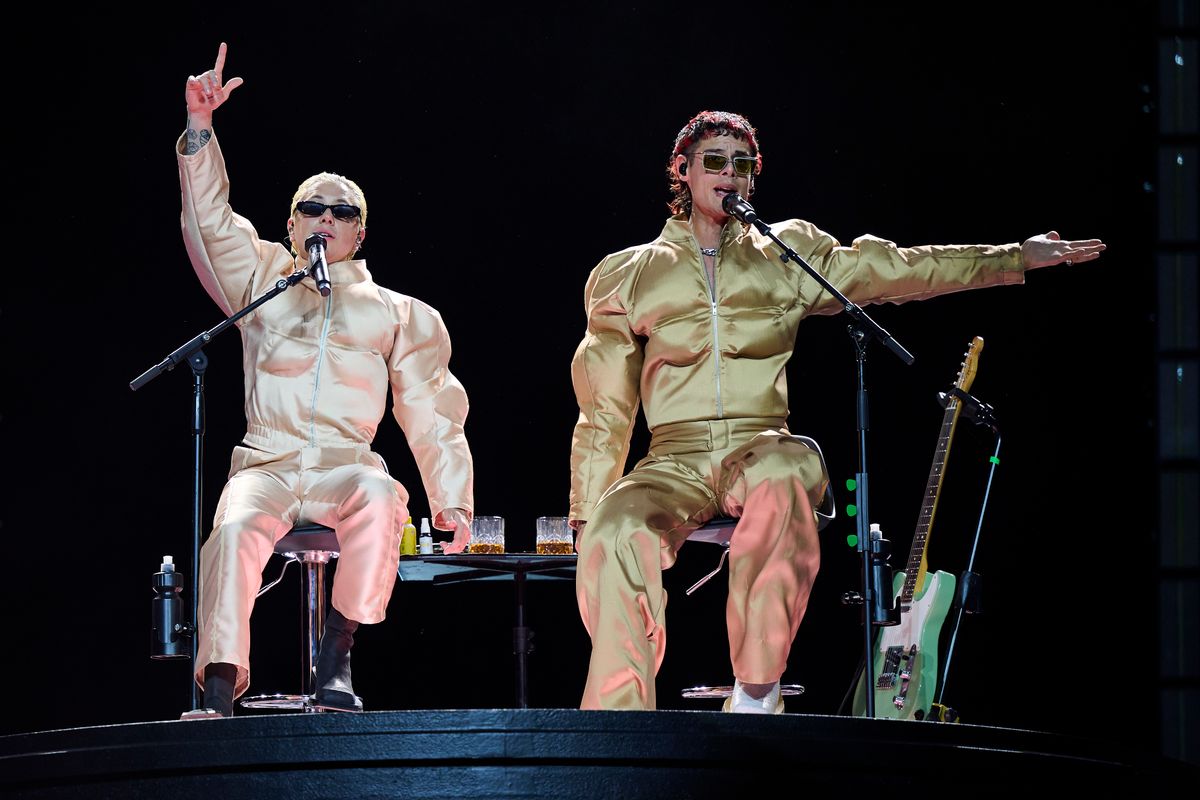
CA7RIEL & Paco Amoroso performs on stage at Movistar Arena on May 28, 2025 in Madrid, Spain
They sat in music workshops together, one strumming guitar, the other violin, eventually forming a rock band called Astor y las Flores de Marte in 2010. They officially became a duo in 2018, shifting into the experimental-trap/funk/hip-hop/pop world, and are among the first wave of Urban musicians in Argentina.
Now, they’ve practically become blood. “We’re not brothers, but we’re basically brothers,” Catriel told Arte.
They dropped their debut studio album, Baño María, in April 2024. But everything changed when they lit up the international scene with their viral Tiny Desk session, released on October 4, 2024, which has garnered over 55 million views at the time of this publication.
Riding the wave of success, they went on tour, opened for Kendrick Lamar, and have played at the world’s biggest music festivals, venues, and stadiums.
The artists won 5 Latin GRAMMYS
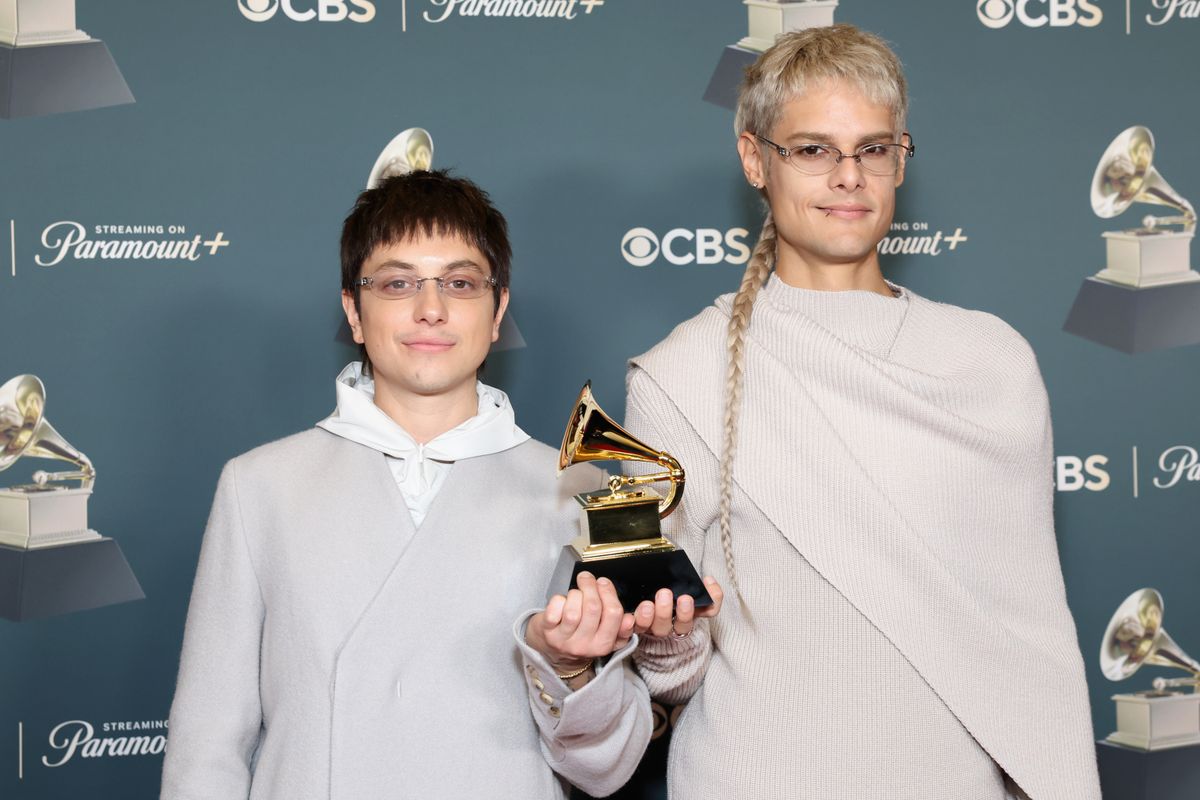
In 2025, they were the stars of the show at the Latin GRAMMYS. Tied with Mexican legend Edgar Barrera for the second most nominations after Bad Bunny, they won 5 awards at the Latin GRAMMY Premiere Ceremony: Best Alternative Song, Best Long Form Music Video, Best Alternative Music Album, Best Short Form Music Video, and Best Pop Song. They also made out.
Seth Rogen has starred in films that mirror his life, but none have hit as close to home as Babies.
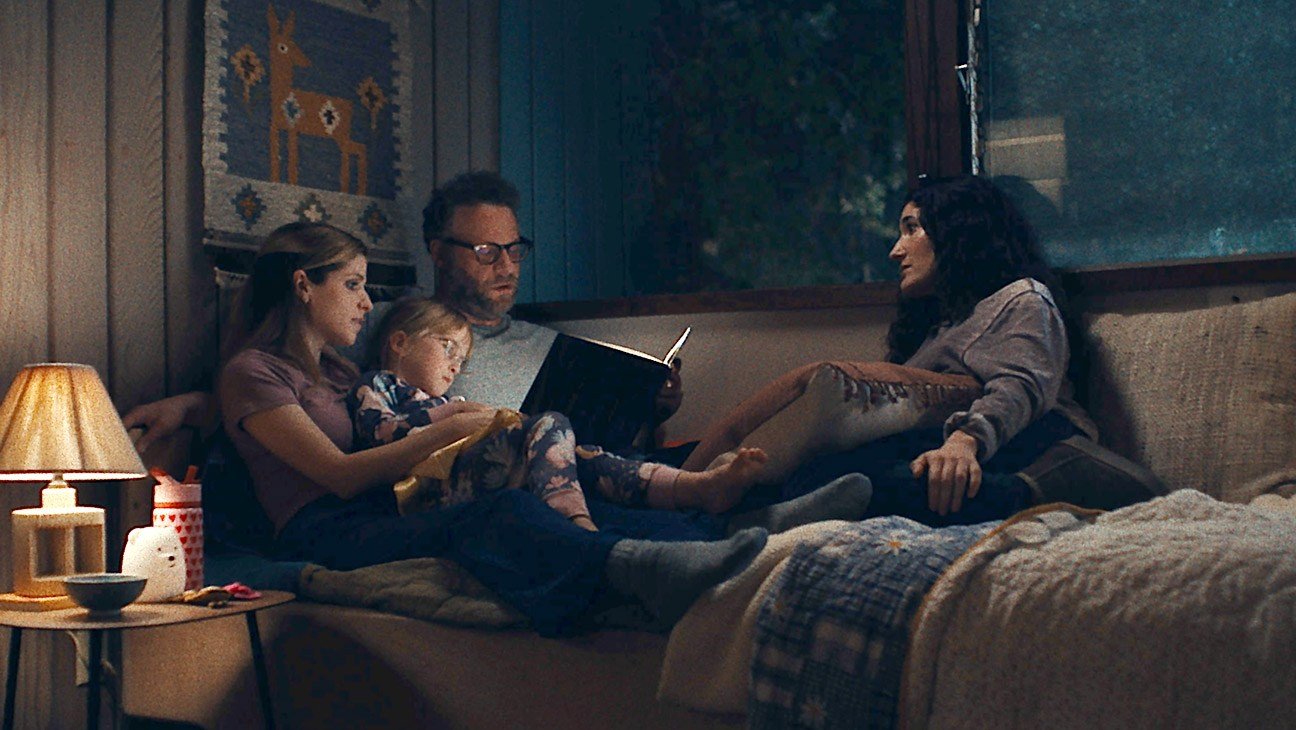
Directed and written by Lauren Miller Rogen, the comedy drama follows a husband (Seth) and wife (Anna Kendrick) who are questioning whether parenthood is the right path for them. For married couple Seth and Lauren, the film was a deeply personal project that reflected their own journey toward a child-free life.
“ I think this movie is much more personal and much more reflective of my actual experiences,” Seth said at The Hollywood Reporter’s Studio at 1 Hotel during TIFF, presented by sponsor Canada Goose, on Saturday. “I think Lauren has really made a very honest film in regards to her thought process and our thought process as a couple. When I look at it, it’s shocking how personal it is, honestly, and about very personal things in our lives. But, to me, it’s very brave to put yourself out there like that and to write about the things that are kind of the most personal things.”
Lauren was first inspired to make the film when her friend, a divorced mother of one, moved in with the couple for one year about a decade ago. The director initially thought the experience would make for a great television series (“That’s an interesting setup for a TV show. People who don’t know if they want to have kids, has someone move in with a kid”) but the idea didn’t go anywhere, in part because Lauren wasn’t sure how her own story was going to end.
“I didn’t know the ending at that point,” Lauren told THR. “I think once we had the kajillion conversations and done all the work and sort of found our own conclusion, then I was like, ‘Oh, now it’s a movie because I know the ending of it.’ I really started working on it as a movie not that long ago. I wrote the script pretty fast in January of 2025; it was done in the spring and we were shooting the next fall.”
In Babies, happily married couple Annie and Aaron (named after Lauren and Seth’s middle names) welcome their friend (Kate Berlant) and her young daughter to stay with them after she separates from her husband. The couple get a chance to see the realities of parenthood up close, while Annie navigates her mother’s battle with Alzheimer’s disease (Lauren’s own mother died from complications of early onset Alzheimer’s disease in 2020).
Anna Kendrick, who stars as Annie, joked that being that open about her own life on screen would cause her to have a “dissociative experience.”
“I don’t know how [Lauren] did it because some of it felt so close to reality and so intense. I was like, ‘I think I’d be setting myself on fire on set,’” Kendrick said with a laugh.
For Seth, Babies also reflects people’s attitudes about parenthood — including the usage of the phrase “dad duty,” which he finds “obnoxious” — and his friend’s experiences being a parent.
“A lot of these are conversations we’ve had with our friends in real life,” Seth shared. “We hang out with our friends and their kids a lot. An interesting perspective the film has, is that, you can like kids and be good with kids, and be very responsible people, and be in a very happy marriage, and tick every box that one would think you need to tick in order to be the perfect parent in many ways, and you could still just maybe not really want it. That’s a very under-shared perspective in a lot of ways.”
Babies explores the decision to remain child-free, but Lauren wants audiences to know the movie was also made for “people who are choosing parenthood.”
“We’ve been around our friends who have had beautiful families. We have amazing relationships with their kids,” Lauren concluded. “I think that it was about not just making [Babies] feel real and grounded to us, but also sort of honoring [what] we’ve witnessed so many times, and how beautiful that relationship is.”
Babies premiered at TIFF on Saturday and is scheduled to hit theaters in 2027.
As the legal battle over the $110 billion Paramount Skydance–Warner Bros. Discovery merger drags on, a coalition of state attorneys general is fighting to block the sale on antitrust grounds — and the buyer is threatening to leave California if the lawsuit succeeds. A leaked report now puts a number on the fallout: As many as 58,000 lost jobs and up to $21 billion a year in losses for California.
The report — from the Los Angeles Economic Development Corporation’s Institute for Applied Economics, commissioned by Paramount itself — was leaked Saturday by Politico and lays out grim numbers for the motion picture industry. Leadership at Paramount-Skydance is negotiating with the gaggle of AGs, led by California’s Rob Bonta, and racing against an Oct. 1 deadline: If the merger hasn’t closed by then, the deal’s “ticking fee” kicks in, paying Warner Bros. Discovery shareholders $7 million a day. Paramount’s threat to relocate the studio to Georgia, Tennessee or Texas has been one of its central negotiating tactics — and has drawn uproar across the industry.
The new report quantifies just how much California stands to lose. It finds the state “would experience the permanent loss of approximately 28,990 to 57,980 full-time job-years statewide across all industries, and losses of between $10.6 billion and $21.2 billion annually in economic output.”
But Paramount’s post-merger commitment to produce 30 features a year for three years would generate an estimated 1,020 to 2,760 job-years in California, and between $377.7 million and $1.01 billion in economic output between Oct. 1 and Sept. 30, 2031. The totals reflects between 340 and 920 job-years and between $125.9 million and $337.2 million in statewide output every year for three years.
The estimated job losses include direct, indirect and induced jobs — accounting for ripple effects through Paramount’s California supply chains and the broader economic activity tied to household spending. In other words, the total reflects job losses across all industries, not just film and TV.
An added blow would come from converting Warner Bros.’ soundstages to commercial or residential property, which the report says would “permanently strip” California of infrastructure built over a century — infrastructure that supports the vendors, crews and post-production facilities built up around it.
California remains the world’s fourth-largest global economy, with a nominal gross domestic product of about $4.1 trillion to $4.4 trillion. If Paramount were to exit, the report states, the best-case scenario would see the company slow-walk its departure as it reduces its spending in California. But the worst-case scenario would involve Paramount “substantially or entirely” relocating to another state, which would tank the state’s economy in terms of tax revenues.
U.S. District Judge Araceli Martinez-Olguin has set a Sept. 24 hearing to consider Paramount’s $1.88 billion bond request of the 12 states and the Writers Guild of America, which is also suing to block the merger. The studio made the bond requests as security to cover losses it would incur if the deal is not completed until after the trial.
If the parties do not settle ongoing negotiations, both are moving toward a March 2027 trial date.
Mahershala Ali and filmmaker Bassam Tariq were all set to make Blade, a Marvel film centered on the titular anti-hero, when the project spectacularly fell apart before being removed from Disney’s line-up in 2024.
The project, which Ali officially walked away from in July, left him prepared and ready to perform action on-screen. Luckily, the connection he formed with Tariq laid the groundwork for their new film, Your Mother, Your Mother, Your Mother, which allowed Ali to show the physicality he has been perfecting for years.
“I think [the movie] spoke to me so deeply,” Ali said at The Hollywood Reporter’s Studio at 1 Hotel during TIFF, presented by sponsor Canada Goose. “It offered up an opportunity to engage and commit to the type of difficult I want to commit to because this work is gonna be hard regardless — whether you’re in a good film or a bad film. [The film] was something that was very exciting to me. It asked all of us to go very deep emotionally, but it also checked sort of an action, movement, physicality box for me that I had been really yearning to really invest energy in.”
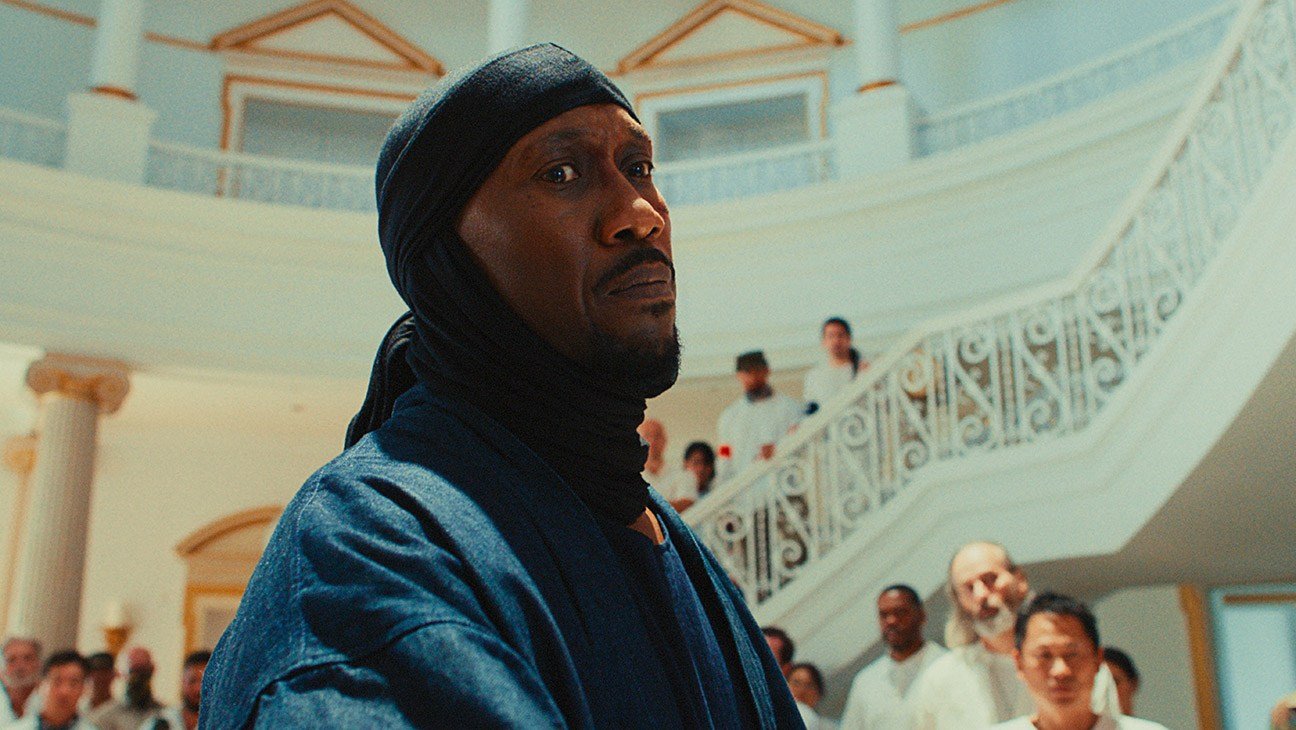
In Your Mother, Your Mother, Your Mother, Ali starsas Latif, a devout Muslim and contract killer who travels across Houston in an effort to protect his three children following the death of his wife. He is confronted with a series of dangerous obstacles, including John Cho’s Haun Yoon, an Army veteran and militant church leader who is determined to destroy what he deems are great evils.
The action film was partly inspired by Tariq’s experience as a new father and “ not feeling like you’re enough as a provider,” the director told THR. Ali said that he was struck by Tariq’s vision when he first read the script.
“Sometimes, you read things and energy starts going off,” Ali said. “It just resonates in a way where you feel called to it — almost as if you don’t even have a choice. You just know that when you read certain things. If anything, it was just more of me having questions about how Bassam was gonna stitch very different worlds together. … You just had to dive in and trust. He is an amazing filmmaker and he was able to, in my humble opinion, stitch that world together in such a fascinating way.”
Ali is also set to star in the season two of HBO’s action-packed series Task, which began filming in July. The Oscar winner said that Emmy-nominated show allowed him to expand on the action techniques he wanted to perform on screen.
“ I’ll just say that there is some physical work in that as well,” Ali teased. “It’s challenging in a very different way, but I’m getting through it.”
Your Mother, Your Mother, Your Mother premiered Sept. 12 at TIFF before being released by Amazon MGM.
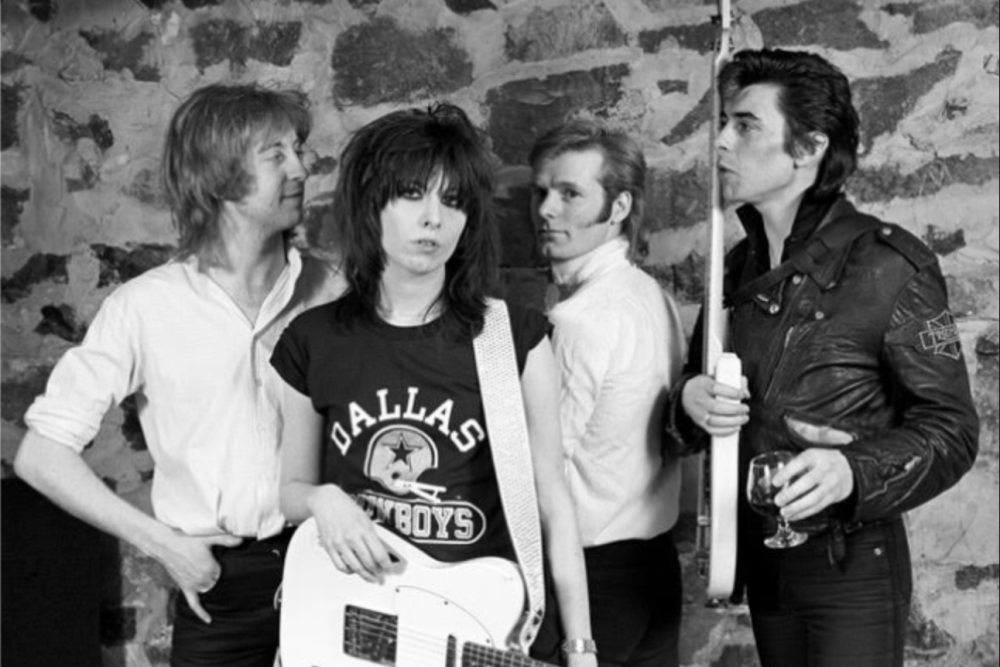
At this late date, what the Pretenders accomplished is no mystery achievement. But it’s also a story that has never been extensively chronicled on film until “The Pretenders,” a Joss Crowley-directed doc that premieres Sunday at the Toronto International Film Festival. The band released what might rightly be considered the best rock ‘n’ roll debut album of all time in Janauary 1980, and Crowley’s film covers the lead-up to that — Chrissie Hynde looking and acting like a biker chick in late ’70s Akron before moving to and finding her real gang in the U.K. — and the tumultuous few years that followed, with further masterpieces arriving alongside band dismisals and deaths. Although the focus is on the original lineup and the first five years, it brings us into the present day of Hynde, still one of the greatest to ever pick up a guitar.
As delightfully plain-spoken as Hynde is when you get her to sit down and talk, she can be to get into that chair, as a naturally camera-shy personality, so Crowley’s film is particularly useful in further immortalizing a subject who never wanted to be anything more than an ordinary musician, whether “rock goddess” was quickly and eternally thrust upon her or not.
Variety spoke with Crowley and the delightfully tart-as-ever Hynde in advance of the Toronto premiere.
Most of the time with modern music documentaries, it’s the artist or their company instigating the doc, and usually co-producing it. But it sounds like that’s not necessarily what happened this time because, Joss, you’ve talked about the difficulty in talking Chrissie into it.
Joss Crowley: I’ve been trying to work with Chrissie and tell the Pretenders’ story for over 10 years, and kept knocking at the door; didn’t get an answer. It was just a question of right time, right place, and Chrissie came round to the idea of meeting me. We sat down and talked about some of the docs I’ve made, and about other things, trying to find some mutual interests. I wasn’t really sure when I left that meeting how it had gone, but within about a week, we sat down and recorded our first interview, at the end of 2023.
Chrissie, you needed less than a week to think about it and get underway after that first meeting?
Chrissie Hynde: Well, we had to have a go and see how it would go, and I think I must have laid down some sort of ground rules, so I was willing to go into it — that it would be (visually focused on) archive footage, and really talk about the band and not focus too much on me, and it wouldn’t be about “women in rock” or any of that kind of thing. It would just be a story of the band. I was kind of keen to have it done because, as we all know, there’s documentaries on everything and everyone now. And in fact, someone else had already made a documentary on the Pretenders, which had nothing to do with me or my entire organization. I was starting to get calls from some of my old friends saying, “Oh, I’m gonna do your documentary on Tuesday.” And I’d be like, “We’re not doing a documentary!” This other team had gone in to people I know and made it sound like it was an official documentary. So I thought, “Well, if that’s happened once, that’s gonna happen again.” Either you want to do it and you want your story out, or you don’t, which I didn’t particularly, but if it’s going to be out, I’d rather know that it’s true.
Chrissie Hynde in ‘The Pretenders’
Courtesy TIFF
At the very end of the film, you’re heard talking a little bit about why you did it and you mention that you especially wanted to do it for James Honeyman-Scott [who suddenly died at the height of the band’s success in 1981], in some way.
Hynde: For me, a rock band is all about electric guitar, and I think he was one of the great guitar heroes. Over the years when I see lists of the greatest 100 rock guitar players, I never see Jimmy’s name. That’s all he was interested in, music and playing the guitar, and I thought he didn’t get his due and that would be important for him. He’s not here, so I thought I could do it for him.
It feels like the way the documentary turned out was kind a nice compromise in the end, since you didn’t want to be on-camera at all, but you were talked into being seen for the very last interview, so there’s a little bit but not a lot. You acquiesced a little bit.
Hynde: Yeah. I haven’t seen it, and I probably won’t. Someone said, “Oh, don’t say that! That sounds negative.” But I think a lot of people don’t like watching themself or listening to themself talk, and I don’t have to watch it, and there you go. It’s not negative. I mean, I’ve already lived through it, so I don’t think I wanna go through it all again.
I think so many people feel this way, and most people that I’ve ever had a conversation about it with do: they don’t like the sound of their speaking voice. I mean, I’ve had to get used to my singing voice because, you know, that’s kind of my shtick. But my speaking voice, when I hear it back, I’m always pretty horrified. And everyone I talk to feels the same way… People expect if you do it for a living, that you must like it, but that’s not necessarily true.
One of your quotes in here is, “I like being in a band, I just don’t like being observed. It’s a real problem.” A lot of people will relate to that, wanting to have a voice — figuratively — while not liking the attention that comes with it.
Hynde: I think so, because I think I represent just ordinary people, and that’s how I feel and that’s how I go through my life. You know, I get the public transport. I don’t live in a gated community. I’m just exactly the same way I always was, and I don’t want that taken away from me. I like hanging out. I’d rather sit on a doorstep and eat a slice of pizza than go to a fancy restaurant. I’ve always been like that, but I think most people are.
It has become more common in documentaries to have the subjects entirely off-screen. I was recently watching Paul McCartney’s Wings documentary, and his interviews in it are all audio-only, which is great most of the time. But at the same time you’re kind of like, “Well, just show him to me for 10 seconds.”
Hynde: Are you talking about “Man on the Run”? I loved that. In fact, I watched it sitting next to Paul when it was screening. He was singing along! I guess he’s so used to seeing himself. It was very moving for me to see Linda in the early days, even before I met her, and how cool and how beautiful she was… We’ve seen so many documentaries, it’s a matter of kind of getting away from the format. But, certainly, archive footage — we were lucky to have any for ours, because this was way before people had camera phones or were thinking much about taking photos.
Crowley: There was a big archive breakthrough when we found this cameraman, Andy Watt, who’s from Hereford, like the band really, and he joined the original band on tour about three months before Pete left and Jimmy died. [Bassist Pete Farndon was dismissed in1982 and died the following year; Honeyman-Scott died two days after Frandon’s firing.] He was able to document two weeks on the road in North America with the band, and that footage has never been seen. We found all 20 tapes of it, and they were in very poor condition and pretty much unusable, but fortunately we found a retired engineer who was able to bring them back to life. Another thing that really helped the device was doing the interviews with Stan, the old tour manager, who read his diaries aloud, and we could suddenly see Jimmy and Pete in and around the band in the period where we focused the story, which is those five years between the end of the ’70s and the early ’80s.
You start the movie with Stan Tippins, now an elder gent, reading these diaries for the camera. It seems like his participatino was really, no pun intended, a tipping point.
Hynde: I’d love to see that stuff, with the Stan diaries. All the time that we were with Stan, he often mentioned, “Now I’m gonna go write my diary,” but no one ever saw them. Joss and I had dinner with Stan and Lynne Honeyman-Scott, Jimmy’s sister, and (original drummer) Martin Chambers, and it never even occurred to me that Stan would be willing to be actually filmed, reading his diaries. I’m dying to see all that part, so maybe I will have to watch it at some point. Stan was so important in the early band. He was our scout leader or something. We were new at this, and he had been a singer in Mott the Hoople [prior to Ian Hunter]. We loved him, because was like having a farmer in a band. He would say things like, “I don’t know why you would wanna take drugs when you could have a nice, juicy pear.” I suppose you could say we were laughing behind his back, but he was the wise man of the operation.
When it came to your interviews, Chrissie, there ae some topics that are tricky or touchy, inevitably. It’s clear on camera when you are willing to get into something and when you aren’t. Joss asks you about Ray Davies, and you say, “I’d rather not get into it. There’s a lawsuit waiting to happen.” But it’s cool that we at least see you address not wanting to discuss something, whereas a lot of docs would just leave that out. And then, of course, you do get into a lot of tough stuff with the early ’80s with everything that happened with the band. Was it cathartic in any way to talk about the hard times of the band, or is it always just difficult?
Hynde: First of all, talking about, for example, Ray Davies — I mean, anything with him or with anyone in my family — I don’t think it’s right to talk about other people because it’s an invasion of their privacy. I’ve never done that, and I don’t think that’s a very dignified thing to do. If people ask me, “Oh, are your kids musical?” I say, “Well, if you ever meet them, you ask them. I don’t wanna talk about it.” Not because I don’t love them, but because this is kind of an invasion of their privacy. And I’ve never talked to any journalist and given a list of things that they’re not allowed to ask. Because if I don’t wanna talk about it, then I can say, “Let’s not talk about it.” But not for any other reason than that. Because certainly as a Kinks fan, I mean, who doesn’t wanna talk about Ray Davies? He’s fucking amazing. But I just don’t do that.
I can’t remember what Joss asked me about the grisly stuff in the ’80s, because I haven’t revisited that. But the other thing is, when you have a story that’s in public or when you become famous or whatever, your story isn’t that much more interesting than just an ordinary person’s. I mean, nobody hasn’t had bereavements and fuck-ups and disappointments and victories, and all these things that happen in a person’s life. I think there’s too much emphasis on the extraordinary life of celebrities.
You’ve been clear from the beginning of your career up till now that you never wanted to be a poster girl or an emblem or spokesperson for anything.
Hynde: Being in a rock band… I mean, who didn’t wanna be in a rock band? Did you wanna be in a rock band?
Of course.
Hynde: Are you now?
No, sadly.
Hynde: But you wanted to be. So, I’ve offered some music, and that’s all I’m offering. Everyone that I grew up with wanted to be in a rock band. That was my generation. We were all very ordinary kids. People didn’t get into bands to become celebrities. They just wanted to be in a band. I’ve never graduated beyond that initial interest in it.
Surely you’ve grown in a thousand ways since the band’s early days, but the film kind of presents you as somebody who sort of had either a certain idealism or just a basic attitude about certain things and stuck to it.
Hynde: I also had some great people that I’ve met in my life who were inspirational. Lemmy never changed. Lemmy was always the same. and that’s kind of been my motto. That’s why I don’t do fashion magazines. Well, there’s many reasons I don’t! But I always think, “Well, if you wouldn’t ask Lemmy to do it, don’t ask me.” Because he’s kind of, I suppose you could say, my style icon, if there is such a thing in the case of someone who was in Motörhead.
Neil Young’s another. He’s never changed. You might not have ever met him, but anyone who’s listened to his music, you have met him. He’s exactly what you think he’s going to be. Bob Dylan, I mean, ia obviously more of an enigma, because he’s a little bit more of a trickster and a comedian. But he offered the world all that music and I’m not sure that he got into it to be the spokesman of his generation, which was the mantle that he had to carry. And in the case of Willie Nelson, Neil Young, Bob… First name basis, did you get that? [Laughs.] Paul McCartney’s the best example because he was in the fucking Beatles, and yet he’s still doing exactly what he was doing. If his band hadn’t made it that big, I reckon if he was still in Liverpool and he got married and had some kids, he’d probably still be playing in a band in a local bar somewhere, because that’s what he likes.
Joss, is there any way to put in a nutshell what you wanted to capture about Chrissie in this film? And did it change at all as you spent so many hours with her?
Crowley: To answer the first question, it’s the story of the Pretenders, which I know is obviously very much about Chrissie, but also about the rest of the band. But with Chrissie, I because I spent so many hours with her, I just wanted to make sure her personality came across in the film. Because I think that’s what documentary does perhaps better than any other medium, is that it brings personality to the screen. And so if it felt awkward at times, that’s OK. When it was successful, great. When the band was successful, great. And everything in between, and when it was emotional and sad, it had to be there. We were talking about voices earlier on, and I’ve had to get used to hearing my voice a bit because it was important to hear questions that I put to Chrissie that she didn’t want to answer, or at least didn’t want to answer initially and then came round to answering later on. Because that, I think, tells you as much about Chrissie as a perfectly articulated answer. So that was something I guess I warmed up to, the idea of keeping my questions in, which I haven’t done in previous documentaries. That was a good way to unlocking a bit more about who Chrissie is.
The other question: in terms of hours, we would meet monthly, for a few hours…
Hynde: Seems like most of my life. No, Joss did prompt me, but mainly I just imagined a certain time, an event that happened, and I would just talk about it for an hour, and then have a few cups of tea and leave. And then he’d have to figure it out. Definitely the early sessions were much more like that, and as it evolved, it became a bit more interview-based, I suppose, and it had a different rhythm to it.
I didn’t want to ask my mates to sit down in front of a camera, because I find it uncomfortable, so I thought, “Well, why would I expect them to do it?” So I made a real point of just having talk over {i.e., audio-only interview]. But then you have to think about, if you’re on stage, what are you prepared to do? But then you also have to think about the audience: What do they want? And I’ve been in the audience as much as I’ve been on stage, if not more. I know the audience wants a certain thing. And [for a documentary] I know the audience wants to see people sitting down talking to camera. I know I want to see that.
Crowley: There were two things that Chrissie said to me early on in the process. She said, “Make it good, and make it different.” And I think we’ve achieved that. But you can’t make something different for the sake of it being different. It has to work for the story that the film tells. And Chrissie doesn’t like cameras. Chrissie doesn’t like having her photograph taken. It was really hard to find archive as well because lots of times cameramen or camera crews weren’t allowed access to the band. It was hard on a lot of levels. So the fact that I managed to to convince Chrissie to go on camera for the final interview, it just sort of works. I think it’s an achievement of the film and also a reflection of how much she doesn’t want to be on camera all the time.
You probably did get much more intimate stuff by allowing her to just speak into a microphone. And we get to luxuriate in the sound of her voice as she’s digging deep on some of that stuff…
Hynde: Oh, God, when you said “luxuriate in the sound of her voice,” I’m cringing.
You often say you don’t like to be a symbol of anything, but is anything you represent to the public that you kind of allow for yourself as being OK?
Hynde: Well, of course I like being a sex symbol, but…
Glad you brought that up, because that was something that struck me watching the movie — that to some people you were and are a sex symbol, and at the same time, there is Shirley Manson talking about how what you got out of it was loving seeing you be androgynous, so…
Hynde: I was being facetious! [About being a sex symbol.] I’m just, you know… I’m a man of the people.
One thing that hasn’t changed that you represent: being against rock turning completely consumerist. Every time I see a music star doing a product commercial, I think of your song “How Much Did You Get for Your Soul?”
Hynde: Yeah. They’re all at it, aren’t they? Well, you know, fuck ’em.
Joss, do you have a favorite moment in the movie?
Crowley: Favorite part of the production of making the film, I guess, was when Stan opened his diaries for the first time, and he found the first time he met Chrissie in rehearsals, because it was such a breakthrough for me. I think he summed up quite a lot about, about Chrissie and the band in a few words. Do you know the bit I’m talking about? I can’t remember exactly what he says, but it’s something like, “She has quite a lot of fun, but underneath she might be a bit nervous.”
Hynde: Oh, God, I hate to think what’s in those diaries. Fuck me. But we love Stan, so there you go.
Chrissie, we can’t ask you if you have a favorite moment in the movie…
Hynde: I saw my manager, Ian Grenfell, yesterday and I said, “Hey, is this gonna come across really negative if I say I haven’t watched it?” And he goes, “Don’t worry about it, because that horse has bolted. People already know [to expect] you haven’t watched it. And a lot of people do not watch their documentaries.” So I was relieved that I don’t have to tough it out… I’ve been very inspired in the last couple of days, seeing Noel and Liam (Gallagher, from Oasis) out there. They’ve got a documentary out and they’re on the front line going for it. But I just don’t have that kind of drive.
I’m sure you’ll be in Toronto, Joss. Are you going, Chrissie, or will you be avoiding the premiere?
Hynde: Yeah, I am going. And then Martin’s going. It’s gonna be me and Martin there on the red carpet, so that should be… Well, it won’t be a beauty contest.
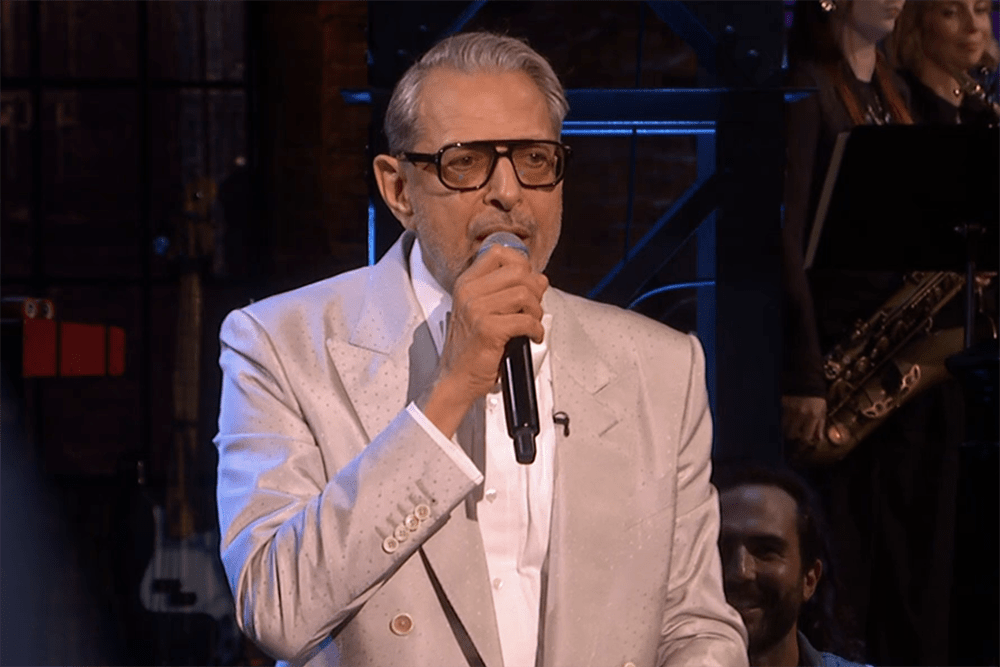
Jeff Goldblum kicked off his hosting duties on “Saturday Night Live U.K.” by employing his musical skills in a jazzy number about spending time in London.
“Can you believe this is Saturday night, first of all?” Goldblum asked the live audience after making his grand entrance. “And me, I’m hosting this gosh darn ‘SNL U.K.’ triumphant second season first episode! So, for the occasion, may we perform something we’ve just composed special for you tonight?”
The American actor, who has his own jazz band in addition to starring in franchises like “Wicked” and “Jurassic Park,” then took a seat behind the piano and began to sing a tune chock-full of U.K. references. “I’m hoping to be your precise cup of tea and that you’ll like me more than Nando’s or Marmite,” Goldblum sang. “Even if I still bomb, I will keep calm and carry on because I’m hosting from London tonight.”
Goldblum danced around the stage and even made a reference to his “Wicked” role, singing: “Despite a few wicked flaws, I am the Wizard of Oz!”
Musical guest CMAT then came out to help Goldblum with the lyrics, holding cue cards that read “Life Finds a Way,” in reference to his famous “Jurassic Park” line. “I don’t recognize it,” Goldblum said — but then the band begin to play the “Jurassic Park” theme and he remembered who he was. “I get it now, I can do it!”
“Life finds a way, when you’re live on Saturday,” he concluded with a big finish. “Like Sainsbury’s Local, we’re all feeling vocal. And I’m hosting right here, in London tonight!”
U.S. President Donald Trump’s new hairstyle was heavily mocked in “Saturday Night Live U.K.’s” Weekend Update segment.
“This week, President Trump stepped off Air Force One sporting a different hair color,” quipped co-anchor Ania Magliano. “He appears to be trialling a new shade of brown. Or, he’s shat his head.”
“People are questioning, does the carpet still match the drapes?” added Paddy Young. “I wouldn’t know, that’s between the president and the punchline that just a second ago was taken from me by our legal team. Thank you, legal team, it was almost funny.” It’s unclear whether this moment was a joke, or whether the legal department actually did intervene.
Elsewhere, Prince George’s first day at the prestigious Eton College was imbued with some dark humor. “How will he survive being stuck in a place famous for producing sexual abusers? By leaving it and going to Eton College,” Magliano said to “ooo”s from the audience.
Recent anti-migrant protests taking place in the U.K. were also under the microscope, including that of far-right activist Danny Tommo. “On Saturday, members of Tommo’s group Patriot Platform yelled obscenities, threw stones, spat and then said goodbye to their families and headed to the protest,” Magliano joked.
“Who is this Danny Tommo?” responded Young. “Before launching Patriot Platform he is reported to have tried his luck as both a bricklayer and a web designer. However, neither worked out as he had the physique of a web designer and a mind of a brick.”
The first episode of “SNL U.K.” Season 2 was hosted by Jeff Goldblum.
CA7RIEL & Paco Amoroso are on their Free Spirits World Tour until November, but they’ll be hitting the state again in 2027 for one of the biggest milestones of their career. On Thursday, Harry Styles dropped the dates for his Together, Together 2027 tour, and fans quickly noticed the Argentine duo’s name.
CA7RIEL and Paco Amoroso are one of the most unique acts in music right now
Styles will be in six cities on the North American leg of the global stadium tour before heading to Europe. CA7RIEL & Paco Amoroso will be joining them on April 9 and April 10 for their shows in Dallas, Texas, at AT&T Stadium.
The duo met in first grade after sitting next to eachother by chance
The duo, often mistaken for brothers due to their shared surname, consists of Catriel Guerreiro (aka Ca7riel) and Ulises Guerriero (aka Paco Amoroso). They met way back in primary school when they were six.
Catriel said in an interview with Arte that they sat next to each other. “It was first grade. Just one of those f***ing coincidences in life; we ended up sitting next to each other,” he explained.
Since the beginning, people thought they were siblings, and they started trolling together immediately. “The teacher was taking attendance and said, ‘Okay, Ulises Guerriero?’ He raised his hand. ‘Catriel Guerreiro.’ I raised my hand. “Oh, are you brothers?” she asked. And we said yes,” he said.
CA7RIEL & Paco Amoroso performs on stage at Movistar Arena on May 28, 2025 in Madrid, Spain
They sat in music workshops together, one strumming guitar, the other violin, eventually forming a rock band called Astor y las Flores de Marte in 2010. They officially became a duo in 2018, shifting into the experimental-trap/funk/hip-hop/pop world, and are among the first wave of Urban musicians in Argentina.
Now, they’ve practically become blood. “We’re not brothers, but we’re basically brothers,” Catriel told Arte.
They dropped their debut studio album, Baño María, in April 2024. But everything changed when they lit up the international scene with their viral Tiny Desk session, released on October 4, 2024, which has garnered over 55 million views at the time of this publication.
Riding the wave of success, they went on tour, opened for Kendrick Lamar, and have played at the world’s biggest music festivals, venues, and stadiums.
The artists won 5 Latin GRAMMYS
In 2025, they were the stars of the show at the Latin GRAMMYS. Tied with Mexican legend Edgar Barrera for the second most nominations after Bad Bunny, they won 5 awards at the Latin GRAMMY Premiere Ceremony: Best Alternative Song, Best Long Form Music Video, Best Alternative Music Album, Best Short Form Music Video, and Best Pop Song. They also made out.
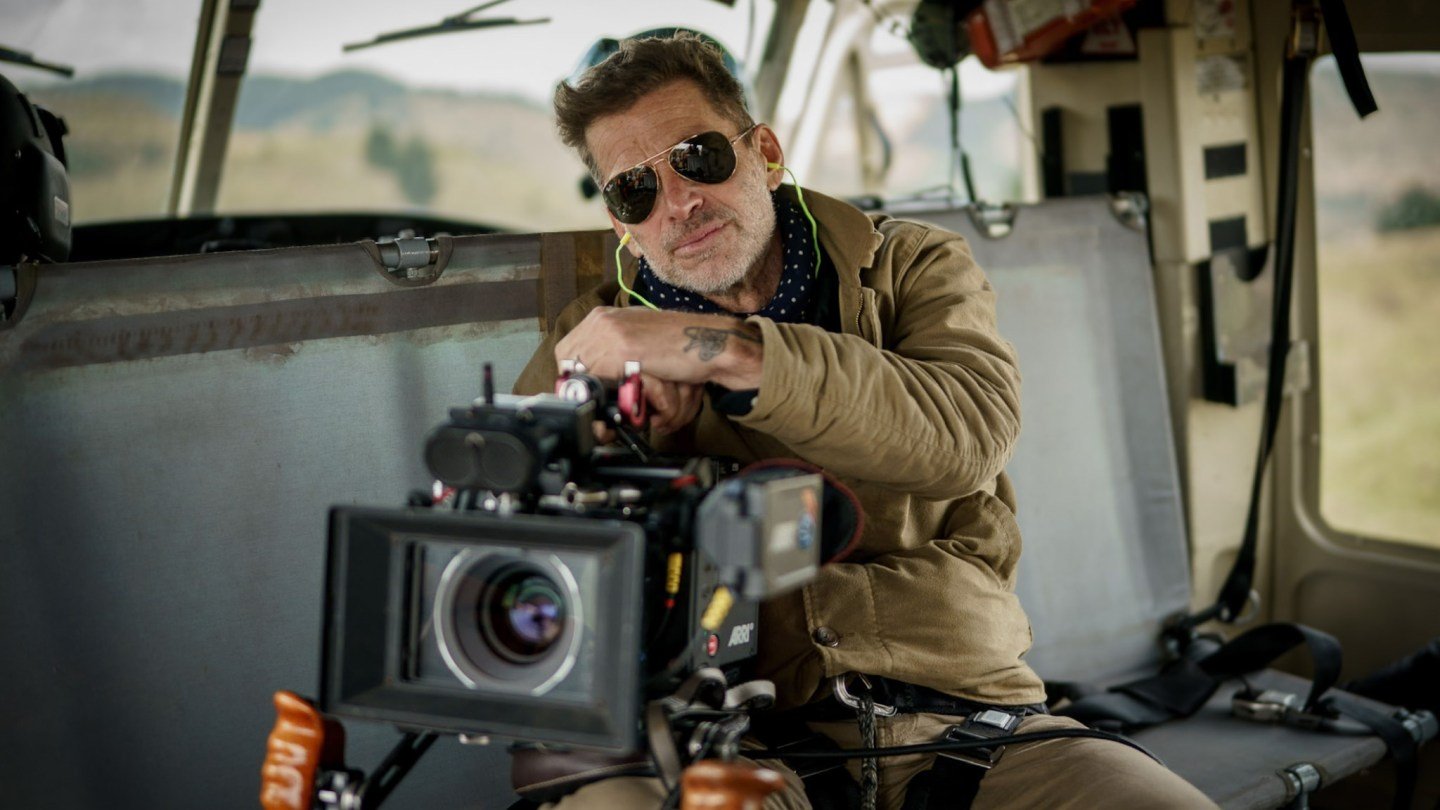
Zack Snyder sat in the back of a cramped, beat-up van, drenched in sweat. Perspiration waterfalled down his face. His back was soaked. He was on the verge of passing out.
It could have been the triple-digit jungle heat. He was in the southern reaches of Colombia after all. It could have been from the triple-digit degree fever that he didn’t know he had. (He would later find out he contracted COVID.) But he had a camera on his shoulder and what he did know was that he could not afford to stop shooting the scenes he needed to get that day. He was in the middle of finally making his passion project, The Last Photograph, and he was both director and cameraman. The movie was figuratively and literally on his shoulders.
When he returned to Leticia, Colombia’s southernmost city that sits on the Amazon River, a woman offered a trembling Snyder cough drops. “Halls is the answer?!” he thought to himself. “OK, fine. Fuck it.”
When I ask him if he tried wearing a mask, Snyder scoffs, “There are no masks in the Amazon. They don’t… there’s no masks. That’s hilarious.”
It’s now just under a year later. Snyder is sitting in his sleek, modern, aerie office high in the hills of Pasadena, prepping to go to the Toronto International Film Festival where Last Photograph will premiere Sunday. The score from Escape from New York is playing on a record player, adding mood to a day that surprisingly becomes rainy.
It’s been a 20-year journey to make the movie and in that time, Snyder went from a commercials and video director to a big Hollywood studio director, to then directing some of the biggest-budgeted, most heavily scrutinized movies of the century, Warner Bros.’s DC movies of the 2010s. His journey still not done, he endured a personal tragedy and the loss of control of DC mega-movie Justice League, followed by the storied affair of the #SnyderCut, and then a return via a pair, or maybe a trio, depending on how you want to count, of Netflix movies, Army of the Dead and the two-part Rebel Moon.
But Last Photograph saw Snyder working in a way he has never been before: As an independent filmmaker. There is no studio or streamer backing him. The scale is small, the budget smaller than some of the commercials he worked on earlier in his career.
“There’s no agenda to the movie. When you make a big studio movie, there’s a lot of things to consider about the product that you’re creating. Because it really is like a product much more than a thing that’s really a tone poem, you know what I mean?” he says.
He continues, “Like, the stakes are lower, right? You’re not trying to sell the audience something. You’re just giving them an experience and that experience doesn’t necessarily have to end with a sequel. I’m not trying to get them to go to another movie or buy a toy. The why of the movie is completely different.”
Making Last Photograph, he says, “was really singular and intimate and that was cathartic for me, to get the experience of making a movie that was really just true to itself and owed nothing but to the moments that we were trying to create.”
Snyder filming The Last Photograph in Colombia.
Daniel Billington
The story is set in an unnamed South American country and follows a heroin-addled war photographer who is the surviving witness to a mass murder that included a diplomat and his wife. When the diplomat’s brother shows up, the two men find themselves on a journey that takes them further and further away from the city and civilization, in search of the family’s kidnapped children. There is almost a mist-shrouded Knights of the Round Table searching for the Holy Grail quality at times, with the pair looking for their own Grail that can heal them.
Last Photograph began life as more of a spy or war thriller, but it was always a two-hander. At one point, it had A-listers like Sean Penn and Christian Bale attached to star, when it was set up at Warner Bros., Snyder’s once-longtime production home. But after the suicide of his daughter Autumn in 2017, however, and in the years after leaving the studio, Snyder began approaching the material differently.
“Yes, the framing is very similar and the events are similar, but what it became was a meditation on death and redemption,” he explains, “And, for me, about how people see the world in different ways.”
Snyder acquired the rights to Last Photograph back from Warners (the studio let it go after it was clear Snyder would not be taking it to a competitor). Unshackled from a studio, and with a limited budget, he assembled a small crew, marshaling his longtime partners — wife and producing partner Deborah Snyder and executive Wesley Coller — along with Gianni Nunnari, the Italian producer with whom he worked on the 2007 adaptation of Frank Miller’s 300. For his leads, Snyder tapped Scottish actor Stuart Martin and Irish actor Fra Fee, both co-starred in Snyder’s Rebel Moon.
In Last Photograph, none of the well-worn Snyder hallmarks appear: no slow motion or green-screen shot. (There is, however, a commando raid where a helicopter gets blown up.) The movie is beautifully photographed and artfully composed. Snyder decided he wanted act as cinematographer, something he did when he was starting out and directing commercials and finally returned to with Army of the Dead.
“The budgets got bigger, the movies got bigger, and he would find himself further and further away from the camera,” says Deborah Snyder, who has produced her husband’s projects since first working with him on a Reebok commercial in the ’90s. With Snyder behind the camera, there was an intimacy to the shoot.
“It almost harkens back to his commercial and music video roots,” she says. “You have this smaller crew, but your visuals still look stunning. He knows how to make beautiful visuals, but you just don’t need all the bells and whistles, and all the people. You can move faster and shoot more. And I feel like that’s the evolution of him as a filmmaker.”
She adds, “When [the movies] got so big, you think you have more creative freedoms, but you actually have less, because you can’t move with agility.”
And agile Snyder was. It was a 32-day shoot, “the shortest by half of any movie I ever made,” he says. The crew averaged 40 set-ups a day.
“On our first day of shooting, I did 72 real camera [setups],” he says enthusiastically. “That’s insane. On Justice League, there were times when I did just four setups a day.”
Most of the movie is shot handheld, minus a dolly or two. Forget about any crane shots. Or a video village. Snyder remembers, “No trailers, no chairs, no nothing. It was just me and the camera, and literally a handful of people.” There was craft services, and the hotel everyone was staying in would offer live beetle grubs once a week for breakfast.
In our conversation, Snyder is energetic, bounding up and describing capturing a shot on the river against a setting sun. He reenacts shooting the commando raid and goes into detail about the process of using gas guns. And he talks about how Harvey Penick’s The Little Green Golf Book can also apply to filmmakers, especially the part about how you have to be good enough to give luck a chance. Luck and skill were on hand in the making of Last Photograph, even getting through the 100-plus degree fever.
“I really see in Zack a general,” says Nunnari, who recalls Snyder working through a sick wintery set in Montreal during the making of 300. “He knows he has to create something and he does it.”
Past the premiere of Last Photograph, Snyder is already putting the pieces in motion to return to IP filmmaking, currently puzzling over how to do a remake of the John Carpenter classic Escape from New York. (See, there was a reason why he had the movie’s record lying about.) The original, made in 1981, was set in a dystopian future in 1997. Snyder’s will also be set in 1997, a sort of futuristic period movie. The original captured his imagination as an impressionable 13-year-old Snyder and never let go.
“It is genre-defining and genre-defying at the same time because no one’s really been able to duplicate the kind of audacity that the movie has,” he notes.
He recently returned to Warner Bros for a special screening of one his favorite movies, John Boorman’s Excalibur. It was part of the private on the lot screening series led by studio heads Pam Abdy and Michael De Luca conduct. He was thrilled to be back — “I’m a huge fan of the vibes of that lot,” he says — and even subjected himself to an hour-long Q&A.
“There was some hard-hitting questions, too, like ‘What adversity have you faced in your career?’” Snyder thought about the irony of being asked this on the very studio lot where he lost his superhero universe. “I was like, ‘That’s a strange question to ask me in this room, but it’s cool.’”
One thing he has not fully returned to is watching DC movies. He has not, for example, watched James Gunn’s Superman.
“I just haven’t gotten around to it yet,” he says, letting out a little laugh. He quickly adds he is a supporter of Gunn’s and wants the DC division to do well.
Just as Last Photograph finds Snyder at his most contemplative, so too are his views on his DC legacy and the popularity of Marvel movies. Batman, Superman and Wonder Woman are the most popular and most recognized superheroes in the world, with the exception of Spider-Man. That should, theoretically, make them easier to sell to audiences.
In his view, Marvel has cracked the code on how to bend its characters into a very marketable way. He, on the other hand, was interested in what he believed was their inner and iconic core.
“[Marvel is] like an amusement park ride, right? The ups, the drops, the kind of cruising part, and then another drop. At the end, you’re like, ‘Wow, that was crazy, that was awesome.’ I had no interest in that. And you know, maybe that was a mistake. But I don’t think that way. I can’t do that. I’d rather just kind of talk about the mythology of them. And maybe that’s not as fun,” he muses.
Director Lan Hongchun’s plan was to make a small drama about the Chinese diaspora, then hope the audiences would connect with its tale of family, of love and loss.
Little did he know what he was in for.
Lan’s Dear You has this year been an unprecedented success in China and beyond. Made for around $2 million, the film has grossed around $300 million across its run on the Chinese mainland and then found impressive numbers as it rolled out across Asia — including Hong Kong, Singapore and Malaysia.
Audiences everywhere warmed to its tale of romance and sacrifice and have connected with the fact that is centered around families separated because of fate.
“Seeing such enthusiastic responses is deeply moving,” says the director. “To genuinely see that a story we carefully crafted has truly touched countless hearts and brought to light the family memories hidden within so many people — it makes all the creative effort worthwhile.”
Dear You comes to Toronto this week as part of the China Film Showcase of six features after being released across North America on September 4. The slate at TIFF will be screening from September 14-16 at the TIFF Lightbox, under the guidance of China Film Administration and being hosted by the China Film Co-production Corporation. It reflects a growing diversity in content emerging from China that industry watchers have tagged as a direct response to an audience that’s increasingly looking to be entertained by more than simply the blockbusters that first drove the market as it emerged as a global force around 15 years ago.
‘Dear You,’ courtesy of Blade Vista Public Relations
Courtesy of TIFF
Alongside Dear You’s quiet dramatics, the showcase features the likes of the comedy-drama The Lychee Road, set in the Tang Dynasty (618-907) and based on a successful novel about a lowly servant with big dreams. There’s also the inspiring coming-of-age drama Big World, which stars the former pop idol Jackson Yee in his breakthrough dramatic role as a boy born with cerebral palsy.
Lan — who’s previous films, such as 2022’s Back to Love, have also focused on China’s ethnic Teochew community — believes the success of these smaller-budgeted films has been driven in no small way by the way contemporary filmmakers are presented with information about movies.
“With the rise of internet recommendation algorithms, these small-scale, personalized, niche-story films can find more space,” says Lan. “It also gives more creators the chance to make small-budget stories that can more precisely reach their audiences. So I believe there are more opportunities for individualized narrative expression.”
The China Film Showcase comes to Toronto as the industry back home is increasingly making noise about a post-pandemic claw-back in revenue. While the Chinese government has thrown its weight behind the industry, the numbers over these past few months are cause for optimism.
‘Dear You,’ courtesy of Blade Vista Public Relations
By last month, China’s box office hit $3.57 billion, down 31.8 per cent from the same time last year. But state-run media last week noted summer office revenue was up from the same period in 2025 — marginally — to $1.84 billion from $1.78 billion, with admissions rising to 340 million from 321 million in 2025. Still way off the records for summer set in 2023 — close to $3 billion in revenue with 504 million admissions — but a welcome change, nonetheless, that media put down to “the quality and diversity of this year’s film slate” and as “a bright spot after several sluggish seasons.”
Lan believes his own film’s success was boosted by the resonance felt both in China and beyond. Dear You uses the cultural phenomenon of qiaopi — or letters or money sent home from overseas — as the foundation of his story. It traces the path of a young man (Wang Yantong) who travels to Thailand to find his grandfather, only to find the man’s story is not what he was led to believe.
Many families in modern China — especially among the Teochew community in which the film is set — have either first-hand experiences of, or have heard countless stories around the kitchen table about, the stresses and loneliness of immigration.
“It’s a story about migrating to Southeast Asia, and that phenomenon was a grand historical event across China’s southeastern coastal areas, involving millions of people and directly connected to many Chinese families in those regions,” explains the filmmaker. “So in China’s qiaoxiang [the hometowns of overseas Chinese], the story evokes strong resonance — audiences easily associated with their own ancestors’ experiences and naturally empathize with it.”
‘Dear You,’ courtesy of Blade Vista Public Relations
Adds Lan: “Many viewers, after watching the film, would voluntarily share their own family histories with us, saying that the story told in the film felt just like the past of their own grandparents and ancestors. In a sense, this film carries the shared memories of many Chinese families who migrated to Southeast Asia.”
The film has also continued a recent phenomenon in China of turning the places where it is either set or shot into tourist attractions — both domestic and international — much like other recent hits likw the sports comedy Pegasus 3 (shot in Delingha) and the comedy Her Story (Shanghai).
“It has significantly boosted the visibility and popularity of the Chaoshan region,” says Lan. “In the past two to three months, there has also been a noticeable increase in overseas Chinese returning to China to reunite with their families, and online you can see many real stories of overseas Chinese descendants coming back to Chaoshan to trace their roots and successfully finding their relatives. The film has spurred a tourism boom in Chaoshan, with visitor numbers surging in recent months.”
Dear You has also already proved a hit on the international festival circuit — before arriving at TIFF it closed the New York Asian Film Festival to much acclaim.
Says Lan: “The biggest feeling I get is still surprise. And also a fuller confidence in what I have always insisted on — earnestly portraying individual destinies and sincerely sharing my own life experiences. Screening at festivals and receiving recognition and encouragement from many jurors has proven that our creative approach is not wrong. It makes us more determined to continue on the same path we’ve been taking.”
 © Getty
 © Getty
 © Redferns
 © Getty
 © Getty