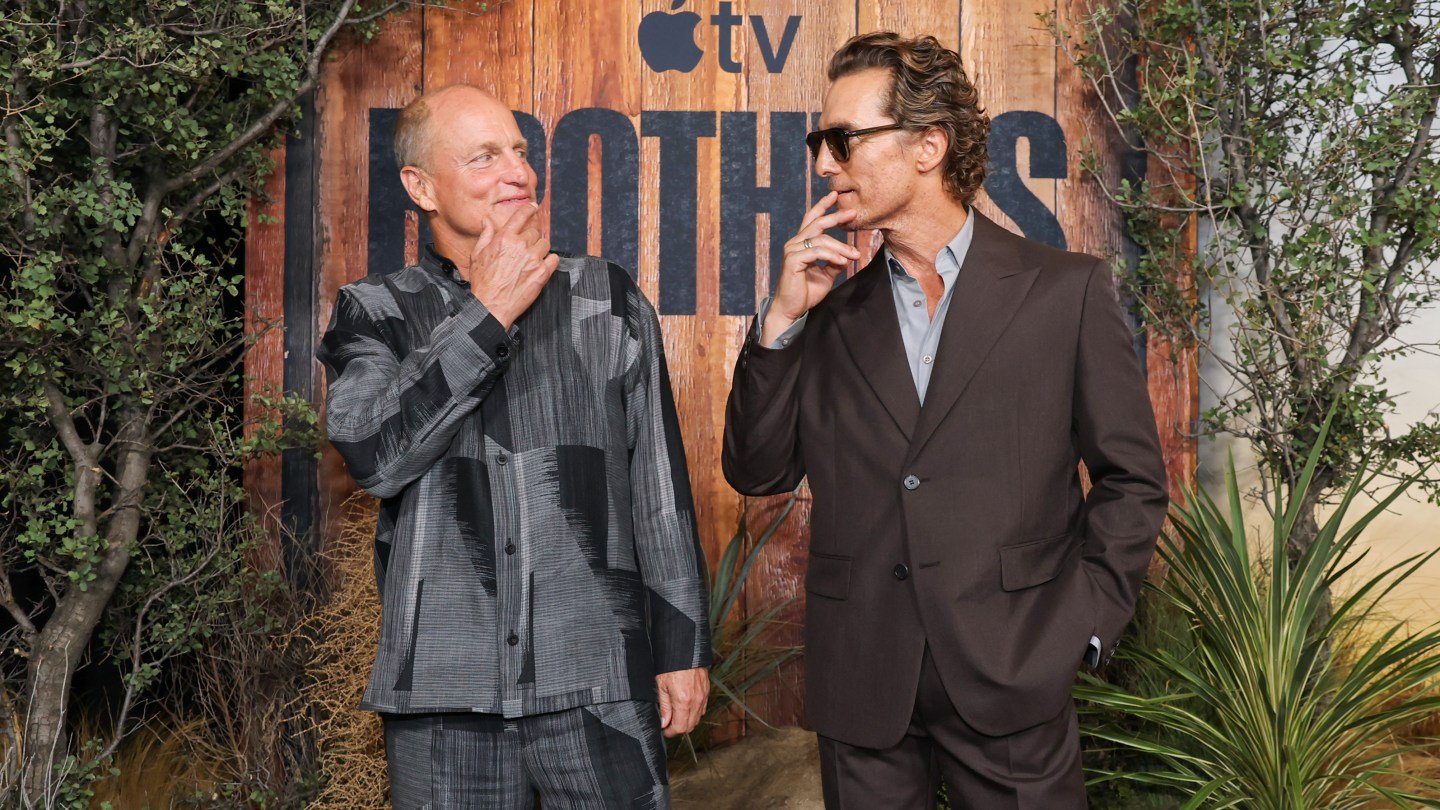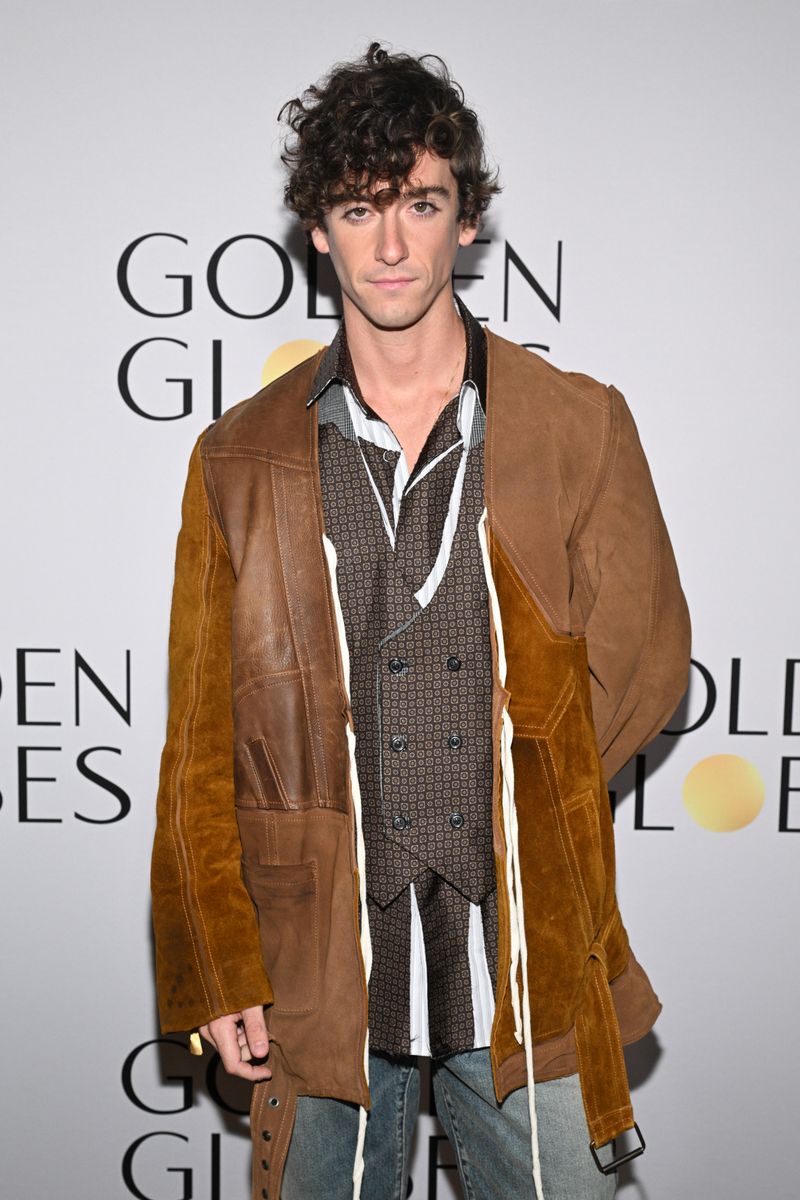
The Last of Us actor reflected on his cameo in the Grammy Award winner’s monumental Super Bowl performance in a profile with Fantastic Man. Pascal admitted that he reached out to Bad Bunny’s team about participating somehow, even if that meant he’d be volunteering or serving coffee.
“I wanted to participate in any way — literally a volunteer position, like serving coffee if needed — and I put the feelers out through people I work with,” he said. “When it comes to representation synchronized with celebration there’s no one better than Benito at the moment, and that fills me with inspiration outside of just being super into his music.”
The Emmy nominee explained he went into shooting Tony Gilroy’s Behemoth! and hadn’t heard back from Bad Bunny’s team, so he “sent someone an email with a selfie of me sticking my tongue out, being, like, ‘It’s really me.’ Within 25 minutes, they called me back and they were, like, ‘We want you to come to the show.’”
Once he made it to Super Bowl LX, the actor explained he did not explicitly know he’d be taking the field to appear in Bad Bunny’s La Casita, a set piece he utilizes in his live performances. All he was told was to wear the color beige, but he quickly realized he was going to be featured in the performance.
“I was under the impression that I would be in a suite. There was a dress code – ‘wear beige’ – but I thought it was in case there’d be a photographer,” Pascal said. “So we’re up in the stands watching the game and somebody pulls me from my seat and takes me backstage and then there’s Cardi B and there’s Young Miko and Karol G and Jessica Alba. They do a wardrobe check and then they tell me, ‘Okay, so the vibe is: you’re dancing.’”
That’s when the Materialists star realized he’d be featured in the show, specifically in Bad Bunny’s La Casita. “I started to realize right before they started, and I was, like, ‘It’s the Casita. I’m such a fucking idiot. Oh my god, I’m going to be in the Casita,’ as I was being marched out into the field. So I think that’s why I seemed like a deer in headlights,” he added.
As Pascal outlined, he was not the only star featured in the singer’s performance. Alongside Cardi B, Young Miko, Karol G and Jessica Alba, the “Tití Me Preguntó” singer also tapped Ricky Martin and Lady Gaga to perform with him mid-set, while Alix Earle, Dave Grutman and Ronald Acuña Jr. also appeared in Bad Bunny’s La Casita.
[This story contains major spoilers from the finale of RuPaul‘s Drag Race season 18.]
RuPaul has crowned America’s Next Drag Superstar!
Season 18 of RuPaul’s Drag Race has come to an end, and Myki Meeks has snatched the crown.
Heading into Friday night’s finale, Darlene Mitchell, Myki Meeks and Nini Coco were named the top three of the competition. Each drag artist dished out a performance to their own original song in the cumulative episode, though it was Myki and Nini who RuPaul named the top two queens of season 18.
Darlene was named second runner-up, and before she exited the stage to make way for the lip sync, she jokingly turned back to RuPaul and asked, “You sure?”
But before RuPaul’s Drag Race named its mint winner, Jane Don’t was presented with the coveted title of Miss Congeniality, voted on by the cast. While she did not win season 18, Jane Don’t was a frontrunner throughout the season, with her elimination in episode 13 coming as a surprise. (She unpacked her Drag Race tenure with THR here.)
Miley Cyrus was on hand to receive the Giving Us Lifetime Achievement Award, and the top two queens performed in a Lip Sync for the Crown to her song “Every Girl You’ve Ever Loved.”
Myki Meeks and Nini Coco in the final lip sync of RuPaul’s Drag Race season 18.
MTV
Both queens dished out impressive performances, but it was Myki who ultimately won the lip sync, also securing her newfound title of America’s Next Drag Superstar. Onya Nurve, winner of Drag Race season 17, presented Myki with their crown and scepter.
Hailing from Orlando, Florida, Myki was a dominating force throughout the tailend of season 18, consecutively winning the final three challenges of the installment. She won a total of four challenges, joining a lucrative list of queens from the Drag Race universe who have won a quartet of episodes on the series.
“This is for my friends, my family, all of Orlando, live fiercely, love boldly, and write it in the books baby, the Meeks shall inherit the crown!” Myki said after snatching the top spot.
The season 18 winner won a cash prize of $200,000, and for the first time, an official makeup collaboration with Anastasia Beverly Hills Cosmetics. During the finale episode, Darlene, Myki and Nini each visited the makeup company’s headquarters, where they spoke with president Norvina about what their potential collaboration would look like.
See how the queens of RuPaul’s Drag Race season 18 finished below.
Myki Meeks (WINNER) Nini Coco (2nd place) Darlene Mitchell (3rd place) Juicy Love Dion (4th place) Jane Don’t (5th place) Discord Addams (6th place) Kenya Pleaser (7th place) Athena Dion (8th place) Mia Starr (9th place) Vita VonTesse Starr (10th place) Ciara Myst (11th place) Briar Blush (12th place) Mandy Mango (13th place) DD Fuego (14th place)
The Guadalajara Film Festival’s (FICG) prominent LGBTQ+ strand, the Premio Maguey, is marking its 15th year, a milestone they have dubbed Queerciañera, fusing the words queer and quinceañera, Latin America’s hallowed coming-of-age celebration for girls turning 15.
Since it was launched in 2012, the first queer film award to be launched in Mexico and Latin America has grown in stature, establishing itself as one of the festival’s strongest sidebars.
Reflecting on this all-important milestone, its director Pavel Cortes said: “Talking about the impact that the Premio Maguey has had on Guadalajara and the rest of the country might seem rather pretentious. However, its social contribution to the legitimization of sexual diversity and queer culture—both locally and nationally—is undeniable.”
Its impact underscores cinema’s role as a powerful tool for social transformation, he added.
“Unfortunately, it continues to be a very important and necessary award, even though over these 15 years of the Premio Maguey we have witnessed the transformation of the world in relation to sexual diversity—acceptance remains a matter of privilege.”
“Mexico remains an intolerant country toward sexual diversity,” he asserted, “with a significant record of hate crimes and transfemicides.”
Premio Maguey launched at a time when the topic was still taboo in the country, subjected to segregation and marginalization, he said. “Since then, national queer film production has consolidated and, in this edition, we present seven Mexican films out of the 16 that make up our official competition for Best Film, the Jury Prize and Best Performance.”
The 15th edition features a selection of fiction, documentary and short films with stand-outs among the Mexican productions and those focusing on transmasculine parenthood: Sharon Kleinberg’s “I Am Mario (Mexico) and Daniel Ribeiro’s “I Will Miss You” (Brazil) as well as the short film among the special screenings, “Alex,” (Mexico), which follows Alex, a non-binary person, who becomes pregnant and sets out to get an abortion.
Alejandro Amenábar’s Oscar-winning “The Sea Inside” and “On the Road,” David Pablos winner of the Venice Orizzonti Award for Best Film and the Queer Lion Award, are among the special screenings slated for this edition.
FICTION
Eruption (“Erupción”) Pete Ohs, U.S., Poland A Polish florist and a British tourist spark an unexpected romance through chance encounters and fleeting, magical moments.
‘Eruption’ Courtesy of FICG
I Am Mario (“Soy Mario”) Sharon Kleinberg, Mexico Mario, a forty-year-old trans taxi driver, faces an unexpected pregnancy that opens the possibility of fulfilling his dream of becoming a father.
I Will Miss You (“Eu vou ter saudades de você “) Daniel Ribeiro, Brazil After seven years together, Amanda and Caio move in together, but love is not enough. When João enters their lives, their relationship is tested and transformed.
Iván & Hadoum (“Iván & Hadoum”) Ian de la Rosa, Spain Iván, a trans man working in greenhouse warehouses, falls in love with Hadoum, a Spanish-Moroccan coworker. Against family opposition, they pursue their relationship between greenhouses and seaside landscapes.
Like a Kite (“Feito pipa”) Allan Everton, Brazil Gugu dreams of becoming a great footballer. Raised freely by his grandmother, he will do whatever it takes to avoid living with his father.
No Dogs Allowed (“No se permiten perros”) Steve Bache, Germany Gabo, a seemingly ordinary 15-year-old, develops disturbing tendencies and forms a troubling bond with an older man. When the man is arrested, Gabo must decide whether to testify or protect his own dark secret.
‘No Dogs Allowed’ Courtesy of FICG
On the Sea (“En el mar”) Helen Walsh, U.K. A poetic exploration of masculinity and desire within a remote fishing community of stark and untamed beauty.
Pioneers (“Pioneras”) Marta Díaz de Lope Díaz, Spain In early 1970s Spain under Franco’s regime, a group of young women defy societal norms to play football, finding an unlikely ally and laying the groundwork for the future of women’s football.
The Circle of Liars (“El círculo de los mentirosos”) Nancy Cruz Orozco, Mexico Cecilia arrives in the city aspiring to be a writer and meets Nicolás and Aristeo, two young poets who claim to be the founders and sole members of an underground ultraist movement.
Wanted (“Se busca”) Kenya Márquez, Mexico René, a lonely teenager, runs away from home to Ciudad Juárez, where an inner calling leads her on a journey of self-discovery.
What They Leave Us (“Lo que nos van dejando”) Issa García Ascot, Mexico A biologist is forced to travel to the jungle, where she confronts deeply buried memories from her past.
DOCUMENTARY
“Cuba Street” (“Calle Cuba”) Vanessa Batista, Chile, Cuba, Mexico Four women, one street and an entire country pulsing between invisible wounds and the dream of resistance
“I Have Two Dads” (“Yo tengo dos papás”) Edgar Reyes, Mexico The story of Santiago: from abandonment to the embrace that transforms his destiny
“Mickey” (“Mickey”) Dano García, Mexico A decade-long collage by two friends becomes a film exploring Mickey’s self-discovery and the journeys of those who grew up with her
‘Mickey’ Courtesy of FICG
“Our Body is a Star that Expands” (“Nuestro cuerpo es una estrella que se expande”) Semillites Hernández Velasco, Tania Hernández Velasco, Mexico Tania and her brother Semillites confront childhood rejection and question their bodies through collage, animation, dance and intimate documentary, creating a sensorial exploration of identity
“Shelter” (“Cobijo”) Adrián Silvestre, Spain Cecilia joins a youth poetry movement in the city that becomes corrupted by envy as she studies to become a writer
SPECIAL SCREENINGS
“Alex” Natalia Bermúdez, Mexico Alex, a non-binary person, becomes pregnant and embarks on a journey to have an abortion with the support of their aunt Salome, a traditional doctor
“A Teacher’s Gift” Artur Ribeiro, United Kingdom, India In London, a Hindi teacher torn between duty and desire forms an unexpected bond that leads him to India
“Flowers” (“Flores”) Job Samaniego Rivera, Mexico After a magical encounter with a flower, Moisés and his daughter Samy embark on a journey of discovery and transformation Through an ancient tale seen through Samy’s eyes, a colorful world emerges, allowing Moisés to accept himself and finally see Samy for who she truly is
“Lemebel” (“Lemebel”) Joanna Reposi Garibaldi, Mexico The story of writer and visual artist Pedro Lemebel, from the founding of the collective Las Yeguas del Apocalipsis during the dictatorship to his death in 2015 from cancer
“On the Road” (“En el camino”) David Pablos, Mexico A drifter who sleeps with truck drivers meets a reserved driver and joins him transporting goods in northern Mexico As they grow closer on the road, the drifter’s past threatens them both
“The Sea Inside” (“Mar adentro”) Alejandro Amenábar, Spain, France, Italy A portrait starring Javier Bardem of Spaniard Ramón Sampedro, who fought for 30 years for euthanasia and his own right to die. An Academy Award Foreign-Language Feature winner.
“When You Get Home” (“Cuando llegue a casa”) Edgar Adrián, Mexico A teenager in Guadalajara explores identity between friendship and desire. During temple festivals, this search puts their relationship with their grandmother at risk.
Pedro Pascal wasn’t about to sit around and wait for invitation to be a part of Bad Bunny’s Super Bowl Halftime show. Instead, the “Last of Us” star reached out to the Grammy-winning superstar’s team.
“I wanted to participate in any way – literally a volunteer position, like serving coffee if needed – and I put the feelers out through people I work with,” Pascal says in the new issue of Fantastic Man magazine. “When it comes to representation synchronized with celebration there’s no one better than Benito at the moment, and that fills me with inspiration outside of just being super into his music.”
However, Pascal didn’t hear back right away. After wrapping Tony Gilroy’s upcoming “Behemoth,” Pascal said, ” I was lamenting about not hearing back and I sent someone an email with a selfie of me sticking my tongue out, being, like, ‘It’s really me.’ Within 25 minutes, they called me back and they were like, ‘We want you to come to the show.’”
His only instruction was to wear beige on the big day. “We’re up in the stands watching the game and somebody pulls me from my seat and takes me backstage and then there’s Cardi B and there’s Young Miko and Karol G and Jessica Alba,” Pascal recalled. “They do a wardrobe check and then they tell me, ‘OK, so the vibe is: you’re dancing.’ I started to realize right before they started, and I was like, ‘It’s the Casita. I’m such a fucking idiot. Oh my god, I’m going to be in the Casita,’ as I was being marched out into the field. So I think that’s why I seemed like a deer in headlights.”
Ethan James Green / Fantastic Man
In the same interview, Pascal also talked about experiencing fame at an older age than most of his peers. “I think there are two ways of looking at it,” said Pascal, who turned 51 on April 2. “There’s a universal feeling of imposter syndrome that we all can experience when we’re being unkind to ourselves, especially if it’s somehow uncomfortable to get what you want. Then the kinder side of it is that, as old as I feel, and as silly as some of it can be – because of ‘What is a 50-year-old man doing dancing in La Casita?’ – I’m incredibly grateful for having been a fully developed character before experiencing any kind of large-scale exposure. I’m kind of out of the oven, already baked. I was 38 years old when I got the part of Oberyn Martell [in ‘Game of Thrones’].”
Ethan James Green / Fantastic Man
He talked about the many waitering and bartending jobs he held in New York City. “It was paycheck to paycheck, but the theatre work became somewhat consistent for a few years,” Pascal said. “And then you always felt like it was this enormous score if you got an episode of ‘Law & Order’ or something. I was scraping by. I got bailed out a lot over the years by my sister and friends.”
Pascal was asked about his signature mustache. “I’d never had the courage to sport facial hair of any kind because I felt like I grew such weak facial hair. To this day, I can’t grow a proper beard,” he said. “The role where I was assisted with specific facial-hair grooming was that of Oberyn Martell. Then came ‘Narcos’, in which I felt like a moustache was completely fitting for the period. So now I sort of cling a little to the vanity of having some definition in the face with my very weak, patchy facial hair. But if the role calls for it, it can all disappear.”
Ethan James Green / Fantastic Man
On a more serious note, Pascal explained why he’s so outspoken about progressive politics. “I think staying quiet is the harder path,” the actor said. “I would have too hard of a time living with myself. It’s the way I was raised. Decency and compassion. The idea of the vulnerable being scapegoated and terrorized in this way is unspeakably painful.”
Days removed from a 10-song Coachella DJ set that may have earned him a new audience, Moby revealed on April 16 that he was donating all profits from the festival gig to animal rights organizations, including non-profit Mercy For Animals. The move was in keeping with the artist’s longstanding advocacy, his vegan lifestyle may be the one thing that people know about him aside from singles like “Porcelain” and “Natural Blues.”
For Mercy for Animals it was another PR win as the organization, which has long had close ties to Hollywood through its star-studded galas, cultivates industry talent to marshal for its causes. That includes promoting undercover videos showing the perils of factory farming, sometimes with narrators or amplifiers like Joaquin Phoenix, Alicia Silverstone, Pamela Anderson and Woody Harrelson.
The manager who deals with stars, their publicists and activists at the group is Nik Tyler, who has spent nearly a decade with the org building ties between the entertainment industry and connecting artists to its campaigns. He spoke with The Hollywood Reporter about how that process works.
How did you get involved with this type of advocacy?
I started working as a child actor when I was six and went on to work on Broadway and in TV as a kid, and I grew up in New York. So I was around the entertainment industry and grew up on sets, and was very involved as an actor. Then I took a hiatus from acting, and went to NYU for film school, and I was studying to be a filmmaker and I decided to return to acting after college, and I moved out to Los Angeles for a pilot season.
It was at that time that I was introduced to someone out there who had just written a New York Times bestselling book about these issues of factory farming and plant-based living, and the impact on the environment and people and animals. I was really inspired by the concept of people being able to be artists in the entertainment industry, and then to also use their platform to shine a spotlight onto these issues that were important to them.
What sort of projects do you work on with talent at the non-profit?
I’m constantly looking for opportunities to engage and connect multiple people for the cause and the movement and unify public figures to raise awareness about the issues that we champion. Moby, Diane Warren, Tom Scholz, these are people that are deeply connected to our work and have been ambassadors for the organization, have been involved in our PSAs and our video work. A big part of our work is undercover investigations, it’s what put us onto the map, undercover investigations into factory farming.
The undercover investigators are not activists, but there are celebrity ambassadors that will be a part of an undercover investigation in terms of sharing the footage. So in the past, people like Pamela Anderson and Joaquin Phoenix, they’ve narrated videos. We’ve had a lot of celebrities that will lend their name and their voice and their time to sharing that critical footage, which is very intense footage to reveal, but there are some really incredible actors and public figures who are ardent activists, it’s so close to their heart. They are very happy to shine their spotlight onto the hidden atrocities within factory farming.
What are the areas the non-profit focuses on?
The core areas of work that we focus on is reducing suffering. So that’s work that we’ll do with governments and leaders in the food industry, to be more mindful to incorporate animal welfare policies and to diminish the suffering of farm animals. A big focus of ours is addressing cage confinement and inspiring and educating regarding plant-based food options, whether that’s in restaurants or in your shopping cart.
Do you see Hollywood support trend toward or away depending on the political environment?
I feel like the public figures that support us and have throughout the 26-year lifespan of the organization, they are so authentically passionate about it. They care so deeply about speaking up for animals, about speaking up for injustice against not just animals, but also factory farm workers. It’s so inherent to who they are, that I don’t think they’re ever deterred from sharing that information in an openhearted way.
You’re also producing short films for Mercy for Animals as a series.
The Voices of Hope series originated in 2024 when I reached out to partner with Jane Goodall’s Institute and to create Voices of Hope: Words of Wisdom by Jane Goodall, which is a short film crafted from decades of Jane Goodall’s public statements. I brought in 22 public figures to co-narrate as an ensemble her words of wisdom.
The second film, Voices of Hope: Words of Wisdom by Marlon Brando, which was in partnership with Marlon Brando’s trustees, was honoring his legacy of activism, his groundbreaking advocacy for social justice and environmentalism, and his affinity for animals. Similarly to Jane Goodall’s film, it also brought 22 public figures to co-narrate. Then this year for what would have been Ram Dass’ 95th birthday it completed the trilogy, with a short film honoring his legacy of spiritual wisdom and his compassionate heart.
When you’re looking to partner with a celebrity, what is the typical ask?
For me, talent involvement is about building relationships and inviting people into the community. Inviting public figures to the cause is something I do constantly — whether they’re attending a live or a virtual event as a guest or participating in a program like being a presenter at a gala or a music festival, or we’re honoring them at the gala with an award for their advocacy — I’m always looking for opportunities to invite everyone to participate at whatever stage of their advocacy journey they’re on.
They don’t need to be an ardent animal rights activist. They don’t need to be vegan or vegetarian. They just need to care about causes — whether it’s humanitarianism, environmental, children’s welfare, women’s welfare — when someone shows interest in advocacy and using their voice and platform for the greater good, I’m paying attention to that.
This interview has been edited and condensed for clarity.
“Sometimes you’ve got to be bold about it,” Sheryl Lee Ralph says. The Emmy winner is among the first to log onto a Zoom conversation about her new film Ricky, and before all have even arrived, nicely sums up their movie’s journey of defying expectations.
Coming from first-time feature director Rashad Frett with a producing team including Sterling Brim, also making his film debut, Ricky premiered 16 months ago at Sundance to wide acclaim and won the festival competition’s directing prize. The drama, intricately focused on a 30-year-old man’s reintegration into society after being incarcerated since his teens, featured powerhouse performances from Ralph and If Beale Street Could Talk alum Stephan James. But in a challenged and changing indie film landscape, distributors didn’t bite as hoped — and the opportunity to get creative presented itself.
Bold, indeed.
With facilitation by Blue Harbor Entertainment, Ricky is being self-distributed, with filmmakers still holding the rights as they gear up for an April 24 theatrical release. A Kickstarter campaign also helped drive its targeted focus. “We wanted to make sure that people who are actually affected by recidivism and the imprisonment system could see this film,” Brim says. “I wanted to make sure that people in Chicago, people in Detroit and any of the big cities that you think about that have Black and brown people and marginalized groups could see this film.”
Sheryl Lee Ralph in Ricky.
Frett says he “grew up in the environment” of Ricky, absorbing many of the narratives and situations depicted in the film from when he was young. He’d been focused on documentaries before making an initial short of the same name. The film is marked by its verisimilitude: Frett maintains a rigorous focus on the realities of life after incarceration, the script hitting at times painfully realistic beats while the filmmaking embraces the chaos of life as it happens.
“I wanted to make this film as visceral and as real as possible, so I was telling my cinematographer, ‘Find the shots, find the frame,’” Frett says. “We were on the headset and I’m constantly in his ear: ‘Just follow the movement.’”
James, who plays the eponymous role, adds, “It felt like a film that was made with intention, with purpose. Every frame of that film was calculated…. You’re dealing with a 15-year-old boy entering adulthood for the first time [at 30]. As a character study, it was just so fascinating.” He spent extensive time with teenagers to observe the way they move through and process the world. “I had to get into the psychology of a 15-year-old boy,” he says. This is essentially where we meet Ricky no matter his literal age: “I took real pride in understanding the full picture.”
Ralph portrays Ricky’s parole officer Joanne, and was drawn to working with James as well as the story itself. “We don’t see a lot of stories about successful young Black men, marginalized young men coming out and having the life that they’ve dreamed of,” she says. “This script spoke so well about so many things that these young men face coming out of the system, and how they get involved in the system to begin with.”
The film’s success at Sundance did not yield much commercial interest — a larger issue for last year’s competition among American narrative features, many of which took around a year to find distribution. (Grand Jury Prize winner Atropia was acquired in October, 10 months after the festival.) “We navigated it as best as possible with the type of film this is,” Frett says.
“We’re trying to be creative with this industry changing and finding out new ways to get quality independent films out there — and being a young producer, you don’t want to watch anything that you make die,” Brim adds. “For these people involved, I just knew we had to make sure this lived and that it could live amongst the people that it needed to live amongst.”
So that’s exactly what the Ricky filmmakers started doing. Various screenings have taken place over the past year aimed at direct community engagement. Ralph attended one at the men’s prison San Quentin Rehabilitation Center that included a Q&A, and remains deeply moved by the memory of it.
“We were in a room with men who were very much like the character in the movie — some of them had aged up, but they had still been that character; some of them were that character right at that moment,” Ralph says. “There were moments when the movie was screening, you could hear a pin drop…. Their response was so, ‘Whoa.’ And there were moments in the film where they started talking back to the film…. It was a moment to be a human being with other human beings trying to figure out what the next step would be, even if they were in their 20s and they wouldn’t be out for another 50 years. I’ve never experienced anything like that.”
“People are going to see this film and say, ‘Wow, I’m seeing myself in a way I’ve never seen myself,’” James says. “‘People are looking at me, I’m being seen.’ That’s really the greatest testament in being able to make a film like this.”
There will be a learning curve as the theatrical launch looms for this group of artists, all embarking on this kind of independent release for the first time. Frett teaches directing at Brooklyn College and admits even the promotional aspects of Ricky have been a little daunting. Brim came into Ricky following his longtime stint as a cohost of the comedy clip show Ridiculousness, and with his fellow producers has not taken the easy — or safe — rollout path. But no one involved seems to be second-guessing the choice, no matter how new it all feels. In their eyes, this was the right, even obvious move; they barely feel the need to explain it.
Leave it to Ralph, though, to do just that.
“The offers didn’t come — or they were late to come, or slow to come — and people didn’t know if they wanted to touch this subject. That happens so often when it’s an independent film that has something to say about people who so often get marginalized — whether they’re in prison, out of prison — just because of who and what they are,” Ralph says. “So it is bold to say, ‘You know what? If you’re not going to open up the door for me here, I think enough about the work that I have created to go out and say we’re going to do it ourselves. We’re four-walling this thing ourselves because we refuse for you not to see it.’”
British actor David Jonsson is only five films into his career, but you’d already know his gaze anywhere: Even in a film as spry and bright as the 2023 romcom “Rye Lane,” those crinkly, softly drooping eyes bring an air of old-soul melancholy to proceedings. But they’ve never borne quite as much sorrow as they do in “Wasteman,” a coolly brutal prison drama that follows a pretty rusty narrative template — hardened inmate on the brink of parole struggles to stay on the straight and narrow — but finds more interest in the dueling masculine energies of its two principal stars. If Jonsson, as the nearly-free man in question, is all guarded regret and head-down resilience, Tom Blyth is his lethal opposite number: As a near-feral cellmate from hell, he’s the disruptive force that gives an otherwise predictable film a spark of erratic danger.
Though Jonsson and Blyth’s stealthily adversarial, hot-and-cold double act represents the chief selling point of “Wasteman” — which premiered at last year’s Toronto festival and hit screens in its native U.K. back in February — the film is most emphatically a calling card for first-time feature director Cal McMau, who picked up a surprise win for Best Debut Director at last year’s British Independent Film Awards (beating the more hotly tipped likes of Akinola Davies Jr. and Harry Lighton) en route to a nomination in the BAFTAs’ equivalent category. An artist turned commercials director, he handles proceedings here with equal parts grit and polish, smoothly integrating multiple shooting formats and implied points of view — with an emphasis on vertical cellphone footage that gives us a bristlingly immediate sense of life on the inside.
Slightly less persuasive, however, is the script by Hunter Andrews and Eoin Doran, also taking their first feature credit. Trading in starkly opposed male archetypes but scantly developed characters, it builds some claustrophobic drama around inmates’ jostling for alpha status within these bleak, blue-washed walls, though it’s only glancingly attentive to the systemic failures governing this sordid battle royal, or more specific, unspoken social and racial conflicts presumably coursing through a pressure-cooker microcosm of modern British manhood. (Give or take the flavorful accents, the tone of the drama here is most reminiscent of that decades-old HBO TV provocation “Oz.”)
Jonsson plays Taylor, a watchful, aged-beyond-his-years introvert who has spent 13 years behind bars on a manslaughter charge — missing almost the entire life of his teenage son Adam (Cole Martin), from whom the boy’s mother is determined to keep him estranged. He’s a quiet prisoner if not exactly a model one, with an opioid addiction he can’t kick, funded by his stoic work as a barber to his fellow inmates. When he’s informed that he’s soon to be up for parole — due less to his own good behavior than a need to free up prison space — he’s cautioned not to put a foot wrong; receding into himself is the safest course of action.
It’s a bad time, then, to be paired with a new cellmate, particularly an unholy terror like Dee (Blyth), a grinning, nihilistic thug with a taste for living large — which, in prison confines, amounts to an in-cell air fryer and a shelf for his impressive sneaker collection — and a steady supply of drugs that soon makes him the most popular dealer on the wing, to the consternation of former big dogs Gaz (Corin Silva) and Paul (Alex Hassell). Generous with his stash and with access to his phone — which Taylor uses to communicate with Adam on social media — Dee ropes the addict into his trade, though their tentative friendship is soon subsumed into the prison’s overriding culture of violence.
With his gangly, clammy physicality and strident delivery, Blyth is an electrifying hair-trigger antagonist, jump-starting each scene he’s in and even contributing some leering wit to an otherwise stern affair. “I don’t need to be careful,” he brags to the walking-on-eggshells Taylor: For Dee, being beyond redemption is a point of pride. The actor can’t, however, find much semblance of humanity in this flatly vicious figure, who ultimately serves to highlight the manifold vulnerabilities of our flawed but contrastingly soulful hero, played by Jonsson with a tight, walled-off reserve that seems liable to break at any given moment.
That palpable desperation is compounded by the sheer airlessness of Phoebe Platman’s production design and Lorenzo Levrini’s prowling cinematography, which permits only the odd, stray shaft of natural light into this dank, metallic-hued world. The most explosive setpieces here are the pummelling prison riots, which Levrini charges into with handheld gusto, but the film feels rawest and realest in recurring interludes where the aspect ratio narrows and McMau views prison life (some of it battering, some of it banal) through the grainy lens of the inmates’ devices. A more unusual, subversive work might have stuck to this conceit throughout, but “Wasteman” finds some relief in formal convention.
After 2000’s Meet the Parents became a box office hit, Stiller and Robert De Niro went on to reprise their roles as Greg Focker and Jack Byrnes, respectively, in three more installments: 2004’s Meet the Fockers, 2010’s Little Fockers and the upcoming Focker-In-Law.
The new film, hitting theaters on Nov. 25, centers on Greg and Pam Focker’s (Teri Polo) son Henry (Skyler Gisondo), who causes family chaos when he decides to marry Olivia Jones (Grande), a strong-willed woman who appears to be his complete mismatch.
The Arianators are clearly excited, with one asking on X, “Yall I did not watch the first 3 movies (and I don’t want to watch it either) but I want to watch the 4th one. Will I lose major plot?”
And none other than Greg Foster himself, aka Stiller, replied: “No! But I stand by the first two.”
Though the Zoolander star didn’t share details on why he isn’t a big fan of the third installment, another person followed up in a second post, “So what went wrong with Little Fockers? You worked on it.” Stiller added, “We always try. Fully.”
Little Fockers definitely won’t be making it on Stiller’s list of all-time favorite films, but he does seem excited about the new sequel with Grande following his recent appearance at CinemaCon in Las Vegas.
While on stage during Universal Pictures’ presentation, the Night at the Museum actor joked that the franchise’s team planned a “fully intentional 15-year break between movies three and four.” Stiller also teased De Niro at one point, noting that he’s now roughly the same age that the Oscar winner was in the 2000 film.
“I guess you could say I’m the new De Niro of the franchise,” Stiller quipped, leading De Niro to come out and defend himself. “Don’t say that. It’s very disrespectful,” the Killers of the Flower Moon actor replied. “You made a very unflattering comparison that forced me to defend my honor.”
Owen Wilson and Blythe Danner and Polo are also all reprising their roles in Focker-In-Law.
Perfect Crown is Disney‘s new streaming king in the Korean drama category. The smash-hit rom-com, which launched on Disney+ on April 10, has achieved the platform’s biggest-ever viewership for a Korean series within five days of launch.
Disney+ announced the record on Thursday but declined to release specific viewership figures, saying only that Perfect Crown has become the No. 1 most-viewed Korean series premiere on the platform globally.
The series — which also airs domestically on MBC in Korea’s coveted Friday-Saturday prime-time slot — is set in an alternate-reality version of modern South Korea where the country remains a constitutional monarchy. Pop-star-turned-actress IU stars as Seong Hui-ju, the sharp-elbowed heir to a major Korean conglomerate whose commoner status grates against her ambition. Byeon Woo-seok plays Grand Prince I-AN, the king’s second son, whose royal title comes with little else. When mounting pressures push the two into a marriage of convenience, the arrangement proves harder to keep strictly transactional than either of them planned.
Byeon Woo-seok and IU star in ‘Perfect Crown.’
Disney+
The pairing has generated outsize anticipation. IU, one of the biggest stars in Korean entertainment, arrives fresh off her acclaimed turn in Netflix’s When Life Gives You Tangerines, the sweeping Jeju Island romance that won best drama at last year’s Baeksang Arts Awards. Byeon, meanwhile, became one of the country’s most bankable leading men virtually overnight after the 2024 tvN romance Lovely Runner turned him into a phenomenon. The two previously shared the screen about a decade ago in SBS’s Moon Lovers: Scarlet Heart Ryeo (2016), when Byeon was still a little-known supporting player.
Perfect Crown is directed by Park Joon-hwa, known for a string of hits in the rom-com and fantasy genres, including What’s Wrong With Secretary Kim and the tvN mega-hit Alchemy of Souls. Yoo Ji-won wrote the series.
Perfect Crown streams on Disney+ internationally and on Hulu in the U.S. The show entered Disney+’s Global Top 10 within days and has trended in more than 40 countries.
Perfect Crown arrives at a moment when Disney+ is working rapidly to establish the kind of steady Korean content pipeline that Netflix has built over the past decade. The platform scored a major hit with the 2023 action-thriller Moving and has steadily expanded its K-drama slate with titles like A Shop for Killers, Gangnam B-Side and Light Shop. The company has several high-profile Korean projects in the pipeline, including a second season of A Shop for Killers; The Remarried Empress, starring Shin Min-a, Ju Ji-hoon and Lee Jong-suk; and The Koreans, a high-profile remake of FX’s The Americans starring Lee Byung-hun and Han Ji-min.
New episodes of Perfect Crown are released every Friday and Saturday at 11:20 p.m., Korean standard time. The series runs through May 16.
Grief is one of the most confounding aspects of the human experience. To live is to experience loss, and yet, we are never truly prepared. This type of agony is always a detriment to mental health, even more so when someone is already predisposed to instability. In the first Broadway revival of Pulitzer Prize-winning playwright David Auburn’s Tony Award-winning play, “Proof,” a young woman reels from her father’s death amid her own rapidly deteriorating mental health. Tormented by her own fears, doubted by her father’s peers, and infantilized by her older sister, Catherine (Ayo Edebiri in her Broadway debut) walks the line between self-confidence and deep distrust. The play has gripping themes and a thrilling cast. However, as the narrative presses forward, it becomes clear that Edebiri isn’t the best fit for the role. Directed by Thomas Kail, “Proof” opens on the Southside of Chicago sometime in the 1990s. Catherine (Edebiri) is seen nodding off on the back porch of her family home. Her father, Robert (a commanding Don Cheadle in his Broadway debut), comes out to greet her. It’s Catherine’s 25th birthday. The mathematical genius is eager to celebrate his youngest daughter with a bottle of champagne and some math banter. Unfortunately, Catherine would rather wallow in her own depression. A brilliant mathematician in her own right, Catherine reflects on Robert’s mental illness and how it has eroded her life. His condition has driven him away from the halls of the University of Chicago. For years, he has been sequestered in their house, ranting, raving and writing nonsensical math equations in hundreds of notebooks. Exhausted by her plight, Catherine also wonders if Robert’s schizophrenia is hereditary. After all, though the two are conversing on her birthday, the audience learns that Robert died a week prior. From there, amid a series of cleverly placed flashbacks, viewers learn more about Catherine and Robert’s father-daughter bond. The flashbacks reveal Robert’s descent into madness and the personal and professional sacrifices Catherine has made as a result. Things come to a head in the days leading up to the mathematician’s funeral. Hal (Jin Ha), one of Robert’s brightest students, begins looking through the professor’s notebooks. The young professor’s constant presence forces Catherine to confront her self-inflicted loneliness and her long-concealed mathematical mastery. When her Type A, but well-meaning older sister Claire (the ever-astounding Kara Young) arrives from New York to try to pull Catherine out of her despair, the things Catherine has long buried begin to surface. Edebiri and Young’s sisterly dynamic is one of the most authentic and witty aspects of the production. The play is set in a single location, a roomy back porch designed by Teresa L. Williams. The ingenious use of light, led by Amada Zieve, effortlessly guides the audience through the varied time and seasonal changes explored in “Proof.” The scenic design and lighting shifts, incorporated into the house itself, are paired with original music by Kris Bowers. Together, they aid in “Proof’s” ever-changing tone and atmosphere. As it did during its 2000 Broadway debut starring Mary-Louise Parker, and later in the 2005 film of the same name starring Gwyneth Paltrow, “Proof” continues to resonate. The play highlights the immense sacrifice of caregiving — a role often thrust upon women. It also explores sexism in academia and the terror of mental instability. Additionally, it depicts how familial legacy can shape people’s self-perception, capabilities and identities. Though dramatic at its core, this revival infuses a levity and sarcasm that alleviate much of its heaviness. While Edebiri is fantastic in the wittier sequences, her dramatic turns lack an effortless authenticity. Cheadle is sequestered mostly to the second act, which means Edebiri is forced to carry the majority of Act I alone. As a result, the production doesn’t feel as emotionally grounded as it should. “Proof” remains a scintillating play. Its questions about hereditary mental illness, the truth, and who can be labeled a genius — especially with a Black woman at the center — continue to resonate. Cheadle, Young, and Ha deliver effortless portrayals. They anchor the story in time and space with dynamic, heartfelt performances. Yet, because Edebiri simply doesn’t work as the lead, this revival doesn’t quite knock it out of the park.