Category: Business

  • Bitcoin and Markets Focused on the Jackson Hole Meeting: As Kevin Warsh Prepares for His First Speech, Hawkish Statements Emerge from Three FED Members!…

    Bitcoin and Markets Focused on the Jackson Hole Meeting: As Kevin Warsh Prepares for His First Speech, Hawkish Statements Emerge from Three FED Members!…

    Global markets are focused on Federal Reserve Chairman Kevin Warsh’s speech today in Jackson Hole. While FED officials have given conflicting messages regarding the trajectory of inflation and interest rates, investors are eagerly awaiting Warsh’s message on the direction of monetary policy and inflation.

    This is because Federal Reserve officials have differing assessments of the future of inflation in the US. Some officials argue that higher interest rates are needed to control price pressures, while others see no urgency for tightening monetary policy. This divergence increases uncertainty regarding the Fed’s future interest rate policy.

    When Will He Speak?

    Warsh is expected to speak at 5:00 PM Turkish time at the traditional annual Jackson Hole Economic Policy Symposium in Wyoming.

    This speech is also significant because it will be Warsh’s first Jackson Hole meeting as FED Chairman.

    If Warsh were to say things like, “Inflation is still the biggest risk,” “The current interest rate isn’t restrictive enough,” or “We need to see more progress on inflation before cutting interest rates,” that would be a hawkish tone. In this case, we can expect the dollar to strengthen, US bond yields to rise, and Bitcoin and gold to come under pressure.

    Conversely, if Warsh were to say something like, “The inflation trend is downward, the current interest rate level is sufficiently restrictive, or we need to see the lagged effects of the policy,” that would be a dovish message.

    In this scenario, expectations of a September rate cut could strengthen again, the dollar and bond yields could fall, and Bitcoin and gold could rise.

    Federal Reserve officials, meeting in Jackson Hole, Wyoming for the Kansas City Fed’s closely watched annual economic symposium, shared their ongoing concerns about the U.S. inflation landscape.

    According to Reuters, Chicago Fed President Austan Goolsbee said in an interview in Jackson Hole that his biggest fear in the short term is that inflation will not be brought under control.

    Austan Goolsbee, one of the Fed’s most prominent dovish figures, said that inflation is the biggest variable for the US economy.

    Goolsbee’s core approach can be summarized as: “Wait for the data, be convinced about inflation.”

    “Inflation is still well above the Fed’s 2% target.
    Rising energy prices and tariffs could create new inflationary pressures.
    Nevertheless, the inflation trend over the last 3 months is not alarming.
    Interest rate cuts would only be possible if convincing data shows that inflation is actually moving towards 2%.”

    According to experts, Goolsbee’s message to the market can be summarized as “The door to a discount is not closed, but there isn’t enough confidence for a discount right now,” which is seen as a hawkish tone compared to previous dovish expectations.

    Jeffrey Schmid, president of the Kansas City Federal Reserve, who was among the speakers in Jackson Hole, said that inflation is still stubborn and persistent and that ways to bring it back down to the 2% level must continue to be found.

    Speaking to CNBC, Schmid stated that the current policy interest rate, which the Fed left in the 3.50%-3.75% range in July, does not appear restrictive, saying, “I don’t know what we are restricting with the interest rate policy we are currently implementing.”

    Schmid, who has recently stated that he favors raising interest rates to bring inflation down to the Fed’s 2% target, believes that monetary policy is not working to counter current price pressures.

    Cleveland Fed President Beth Hammack, considered one of the leading hawks at the Fed, was also among the speakers. Speaking to CNBC, Hammack made her position clearer. She stated that inflation has remained above the Fed’s target for more than five years and that monetary policy has not curbed the economy. Hammack, one of three officials at last month’s FOMC meeting who preferred a rate hike to a rate cut, said, “Now is the time to act.”

    *This is not investment advice.
  • Bitcoin is outperforming stocks and correlating with gold just when it matters most

    Bitcoin $BTC$79,627.45 is outperforming gold, the Nasdaq 100 index, the S&P 500 and other major asset classes just when it matters most.

    The cryptocurrency’s price has surged 26% this month, according to CoinDesk data, and was recently around $79,200. Gold, meanwhile, has gained 13.8%, with the Nasdaq 100 and S&P 500 indexes adding 4.8% and 3.2%, respectively. Both hard assets lagged early this year but are now climbing faster than stocks, which are already at record highs after a strong run so far in 2026.

    More importantly, TradingView data shows $BTC’s 30-day correlation with gold has climbed to +0.81, indicating a strong tendency for the two to move in tandem. In contrast, its relationship with the Dollar Index has deepened to -0.86, a sign it’s moved in the opposite direction to the greenback. At the same time, $BTC’s link with the Nasdaq has weakened.

    The price outperformance, coupled with the positive correlation with gold and negative correlation with the DXY, underscores bitcoin’s appeal as a store of value and a hedge against fiscal and monetary imprudence.

  • Coinbase Announces Delay in Altcoin Listing Scheduled for This Week! Here’s the Altcoin

    Coinbase Announces Delay in Altcoin Listing Scheduled for This Week! Here’s the Altcoin

    Coinbase, one of the largest cryptocurrency exchanges in the US, announced that it has postponed the planned listing date for Dolphin (POD) spot trading pairs this week. Following the postponement, the exchange stated that the POD token remains on its listing roadmap and that further developments regarding when trading will begin will be shared.

    Coinbase announced that spot trading pairs for Dolphin were planned to launch this week, but the listing has been postponed to a later date. The exchange did not share a specific date for the start of the new trading.

    The assets included in Coinbase’s listing roadmap encompass cryptocurrencies that have passed the exchange’s review process and are planned to be traded on the platform in the future. The presence of a token on this list does not necessarily mean trading will begin; it indicates that Coinbase’s evaluation of the asset is ongoing.

    The postponement of planned spot trading pairs for Dolphin (POD) has led investors to await the token’s launch on Coinbase. Listings on major centralized exchanges are generally considered a significant development in the crypto market, as they allow new assets to reach a wider investor base.

    Coinbase emphasized in its statement that POD is still on its listing roadmap, and that updates regarding the launch will be shared later. This clarifies that the delay does not mean the token has been completely removed from the listing process.

    Before listing new tokens on cryptocurrency exchanges, various factors such as technical preparations, liquidity conditions, market structure, and regional regulations are evaluated. Therefore, changes to the planned trading start dates are possible.

    Coinbase has not shared any details regarding why it delayed the POD listing. Investors are expected to follow official announcements from the exchange regarding the new trading date.

    It is stated that if POD were to start spot trading on Coinbase in the future, the token’s liquidity and accessibility could increase, but how the listing would affect price performance would depend on market conditions.

    *This is not investment advice.
  • Solana’s faster supply cuts lead vote while $800,000 daily burn plan trails

    Solana’s faster supply cuts lead vote while $800,000 daily burn plan trails

    Each proposal needs one-third of network stake to participate and two-thirds of participating stake to vote in favor. Abstentions count toward participation, meaning they help meet quorum but do not help a proposal reach the two-thirds approval threshold. All three votes have cleared quorum as of Friday, data from the governance page show.

    (Solana Validator Governance)

    What the proposals are

    The so-termed constitution is passing easily. Solana Governance Proposal (SGP)-0001 sets the rules for how major network decisions are put to a vote, including who can participate, how votes are weighted and what support is needed to pass. It has 95.35% support with just 0.22% opposed.

    SGP-0002 is over the line, though not by much. It would make Solana reduce the rate at which new $SOL is created by 30% each year instead of 15%. The proposal has 68.77% support with 47.72% participation.

    That would bring the rate of new token creation down to its minimum of 1.5% a year around 2029 instead of 2032, resulting in roughly 18.9 million fewer $SOL being created over six years.

    Read more: New Solana vote could ramp daily $SOL burns to $800,000 and slow new token creation

    SGP-0003, which would change transaction fees and destroy far more $SOL, has 62.72% support, with 16.52% opposed and 20.75% abstaining. Participation stands at 42.51%, leaving it below the two-thirds support needed to pass.

  • Here’s why Warsh’s Jackson Hole speech is a major event for bitcoin and gold

    As such, markets took it as a sign of an official bid to cap long-term borrowing costs – one that may eventually see the Fed step in and buy as many bonds as required to hold yields down, a form of yield-curve control.

    Hard assets that benefit from financial repression and a deluge of fiat liquidity quickly rallied. Bitcoin and gold surged, with bitcoin rising from $64,000 to $80,000 in a week. Treasury’s program is not QE, meaning it does not add fresh liquidity to markets, and the size is small compared with the $40 trillion federal debt. So unless the Fed joins in, buying bonds itself and injecting liquidity, a sustained decline in yields looks unlikely.

    “The market senses a slippery slope towards fiscal dominance and a possible loss in Fed independence. The assumption here is that for the Treasury to be successful in keeping yields down, it will need to significantly increase the size of the buybacks. That might require the Fed to become complicit in this operation twist, which takes us down the debasement path,” Jurrien Timmer, Fidelity’s director of global macro, said.

    That assumption is what Warsh’s speech will test.

    If Friday’s speech undercuts that assumption, the bullish momentum in bitcoin and gold could weaken. Language that casts the buybacks as routine liquidity work, stresses monetary policy independence, and rules out Fed participation would could push Treasury yields and the dollar higher and bitcoin and gold lower.

  • THORChain’s privacy upgrade sends RUNE up 26% – Can bulls flip $0.65?

    THORChain’s privacy upgrade sends RUNE up 26% – Can bulls flip $0.65?

    THORChain [$RUNE] surged by more than 26% in the past 24 hours, ranking first among all gainers in the top 200 cryptos by market cap.

    The hype around a network upgrade alongside a broader, stronger crypto market drove the token’s price. As a result, $RUNE’s daily trading volume matched the uptick in price, recording a 3x increase, but remained fairly low, in excess of $20 million.

    Here is how the THORChain v3.20 upgrade fueled the sudden surge:

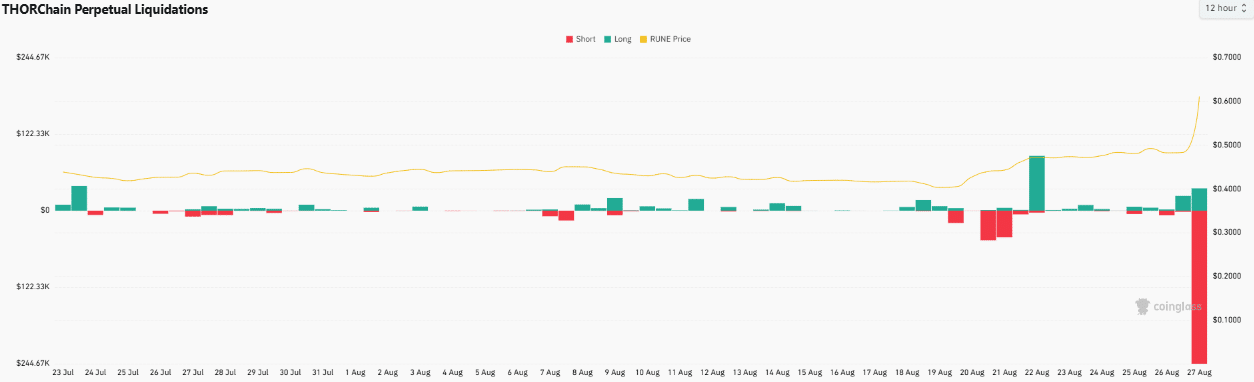
    THORChain v3.20 upgrade goes live as short liquidations spike

    The network announced that the THORChain v3.20 upgrade went live on the 26th of August. This upgrade allows swapping Monero [XMR] and Zcash [ZEC] for Bitcoin [$BTC], Ethereum [$ETH], and stablecoins.

    The upgrade has expanded THORChain’s addressable market as it brings privacy users to a direct connection to crypto. The upgrade comes three months after an attacker exploited THORChain for over $10 million across $BTC, $ETH, and BSC.

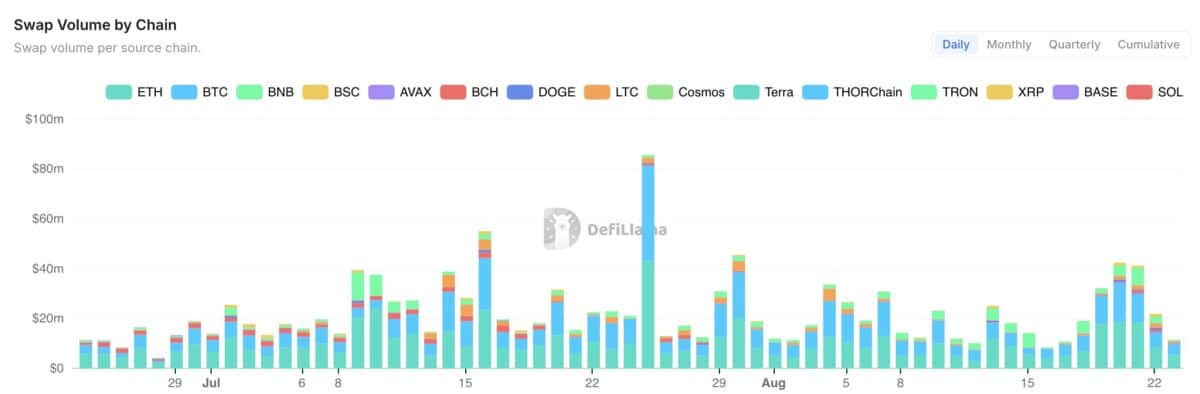
    That could increase the chain’s swap volume, with Ethereum and Bitcoin consistently dominating as per data from DefiLlama. The chain averaged $7 million in daily $BTC swaps and $10 million in daily $ETH swaps.

    Source: DeFiLlama

    Thus, it is safe to say the rally was driven by a surge in sentiment following the upgrade and increased user base.

    The surge in daily buying volume triggered liquidation of perpetual short orders. As per CoinGlass data, $RUNE short positions worth 10x those of longs were wiped out.

    Source: CoinGlass

    With a stronger crypto market and altcoins gaining ground, $RUNE could truly shift its market structure. Let’s find…

    Can $RUNE bulls flip $0.65 into support?

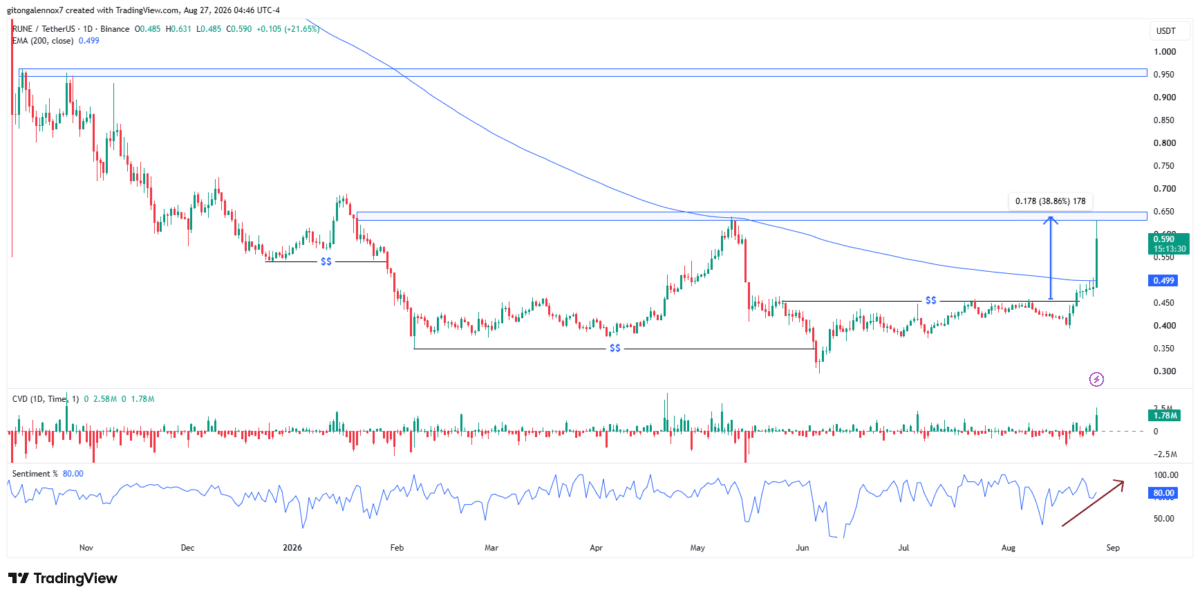
    The 200-day EMA shows that $RUNE price action has turned bullish on a long-term daily scale. The altcoin was still bearish looking at the horizontal structural levels.

    $RUNE was still trading below the $0.65 zone, which was the last lower high of the bearish trend. The market structure has shifted from the EMA perspective, but it is yet to confirm by flipping the $0.65 resistance into support.

    Bulls tested the $0.65 supply zone but met instant rejection. It is still unclear if they got the zeal to breach the resistance.

    Source: $RUNE/USDT on TradingView

    However, the CVD showed bulls were positioning with 1.78 million $RUNE bought on Binance as of the time of press. Moreover, the Sentiment was at 80, indicating the crowd was convinced the altcoin rally may be sustainable.

    Still, it is worth noting that the rally may be short-lived since it is sentiment-driven. Otherwise, if the market structure is shifting, then $RUNE may be positioning for more gains.

    Final Summary

    • $RUNE rallies by more than 26% in 24 hours after the THORChain v3.20 upgrade, leading all of the top 200 cryptos by market cap.
    • $RUNE bulls tested the $0.65 resistance level, which, if flipped into support, would shift the market structure to bullish.
  • Bittensor jumps 10% as AI hype returns – Can TAO break $260?

    Bittensor jumps 10% as AI hype returns – Can TAO break $260?

    Bittensor [$TAO] gained more than 10% in the past 24 hours, at press time, extending $TAO’s weekly gains to more than 21%. Social Insights on CoinMarketCap showed that the mindshare of $TAO surged by 23%, with mentions and engagements surpassing 12.44K.

    Notably, a resurgence in the AI narrative and more liquidity exposure drove this shift in social sentiment.

    Is the AI narrative back as $TAO surges 10%?

    Typically, news surrounding tech stocks fuels the AI narrative, as it reflects overall market sentiment. As such, the Q2 earnings report indicated Nvidia [NVDA] had record revenue of $96.20 billion.

    This reading fueled tokenized NVDA to climb to around $221 with over $131 in daily volume. The strength spread across the AI sector, with Bittensor and Venice Token [VVV] benefiting.

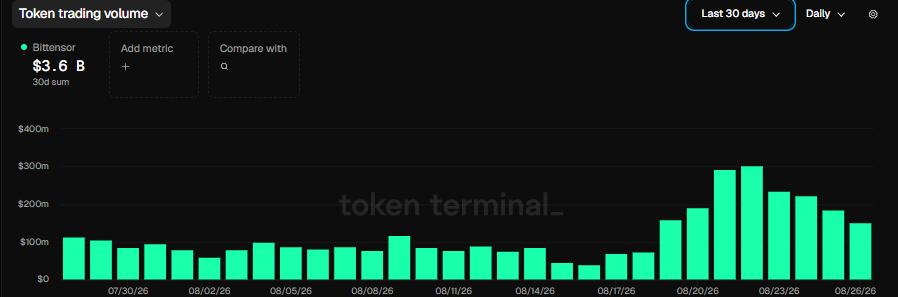
    Additionally, Bittensor expanded its liquidity by more than $600K after the $TAO-USDC pool went live on Aerodrome [AERO]. This means the token is now exposed to Base Chain users. As a result, token trading volume has surged significantly in August, with the average surpassing $300 million in mid-month.

    Source: Token Terminal

    Moreover, there was an organic social growth. The ecosystem was expanding with 128 subnets as of press time.

    In general, the market cap of the AI sector was up slightly, with $TAO being the most standout. Still, this AI narrative resurgence is not convincing enough to trigger a full bull reversal.

    What do $TAO bulls need to trigger a full reversal?

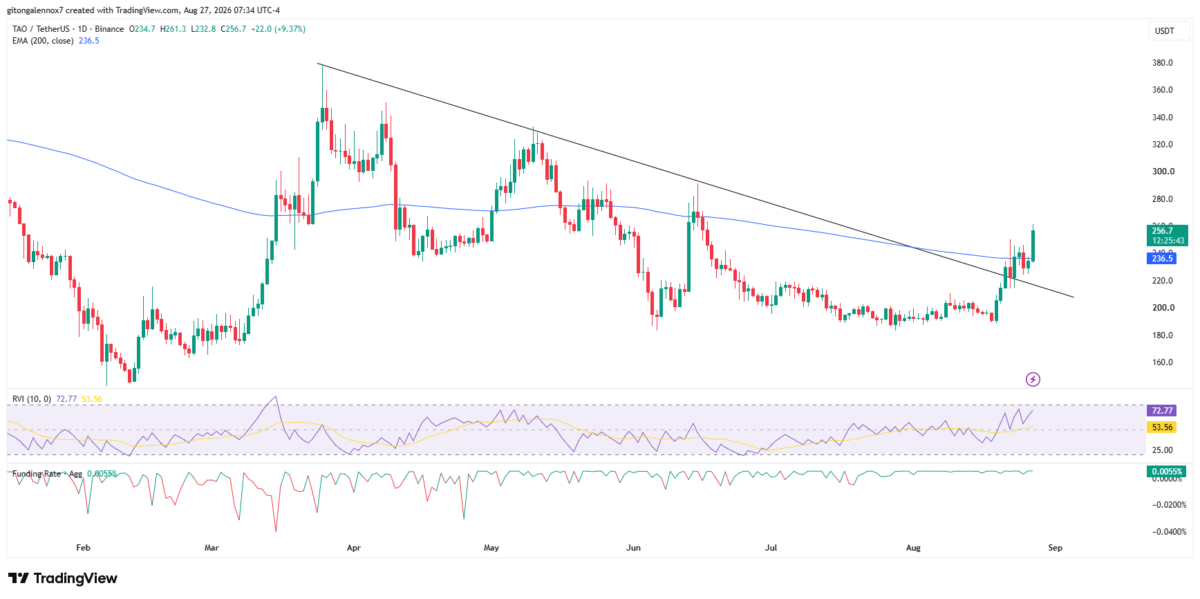
    On the daily chart, $TAO is trading above a descending trendline that has been a resistance since late March. The altcoin has also flipped the 200-day EMA at $236.5, reinforcing the shifting market structure. $TAO’s multi-month trendline breakout was confirmed with a retest at the $225 level.

    At the time of writing, the Funding Rate was also leaning toward buyer dominance with a reading of 0.0055%. Additionally, the Relative Volatility Index (RVI) was at 72.77, indicating volatility was rising with the prices.

    Source: $TAO/USDT on TradingView

    Despite the bullishness in $TAO, an analyst warned that a full reversal hinged on a level in the 3-day chart, noting,

    If $TAO breaches over the $260 range will be absolutely ready to trigger the full bullish reversal.

    If that becomes the case, $TAO may break subsequent levels at $290, $350, or even above $450, as levels above $450 were last visited in November.

    Otherwise, if a rejection happens at $260, $TAO may retest the broken trendline or even trade back into the consolidation pattern.


    Final Summary

    • Bittensor rallied by 10% amid record Q2 earnings for Nvidia, triggering an uptick in the broader AI sector.
    • $TAO cleared a multi-month trendline resistance and confirmed the breakout with a retest.
  • Zcash price reclaims $800 as coinholders vote on major NU7 changes

    Zcash price reclaims $800 as coinholders vote on major NU7 changes

    Zcash price [$ZEC] has returned above $800 as holders consider changes that could impact the network’s speed and issuance.

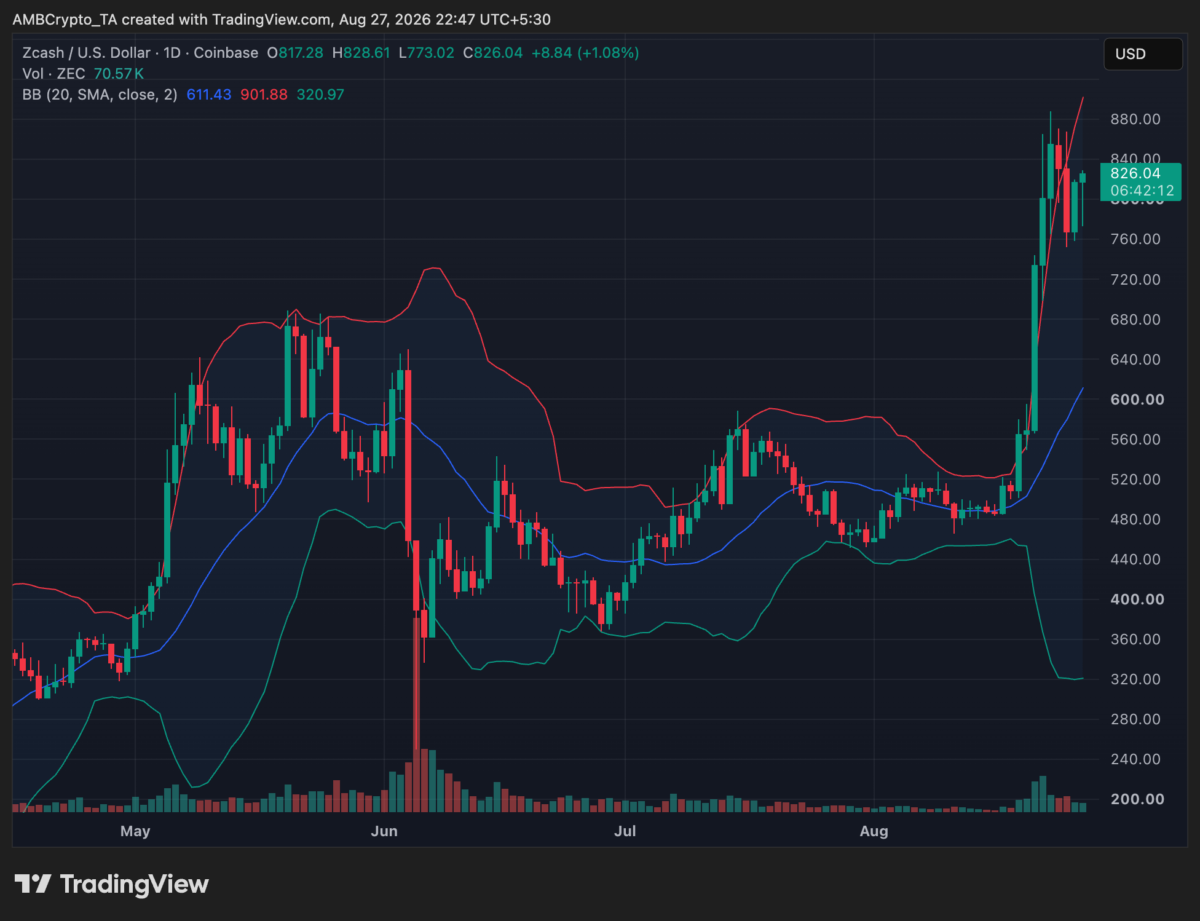
    $ZEC traded near $826 at the time of writing after falling briefly to the $773 level. The recovery comes during a time when it’s seeing a sharp weekly rally, even as the price remains below its recent peak near $890.

    Zcash coinholders weigh five NU7 questions

    The NU7 coinholder poll asks eligible $ZEC holders to vote on five questions concerning Zcash’s next major network upgrade.

    One of the proposals is asking for the current four-year halving cycle to be replaced with a smoother reduction in new issuance. Supporters of this proposal believe that this would give miners and users greater certainty instead of cutting rewards suddenly at fixed intervals.

    Coinholders are also considering whether part of the network’s transaction fees should return to future block rewards. Other questions cover retiring the old Sprout transaction system and allowing NU7 to proceed if some planned features face delays.

    Another proposal would reduce Zcash’s block time from 75 seconds to 25 seconds, which means users would wait less time for transactions to appear on the network.

    Cypherpunk Technologies has published its recommended positions on all five questions. The Zcash-focused treasury company strongly supports faster blocks, citing test results that it believes show the network can handle the change.

    The poll is also advisory, and its result will only show what participating coinholders prefer, but it does not guarantee that every supported proposal will enter NU7.

    $ZEC recovers after falling below $800

    $ZEC’s return above $800 follows a positive move from around $500 within several trading sessions.

    The rally briefly took it towards $890 before sellers stepped in, and then it dropped below $800, reaching $773 during the latest session. But buyers pushed it back to around $826.

    Source: TradingView

    That leaves $850–$880 as the next area to overcome, as a move beyond the recent high could bring $900 into view.

    The first support sits around $780, and if that level fails, the price could return to $750, an area where buyers previously responded.

    There was a lot of trading activity during the initial surge, but it has since reduced. That does not end the rally, but it suggests the latest rebound has led to less activity compared to the move that took its price to $800.


    Final Summary

    • Zcash holders are voting on faster blocks, issuance changes and other NU7 questions.
    • $ZEC recovered from a fall to $773 to around $826, leaving $850–$880 as its next test.

  • Aave V4 Deposits Reach $806 Million After 30% Weekly Gain

    Aave V4 Deposits Reach $806 Million After 30% Weekly Gain

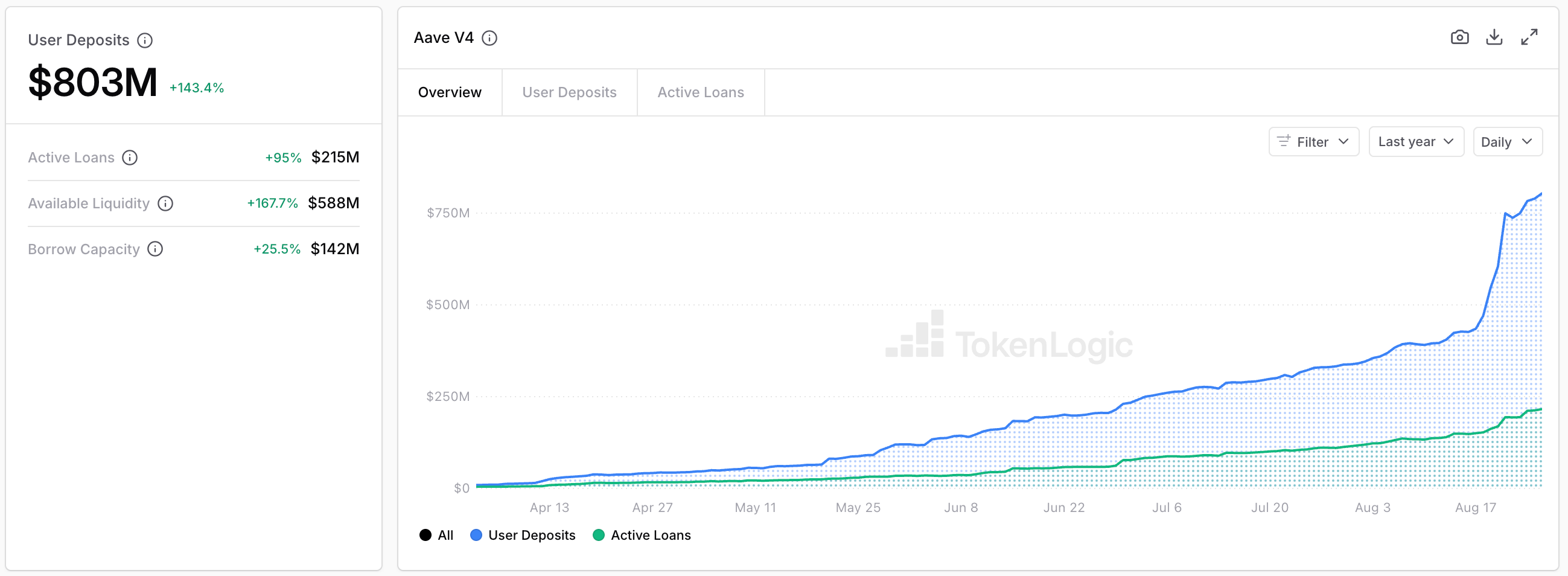
    Aave’s live onchain dashboard listed V4 user deposits at $806 million. Deposits jumped by 30% over seven days and reached a new all-time high above $800 million.

    The latest reading extends a steep August climb. Aave announced that V4 deposits crossed $500 million on Aug. 19 and $600 million on Aug. 21, before moving above $800 million six days later. A separate announcement said Ethereum V4 deposits alone crossed $500 million on Aug. 25. EtherFi Cash accounted for V4’s second-largest current market.

    The market is supporting borrowing as well as deposits. V4 had $216 million in active loans on the dashboard. Aave separately measured $62 million of active loans in the EtherFi market, where weETH collateral backed WETH borrowing at 92% utilization.

    The current market mix includes V4 deployments on Ethereum, Optimism and Avalanche. Ethereum Core held $378 million, followed by EtherFi Cash on Optimism at $257 million, Ethereum Global Dollar at $75 million and Ethereum Prime at $63 million. Avalanche Core and Ethereum Plus accounted for another $18 million and $15 million, respectively.

    The deposit mix was led by weETH at $97 million and USDG at $90 million. WETH and USDC each accounted for $81 million, followed by liquidETH at $77 million, liquidUSD at $58 million and WBTC at $54 million.

    V3 Retains a Far Larger Base

    Aave’s equivalent V3 dashboard showed $31 billion in user deposits, far above V4’s $806 million. Ethereum Core alone held $25 billion on V3.

    The versions organize liquidity differently. Aave’s documentation says V4 replaces V3’s market-per-pool design with a hub-and-spoke system: hubs consolidate liquidity and accounting, while spokes apply separate borrowing rules and risk limits to particular markets.

    On Aug. 27, TokenLogic said the EtherFi Cash market had been live for two weeks and was moving toward a $500 million lending-capacity target.

  • Investors just moved $7 billion into Bitcoin and gold in five days to escape an accelerating dollar crisis

    Investors just moved $7 billion into Bitcoin and gold in five days to escape an accelerating dollar crisis

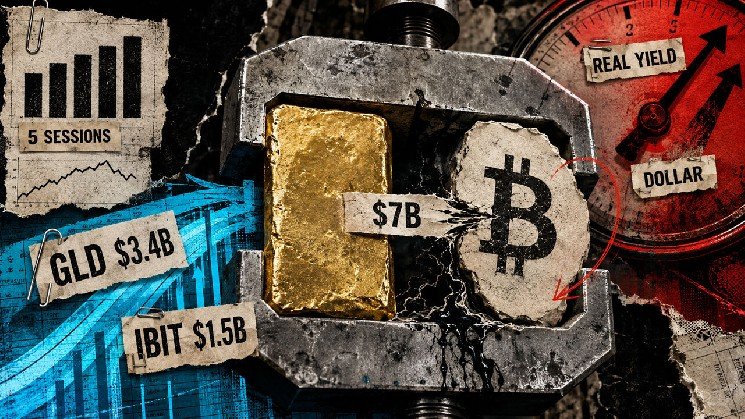
    Gold and Bitcoin exchange-traded funds (ETFs) drew roughly $7 billion over five US trading sessions, a record combined haul that puts both assets at the center of a renewed investor push for protection against currency weakness and mounting fiscal pressure.

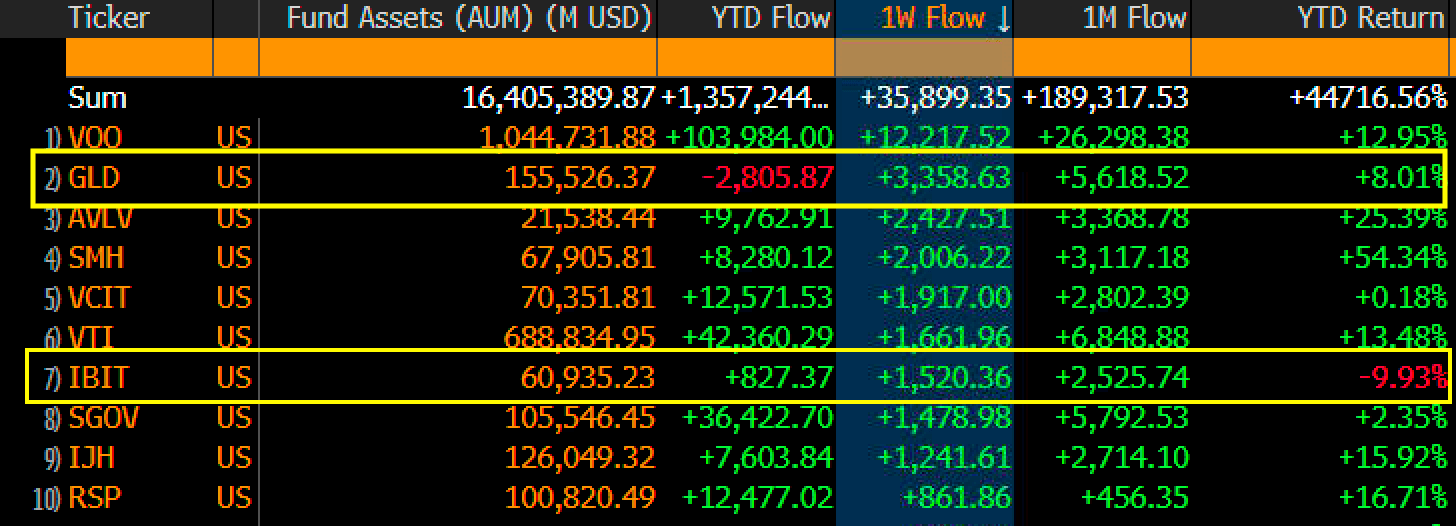
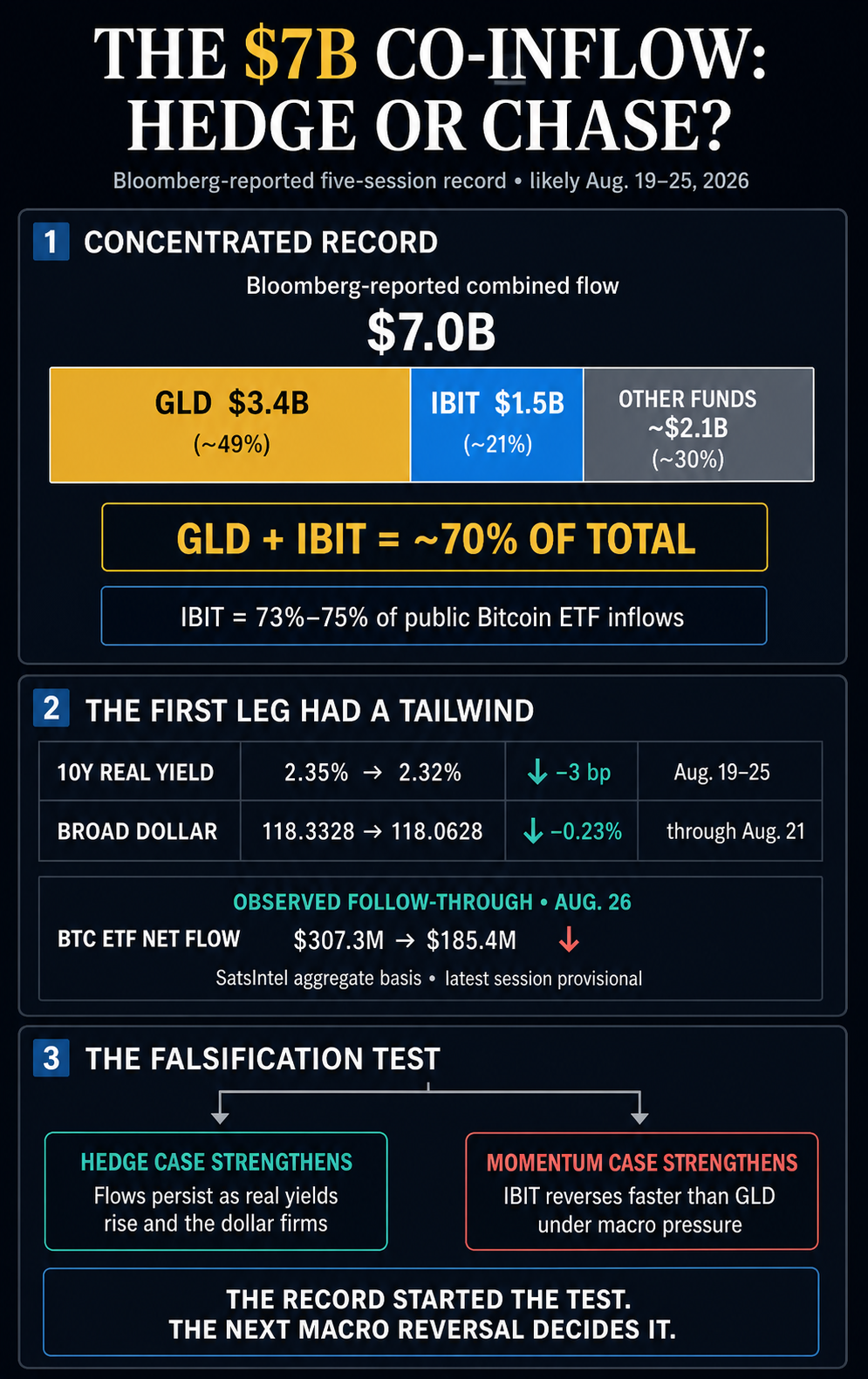
    About $3.4 billion of this capital went into SPDR Gold Shares (GLD) while BlackRock’s iShares Bitcoin Trust (IBIT) attracted roughly $1.5 billion. GLD manages more than $150 billion in assets, while IBIT holds around $60 billion, making each the dominant institutional access point in its respective market.

    Together, the two funds accounted for about 70% of the combined “debasement trade” inflow, showing how strongly the move was concentrated in the largest vehicles.

    Bloomberg Intelligence analyst Eric Balchunas said the five-day total was easily a record for the pair, with both GLD and IBIT ranking among the 10 biggest US ETFs by weekly inflows. He also noted that IBIT’s year-to-date flows had returned to positive territory after recovering from an earlier deficit.

    Top 10 US ETFs by Weekly Flow (Source: Bloomberg)

    The surge came as both assets climbed sharply. Bitcoin broke above $80,000, while gold traded above $4,600 an ounce, extending a move that has increasingly linked the two through the same scarcity narrative.

    Fiscal pressure revives demand for hard assets

    The synchronized buying accelerated as investors focused on US debt, Treasury-market strains and a softer dollar.

    Treasury’s Aug. 19 decision to at least double the maximum size of liquidity-support buybacks for longer-dated securities to $4 billion per operation added to that backdrop. The change helped pull long-term yields lower initially and came with U.S. public debt already above $40 trillion.

    That combination has revived the so-called debasement trade, where investors seek assets with constrained supply as protection against the possibility that persistent deficits and currency expansion erode purchasing power.

    Bitwise Chief Investment Officer Matt Hougan said the attraction partly reflects how traditional portfolios remain fully denominated in fiat money.

    “A 60/40 portfolio is 100% exposed to fiat currency,” Hougan said, arguing that investors are increasingly looking for a modest source of diversification as fiscal uncertainty rises.

    Strive Chief Executive Matt Cole framed the same shift through scarcity, saying dollar debasement expands the pool of capital searching for limited-supply assets and that Bitcoin’s continuing monetization allows it to capture a growing share of that demand.

    Bitcoin’s fixed 21 million supply makes it an obvious candidate for that trade, although it remains far more volatile than gold and has a much shorter history as a defensive asset.

    Market trends are currently moving in the same direction. Charlie Morris, founder of ByteTree, pointed out that both Bitcoin and gold have positively sloping 200-day moving averages and carry ByteTrend scores of 5, the firm’s strongest bullish reading. The dollar, by contrast, carries a score of zero.

    That alignment does not establish why investors are buying, but it reinforces the divergence now visible between scarce assets and the currency against which they are priced.

    Wall Street sees a longer-term scarcity trade

    The stronger argument for the trade is that the pressure may persist even after the latest move in yields and the dollar fades.

    Bernstein said the four-decade decline in interest rates appears to have ended just as sovereign debt burdens have reached record levels, leaving governments more exposed to rising debt-servicing costs. Higher yields can then feed back into larger interest bills, wider deficits and greater borrowing needs, increasing the difficulty of stabilizing public finances.

    The firm expects policymakers facing that tradeoff to ultimately favor currency debasement over prolonged fiscal restraint, which it views as the less politically disruptive path.

    That would strengthen the case for assets whose supply cannot be readily expanded.

    Bernstein said Bitcoin is particularly well positioned because of its fixed issuance, wider institutional and retail access, and a holder base that has historically absorbed severe drawdowns. It estimates about 60% of Bitcoin is held by investors that remained through declines of more than 50%.

    BlackRock has also pushed Bitcoin further into conventional portfolio discussions. In research published this month, the asset manager said historical modeling showed that a 1% to 2% Bitcoin allocation could have improved the risk-adjusted performance of a traditional 60/40 portfolio.

    Those arguments help explain why the latest ETF flows are attracting more attention than another short-term rally.

    Gold already has an established role as protection against monetary and fiscal uncertainty. Bitcoin is increasingly being considered for the same scarcity allocation, but its record remains far shorter and its volatility substantially higher.

    That leaves Bitcoin with a test gold does not face to the same degree.

    If the dollar strengthens or real yields rise and Bitcoin ETFs continue attracting capital, the latest $7 billion co-inflow would look more like a durable shift in portfolio construction than a trade built around favorable macro conditions.

    However, if Bitcoin demand fades while gold remains resilient, the two assets may have benefited from the same debasement narrative without yet earning the same status in investor portfolios.