Category: Business

  • Despite Bitcoin’s Recent Gains, One Analyst Remains Cautious: “I Haven’t Seen What I’m Looking For Yet”

    Despite Bitcoin’s Recent Gains, One Analyst Remains Cautious: “I Haven’t Seen What I’m Looking For Yet”

    While Bitcoin’s recent recovery in the cryptocurrency market has rekindled bullish expectations, Alphractal founder Joao Wedson stated that on-chain data presents a more cautious picture. According to Wedson, the ultimate price bottom of the cycle for Bitcoin may not yet have been reached, and if certain historical indicators are repeating themselves, the BTC price could fall to $53,000 or even lower.

    In his analysis, Wedson specifically highlighted the MVRV Z-Score indicator, which is used to measure investor behavior and the realized value of the market. The analyst stated that on-chain metrics reflect investor behavior, arguing that this behavior is directly linked to periods of euphoria and fear in market cycles.

    Wedson Pointed Out the 2018 Bitcoin Crash

    Wedson compared the current market structure to the 2017-2018 cycle. According to the analyst, the MVRV Z-Score formed three significant peaks during the 2017 bull market before Bitcoin reached its all-time high.

    Wedson noted that after Bitcoin peaked and then declined, the indicator formed a base between approximately 0.25 and 1.16, adding that at the time, a large portion of the market did not expect a new and sharp drop. However, Bitcoin experienced another sharp decline in November 2018, falling to around $3,180.

    According to Wedson, the MVRV Z-Score formed three separate peaks during the 2024-2025 period. However, the analyst stated that the enthusiasm at these peaks was more limited compared to 2017, as the market became more complex than in previous cycles.

    Wedson noted that following Bitcoin’s recent decline after its peak, the MVRV Z-Score formed a base in an area similar to that seen in 2018, but the indicator has recently risen again, with the Bitcoin price following suit.

    “MVRV Z-Score Has Not Yet Fallen into Negative Zone”

    The main risk highlighted by the analyst is that the indicator has not yet reached the negative zone, which has been associated with major cycle lows in Bitcoin in the past.

    Wedson stated that based on the available data, he constantly asked himself the same question: If the MVRV Z-Score needs to go down, will the Bitcoin price follow the indicator?

    According to the Alphractal founder, considering only on-chain data, there aren’t enough signals to be certain that the current decline is the ultimate bottom for Bitcoin.

    Wedson said that for the conditions he is tracking to be met, Bitcoin might need to fall to at least around $53,000 or even lower.

    The analyst specifically emphasized that this assessment was not financial advice, stating that it questioned the data directly, not the current bullish narrative in the market.

    Wedson, recalling that in 2018 too, the majority of market participants did not expect another sharp decline, said that the critical question was whether the current cycle would conclude similarly to past cycles.

    According to the analyst, on-chain indicators at this stage suggest that downside risks have not completely disappeared, rather than definitively indicating that “the bottom has been reached” for Bitcoin.

    *This is not investment advice.
  • Why Bitcoin Crashed After Warsh’s Jackson Hole Speech – and What Happens Next

    Why Bitcoin Crashed After Warsh’s Jackson Hole Speech – and What Happens Next

    Bitcoin’s rally from under $65,000 to over $81,000 faced its first major macro setback after Fed Chair Kevin Warsh delivered a hawkish message at Jackson Hole on Friday. The bigger question now is whether potentially higher rates and rising Treasury yields can derail the impressive market recovery.

    Although $BTC remained relatively stable during the speech, it dumped by $3,000 in hours after its conclusion, slipping below $77,000 for the first time in almost a week. The sell-off extended to essentially all other financial markets, including stocks, precious metals, and other risk-sensitive assets.

    So, What Really Happened?

    Warsh didn’t say directly that the Fed is seriously contemplating hiking the rates, but he didn’t have to. His message was quite clear: inflation remains too high, the US economy is still strong, and the Federal Reserve cannot simply declare victory. Its preferred PCE inflation gauge currently stands at 3.7% YoY, while its six-month annualized rate is even higher at 4.1%. Both remain far above the central bank’s target.

    He emphasized that the Fed’s 2% inflation objective is “firm and fixed” and argued that price stability won’t simply restore itself without additional actions from the central bank.

    He also dismissed some of the most promising inflation readings this summer, including the June numbers, saying they had not convinced him and his colleagues that the underlying trend had improved significantly. Until the Fed reassures that inflation is moving toward 2% “clearly and at sufficient speed,” policymakers will continue to “have work to do,” he added.

    Rate-Hike Odds Rise, $BTC Drops

    Traders had assigned a one-third probability to a rate increase in September before the speech, but these odds jumped toward 60% after its conclusion, according to market pricing cited by Reuters. US Treasury yields climbed again, while the dollar strengthened sharply after its decline last week.

    That’s essentially the exact opposite of the macro environment that helped $BTC explode higher 10 days ago. Perhaps that’s why the asset went from a then-peak of over $80,000 to under $77,000 in a few hours, dragging most altcoins with it.

    Warsh also pointed to business investments growing at roughly 9% per year, the S&P 500 surging by 20%, while unemployment remained at around 4% and credit conditions were relatively easy. In other words, the economy isn’t currently giving the central bank an obvious reason to tolerate elevated inflation.

    In general, higher expected policy rates push Treasury yields upward, which increases the return investors can obtain from the assets that are considered much safer. A more hawkish Fed also tends to support the dollar and tighten broader financial conditions. History shows that such an environment is not ideal for $BTC and more speculative altcoins.

    Treasury and Fed

    Treasury Secretary Scott Bessent’s recent bond-market intervention, which contributed to $BTC’s major rally, helped push long-term yields lower, at least in the short term. However, Warsh reminded investors that the Fed’s mandate is quite different.

    The Treasury might want to reduce borrowing costs and improve market liquidity, but the country’s central bank still has to deal with inflation running above its target.

    This means that markets are still split between two powerful forces: Treasury support for financial conditions and a Fed that may need to keep monetary policy tighter than investors expected.

  • New York Warns of Fake Crypto and AI as Scam Losses Hit $8 Billion

    New York Warns of Fake Crypto and AI as Scam Losses Hit $8 Billion

    Investment Scam Losses Rise 38%

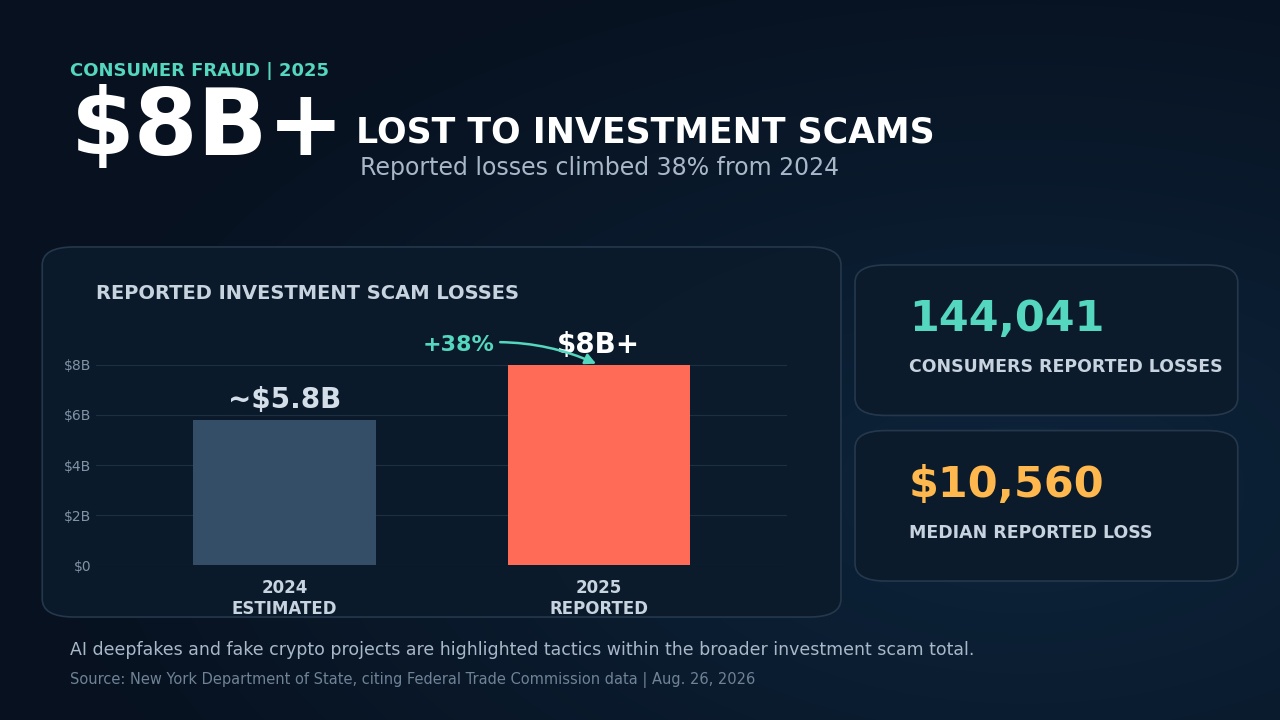
    Investment scams became the costliest fraud category tracked by the Federal Trade Commission in 2025, according to New York officials. The state’s Division of Consumer Protection issued an AI investment scam warning on Aug. 26 after 144,041 consumers reported losing more than $8 billion, a 38% increase from 2024. The median reported loss reached $10,560.

    The schemes can begin through social media, dating apps, text messages, emails, online advertisements, or apparently friendly conversations. The FTC’s own April consumer alert put the same 2025 total at more than $7.9 billion, with a median individual loss above $10,000. That agency listed cryptocurrency alongside stocks and forex among the investments scammers pitch through fake coaching offers.

    Secretary of State Walter T. Mosley cautioned:

    “New Yorkers need to be vigilant against scammers, who may be able to create increasingly sophisticated and realistic messaging using AI technology or other means to steal your hard-earned money. If it seems too good to be true, it probably is.”

    Reported investment scam losses exceeded $8 billion in 2025, up 38% from 2024, while the median reported loss reached $10,560. Chart generated by Bitcoin.com News using New York Department of State figures citing Federal Trade Commission data.

    AI Deepfakes Promote Fake Crypto Investments

    Artificial intelligence allows fraudsters to clone voices, fabricate videos, impersonate financial figures, and produce polished social media advertisements. An April warning from New York Attorney General Letitia James described schemes involving deepfake celebrity endorsements, fraudulent cryptocurrencies, pump-and-dump operations, and fake trading platforms promoted across Facebook, Instagram, and Whatsapp.

    Victims may encounter professional-looking applications that display fabricated balances, returns, and trading activity. Some operators permit small initial withdrawals to establish credibility before pressing targets to deposit larger amounts. Similar tactics have appeared internationally, with Australian regulators recently dismantling 3,106 fraudulent cryptocurrency investment platforms during the 2026 financial year as AI-generated endorsements became increasingly difficult to distinguish from authentic promotions.

    Fake Platforms Build Trust Before Demanding Fees

    A separate Australian case showed how organized groups build an entire fake internet around a crypto investment that does not exist. Investigators detailed counterfeit trading platforms, fabricated news articles, and chatbots posing as support staff, deployed before a woman lost nearly $74,690. Operators may then ask for additional fees before releasing funds, which New York’s alert tells consumers never to pay.

    New York officials advised consumers to confirm the identity of any promoter, verify the company and investment, and establish where their money will go before transferring funds. Common crypto scam warning signs include guaranteed high returns, unsolicited investment offers, high-pressure sales tactics, and projects lacking clear documentation. Anyone who suspects fraud should stop sending money immediately and report it to the FTC, the FBI’s Internet Crime Complaint Center, the SEC, or the New York Attorney General.

  • Hyperliquid’s $249B volume lead – Can HYPE survive the crowd it created?

    Hyperliquid’s $249B volume lead – Can HYPE survive the crowd it created?

    Hyperliquid [$HYPE] is unstoppable, but markets rarely stay that simple. Behind the strong exterior, things are looking shaky.

    Here’s why.

    Hyperliquid is now in a league of its own

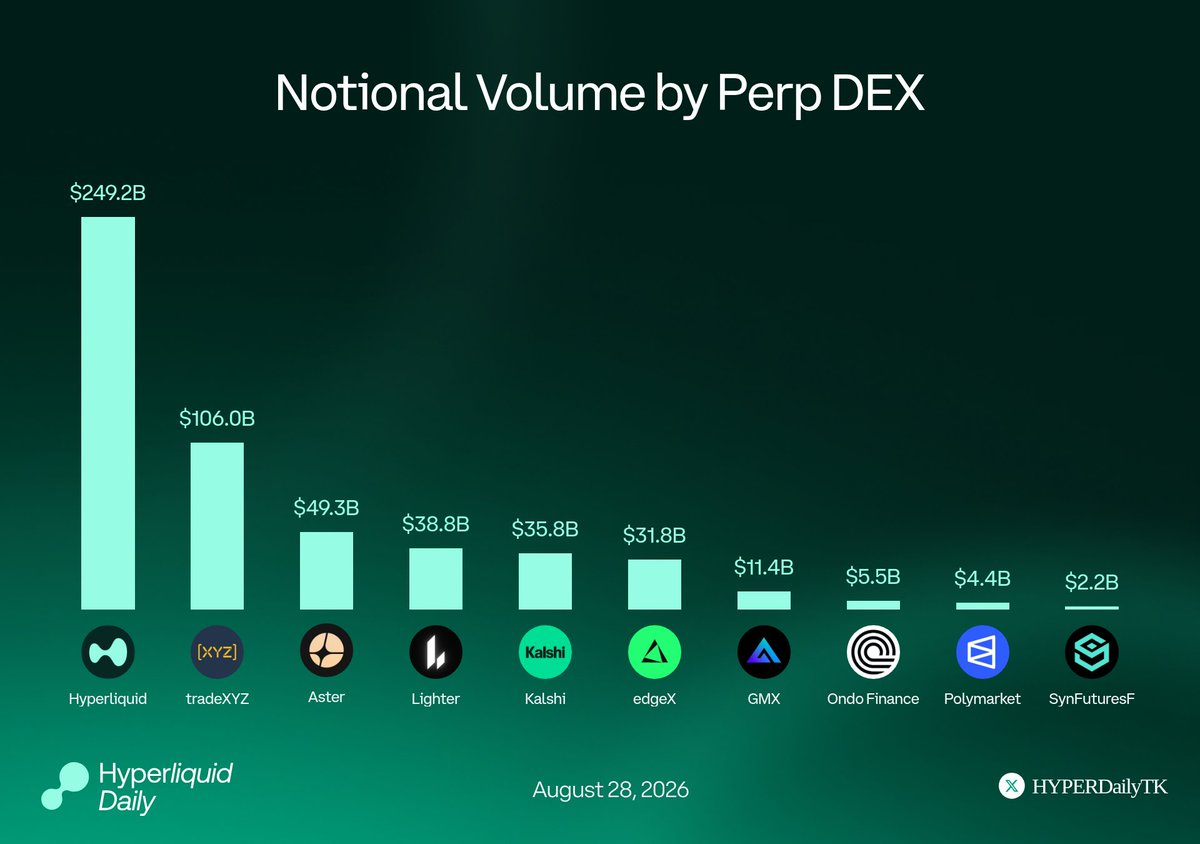
    Hyperliquid’s notional volume is at $249.2 billion. That’s more than double the $106 billion recorded by its nearest competitor, TradeXYZ.

    The gap only gets wider from there.

    Source: X

    Aster was at $49.3 billion, while Lighter, Kalshi and edgeX are all below $40 billion.

    LIquidity tends to attract even more liquidity, and that becomes self-reinforcing real quick. More volume brings deeper markets, and in turn, more traders.

    Hyperliquid Strategies turned $HYPE into a big balance sheet bet

    It’s not just the traders who believe.

    Nasdaq-listed Hyperliquid Strategies more than doubled its $HYPE treasury to 29.3 million tokens. They were worth $1.9 billion at the end of the fiscal year on June 30.

    The company raised $647 million through equity financing. Since then, it has deployed another $773.4 million to buy 16.5 million $HYPE tokens.

    That is a sizeable commitment to a single ecosystem. Most of those tokens are also being staked, so those assets are being put to work for more yield.

    Too many traders on one side?

    Now, it’s not all sunshine and rainbows. We have too many traders leaning the same way.

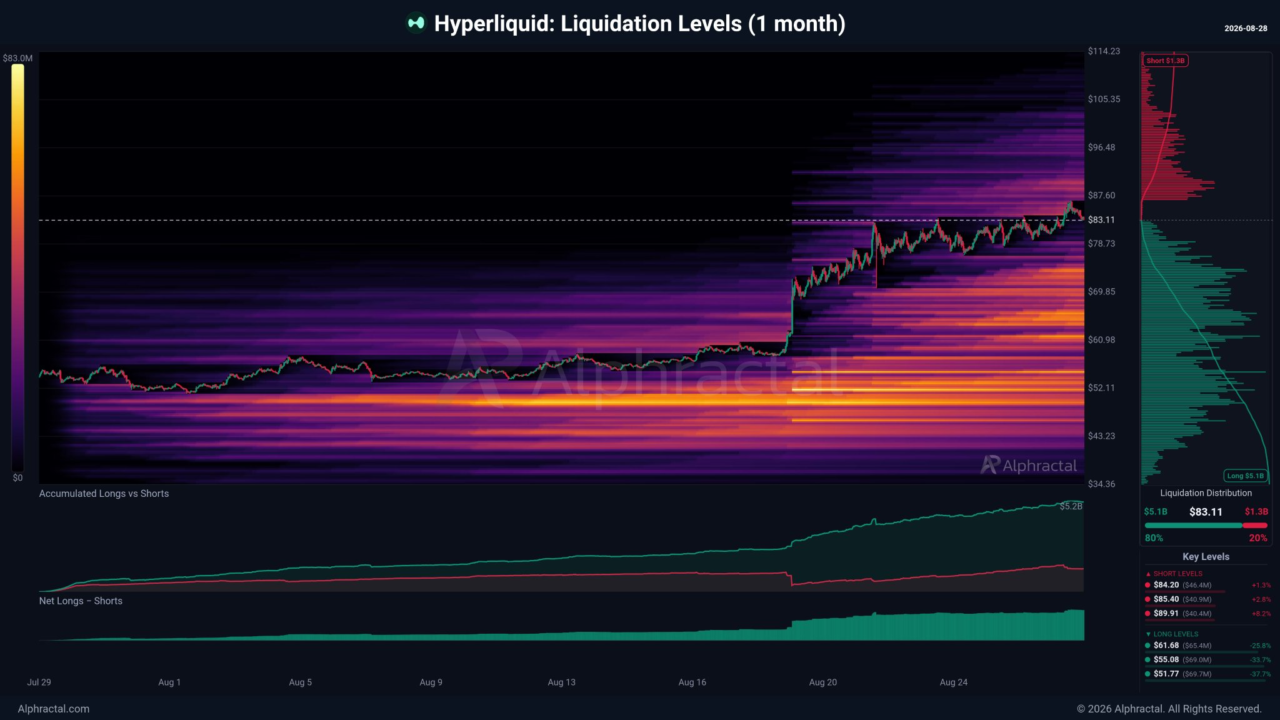
    Over the one-month liquidation window, about 80% of liquidation exposure is on the long side, versus 20% on shorts.

    Source: Alphractal

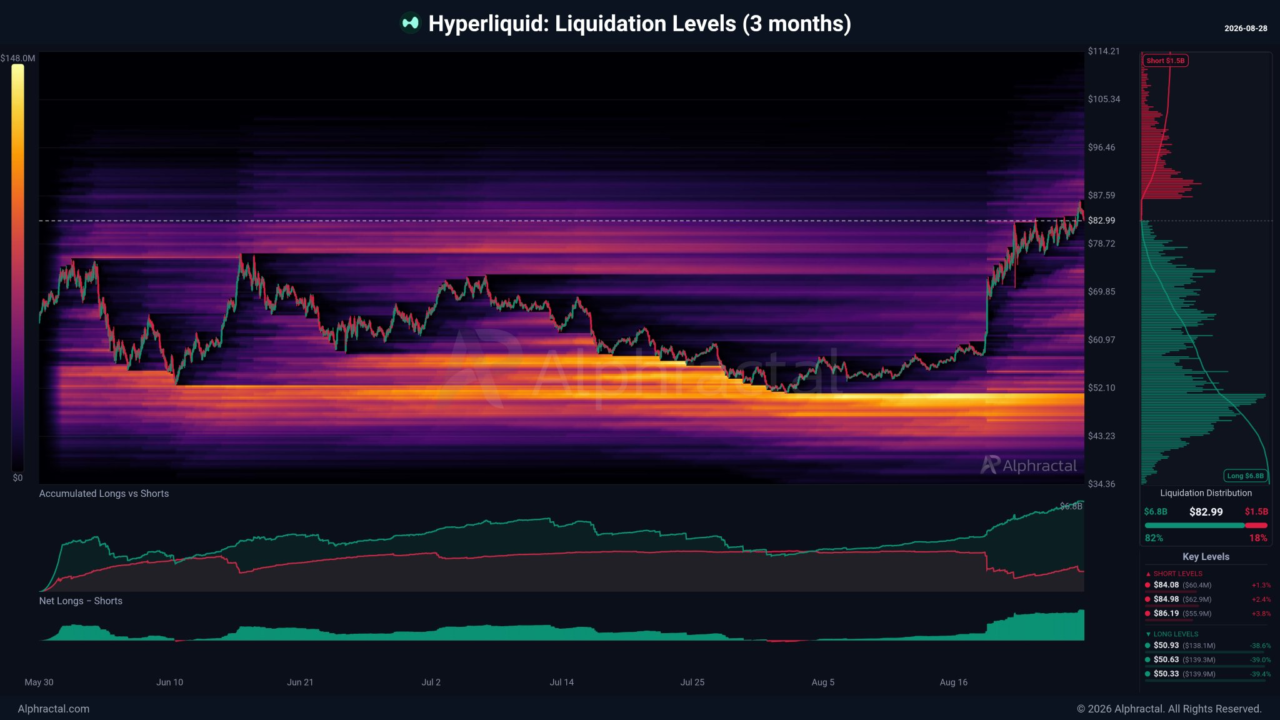
    It’s a lot more stretched at three months: 82% longs and 18% shorts.

    Source: Alphractal

    According to Joao Wedson, CEO of Alphractal, that imbalance may be dangerous.

    A price decline appears to be the more likely scenario.

    The concern is that $HYPE’s success pulled too much bullish positioning into the market. The short-term structure is going to punish late buyers.

    Will we survive a shakeout?

    The next move may matter less than it first appears.

    If $HYPE holds this level, it could be strong enough for another move higher. If too many long positions start closing, price could fall to the lower liquidity levels.

    A yellow fork in the road that’s worth watching.

    Final Summary

    • Hyperliquid leads perp DEX volume; Hyperliquid Strategies holds about $1.9B in $HYPE.
    • If bullish positioning unwinds, things could go south quick.
  • Crypto faces $3.63 billion security crisis despite audited protocols — Details

    Crypto faces $3.63 billion security crisis despite audited protocols — Details

    Almost eight months have passed in 2026, and the frequency of scams is yet to slow down. In fact, in H1 2026 alone, attackers carried out 207 separate hacks.

    And yet, despite the hike in incidents, total losses were just $972 million, less than half of the $2.3 billion stolen during the first half of 2025.

    CoinGecko’s recent report titled ‘2026’s State of Crypto Security’ shed light on the fact that between January 2025 and July 2026, crypto platforms saw 245 documented security incidents. These resulted in $3.63 billion in losses.

    Yearly crypto hack breakdown

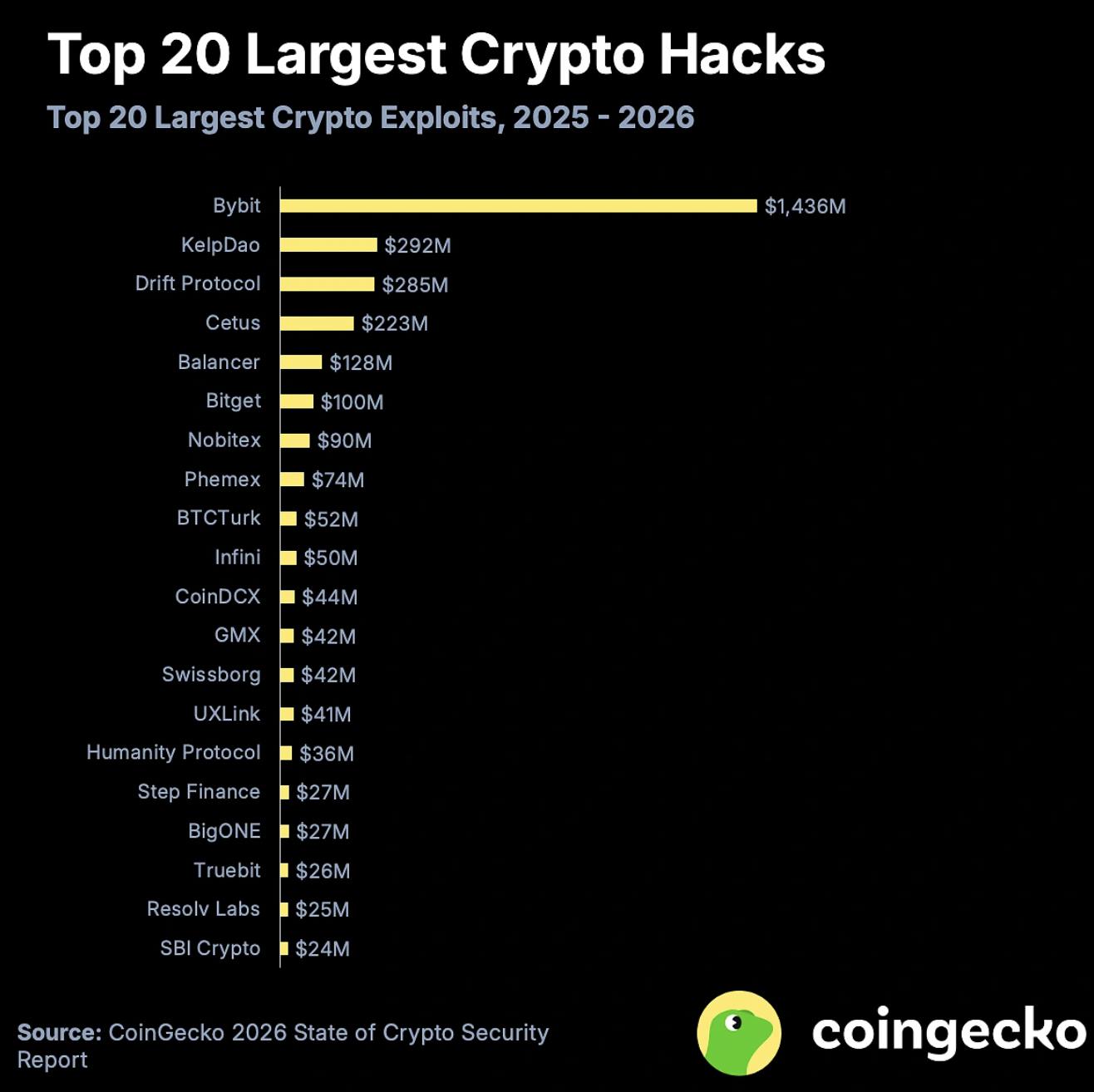
    The damage was so massive that the largest 10 attacks accounted for more than 72.5% of all stolen funds. According to the report, DEXs and dApps faced greater exposure to smart-contract exploits, with around $546 million lost through such attacks.

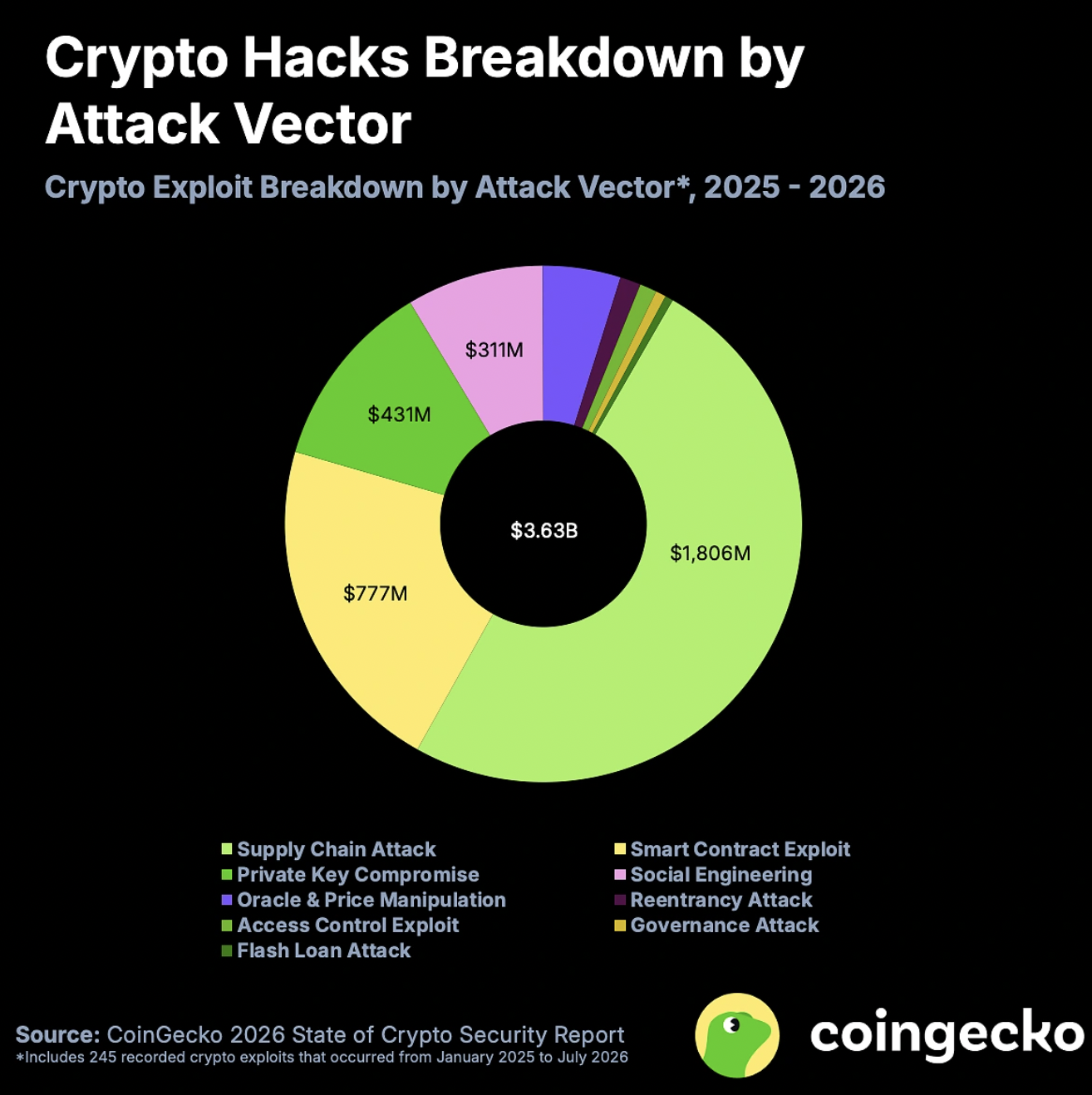
    However, threats increasingly extended beyond core code. Notably, more than $1.8 billion was lost to infrastructure and supply-chain vulnerabilities, including weaknesses in third-party services, integrations, and updates.

    Of these, high-profile case studies included the security failures at Bybit and KelpDAO.

    Source: CoinGecko

    Of the 245 documented incidents, 147 involved audited protocols, which accounted for 88.44% of stolen capital.

    However, only about 11% of these attacks targeted vulnerabilities within the audit’s scope, causing around $396 million in losses. Most attacks exploited areas such as infrastructure, third-party services, governance, front ends, or human error.

    Source: CoinGecko

    What else did the report say?

    Despite the hike in crypto hacks, active insurance coverage fell to 20.2%, from $163.2 million to $130.2 million. This, while cumulative payouts remained around $33 million.

    Here, it must be pointed out that the sector is also struggling to scale, with 5 of 9 on-chain insurance protocols becoming inactive or pivoting by August 2026.

    This, on the back of the SEC revisiting its Custody Rule to clarify who can safeguard customer crypto.

    On 25th August, they submitted proposed amendments to OIRA for review, with publication expected by October 2026, followed by at least 60 days of public comments. However, the rules are not yet effective. A further analysis and a second SEC vote mean mandatory compliance and could still take several years.


    Final Summary

    • Largest 10 attacks accounted for more than 72.5% of all stolen funds.
    • Of the 245 documented incidents, 147 involved audited protocols, which accounted for 88.44% of all stolen capital.
  • How is HYPE’s whale accumulation challenging its $72M institutional transfers?

    How is HYPE’s whale accumulation challenging its $72M institutional transfers?

    A supply battle is in motion across $HYPE’s market, with whale accumulation challenging institutional players. All while spot outflows have been reducing the immediate exchange-side pressure.

    In fact, a new wallet accumulated around 440,000 $HYPE worth $37.26 million from FalconX. In doing so, it generated considerable demand in opposition to institutional transfers.

    Besides, Multicoin Capital deposited 815,885 $HYPE worth $59.8 million into Coinbase Prime over ten days. Those deposits brought in a lot of potential supply as the tokens turned out to be heading towards an institutional exchange venue.

    Within the same period, Bitwise transferred a total of 145,170 $HYPE worth $12.04 million to Hyperliquid. The most recent transfer was 82,580 $HYPE, worth approximately $7.11 million, which was another large institutional move.

    And yet, a significant amount of those flows were absorbed by the fresh whale purchase, strengthening the accumulation side.

    Spot outflows weaken the supply threat

    $HYPE’s broader exchange activity strengthened the demand outlook after recent flows largely favored inflows.

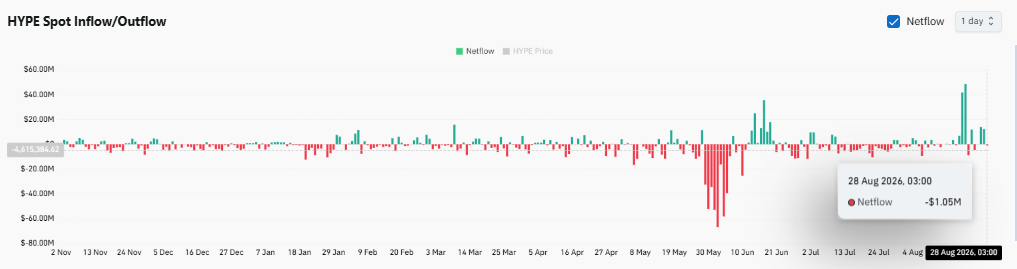
    On 27th August, the positive netflows climbed to approximately $12 million. This suggested that exchange inflows had significantly exceeded withdrawals.

    The most recent reading, however, switched to a spot netflow of -$1.05 million, indicating that outflows surpassed inflows for the period. This reversal helped reduce the exchange supply pressure that accompanied $HYPE’s latest rally.

    Notably, the shift also emerged as a new whale accumulated $37.26 million worth of $HYPE. These developments placed the broader exchange positioning closer to the accumulation side despite sustained institutional deposits.

    However, a negative reading alone would not prove a sustained withdrawal pattern. Sustained outflows would suggest a more pronounced break from the recent inflow-driven pattern.

    Source: CoinGlass

    Can $75-zone keep the breakout structure intact?

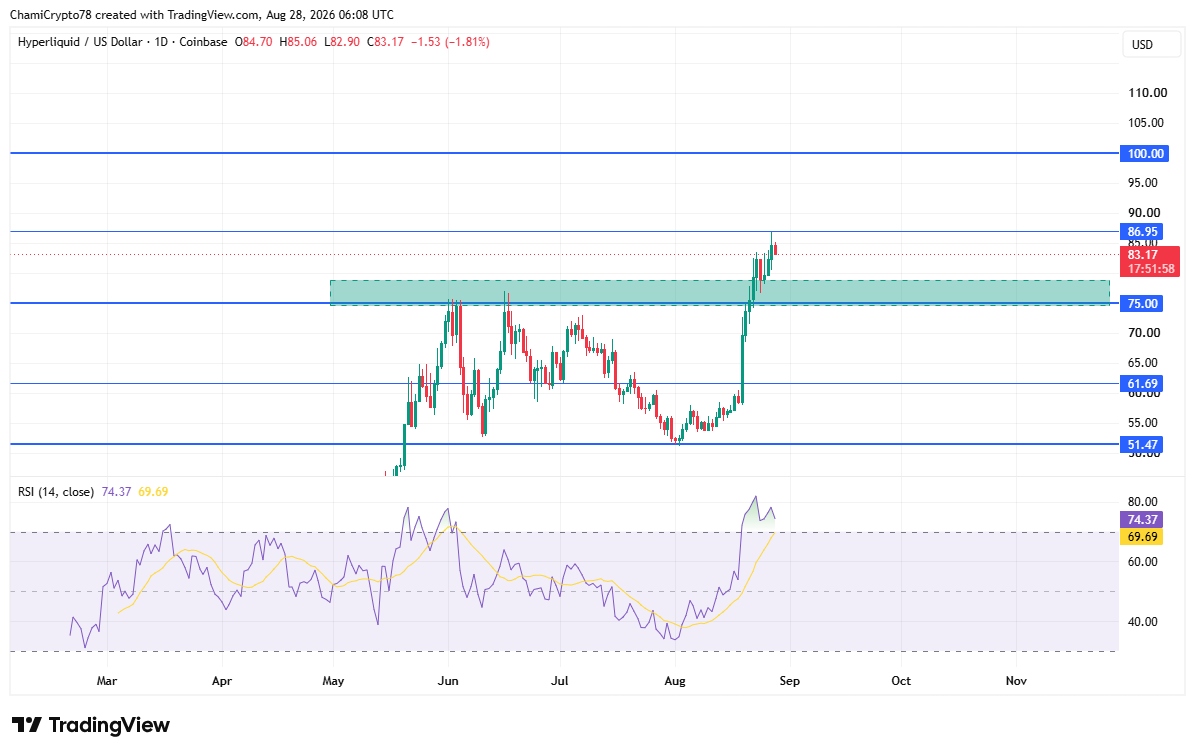
    $HYPE’s overall recovery has remained intact as buyers pushed the token above the $75-resistance level. The altcoin then moved into the previous $75-$79 supply area and drove towards the $86.95-level where sellers, likely profit takers, halted the rally.

    The price then retraced towards the $83.17-level and yet, the pullback remained well above the reclaimed breakout zone. Hence, the former supply zone now represents the key area protecting $HYPE’s bullish structure.

    At press time, the RSI was consolidating around 74.37, placing $HYPE in overbought territory following rapid price expansion. Meanwhile, its RSI average had a reading of 69.69, indicating stretched short-term conditions.

    Rather than immediately invalidating the breakout, cooling pressure could keep $HYPE consolidating above its reclaimed region.

    Renewed buying pressure may then push the price back to the $86.95-area, where the recent advance encountered resistance.

    Source: TradingView

    Liquidity surrounds $HYPE near $83

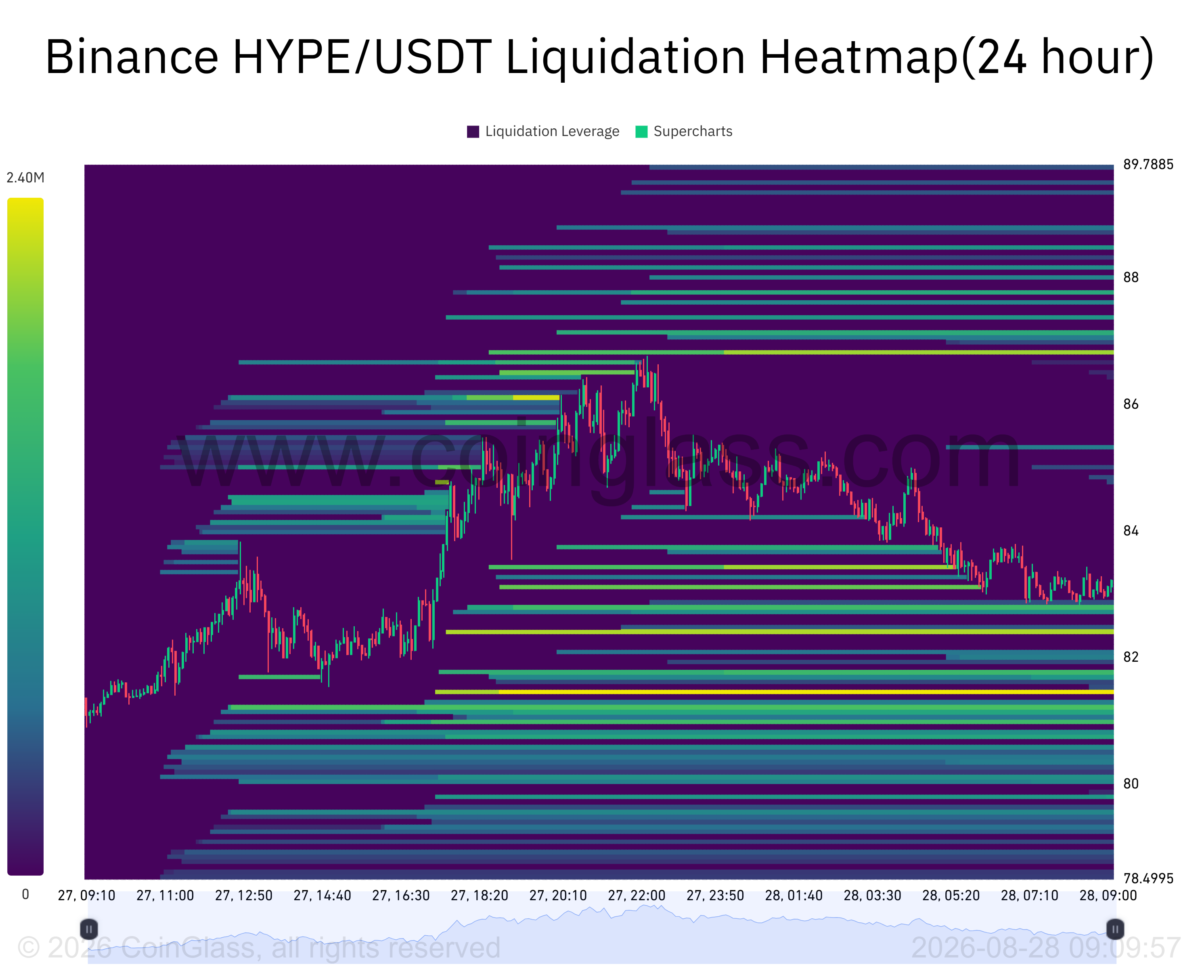
    Binance’s Liquidation Heatmap created further complications as $HYPE rallied from a near rejection at $86.95 to round $83. Notably, significant downside liquidity appeared between approximately $80 and $82.50 price levels, placing a dense cluster below the press time price.

    Meanwhile, another significant formation was building near $86 to $87, just about where the recent resistance band is. $HYPE thus traded between two liquidation areas which could affect its next near-term move.

    A deeper retracement may target the $80-$82.50 zone cluster liquidity before retesting the reclaimed price level area. Alternatively, a stronger buying pressure would bring the $86–$87 liquidity concentration back into immediate focus.

    Most importantly, the upper cluster overlapped with the $86.95-resistance level, making that region particularly important for a price expansion. Clearing this level would help open up the breakout and bring focus to the higher $100-price level.

    Source: CoinGlass

    Final Summary

    • Fresh whale accumulation is absorbing pressure as institutional $HYPE distribution remains elevated.
    • $HYPE held on to its breakout above $75, but overbought conditions could slow further gains.
  • Here’s how TRUMP can hit its short-term price target of $3.60

    Here’s how TRUMP can hit its short-term price target of $3.60

    Official Trump [$TRUMP] is in the news today after it led the market’s top 100 by daily gains with a surge of more than 23%. Its latest rally pushed its weekly gains to more than 64%. All while its daily trading volume surged by 166% too, surpassing the $1.06 billion-mark.

    Hence, the question: When will the rally pause? What’s next for the memecoin’s price?

    Why is $TRUMP’s price rallying?

    One of the key drivers is the expansion of its market reach.

    According to Scott Melker, the $TRUMP memecoin will make its first conference appearance at Korea Blockchain Week. This move will offer $TRUMP exposure to the Asian market, which has driven memecoins like Moo Deng [MOODENG] in the past.

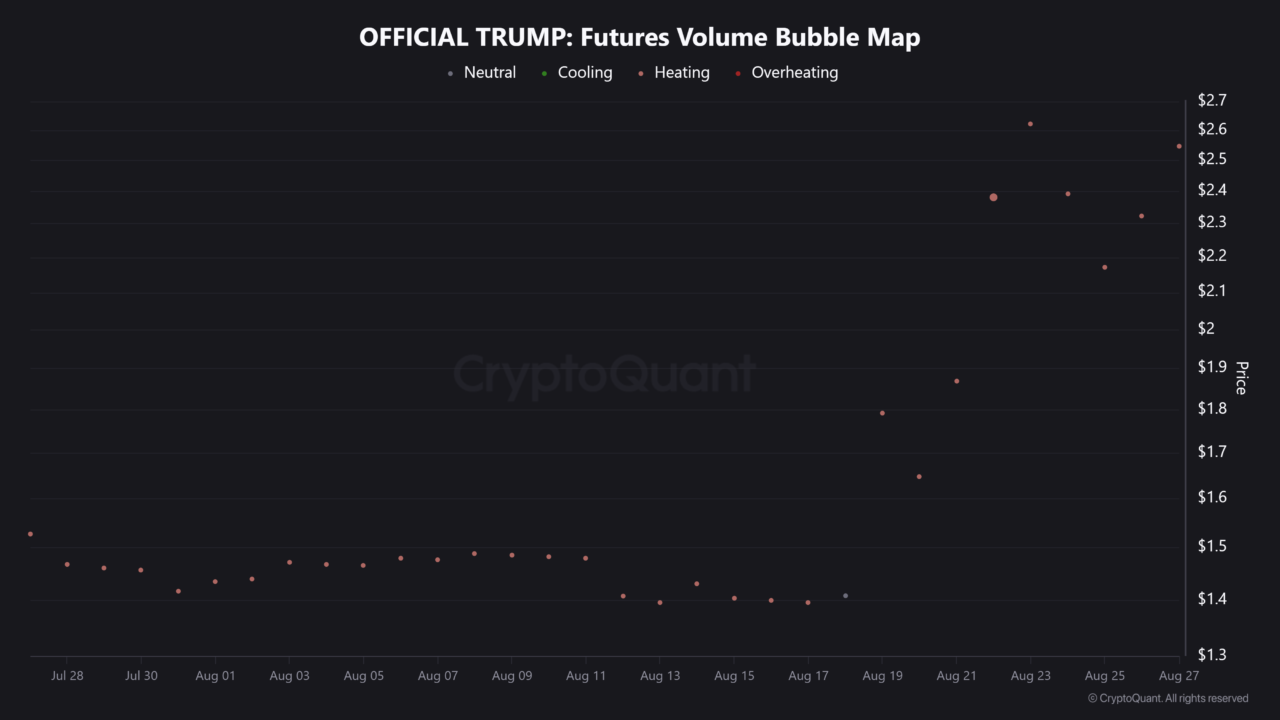
    This debut could supplement $TRUMP‘s trading volume too, with the same increasing across the Futures and Spot markets. In fact, as per the Futures Volume Bubble Map for August, trading activity has risen from neutral to heating.

    Source: CryptoQuant

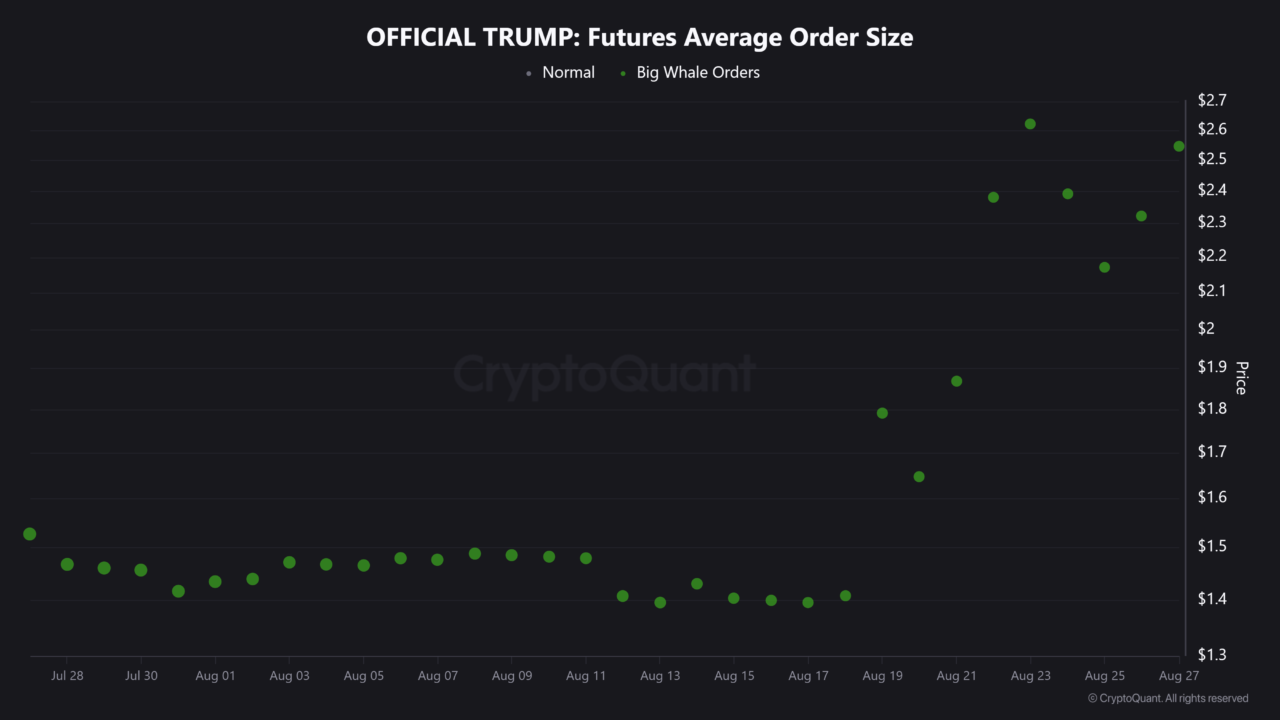
    That’s not all either as whales seemed to be leveraging the memecoin too, rather than buying its spot product. This, because the Average Order Size showed there were big whale positions in the Futures market while the Spot market had normal orders.

    More often that not, when whales buy on the Futures market, it is evidence of leveraging. In fact, 10x, 25x, and 50x leveraged long orders were situated between $2.44 and $2.77, according to Coinglass.

    The Cumulative Short Liquidation Leverage was characterized mainly by 5x and 10x magnitudes.

    Source: CryptoQuant

    However, traders should note that leverage is a double-edged sword. Especially since it can amplify either gains or losses.

    Can $TRUMP bulls clear the sideways range?

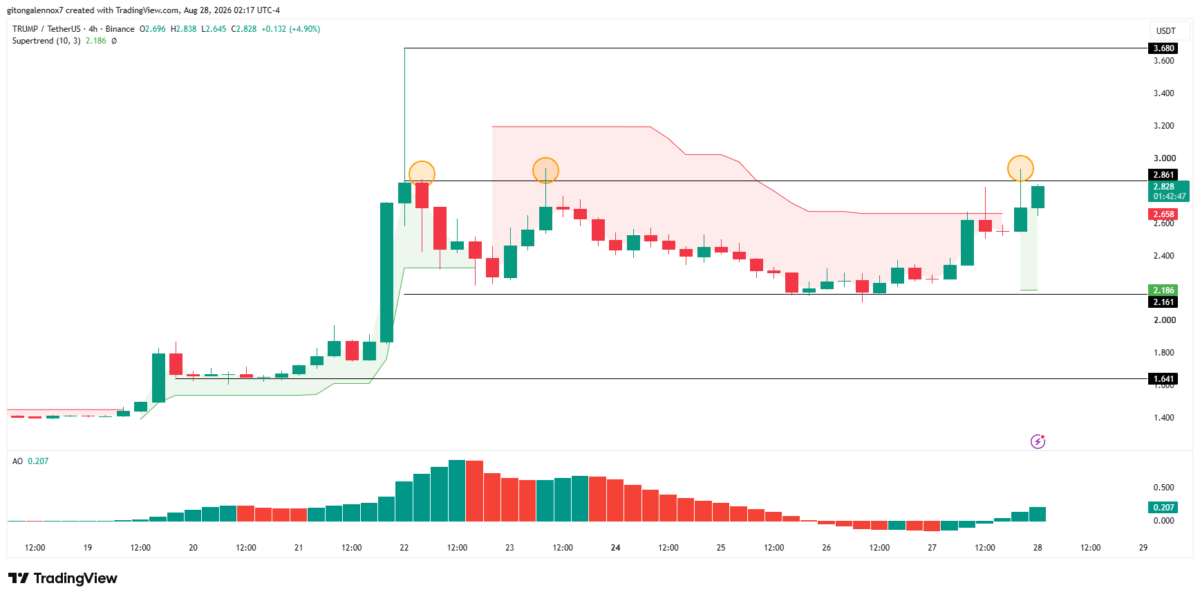
    On the price charts, $TRUMP has been trading around the highs established by the explosive rally that began last week. At press time, the memecoin was trading between the $2.90-top and $2.16.

    The Supertrend indicator flipped from bullish to bearish and back to bullish again, indicating buyers were a little inconsistent. This suggested that $TRUMP could extend its stay in this sideways range.

    However, the Awesome Oscillator (AO) was green with the bars gradually growing bigger, a sign that bulls were still present. If this momentum is maintained, the memecoin may fill the wick above $2.90 to around $3.68.

    Source: $TRUMP/USDT on TradingView

    On the other hand, losing the horizontal level at $2.16 and the Supertrend support at $2.19 could cause $TRUMP to slide below $2. Therefore, traders should watch how the memecoin reacts around the levels confining its movement.


    Final Summary

    • $TRUMP rallied by over 23% in 24 hours, outperforming all top-100 cryptos by market cap.
    • Trading between $2.16 and $2.90, a breakout on either side of the range could define its next move.
  • 12 Years Later, Bitcoin Remembers the Man Who Got There First

    12 Years Later, Bitcoin Remembers the Man Who Got There First

    A Signature Before Bitcoin Had a Price

    Before bitcoin had a massive price tag attached to it, it had its first true recipient. On January 12, 2009, Finney became the first person to receive a bitcoin transaction, when Satoshi Nakamoto sent him 10 $BTC in what is now recognized as the moment digital cash left the whiteboard and became a working network.

    That said, Finney was not some bystander who got lucky but a tech veteran who had already spent decades building the tools Bitcoin would eventually lean on. In the early 1990s, he was an active voice on various cypherpunk mailing lists, the same community of coders and privacy advocates whose ideas fed into Bitcoin’s design.

    He later became the second employee hired by Phil Zimmermann at PGP Corporation, the company behind Pretty Good Privacy (PGP) encryption software, and worked there as a key contributor until his retirement in 2011.

    Moreover, in 2004, years before Bitcoin existed, Finney built Reusable Proofs of Work (RPoW), an early prototype cryptocurrency built on Hashcash that proved out concepts Bitcoin would later formalize.

    A Fight He Didn’t Step Away From

    Finney disclosed his amyotrophic lateral sclerosis (ALS) diagnosis publicly in October 2009, less than a year after receiving that first bitcoin transaction. The disease is progressive and attacks the nerve cells that control muscle movement.

    Finney wrote in March 2013 that he had become “essentially paralyzed,” yet he kept engaging with Bitcoin’s early community through the disease’s advancing stages. When he was declared legally dead on August 28, 2014, in Phoenix, Arizona, at age 58, his family carried out cryopreservation arrangements with the Alcor Life Extension Foundation that had been made years in advance.

    The Satoshi Question That Won’t Go Away

    Finney’s closeness to Bitcoin’s creation, paired with his cryptography background and a Caltech engineering degree, has fueled years of speculation that he was Satoshi Nakamoto himself, or worked closely with whoever was.

    Bitcoin.com News has previously laid out the many facts pointing to Hal Finney being Satoshi, an internal look at the circumstantial case that still gets revisited every time the identity question resurfaces. Finney always denied being Bitcoin’s creator, and no verified evidence has settled the question either way.

    What Ten Bitcoin Became

    The anniversary lands at a notable moment for the asset Finney helped bring to life. Bitcoin’s price crossed $80,000 for the first time since May on August 25, gaining roughly 28% over eight days and briefly touching an intraday high above $81,000.

    At that price range, the 10 $BTC Finney received from Satoshi Nakamoto in January 2009 would be worth roughly $805,000 today, a figure that would have sounded absurd to almost anyone in the room when that transaction first went through.

    Finney never got to see bitcoin’s price reach even a small fraction of where it trades now. But the tools he built, the questions his life still raises about Bitcoin’s origins, and the fact that his name remains the answer to “who received the first bitcoin” mean his imprint on the network hasn’t faded with time.

    Twelve years on, that’s still what people are logging on to remember today.

  • Capital B’s €21 million Bitcoin raise comes with heavy warrant dilution risk

    Capital B’s €21 million Bitcoin raise comes with heavy warrant dilution risk

    Bitcoin treasury company Capital B plans to raise €21 million and use the proceeds, along with operating funds, to buy another 270 Bitcoin.

    The immediate deal would leave the company’s stated measure of Bitcoin backing per diluted share almost unchanged, while four warrants attached to each new share create a larger layer of contingent dilution.

    The company announced a private placement of 36,219,070 shares with attached warrants at €0.58 per unit. That would produce €21.01 million in gross proceeds and an estimated €19.9 million after fees.

    Closing was expected on Aug. 31 at the earliest, meaning neither the shares nor the planned Bitcoin purchase was complete when the deal was announced. Capital B said the proceeds and operating funds could lift its treasury from the 3,145 $BTC confirmed on Aug. 17 to a potential 3,415 $BTC.

    The immediate Bitcoin-per-share math is flat

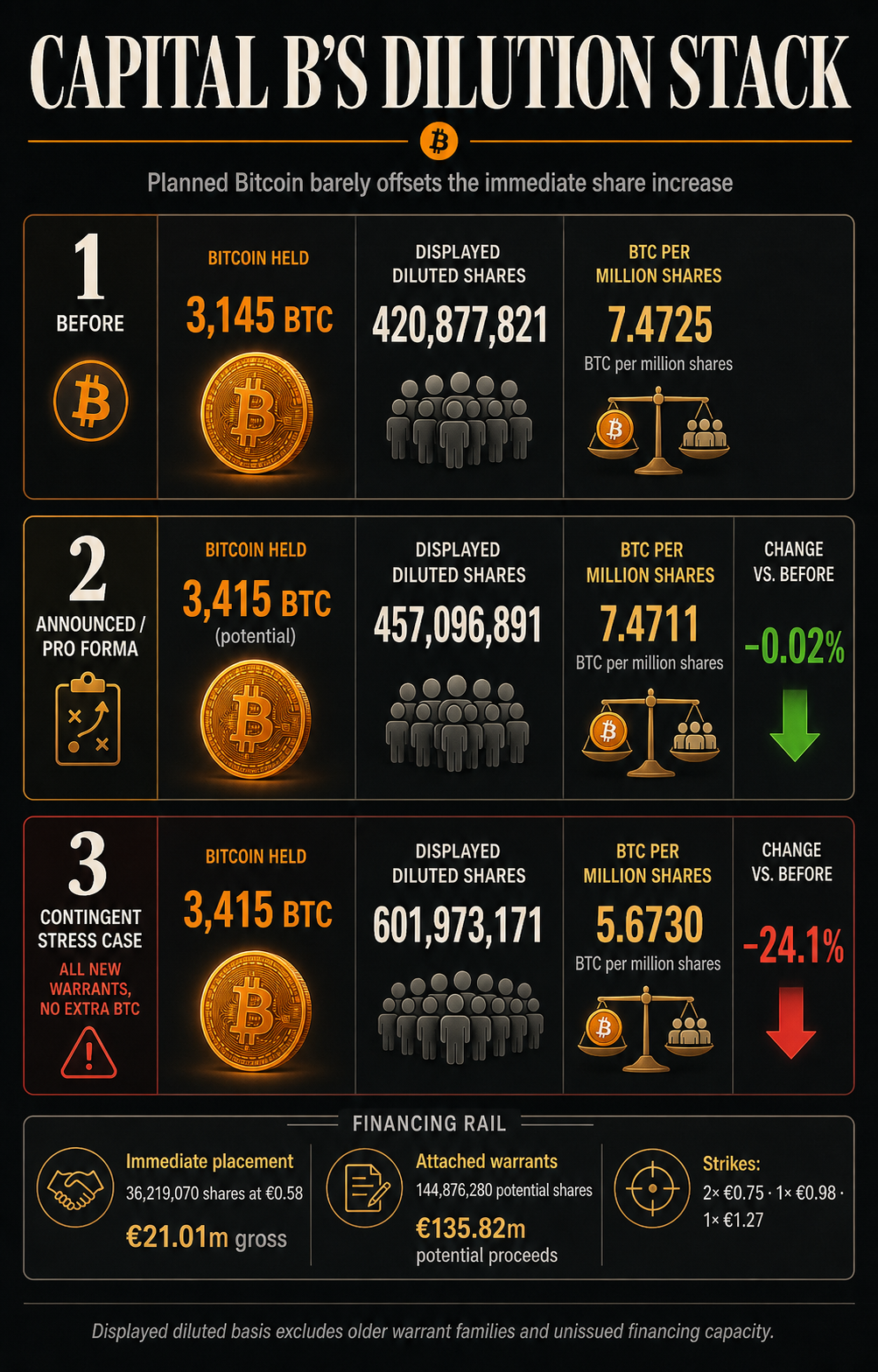
    On the diluted shareholder bases displayed in Capital B’s Aug. 28 release, the company had about 7.4725 $BTC per million shares before the placement. Combining the proposed 3,415 $BTC with the post-placement diluted count of 457,096,891 shares produces about 7.4711 $BTC per million shares.

    That is a decrease of roughly 0.02%, making the immediate transaction effectively flat against the company’s stated objective of increasing Bitcoin per diluted share over time.

    Infographic outlines Capital B’s Bitcoin holdings, diluted share counts, and $BTC per million shares across three dilution scenarios and financing estimates.

    Related Reading

    Bitcoin treasury Strive bought 20 $BTC, but 110,000 new shares left holders with less Bitcoin exposure

    Before the reverse-split adjustment, each new share carries two warrants exercisable at €0.75, €0.98, and €1.27. Full exercise would create 144,876,280 more shares and provide another €135.82 million.

    If every new warrant were exercised and no additional Bitcoin were attributed to those proceeds, Capital B’s potential 3,415 $BTC would be spread across 601,973,171 displayed diluted shares. That equals about 5.6730 $BTC per million shares, 24.1% below the pre-placement ratio.

    The five-year warrants are contingent on investors choosing to exercise them, so the associated shares and cash have not been received.

    An investor holding 1% before the placement would fall to 0.9% on the ordinary post-placement basis and 0.72% on the company’s diluted basis without participating. Full exercise of the new warrants would reduce those figures to 0.65% and 0.55%, respectively.

    The issuer also says its displayed diluted calculation excludes older BSA families, specified warrants attached to convertible bonds and unissued capacity under a €300 million TOBAM program. Those items sit outside the 24.1% scenario.

    In June, shareholders had authorized much broader financing capacity, including up to €5 billion of capital increases and €100 billion of credit instruments.

    The Aug. 28 placement is a priced example that the proposed Bitcoin only matches the immediate share expansion, while the attached warrants determine whether the longer-term ratio improves or falls.