Public blockchains create a privacy problem. Paying from a visible address can expose its balance, previous transactions and links to other addresses. A shielded Zcash payment hides the sender, recipient and amount from the public record, allowing a customer to pay without handing the merchant or anyone watching the blockchain a searchable trail into their finances.
Zcash block times
Blocks are batches of transactions that miners add to a blockchain, and a payment receives its first confirmation when it appears in one. Cutting Zcash’s target block time would let an exchange or bridge that waits for a fixed number of confirmations release $ZEC in about one-third the time.
At a shop counter, it would still be slower than tapping a card, but the shorter wait makes a direct private payment more practical, in the view of Zcash’s developers.
Producing three times as many blocks would not create three times as much $ZEC, however. The proposal divides the reward paid with each block by three and extends the halving interval from 1.68 million blocks to 5.04 million, leaving issuance over time largely unchanged.
NU7 would also introduce Zcash’s Network Sustainability Mechanism.
Roughly 60% of transaction fees would be temporarily removed from circulation, rather than paid to miners, under ZIP-235. Those coins are intended to return through block rewards beginning in February 2031, adding to miner income as Zcash’s regular issuance falls through successive halvings.
Celo has added support for local currency payments for AI agents through its native x402 facilitator. The update allows agents on the network to use Ripio’s wARS, wBRL and wCOP tokens for payments in Argentine pesos, Brazilian reais, and Colombian pesos.
Celo Core Co., the team developing the Celo blockchain, launched the native x402 facilitator on July 16. The company says the new support can help agents make payments without converting local currencies into dollar-based stablecoins.
The change is aimed at reducing foreign exchange exposure for users who allow AI agents to make transactions on their behalf. Agents can operate with the same currency as their owners, while businesses and developers can also charge for services, data, and APIs in local currencies.
Ripio, a Latin American digital asset company, issues the wFIAT tokens used for local currency payments. Its assets are backed by currencies, including the Argentine, Brazilian, Mexican, Colombian, and Chilean pesos, as well as the Peruvian sol.
Celo currently supports 20 currencies across 33 stablecoins. The company said support for wMXN, wCLP, and wPEN is planned for the future. Since its mainnet launch in 2020, the network has processed more than 1.4 billion transactions, driven by payments, remittances, commerce, and DeFi.
South Korean blockchain infrastructure company DSRV has joined $XDC Network as an institutional masternode validator. The company has been running a node on the network’s mainnet for about a month and will now take part in its consensus layer. $XDC Network is a blockchain focused on trade finance and enterprise use cases. Its validator set already includes companies such as HashKey, Deutsche Telekom, Clear Street, and CertiK.
DSRV provides blockchain infrastructure and digital asset services. The company manages close to KRW 4 trillion in digital assets and operates validator nodes across more than 70 networks. It is also registered as a Virtual Asset Service Provider with South Korea’s Financial Intelligence Unit.
In July, DSRV and SBI $XDC Network APAC agreed to jointly explore blockchain applications for businesses in Japan and South Korea. DSRV’s addition as an $XDC Network validator is the first result of their cooperation. The companies will also explore blockchain applications in trade finance, supply chain management, and asset tokenization.
Crypto asset management company Grayscale assessed that the impact of the US Federal Reserve’s (Fed) recent interest rate hike on the cryptocurrency market may be limited. The company viewed this move as an interim adjustment within the current economic cycle, noting that it does not signify the beginning of a new interest rate cycle.
Grayscale pointed out that a similar interest rate hike occurred in 1997. According to the company, the 1997 interest rate increase had a limited impact on asset markets. Based on this historical example, it was stated that the latest interest rate increase is not expected to lead to a large-scale change in the cryptocurrency market.
However, the company stated that investors should focus more closely on stablecoin issuers. Grayscale’s assessment highlighted companies like Circle and Tether, primarily because interest income from reserve assets constitutes a significant portion of their revenue structure.
Rising interest rates can contribute to increased interest income earned by stablecoin issuers from the assets they hold in their reserves. Therefore, there can be a direct correlation between the profitability of these companies and interest rates.
Grayscale’s assessment indicates that the Fed’s monetary policy decisions do not affect all actors in the crypto market in the same way. While changes in interest rates can affect the pricing of Bitcoin and other risky assets, stablecoin companies managing large reserves may have a different revenue dynamic.
The company stated that in assessing the impact of the recent interest rate hike on crypto assets, macroeconomic conditions as well as developments in the stablecoin sector should be monitored.
Avalanche’s Helicon upgrade is scheduled to give validators shorter, auto-renewing commitments while raising the uptime cutoff for rewards and reducing returns at the shortest durations.
The network upgrade is set to activate on Avalanche Mainnet on Sept. 22 at 15:00 UTC. Validators must install AvalancheGo v1.15.0 beforehand to remain compatible with the upgraded chain.
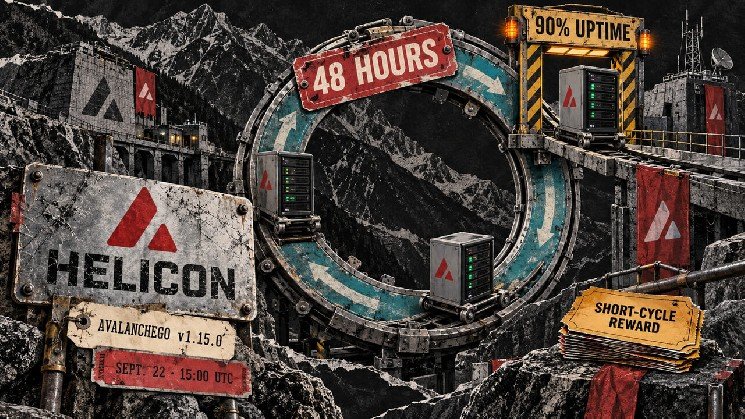
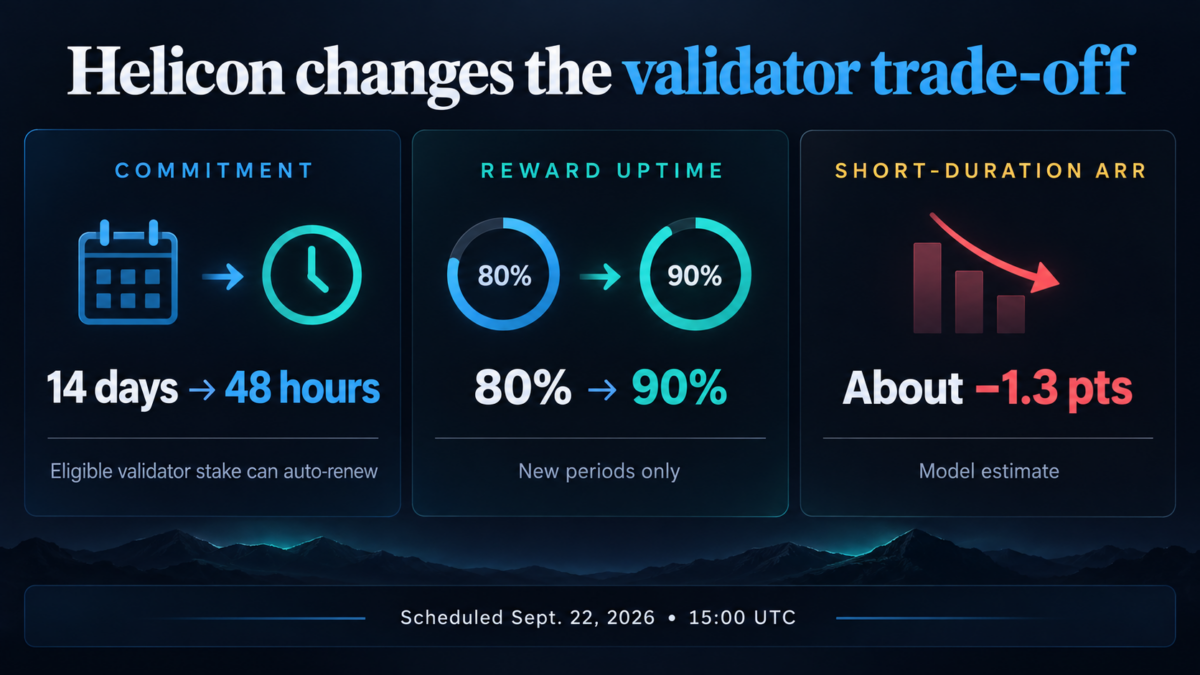
Infographic shows Helicon reducing validator commitments from 14 days to 48 hours, raising reward uptime to 90%, and lowering short-duration ARR by 1.3 points.
What changes for validators
Helicon will cut the minimum Primary Network validation period from 336 hours to 48 hours. It will also let eligible validators automatically begin another cycle when the current one ends, reducing manual signing work and potential reward gaps from repeatedly leaving and rejoining the validator set.
Operators can choose how much of each cycle’s reward to compound into the next one and can update the configuration for a future cycle. That creates a way to combine brief capital commitments with continuous validation, instead of choosing between a long lockup and repeated manual restaking.
The feature applies only to the validator’s own stake. Delegations will not auto-renew, and each delegation must fit inside one validator cycle because the validator is not guaranteed to continue beyond that boundary.
Validation periods that start on or after Helicon activation must achieve at least 90% uptime to earn rewards, up from 80%. The rule is not retroactive: periods that began before activation remain subject to the existing 80% requirement even if they extend beyond Sept. 22.
Avalanche’s uptime measurement will not change, and rewards will remain all or nothing. Falling below the applicable threshold forfeits the full reward for that period, though the validator’s principal is not slashed.
For a validator using auto-renewal, missing the threshold has an additional consequence. The position will not roll into another cycle, and the validator will exit. Its principal and rewards accrued in earlier cycles are returned, but the failed cycle’s reward is lost.
Short cycles reduce how long capital is committed, while the higher threshold raises the operational reliability required to collect each cycle’s reward and continue automatically. For operators, that links continuity to cycle-by-cycle performance without changing how Avalanche measures peer responsiveness or adding a partial-reward buffer.
How short-duration Avalanche rewards change
Helicon will also begin a 90-day adjustment to Avalanche’s reward curve. The protocol’s minimum consumption rate, an input that helps determine staking rewards, is scheduled to decline linearly from 10% to 7.5%. The maximum rate at the one-year duration will remain unchanged.
Avalanche’s modeling estimates that this adjustment will reduce the annualized reward rate at the shortest duration by about 1.3% after the phase-in. The exact realized yield will remain variable because it depends on factors including $AVAX supply, duration, and compounding choices.
The same modeling projects annual $AVAX inflation falling by roughly 0.5% to 1% and the stake-weighted average duration increasing by about two months. Those outcomes are estimates depending on how validators and delegators respond.
The mechanical trade-off is more certain: Helicon makes short, renewable validator commitments easier to use, but sets a lower reward at the short end while preserving the one-year rate and demands more reliable uptime for new validation periods.
Ripple has expanded its $XRP Ledger developer kit to support a payments standard created by Stripe and Tempo, giving builders another way to make AI agents pay for data, computing and other online services using crypto.
Version 1.1 of the XRPL AI Starter Kit adds support for the Machine Payments Protocol, or MPP, and the Open Wallet Standard, which lets software manage wallets across multiple blockchains through a common interface, according to a RippleX developer post.
“Our job is to make $XRP and $RLUSD first-class options wherever developers are building,” RippleX head of product Jazzi Cooper wrote on X. $RLUSD is Ripple’s dollar-pegged stablecoin.
Ripple added support for x402, another standard for web payments, in June and MPP now, backing both rather than betting on either.
MPP gives an AI agent, software that can carry out tasks on a user’s behalf, a way to pay as it works. A service responds to a request with a price, the agent authorizes payment, and the service delivers the requested resource. Payments company Stripe and Tempo, a blockchain built for payments, co-authored the standard.
Why the release matters
An AI agent buying data or computing power needs a currency the seller accepts and software that can send it. Ripple wants $XRP and $RLUSD among those choices as developers build services that charge machines for each request.
Bitwise CIO Matt Hougan stated that the upward trend in Bitcoin’s price could continue as long as debt-related concerns do not ease. Hougan supported his assessment with a chart he shared on social media platform X, highlighting the relationship between market developments and Bitcoin’s performance.
According to Hougan’s chart, between July 1st and September 15th, the probability of the US Clarity Act being passed this year dropped from 39% to 18% in the Polymarket. During the same period, the price of Bitcoin increased by 38%.
The data reveals that expectations regarding regulatory developments in the cryptocurrency market are not aligning with Bitcoin’s price movement. Hougan stated that, based on this picture, concerns about the US debt outlook have become a significant factor in market pricing.
The Clarity Act is one of the legislative proposals aimed at clarifying the regulatory framework for crypto assets in the United States. Its progress through the legislative process is influenced by procedural votes in the Senate.
A previous cloture vote in the US Senate failed to secure the necessary support to move the bill to the next stage. The cloture procedure aims to end discussions on a bill, paving the way for it to be considered in the Senate General Assembly.
Hougan’s assessment suggests that Bitcoin’s recent performance is linked not only to developments specific to the crypto sector, but also to broader macroeconomic factors such as the US fiscal outlook and investor debt concerns. However, the future trajectory of Bitcoin’s price depends on numerous different market conditions.
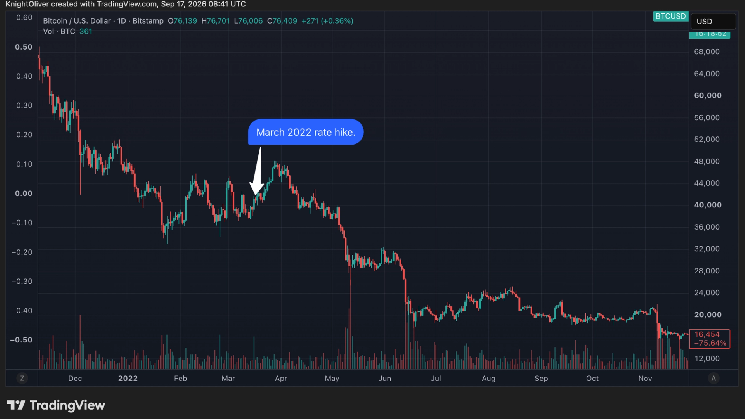
Following the initial March 2022 hike, bitcoin rallied roughly 18% over the following 12 days before subsequently falling around 50%. That raises the possibility that another relief rally could give way to a prolonged bear market. However, one comparable cycle offers limited evidence, and bitcoin’s decline in 2022 coincided with losses across equities, bonds and metals, alongside turmoil within the crypto industry.
The reasons the Fed hiked rates on Wednesday was due to inflation, annual headline inflation has remained above 2% for over five years, although core inflation, which excludes food and energy, has eased to 2.4%, its lowest level in five years. So progress is being made.
However, that progress has now been faced with an energy shock. Geopolitical tensions in the Middle East have pushed both WTI and Brent crude well above $100 a barrel, threatening to reignite inflation and squeeze growth. Global bond yields have also climbed, with the U.S. 10-year Treasury yield reaching 5%, adding further pressure to financial conditions and risk assets.
Bitcoin’s bear market is approaching the one-year mark. Could a new rate-hiking cycle prolong the downturn?