Polymarket has announced the launch of Protocol V2, set for a full mainnet switchover on November 2. This upgrade replaces the outdated Gnosis CTF foundation and aims to streamline operations by consolidating various market types. The news comes from CryptoTwitter commentator @WuBlockchain, highlighting significant advancements in Polymarket’s infrastructure and capabilities.
Key Details
Polymarket’s Protocol V2 replaces its 2019 Gnosis CTF foundation. The full mainnet switchover is scheduled for November 2. The upgrade features a single ERC-1155 position contract and uses pUSD as collateral. It supports a multi-oracle aggregator, including UMA and Chainlink. The system will undergo testing through canary markets from October 5 to 30. Protocol V2 is formally verified by Certora and heavily audited.
The Numbers
Currently, Polymarket is experiencing low trading activity with a 24-hour volume of $0, reflecting cautious sentiment as traders await the new protocol’s launch. The integration of cross-chain bridging and a modular design could potentially attract more users and increase liquidity once fully operational. The overall market context remains volatile, compelling traders to keep a close eye on upcoming developments.
Open interest measures outstanding futures exposure, but assessing the vulnerability of those positions also requires information about account leverage and collateral.
The remaining exposure was still near the upper edge of Glassnode’s statistical range. Long-side funding payments rose from $926,400 to $1.5 million, showing that the contraction in open interest coexisted with stronger demand for bullish perpetual exposure.
How recent activity changes the risk picture
Glassnode’s March 2025 Market Pulse glossary describes Hot Capital Share over a three-month window.
Separately, its realized-cap age-band methodology values coins at the price when they last moved, and divides each band’s value by total realized capitalization. The denominator represents the combined last-movement value of the coin supply.
When older coins move, their age resets and their realized value updates, so an established holder can reactivate dormant coins and increase recent-coin economic weight. Activity alone cannot identify first-time investors or fresh fiat deposits.
The supply ratio divides short-term-holder coin supply by long-term-holder coin supply. At 14.2%, it means about 14.2 units of short-term supply for every 100 units of long-term supply.
Glassnode’s holder classification groups addresses into entities and smooths their entity-average holding-age classification around a 155-day midpoint, excluding exchange balances.
Younger cohorts tend to spend more readily during volatility. Their growing relative presence supports continued price sensitivity, while leaving the timing and direction of future spending open.
The report’s spot cumulative volume delta, the balance between buyer- and seller-initiated trades, changed from negative $102.8 million to positive $33.2 million. The measure tracks trading aggression, so its improvement indicates a shift toward buyers without quantifying new investor capital.
Whether continued demand absorbs active supply is the next test. Sustained spot buying would temper the fragility concern, while renewed taker selling alongside deteriorating holder profitability would strengthen it.
Futures exposure and holder activity therefore need to be read together. The October snapshot shows a smaller nominal derivatives footprint alongside more recently active capital, with improving spot buying providing a counterweight. Holder sensitivity remains a separate risk to watch.
This statement is significant because the growth of institutional Bitcoin reserves raises the question of whether these assets can be sold in large quantities without creating excessive market impact. With this transaction, Metaplanet aimed to demonstrate that Bitcoin reserves are not merely a passive asset held long-term, but a source of liquidity that can be used for corporate financing when needed.
The sale does not mean the company has abandoned its Bitcoin strategy. After selling 10,000 $BTC, Metaplanet bought back a larger amount of Bitcoin, increasing its total reserves. However, it was reported that the company purchased Bitcoin at a higher average cost than it sold during the buyback.
The transactions resulted in a potential tax loss that could be utilized by the US side. Whether this loss will be recognized as a deferred tax asset on the balance sheet will be determined after the audit firm’s review. Therefore, the potential tax advantage is not yet certain.
Metaplanet also reported an 11.3% return on $BTC for the third quarter. The company generated approximately 848 million yen from income activities encompassing options and other Bitcoin-related transactions. The reported $BTC return is not the same as traditional cash earnings; it is used as an institutional performance indicator measuring the change in Bitcoin holdings relative to the number of shares.
Prince William and Princess Kate’s three children reportedly ditch their formal titles for something a little more casual while at school.
Being part of the British monarchy means Prince George, Princess Charlotte and Prince Louis are some of the most famous kids in the world, but it seems when they’re at school they’d rather not stand out.
The surname Wales is, of course, a nod to their parents’ titles as Prince and Princess of Wales, which they were given following the death of Queen Elizabeth II in 2022.
The children’s monikers follow part of a long-standing tradition in the royal family.
Prince George, Princess Charlotte and Prince Louis leave their titles at their school gates (Karwai Tang/WireImage)
Both their dad William and uncle Prince Harry used the surname Wales as school, because their dad – the now-King Charles – was the Prince of Wales at the time.
Prior to using the last name Wales, the children were called George Cambridge, Charlotte Cambridge and Louis Cambridge – again, in a nod to their parents’ former titles of the Duke and Duchess of Cambridge.
Prince Harry’s children follow the same tradition
Much like their cousins, Harry’s children Prince Archie and Princess Lilibet use the surname Sussex.
Harry and wife Meghan have the titles Duke and Duchess of Sussex and, in-keeping with that same time-honoured tradition, use it as their last name.
When the children were born, they were named Archie Mountbatten-Windsor and Lilibet Mountbatten-Windsor but when they became a Prince and Princess the surname was dropped.
The royal family’s website states: “The Queen’s descendants, other than those with the style of Royal Highness and the title of Prince/Princess or female descendants who marry, would carry the name of Mountbatten-Windsor.”
Last year, Meghan confirmed her name and her children’s names on her Netflix show With Love Meghan.
Harry and Meghan’s kids share the same tradition when it comes to their surnames (Instagram/@meghan)
Speaking to pal Mindy Kahling, she said: “It’s so funny, too, that you keep saying Meghan Markle. You know I’m Sussex now.
“I share my name with my children. I didn’t know how meaningful that would be to me, but it just means so much to go, ‘This is our family name, our little family name.’”
She then addressed the discourse around her and her kids’ names in an interview with PEOPLE, explaining: “It’s our shared name as a family, and I guess I hadn’t recognised how meaningful that would be to me until we had children. I love that that is something about Archie, Lili, H and I all have together. It means a lot to me.”
She went on to say that the name Sussex had become part of her ‘love story’ with husband Harry.
“I think as the kids get older, they’re so excited about, ‘Oh my gosh, Mama and Papa, how did you meet?’ I think that will come with time as they get older, but for right now a huge part of our love story is that we share the name Sussex,” she added.
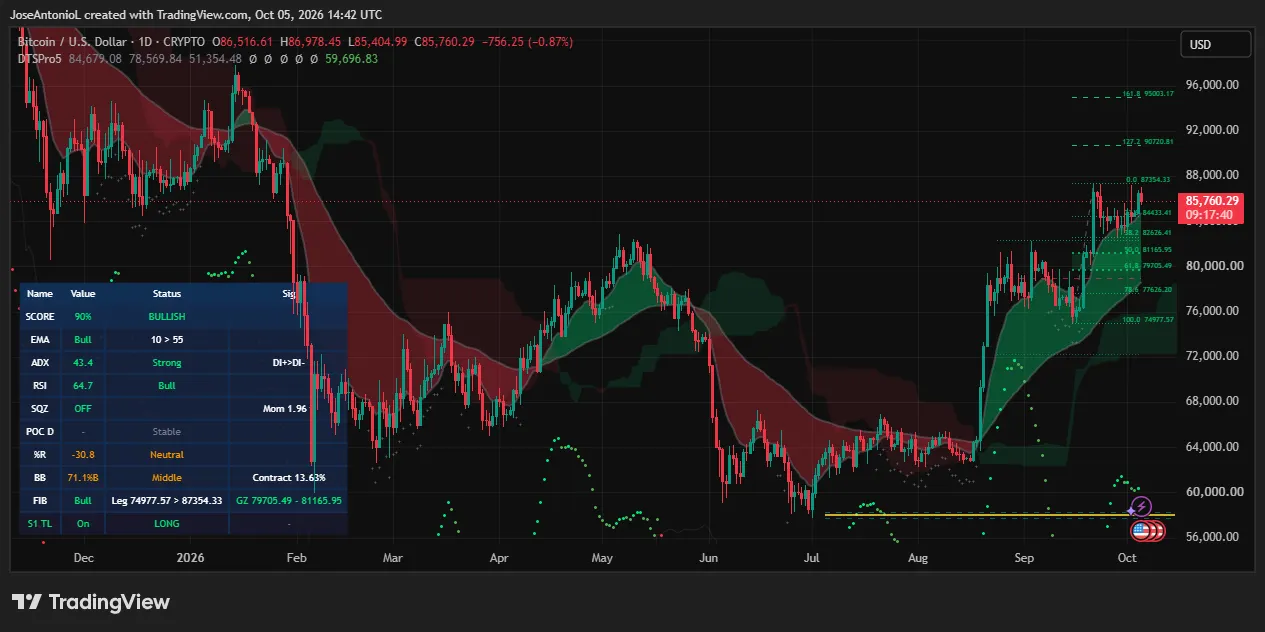
Bitcoin traded around $86,000 on Monday, roughly $1,200 below the $87,354 swing high that has capped the rally.
Macroeconomic winds have turned in Bitcoin’s favor, with potential future catalysts around the corner.
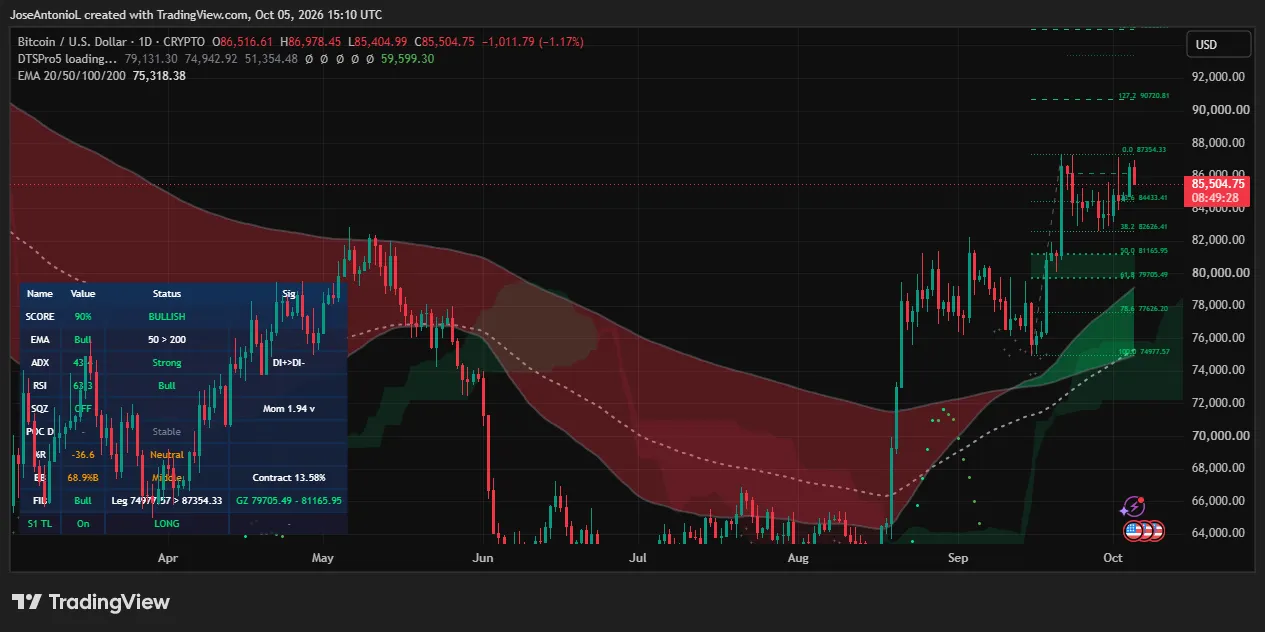
The daily chart has painted a decidedly bullish picture, with Bitcoin entering a second, stronger “golden cross.”
Bitcoin is starting the week on the front foot. It still can’t clear the ceiling, but investors have reason to be optimistic.
The top crypto asset traded around $86,100 on Monday morning, up 1.14% in 24 hours, with a market capitalization of $1.73 trillion. The entire crypto market is worth $2.94 trillion, up 1.36% on the day, and the Fear & Greed Index sits at 68, still in “greed” territory and stabilizing sentiment after a dip from “extreme greed” readings last month.
The spark was Friday’s jobs report, and it was ugly—for the economy, that is. U.S. employers added only 29,000 positions in September, according to the Bureau of Labor Statistics, roughly a third of what economists expected. The unemployment rate ticked up to 4.2%.
Revisions made it worse. July was revised from a gain of 21,000 to a loss of 10,000 jobs, and August was cut from 162,000 to 133,000. Annual wage growth cooled to 3.0%.
Bad news for workers, good news for risk assets. That’s the weird math of this cycle.
Bitcoin price data. Image: Tradingview
The Federal Reserve raised rates a quarter point to 3.75%-4.00% on September 16 in a unanimous vote. A week before Friday’s report, bond traders gave an October hike a 64% chance. After it, those odds fell to roughly 16%-22%, depending on the snapshot.
It is the mirror image of last month. On September 4, a blowout August report sent Bitcoin sliding more than 2% to near $79,300 as hike bets rose. Bitcoin now trades about 8% above that level.
Stocks cheered too. The S&P 500 closed Friday at 7,722.72, up 0.73%, while the Nasdaq gained 1.19% to 27,190.86 and the Dow added 0.49% to 51,176.96. Nvidia hit a fresh record high, and stock futures edged higher Sunday night.
Altcoins are mixed. Ethereum trades at $2,711, up 0.59%, and XRP is at $1.51, up 0.81%. Solana slipped 0.91% to $120.31. All the top 10 altcoins are in the green, but not a single one has moved more than 1%, except for Hyperliquid, which is up 3.68% on the day to $93.17 and 6% on the week.
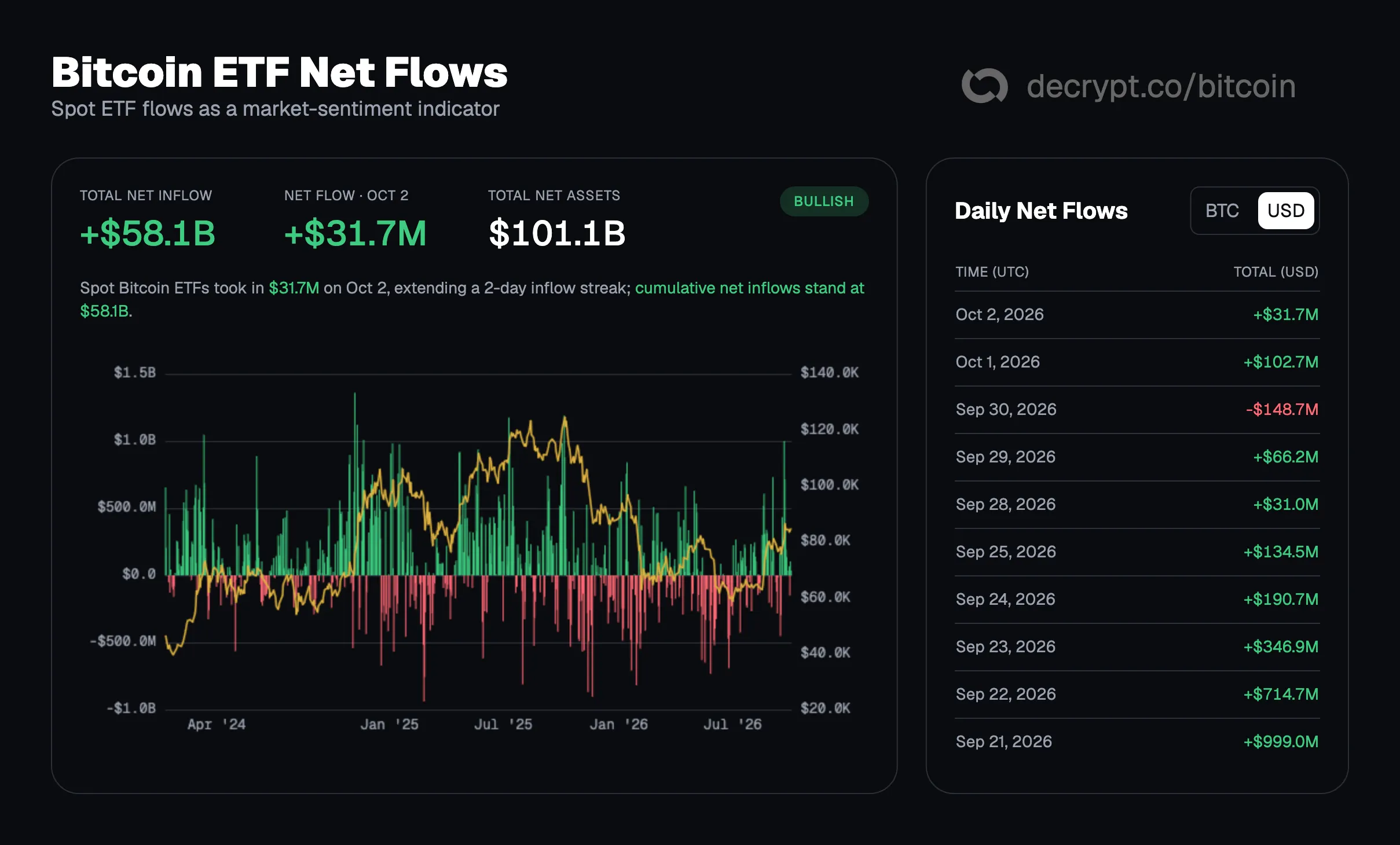
ETF money is not fading either. U.S. spot bitcoin ETFs recorded $189.84 million in net inflows on the latest daily reading, with total net assets at $101.1 billion, according to Decrypt data.
Bitcoin price: Rejected at the door, but pushing up with force
The chart explains the hesitation. On the daily time frame, the $87,354 high remains the line to beat.
Momentum is strong. The Relative Strength Index, which scores recent gains against losses on a 0-100 scale where readings above 70 are considered overbought, sits at 64.7 which is hot but not extremely overbought. The Average Directional Index, which measures trend strength regardless of direction and reads above 25 as a strong trend, is at 43.4.
Exponential moving averages, or EMAs, track the average price over a set number of days while giving more weight to recent days. A golden cross happens when a faster EMA climbs above a slower one. The chart shows the 50-day EMA (the average price of the last 50 days) above the 200-day EMA, the classic version of a golden cross. This happened in mid-September as Bitcoin registered the second best performance in that month, ever.
But an even stronger sign has just appeared as the 100-day EMA has now also crossed above the 200 day. You can see it in the following chart. The 100-day EMA being the dotted white line.
Why is the 100/200 cross even more bullish? Because it’s harder to fake. A sharp two-month bounce can drag the 50-day EMA over the 200 day. To pull the slower 100-day EMA over the 200 day, the price of Bitcoin has to stay elevated for months, which means BTC has not just bounced from the sub-$60,000 levels of July but rebuilt its medium-term trend.
Together, the two crosses mean the short-term and medium-term averages both sit above the long-term one. Think of it as a second confirmation of the same story. The catch: EMAs lag, so a golden cross confirms a move that has already happened rather than predicting the next one.
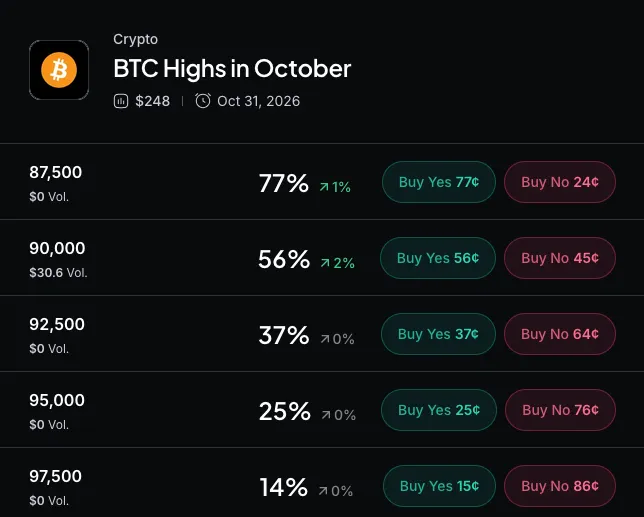
On Myriad, a prediction market built by Decrypt‘s parent company Dastan, traders are leaning bullish on a short-term push. In the October highs market, an $87,500 touch trades at 80%, $90,000 at 59%, $95,000 at 25%, and $100,000 at 12%.
As far as future catalysts, the week’s calendar is short but loaded. The Fed releases the minutes of its September meeting on Wednesday, October 7, at 2:00 p.m. ET, and the BLS publishes September CPI on October 14. The Fed’s next policy meeting runs October 27-28, with a press conference on October 28 at 2:30 p.m. ET.
Disclaimer
The views and opinions expressed by the author are for informational purposes only and do not constitute financial, investment, or other advice.
Daily Debrief Newsletter
Start every day with the top news stories right now, plus original features, a podcast, videos and more.
The UK is to be protected by an ‘Iron Dome’ defence designed to prevent air attack, Tory leader Kemi Badenoch has promised.
Under the £10 billion system – which has been called ‘Britannia Shield’ – Army bases, nuclear sites, power plants and population centres will be protected from rockets and drones launched against Britain by its enemies, reports the Daily Mail.
There would be a network of command and control communication systems, radar, interceptors and anti-drone hardware – much like that already used by Israel.
The Conservatives argue the proposed system is needed because Labour has failed to spend the target 3 percent of GDP on defence, leaving the country open to attack by nations such as Iran and Russia, they argue.
This launch of the Pajohesh rocket shows how Iran is developing new weapons (Getty)
Mrs Badenoch said, “The world will not wait for Britain to get ready. War has returned to Europe. Missiles and drones are transforming warfare in the Middle East. Cheap weapons can now threaten cities, military bases and critical infrastructure in ways that would have sounded like science fiction a generation ago.
“If a missile or drone is launched at Britain, we do not get a second chance to wish we had prepared.
“That is why we are announcing Britannia Shield: a new national missile-and-drone defence system to protect the whole United Kingdom, our sovereign territories and British bases overseas.”
The promise made at the Conservative Party Conference being held in Birmingham this week, comes as tensions between Russia and the West continue to heighten.
The British Army has suffered under funding for years, say defence experts (Getty)
On Monday Russian drones targeted Moldova when projectiles from a Russian attack on Ukraine hit a bus carrying passengers across the border.
Kaja Kallas, EU foreign policy chief said: “Europe has seen a spike in the Russian hybrid attacks and sabotage attempts and airspace violations in recent weeks.
“Russian missiles and drones violated Moldovan airspace again over the weekend. This is completely unacceptable.”
The Tories have promised to fund a £10 billion increase in defence spending each year they are in government through cuts to welfare – and believe the new shield could be operational within five years of a Conservative government.
The pledge follows a Commons defence committee found last year that Britain had ‘next to nothing’ when compared to other NATO countries when it came to air defence.
Getty Stock Photo
James Cartlidge, Tory defence spokesman, added: “With a £10 billion budget, this would be one of Britain’s most significant military programmes since the Cold War.
“But one that is totally necessary because of the threats we face. And only possible because of our willingness to take the tough decisions to fund defence.”
A Labour spokesman said: “Andy Burnham’s Labour government is delivering the biggest sustained increase in defence spending since the Cold War. Keeping Britain safe is the first priority of this Government.”
Christa Pike remains on life support in hospital with specialists keeping her alive – despite spending three decades on death row.
It followed a fail execution attempt of the killer which has made repeated headlines since she was taken to hospital following the incident on 30 September.
Pike, now aged 50, was due to become the first woman put to death in Tennessee in two centuries after being sent to prison for the 1995 murder of Colleen Slemmer.
Christa Pike is still alive following her execution attempt (Tennessee Department of Corrections)
Her lawyer said her future now remains uncertain as doctors attempt to clear two doses of pentobarbital from her body.
Pike reportedly ‘remains critically ill‘ and is being treated at a hospital in Nashville, Texas, with her legal team claiming she ‘may not fully recover’.
Her lawyer Stephen Ferrel told CNN of her current status: “She is guarded. I’m not sure who may have seen her.
“I know I have not seen her. The state of Tennessee has not yet said whether it will ultimately try to execute her again.”
Christa Pike, pictured in 1995, is receiving life-saving medical care in hospital (WBIR10)
Reason for life-saving treatment
With the convicted killer remaining on a ventilator, questions are being raised as to why she is still receiving life-saving medical care despite the execution attempts and her death penalty sentence.
But this is because the death sentence had been imposed by the courts, with her execution authorised to be carried out only at the Debra K. Johnson Rehabilitation Center, where she was imprisoned.
Constitutional attorney David Raybin, who helped write the Tennessee death penalty statute, told Fox 17, “She is in a situation where the government itself is responsible for failing to execute her properly; they bear the consequences.
Christa Pike (Tennessee Department of Corrections)
“The death sentence was imposed by a court, but it was to be done at the prison.
“They can not ‘execute’ her at a hospital by removing her life support. That would be murder.”
Gov. Bill Lee has since halted the one remaining execution for the rest of the year in Tennessee pending an investigation.
And Tennessee’s prisons chief resigned after the failed execution of Pike on 30 September.
Frank Strada has stepped down from his post after Pike’s lethal injection attempts went wrong, leading to her to be taken to hospital where she remains ‘critical’.
Strada will leave his role this month after being the residing commissioner of Tennessee’s Department of Correction for the past three years, and also in the role when the May execution of Tony Carruthers, was called off due to problems finding a vein for his lethal injection.
Pike has been locked up since 1996 after killing her classmate, Colleen Slemmer, when she was 18 at the time. She had allegedly killed Slemmer in Knoxville in a jealous rage.
Prosecutors also said a pentagram was carved on Slemmer’s body, and that Pike took a piece of her skull with her as a souvenir following the killing.
The CFTC published an advance notice outlining Regulation CTX and Regulation CAM, which would let crypto exchanges register as a new type of federally regulated “crypto asset market.”
Under the agency’s preliminary reading, merely offering leverage could bring even fully paid trades under CFTC oversight unless customers take actual delivery of their crypto.
The public has 60 days to comment. Exchanges that don’t offer leverage could keep operating under state licenses.
The CFTC wants to give crypto exchanges a federal home, and leverage is the key that unlocks the door.
The agency is moving forward with further rulemaking proposals following the collapse of the Clarity Act, the legislation that would have established the ground rules for most cryptocurrency activity in the United States but last month fell short. The CFTC on Monday published an advance notice of proposed rulemaking, an early step that seeks public input before formal rules are drafted.
Its proposal outlines two linked frameworks: Regulation Crypto Asset Transactions, or Regulation CTX, and Regulation Crypto Asset Markets, or Regulation CAM. The public will have 60 days to comment once the notice appears in the Federal Register.
The plan rests on a 2010 Dodd-Frank provision requiring retail commodity trades offered with leverage, margin, or financing to take place on a CFTC-registered exchange, as if they were futures.
Under Regulation CTX, the CFTC reads that rule broadly. Simply offering leverage, even through routine onboarding documents or terms of service, could pull fully paid trades under the agency’s watch, as long as the purchased crypto sits on the exchange’s internal books rather than in the customer’s own wallet.
Those trades escape federal oversight only through “actual delivery,” which the CFTC suggests could require customers to hold their private keys. On-chain trading protocols, which typically send tokens straight to users’ wallets, would usually clear that bar, the agency said.
BitcoinBTC · USD
$85,338+1.62%
Sep 29Oct 1Oct 2Oct 4Oct 6
$86.8k$85.6k$84.3k$83.0k
24h HighHigh$86,662
24h LowLow$85,010
VolVol$1.2B
Market projectionsOdds by Myriad
→
Regulation CAM would create a “crypto asset market” license, a tailored version of the designated contract market status held by futures exchanges. Trades would run through futures commission merchants, brokers subject to anti-money laundering rules, and leverage could come only from those brokers or banks they sponsor. Exchanges could also register as their own broker and clearinghouse.
The CFTC is weighing proof-of-reserves requirements and standards against listing tokens prone to manipulation. Exchanges that don’t offer leverage could keep operating under state money transmitter licenses.
CFTC Chairman Michael Selig said the rules are “designed to prevent, rather than only prosecute after the fact, fraudulent schemes such as FTX.”
The notice also repudiates the agency’s past approach, describing its Biden-era cases against Kraken, Ooki DAO, and Uniswap as “regulation by enforcement.”
The SEC approved Cboe’s request on October 2 to list six 3x funds from Volatility Shares tracking Bitcoin, Ethereum, gold, silver, crude oil and natural gas.
Each fund targets three times the daily performance of futures contracts on its asset, and the order sets no launch date.
The approval follows SEC warning letters on leverage above 2x in December 2025 and a March 2026 request to avoid 5x products.
The SEC approved a rule change on October 2 that lets the Cboe exchange list six funds built to deliver three times the daily price moves of Bitcoin, Ethereum, gold, silver, crude oil, and natural gas, per the agency’s order.
The funds come from Volatility Shares, the firm behind existing 2x Bitcoin and Ethereum products. Shares will trade on Cboe’s BZX Exchange like a regular stock.
An ETF, or exchange-traded fund, is a basket of assets you buy and sell through a brokerage app like a share. A leveraged one uses debt and other financial tools to amplify returns, and losses.
These funds aim for triple. If Bitcoin futures rise 2% in a day, the fund aims to gain 6%. If they fall 2%, it aims to lose 6%.
The funds mainly get that exposure through futures, which are contracts to buy or sell an asset at a set price on a later date.
But there’s a catch in the word “daily.” These funds reset every day, so the 3x promise applies to one day at a time. Over longer stretches, results can drift far from three times the asset’s move.
So, for example Bitcoin futures drop 10% on Monday, then rise 10% on Tuesday. The asset ends down 1%, while a 3x fund falls 30%, gains 30% and ends down 9%. If you have $100 worth of Bitcoin, a 30% drop takes off 30% of $100, which is $30, leaving you with $70 net. A 30% gain adds 30% of $70, which is $21. You’re at $91, overall 9% down after the movement.
BitcoinBTC · USD
$85,346+1.63%
Sep 29Oct 1Oct 2Oct 4Oct 6
$86.8k$85.6k$84.3k$83.0k
24h HighHigh$86,662
24h LowLow$85,010
VolVol$1.2B
Market projectionsOdds by Myriad
→
The SEC and FINRA have warned investors about exactly this. Their alert says returns over more than a day can differ significantly from the daily target.
Why the SEC had to vote
Cboe’s fast-track listing rules for commodity funds exclude products that chase a multiple of an asset’s return, so the exchange needed the SEC to approve these funds individually. Apart from the 3x target, the funds must meet all of Cboe’s other listing requirements.
The SEC leaned on existing guardrails. Brokers must act in a retail customer’s best interest under Regulation Best Interest, and FINRA, the brokerage industry’s self-regulator, requires tougher sales and margin (borrowing) rules for leveraged products.
Volatility Shares launched the first leveraged crypto ETF in the U.S. in 2023, tracking Bitcoin futures. Spot Bitcoin ETFs, which hold the coins directly, arrived in January 2024 after a decade of rejections.
Then the race for more leverage began. In October 2025, Defiance filed for 49 funds with 3x long and short exposure, and Volatility Shares filed for 5x products.
The SEC pushed back. In December 2025 it halted review of products above 2x exposure and sent warning letters to nine issuers, including ProShares. In March 2026, it asked issuers to avoid 5x products.
Volatility Shares kept shipping 2x funds anyway. In April 2026 it launched 2x funds on Cardano, Stellar, and Chainlink, adding to existing 2x products on Bitcoin, Ethereum, Solana, and XRP.
These aren’t the first 3x products. Earlier ones tied to silver, crude oil and natural gas, from other issuers, have since left the market, per the order. A 3x gold product from another issuer still trades.
The order sets no launch date. According to Cboe’s filing, the shares can’t trade until each fund’s registration statement takes effect.
Daily Debrief Newsletter
Start every day with the top news stories right now, plus original features, a podcast, videos and more.
The expansion is designed to bring fiat and digital asset operations into the same platform rather than requiring institutions to use separate providers for banking, custody, trading and settlement.
Clients can access institutional USD accounts, named virtual accounts with unique routing details, SWIFT transfers and Anchorage Digital’s Atlas settlement network alongside the firm’s digital asset custody and trading services.
“Global businesses should not have to choose between the speed of digital assets and the reliability of traditional banking rails,” Anchorage Digital CEO and co-founder Nathan McCauley said.
The company said the service is aimed at global trading firms, crypto exchanges, protocols, neobanks, banks, asset managers, family offices and corporates operating across multiple markets.
The move also expands Anchorage Digital’s presence in Asia Pacific, where the company said institutional demand for digital asset infrastructure continues to grow.
Standard Chartered Global Head of Fintech Luke Boland said the partnership combines the bank’s payments and risk infrastructure with Anchorage Digital’s regulated platform to make it easier for institutional firms to manage fiat and digital assets across borders.
Anchorage Digital said the broader goal is to consolidate payments, custody, trading and settlement into a single institutional platform as traditional banking rails and blockchain infrastructure increasingly converge.