One of the most striking aspects of the incident is that the modified devices were able to pass Ledger’s official Genuine Check test. This is because the attackers were able to install additional hardware without altering the device’s original security chip. While Ledger’s verification system can check the authenticity of the security chip, it cannot detect all physical modifications made to the device.
Related NewsAllegations of a Massive Hack at One of the Largest Crypto Wallets—A Substantial Amount Stolen, CZ Issues a Warning
According to one theory, the attackers had been collecting users’ recovery words for a long time through compromised devices. However, instead of carrying out the attack immediately, they waited to empty numerous wallets simultaneously.
It is speculated that after Karpelès’ warning, which garnered approximately 90,000 views, the attackers may have realized their activities had been exposed and taken action. According to this scenario, the attackers quickly began transferring assets from the wallets they had compromised after their operation was revealed.
However, a direct link between Karpelès’ statement and the subsequent large-scale wallet robberies has not yet been confirmed. It is also unknown whether the spyware in question was responsible for all the attacks.
Initial findings suggest a supply chain attack involving the physical alteration of devices before they reach users, rather than a vulnerability in Ledger’s cryptographic security system.
“People were keenly aware, like me, they were bulled up because it was ‘go’ time,” Connors said. “We were going to go to that $250,000 to $300,000, $400,000 level using previous cycles.”
Instead, the market turned against them.
“The movement was obviously not onchain data. I mean, it was all derivatives,” he said. “So paper bitcoin again is alive and well and governs the near term.” The lesson, he argues, is that bitcoin’s price can be driven as much by leveraged bets as by demand for the asset itself.
That hasn’t changed much in the past year. Perpetual futures, which allow traders to bet on price moves without owning bitcoin, remain a major part of crypto trading. Exchanges also have strong financial incentives to keep offering leveraged products. Still, traders may be better equipped to navigate the risks.
“The data is getting better at defining what the market structure is,” Connors argued, pointing to improved visibility into order books and positioning. “More information means greater certainty, less volatility.”
Chris Sullivan, co-founder of Hyperion Decimus, said traders can take steps to protect themselves from the kind of losses seen last October.
His advice starts with avoiding leverage and keeping a close eye on open interest, funding rates and market sentiment. Open interest tracks the number of outstanding derivatives contracts, while funding rates reflect the cost of holding positions in perpetual futures. Together, they can help traders spot when the market is leaning too far in one direction.
Zacharia had traded at an implied probability of about 1% in the days before the news, the Journal reported. The Kalshi spokeswoman confirmed that the company was probing trades predicting her selection but declined to comment further. An investigation is not a finding that any trader used inside information.
Settlement Is Not Withdrawal
Kalshi’s exchange rulebook separates settlement from access to funds. Rule 6.4 permits withdrawal requests to be suspended or denied when Kalshi or its clearinghouse determines that the funds are relevant to a pending investigation.
The exchange’s published insider-trading policy says accounts flagged for potential insider trading are frozen, preventing withdrawals until an investigation is completed. That is its general policy; whether particular accounts in the press secretary investigation face those restrictions remains unclear. Its rulebook also allows fines, recovery of profits and suspension or revocation of trading privileges following disciplinary proceedings or settlements.
The inquiry follows earlier scrutiny of political betting on the platform. In June, The Defiant covered reported DOJ and Commodity Futures Trading Commission investigations into George Santos’s Kalshi trades, citing NPR.
The CFTC’s February enforcement advisory described earlier Kalshi disciplinary cases involving a political candidate trading on his own candidacy and a YouTube editor trading contracts tied to videos. The agency said exchanges have an independent duty to maintain audit trails, conduct surveillance and enforce trading rules, while the CFTC retains authority to investigate and prosecute violations on those exchanges.
Could Christa Pike’s hair colour have played a role in her botched execution?
Just a week after the state of Tennessee bungled Pike’s lethal injection, 46-year-old Jamaal Howard was put to death in Texas.
Both executions used the same drug, a powerful sedative known as pentobarbital, with just 30 seconds elapsing between the moment Howard was injected and him ceasing to move.
However, in Pike’s case, she was still alive over an hour after being given two doses of the drug, with reporters and witnesses in attendance recalling hearing the 50-year-old killer talking, breathing and snoring during the process.
While Pike isn’t the first inmate on death row in Tennessee to undergo a failed lethal injection – Tony Carruthers’ was granted a one-year reprieve after staff failed to find a vein – she is the only person to still be alive after being injected with two fatal doses of pentobarbital.
And one medical expert has suggested that Pike’s hair colour could’ve played a role in how her body reacted to the drug.
As a natural redhead, Christa Pike will likely have the mutated MC1R gene (YouTube/Inside Edition)
Speaking to LADbible about the differences between Pike and Howard’s executions, Dr Elisha Peterson, a board-certified anesthesiologist in the US, noted that Pike is a natural redhead – and this may have influenced how the medication reacted with her system.
Research has revealed that the overwhelming majority of people with natural red hair have mutations to the MC1R gene, which has also been associated with an increased tolerance to anaesthesia.
“Redhead patients require more medication to fall asleep and stay asleep,” Peterson explained, adding that the MC1R gene makes ‘certain receptors in the nervous system more resistant to anaesthetic medications’.
Peterson went on to explain that while pentobarbitol is not used in operating theatres, it does have similar properties to propofol, a commonly used form of general anaesthetic, which redheads can require more of to induce sedation.
“The problem with the protocol,” Peterson said of state executions, “Is that it does not allow for any variability in the dosing given her physiology.”
(LADbible)
Peterson also referenced the ongoing suggestion that the pentobarbital injected into Pike went into the soft tissues in her arm rather than the bloodstream.
While an investigation is still ongoing into what exactly caused Pike’s execution to fail, various medical experts and her legal team have all suggested a punctured vein or injection into the soft tissue as the most likely scenario for her surviving, pointing to her complaints that a vein in her arm felt like it was ‘about to bust’ and claims that seven needles were used when finding a vein.
In contrast to Pike, Peterson added that Howard’s execution seemed to go as planned, meaning the whole dose of pentobarbital entered his circulatory system.
What happened to Christa Pike after the lethal injection?
While the state of Tennessee has put a temporary pause on all executions, pending an investigation into Pike’s case, concerns have been raised over potential long-term health complications.
A punctured vein may also have impacted the amount of pentobarbital in her system (Getty Stock Images)
The UK has sanctioned three crypto exchanges, two payment platforms and one individual it suspects of helping Russia circumvent financial sanctions.
The targets include Xeltox Enterprises, the Canadian company the UK says owns Cryptomus, and a Kyrgyz payment firm owned by the country’s Ministry of Finance.
The 38-designation package also hit Russian oil producers Zarubezhneft and INK Capital, and 12 more shadow fleet tankers.
The UK has sanctioned three crypto exchanges and two payment platforms that it suspects Russia is using to circumvent financial sanctions, the Foreign, Commonwealth & Development Officesaid Thursday.
The targets include Xeltox Enterprises, a Vancouver-registered company designated through its ownership of Cryptomus and activities “linked to and continued via” Heleket, according to the UK’ssanctions notice. Kyrgyz firms TokenSpot and Tsunami Payments, which share an office tower in Bishkek, were also designated.
Putin’s war depends on money, oil revenues and the networks that help sustain them.
Today, the UK is imposing 38 new sanctions to disrupt those networks.
The message is simple: if you help Russia fund or equip this war, you will face the consequences. pic.twitter.com/bCMq37dKPa
— Foreign, Commonwealth & Development Office (@FCDOGovUK) October 8, 2026
So was Processing KG, the operator of payment service VexPay, whose parent company is Kyrgyzstan’s Ministry of Finance, according to the notice. Its director, Ulan Bukabaev, was sanctioned alongside it.
Two of the targets processed and facilitated transactions with the A7 network, the government said, without specifying which.
Beyond asset freezes, the four companies face internet services sanctions, which require social media platforms, internet providers and app stores to take reasonable steps to stop UK users accessing their sites and apps.
The UK describes A7 as a Kremlin-backed “illicit finance network” used to circumvent sanctions on Russia’s financial sector. The network claimed to have moved more than $90 billion last year, roughly half of Russia’s annual military spending, according to the government.
The crypto designations are part of a 38-target package that also includes Russian oil companies Zarubezhneft and INK Capital. UK sanctions now cover more than 90% of Russia’s oil production capacity, the government said.
The package adds 12 shadow fleet tankers, bringing the number sanctioned to more than 600, and 17 entities and individuals involved in supplying goods critical to Russia’s missile and drone production.
The UK, the U.S. and the EU have sanctioned a string of crypto businesses as part of their Russia sanctions packages over the past few years. In May, the UKsanctioned Justin Sun’s HTX and other crypto firms, accusing HTX of providing financial services to A7. The EUnamed HTX in its own Russia sanctions two months later.
The U.S. has sincedesignated the A7 network as a transnational criminal organization, and the EU hasmoved toward a ban on all crypto transactions with Russian entities.
A UKoperation targeting Russian sanctions evasion has also led to 128 arrests and seizures of crypto and cash.
In May, Kyrgyzstanordered 50 companies to cease activity after state agencies flagged them for sanctions risks.
Daily Debrief Newsletter
Start every day with the top news stories right now, plus original features, a podcast, videos and more.
Keely Hodgkinson’s team have insisted that the distinctive catsuit she recently donned does have benefits after Hodgkinson was barred from wearing it at the Olympics in 2028.
The unusual garment is skin tight, partially backless, and also has a wetsuit-style hood that goes over the athlete’s head, which is described as a ‘sleek speed hood’ and even has a special hole cut out of it at the back for her ponytail.
All in all it looks more like something you might expect to see in a 1970s science fiction film rather than on the competitive field in 2026.
Nonetheless, it is claimed that the specially designed suit may just give her a competitive edge over rivals in the mid distance running, something which Hodgkinson’s team have insisted after she was barred from wearing it at the Olympics, though for different reasons.
Speaking to Athletics Weekly her coach Jenny Meadows said that the garment helps Hodgkinson with her performance, saying that she had been able to run in it after suffering from an injury when she fell badly prior to the Prefontaine Classic, The Sun reports.
Hodgkinson wearing the catsuit in the ATHLOS London 2026 (Kate Green/Athlos/Getty Images)
“She could hardly walk because her knees were so swollen,” said Meadows. “She was in a really, really bad way. And she was very tearful all day.
“By the end of the day, she got on an anti-gravity treadmill at the Center and she put the speed suit on. She said it helped her to be able to move.”
She added: “Without the speed suit, she couldn’t bend and flex her knee because of the inflammation.”
Hodgkinson’s coach went on to say that the athlete, who is the sixth-fastest woman in history, had told her that the suit had helped a lot.
“She was literally like: ‘Guys in this speed suit, I can run’,” said Meadows. “Keely gives genuine feedback and the speed suit helped her run that day.
“She says it feels like she’s not wearing anything. She says: ‘Honestly, it feels just so light. I can flow’.”
However, Hodgkinson will not be able to wear the ‘Zero-Distraction Speed Suit’ when she competes for Team GB in Los Angeles for the 2028 Olympics, though not because of concerns around an unfair advantage, but due to conflicting sponsorship deals.
Hodgkinson’s coach said she thought the suit helped her performance (Kate Green/Athlos/Getty Images)
The British Olympic Association has a sponsorship deal with Adidas, and the catwoman-like speed suit is made by Nike, a business competitor.
Nonetheless, Meadows, who is herself a world championship silver medallist in the 800 metres, has said that the suit really does make a statement, and that her initial reaction when she first saw the suit was a little sceptical.
“My initial reaction was like: ‘Oh, you’ve got to be brave to wear that’,” she said, while her husband and fellow coach Trevor Painter had a different reaction.
“Trevor was kind of like: ‘Yeah, you look Catwoman. Go for it. It’s so you’,” she recalled.
“You’ve got to think: Is it faster or is it just a gimmick?” said Meadows. “You’ve actually got to walk out in front of an audience the first time and you’ve got to win in that thing. It’s a statement piece.”
Bitcoin has dropped 4.1% this week, after U.S. spot BTC ETFs shed $484.9 million Wednesday.
The slide comes in October, which is historically a green month for the leading cryptocurrency.
Experts warn that Bitcoin could continue to stoop, testing support levels as low as $72,000.
Bitcoin has been in the red since October started, a month historically green for the leading cryptocurrency—often referred to as “Uptober.” Experts warn not to treat October as a reliable bottom for Bitcoin, and predict there could be more bleeding ahead.
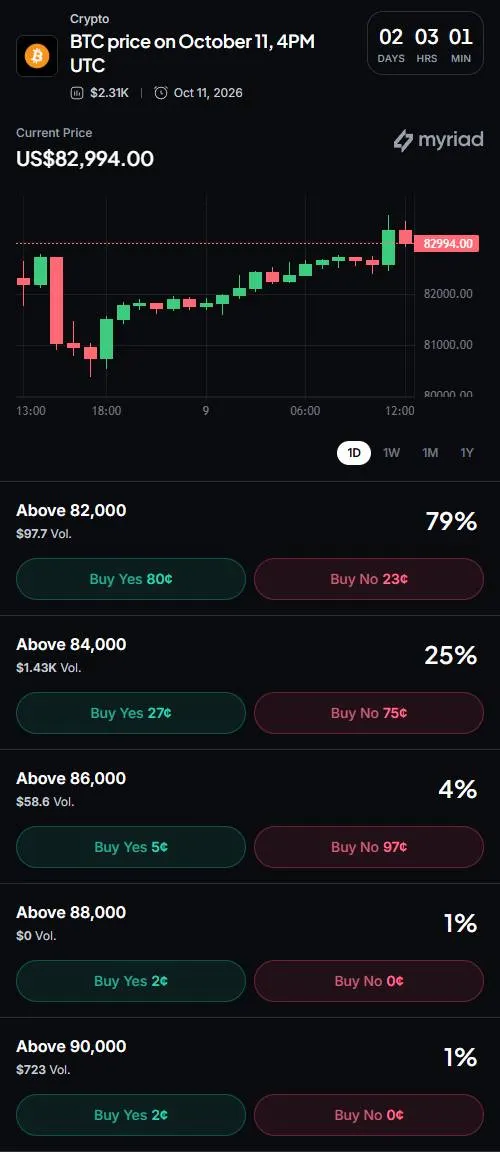
Per CoinGecko data, Bitcoin hit lows of $80,427 in the past week, and is currently trading at just under $83,000, down 4.1% over the past seven days. On Myriad, a prediction market owned by Decrypt‘s parent company Dastan, users put a 79% chance on Bitcoin ending the week above $82,000, and just a 28% chance of it topping $84,000.
“From a market-structure perspective, the $83,000 region remains an interesting level,” Luke Deans, Senior Research Associate at Bitwise Europe, told Decrypt. “This area combines the average ETF cost basis with the prior technical higher-high threshold and has been tested repeatedly over recent weeks.”
Myriad: BTC price on October 11, 4PM UTC. Click to make your prediction.
Where is support?
Bitcoin fell below $83,000 early on Thursday morning and is currently attempting to recover. Deans said the reaction to this will be “informative,” as if it struggles to recover, then lower structural support targets should be considered.
Ananda Banerjee, Founder and Principal Quantitative Researcher at analysis firm Charlie Quant Lab, told Decrypt that he sees strongest support at $77,000. This is according to on-chain metrics, he said, which show a notable cluster of the Bitcoin supply was bought at this level. Deans agrees that the average acquisition price of active investors, or the True Market Mean, is near $77,000.
BitcoinBTC · USD
$82,656−2.34%
Oct 3Oct 4Oct 6Oct 8Oct 10
$86.7k$84.7k$82.7k$80.7k
24h HighHigh$83,398
24h LowLow$81,857
VolVol$1.0B
Market projectionsOdds by Myriad
→
However, Deans also sees lower support at $74,000 with the Short-Term Holder Cost Basis, which represents the average acquisition price of newer market participants. The 200-day moving average also sits at $72,000, which he said provides an independent technical reference alongside the on-chain measures.
“Through this lens, Bitcoin could fall materially from current levels and still remain within what we would consider a constructive risk-on structure,” Deans told Decrypt. “A move into the $72,000 to $77,000 region would represent a strong retest of the broader transition zone.”
If that area is successfully defended, he said, then a range which previously acted as resistance for Bitcoin movements will be turned into support—which would be a positive signal. That said, failing to defend that zone could “impair current market structure.”
Still, Bitcoin tested a move above $87,000 at the start of the week, albeit unsuccessfully. The failure was driven “mainly by futures positioning rather than spot demand,” Bitfinex analysts told Decrypt. “Spot demand remains the missing piece,” they added, noting that U.S. spot Bitcoin ETFs took in $241.1 million in the week of September 28 to October 2, against $2.39 billion the week before. “The average ETF investor is back at breakeven for the first time since January, a level at which inflows have historically been slow,” they said.
Can-Luca Köymen, Investment Strategist at Sygnum Bank, also told Decrypt that low spot volume is stunting Bitcoin’s price action.
Bitfinex analysts believe that Bitcoin’s consolidation range is between $84,000 and its yearly open of $87,722. The analysts said that September CPI on October 14 could put an end to that range, alongside ETF flows picking up.
Bitcoin ETFs lost $484.9 million on Wednesday, the worst single-day outflow since June 25, according to Decrypt’s ETF tracker. BlackRock’s IBIT took the biggest hit at $207.7 million, with Fidelity’s FBTC next at $105.1 million. Experts believe this needs to reverse for a successful Uptober—but with the funds shedding a further $244 million Thursday, the direction of travel is still downwards.
Is Uptober cancelled?
So, is Uptober over? Most experts that Decrypt spoke to were hesitant to declare Uptober cancelled over a single week of red action. Still, they warned against basing investment decisions based on a hyped up month rather than fundamentals.
“Historical evidence supports October strength,” Jake Kennis, Senior Research Analyst at Nansen, told Decrypt. “Bitcoin has posted a median October return of roughly 14% since 2013, with 10 of the past 13 Octobers finishing positive.”
“But ultimately liquidity, positioning, macro conditions, and underlying demand are more important drivers than any specific date,” he added.
Daily Debrief Newsletter
Start every day with the top news stories right now, plus original features, a podcast, videos and more.
A man was able to avoid paying a parking charge after using ChatGPT as his ‘lawyer’ to push back against the charge.
Rafal Goral had gone to Newquay in Cornwall in August 2023, hoping to enjoy a lovely day out at the seaside.
He parked up at a car park operated by Smart Parking Limited, and joined a long queue to go and pay for his parking, but when he got to the machine he found that it wasn’t accepting card payments, so he downloaded an app and paid for his parking that way.
Unfortunately for Rafal, 45, during this period he had unknowingly passed a time limit, with a ticking clock that started the second his reg number was registered driving onto the car park. Between arriving and paying via app 16 minutes had passed.
Two weeks later Rafal, a refinery worker from Chelmsford in Essex, received a letter informing him that he would have a pay a £100 parking charge due to his late payment but after years of back and forth between them, he was finally able to get the charge cancelled.
Rafal was able to successfully get the charge cancelled (SWNS)
“From start to finish it was not about the money, I could pay it, but it is about the principle,” he said. “If you know you are right then you shouldn’t be paying any money to them.
“This is kind of a David and Goliath battle. They have lawyers and they are a big company and they just gave up in the end.”
In a desperate move, Rafal had uploaded the letters he was receiving into ChatGPT and asking the AI to generate a response for what he should say.
“From start to finish I was asking ChatGPT every time I got a letter what to do. It was telling me what to say, where to go, and everything,” he said. “I did it all with the help of AI.”
Rafal has shared a message that people can push back against parking charges.
“I want the public to know that they can do it and they shouldn’t give up,” he said. “People don’t want to go through the hassle, so they just pay but it is wrong. It is shocking.”
Rafal had arrived at the car park at approximately 10:12am on 4 August 2023, and said it took time to download the app and pay for his parking.
Rafal had to push back against the charge for years (SWNS)
After receiving the parking charge notice on 25 August, he appealed the charge in September, but didn’t anything else until January, by which time the parking charge had gone up to £170.
“I appealed straight away and I heard nothing from them. They were harassing me and sending me letters saying that I had to go to court,” he said. “They were trying to make me scared.”
Things continued to escalate, until Rafal was threatened with being taken to court over the charges in October 2026 after refusing to pay a fine that they dropped to £60.
Eventually, the parking charges were dropped, and Rafal was left ecstatic.
“I am so happy,” he said. “This is something that properly raised me up after three years of this fight.
LADBible has approached Smart Parking Limited for comment.
It is not recommended to use generative AI for legal advice.
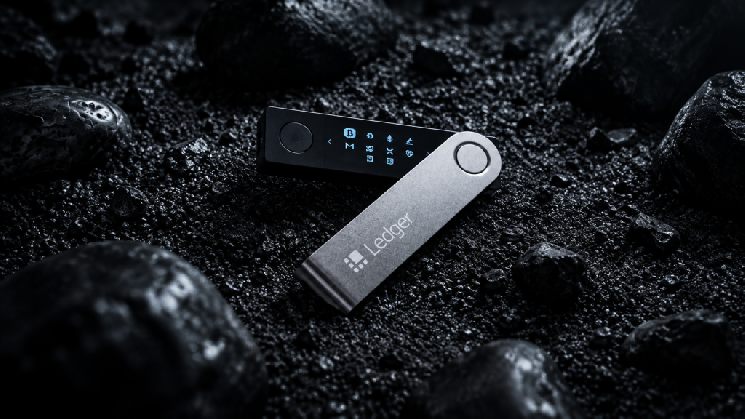
Ledger is investigating reported losses among Southeast Asian customers who bought devices from reseller CryptoBilis, and has asked the reseller to pause sales and shipments.
The company told anyone who bought from CryptoBilis in the past 90 days not to set up their device, and those who have to move funds to a new device with a fresh seed phrase.
Onchain investigator Specter traced more than $86 million in suspected thefts across Ethereum, Tron and Bitcoin. Ledger hasn’t confirmed the figure or the cause.
Ledger is telling some customers to hold off on setting up their hardware wallets.
The Paris-based wallet maker said Friday it is investigating reports that users in Southeast Asia who bought devices from a reseller called CryptoBilis have lost funds.
“As a precaution, and pending the results of our investigation, we have asked CryptoBilis to pause all sales and shipments of Ledger devices,” the company’s support account wrote on X.
Ledger urged anyone who bought from the reseller in the past 90 days not to set up their device if they haven’t already. Those who have should consider moving their assets to a new Ledger signer with a new seed phrase, the master backup that can regenerate a wallet’s private keys.
Ledger is investigating reports of loss of funds from users in South East Asia who purchased products from a reseller named CryptoBillis. As a precaution, and pending the results of our investigation, we have asked CryptoBilis to pause all sales and shipments of Ledger devices.…
Ledger didn’t say what caused the losses or how many customers were affected. Hardware wallets are designed to keep private keys offline, but a device compromised before it reaches the buyer, such as one shipped with a recovery phrase an attacker already knows, can leave funds exposed. No tampering has been confirmed.
The losses may be large, potentially in the tens of millions of dollars. Pseudonymous crypto investigator Specter said they traced theft addresses flagged in reports from Ledger users on X and Reddit and found inflows from hundreds of victim wallets across Ethereum, Tron, and Bitcoin.
There have been a reports on X and Reddit of wallet-draining by Ledger users.
I traced the theft addresses and identified inflows from more hundreds of victim wallets across several major blockchains, including Ethereum, TRON, and Bitcoin.
“Total losses $86M+,” Specter wrote. Arkham data shared by the investigator shows nearly $87 million at those addresses, including about $42 million in ETH, $17.6 million in BTC and $16.5 million in USDT. Ledger hasn’t confirmed the figure, and it’s unclear whether every theft is linked to the reseller.
Rival Trezor has faced its own security headaches, including customer data exposed in a shipping partner breach and a breach of its email just last month.
BitcoinBTC · USD
$82,656−2.34%
Oct 3Oct 4Oct 6Oct 8Oct 10
$86.7k$84.7k$82.7k$80.7k
24h HighHigh$83,398
24h LowLow$81,857
VolVol$1.0B
Market projectionsOdds by Myriad
→
The episode adds to a brutal stretch for crypto security. Last month, Bitget lost roughly $387 million in a hack that investigators have tied to North Korea, and blockchain tracking firms Chainalysis and Elliptic have since traced part of the haul.
Currently, there is no price data available for Binance, reflecting uncertainty in the market. The lack of trading volume indicates thin flow, which may be a result of traders waiting for clarity on the ongoing investigation. As the situation develops, market participants are likely to reassess their positions based on the DOJ’s findings and Binance’s response to the allegations.
Binance is one of the largest cryptocurrency exchanges globally, facilitating a wide range of crypto trading activities. The DOJ has jurisdiction due to Binance’s operations within the U.S. and its involvement in transactions that may violate federal laws, particularly regarding sanctions compliance.
Where Do We Go From Here
What traders should watch next includes how Binance responds to the DOJ’s investigation and any further developments regarding the sanctions probe. Key levels to monitor will be the exchange’s compliance measures and any shifts in trading volume as the market digests news on regulatory actions. The potential for substantial fines could have broader implications for the exchange and the crypto market as a whole.