Category: Business

  • Paul Tudor Jones’ Firm Buys Back Into BlackRock Bitcoin ETF After a Year of Selling

    Paul Tudor Jones’ Firm Buys Back Into BlackRock Bitcoin ETF After a Year of Selling

    In brief

    • Tudor Investment increased its stake in BlackRock’s IBIT to 688,529 shares (~$22.9 million) as of June 30, an 18.9% jump from the prior quarter, reversing a year of selling, per its latest 13F filing.
    • The firm also cut its reported IBIT call options by about 85% while keeping puts roughly flat, suggesting a move from leveraged positions toward straightforward spot exposure—though the stake remains far below its late-2024 peak of over 8 million shares.
    • The buying, from a longtime Bitcoin-as-inflation-hedge advocate, lands amid renewed institutional ETF interest.

    Tudor Investment, the macro hedge fund founded by billionaire Paul Tudor Jones, added to its stake in BlackRock’s spot Bitcoin ETF last quarter, reversing a year-long stretch of selling.

    The Connecticut firm held 688,529 shares of the iShares Bitcoin Trust, or IBIT, valued at about $22.9 million as of June 30, according to a 13F filing submitted to the Securities and Exchange Commission on Aug. 14.
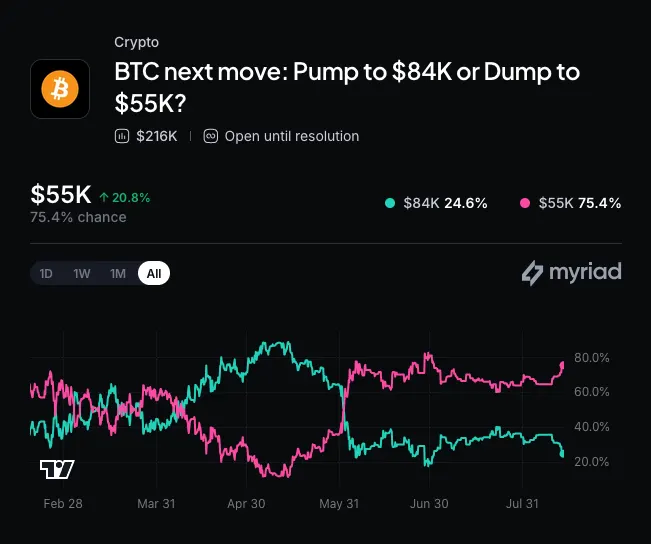
    Myriad: Bitcoin's next move? Click to make your prediction.
    Myriad: Bitcoin’s next move? Click to make your prediction.

    That marks an 18.9% jump from the 579,083 shares it reported at the end of March, a net addition of 109,446 shares.

    The increase is modest in the context of Tudor’s roughly $100 billion-plus in assets, amounting to a fraction of a percent of its reported 13F holdings, and it remains far below the firm’s late-2024 peak of more than 8 million IBIT shares, then worth around $427 million, which it whittled down through 2025.

    Still, the reversal is being read as a notable signal from one of Wall Street’s most closely watched traders returning to accumulation.

    The filing also showed Tudor reshaping how it holds that exposure. The firm slashed its reported call options tied to IBIT by about 85%, to the equivalent of 148,000 underlying shares from 998,000, while its put position held roughly steady. The shift from options toward direct shares suggests a move away from leveraged bets and toward straightforward spot exposure, though 13F filings don’t disclose strike prices or expirations, leaving the full strategy unclear.

    Jones has long championed Bitcoin as a hedge against inflation, a thesis he first laid out in a 2020 market note and has reiterated since, framing the asset as a bet against currency debasement and, at times, as an option on geopolitical instability.

    His firm’s buying arrives during a stretch of renewed institutional interest in the ETFs. The funds drew hundreds of millions in inflows over a recent five-day span as expectations for interest-rate hikes cooled. IBIT continues to dominate the category, commanding roughly 49% of U.S. spot Bitcoin ETF assets.

    Daily Debrief Newsletter

    Start every day with the top news stories right now, plus original features, a podcast, videos and more.
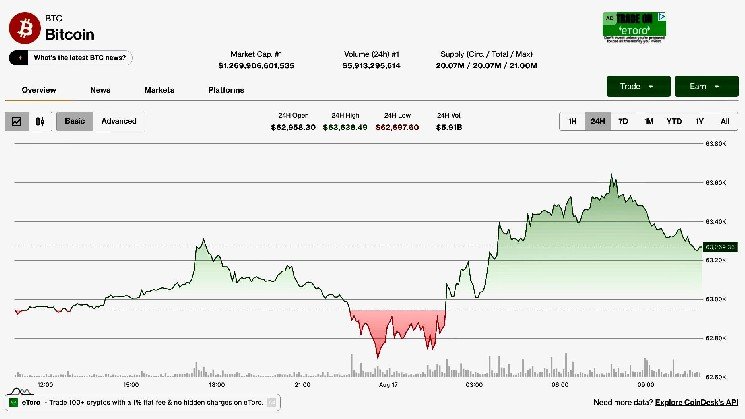

  • Bitcoin tracks equity bounce, but $390 million ETF outflow week keeps bulls on back foot

    Bitcoin tracks equity bounce, but $390 million ETF outflow week keeps bulls on back foot

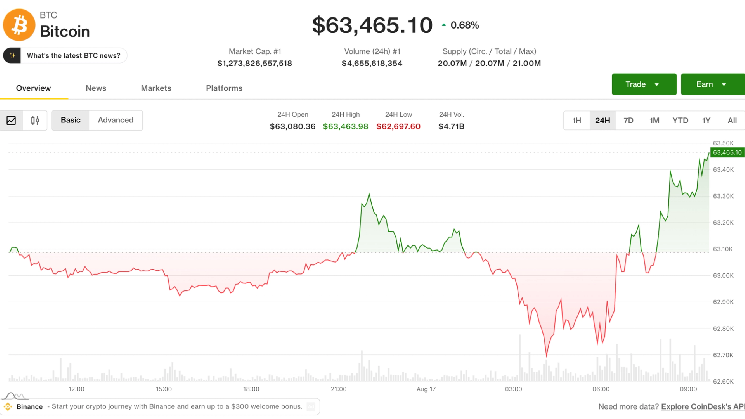
    Bitcoin $BTC$63,558.97 steadied above $63,000 on Monday, clawing back a fraction of last week’s losses with a 0.8% gain since midnight UTC.

    Without an obvious catalyst, the largest cryptocurrency appears to be tracking U.S. equities. Nasdaq 100 index futures are up 0.5% to their highest point since July 2.

    Any positive reading will need to take into account last week’s net $390 million outflow from spot exchange-traded funds, including the first three-day stretch since the end of July. That was the largest weekly withdrawal from U.S. spot bitcoin products in six weeks.

    Ether $ETH$1,903.86 ETFs flows were limited, and solana ($SOL) ETFs bucked the trend with their strongest weekly inflows since mid-May.

    The bigger picture is the Clarity Act. Galaxy Research’s head of research, Alex Thorn, cut his odds of the landmark crypto bill becoming law in 2026 to roughly 10% on Aug. 14, joining prediction markets that now put the probability at around 17%. A cloture vote is scheduled for Sept. 15 when the Senate returns from recess, although market observers are expecting another delay.

    Derivatives positioning

    • Taker ratio stays balanced: the 24-hour long-short volume ratio for takers hangs in balance again, extending Friday’s trend. Takers are entities that pull liquidity from the order book by trading at available prices.
    • Thin liquidity raises swing risk: $BTC‘s notional open interest, at $48 billion, is now nearly double its 24-hour trading volume. $XRP‘s market shows a similar pattern. That gap means any mass liquidation event could run into thin liquidity, raising the odds of wild price swings.
    • $BTC OI pulls back, $XRP holds firm: in contract terms, $BTC‘s open interest (OI) has pulled back to 750,000 $BTC from Friday’s 760,000 $BTC. That’s been a pattern since April, with spikes above 750,000 $BTC often proving short-lived. $XRP futures show the opposite dynamic, with OI holding steady at 10-month highs. Positioning in $ETH and $SOL remains relatively light in comparison.
    • CC shows bearish buildup: Canton Network’s CC token has dropped over 1.5% in 24 hours, making it one of the biggest losers among the top 100 coins by market value. OI in futures tied to the token has risen more than 5% over the same period. That combination points to shorts, or bearish bets, being built up. Negative annualized perpetual funding rates and a negative OI-adjusted 24-hour cumulative volume delta (CVD) both support that read, indicating bears are leading the market.
    • $ZEC bucks the trend: Privacy-focused $ZEC is also an OI gainer. In this case, a positive 24-hour CVD, is a sign bulls are being more aggressive, taking longs via market orders rather than passive limit orders. $ZEC‘s funding rate is also positive at +10%, indicating a growing bias toward bullish bets.
    • Volatility and fear stay low: Bitcoin and ether’s 30-day implied volatility indexes remain pinned near year-to-date lows, suggesting fear levels and demand for options-based insurance against price swings are both muted. Wall Street’s VIX tells a similar story, sitting at its lowest level since January.
    • Options positioning leans bullish near-term: On Deribit, the skew for $BTC and $ETH shows a bid for calls, or bullish bets, at the front end of the curve. The implied volatility term structure shows no signs of short-term stress either, despite Wednesday’s scheduled release of the Fed minutes.
    • Volume rankings show a split: 24-hour volume rankings show a mixed profile, with both $BTC calls and puts among the top five most-traded instruments. The same holds for ether.

    Token talk

    • Pump.fun PUMP$0.002880 is one of the standout performers on Monday, adding 7.80% since midnight UTC with daily trading volume rising 55% to $90 million.
    • $ZEC has gained 4.70% since midnight at $508, extending a notable stretch for privacy coins following XMR’s strong run last week.
    • MORPHO advanced by 5% at $2.07, reversing some of Friday’s weakness and leading the DeFi names higher.
    • HYPE rose 3.53% to $59.08, continuing its steady grind and now up around 2% on the week.
    • FET is one of the weakest altcoins on Monday, down 1.56% since midnight at $0.1196, giving back some of last week’s gains as AI-adjacent tokens lose momentum.
    • CoinMarketCap’s “Altcoin Season” indicator is at 46/100, recovering from the Aug. 7 low of 36/100 as optimism slowly returns to the altcoin sector. CoinMarketCap’s Fear and Greed index sits at 38/100, a “fear” reading.
  • Bitpanda fined €70,000 in Austria’s first published MiCA enforcement case

    Bitpanda fined €70,000 in Austria’s first published MiCA enforcement case

    Austria’s Financial Market Authority fined Bitpanda GmbH 70,000 euros ($81,150) for breaches of the European Union’s Markets in Crypto-Assets (MiCA) regulation in the regulator’s first penalty over the rules.

    The FMA said Bitpanda failed to submit a cryptocurrency white paper at least 20 working days before publishing it. The regulator did not identify the cryptocurrency involved.

    Bitpanda also circulated a marketing communication before publishing the required white paper. Another communication omitted a statement that regulators had not reviewed or approved the document and that the provider was solely responsible for its contents, as well as a telephone number and email address.

    The firm told CoinDesk in an emailed statement the regulator’s findings “related exclusively to timing and formal specifications surrounding the publication of the whitepaper and an accompanying information document.”

    “For the token launch in question, we prepared a comprehensive whitepaper in accordance with MiCAR requirements, submitted it to the FMA, and continuously coordinated the entire process with the authority,” Bitpanda said. “The points cited related exclusively to timing and formal specifications surrounding the publication of the whitepaper and an accompanying information document.”

    The white paper was submitted early last year, the firm told CoinDesk.

  • Strategy CEO Phong Le Points to the Date When the Cryptocurrency Market Will Regain Momentum! Here Are the Details

    Strategy CEO Phong Le Points to the Date When the Cryptocurrency Market Will Regain Momentum! Here Are the Details

    Phong Le, CEO of Strategy, known for its Bitcoin-focused institutional investment strategy, said the cryptocurrency market has been quiet late in the summer but could become active again in the fall. In his assessment shared on the social media platform X, Le highlighted a number of key developments that could shape the market in the coming months.

    According to Phong Le, regulatory steps could play a decisive role in the cryptocurrency market regaining momentum. In particular, the implementation of regulatory exemptions for innovative financial technologies and progress on the Clarity Act, which is expected to shape the legal framework of the cryptocurrency market in the US, are among the factors that could increase investor confidence.

    Le also noted that banks beginning to adopt Bitcoin on a wider scale, and the growth of digital credit and digital currency markets, could be important catalysts for the sector. In addition, he stated that strengthening stability in the global economy and a decrease in geopolitical tensions could increase appetite for risky assets.

    Strategy CEO emphasized that the upcoming US midterm elections could also influence investor behavior, while arguing that the cryptocurrency sector is still in its early stages of development. According to Le, although current market conditions appear stagnant in the short term, the sector retains its long-term growth potential.

    On the other hand, Strategy’s recent transactions are also attracting the attention of investors. The company announced that it sold approximately 3,327 BTC in the last two weeks. These sales are being closely monitored within the scope of the company’s long-standing Bitcoin-focused balance sheet strategy.

    *This is not investment advice.

  • 10x Research Founder Explains It’s Mathematically Impossible for Bitcoin to Reach $1 Million by 2030! Here’s Why

    10x Research Founder Explains It’s Mathematically Impossible for Bitcoin to Reach $1 Million by 2030! Here’s Why

    A noteworthy assessment has emerged regarding the long-debated question in the cryptocurrency market: “Can Bitcoin reach $1 million by 2030?” Markus Thielen, founder of the research firm 10x Research, argued on the Trade Secrets program that it is mathematically unrealistic for Bitcoin to reach $1 million in the coming years.

    In recent years, many industry representatives and investors have suggested that Bitcoin could reach $1 million in the long term due to increasing institutional adoption, demand for spot Bitcoin ETFs, and growth in the global money supply. However, Thielen noted that the market capitalization required for this scenario to materialize is extremely high under current conditions.

    According to the analyst, for Bitcoin to reach the $1 million level, its total market capitalization would need to rise many times over its current level. Thielen stated that such a large increase in value would require much larger changes in global capital flows and investor behavior, and that current data does not support such a scenario.

    However, Thielen’s statements do not mean that Bitcoin has no long-term bullish potential. The analyst acknowledges that the digital asset continues to be adopted by institutional investors and is increasingly accepted in the traditional financial world. But according to him, investors need to act with more realistic expectations rather than overly optimistic price predictions.

    While disagreements persist regarding price predictions in the cryptocurrency market, some analysts argue that Bitcoin could reach new highs in the coming years, while others believe that current macroeconomic conditions point to more limited upside potential. Thielen’s statements have added a new dimension to this debate.

    *This is not investment advice.

  • Bitcoin tops $64,000 in Asia morning hours as HYPE jumps 8% on the week

    Bitcoin tops $64,000 in Asia morning hours as HYPE jumps 8% on the week

    Bitcoin crossed $64,000 in Asian morning hours Monday, up half a percent on the day but down almost 3% over the week, as a softer dollar and fading rate-hike bets failed to lift crypto out of its recent range.

    Hyperliquid’s HYPE was the standout, up over 3% to $59 and almost 9% on the week, the only major with a meaningful weekly gain. Ether rose over 1% to just under $1,900 but is down 1% over seven days.

    Dogecoin added almost 1% to 7 cents, tron under half a percent to just over 33 cents and $XRP marginally to $1, though $XRP is down 3% on the week. Solana edged up to just over $75 and is down almost 2% over seven days. BNB slipped marginally to just over $604 and was flat on the week.

    The macro backdrop turned friendlier without moving crypto. A Bloomberg gauge of the dollar slipped 0.1% toward a third straight decline and levels last seen in May, while MSCI’s emerging-market currency index hit an intraday record, led by the Taiwanese dollar and Thai baht.

  • XRP traders bet on a rebound as price slips to $1 and bearish chatter surges

    XRP traders bet on a rebound as price slips to $1 and bearish chatter surges

    The scale of the positioning is easier to see measured in tokens. About 2.77 billion $XRP now sits in futures positions, up from closer to 2 billion earlier this summer and nearing the levels last seen when the token was worth several times more.

    The ledger is getting busier too. Nearly 50,000 addresses were active over one 24-hour stretch, the most in more than two months, per Santiment, after activity slid close to its 2026 lows in July.

    An active address is a wallet that sent or received anything during the period. It shows more wallets are using the ledger, but not whether the people behind them are buying, selling or shuffling tokens between their own accounts.

    CoinGlass data shows the long-to-short ratio across all venues at about 0.93 over 24 hours, meaning positioning market-wide is close to balanced. The heavy long bias sits on Binance, OKX and among their bigger accounts.

    Watch what happens if $XRP breaks below $1, as leveraged longs that run out of collateral get closed by the exchange, which could mean selling into the market.

    $XRP trades around $1 in Asia morning hours Monday, with bitcoin topping $64,000.

  • The bitcoin futures market looks like a crowded club with a tiny exit – and it could cause pain

    The bitcoin futures market looks like a crowded club with a tiny exit – and it could cause pain

    Volume, meanwhile, is dead simple as it measures the number of contracts that changed hands during a given period. Think of it as measuring how many times the front door of that exclusive club opened and closed over a given period, regardless of who stayed. It thus represents the degree of churn or liquidity available to manage positions.

    So, the latest case of volume falling far behind OI is like a large club with a tiny exit door. What happens if a large number of people try to rush out?

    Because overall investor positioning is massive, a sudden catalyst could trigger a wave of contract closures, such as forced liquidations due to margin shortages. Without the underlying daily volume to provide liquidity, the market may not be able to absorb the rush smoothly, leading to volatile, exaggerated price swings.

    “The risk is mechanical. When open interest towers over daily volume, liquidations meet little resting flow to absorb them, and adverse moves extend further than they otherwise would. Traders have added substantial risk, most of it long, into a market that shows no matching demand,” blockchain analytics firm Glassnode said in a report.

    The risk of an exaggerated move is particularly likely to the downside because of weakening demand and a lack of resting bids or buy orders at lower price levels.

  • SafePal Data Breach: 39,798 Customers’ Personal Information Exposed, Funds Secure

    SafePal Data Breach: 39,798 Customers’ Personal Information Exposed, Funds Secure

    SafePal, a cryptocurrency wallet provider, has disclosed a data breach that exposed the personal information of approximately 39,798 customers. The company announced the incident via its official X account, stating that names, email addresses, shipping addresses, phone numbers, and purchase histories were compromised. The breach affected customers who placed orders between March 2, 2025, and April 11, 2026.

    What Caused the Breach?

    SafePal attributed the breach to a code flaw in an order-tracking plugin. The company said it has since fixed the vulnerability and completed additional security measures to prevent similar incidents. While the exposed data includes sensitive personal details, SafePal emphasized that wallet systems, seed phrases, and private keys remain securely protected. This distinction is crucial for users concerned about the safety of their crypto assets.

    Implications for Affected Users

    Although the breach did not compromise funds, the exposure of personal information poses significant risks. Cybercriminals could use the stolen data for phishing attacks, identity theft, or social engineering schemes. SafePal urged affected users to remain vigilant against phishing or impersonation attempts. This incident highlights the broader challenges of data security in the cryptocurrency industry, where customer trust is paramount.

    Why This Matters to the Crypto Community

    For crypto users, this breach serves as a reminder that even non-financial data can be a target. The fact that SafePal’s core wallet infrastructure remained secure is reassuring, but the leak of personal details can still lead to targeted scams. Users should be cautious of unsolicited communications that reference their SafePal orders or request sensitive information. This event also underscores the importance of using strong, unique passwords and enabling two-factor authentication across all accounts.

    Conclusion

    SafePal’s data breach is a serious incident that exposed personal information of nearly 40,000 customers. While the company has fixed the vulnerability and assures that funds are safe, affected users must stay alert to phishing risks. This event serves as a critical reminder of the importance of robust security practices in the crypto space. SafePal’s response, including the swift fix and communication, is a positive step, but ongoing vigilance is essential.

    FAQs

    Q1: What data was exposed in the SafePal breach?
    Personal information such as names, email addresses, shipping addresses, phone numbers, and purchase histories of customers who ordered between March 2, 2025, and April 11, 2026, was exposed.

    Q2: Are my crypto funds at risk after the SafePal breach?
    No, SafePal has confirmed that wallet systems, seed phrases, and private keys remain securely protected. The breach only affected personal information, not financial assets.

    Q3: What should I do if I was affected by the SafePal data breach?
    Stay alert for phishing or impersonation attempts. Do not click on suspicious links or provide personal information in response to unsolicited messages. Consider changing your passwords and enabling two-factor authentication for added security.