Category: Business

  • Judge Rules Caitlyn Jenner’s JENNER Memecoin Is Not a Security in Class Action Blow

    Judge Rules Caitlyn Jenner’s JENNER Memecoin Is Not a Security in Class Action Blow

    TL:DR:

    • Judge Stanley Blumenfeld Jr. determined that the token does not meet the criteria of an investment contract, invalidating claims of unregistered securities.
    • The lead plaintiff, Lee Greenfield, reported losses exceeding $40,000 after investing in the Solana and Ethereum versions of the asset.
    • The ruling concludes that there was no “common enterprise” according to the Howey Test, exempting Jenner from federal securities fraud allegations.

    On Friday, a district judge in California issued a landmark ruling by decreeing that Caitlyn Jenner’s JENNER cryptocurrency does not constitute a financial security. The decision follows a class-action lawsuit accusing the celebrity of promoting unregulated assets.

    The court analyzed the case under the Howey Test, a legal tool that defines whether an asset is an investment contract. The judge concluded that there was no “common enterprise” or technical capital pooling mechanisms to justify the classification.

    Despite the plaintiff’s argument that Jenner’s fame influenced the expectation of profits, the ruling maintains that investors did not share profits or losses collectively. This technical nuance is crucial for differentiating memecoins from traditional stocks.

    The defense for Jenner and her late manager, Sophia Hutchins, always maintained that the Ethereum-based token lacked the characteristics of a security. The court finally validated this stance, pointing out deficiencies in the prosecution’s arguments.

    The Impact of the Howey Test on the Memecoin Ecosystem

    This verdict represents a significant precedent for the celebrity-linked cryptocurrency sector. By ruling in favor of the defense, the court limits the ability of investors to claim damages based strictly on market volatility.

    Furthermore, the resolution highlights that the simple act of investing money does not guarantee the existence of a security if there is no corporate structure behind it. This distinction protects, in part, token creators against litigation over price fluctuations.

    The judge rejected the idea that transaction taxes or marketing plans constituted an investment in a common enterprise. According to the record, resources were not pooled to generate capital beyond the coin itself.

    Consequently, Judge Blumenfeld dismissed the federal charges, suggesting that any remaining state-level claims must be resolved in other venues. The sentence closes a tense chapter for Caitlyn Jenner’s public image in the crypto space.

    U.S. justice has drawn a clear line by determining that the JENNER memecoin does not qualify as a security. The ruling underscores the lack of a common enterprise, leaving claims for economic losses outside federal securities jurisdiction.

  • Chainalysis Details ‘Shadow Crypto Economy’ Exposure as Grinex Suspends Operations

    Chainalysis Details ‘Shadow Crypto Economy’ Exposure as Grinex Suspends Operations

    Grinex’s shutdown is intensifying scrutiny of crypto laundering tactics, as fund movements suggest behavior inconsistent with typical enforcement actions. Chainalysis analysis highlights patterns that raise questions about whether the activity aligns with a conventional external hack or alternative explanations.

    Key Takeaways:

    • Chainalysis flags Grinex swaps as inconsistent with typical law enforcement seizures.
    • Tron-based conversions show illicit actors avoiding stablecoin issuer intervention.
    • Grinex activity does not clearly align with patterns of a conventional external hack.

    Grinex Shutdown Raises Questions About Crypto Laundering Tactics

    Sanctions pressure continues to test the resilience of crypto networks tied to restricted financial activity. Blockchain intelligence firm Chainalysis on April 17 examined Grinex after the sanctioned exchange suspended operations. The review described the shutdown as a new stress point for infrastructure tied to sanctions evasion.

    Grinex claimed a cyberattack cost about 1 billion rubles, or $13.7 million, and published the source and destination addresses involved. Chainalysis then assessed the transfers using on-chain data rather than relying on the exchange’s narrative. The analysis found that the stolen assets were mainly a fiat-backed stablecoin before being moved through a Tron-based decentralized exchange into TRX.

    “In the case of the alleged Grinex hack, the stablecoin funds were quickly swapped for a non-freezable token, thereby avoiding the risk of having the stablecoins frozen by the issuer,” the blockchain analytics firm stated, adding:

    “This frantic swapping from stablecoins to more decentralized tokens is a hallmark tactic of cybercriminals and illicit actors attempting to launder funds before a centralized freeze can be executed.”

    Chainalysis argued that this behavior does not fit a typical Western law enforcement seizure because authorities can request freezes from centralized stablecoin issuers. The firm instead said the rapid conversion raises questions about whether the activity aligns with a conventional external hack.

    Shadow Crypto Economy Shows Deep Interconnected Structure

    Those conclusions rest on more than the attack claim alone. Chainalysis noted that the decentralized exchange used in the swap had previously served Garantex, the sanctioned predecessor to Grinex, as a liquidity source for hot wallets. That detail is notable because Chainalysis has already described Grinex as the direct successor to Garantex after international enforcement disrupted the earlier platform. The company also tied Grinex to A7A5, a ruble-backed token issued by sanctioned Kyrgyzstani company Old Vector.

    According to the analysis, A7A5 was built for a narrow Russia-linked payments ecosystem aligned with cross-border settlement needs under sanctions pressure. Chainalysis added that the exfiltrated funds were still sitting in a single address at publication time, leaving a live trail for future forensic review.

    The broader takeaway was less about one theft than about the financial system surrounding it. Chainalysis observed that the episode is the latest disruption inside a “shadow crypto economy.” That phrase captured the firm’s larger conclusion that Grinex, Garantex, A7A5, and related services formed an interlinked network designed to keep value moving despite sanctions. Chainalysis further disclosed that it labeled the relevant addresses in its products to help customers identify exposure as the funds move downstream. Even without final attribution, the firm made clear that Grinex’s suspension damages a key channel within that sanctioned ecosystem.

  • Circle Hit With Class Action Lawsuit Over $285M Drift Protocol Hack

    Circle Hit With Class Action Lawsuit Over $285M Drift Protocol Hack

    In brief

    • Stablecoin issuer Circle is facing a class action lawsuit from Drift Protocol investors who lost money in a recent $280 million exploit of the DeFi protocol.
    • The suit targets Circle’s handling of the exploit, alleging that hackers moved stolen USDC through the firm’s own cross-chain infrastructure.
    • Circle has defended its actions, saying it only freezes assets when legally mandated to do so.

    USDC issuer Circle has been hit with a class action lawsuit from Drift Protocol investors who lost money during the April 1 exploit that saw $285 million drained from the the Solana DeFi platform.

    The suit, filed on April 14, accuses Circle Internet Financial of failing to freeze stolen funds during the exploit.

    The lawsuit centers on an eight-hour window during which attackers moved $232 million in USDC from Solana to Ethereum using Circle’s Cross-Chain Transfer Protocol. The hackers had exploited Drift Protocol through pre-signed administrative transfers using “durable nonces,” a legitimate Solana feature they weaponized weeks before the April 1 attack.

    Drift Protocol subsequently linked North Korean state-affiliated hackers to the attack, noting that they had infiltrated the company over the course of six months by posing as a quantitative trading firm.

    The incident prompted sharp criticism of Circle from within the crypto community, with blockchain investigator ZachXBT accusing the firm of having been “asleep,” during the Drift exploit, adding, “Why should crypto businesses continue to build on Circle when a project with 9 fig TVL could not get support during a major incident?”

    Circle maintains it acted appropriately within legal constraints. “Circle is a regulated company that complies with sanctions, law enforcement orders, and court-mandated requirements,” a company spokesperson said. Earlier this week, CEO Jeremy Allaire warned that unilateral freezing decisions outside established legal processes could create a “significant moral quandary.”

    Chief Strategy Officer Dante Disparte reinforced this position in a blog, stating that, “when Circle freezes USDC, it is not because we have decided, unilaterally or arbitrarily, that someone’s assets should be taken from them. It is because the law requires us to act.”

    While Circle defended its position, Drift Protocol secured recovery commitments of up to $127.5 million from Tether and $20 million from other partners on Thursday. Tether CEO Paolo Ardoino positioned his firm as more responsive, stating that, “Tether’s role in the digital assets ecosystem is to provide a platform for individuals and institutions alike that is ready to step forward to help the industry in the moment of darkness.”

    The legal action arrives amid broader concerns about stablecoin issuers’ responsibilities in combating illicit finance. TRM Labs data shows around $141 billion in stablecoin transactions last year were linked to illicit activity including sanctions evasion and money laundering, while ZachXBT has documented approximately $420 million in suspicious USDC flows since 2022 that went unblocked.

    Circle reported soaring USDC circulation and transaction volume figures in its Q4 2025 report, with Allaire claiming that the firm would grow in tandem with the artificial intelligence industry, and “drive the greatest acceleration of economic activity we’ve ever seen in human history.”

    Daily Debrief Newsletter

    Start every day with the top news stories right now, plus original features, a podcast, videos and more.

  • Negative Funding Rates Hit Yearly High as Bitcoin Tests $76K

    Negative Funding Rates Hit Yearly High as Bitcoin Tests $76K

    In brief

    • Bitcoin funding rates have remained negative for over a month even as BTC touched $76,000, signaling heavy bearish positioning.
    • A potential uptrend could see Bitcoin revisit $125,000 in 30-60 days, Decrypt was told.
    • Despite bullish catalysts, analysts remain cautious, highlighting $80,000 as a key trigger level; failure risks a double-digit sell-off similar to that seen in May 2022.

    Bitcoin’s recent rally toward $76,000 faces a dilemma, leaving investors split on its near-term outlook.

    Funding rates for Bitcoin—a fee paid by derivatives traders to maintain the alignment between spot and futures prices—have remained negative for over a month and hit the highest level this year, according to Coinglass data.

    Negative funding rates indicate investors are shorting the recent rally with the expectation of a reversal.

    The divergence between bearish derivatives positioning and bullish spot catalysts sets up a potential short squeeze—or a bull trap—depending on which side breaks first.

    “Funding rates this negative tell you the market is heavily short,” Daniel Reis-Faria, CEO of ZeroStack, told Decrypt.

    The derivatives data directly contrasts with Bitcoin’s recent uptick, which was in part driven by bullish catalysts such as sustained ETF inflows, regulatory development surrounding the CLARITY Act, and the two-week ceasefire between the U.S. and Iran, Decrypt previously reported.

    “For a squeeze to gain real momentum, Bitcoin would need to break and hold above $80,000,” Illia Otychenko, lead analyst at crypto exchange CEX.IO, told Decrypt.

    Such a move could trigger “cascading liquidations of short positions and accelerate the rally,” Otychenko said.

    Reis-Faria’s bullish forecast involves Bitcoin pushing close to “$125,000 in the next 30 to 60 days,” adding that a short squeeze would help this case.

    Bitcoin is currently trading at around $75,580, up 1.2% in the past 24 hours after having reached an intraday high of $76,114, according to CoinGecko data.

    Short squeeze or bull trap?

    At this stage, a short squeeze isn’t guaranteed.

    Options data reveal the 7- and 30-day 25-delta skew hovers between -2% to -4%, according to Deribit, suggesting that investors are paying a premium for downside protection via bearish bets.

    Additionally, the 0.72 put/call ratio is climbing, also reflecting growing demand for downside protection. “The pattern closely resembles late May 2022, when a similar squeeze setup instead preceded a double-digit sell-off,” Otychenko said.

    Despite the demand from ETF investors and improving geopolitical outlook, there is a “real risk this setup turns into a bull trap rather than a breakout,” he warned.

    Experts who spoke to Decrypt also maintained a similar outlook, adding that the geopolitical risks haven’t subsided but merely paused. A resumption of the U.S.-Iran war could further push oil prices higher, awakening inflation concerns and subsequently reducing risk appetite, keeping Bitcoin and the broader financial markets capped.

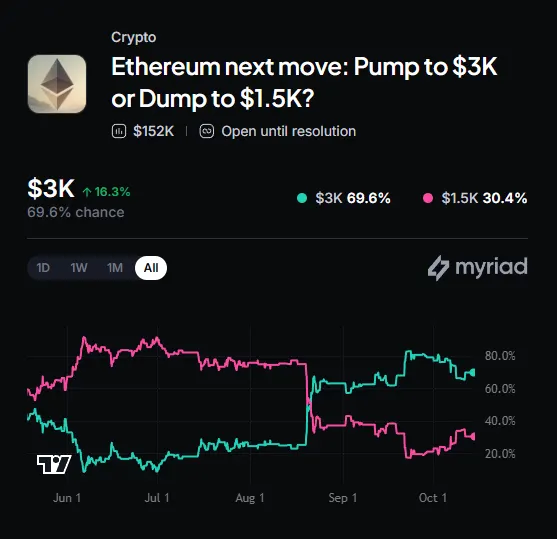
    On prediction market Myriad, owned by Decrypt‘s parent company Dastan, users are increasingly optimistic on Bitcoin’s prospects. They now place a 67% chance on its next move taking it to $84,000 rather than $55,000, up from 54% at the start of the week. Myriad users are similarly positive about the geopolitical situation, putting a 66% chance on the number of ships transiting the Strait of Hormuz averaging more than 15 before May, up from 49% on Monday.

    Daily Debrief Newsletter

    Start every day with the top news stories right now, plus original features, a podcast, videos and more.

  • Analyst Says “Onchain Data is Giving a Signal!”, Warns About XRP!

    Analyst Says “Onchain Data is Giving a Signal!”, Warns About XRP!

    Bitcoin (BTC) surged above $77,000 following news from the US-Iran front. While the price subsequently fell back to around $76,000, one analyst suggests a significant rise in $XRP is possible.

    Darkfost, a CryptoQuant analyst, stated that the funding rate for $XRP is negative.

    The analyst noted that the funding rate for $XRP perpetual futures on Binance has remained consistently negative this year, indicating an extreme bearish trend.

    This indicates that $XRP investors on Binance are gradually shifting towards a general bearish sentiment and are now approaching a market-wide consensus.

    The analyst also noted that the $XRP correction is currently around -60%, with investors continuing to position themselves for further declines rather than expecting a recovery.

    “Historically, these kinds of extreme emotional dynamics haven’t always been well-timed signals for following consensus.”

    He recalled that after a similar situation was last observed, $XRP triggered a strong upward momentum, rising from approximately $1.6 to $3.6, showing an increase of about 127%.

    However, the analyst noted that the overall market environment remains challenging, especially for altcoins, and therefore caution should be exercised in position strategies.

    *This is not investment advice.

  • HOT MOMENTS: Bitcoin Soars Following Donald Trump’s Comments

    HOT MOMENTS: Bitcoin Soars Following Donald Trump’s Comments

    A critical development regarding the Strait of Hormuz has occurred within the ongoing negotiations between the US and Iran.

    According to reports in the US press, the Iranian government announced that the Strait of Hormuz will remain “fully open” to all commercial vessels during the ceasefire. This step is considered an important signal regarding the security of global energy and trade flows.

    US President Donald Trump announced that Iran had pledged not to close the waterway again. However, Trump emphasized that the US naval blockade in the region would continue until a comprehensive agreement is reached. The Washington administration appears inclined to maintain military and strategic pressure while awaiting a final agreement.

    Related News Analysis Company Claims “Bullish Signs” May Have Begun to Emerge in an Altcoin That Has Been Stagnant for a Long Time

    While progress has been reported in negotiations between the parties, there are hopes that an agreement could be reached by the end of the week. However, disagreements on critical issues are said to persist. It is claimed that the US is considering releasing approximately $20 billion worth of Iranian assets as part of the negotiations, while the Trump administration maintains that they plan to take over Iran’s enriched uranium and that “no money transfers will take place” in this process.

    Meanwhile, on the Lebanese front, another aspect of the tension in the region, the 10-day ceasefire is reportedly being largely maintained. Israel has stated it will not withdraw from southern Lebanon, while Iranian-backed Hezbollah has indicated it will only abide by the ceasefire if Israeli attacks cease completely. This delicate balance in Lebanon remains a crucial bargaining chip in the comprehensive peace talks with Iran.

    Following these developments, the price of Bitcoin experienced a significant increase.

    A chart showing the recent rise in BTC price.

    *This is not investment advice.

  • Sanctioned Russia-linked Grinex halts operations after large-scale crypto hack

    Sanctioned Russia-linked Grinex halts operations after large-scale crypto hack

    Grinex, a sanctioned Russia‑linked crypto exchange, announced Thursday it had been targeted in a large-scale cyberattack that led to the theft of more than one billion rubles (approximately $13.7 million) from user accounts. The company claimed the incident may have been linked to foreign intelligence agencies.

    In an official statement, the exchange stated that technical evidence points to an unusually high level of sophistication, suggesting access to capabilities typically limited to state-backed entities. Early assessments indicate the attack was organized to inflict direct damage on Russia’s financial system.

    Grinex has faced ongoing challenges since its inception, including sanctions, targeted wallet monitoring, and blocked transactions aimed at limiting crypto transfers beyond the CIS, according to the exchange.

    The breach is described as a new phase of destabilization involving coordinated cyber theft targeting Russian users.

    As a result, Grinex has suspended its services and provided all collected information to law enforcement. Relevant authorities have been alerted and a criminal investigation is now underway.

    The Garantex backstory

    To understand why Grinex matters at all, it is important to first consider the background of Garantex. That exchange, sanctioned by OFAC in April 2022, became one of the most active conduits for Russian sanctions evasion and ransomware laundering over its six-year run.

    From 2019 through its disruption by international law enforcement in March 2025, Garantex processed $96 billion in transactions. When authorities shut it down, they froze $26 million in assets, a rounding error relative to the volume that had already flowed through.

    Following the takedown of Garantex by global law enforcement, investigators from TRM Labs reported that a new exchange, Grinex, had been identified as a likely successor.

    TRM Labs’ analysis shows that Garantex had been heavily involved in sanctions evasion and illicit finance, processing massive transaction volumes despite OFAC restrictions. Prior to its shutdown, it began transferring assets into A7A5, a ruble-linked stablecoin used across the Ethereum and TRON networks, which may have been designed to help preserve liquidity and bypass enforcement actions.

    In the aftermath, Grinex was promoted by Garantex-linked Telegram communities and showed strong operational similarities, including interface design and user migration patterns.

  • The Translation Layer: Why AI Is Necessary to Scale Decentralized Finance

    The Translation Layer: Why AI Is Necessary to Scale Decentralized Finance

    The emergence of artificial intelligence (AI) agents in decentralized finance signals a transition into an autopilot era. Jacob C. of Coinfello argues that these agents fundamentally enhance how users interface with complex smart contracts.

    Key Takeaways:

    • AI agents like Coinfello automate DeFi tasks once reserved for hedge funds to manage 24/7 market risks.
    • Jacob C. warns that the “translation layer” must solve oracle and agency risks for DeFi to scale safely.
    • By 2030, Jacob C. predicts dapps will decline as AI agents become the primary way to use smart contracts.

    The Shift to Autonomous Finance

    The shift from manual interaction to artificial intelligence (AI) agents in decentralized finance (DeFi) represents the autopilot era of crypto. In the past, DeFi required users to be glued to screens, monitoring gas fees, slippage, and liquidation risks. Today, autonomous agents are taking over the heavy lifting, providing continuous monitoring that was previously available only to institutional hedge funds.

    In some cases, agents can automatically pull liquidity out of a pool if they detect a rug pull pattern or if a stablecoin starts to de-peg. According to Jacob C., the co-founder and CEO of Coinfello, AI agents are also enhancing the way DeFi users interact with smart contracts.

    “Before AI agents, users were required to trust a centralized intermediary website (the dapp) which pointed at the smart contract,” Jacob C. said. “They had to trust the website to honestly convey what a smart contract does, to legitimately point at the correct smart contract, and to not be hacked by a malicious third party.”

    AI agents like Coinfello, Jacob C. argues, are eliminating this risk by interfacing directly with smart contracts, reading them, and explaining their risks to users. In other words, AI agents act as a translation layer that could prove vital if DeFi is to scale to levels that seem impossible now.

    Nevertheless, while AI agents undeniably enhance efficiency and streamline complex workflows, they also expose systems to new vulnerabilities—most notably oracle dependency, where external data sources can distort outcomes, and a subtle erosion of human agency, as decision-making authority shifts from individuals to algorithms. The Coinfello CEO concurs, warning that users still need to be able to verify or audit an agent before completely surrendering control or access to their funds.

    “Most of the AI agents that we see on the market today require users to transfer funds into a wallet fully controlled by the AI agent, and to trust that the agent will not make mistakes or will not be malicious,” the CEO said.

    bn_article_selector]

    To get around this problem, Jacob C. said his platform uses what he called “ liquidity sandboxing,” a concept he says enables users to approve individual permissions to the AI agent that limit which tokens the agent can access. The Coinfello team believes this approach “creates guardrails that fundamentally solve the dangers of securely using AI agents.”

    Regarding the prospects of DeFi in the age of AI agents, Jacob C. foresees these agents automating actions that a user otherwise would not have time to monitor, such as dollar-cost averaging or executing personally defined trading strategies. By 2030, he predicts decentralized applications ( dApps) will decline to the point where they are no longer the primary way people use smart contracts.

  • Charles Schwab Weighs Prediction Markets Move as Bitcoin, Ethereum Trading Nears

    Charles Schwab Weighs Prediction Markets Move as Bitcoin, Ethereum Trading Nears

    In brief

    • Charles Schwab President and CEO Rick Wurster indicated that America’s largest discount brokerage will likely support prediction markets.
    • However, he said that the company plans to steer clear of topics that touch pop culture, politics, and sports in favor of wagers tied to financial events.
    • Separately, the company said that it is rolling out access to Bitcoin and Ethereum trading in the coming weeks.

    America’s largest discount brokerage is eyeing prediction markets, but Charles Schwab President and CEO Rick Wurster sees a big distinction between speculation on Taylor Swift’s love life and the latest inflation numbers.

    “At some point, we will likely have prediction markets,” Wurster said during the company’s first-quarter earnings call on Thursday, describing wagers on financial events as distinct from topics like sports, politics, and pop culture.

    With $11.8 trillion in total client assets, Charles Schwab’s support of prediction markets would serve as the latest sign that Wall Street giants are embracing technology historically viewed as a fringe playground or regulatory gray area. However, Wurster indicated that Charles Schwab isn’t among firms racing to bring products associated with the sector to market.

    “It’s not at the top of our clients’ list,” he said. “And if you look at the stats on the success of gamblers, they’re not strong and people generally lose money.”

    The assessment comes as exchange operators like Cboe Global Markets prepare to debut event contracts tied to financial events, mirroring platforms like Polymarket and Kalshi while using traditional financial rails. And last month, Nasdaq filed with the SEC to offer options contracts for yes-or-no bets on whether a specified event happens.

    “That’s something certainly we will take a hard look at and then will be quite straightforward for us to offer,” Wurster said. “When we do, we’ll stay away from gambling.”

    Whether it’s Robinhood or Coinbase, prediction markets have emerged as core offerings for platforms aimed at retail investors through integrations with Kalshi. Last week, sports wagers accounted for 78% of the platform’s volume at $2.7 billion, according to a Dune dashboard.

    Asked whether Charles Schwab’s prediction market offering would tap Polymarket or Kalshi, a spokesperson told Decrypt the company—which notched a record 9.9 million trades in the first quarter—doesn’t have anything to share beyond Wurster’s comments at this time.

    As Robinhood and Coinbase have expanded their offerings, so too has Charles Schwab, which said Thursday that it plans to roll out access to trading Bitcoin and Ethereum in the coming weeks. At a rate of 0.75% per trade, the firm said in an announcement that its fees are “among the lowest in the industry.”

    The discount brokerage said it plans to grow its crypto offering over time by adding a suite of features Robinhood and Coinbase users are already familiar with. That includes the ability to deposit and withdraw digital assets, as well as an expansion of the tokens it supports.

    Daily Debrief Newsletter

    Start every day with the top news stories right now, plus original features, a podcast, videos and more.

  • Stack BTC CEO Steps Down as Farage-Linked Bitcoin Venture Reshuffles Leadership

    Stack BTC CEO Steps Down as Farage-Linked Bitcoin Venture Reshuffles Leadership

    In brief

    • Stack BTC CEO Jai Patel has exited the Bitcoin treasury firm’s board, with David Galan taking over as chief executive.
    • Reform UK leader Nigel Farage has invested around $291,000 in the firm.
    • The Liberal Democrats have called for an FCA inquiry into Farage’s promotion of Stack BTC.

    Stack BTC has replaced its chief executive after completing a shift in strategy, marking a fresh attempt to stabilise the UK Bitcoin-focused investment vehicle and bolster investor confidence. The company said on Wednesday that Jai Patel, who founded the business in its earlier form, had stepped down from the board with immediate effect.

    Announcing the change in a tweet, the firm said that incoming chief executive David Galan brings a mix of dealmaking, financial and operational experience suited to its approach.

    “Stack BTC isn’t a fund. It isn’t a single-thesis bet. It acquires cash-generative operating businesses and uses that engine to accumulate Bitcoin,” it said.

    “Executing that model at scale requires someone who understands the numbers, can close deals, and can manage institutional capital relationships, all at once. David does.”

    The company holds just over 68 BTC, valued at $4.76 million in current market prices. It reported an average entry price of about $70,000 per Bitcoin and said the position is up 2.7%.

    The leadership switch comes as cryptocurrency businesses become increasingly entangled with UK political figures, with Reform UK leader Nigel Farage among the most prominent political advocates of the sector. He announced his backing of the company in early March.

    From Kasei Holdings to Stack BTC

    Stack BTC relaunched in March with investment from Farage and former Conservative chancellor Kwasi Kwarteng, recasting itself as a Bitcoin treasury company. Its strategy centres on buying profitable operating businesses and using their cash flows to build a growing Bitcoin reserve.

    The business originated as Kasei Holdings. It was established in 2021 before changing its name to Kasei Digital Assets and then finally StackBitcointreasury.

    Since rebranding, the company has sought to present itself as a more focused vehicle. Patel remains a shareholder, while Galan—who has a background in property and corporate finance—has been tasked with delivering the revised model.

    Farage invested £215,000 ($291,000) in the relaunched company and also took part in a £260,000 ($352,000) fundraising round earlier this year. The value of his holding has risen alongside movements in the Bitcoin price.

    Some industry figures have expressed doubts about the venture’s positioning. Speaking to The Guardian, Ian Taylor of CryptoUK called the project a “PR branding exercise,” arguing that investors should “be doing their due diligence on the financials, the quality and experience of the management.”

    Earlier this week, the Liberal Democrats called for an FCA inquiry into a promotional video released by Stack featuring Farage. Party leader Daisy Cooper said the regulator “must investigate whether Farage’s plans to cash in on crypto could potentially amount to market abuse and a conflict of interest,” accusing him of “using the Donald Trump playbook to put his own financial interests above the public good.”

    Speaking to the BBC, a spokesperson for Farage stated that the video, which announced Slack’s purchase of £2 million in Bitcoin, was a “photo call,” and that the Reform UK leader “bought the crypto on behalf of Stack and not personally.”

    Reform UK and crypto

    Reform UK has embraced cryptocurrency more openly than other major parties, previously accepting digital asset donations and promoting pro-crypto policies.

    Campaigners and politicians have argued that crypto-based donations could obscure the origin of funds or enable foreign influence in UK elections. The government has responded by introducing a temporary ban on such donations following a review into electoral risks, with further rules expected.

    Farage and his supporters have pushed back, arguing that digital assets can be accommodated within existing frameworks and warning that tighter controls could disadvantage newer political entrants.

    Stack BTC and Nigel Farage have both been approached for comment.

    Daily Debrief Newsletter

    Start every day with the top news stories right now, plus original features, a podcast, videos and more.