According to Schiff, political developments in the US, rising inflation, and bond yields are among the factors that could put pressure on risky assets. The renowned investor believes these conditions could lead to a broader correction in financial markets.
Schiff, in particular, highlighted the potential impact of rising bond yields on asset prices and expressed doubts about the sustainability of the current market outlook.
Schiff, known for his criticisms of Bitcoin, considers gold a long-term store of value. In his latest statement, he reiterated his view that people should invest in gold instead of Bitcoin.
Schiff’s assessments are based on the belief that Bitcoin’s current price levels do not adequately reflect economic risks. However, these statements reflect the investor’s personal market expectations.
Bitcoin’s future price movements will depend on global economic conditions, investor demand, and developments in financial markets. Whether the sharp decline predicted by Schiff will materialize remains uncertain.
He also pointed to data centers’ job creation, noting demand for construction workers, energy infrastructure and AI compute hardware.
Moody’s estimates planned capital spending on U.S. data centers at $700 billion this year, rising to between $2.4 trillion and $2.48 trillion through 2030. Globally, spending is expected to reach $7 trillion by the end of the decade.
Any attempt to stifle that spending could have wide-ranging effects. The U.S. economy is already stressed on several fronts, including sticky inflation and rising bond yields.
A recession would matter for crypto traders too, since it typically reduces investors’ appetite for risky assets. Bitcoin proponents hail it as a haven, but it has historically faced selling pressure during broad-based risk aversion. At press time, the cryptocurrency traded near $81,200, down 0.8% since midnight UTC.
BlackRock’s iShares Bitcoin Trust (IBIT) is the world’s largest publicly listed bitcoin fund, with cumulative net inflows of $65.62 billion since its debut in January 2024, according to SoSoValue.
$40 trillion debt
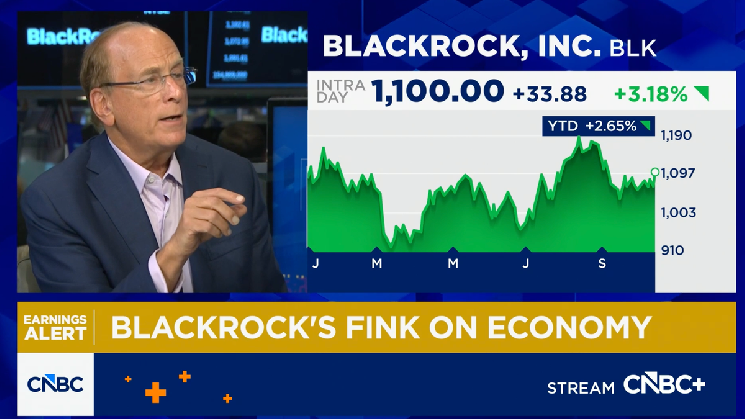
Fink also pointed to government borrowing. “U.S. deficits are starting to have a serious impact,” he said, noting the national debt has gone from $8 trillion in 2000 to $40 trillion in 2026.
“We grew $32 trillion in 26 years,” Fink said. “That’s a massive impact on demand for credit. The government is demanding more and more credit, and bond auctions are getting larger and larger.”
The BitMEX co-founder emphasized that he maintains his bullish view on Bitcoin and Ethereum, in line with this expectation. Hayes’ approach focuses on the impact of potential economic stimulus policies on financial markets, rather than price movements in the AI sector.
The main scenario highlighted in Hayes’ assessment was the possibility of large-scale financial bailout measures being implemented in the future. Such interventions are considered to potentially alter liquidity conditions in the markets and affect cryptocurrency prices.
However, Hayes specifically stated that he did not foresee a collapse in the AI sector. His remarks did not provide details on when or under what conditions any rescue package might be implemented.
Hayes’ optimistic approach to Bitcoin and Ethereum is based on the expectation of potential future liquidity expansion. However, there is no certainty that this scenario will materialize or lead to a rise in cryptocurrency prices.
Ledger has asked resellers and distributors in six Southeast Asian countries and Hong Kong to suspend sales of its devices while it investigates tampered wallets.
The company said the only confirmed incidents remain in Southeast Asia, and that it has not verified a drain linked to a device bought elsewhere.
MediaMarkt Saturn has stopped selling Ledger devices in its stores and online after a customer in Germany reported an implant, though no funds were lost.
Ledger has asked resellers and distributors in Southeast Asia and Hong Kong to stop selling its hardware wallets and take them off the shelves while it investigates devices fitted with a hidden implant, the company said in atweet on Tuesday.
The request covers Indonesia, Singapore, Thailand, the Philippines, Vietnam, Malaysia and Hong Kong.
Incident Update – Oct 13th, 2026
Ledger is asking resellers and distributors in Southeast Asia and Hong Kong to suspend sales of Ledger devices while the investigation is ongoing. This includes taking products off the shelves.
The only confirmed incidents remain in Southeast Asia, Ledger said, and it has not verified a drain linked to a device bought elsewhere. The company haspreviously said that all confirmed losses involve devices sold through CryptoBilis, a reseller in the region.
Ledger is still working to establish who tampered with the devices and at what point in the distribution chain. It said it has no indication that its own infrastructure, systems, services or direct sales channel have been compromised.
Ledger’s Donjon security teamfound that the implant reads the 24-word recovery phrase from the device’s screen during setup and sends it out over LTE. Anyone holding that phrase can restore the wallet and move its funds. Onchain investigator Specter hastraced more than $86 million in suspected thefts, a figure Ledger says it has not verified.
Earlier on Tuesday, MediaMarkt Saturn stopped selling Ledger devices in its stores and online, with Ledger’s agreement, after a customer in Germany reported an implant, Ledger said in a separatetweet. No loss of funds was reported.
Rival hardware wallet maker Trezor said on Tuesday that it willend its authorizations for resellers on January 1, 2027, describing the move as a “precautionary measure.” Trezor said there was no evidence that its own devices had been compromised.
Daily Debrief Newsletter
Start every day with the top news stories right now, plus original features, a podcast, videos and more.
The application also covers cash denominated in U.S. dollars, euros and British pounds, as well as jewelry, bank deposits and investment portfolios.
Notably, the $DOGE holdings have reportedly already been converted into cash by British judicial authorities and deposited into an interest-bearing account.
Massive $6 billion crypto fraud
The confiscation proceedings stem from a massive investment fraud scheme allegedly orchestrated by Qian through Tianjin Lantian Gerui Electronic Technology.
Between April 2014 and August 2017, the company illegally raised approximately 40.38 billion yuan (roughly $6 billion) by selling fraudulent investment products that promised substantial returns.
According to Chinese prosecutors, the scheme affected more than 102,000 investors, who suffered combined losses of approximately 19.98 billion yuan.
Much of the money was used to repay existing investors, operate fraudulent investment projects and purchase assets, including Bitcoin, real estate, vehicles and jewelry.
Qian fled China in 2017, eventually arriving in the United Kingdom, where British authorities subsequently seized her cryptocurrency holdings.
In November 2025, she was sentenced to 11 years and eight months in prison by a British court for money laundering offenses.
What happens to seized Bitcoin?
The latest development comes as British courts are also considering the legal ownership of the massive Bitcoin fortune.
On October 12, the UK’s High Court ruled that Chinese law should govern claims made by victims seeking to recover the seized cryptocurrency.
The decision could have major implications for whether investors are entitled to the original value of their losses or potentially benefit from Bitcoin’s substantial appreciation since the fraud took place.
However, the British ruling does not establish final ownership of the assets. Further proceedings will determine whether the victims can demonstrate enforceable rights to the cryptocurrency.
Meanwhile, the Chinese court has opened a six-month period during which Qian’s relatives and other interested parties, including affected investors, can participate in the confiscation proceedings.
Turkish police and intelligence officers detained Hex founder Richard Heart in Istanbul on Wednesday, Turkish media reported, acting on an Interpol Red Notice.
Finland sought the notice in 2024 on a charge of aggravated tax fraud, and Heart was detained along with his wife, according to the reports.
The U.S. Securities and Exchange Commission accused Heart in 2023 of raising more than $1 billion in unregistered crypto offerings, but later dropped the case.
Turkish authorities have detained Richard Heart, the founder of the Hex cryptocurrency, in Istanbul on an Interpol Red Notice, Daily Sabahreported on Wednesday, citing Turkish news agency IHA.
Heart, whose legal name is Richard James Schueler, was detained with his wife on Wednesday morning in an operation by Istanbul police and Turkey’s National Intelligence Organization (MIT), according to the report. Police had monitored his address in the city’s Beşiktaş district before the arrest.
Officers seized a dozen mobile phones, several laptops, graphics cards, rifles, pistols, two drones, gold bracelets and a large amount of cash in different currencies, IHA reported.
A Red Notice is a request to law enforcement worldwide to locate and provisionally arrest a person pending extradition or similar legal action, and is not an international arrest warrant. Interpol issued the notice for Heart in 2024 at the request of Finland. The notice lists a single charge, aggravated tax fraud, though Finnish authorities have also sought him over an alleged assault. Daily Sabah described the notice as relating to high-value cryptocurrency fraud.
Heart and Hex
Heart launched Hex in 2018, marketing it as a high-yield “blockchain certificate of deposit.”
In 2023, the SEC charged Heart and three entities he controlled, Hex, PulseChain and PulseX, with conducting unregistered offerings of crypto asset securities that raised more than $1 billion. It also accused him of misappropriating at least $12 million of investor funds to buy luxury goods, including sports cars, watches and a 555-carat black diamond known as “The Enigma.”
A federal judge dismissed the complaint in February 2025 for lack of jurisdiction, finding that Heart’s activities were not clearly aimed at U.S. investors. The SEC declined to amend it by an April deadline, ending the case, which Heart’s lawyer called “a complete victory.”
It was not immediately clear whether Finnish authorities have requested Heart’s extradition from Turkey.
Daily Debrief Newsletter
Start every day with the top news stories right now, plus original features, a podcast, videos and more.
Romania sent up two of its F-16 fighter jets after it detected an ‘aerial target’ near the eastern NATO border today.
The Ministry of National Defence of Romania (MApN) said the ‘aerial target; briefly entered its airspace near Sulina, before it moved over the black sea.
The target then entered Ukrainian airspace, where it was quickly shot down by Ukraine’s air defence system, MApN said.
MApN said the target had been spotted by its radar surveillance system this morning (14 October) and notified the General Inspectorate for Emergency Situations to trigger alert measures for parts of Tulcea County.
An emergency message was sent to phones for those impacted at around 10.20am local time.
And MApN scrambled two Romanian Air Force F-16 aircraft.
The air alert ended at 11.22am and the public warning was lifted.
NATO member Romania borders Ukraine and has frequently had to scramble its military aircraft in response to drone activity near the border.
On Tuesday (13 October), a drone hit two ships off the coast of Bulgaria in the Black Sea, sinking one.
The MApN said the target was shot down over Ukraine (Yan Dobronosov/Global Images Ukraine via Getty Images)
Bulgaria’s Prime Minister Rumen Radev, said one of the ships was sailing under the Maltese flag and was hit by three drones at around 1.30am local time.
The second ship, which was sailing under the flag of St Kitts and Nevis, was also hit and sank with one sailor rescued.
In recent weeks, several senior European officials and intelligence services have warned that Russia may be planning to test the NATO alliance with increased covert attacks or even an incursion after a spate of sabotage incidents across the continent.
Denmark’s defence intelligence service specifically warned Russia could use such tactics to split the NATO alliance.
Earlier this week, a top NATO military commander said the alliance is ‘ready to fight tonight’ if it is attacked.
US General Alexus Grynkewich said that he doesn’t believe a conflict is imminent or inevitable but went on to say that the most effective way to preserve peace is to prepare for war and to maintain open lines of communication to ‘resolve misunderstandings’.
Gen Grynkewich provided no specific details about what kind of attack Nato is preparing for, nor where, nor with what kind of forces.
But outlining what a response to a Russian attack could look like, Gen Grynkewich said Nato’s combined land, sea and air forces will move to stop Moscow seizing territory and deny Russia the ability to hold ground.
“My theory of victory is simple,” he said at the Warsaw Security Forum.
“We will block the initial attack. If the attack persists, we will blunt it and prevent any enemy advance. And if required, we will break the enemy’s forces and the operational war-fighting system arrayed against us.”
This includes not just the attacking force but anything and everything that supports, sustains and controls it, he said.
Gen Grynkewich added that it is important that NATO alliance members co-ordinate a ‘coherent’ response to Russian activity to make it clear to Moscow ‘where our red lines are’.
Current market conditions indicate that Solana’s performance is being closely watched alongside Bitcoin and Ethereum. Analysts are particularly attentive to how institutional interest may shape trading strategies in the coming weeks. Recent discussions have also highlighted the competitive positioning of Solana in relation to its peers, suggesting potential trends that traders should monitor closely.
Solana is a high-performance blockchain known for its speed and low transaction costs. Its growing popularity is attracting interest from institutional investors, which is crucial for enhancing market credibility. Goldman Sachs has jurisdiction over crypto products, making its involvement in Solana ETFs particularly relevant for market dynamics.
Where Do We Go From Here
Traders should watch for increased activity in Solana’s market as Goldman Sachs’ significant holding could lead to heightened institutional interest. With the potential for new ETF flows, the interplay between Solana, Bitcoin, and Ethereum could define future trading strategies. The evolving dynamics among these assets will likely impact investor sentiment and market stability.
The information provided in this article is for informational purposes only and should not be considered as financial advice.
Baba Vanga has some chilling predictions for the next few months, including a change in leadership in Russia and fears of World War III.
The infamous psychic has previously been credited with predicting some huge events, including the 9/11 terror attacks and the Covid-19 pandemic.
The Bulgarian grandmother died in August 1996, but before she passed she made a number of predictions, many of which are still to come.
For this year, Baba Vanga’s predictions reportedly included natural disasters, which we’ve sadly seen.
She also warned that this is the year that humans may begin to find themselves replaced by machines, which echoes concerns about job losses some AI experts have issued.
As we hurtle towards the end of the year there are still a few predictions the mystic made that are on the horizon.
Baba Vanga predicted a change in leadership in Russia (Vyacheslav PROKOFYEV / POOL / AFP via Getty Images)
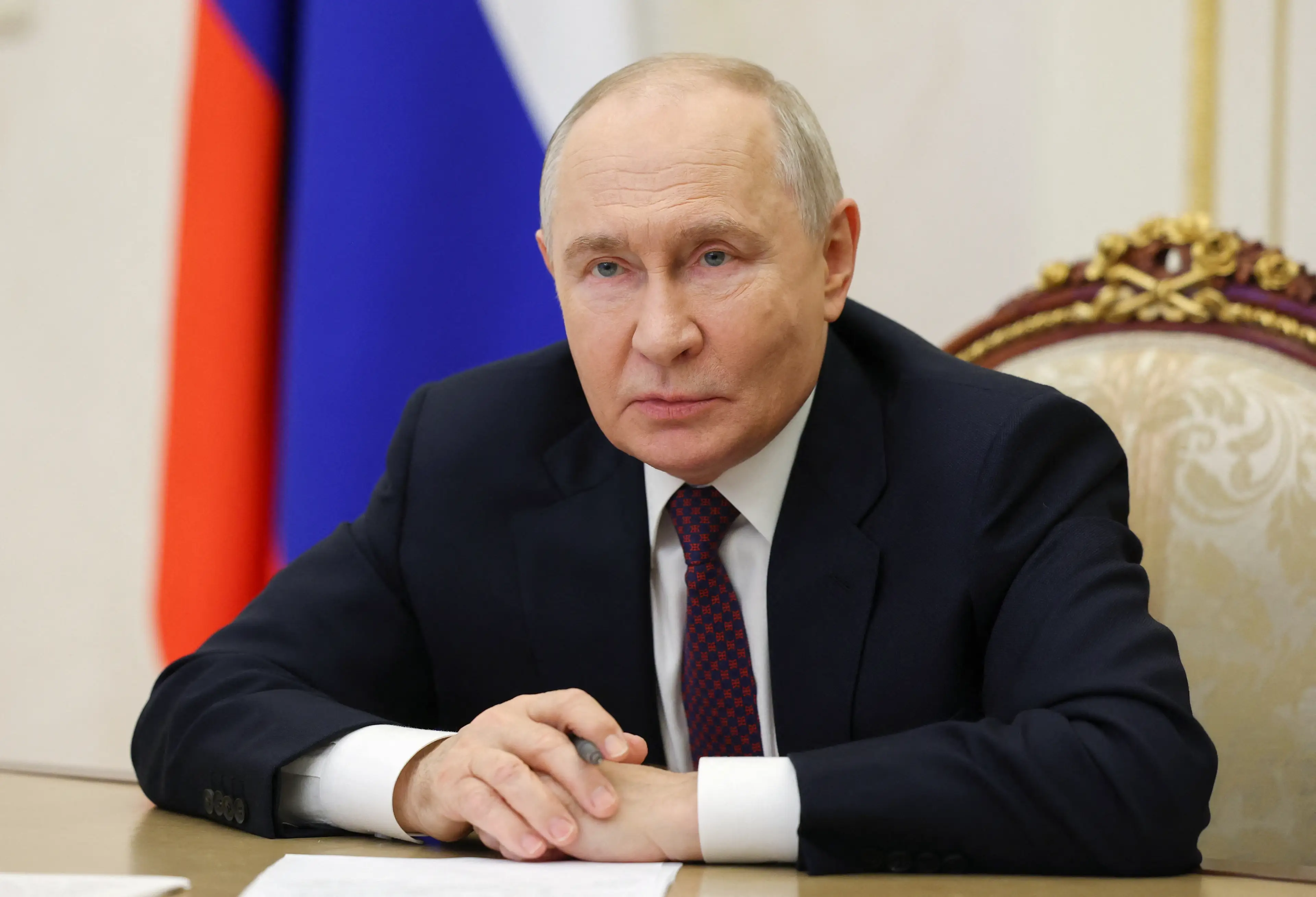
Baba Vanga reportedly predicted that Russia will have a new leader by 2027, ending Vladimir Putin’s 26-year run and potentially ushering in a new era of political turmoil that could see conflicts sparking out between world powers.
And if that isn’t enough to put a damper on your day, then Baba Vanga also predicted that by November the first aliens will arrive on Earth, meaning next month could be lively.
Looking ahead to next year, it seems as though some of us could end with super-human powers.
According to the psychic, in 2027 some folks may end up with ‘superhuman-like traits’ with the prophecy suggesting it could be caused by a mysterious disease or genetic experiment – sounds a bit like the plot of The Boys, doesn’t it?
Of course, these are only predictions and it probably doesn’t make much sense to plan your life around some guesses someone made decades ago.
Alongside that, Baba Vanga never actually wrote her predictions down, instead, they were passed on to those closest to her, including her niece Krasimira Stoyanova.
This means that things can be misinterpreted or misunderstood, especially as more time passes.
And, as you may have noticed, lots of the predictions made by Baba Vanga are pretty vague so they can’t really be pointed to as rock-solid proof of what’s to come.
A scientist once predicted the world would end next month
A scientist pinpointed the exact date he reckons the world will end (Getty stock image)
As well as Baba Vanga’s prediction that aliens might be rocking by the end of next month, back in the 1960s Austrian physicist Heinz von Foerster predicted that the world would end on 13 November 2026.
Yep, that means if von Foerster is correct then we’ve got less than a month left.
Unlike Baba Vanga, who relied on her psychic powers, von Foerster examined 24 estimates of the world’s population spanning a couple of thousand years to see how fast population growth was expanding.
His research showed that where it used to take centuries for the population to double, it had since sped up and each doubling had happened quicker than its predecessor.
The scientist claimed that if things continued in this way, then there would come a point where these doublings would be so rapid we’d run out of space and – as he put it – end up ‘squeezed to death’.
U.S. consumer prices rose 3.7% year over year in September, above the 3.6% forecast, as gasoline jumped 9.1% in a single month.
Odds of an October Fed rate hike roughly doubled from 22% after the report, and the 10-year Treasury yield climbed to about 5.3%.
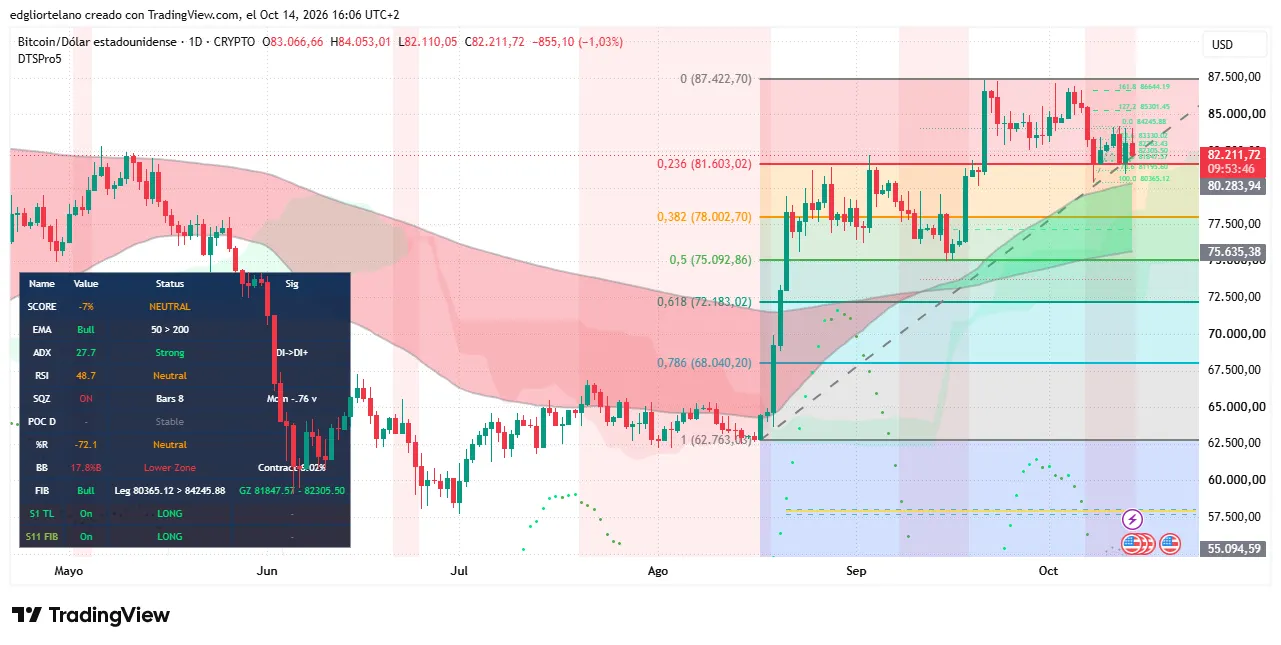
Bitcoin fell 1.5% to $82,142 and is holding the $81,847 to $82,305 Fibonacci golden zone, with $81,603 as the next support.
Bitcoin fell 1.5% to $82,142 on Wednesday after U.S. inflation came in hotter than expected, dragging most of the crypto market down with it. Ethereum dropped 2.8% to $2,440, Solana lost 1.9% and XRP slid 1.3%, while total crypto market cap shed 0.7% to $2.8 trillion.
The Consumer Price Index rose 0.6% in September and 3.7% over the past year, up from 3.4% in August, per the Bureau of Labor Statistics. Economists expected 3.6%. Gasoline prices jumped 9.1% in a single month and accounted for more than half of the increase.
Core CPI, which strips out volatile food and energy prices, rose 2.6% annually against a 2.5% forecast. That is the reading the Federal Reserve watches most closely, since it shows whether price pressure is spreading into rent, airfares, and services.
Expensive gasoline starts with expensive oil, which has traded above $90 a barrel for most of the past two months amid the war between the U.S. and Iran. Pricier fuel raises the cost of shipping and producing almost everything.
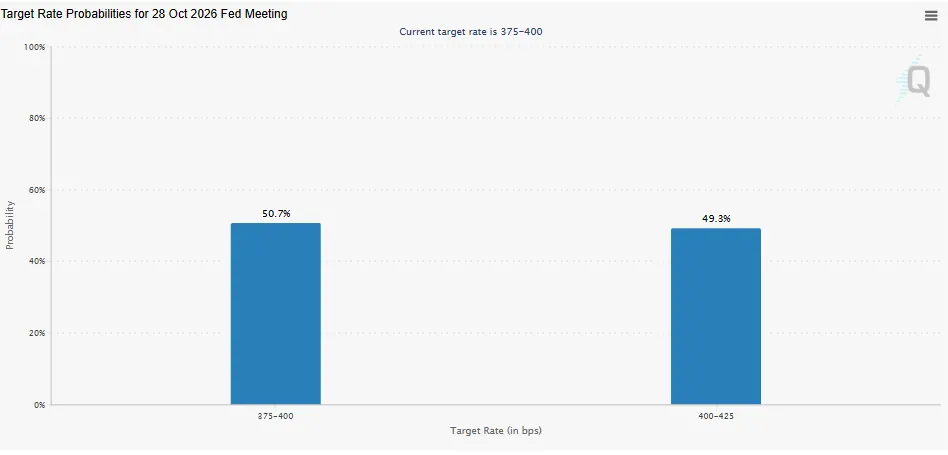
When inflation runs hot, the Fed raises interest rates to cool spending. It already hiked in September to a 3.75%-4.00% range, and traders now see roughly 44% to 49% odds of another hike at its October 27-28 meeting, up from 22% before the report, according to CME FedWatch.
The 2-year Treasury yield, which closely tracks Fed rate expectations, jumped about 10 basis points to roughly 4.9%, while the 10-year climbed to about 5.3%, near 24-year highs.
Higher yields hit crypto directly. A government bond paying 5.3% with almost no risk competes with Bitcoin, which pays nothing. Rising rates also make borrowing more expensive and tend to strengthen the dollar, draining the cheap money speculative assets feed on, which is why the S&P 500 fell 0.6% and the Nasdaq 0.8% on the same news.
Crypto also swings harder than stocks because many traders borrow to bet on rising prices, and when the price drops past a set level, exchanges automatically close those positions, a process called liquidation, and that forced selling can push prices lower and trigger more liquidations in a chain.
BitcoinBTC · USD
$81,686−1.71%
Oct 8Oct 9Oct 11Oct 13Oct 15
$84.2k$83.1k$81.9k$80.7k
24h HighHigh$84,025
24h LowLow$81,376
VolVol$1.5B
Market projectionsOdds by Myriad
→
At the moment, more than $281 million in crypto derivatives positions have been liquidated in the past 24 hours, with most of it coming in just the last four hours—and the majority of that coming from Bitcoin long positions (the bulls betting the price would go up, and now paying the price when it dropped).
Bitcoin price: The macro picture is punching hard
On the daily chart, Bitcoin opened at $83,066 and now trades near $82,211, sitting inside the Fibonacci “golden zone” it reclaimed on Tuesday. That zone marks an area where pullbacks within uptrends often attract buyers.
The average price of the last 50 days remains above the 200-day average, a setup traders read as an intact long-term uptrend. The Average Directional Index, which gauges trend strength on a 0-to-100 scale where readings above 25 confirm a trend, sits at 27.7 with buyers still ahead, down from 29.9 on Tuesday, meaning traders are bullish, just not as much as they used to be.
The Relative Strength Index, a momentum gauge from 0 to 100, slipped to 48.7, just under the 50 line that separates bullish from bearish momentum. The Squeeze Momentum Indicator has been on for eight sessions, meaning volatility is compressed and a big move is building, and its -0.76 reading leans bearish by a small margin.
A daily close below $81,603 would break the golden zone and bring the $80,365 swing low into play, with the trend band near $80,284 right under it; losing that would expose $78,003. On the upside, bulls need to reclaim $84,245 before targeting $85,301, $86,644 and the October high of $87,422.
The next test arrives Thursday with the Producer Price Index, which tracks what businesses pay for goods and services, and the Fed announces its rate decision on October 28.
Disclaimer
The views and opinions expressed by the author are for informational purposes only and do not constitute financial, investment, or other advice.
Daily Debrief Newsletter
Start every day with the top news stories right now, plus original features, a podcast, videos and more.