“It’s amazing to see that Solana was able to advertise and even get an office in China. BNB Chain was not able to do this, so far. Hopefully, what’s good for one industry player is also good for the rest,” declared Binance founder Changpeng Zhao, who was surprised by this event.
While social media sources have claimed that videos of the Solana light show have been taken down on Douyin, the Chinese TikTok, with “$SOL Shanghai” searches being classified as a violation, others have framed this experience from a different perspective.
Local sources indicated that this development was part of a push to enter China as a tech company, and not as a cryptocurrency organization. Techflow argues that by March, Solana had already partnered with Shanghai Hongqiao Alibaba Center to launch the “Shanghai Builder Station,” receiving endorsement from the government.
Solana is also kicking off the Solana Accelerate China event across four cities, including Shanghai, Hangzhou, Shenzhen, and Beijing. The event agenda features themes like artificial intelligence (AI), Robotics, physical AI, emerging markets, and local business development, avoiding subjects directly linked to speculation and the $SOL token, as argued by Techflow.
So, this means the Solana Foundation has opted to enter the Chinese space with a holistic approach, and maybe wait and see whether China changes its current crypto policy, playing the long game.
It remains to be seen whether this will actually happen. But if it does, Solana will have a leg up compared to other networks, having already established a presence in the Chinese ecosystem.
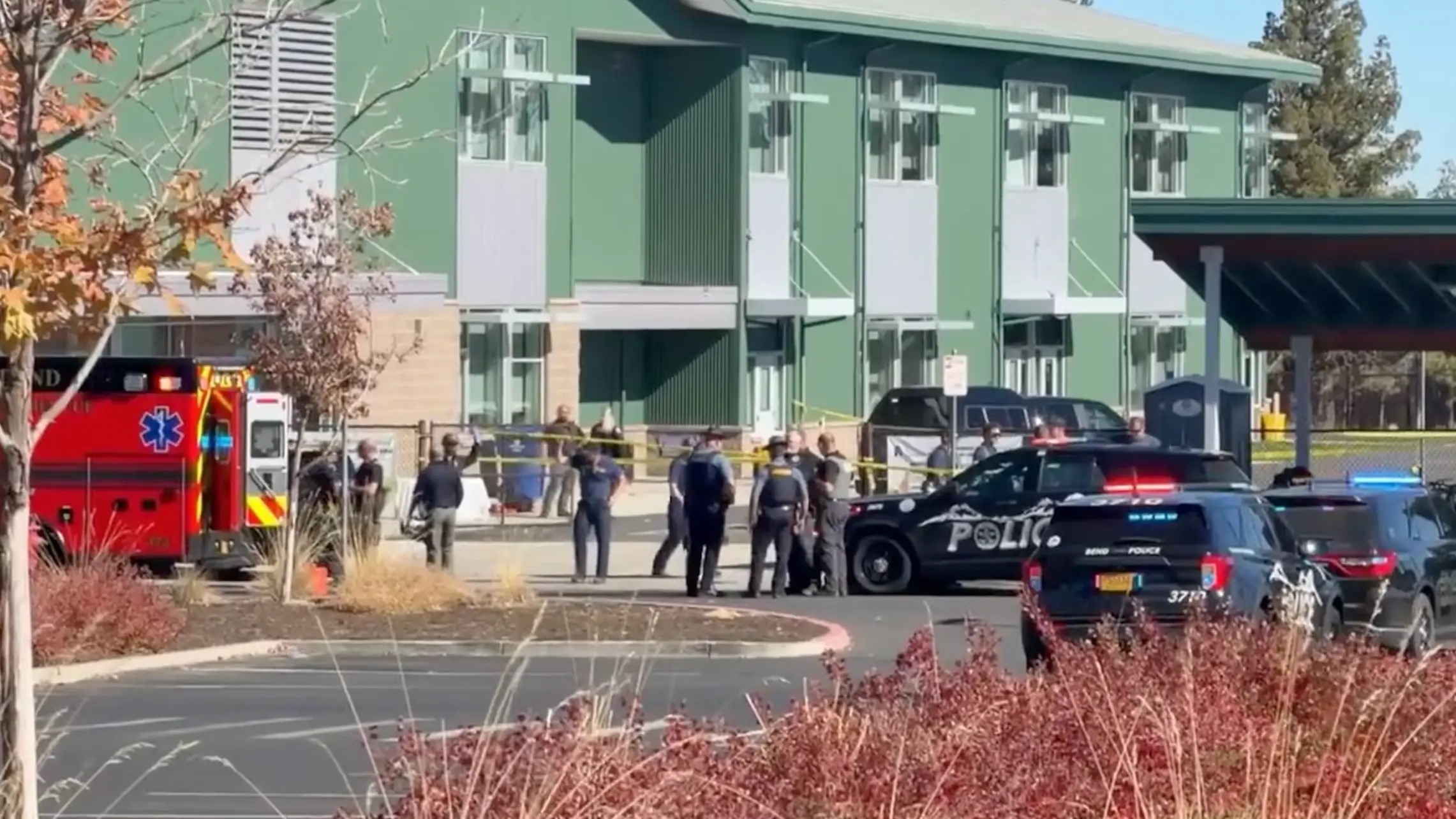
Multiple people, including children, have reportedly died following a shooting at a school in Oregon.
Officers responded to Silver Rail Elementary School in Bend, shortly before 1pm following ‘multiple 911 calls’ about a shooter.
Police said a shot was reportedly fired into a car at around 1.59pm and that police were on the scene at 1.02pm.
Several media outlets have reported that three children and one adult have died in the incident.
At least two people have been taken to hospital, with police confirming ‘multiple victims’.
Sheila Miller from the Bend Police Department said: “At this time, we have confirmed there are multiple victims.”
She added that at least two people were transported to a local hospital, saying: “Their status at this time is not known. Children are among the victims.”
Miller also said the suspected shooter had been killed.
It is not yet clear who killed the suspect but Miller said it ‘may have been a bystander’.
“The Bend Police Department is currently at Silver Rail Elementary School after a report of an active shooter,” the department said in a statement earlier Thursday.
“There is a large police presence in the area. Please avoid the area.”
Bend-La Pine Schools Superintendent Steven Cook said the district is ‘stunned and heartbroken by this senseless tragedy’.
Silver Rail Elementary School in Bend, Oregon (Google Maps)
He said in a statement: “We extend our deepest sympathy to the families and to everyone affected by this violence.
“No words can adequately express the grief our community is experiencing.
“Our immediate priorities are caring for our students and staff and assisting law enforcement and emergency responders.”
Between 400 and 450 children attend Silver Rail Elementary, as well as more than 40 staff members.
Speaking earlier this evening, Miller said: “We’re in the process at this time of evacuating, going room by room, and evacuating each of the people who are in that school.”
Once safely out of the school, people will be taken to by bus to the reunification centre.
FBI Director Kash Patel said an investigation is underway.
“@FBIPortland is on the scene and assisting our local partners in the investigation regarding an earlier shooting at a local school,” he wrote on X.
“We will make every resource they need available.”
In a statement, US Senator Jeff Merkley said his team is monitoring the situation in Bend.
He said: “As details continue to come out, my heart is with the Bend community and all of the students and families affected.
“No one should have to fear violence at school.”
Congresswoman Janelle Bynum said she is pausing all campaign activity following the incident, as she wants to remain ‘focused on supporting and being with the community as it responds to this tragedy’.
“I feel this deep, deep, deep in my soul,’ she said.
“Our whole community does. Our whole state does. And the whole nation should.
“Our babies are supposed to do arts and crafts at school, not use their desks as cover from gunfire. They’re supposed to make friends, not mourn them. This is every parent’s worst fear.
“My heart and my prayers and everything else I got is with the families at Silver Rail Elementary. When will it end?”
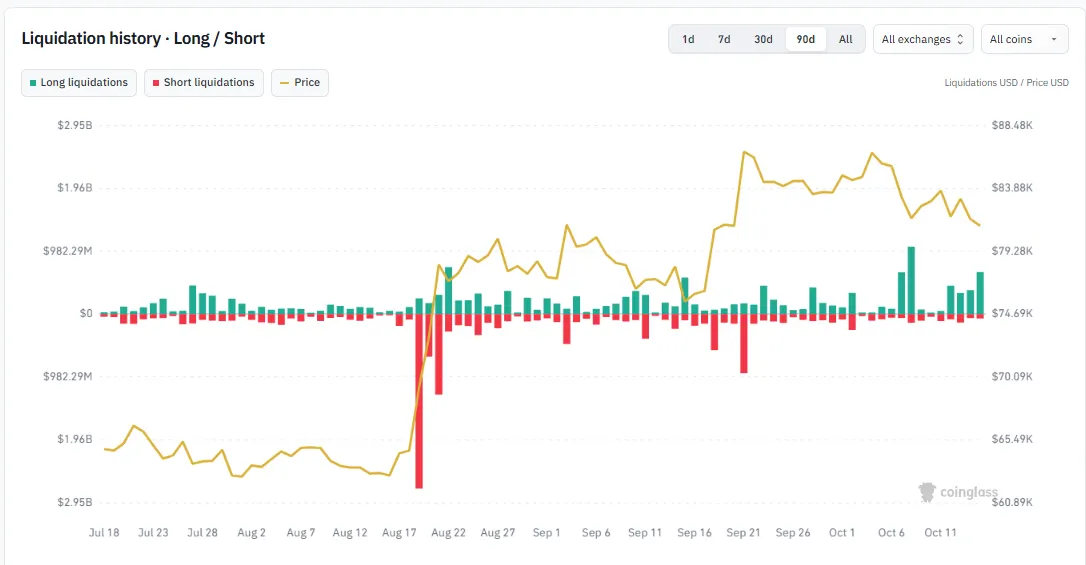
Crypto liquidations reached $948.22 million in 24 hours across 177,440 traders, with long positions accounting for 90.6%, per CoinGlass.
Bitcoin fell 2.6% and broke support after hotter-than-expected CPI and PPI data revived bets on another Fed rate hike.
Bitcoin now trades roughly 2% below the average cost of U.S. spot ETF holders near $82,300, putting those buyers back underwater.
Bitcoin fell below $80,000 on Thursday for the first time in over a month, extending Wednesday’s inflation-driven slide and wiping out nearly $1 billion in leveraged crypto bets. It’s currently trading just about $82,000 after several hours of increased volatility.
Ethereum and XRP dropped close to 5%, Zcash sank almost 10%, and only five coins in the top 100 managed gains above 1%. Pick any coin in the top 100 and it’s likely in the red today.
Across the market, 177,440 traders were liquidated in 24 hours for a total of $948.22 million, per CoinGlass, with longs accounting for $858.96 million, or 90.6%. Ethereum led with $282.03 million, with Bitcoin just behind at a little over $200 million.
This was the third-heaviest day for long liquidations in the last 90 days, behind October 8 and August 22. The largest single order liquidated yesterday was a $12.03 million Bitcoin long on Binance, force-closed at $80,208.96.
A liquidation happens when a trader borrows to bet on a price move and the market goes the other way. Once losses eat through the collateral, the exchange sells the position automatically, and that forced selling drags prices lower and trips the next batch of leveraged longs.
The trigger was Wednesday’s inflation report, which showed consumer prices up 3.7% year over year in September against a 3.6% forecast, with core inflation at 2.6% against 2.5%. Thursday’s Producer Price Index, which tracks business input costs, rose 6.3% annually versus a 5.5% forecast.
Much of that inflation comes from oil, with Brent crude near $104 a barrel, about 70% above a year ago amid the war between the U.S. and Iran. That feeds into fuel, shipping, and almost everything else that needs to be transported to reach consumers.
Hot inflation pushes the Federal Reserve toward higher interest rates, which lifts Treasury yields, the return investors earn for lending to the U.S. government. A bond paying around 5% with almost no risk makes Bitcoin a harder sell, while higher rates make borrowing pricier and strengthen the dollar, draining the cheap money leveraged crypto traders run on.
BitcoinBTC · USD
$82,219+0.5%
Oct 9Oct 10Oct 12Oct 14Oct 16
$84.2k$82.9k$81.5k$80.2k
24h HighHigh$82,508
24h LowLow$79,806
VolVol$1.8B
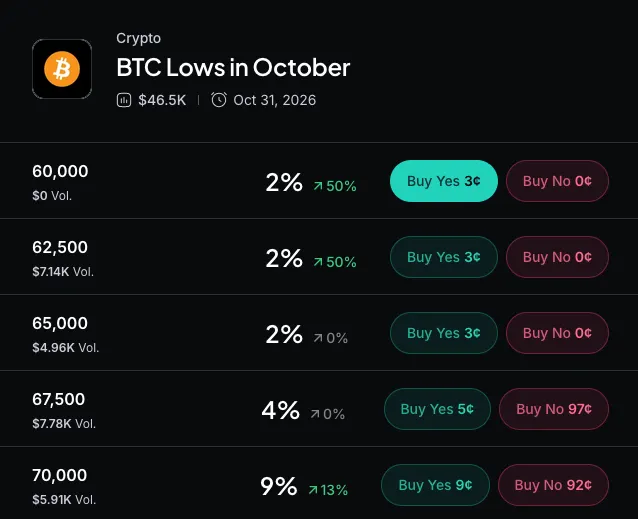
Market projectionsOdds by Myriad
→
Iliya Kalchev, analyst at Nexo, reads the selloff as a broad exit from risk more than a Fed story, with stocks and copper falling, gold rising and South Korea’s Kospi down about 8%.
“Bitcoin has slipped to the bottom of the $81,000 to $87,000 range it has held since late September, and Glassnode flags $80,000 as the level to watch,” Kalchev told Decrypt. “It is also now roughly 2% below the average cost of U.S. spot ETF holders, near $82,300, after closing above that line on 21 of the 24 days since September 21. That puts ETF buyers back underwater, and reclaiming it is the first test of any rebound,”
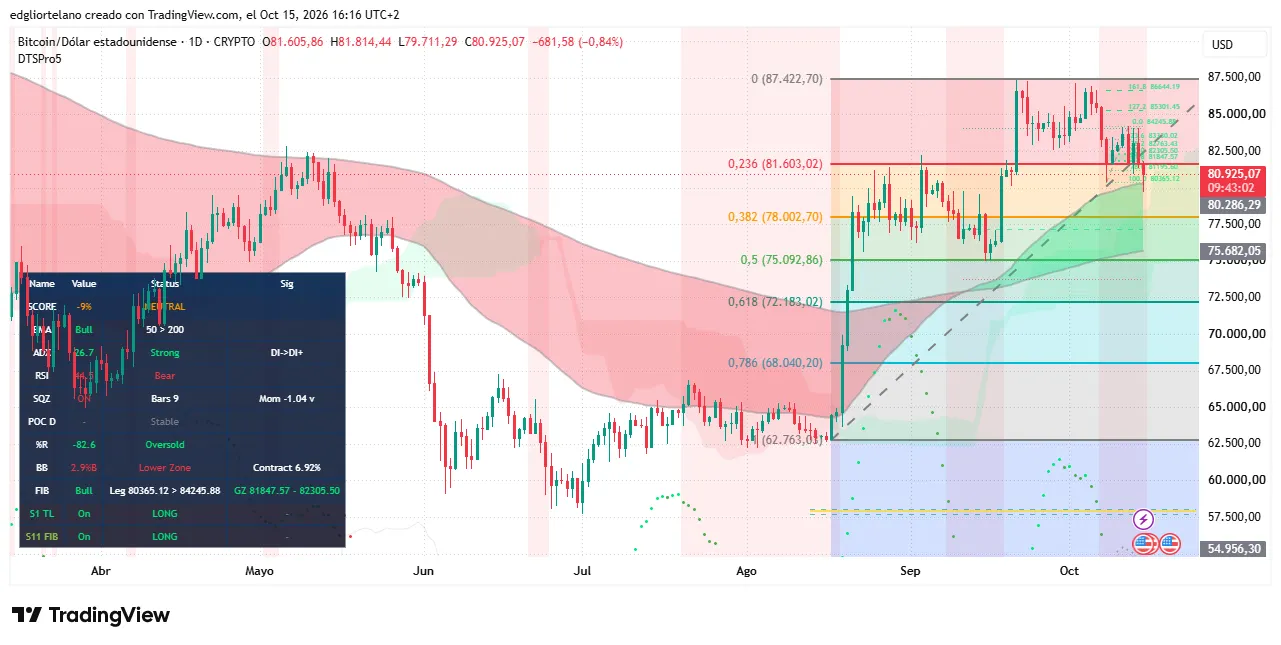
On the daily chart, Bitcoin broke below $81,603, the strongest upper support from its August-to-October rally from $62,763 to $87,422, where uptrend pullbacks often stall. The drop reached $79,711 before buyers pulled the price back near $80,925, off a rising trend band near $80,286.
Bitcoin price data. Image: Tradingview
The Relative Strength Index, a 0-to-100 momentum gauge where 50 splits bulls from bears, fell to about 44, while the golden cross still keeps the longer-term uptrend intact.
A daily close back above $81,603 would reopen the path to $84,245 and the $87,422 swing high. Losing $80,286 would expose $78,002 as the next support, and then $75,092.
Kalchev sees early signs the selling is not deepening, including cooling profit-taking, but said a recovery needs more than a bounce.
“Three things need to line up for Bitcoin to push through. ETF flows have to turn consistently positive, after $681 million of outflows last week and a single $177 million inflow day. Selling by long-term holders has to ease,” Kalchev explained.
For Kalchev, a bullish market would require that leverage happens with a sustained buying instead of just a bounce. He added that a “Fed path that stops at one 25 basis point hike would take some pressure off the backdrop.”
The Fed announces its rate decision on October 28, followed by core PCE inflation data the next day and October payrolls on November 6.
Daily Debrief Newsletter
Start every day with the top news stories right now, plus original features, a podcast, videos and more.
Nineteen people have been injured after a minibus was involved in a collision with a freight train at the Eurotunnel site in Pas-de-Calais, officials have said.
The incident unfolded at around 8pm in Coquelles, sparking a major emergency response with several fire engines, ambulances and a helicopter at the scene.
Those injured were all on the bus, which was carrying HGV drivers towards a Eurotunnel loading platform – the driver of the bus is thought to be one of those hurt in the incident.
Officials have said none of the injuries are life-threatening.
The Pas-de-Calais prefecture said in a statement: “An accident involving a minibus transporting heavy goods vehicle drivers who were about to board a Le Shuttle shuttle occurred this evening, at the loading platform of the Eurotunnel site.
“Significant resources were immediately mobilised by Eurotunnel, then under the authority of the prefect of Pas-de-Calais.
“The initial report indicates 19 people involved, including the driver. No deaths are to be reported at this stage and no lives are in danger.
“The sub-prefect of Calais is currently on site. An initial situation update will be provided during a press briefing scheduled for 10.15pm.”
Local reports claim that two of those who were injured have been assessed as critical and have both been taken to hospital in Lille.
A photograph published by local news outlet La Voix du Nord showed a badly damaged minibus on the platform, with police officers and staff in high-visibility jackets present at the scene.
The image also appeared to show injured people, who had been pixelated, receiving treatment on the platform.
Eurostar said the incident is not expected to impact its service.
It said in a status update: “An incident occurred several kilometres away from the Channel Tunnel.
“This incident does not involve or impact Eurostar trains running from and to London.
“All of Eurostar trains will run as expected.”
The Channel Tunnel opened in 1994 and connects Folkestone in the United Kingdom with Coquelles in northern France.
It’s the only fixed link between Great Britain and the European mainland is the longest underwater section of any tunnel in the world, measuring more than 23 miles.
It runs the Eurostar train service, which carried 20 million passengers in 2025, and freight trains that move tens of millions of tonnes of goods each year.
A woman who was stabbed to death in Manchester in the early hours of this morning has been named, as police arrest a man on suspicion of murder.
Alisha Samuels, 26, was found with serious stab wounds by officers who were responding to reports of a disturbance in Newton Heath at around 2am on Thursday (15 October).
Emergency services rushed to the residential street but despite the best efforts of paramedics, she was pronounced dead at the scene.
Greater Manchester Police have said a 25-year-old man has since been arrested on suspicion of murder.
Another man aged 61 and a woman aged 38 have also been arrested on suspicion of assisting an offender, police said.
All three remain in police custody while police continue with their investigation.
Alisha Samuels died in Manchester on Thursday (GMP/the Press Association)
Detective Inspector Paul Costello, from GMP’s Major Incident Team, said on Thursday: “This was an awful and tragic attack, but I would like to reassure the community that we have three people in our custody, and my team are working tirelessly to identify anyone else who may have been involved.
“There will be a significant police presence in the area, and multiple scenes are in place whilst our investigations continue. I urge anyone who may be able to help with our enquiries to please come forward.”
A local resident said she heard ‘screams’ followed by a ‘car crash’ in the early hours of the morning.
Another told the Manchester Evening News: “I heard shouting and screaming. I went outside and saw all the police.
“They arrested a man, I couldn’t see what he looked like because it was dark.”
A third local resident, who didn’t want to be named, said the horrific incident was a ‘shock’.
“Believe it or not, I was telling my friend the other day that this is a quiet area,” she said.
“So, this has come as a bit of a shock.
“I’ve lived here 30 years and the worst thing we’ve had was a shooting a long time ago. Apart from that, it’s usually quiet.”
Images printed by the MEN showed forensics officers in white suits searching the area outside a property as well as the inside of a white car.
An update from Greater Manchester Police said: “At this time, the family have asked for privacy whilst they deal with the devastating loss of their loved one.”
Detectives are now attempting to determine the circumstance surrounding the incident and have urged witnesses, including anyone with doorbell, phone, or CCTV footage, to get in touch.
The force has called on anyone with relevant information to ‘please come forward to support our investigation and bring justice for Alisha’.
Police can be contacted on 0161 856 5464 or the independent charity Crimestoppers can be contacted anonymously on 0800 555 111.
A Major Incident Public Portal has also been launched, which can be found here.
Ledger has announced Atom, a touchscreen Android device that incorporates a Secure Element running Ledger OS.
Solana Mobile named Ledger as its first hardware expansion partner, with its Seeker app and Solana dApp Store preinstalled on Ledger’s new Atom device.
The launch comes as Ledger investigates hidden implants found in hardware wallets sold through a reseller in Southeast Asia.
Ledger’s new Atom device will ship with Solana’s Seeker app preinstalled, the companiesannounced on stage at Ledger’s Op3n conference in Paris on Thursday.
Billed as a “signer” rather than a hardware wallet, the Atom is an Android-powered touchscreen device equipped with a data-only eSIM and Ledger’s Secure Element, enabling users to send and receive encrypted messages with other Atom users as well as perform crypto transactions in the manner of its range of wallets. To do so, the device switches into a Ledger OS-powered “Secure Mode” for sensitive operations such as signing transactions and authorising AI agent requests.
The Atom sports a 6.77-inch OLED display, rear camera and 4,000mAh battery, and runs on a Qualcomm Dragonwing chip. It also incorporates a hardware privacy switch that physically cuts power to the camera and microphone.
The device also runs third-party apps, and will come preinstalled with Solana’s Seeker app after Solana Mobile named Ledger as its first hardware expansion partner. Seeker combines Solana Mobile’s wallet with its Solana dapp Store, which lists more than 1,500 decentralized apps, and will appear on Atom’s home screen. Until now, the store was available on Solana Mobile’s own Seeker phone.
Your wealth is digital. The device you manage it with should be built for that.
Meet Ledger Atom™: the security of industry leading hardware, the convenience of your everyday apps, plus control over your AI tools, and a rapidly expanding platform of apps, all in one quantum… pic.twitter.com/vHhDNQYipz
Ledger Atom runs on the Android Open Source Project, the free, open version of Google’s mobile operating system, alongside a Secure Element chip running Ledger OS. Its display and touch controls are physically isolated from Android, according to the release, and approvals in the Seeker app happen in a “Secure Mode” backed by the Secure Element.
“Having the Seeker app on Ledger Atom from day one just makes sense, so Ledger users get access to the Solana ecosystem without giving up any of the security,” said Ian Rogers, Ledger’s chief human agency officer.
Solana Mobile began opening its software stack to other Android manufacturers in March. Samsung Wallet also recentlyadded USDC transfers on Solana. Seeker has handled more than $13 billion in transaction volume and 154 million transactions, according to the company, which says it has sold more than 200,000 devices across Seeker and its earlier Saga phone.
Hardware makers that integrate the stack can earn rewards in SKR, the native token of the Solana Mobile ecosystem, which also rewards users and developers, the release said.
Existing Seeker phones will remain fully supported, Solana Mobile said. Reservations for Ledger Atom are open now, though neither company has given a price or shipping date.
The Ledger Atom will include anti-tampering and tamper-evident features from the packaging to the device itself, according to the press release, including ways to help detect whether the enclosure has been opened, and will only be sold through Ledger’s official site.
The announcement of the Atom comes at an awkward time for Ledger, as the firm investigates tampered devices in its reseller network linked to a suspected $87 million wallet drain.
The company this week disclosed that its Donjon security team hadfound an implant in a hardware wallet sold through Southeast Asian reseller CryptoBilis that captures recovery phrases during setup and sends them out over LTE. On Tuesday, itasked resellers in six Southeast Asian countries and Hong Kong to pull its devices from shelves.
Daily Debrief Newsletter
Start every day with the top news stories right now, plus original features, a podcast, videos and more.
Ethereum, XRP, and Solana have all dropped in value on the day, with “outsized drawdowns” compared to Bitcoin.
Experts point to Wednesday’s consumer price index coming in at 3.7% and expectations of an October interest rate hike as major macro pressures.
The slide is also a natural hangover from altcoins’ “strength and momentum” over recent months.
Altcoins have taken a hit over the past 24 hours, with major tokens seeing “outsized drawdowns” compared to Bitcoin. Experts say that this has largely been prompted by macro pressures pushing prices down.
With the market cap of all cryptocurrencies dropping by 2.5% to $2.8 trillion, Ethereum dropped by 5.5% to a $289 billion market cap over the past 24 hours, XRP fell by 5.1% to $82.4 billion, and Solana slipped by 3.8% to $60.6 billion. Meanwhile, industry leader Bitcoin has slipped by 3.1% on the day and 2.6% on the week, sitting at a market cap of $1.6 trillion.
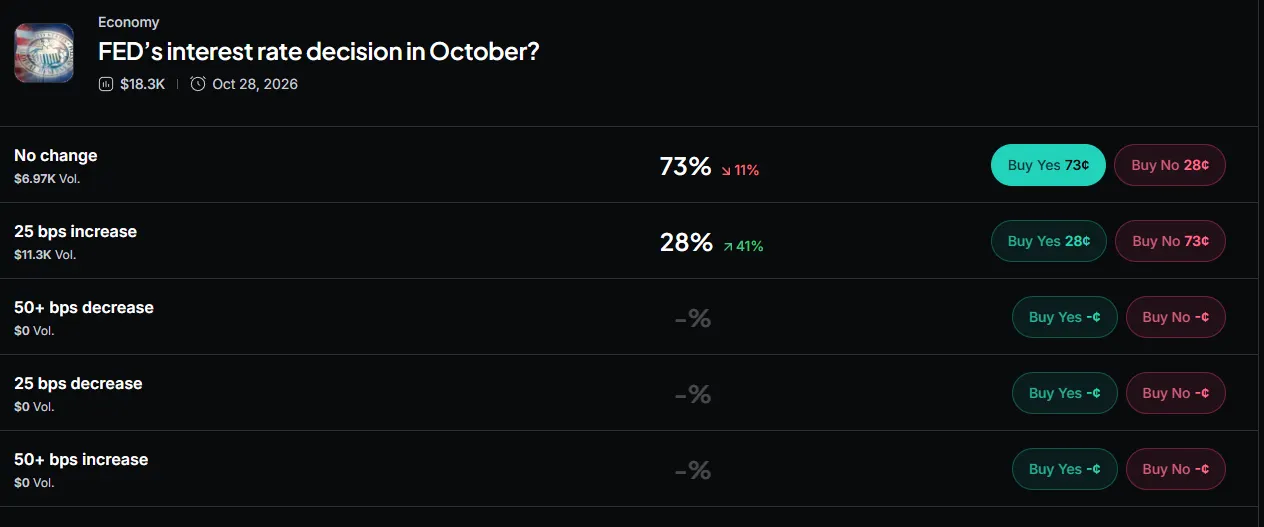
It comes after the consumer price index rose 3.7% in the year to September, as Decrypt reported on Wednesday, with Myriad predictors pointing to a 28% chance of an October interest rate hike (Disclaimer: Myriad is a prediction market operated by Decrypt‘s parent company Dastan).
Nick Forster, founder of options trading exchange Derive.xyz, said in a note shared with Decrypt that this shifted traders into “protection mode” as “hedging activity” on the platform doubled, and whales pulled back on optimistic bets made in spring.
“This immediate pull-back from long-term upside bets alongside aggressive short-term hedging shows a dramatic regime shift,” he said, “with institutional participants rapidly reassessing their macro risk exposure as the path for interest rates turns murky again.”
When markets react like this, Luke Nolan, senior research associate at CoinShares, says that altcoins are impacted the most.
“[It] seems to be high beta assets just got hit harder, similar to in equities as well, where the high flyers have seen outsized drawdowns in recent sessions,” Nolan told Decrypt. “Alts are typically more sensitive to financial conditions, and tightening affects the premise of liquidity expanding.”
Nolan also highlighted the U.S. dollar hitting a near 18-month high as a downward pressure on the entire crypto market. He said that over a medium-term horizon, crypto tends to have an inverse correlation to the US Dollar Index, or DXY. This is partly due to crypto being priced in dollars, Nolan explained, but also because a rising dollar causes a tightening in liquidity and a fall in risk appetite.
Max Shannon, senior associate at Bitwise Europe, told Decrypt that the slide is also a hangover from altcoins’ “strength and momentum” over recent months.
Since the start of October, futures open interest in altcoins (excluding Ethereum) has fallen by $8 billion, Shannon said. To him, that shows traders have “taken chips off the table,” which is a natural reaction after such a strong run.
That pattern is playing out with Ethereum, he added. ETH outperformed Bitcoin for three consecutive months, the first time it’s managed that since March 2021, and investors have been cashing in since. Ethereum ETFs saw 11 straight trading days of net outflows totalling $782.8 million, he said, before a brief inflow on Tuesday. Money has been heading back out since, per CoinGlass data, with $129.5 million in net outflows.
“This price action is more of a consolidation period for altcoins that have already done well,” Shannon told Decrypt. “Altcoins generally tend to exhibit high correlations with BTC in tough times and lower correlations, especially with idiosyncratic catalysts, in better market environments. Hence, for the near term, it is possible that these altcoins trade in lockstep with BTC, albeit more sensitively.”
For prices to recover, Nolan says he wants to see expectations of an interest rate hike in October to fall. Right now, he struggles to call a bottom for altcoins as he sees valid arguments for movements in either direction.
“I could see a situation where Bitcoin loses its support and altcoins likely bleed further,” Nolan told Decrypt. “The opposite could also be true: this could be just a short-term correction, and we could be back into decent market conditions soon, which if Bitcoin was to push back decently above 80k, I could very well see an outsized up move for altcoins.”
Daily Debrief Newsletter
Start every day with the top news stories right now, plus original features, a podcast, videos and more.
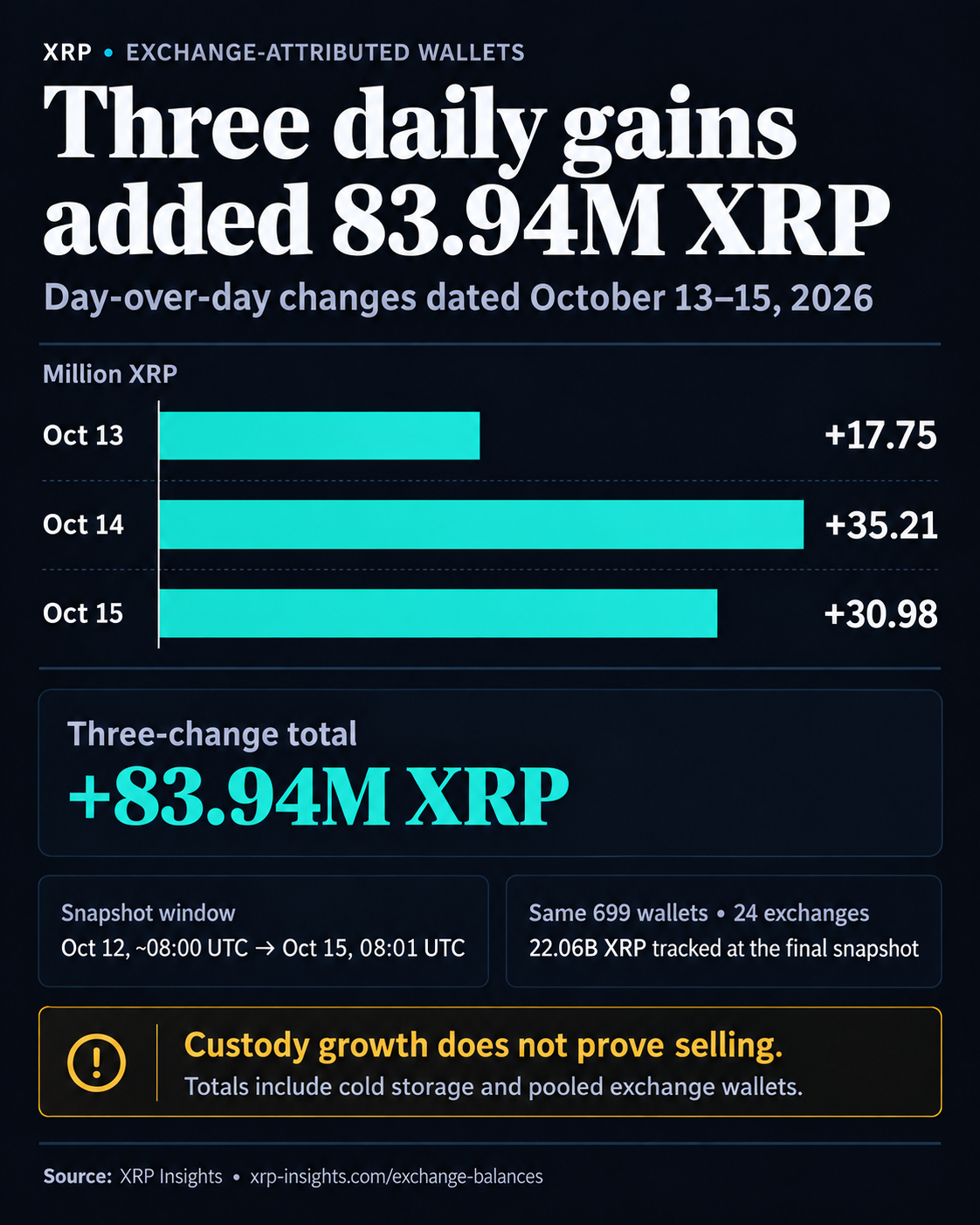
The downloadable balance figures show three successive positive daily changes:
The dates label changes from the preceding day’s snapshot. Together, they cover approximately 08:00 UTC on Oct. 12 through 08:01 UTC on Oct. 15. Over that interval, tracked holdings rose from about 21.973 billion to 22.057 billion $XRP.
Each observation from Oct. 12 through Oct. 15 retained 699 wallets and 24 exchanges, with no newly added wallets or exchanges excluded for coverage changes.
That consistency matters because discovering another exchange wallet can increase a provider’s reported total without any $XRP moving. Here, the provider’s records show a balance increase within the tracked set.
The venue breakdown answers a different question. For Oct. 8–15, $XRP Insights reported an increase of 82.35 million $XRP, or 0.37%, in the same tracked wallets. That seven-day figure overlaps the latest three daily gains; the two totals cannot be added.
Binance-attributed wallets accounted for 54.61 million $XRP of the weekly net increase, the largest positive venue change and roughly two-thirds of the total. Upbit added 11.58 million $XRP, Kraken 9.17 million, Coinbase 8.09 million and Bithumb 5.81 million over the same week.
The build was not uniform. Bybit’s tracked holdings fell by 4.22 million $XRP, while SBI VC Trade and Bitfinex each declined by about 3.4 million and Uphold by 3.04 million. These offsets help explain why the sum of the largest gains exceeds the net increase.
The venue breakdown covers Oct. 8–15. Binance’s 54.61 million $XRP addition belongs to that weekly window; the three-day total is an aggregate across the tracked wallets.
$XRP Insights counts hot wallets, deposit hubs and cold storage. Exchange-controlled wallets can pool customer balances and institutional custody assets, so the total does not measure $XRP available on an order book.
The latest dataset includes about 480.2 million $XRP classified as wrapped-token reserves or other funds, including insurance and charity holdings. Binance’s grouping also includes Binance-Peg $XRP backing and a separately identified Binance.US affiliate wallet.
Shared-address accounting adds another limit. Official $XRP Ledger payment documentation explains that destination tags tell an exchange which customer to credit in its own systems. A ledger balance therefore cannot reveal each customer’s orders or trading intentions.
The tracker uses validated ledger balances and XRPSCAN wallet labels, carrying forward the last value if a read fails. Transfers between tracked and untracked exchange addresses can alter the measured total without a customer deciding to trade.
CryptoSlate’s Oct. 8 supply analysis examined the distinction between custody and executable supply. Its Oct. 12 trading report covered Oct. 8–10 spot turnover and earlier futures rebuilding.
Executed trades would test the supply risk
For $XRP holders, the immediate question is whether the additional balances accompany sustained selling on the venues involved. Further same-wallet growth alongside seller-initiated spot executions would strengthen that concern. A balance reversal or an identified custody transfer would weaken it.
The next test is seller-initiated spot trading on the same venues and over a defined window: incoming sellers accepting resting buyers’ orders.
Direction labels also vary. Coinbase’s trade-record definitions define side as the resting order’s side: a buy record describes a buyer whose order was met by an incoming seller. Venue-specific definitions therefore matter when measuring seller-initiated activity.
The reported $3.1 billion of 24-hour turnover cannot answer that question. It measures aggregate activity, rather than seller aggression tied to the wallet window.
Hackers Exploit Irish Police X Accounts To Promote Fake $XRP Offers
According to An Garda Síochána, unauthorized access began at approximately 11 p.m. on October 14. The police confirmed the incident the following day and urged users to avoid interacting with the compromised accounts.
The fraudulent messages directed followers toward links associated with Xaman, a cryptocurrency wallet previously known as Xumm. The wallet provider confirmed that the advertised $XRP allocations were fraudulent and had no legitimate connection to its service.
Airdrop scams commonly promise free tokens in exchange for connecting a wallet, visiting a malicious website or completing a transaction. Depending on the method used, victims may expose sensitive information, approve harmful blockchain transactions or lose access to their funds.
The incident demonstrates how scammers can exploit established institutions rather than impersonating cryptocurrency projects alone. An official profile with a substantial following can lend an appearance of legitimacy to offers that would otherwise raise suspicion.
Garda Confirms Internal Systems Remained Secure
An Garda Síochána stated that the compromise was confined to the X platform. Authorities reported no evidence that internal police systems or data had been accessed without authorization.
The distinction matters because a social media breach does not automatically indicate that an organization’s internal network has been compromised. However, unauthorized access to official accounts can still expose followers to financial risks and create confusion about legitimate public communications.
The police also cautioned users against engaging with the affected profiles and warned about potential impersonator accounts that could exploit the incident. Meanwhile, X is cooperating with investigators as they work to determine how the attackers obtained control of the accounts.
Data shared by the cryptocurrency analysis platform CryptoQuant reveals a remarkable increase in transfers by large $XRP investors to Binance, one of the world’s largest cryptocurrency exchanges. In the last 30 days, the total amount of $XRP sent by whales to Binance reached 1.66 billion, marking the highest level in the last seven months.
According to CryptoQuant data, 30-day whale inflows, which reached approximately 1.65 billion $XRP in September, subsequently declined. However, transfers have recently gained momentum, allowing the previous peak to be surpassed. As a result, the activity of large investors on Binance has reached its highest level in the last seven months.
Related NewsArthur Hayes Says, “The AI Bubble Will Burst, Bitcoin Will Soar,” and Gives a Date