Category: Business

  • New Hampshire Follows Bitcoin Reserve With ‘Blockchain Basic Laws’ Signing

    New Hampshire Follows Bitcoin Reserve With ‘Blockchain Basic Laws’ Signing

    In brief

    • New Hampshire’s governor signed the Blockchain Basics Law, introducing new protections for blockchain innovation and crypto users in the state.
    • Last year, the state became the first in the nation to introduce a strategic Bitcoin reserve, allowing for up to 5% of public funds to be invested in the leading crypto asset.
    • However, its executive council recently rejected the allowance of the first Bitcoin-backed municipal bond.

    New Hampshire Governor Kelly Ayotte helped make the state into one of the crypto-friendliest in the nation when she signed HB 639 into law last week. 

    Known as the The Blockchain Basic Laws act, the bill provides protections for cryptocurrency innovation and use in the state while also allowing for the creation of a special blockchain dispute docket in the superior court. 

    “With Governor Ayotte’s signature on HB 639, New Hampshire has once again demonstrated that it intends to lead the nation in blockchain innovation,” said New Hampshire Representative Keith Ammon, the bill’s primary sponsor, in a statement. 

    “The Blockchain Basic Laws protect one of the most fundamental rights in the digital economy—the right of individuals to control their own digital assets through self-custody,” he added. “They also provide clear legal protections for blockchain developers, miners, validators, entrepreneurs, and businesses building the next generation of financial technology.”

    The state’s latest blockchain legislation follows its passing of a strategic Bitcoin reserve last year. The bill, signed by Ayotte in May 2025, allows the state’s treasurer to invest up to 5% of its public funds in the leading crypto asset, alongside precious metals like gold and silver. 

    Ammon, who played a key role in that bill’s passage, told Decrypt at the time it was “one little way our state could hedge against inflation in the future.”

    “Today, with the signing of HB 639, we have taken another major step by enacting one of the most comprehensive blockchain rights laws in the country,” he said in a statement. “Entrepreneurs, investors, developers, and innovators across America should know that New Hampshire is open for blockchain business.”

    Despite its advances, the state’s executive council last week blocked a proposal that would have allowed the New Hampshire Business Finance Authority to facilitate a Bitcoin-backed municipal bond.

    Daily Debrief Newsletter

    Start every day with the top news stories right now, plus original features, a podcast, videos and more.


  • Bitcoin braces for Waller warning as US inflation test looms

    Bitcoin braces for Waller warning as US inflation test looms

    Bitcoin has entered a high-risk week as fresh inflation data and renewed Federal Reserve rate concerns have intensified pressure on crypto markets.

    According to Reuters, Federal Reserve Governor Christopher Waller warned that the U.S. central bank could consider raising interest rates if inflation continues to remain above its 2% target, placing investors on alert before this week’s key economic releases.

    His comments come as traders prepare for the June Consumer Price Index (CPI) report due on July 14, followed by the Producer Price Index (PPI) data on July 15.

    Bitcoin has already reacted to rising macro uncertainty. The cryptocurrency slipped below $62,000 after climbing to around $64,500 earlier, with escalating tensions between the United States and Iran adding another layer of risk to global financial markets.

    Higher geopolitical uncertainty has combined with growing expectations of tighter monetary policy to weaken demand for risk assets.

    Inflation data could shape Fed expectations

    Wall Street economists expect the June CPI report to show monthly inflation easing to 0.2% from 0.5% in May. Annual inflation is projected to slow to 3.8% from 4.2%, offering investors another measure of whether price pressures are cooling.

    The inflation figures are likely to influence expectations for future Federal Reserve policy. If consumer prices rise faster than forecast, markets could strengthen their bets that policymakers may keep interest rates higher for longer or even consider another increase.

    Attention will then turn to the June PPI report, which measures inflation at the wholesale level. Together, the two reports are expected to provide a clearer picture of inflation trends across the U.S. economy and could influence trading across equities, bonds and digital assets.

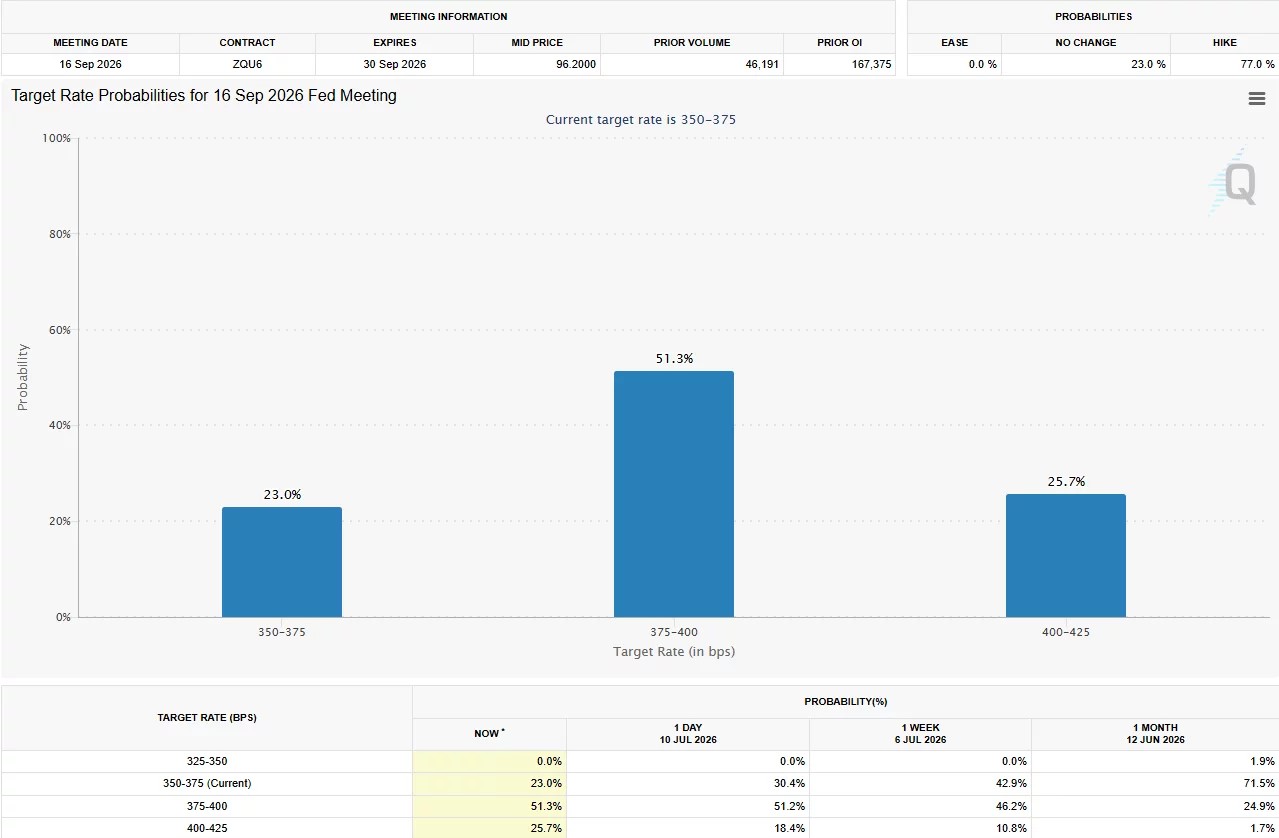
    Following Waller’s remarks, the CME FedWatch Tool showed that the probability of a September Federal Reserve rate hike climbed to 51.3%. Higher borrowing costs typically reduce appetite for speculative investments, making cryptocurrencies particularly sensitive to changes in monetary policy expectations.

    Source: FedWatch

    Recent Federal Reserve communications have already pointed to persistent inflation risks. Minutes from the central bank’s latest policy meeting noted that several officials remain concerned about inflationary pressures, including those linked to rising artificial intelligence investment and stronger-than-expected economic activity, keeping markets cautious ahead of this week’s data releases.

    Crypto legislation adds another market catalyst

    While inflation remains the primary focus, investors are also monitoring developments in Washington as lawmakers prepare for another important week for the CLARITY Act, one of the most closely watched crypto market structure bills.

    U.S. President Donald Trump recently urged the Senate to pass the legislation in honor of Senator Lindsey Graham, who died on July 11. The bill is expected to receive renewed attention this week as lawmakers continue discussions over its final form.

    The legislation seeks to establish a clearer regulatory framework for digital assets in the United States. Market participants have been watching the proposal closely because it could determine how cryptocurrencies are regulated by federal agencies and influence future institutional participation in the sector.

    With inflation reports, Federal Reserve policy expectations, geopolitical tensions, and crypto legislation all converging within days, investors are preparing for another volatile trading week.

    Softer-than-expected inflation could ease pressure on risk assets, while stronger readings may reinforce expectations for tighter monetary policy and keep cryptocurrencies under pressure.

  • ‘The Odyssey’ Director Chris Nolan: Young Audiences are Rejecting ‘AI Slop’

    ‘The Odyssey’ Director Chris Nolan: Young Audiences are Rejecting ‘AI Slop’

    In brief

    • “The Odyssey” director Christopher Nolan has warned that younger film audiences are “utterly rejecting” generative AI.
    • He argued that in filmmakers are showing a “renewed interest” in tactile storytelling after years of “heavily virtual environments.”
    • The emergence of generative AI has divided the top rank of filmmakers, with some embracing the technology and others rejecting it outright.

    “The Odyssey” director Christopher Nolan famously doesn’t use a smartphone, so it’s perhaps unsurprising that he isn’t on board with the latest tech buzzphrase.

    On the press tour for his latest effort, Nolan told The Telegraph that young audiences are “utterly rejecting” generative AI, adding that, “I’ve never seen a more rapid wholesale dismissal of a supposedly foundational jump in technology in my lifetime.”

    He pointed to the reaction of his four children, in their late teens and early 20s. “Their judgment of AI slop has been immediate and harsh,” Nolan said. “They see it for what it is very quickly—and it’s much easier for them to identify it—because it grew out of an online world they know really well.”

    The technology has hit at “exactly the wrong time” for filmmaking, he argued, pointing to a “renewed interest in more tactile, more real forms of storytelling” after a glut of films featuring virtual environments.

    Nolan’s own blockbusters have become famous for their spectacular in-camera effects work, whether crashing a 747 into a building for “Tenet,” landing a Spitfire on a beach for “Dunkirk” or planting entire crops of corn for a chase scene in “Interstellar.”

    That said, he’s not averse to using computer-generated VFX himself, like Two-Face’s scarred visage in “The Dark Knight,” and he conceded that not every aspect of generative AI is necessarily “useless or meaningless.”

    Generative AI and filmmaking

    Generative AI has caused a rift in the film industry, with some creatives openly coming out against the technology and others embracing it. Among the former camp are “Pan’s Labyrinth” director Guillermo del Toro, who has led chants of “fuck AI” on stage, and Steven Spielberg, who has dismissed the technology as an “empty chair with a laptop on it.”

    On the other side of the fence are the likes of Martin Scorsese, who has joined AI firm Black Forest Labs as an adviser, and “Terminator 2” director James Cameron, who sits on the board of Stability AI. Ben Affleck has become a convert to the technology, having sold his AI startup InterPositive to Netflix after previously doubting that the technology would be able to “write anything meaningful” or create films “from whole cloth.”

    While filmmakers debate among themselves, AI companies are pressing ahead with video creation tools like Utopia’s PAI, which aims to maintain consistency of output across cuts and scenes.

    Daily Debrief Newsletter

    Start every day with the top news stories right now, plus original features, a podcast, videos and more.
  • Watch Out: Claims of Manipulation Regarding an Altcoin Are Circulating

    Watch Out: Claims of Manipulation Regarding an Altcoin Are Circulating

    L2Beat, an analytics platform that tracks Ethereum layer-2 networks, announced that it has excluded approximately $7 billion worth of non-circulating tokens held in multi-signature wallets controlled by the $RAIN team from Arbitrum’s Total Guaranteed Value (TVS) calculation.

    Despite the adjustment, the value of $RAIN tokens within TVS on Arbitrum remains at approximately $2.6 billion. This figure makes $RAIN the largest asset on Arbitrum, surpassing USDC and Ethereum (ETH).

    L2Beat researchers described the resulting picture as “clearly illogical,” arguing that they believe the $RAIN token has been “heavily manipulated.” The platform noted that a more comprehensive investigation into the token’s valuation and Arbitrum’s impact on the TVS metric is underway.

    Related News After Strategy, Is Tether Next? Activity Is Being Observed in Bitcoin Wallets

    The TVS metric is used to measure the total value of assets secured by a blockchain or layer-2 network. However, including tokens that are not in circulation and are held in wallets controlled by the project team can make the network’s true economic size appear higher than it actually is.

    Developed on the Arbitrum platform, $RAIN operates as a protocol focused on prediction markets. In May, the project announced a $100 million liquidity commitment, briefly becoming one of the top three prediction market protocols by valuation.

    L2Beat’s review raised new questions about $RAIN’s market capitalization, as well as the transparency of the team-controlled token supply and Arbitrum’s impact on TVS data.

  • MemeToro Staking Breakdown: How the 35% APY Actually Works, Top 5 Crypto Staking Platforms in 2026

    MemeToro Staking Breakdown: How the 35% APY Actually Works, Top 5 Crypto Staking Platforms in 2026

    Staking has become one of the most popular ways for crypto investors to earn passive rewards while continuing to hold their assets. However, staking opportunities vary widely depending on the platform. Some focus on network security, while others use staking to support ecosystem growth or reduce circulating supply.

    MemeToro ($MT) has entered that conversation by introducing a staking model alongside its AI-powered ecosystem. Here’s how it compares with some of the leading staking platforms in 2026.

    5 Staking Platforms Investors Are Watching

    The staking landscape is much broader than Ethereum alone.

    Lido continues leading liquid staking for Ethereum by allowing users to earn rewards while receiving liquid staking tokens that remain usable across decentralized finance applications.

    Rocket Pool follows a similar approach but emphasizes decentralization through community-operated validator nodes. It remains popular among Ethereum users who prefer a more distributed staking model.

    Binance Earn continues attracting both retail and institutional investors through its simple staking interface. Users can stake supported cryptocurrencies without managing validator infrastructure themselves.

    Maxi Doge has taken a different approach. Its presale staking pool currently offers up to 76% APY (which is not trusted yet), with almost 10 billion tokens already locked. The high yield encourages holders to reduce circulating supply before public trading begins.

    Finally, MemeToro introduces staking as part of a larger Web3 ecosystem rather than as a standalone yield product.

    How MemeToro’s 35% $APR Works

    Unlike traditional proof-of-stake networks, MemeToro ($MT) uses staking to encourage long-term participation across its platform.

    Eligible holders can lock their $MT tokens into the platform’s staking contracts and earn rewards of up to 35% $APR. The objective is not only to reward long-term holders but also to strengthen ecosystem participation before additional products become available.

    The staking model is closely connected to the wider platform.

    As prediction markets, AI-powered token launches, and SocialFi products expand, staking becomes one of several ways users interact with the ecosystem rather than the platform’s only utility.

    That creates a different experience from networks where staking exists purely to validate blockchain transactions.

    MemeToro Tokenomics Support Long-Term Participation

    Staking works best when it is supported by balanced tokenomics.

    MemeToro ($MT) has a fixed maximum supply of 1.2 billion $MT tokens, with approximately 71% allocated to the public sale. Marketing and partnership allocations remain subject to a 24-month vesting schedule, while the project’s smart contracts have completed an independent Coinsult audit.

    The Presale Continues Through Stage 4

    Investors interested in staking first need access to the native utility token. MemeToro is currently progressing through Stage 4 of its public presale.

    The project has already raised $66,670.37, filling 82.52% of the current $80,785.59 allocation target. The token is currently priced at $0.00171, with the next presale stage increasing automatically to $0.00190.

    Early participants can secure their allocation before the scheduled price adjustment while positioning themselves for future staking participation after launch.

    Staking Now Means More Than Passive Income

    Crypto staking has evolved well beyond simply locking tokens for rewards. Today, investors can choose between liquid staking providers like Lido and Rocket Pool, exchange-based services such as Binance Earn, or ecosystem-driven models offered by projects like Maxi Doge and MemeToro.

    Each platform serves a different purpose. MemeToro ($MT) distinguishes itself by making staking one component of a broader AI-powered ecosystem that also includes token launches, prediction markets, and SocialFi tools.

    As investors continue comparing passive income opportunities across Web3, staking is increasingly becoming part of a much larger platform experience rather than a standalone feature.

    More Information on MemeToro ($MT) Presale Here:

    Website: https://memetoro.com/

    X: https://x.com/memetoro_mt

    Telegram: https://t.me/memetoro_mt

  • Trump’s crypto riches loom over Clarity Act talks to ban conflicts for U.S. officials

    Trump’s crypto riches loom over Clarity Act talks to ban conflicts for U.S. officials

    The ethics provision is among the final sections of the Clarity Act that need to be ironed out if the bill is to advance to a Senate floor vote. The clock is running out on getting the legislation approved, and industry insiders are anxiously awaiting the latest draft of Clarity, which they expect in the next couple of days. But it isn’t expected to have completed language on this section and a couple of other points also still being debated.

    Earlier, bipartisan discussions had covered the possibilities of extending ethics implementation to a later period that might not impose immediate disruptions on Trump’s extended crypto-related holdings, and that the limits would be on the government officials and not beyond them. But people briefed on the negotiations have said that they’d hit a recent wall, despite the dwindling available calendar for action in the Senate before the summer recess and the shift in focus to the midterm elections.

    The Senate is back to work this week and has just a few weeks remaining before its major break. Senate Majority Leader John Thune had suggested that he’d press forward with a Clarity vote this month, whatever shape the bill is in. The talks now have the element of Trump’s recent financial disclosures to contend with, in which he pocketed massive profits from sales of crypto assets and related income streams from the sector.

  • BitMine Buys $49 Million in Ethereum as Tom Lee Hails Early Robinhood Chain Demand

    BitMine Buys $49 Million in Ethereum as Tom Lee Hails Early Robinhood Chain Demand

    In brief

    • BitMine added $49 million worth of Ethereum in the last week, bumping its total holdings to nearly 4.8% of the circulating token supply.
    • Chairman Tom Lee said that ETH has showcased its product-market fit thanks to the success of Robinhood’s layer-2 network, Robinhood Chain.
    • BitMine’s stash is now worth more than $10.1 billion as ETH trades around $1,780.

    Publicly traded Ethereum treasury firm BitMine Immersion Technologies added another $49 million worth of ETH to its stash last week, acquiring 27,801 ETH. 

    The firm now holds 5,770,038 ETH, nearly 4.8% of the token’s circulating supply, valued around $10.1 billion as Ethereum trades around $1,780 on Monday. 

    BitMine’s latest purchase comes amid a strong week for the underlying Ethereum network, according to its chairman Tom Lee, who pointed to the strong public debut for Robinhood’s Ethereum layer-2 network, Robinhood Chain. (Disclaimer: Tom Lee is an investor in Dastan, the parent company of Decrypt). 

    “One of the biggest crypto success stories in 2026 is the breakaway success of the Robinhood Chain L2 mainnet on July 1, built on Arbitrum,” said Lee in a statement.

    “Already, dollar volumes have exceeded $1 billion, and Robinhood Chain now has more trading volume than any other decentralized exchange (DEX), demonstrating the outstanding utility and product market fit for Ethereum, which is the underlying chain,” he added. 

    DEX volumes on the chain in the last week have surpassed $3 billion according to data from DeFi Llama, but it still trails more established networks like Ethereum and Solana, which have registered $7.27 billion and $12.34 billion worth of DEX volume over the same time period, respectively. 

    Robinhood Chain, which finalizes on Ethereum and uses ETH as its native gas token, has blossomed in the early going, creating small fortunes for some early meme coin traders on the blockchain—like one individual who turned $85 into more than $2 million in paper gains.

    “Robinhood’s 27 million users are paying crypto fees denominated in ETH,” said Lee. “In other words, everyday users are starting to see ETH as money,” he added. 

    While the mobile brokerage may boast millions of users, data gathered by Token Terminal points to just 788,000 active addresses on Robinhood Chain thus far. 

    Despite the activity, ETH has dropped around 2% in the last 24 hours and has only gained around 1.3% in the last week of trading. That marks significant outperformance of shares in BitMine (BMNR), though, which have dipped 5.7% in the last five trading days. 

    BitMine shares are trading around $14.65 shortly after the opening bell on Monday, down more than 2.2% since trading began. 

    Daily Debrief Newsletter

    Start every day with the top news stories right now, plus original features, a podcast, videos and more.
  • Bitcoin panic-selling may be ending as sellers’ profit margins disappear

    Bitcoin panic-selling may be ending as sellers’ profit margins disappear

    Dessislava Ianeva, an analyst at Nexo, made a similar point in an email to CoinDesk.

    “ETF flows confirm it from another angle. The past ten days split between inflow and outflow, netting slightly positive,” Ianeva said.

    “Glassnode data shows spot selling pressure has faded. June’s net selling averaged nearly 2,000 $BTC a day; July’s has slowed to just 53 $BTC a day, the calmest month of 2026 outside April.”

    The relative calm, however, may not indicate a rapid turnaround.

    The price recovery from the year’s low of $57,700, hit earlier this month, is largely driven by derivatives traders and not spot buyers, according to Alex Kuptsikevich, FxPro’s chief market analyst.

    “Demand for Bitcoin is recovering rapidly, though the growth is currently being driven mainly by retail traders in the speculative futures market. At the same time, the situation in the spot market remains less positive,” he said.

    Without a strong return of buy-side liquidity, prices could remain in a sideways trend for months to come, he said.

    Caution is understandable ahead of macroeconomic data that may influence interest-rate decisions and the appetite for risk.

    U.S. CPI for June is scheduled for release Tuesday and Fed Chair Kevin Warsh’s first Congressional testimony is due this week. These events could influence the market trajectory and make, or break, the recovery.