Category: Business

  • ETH Price Eyes $2,163 Target as Double Bottom Completes on Daily Chart

    ETH Price Eyes $2,163 Target as Double Bottom Completes on Daily Chart

    Ethereum ($ETH) is showing strong technical signs of a short-term bottom reversal, with a projected surge to $2,163.

    Ethereum targets $2,163 following double bottom completion

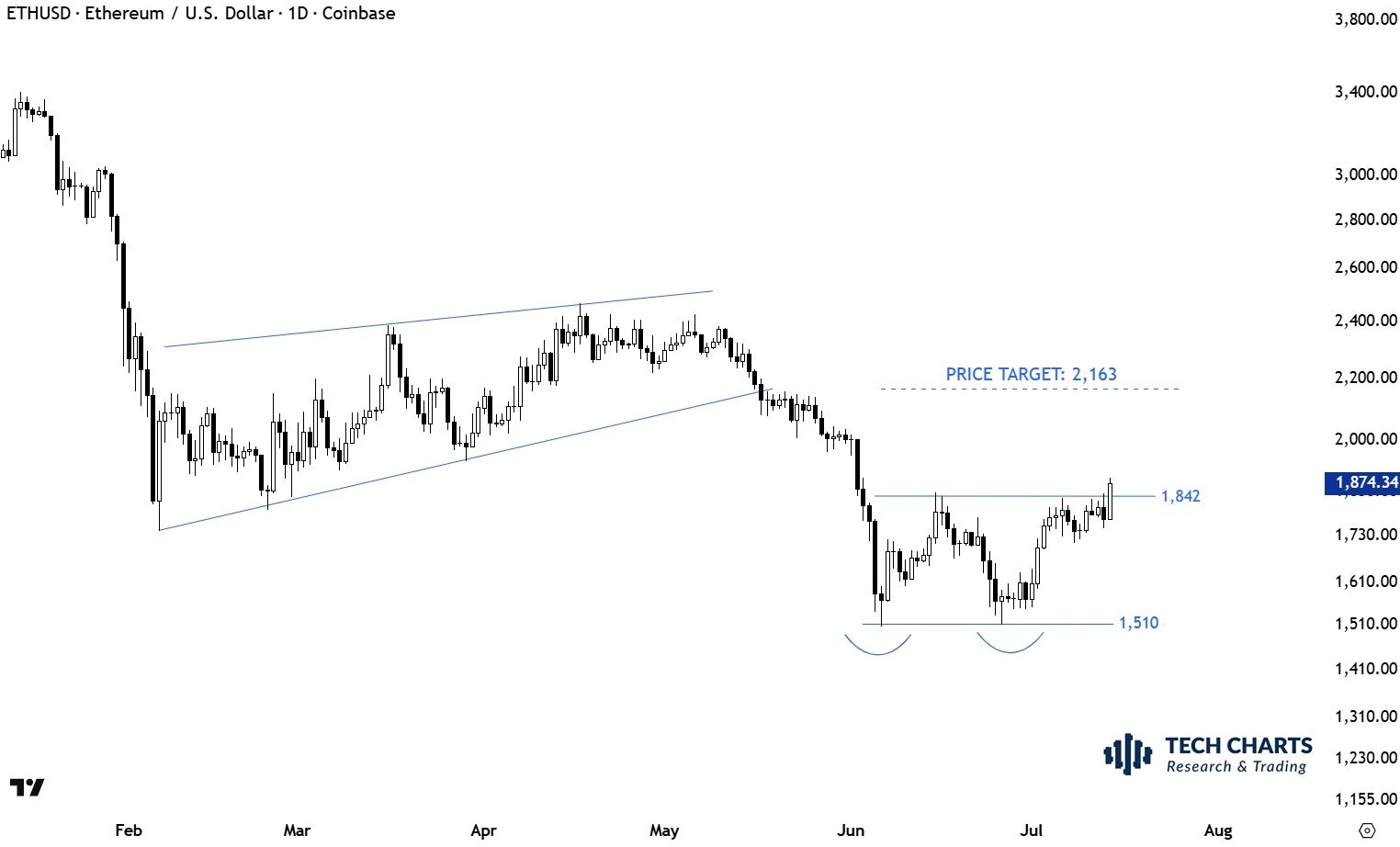
    As shown in the chart below, $ETH has clearly formed a classic double-bottom reversal pattern near the $1,510 support. Even more, just two days ago, the coin broke above the $1,842 neckline resistance after a period of consolidation. At press time, $ETH was still sustaining this bullish momentum, trading at about $1,883 (+6.88% in the last 24 hours).
    Source: Tech Charts

    According to veteran chartist Aksel Kibar, this setup projects an upside target of $2,163 – calculated from the pattern’s move from the double bottom to the neckline. It also follows a similar short-term bullish prediction made by the analyst just three days ago, indicating continued bullish momentum in the reversal.

    Further supporting this thesis is the rising multi-month trendline, which shows higher lows between February and May. This trajectory means buyers are consistently accumulating even as prices rise, further reinforcing the previously mentioned bullish thrust.

    Recent developments fueling upside bias

    In addition to the above technical analysis, EthSystems, a spin-off from the Ethereum Foundation, recently launched as an independent for-profit research and engineering company. The Ethereum community expressed optimism for the event, as it signaled Ethereum’s commitment to providing blockchain privacy to heavily regulated institutions.

    Furthermore, today’s cooler-than-expected inflationary data encouraged investors to flow into crypto assets. Other than retail investors, institutions continue to accumulate the coin, with Bitmine Immersion Technologies now holding 5.77 million $ETH tokens (about 4.8% of the circulating supply).

    Key levels to watch for

    Important levels to watch out for now include the $1,842-$1,850 double-bottom neckline resistance. A downside penetration below this threshold could invalidate the bullish setup.

    Additional resistance lies between $1,900 and $2,000, which marks the highs hit between May and June just before the sharp decline.

    Breaking above these two zones, coupled with rising trade volumes, would pave the way for the $2,163 target.

  • DeepMind CEO Says AGI Will Be Bigger Than Electricity or Fire

    DeepMind CEO Says AGI Will Be Bigger Than Electricity or Fire

    In brief

    • Demis Hassabis says AGI is likely only a few years away.
    • He wants a new U.S. standards body to evaluate frontier AI models before deployment.
    • The proposal calls for pre-release testing that could eventually become mandatory for the most capable systems.

    For the second time this year, Demis Hassabis predicted that artificial general intelligence would arrive before the end of the decade. This time, however, he said it won’t simply be another technological breakthrough—it will rival the discovery of electricity or fire.

    In a blog post published Tuesday on X, the Google DeepMind CEO said AGI is “probably only a few short years away,” describing it as a technology that could reshape human civilization.

    “When we look back on this time in the decades to come, I think we will realise we were standing in the foothills of the singularity–nothing less than the dawning of a new age for humanity.”

    According to Hassabis, AGI, the point when computers can understand, learn, and perform a wide range of tasks as well as or better than humans, should not be compared with advances such as the internet or mobile computing because its impact could be even greater.

    “It is much more akin to the discovery of electricity or fire,” he wrote. “If you stop to think about it, we’ve essentially found a way to make sand think. It’s miraculous.”

    Despite that optimism, Hassabis warned that AI capabilities are advancing faster than society’s ability to understand and manage the risks, pointing to cybersecurity threats that already exist with today’s frontier models, adding that future systems could introduce biological, nuclear, and other national security risks.

    As AI becomes more agentic and capable of self-improvement, he argued, stronger technical safeguards will be needed to ensure humans remain in control.

    “On the horizon, we will need robust safeguards to maintain control of increasingly agentic, recursively self-improving systems–and tackle unknown issues that will only become clearer over time.”

    The news comes as AI leaders have spent much of the past year since the public launch of ChatGPT in 2022 warning that AGI could arrive sooner than expected. In January 2026, Anthropic CEO Dario Amodei said human-level AI could emerge within one to five years and warned governments were underestimating the pace of development. Then, in June, Hassabis predicted AGI would arrive by 2030 and warned society had “not long to prepare.”

    To address those concerns, Hassabis proposed creating a U.S. Frontier AI Standards Body modeled after the Financial Industry Regulatory Authority, or FINRA, a private organization that oversees U.S. brokerage firms. The federally supervised public-private partnership would be funded primarily by the AI industry and staffed by independent technical experts and open-source representatives to evaluate frontier AI models.

    “The rapid progress we’re seeing in AI requires a new approach to testing frontier AI model capabilities that is dynamic, adaptable, and rigorous,” he wrote. “The US is well positioned, given its economic and technical standing, to take the first step in developing such a framework.”

    The proposal follows similar calls made by the prominent members of the industry to establish oversight for advanced AI.

    In May 2023, during a hearing before the U.S. Senate Committee on the Judiciary, OpenAI CEO Sam Altman called for a federal agency to license powerful AI systems and require independent safety audits. More recently, last month, President Donald Trump signed an executive order creating a voluntary framework for reviewing advanced AI models before their release. That same month, Anthropic CEO Dario Amodei warned that AI is getting too powerful and safety rules akin to the Federal Aviation Administration (FAA) are needed.

    Despite the push to regulate AI development, Hassabis said the world has only a limited window to establish common standards before AGI arrives.

    “The future is not yet written, we must use this precious window before AGI arrives to shape this technology for the benefit of all humanity,” he wrote. “What we collectively do now will determine how the next phase of civilisation unfolds. By safely stewarding AGI into the world, we can enter a new golden age of scientific discovery and progress, and usher in a bright future of incredible human flourishing.”

    Daily Debrief Newsletter

    Start every day with the top news stories right now, plus original features, a podcast, videos and more.

  • QuickSwap Goes All-In on Orbs for Perpetual Futures Trading

    QuickSwap Goes All-In on Orbs for Perpetual Futures Trading

    QuickSwap, one of the oldest names in decentralized exchange trading, has officially rolled out Orbs’ Perpetual Hub Ultra 2.0 as the default engine powering perpetual futures across every chain it operates on. The decision wasn’t made behind closed doors. It came after a community vote, “Full Shift of Decentralized Perpetuals to Orbs Network,” which cleared with a decisive 81.8% approval from QUICK token holders.

    The shift effectively retires the Orderly-based Falkor setup that had been running on Polygon PoS, replacing it with the same Orbs-driven architecture that QuickSwap already introduced on Base back in the fourth quarter of 2025. It’s not a cold start, either. QuickSwap and Orbs have been working together for years at this point, with tools like dTWAP, dLIMIT, and Liquidity Hub already live in production on both Polygon PoS and Base.

    Ran Hammer, VP of Business Development at Orbs, framed the announcement as something bigger than a routine infrastructure swap. “This is what the next phase of DeFi looks like: a top-tier DEX running a complete perps stack natively on Layer-3, with liquidity from day one and execution quality that rivals centralized venues,” he said. He also pointed to the vote itself as a signal of where the industry is heading, adding, “An 81.8% community vote says it all – decentralized markets are ready to compete with traditional finance on its own terms.”

    Full-Service Perpetual Trading Stack

    What QuickSwap gets out of the deal, in practical terms, is a full-service perpetual trading stack that doesn’t lean on outside providers. Execution, settlement, hedging, liquidation, pricing, and the trading interface itself are all handled natively through Orbs’ Layer-3 infrastructure. There’s no bootstrapping period to worry about, either; liquidity is pulled in from day one through Orbs’ integrated system, which taps into several deep liquidity sources at once rather than relying on a single pool building up over time.

    Under the hood, the platform runs on a TEE-secured execution environment, meaning trades are processed inside a trusted, hardware-isolated setting rather than out in the open. Price feeds come in cryptographically signed, and the resulting state is periodically committed on-chain through rollup settlement, giving traders a verifiable record without sacrificing speed.

    On the trading side, users get access to the usual order types, market, limit, stop-loss, take-profit, along with more advanced bracket orders. Convenience features like one-click trading, account abstraction, and gasless transactions are also part of the package, lowering the friction that’s historically kept some traders away from on-chain platforms.

    QuickSwap itself needs little introduction to anyone who’s spent time in DeFi. It’s been running since 2020 and remains the top exchange within the Polygon ecosystem, expanding over the years from Polygon PoS into Polygon zkEVM and Base while holding onto its reputation as Polygon’s flagship DEX.

    Like much of its infrastructure, the exchange is steered by its community through QUICK token governance, which is exactly the mechanism that greenlit this latest move. Orbs, for its part, operates as a decentralized Layer-3 network built specifically to handle the kind of complex trading logic that standard smart contracts struggle with.

    Its validator network runs on delegated Proof-of-Stake, backed by more than 1.12 billion ORBS tokens staked across the system. Both teams are pitching this integration as a step toward closing the gap between decentralized and centralized trading venues, not just in terms of speed and cost, but in the overall experience, while still keeping self-custody and on-chain transparency intact for users.

  • CZ’s 1.1B memecoin burn sparks buzz – Can it revive fading demand?

    CZ’s 1.1B memecoin burn sparks buzz – Can it revive fading demand?

    Memecoins often thrive on hype, yet they can lose relevance just as quickly when attention fades.

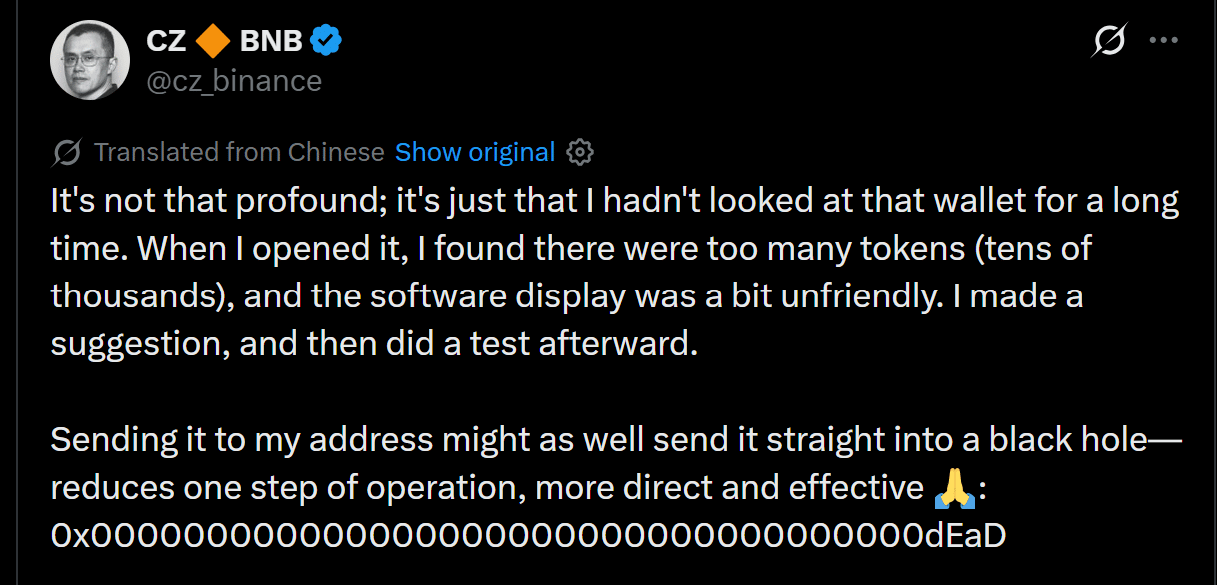
    Binance founder Changpeng Zhao’s (CZ) recent wallet activity initially fueled speculation across the memecoin market. He later clarified the transfers were routine, not valuation‑related.

    Rather than making a statement about token valuations, he simply cleared thousands of unsolicited donations by sending them directly to the burn address.

    In a post on X, CZ noted,

    Source: X

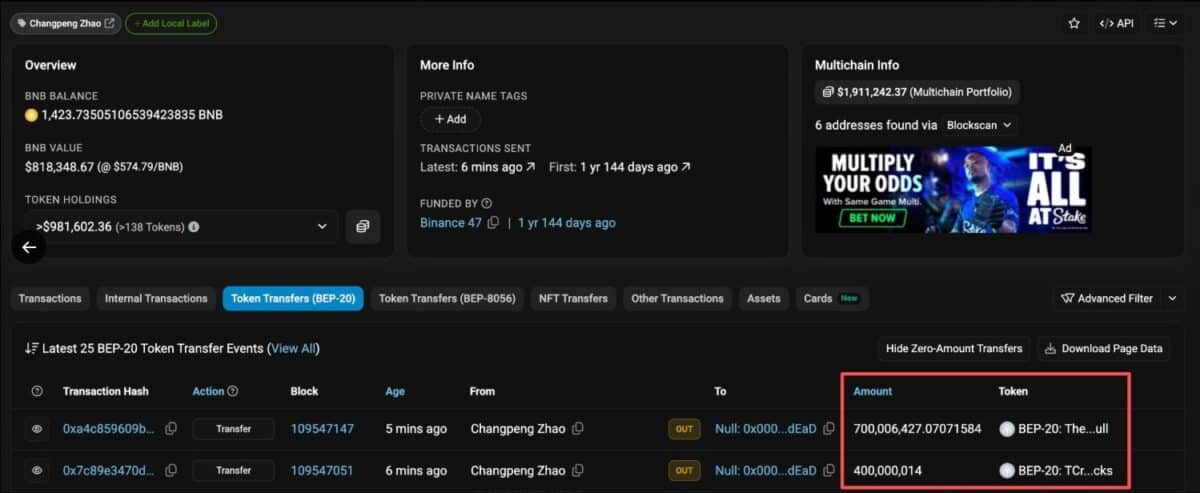
    This move permanently removed roughly 1.1 billion donated memecoins from circulation, including transfers of 700 million and 400 million tokens shown in the wallet activity. However, the broader market impact remains limited because these assets already had little utility or liquidity.

    Source: X

    Instead, the transaction underscores how speculative narratives can quickly overshadow routine wallet management. Ultimately, sustainable valuations will continue to depend on genuine demand rather than symbolic token burns.

    Memecoin demand remains fragile

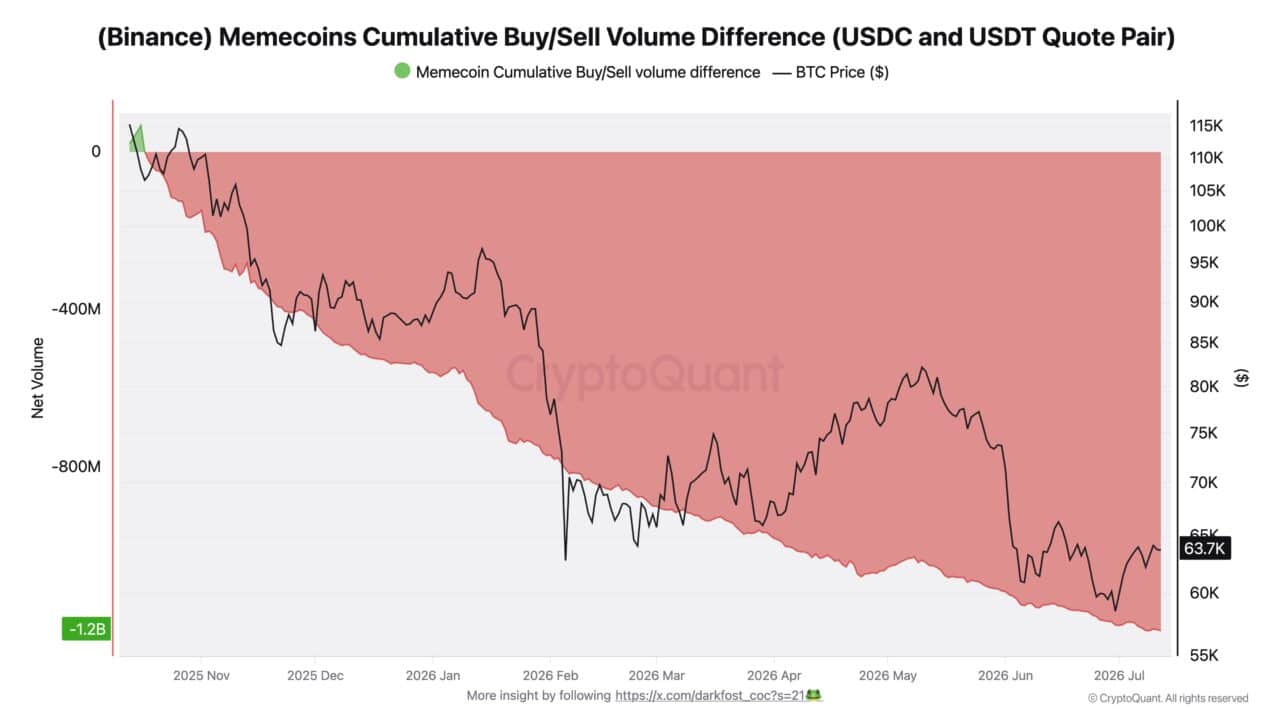
    CZ’s decision to burn unsolicited memecoins also reflects the broader challenges facing the memecoin sector. While new narratives occasionally attract speculative inflows, sustained demand has remained weak since Bitcoin’s October 2025 peak.

    As Bitcoin [$BTC] plummeted, investors began reducing their exposure to riskier assets. This led to cumulative Binance memecoin net volume declining to -$1.21 billion.

    This suggests that rather than accumulate for long-term growth, traders increasingly view memecoins as assets to exit during uncertainty. Unless risk appetite improves, capital will likely continue concentrating in stronger cryptocurrencies.

    Source: Dakforst on X

    As a result, this leaves memecoins vulnerable to lower liquidity, sharper volatility, and shorter-lived recoveries.

    Rather than signaling isolated selling, the persistent outflows point to a prolonged risk-off environment across the sector. Although Robinhood Chain briefly revived interest in newer tokens, that momentum failed to reverse broader capital rotation.

    Without consistent buying, memecoins will stay driven by short‑lived narratives rather than durable demand.


    Final Summary

    • Memecoins remain driven by speculation, with CZ’s burn carrying limited market impact.
    • Bitcoin [$BTC] weakness continues weighing on memecoins, as persistent capital outflows keep the sector in a prolonged risk-off environment.
  • Analyzing Ether.fi’s slip amid $8.6B market crash: What’s next for ETHFI?

    Analyzing Ether.fi’s slip amid $8.6B market crash: What’s next for ETHFI?

    Ether.fi [$ETHFI] has posted a sharp decline as capital outflows across the broader market drive much of the fall.

    The asset recorded a double-digit loss in the early hours of Tuesday, extending its price to a low of $0.384 on the chart. Outflows continue to dominate, yet the market is already flashing early signs of a possible recovery and leaves room for a rally to still stretch higher.

    Capital exits $ETHFI’s on-chain economy

    The steepest hurdle facing $ETHFI’s price over the past day has been the on-chain capital exit.

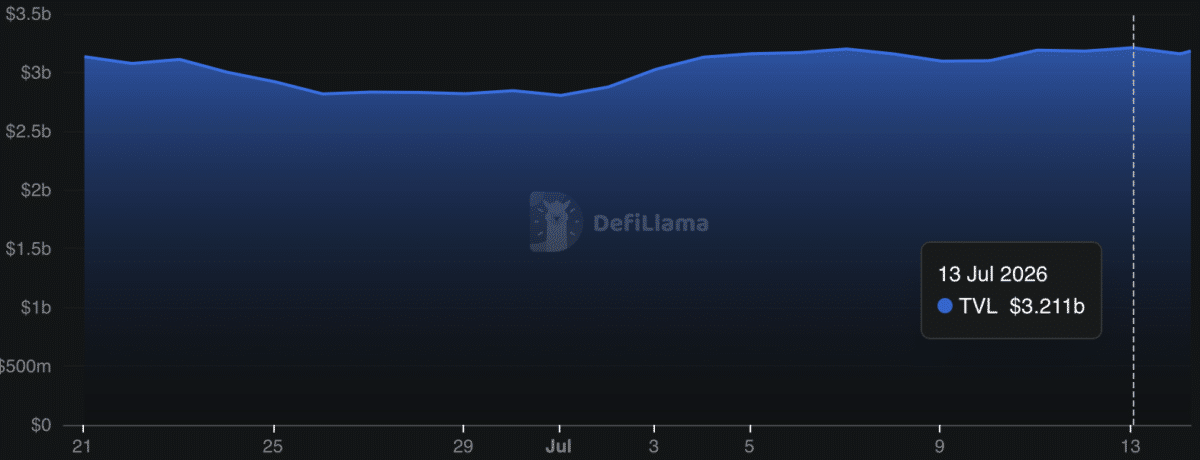
    Total value locked (TVL), which gauges the strength of on-chain capital through the deposits and withdrawals moving through the protocol, shows that roughly $54 million has left the market.

    The metric slid from $3.212 billion to roughly $3.153 billion, signalling that retail holders are exiting the market, likely on concerns over rising volatility.

    Source: DeFiLlama

    On a protocol level, the asset has held up decently, with earnings—the profit that remains once incentives are stripped out—reaching $1.34 million and already nearing half of the $2.79 million generated in June.

    The pattern suggests the recent sell-off reflects a reaction to market sentiment and not a structural bearish trend. That sentiment traces back to the notable decline the crypto market absorbed over the past day, when it shed around $8.61 billion in total capitalization.

    Perpetual contracts keep bears in play

    The clearest gap in the market emerges from $ETHFI’s perpetual contracts, which show that bears still hold some strength after an 11% decline dragged open interest to $62.26 million.

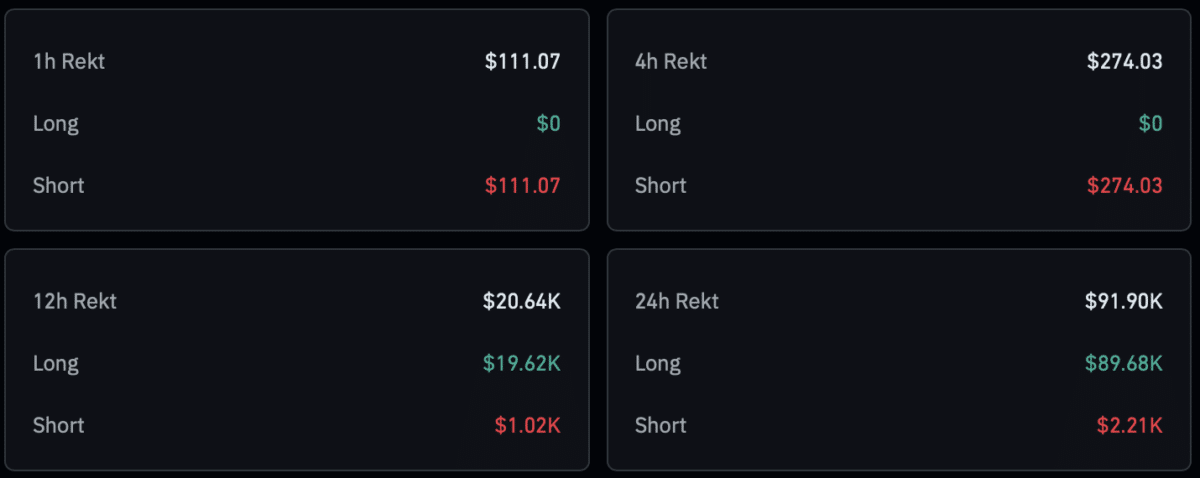
    That gap stems from an imbalance in liquidations, with market data revealing a wide disparity between long and short liquidations. Over the past 24 hours, long traders have lost roughly 40 times more than short traders.

    The liquidation data shows short traders lost just $2,210 against $89,680 for long traders across the same period, and the uneven spread points to the strength of the bears.

    Source: CoinGlass

    On lower timeframes, the liquidation disparity widens further, though the capital lost this time around remains minimal.

    The liquidation heatmap offers no clear directional bias for the asset, instead showing fairly evenly distributed clusters.

    These clusters mark areas on the chart where buy or sell orders sit, and clusters resting above the price usually act as sell zones that pull the price toward them and force selling, while clusters below reverse the dynamic and force buys once the price drops into them.

    For now, there’s no decisive direction, leaving momentum to dictate the next price move.

    Rising long volume hints at $ETHFI accumulation

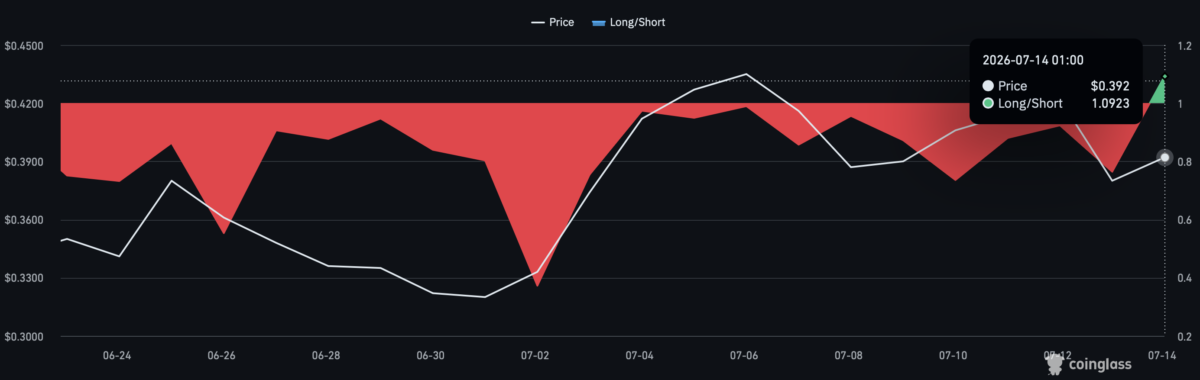
    While liquidations remain skewed in favour of the shorts, activity on the long-to-short ratio points to rising accumulation.

    At the time of writing, the long-to-short volume ratio on the chart shows more long volume in the market, pushing up to 1.02. A continued climb would imply that buy interest still lingers in the market.

    Source: CoinGlass

    Whether that offers a sufficient basis for a shift in direction remains unclear. The broader crypto market that shaped the sell-off sentiment has begun cooling, and a strong chance remains that $ETHFI benefits from the turn and recovers, flipping momentum against the sellers.


    Final Summary

    • Ether.fi’s token fell 10% after roughly $54 million left the protocol, moving in step with a broader crypto market that shed about $8.61 billion in a day.
    • Buying activity is quietly picking up and a calming market could give $ETHFI room to bounce back.
  • Morning Minute: Saylor’s Strategy Hoards Cash, Doesn’t Buy BTC

    Morning Minute: Saylor’s Strategy Hoards Cash, Doesn’t Buy BTC

    Morning Minute is a daily newsletter written by Tyler Warner. The analysis and opinions expressed are his own and do not necessarily reflect those of Decrypt. And check out our new daily news show covering all of the top stories in 5 minutes, downloadable on Apple Pod or Spotify.

    GM!

    Today’s top news:

    • Crypto majors are mixed ahead CPI; BTC at $62.7k
    • Saylor sells $467M in MSTR, doesn’t buy BTC
    • ETFs flip to outflows as BTC ETFs see $425M exodus
    • BTC and ETH social media posts fall to 6-year lows
    • Jupiter announces new gacha platform powered by Collector Crypt (CARDS +20%)

    🟠 Strategy Raises $467M and Skips Bitcoin for a Third Straight Week

    Strategy’s Bitcoin-buying machine stayed in neutral last week. The company raised $467M by issuing common stock and put all of it toward cash, lifting its USD Reserve to a record $3B. That means no Bitcoin purchase for the third week running.

    The raise added roughly 18% to Strategy’s cash reserves in one move, giving the company more than 20 months of coverage on its $1.76B in annual dividend and interest obligations. So the entirety of the week’s capital markets activity went toward fortifying the balance sheet’s cash cushion. Since its last Bitcoin purchase on June 22, Strategy has generated about $215M from selling Bitcoin, less than half of what this single stock issuance brought in. So the stock sales are now doing more work than the Bitcoin sales.

    Once again, Saylor is issuing common shares to fund dividend payments on his preferred stock. MSTR holders are being diluted to pay STRC holders. MSTR fell 4% Monday to around $90.80, down 18% on the month, though it has steadied since hitting a 28-month low of $81.81 in late June. STRC sits at $87.04, still below its $100 par value where it has lingered since mid-May while paying a 12% dividend. And with Bitcoin at $62,600 against an average cost of $75,476, the 843,775-coin stack is roughly $11B underwater.

    The biggest open question right now is—why isn’t he buying Bitcoin at these prices? Raising cash to alleviate market concerns and to fund future debt payments made sense when he was mostly depleted, but now Saylor is flush. He’s got 20 months’ runway, and more importantly, he’s proven he can just dump MSTR shares whenever to raise cash. So why not buy BTC here 50% off ATH? Certainly any BTC buy in the low 60s makes more sense than buys in the 80s, 90s, or over 100k. So why aren’t they coming? And when will the next buys hit the tape? Hopefully we find out soon. Or Saylor will have some explaining to do…

    🏛️ Democratic Opposition to the CLARITY Act Grows With Four Weeks Left

    Senate Democrats are hardening against the CLARITY Act, and Trump’s $1.2 billion crypto fortune is (unsurprisingly) the wedge.

    Elizabeth Warren wrote to Senate leadership on Monday, demanding the bill bar the president, vice president, senior officials, members of Congress, and their families from profiting off the crypto industry. Anything less would be a giveaway to the president and his family at the public’s expense, in her words. On Tuesday, more Senate Democrats including Chris Murphy and Chris Van Hollen are expected to hold a press conference against it, hitting both Trump’s crypto dealings and the argument that the bill weakens financial oversight built after the Great Depression.

    The vote math is the tricky part here. CLARITY needs 60 votes, which means at least seven Democrats have to cross over, and possibly more given the Republican bench is thinner than expected (Mitch McConnell remains hospitalized, and Lindsey Graham died suddenly over the weekend). Trump argued Monday that the Senate should pass CLARITY in Graham’s honor, calling him a big supporter of crypto legislation. Graham was never involved in the negotiations, rarely spoke on the topic, and was the only Senate Republican to co-sponsor a 2023 anti-money-laundering bill that crypto groups called deeply hostile to the industry.

    So where does this leave us? Less than four weeks remain before the August recess, and everyone involved agrees that missing it means the bill dies in the noise of the November midterms. The industry’s own forecasters have already marked it down, with Galaxy cutting its odds to 50% and prediction markets pricing it in the low 40s. The core problem is that the harder Democrats push for ethics language, the more they force Republicans to choose between passing the bill and protecting the president’s business interests. That’s a bad trade to have to make with a hard deadline bearing down.

    🌎 Macro Crypto and Markets

    • Crypto majors are mixed ahead of CPI; BTC even at $62.7k; ETH +1% at $1,795; SOL -1% at $75; HYPE -2% at $64
    • HASH (+11%), INJ (+5%) and ENA (+5%) led top movers
    • Oil +10% at $81; Gold -1% at $4,020
    • Stock futures are mixed as oil spikes and June CPI data comes this AM; DOW -0.7%, Nasdaq +0.3%
    • June CEX volumes fell 5% from May, while derivatives trading rose by 4%
    • BTC and ETH social media posts have fallen to their lowest level since 2020
    • Coinbase CEO Brian Armstrong admitted Base “messed up” on content coins, saying they didn’t work and that Base pivoted away early this year, with resources now going toward trading, payments, and AI agents
    • BlackRock, Goldman Sachs, and JPMorgan joined a 54-firm UK tokenization taskforce backed by the government, starting with tokenized repo, with a Treasury report projecting up to £33 billion in annual economic output by 2035
    • TeraWulf’s CEO said “not all megawatts are created equally” in the AI race, stating flatly that “we’re not involved in Bitcoin” anymore as its $19 billion Anthropic hosting deal completes its shift from miner to AI infrastructure company
    • SBI Holdings’ blockchain initiative pivoted to Solana for tokenization and stablecoin issuance, moving off R3’s Corda and bringing the Solana Foundation into its joint venture, with plans including payment infrastructure for AI agents

    Corporate Treasuries & ETFs

    Meme Coin Tracker

    • Meme leaders were mostly red down 1-2%; DOGE even, SHIB -2%, PEPE -1%, PENGU -4%, TRUMP -1%, BONK -2%
    • Robinhood chain memes were led by Cashcat +8% to $180M, WOOD +70% to $15M, Wishbone +45% to $9M
    • Febu (+60%), three (+100%) and Cards +20% were notable Solana movers

    📈 Myriad Market of the Day

    💰 Token, Airdrop & Protocol Tracker

    🚚 What is happening in NFTs?

    • NFT leaders were mixed; Punks even at 32.4 ETH, BAYC +1% at 8.94 ETH, Pudgy -1% at 4.33 ETH; Hypurr’s -4% at 179 HYPE
    • PXL NET (+60%) and Squiggles (+10%) led top movers
    • New Robinhood NFT sets jumped including RH Miners (+1350%) and 8skullz (+340%)

    Daily Debrief Newsletter

    Start every day with the top news stories right now, plus original features, a podcast, videos and more.

  • BREAKING! Critical US Inflation Data Released! What Was Bitcoin’s (BTC) Initial Reaction?

    BREAKING! Critical US Inflation Data Released! What Was Bitcoin’s (BTC) Initial Reaction?

    Global financial markets are focused on the US Consumer Price Index (CPI) data to be released today, while investors in the cryptocurrency market are also acting cautiously.

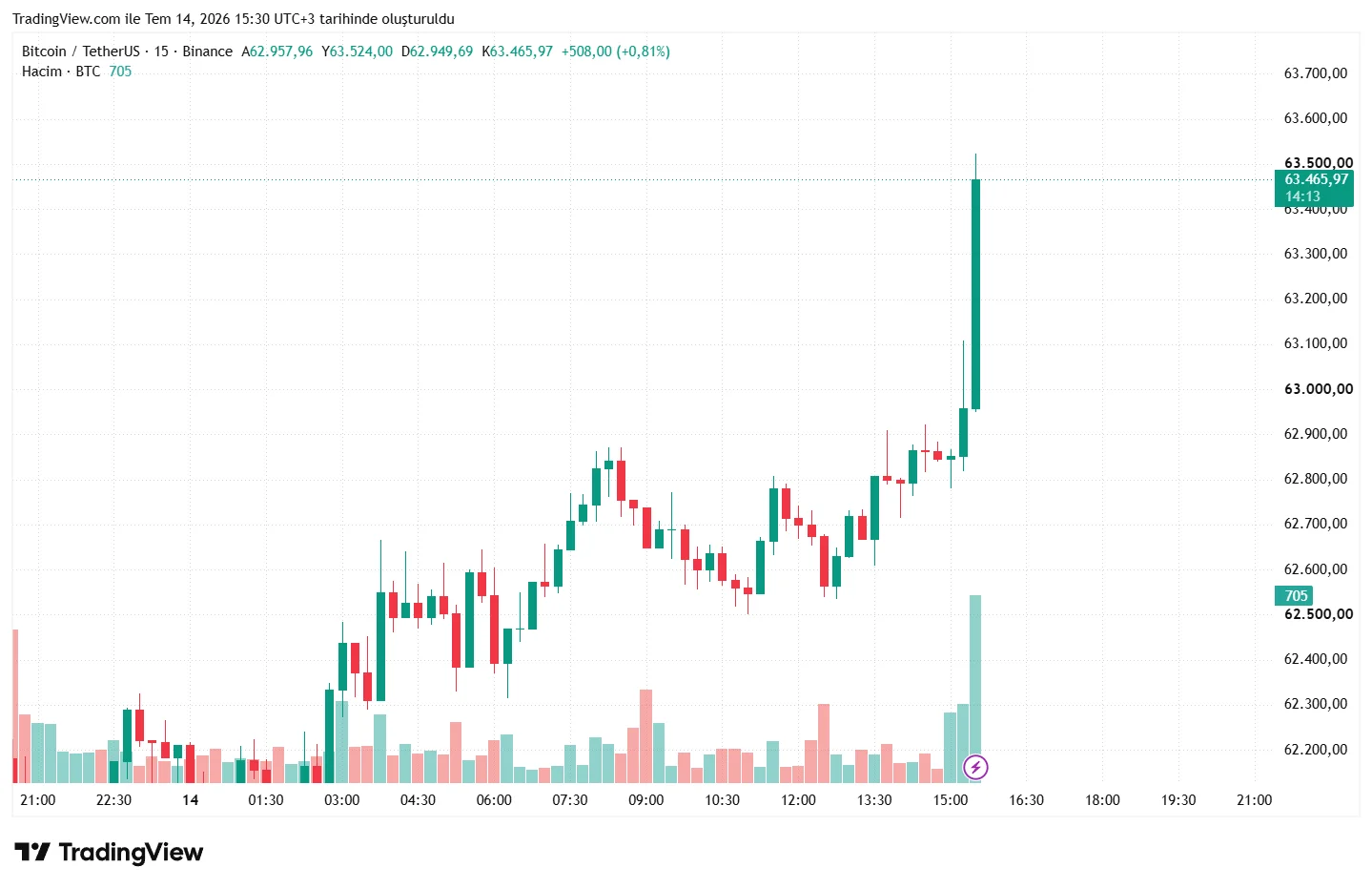
    Bitcoin, which surged above $64,000 on Friday, is maintaining its strong performance around the $62,000 level despite recent escalation in US-Iran tensions.

    However, the inflation data to be released is expected to be a determining factor in short-term price movements.

    Analysts are concerned that inflation, which the Fed has long been trying to bring down to its 2 percent target, will continue to face upward pressure due to increases in energy prices.

    At this point, while there is talk that the Fed might even raise interest rates in the face of increasing inflation risk (according to FEDWatcholl data, the probability of a rate hike in July is priced at 39%), the US June inflation data, which the Fed closely monitors when making its interest rate decisions, has been released.

    Here are the US inflation figures that have been released:

    Consumer Price Index Annual: Announced 3.5% – Expectation 3.8% – Previous 4.2%

    Consumer Price Index Monthly: Announced -0.4% – Expectation -0.1% – Previous 0.5%

    Core Consumer Price Index Annual: Announced 2.6% – Expected 2.8% – Previous 2.9%

    Core Consumer Price Index Monthly: Announced 0.0% – Expectation 0.2% – Previous 0.2%

    The consumer price index is a key variable used to measure consumer purchasing trends and changes in US inflation.

    According to The Kobeissi letter, June CPI inflation fell to 3.5%, below expectations of 3.8%. Core CPI inflation fell to 2.6%, also below expectations of 2.8%. Monthly CPI inflation fell by -0.4%, marking the largest monthly decline since May 2020. Following this data, US stock market futures rose in response to the news.

    Bitcoin’s Initial Reaction After the CPI Data!

    *This is not investment advice.

  • Hut 8 price target hiked to $165 at Benchmark as AI pivot reshapes valuation

    Hut 8 price target hiked to $165 at Benchmark as AI pivot reshapes valuation

    Companies including Hut 8, Core Scientific (CORZ), Hive Digital (HIVE) and Bit Digital (BTBT) have repositioned portions of their power and infrastructure assets to serve AI workloads, betting that long-term contracts with hyperscale customers will generate steadier, higher-margin revenue than cryptocurrency mining alone.

    Hut 8 has signed two 15-year, triple-net, take-or-pay leases covering 597 megawatts of IT capacity at its River Bend, Louisiana, and Beacon Point, Texas, campuses. According to Palmer, the agreements represent $16.8 billion in contracted base-term lease value and could rise to $42.8 billion if tenants exercise renewal options.

    Palmer said the Beacon Point agreement was the primary driver behind the higher valuation. The broker estimated that the project’s first phase alone carries $9.8 billion in base-term contract value and about $655 million in average annual net operating income.

    He also pointed to Hut 8’s financing strategy, noting the company recently completed $4.25 billion of investment-grade project financing for Beacon Point after raising $3.25 billion for River Bend. The deals validate management’s strategy of lowering its cost of capital by converting development assets into long-term contracted cash flows.

    Beyond its existing projects, the report highlighted Hut 8’s development pipeline, which totals more than 9 gigawatts across projects under exclusivity, development, construction and management, providing what it called a long runway for future growth.

  • Santiment Warns: “Bitcoin is Stable, But FOMO is at its Peak in Two Major Altcoins! Prices Could Fall!”

    Santiment Warns: “Bitcoin is Stable, But FOMO is at its Peak in Two Major Altcoins! Prices Could Fall!”

    While the leading cryptocurrency Bitcoin has been more stable in recent days, investor sentiment in the cryptocurrency market is reportedly on the rise again.

    At this point, cryptocurrency data analysis platform Santiment noted that although overall investor sentiment in the market is rising, $XRP and Ethereum have recorded their highest “FOMO” (fear of missing out) levels in the last five weeks.

    According to Santiment’s latest data, $ETH and $XRP investors have become significantly more optimistic. This has led to $ETH and $XRP reaching their highest FOMO levels in the last five weeks.

    According to the data, $XRP reached its highest FOMO level with 3.02 bullish comments for every bearish comment, while Ethereum was in the mild FOMO zone with a ratio of 2.31. In contrast, Bitcoin’s ratio of 1.40 indicated a more balanced and neutral investor sentiment.

    This shift in investor sentiment, at a time when prices are struggling to gain steady momentum, raises the possibility that the upward trend may have overtaken market performance.

    At this point, Santiment analysts note that the cryptocurrency market is moving in the opposite direction of investor expectations. They emphasize that the increasing optimism for $ETH and $XRP could be a counter-signal for the price.

    The analysis notes that historically, short-term corrections can occur during periods when investors have excessively bullish expectations, and suggests that high optimism in $XRP and Ethereum could increase downside risks or limit the pace of their rise in the short term.

    In contrast, balanced and neutral investor sentiment in Bitcoin is seen as healthier in terms of price. This is because, according to Santiment analysts, strong rallies can occur when investors are not yet fully focused on bullish expectations.

    *This is not investment advice.