Category: Business

  • A timeline of the Ethereum Foundation’s ongoing shakeup

    A timeline of the Ethereum Foundation’s ongoing shakeup

    The Ethereum Foundation entered 2026 under mounting pressure. Developers, investors and prominent Ethereum community members had spent months criticizing the organization’s pace of execution, governance and technical priorities, with many arguing Ethereum’s roadmap had become overly focused on layer-2 scaling while neglecting improvements to the base layer.

    The first major shakeup to the foundation came in February, when co-executive director Tomasz Stańczak announced he would step down after helping lead the foundation through its initial restructuring. A few weeks later, the foundation published a new mandate outlining a narrower vision for its role within the Ethereum ecosystem. Built around the CROPS framework — censorship resistance, resilience, openness, privacy and security — the document recast the foundation as a long-term steward rather than the ecosystem’s primary builder or coordinator.

    The leadership transition was followed by a steady stream of departures. Over the following months, nine senior foundation leaders, researchers and executives left the organization, marking one of the largest periods of turnover in its 12-year history. The exits fueled speculation about the foundation’s future even as its leadership insisted the changes were not a sign of decline, but rather a necessary part of a broader organizational reset.

  • First Strong Bullish Signal for Ethereum! German Analysis Company Reveals Must-Break Levels for an Uptrend!

    First Strong Bullish Signal for Ethereum! German Analysis Company Reveals Must-Break Levels for an Uptrend!

    Yesterday’s lower-than-expected CPI data triggered an upward movement in Bitcoin and altcoins. In this context, BTC rose above $64,000, while Ethereum climbed 5% in the last 24 hours to reach $1,870.

    While $ETH investors are hopeful for a continuation of the uptrend, analysts at the German analytics company Makrovision Research shared their technical analysis and stated that the first strong signal for an upward move has arrived.

    According to analysts, Ethereum has given the first long-awaited positive signal on the technical front. With the $ETH price rising above its recent significant peak of around $1,850, the ongoing series of lower peaks in the short term has been broken. This development indicates that buyers are beginning to regain strength.

    However, analysts warn that the current rise alone does not mean the start of a new bull trend.

    Ethereum’s price is still trading below the long-term downtrend line and the critical resistance zone at $2,130. Therefore, the current rise alone cannot be considered a permanent trend reversal.

    Analysts stated that there are currently two critical levels that should be closely monitored: “$1,730 and $1,850”.

    “If Ethereum manages to stay above the $1,730 support level and holds onto the $1,850 level, the possibility of the price testing the $2,130 resistance level may increase.”

    Conversely, if Ethereum falls below $1,730 again, selling pressure may increase, and the possibility of a drop to $1,545 and $1,400 levels may resurface.”

    In conclusion, while the breakout from the short-term bearish pattern is considered a positive development for Ethereum in the technical view, analysts believe that for a true trend reversal in Ethereum, the price needs to both break above the long-term downtrend line and maintain its position above the $2,130 resistance level.

    *This is not investment advice.

  • US, UK Outline Recommendations to Align Stablecoin and Tokenization Rules

    US, UK Outline Recommendations to Align Stablecoin and Tokenization Rules

    In brief

    • The U.S. and UK Treasuries have published 10 joint recommendations to align their regulation of stablecoins, tokenized assets, and capital markets, five of them focused on digital assets.
    • The recommendations, from a taskforce set up during President Trump’s 2025 UK state visit, add no binding rules but set a shared direction, including a private-sector group to test cross-border tokenization and a joint statement backing stablecoins.
    • Coinbase welcomed the plan, calling the recommendations a “critical moment for transatlantic cooperation.”

    The U.S. and UK have laid out a joint roadmap for aligning how they regulate stablecoins, tokenized assets, and digital money, a coordinated push by two of the world’s largest financial centres to let blockchain-based finance move more easily across the Atlantic.

    The 10 recommendations, published Tuesday by HM Treasury and the U.S. Treasury, come from the Transatlantic Taskforce for Markets of the Future, which Chancellor Rachel Reeves and Treasury Secretary Scott Bessent set up during President Trump’s UK state visit in September 2025.

    Five cover digital assets and the rest address traditional capital markets, though none are binding rules, leaving each country to complete its own regulatory processes under a shared direction.

    Stablecoins and tokenization

    On the digital-assets side, the taskforce wants regulators, the Bank of England, the FCA, the SEC, and the CFTC, to find common approaches to tokenized assets, including how tokenized securities reach settlement finality and whether stablecoins and tokenized money market funds can serve as collateral at clearing houses. It calls for a private sector-led group to spend a year testing cross-border tokenization use cases, and for a “multi-money ecosystem” in which stablecoins, tokenized bank deposits, and other digital money coexist.

    Alongside the recommendations, the two governments are developing a joint statement on stablecoins, backing a dynamic cross-border market and saying payment stablecoins should be fully backed on at least a one-to-one basis by high-quality liquid assets. Those principles echo the U.S. GENIUS Act, the federal stablecoin law signed last year. A fifth recommendation asks both sides to push for a technology-neutral review of how the Basel Committee treats banks’ crypto exposures.

    The alignment effort lands as both countries build out their own regimes. The U.S. is implementing the GENIUS Act ahead of a 2027 effective date, while the UK’s own cryptoasset regime is due to take effect in October 2027. Both are moving to catch the European Union, whose MiCA rules have been fully in force since the end of 2024 and is set to be revised in 2027. The recommendations stop short of mutual recognition, with a stablecoin licensed in one country still having to clear the other’s rules to operate there.

    Industry reaction

    Crypto firms welcomed the direction. Katie Harries, Coinbase’s head of policy for Europe, called the recommendations a “critical moment for transatlantic cooperation,” highlighting the opportunity for the two financial centres to “reimagine global capital markets through tokenisation.”

    For the UK, the recommendations build on an ambition to “minimize frictions” between the two countries, as outlined by Economic Secretary to the Treasury Lucy Rigby in May, when she suggested that it “may well take the form of some forms of recognition or alignment.”

    At the time, Rigby said that digital assets carry the potential for a “complete transformation” of the country’s markets, as the government advances stablecoin rules, an FCA-run stablecoin sandbox, and a consultation on a single framework for traditional and tokenized payments.

    Daily Debrief Newsletter

    Start every day with the top news stories right now, plus original features, a podcast, videos and more.

  • Binance Announces Addition of 10 New Trading Pairs to its Spot Market Product Range! Here Are the Details

    Binance Announces Addition of 10 New Trading Pairs to its Spot Market Product Range! Here Are the Details

    Binance continues to expand its portfolio in the spot market. The platform, one of the world’s largest cryptocurrency exchanges, announced it will list 10 new trading pairs under its bStocks product family to offer users more trading options. The company also stated that it will reduce the maker trading fee to zero for these newly listed assets for a limited period.

    According to a statement by Binance, the bStocks assets named AAOIB (Applied Optoelectronics), ARMB (Arm), AVGOB (Broadcom), BABAB (Alibaba), HOODB (Robinhood), IBMB (IBM), MRVLB (Marvell Technology), NOKB (Nokia), RKLBB (Rocket Lab), and TSMB (TSMC) will be available for spot trading with $USDT pairs on July 15, 2026, at 16:30. Simultaneously, the Spot Algo Trading Bots service will also be launched for these trading pairs.

    The newly listed trading pairs will be AAOIB/$USDT, ARMB/$USDT, AVGOB/$USDT, BABAB/$USDT, HOODB/$USDT, IBMB/$USDT, MRVLB/$USDT, NOKB/$USDT, RKLBB/$USDT, and TSMB/$USDT. This will allow users to perform both manual trades and utilize algorithmic trading bots for these tokens.

    Binance has also launched a special campaign to support the listing. Accordingly, the maker commission fee for all bStocks trading pairs listed above will be 0% from the listing date until August 31, 2026 at 02:59. This means that investors providing liquidity to the order book will be able to trade without paying maker fees during the campaign period.

    bStocks products stand out as digital assets based on the shares of some major companies in traditional financial markets. Recently, Binance has been expanding this product line, aiming to offer its users blockchain-based investment opportunities in leading companies in the technology and finance sectors.

    Market experts say the new listings could boost trading volume and that the zero-maker commission campaign could particularly appeal to professional investors and market makers. Binance’s move is seen as part of its strategy to strengthen integration between traditional finance and the digital asset ecosystem.

    This is not investment advice.

  • Ledger adds Celo fee abstraction, expands support to 18 token gas payment options

    Ledger adds Celo fee abstraction, expands support to 18 token gas payment options

    Celo has enhanced its collaboration with Ledger by integrating a key network feature into the hardware wallet provider’s platform, offering more flexible transaction fee options to users worldwide.

    Ledger supports Celo’s CIP-64 fee abstraction

    Ledger has implemented support for Celo’s fee abstraction, made possible through the network’s CIP-64 upgrade. This change allows users to pay transaction fees using a variety of Celo-native assets, rather than being restricted to the $CELO token.

    The new functionality builds on Ledger Live’s December 2025 update, where users gained the ability to transact and exchange $CELO and Celo stablecoins through Ledger’s interface.

    With this latest expansion, Ledger’s user base of more than 8 million people in over 200 countries can now settle gas fees in any of 18 supported tokens. These payment options include Tether USD₮, USDC, Wrapped Ether (WETH), and multiple fiat-referenced stablecoins developed by Mento Labs.

    Accepted fiat-backed tokens span a range of global currencies such as the euro, British pound, Japanese yen, Canadian dollar, Australian dollar, Nigerian naira, Kenyan shilling, and South African rand, offering considerably broader payment flexibility.

    Mini dictionary: CIP-64, or Celo Improvement Proposal 64, is an upgrade that enables transaction fees to be paid with approved ERC-20 tokens on the Celo network, rather than requiring users to exclusively use the $CELO token for gas payments.

    Stablecoins overtake $CELO for transactions

    Launched in July 2023 during the network’s Gingerbread hard fork, CIP-64 has allowed users to pay transaction fees with selected stablecoins and other ERC-20 tokens. This approach, now widely adopted across the Celo network, has led to a significant shift in transaction behavior.

    Celo reports that nearly half of all transaction volume on the network now uses stablecoins denominated in US dollars, instead of the network’s native $CELO token.

    By allowing users to handle transaction fees with familiar currencies, Celo aims to lower barriers to entry and streamline the experience of using money across blockchain payments and decentralized finance applications.

    The integration with Ledger is expected to further simplify onboarding, particularly for users interested in exploring Celo payments and DeFi solutions.

    Celo leads in tokenized gold adoption

    Beyond network transactions, Celo highlighted its leading position in the market for tokenized gold. According to network figures, 107,622 users on Celo own Tether Gold (XAUT), positioning the network as the dominant platform for tokenized gold holders.

    Blockchain data estimates a total of 118,500 XAUT holders across seven blockchain networks. Of these, Celo accounts for 90.8%, followed by Solana at 4.5%. Other platforms with measurable XAUT user bases include HyperEVM (1.9%), Arbitrum One (1.8%), Plasma (0.6%), Monad (0.3%), and Ink (0.1%).

    Celo attributes its dominance to a growing ecosystem, including applications such as MiniPay, Squid Router, Uniswap, Featherlend, Morpho, and TheoriqAI, that together drive adoption of real-world asset tokenization.

    Celo, a mobile-first blockchain that aims to make decentralized financial services accessible to anyone with a smartphone, is now advancing into sectors beyond digital-only payments. By making stablecoin-based gas payments easier and leading the charge on tokenized gold, Celo is seeking new use cases for blockchain technology in mainstream finance.

    Celo’s expanding ecosystem and diverse payment options underscore its strategy to position itself as a leading platform for accessible and practical financial instruments on the blockchain.

  • NEAR Governance Vote To Scrap Gas Rebates Puts Developer Incentives Under Review

    NEAR Governance Vote To Scrap Gas Rebates Puts Developer Incentives Under Review

    $NEAR Governance Vote To Scrap Gas Rebates Puts Developer Incentives Under Review is a useful reminder that crypto coverage is not only about token prices. Sometimes the more important story is the infrastructure, regulation, security, or product layer sitting underneath the market noise.

    The immediate point is straightforward: nEAR governance voted to scrap developer gas rebates. That gives readers something concrete to work with, rather than another vague sentiment update.

    TL;DR

    • $NEAR governance voted to scrap developer gas rebates.
    • The change affects developers who relied on protocol gas distributions.
    • It raises a broader question about how chains should reward app builders.

    Why This Matters Now

    The timing matters because $NEAR is already part of a wider conversation across the market. Traders want to know whether the development changes liquidity or risk. Builders want to know whether it changes what can be deployed. Compliance teams want to know whether it changes how platforms operate.

    In that sense, the story is bigger than one headline. It sits inside the ongoing shift from speculative crypto cycles toward more practical questions: who can use these systems, how safe are they, and whether the underlying incentives actually work.

    The best way to read it is with discipline. It is not a guarantee of immediate upside, and it should not be treated as one. But it does add a fresh data point to the way the market is thinking about $NEAR.

    The $NEAR Angle

    For $NEAR, the important part is the specific mechanism. If this is a security issue, the risk sits in dependencies and user protection. If it is a listing or product launch, the question is access and liquidity. If it is a governance or research proposal, the question is whether the idea can survive implementation.

    That is where this update becomes useful. It is not just a label attached to a trend. It gives readers a way to understand what might actually change if the development gains traction.

    Crypto has a habit of turning every announcement into a broad market claim. This one deserves a narrower read. The value is in seeing how it affects the users, developers, institutions, or traders closest to the issue.

    The Risk Side

    There is also a caution attached. Source material can confirm that a development exists, but it cannot prove that adoption will follow. A proposal still needs support. A product still needs users. A chart still needs confirmation. A compliance tool still needs integration.

    That is why the responsible reading is not to oversell the story. The stronger takeaway is that this adds to a pattern. The crypto market is steadily becoming more professional, more technical, and more sensitive to real operational details.

    Readers should also watch for follow-up signals. That could mean developer feedback, exchange support, regulatory response, wallet adoption, liquidity data, or simply whether market participants continue reacting after the first headline fades.

    What Comes Next

    The next stage will decide whether this remains a narrow update or becomes part of a larger market theme. In crypto, that difference matters. Plenty of stories look important for a few hours and then disappear. The ones that last usually show up again through usage, liquidity, enforcement, governance, or developer adoption.

    For now, this gives the market another piece of information to weigh. It is specific enough to be useful, but still early enough that readers should keep the caveats in view.

    That makes it worth covering without pretending it settles anything. The story is a signal, not a final verdict.

    The key is not to confuse coverage with certainty. $NEAR stories can move quickly, especially when they touch security, regulation, listings, infrastructure, or price levels. The useful approach is to track the next confirming detail rather than assume the first update carries the whole market story. That is how traders avoid chasing noise and how readers separate a genuine development from another passing headline.

    This report is based on information from thedefiant.io.

    This article was written by the News Desk and edited by Samuel Rae.

  • Bitmine generated $46M from Ethereum staking last quarter

    Bitmine generated $46M from Ethereum staking last quarter

    Bitmine Immersion Technologies recorded $45.7 million in revenue from Ether staking and validation last quarter, following the launch of its institutional-grade Ethereum staking platform in March.

    Staking revenue accounted for 98% of total revenue for the three months ended May 31, far outpacing the $624,000 from self-mining Bitcoin (BTC) and the $168,000 from consulting services, according to Bitmine’s latest 10-Q filing. On Monday, Bitmine said it had staked 85% of its $ETH holdings, equating to around 4.9 million Ether ($ETH).

    “Bitmine has staked more $ETH than other entities in the world. At scale (when Bitmine’s $ETH is fully staked by MAVAN and its staking partners), the projected $ETH staking reward is $284 million on an annualized basis,” said Tom Lee, chairman of Bitmine.

    The latest quarterly results show how Bitmine’s pivot to Ethereum has reshaped its revenue mix. A year ago, Bitmine recorded just $2 million in total revenue for the quarter ended May 31, 2025, primarily from machine leasing.

    The results also reflect the March launch of MAVAN, an institutional-grade Ethereum staking platform that operates validator infrastructure for its own holdings and external clients.

    Related: Ethereum backers launch nonprofit to lead institutional adoption efforts

    MAVAN, short for “Made in America VAlidator Network,” followed the acquisition of Australia-based non-custodial validator operator Pier Two Holdings. It was originally developed to support Bitmine’s own Ethereum treasury; its scope expanded to serve institutional investors, custodians and ecosystem partners.

    Lee calls Robinhood Chain a “breakaway success”

    On Monday, Lee highlighted the success of the newly launched Robinhood Chain, with dollar volumes exceeding $1 billion since its July 1 launch.

    “Robinhood Chain now has more trading volume than any other decentralized exchange (DEX), demonstrating the outstanding utility and product market fit for Ethereum, which is the underlying chain,” he said.

    “Robinhood Chain uses $ETH as the native gas token. And transaction fees are denominated in $ETH and the finality is settled on Ethereum. Robinhood’s 27 million users are paying crypto fees denominated in $ETH. In other words, everyday users are starting to see $ETH as money,” he added.

    Magazine: Strategy became a symbol of the dot-com crash: Could history repeat?

  • ETH Price Eyes $2,163 Target as Double Bottom Completes on Daily Chart

    ETH Price Eyes $2,163 Target as Double Bottom Completes on Daily Chart

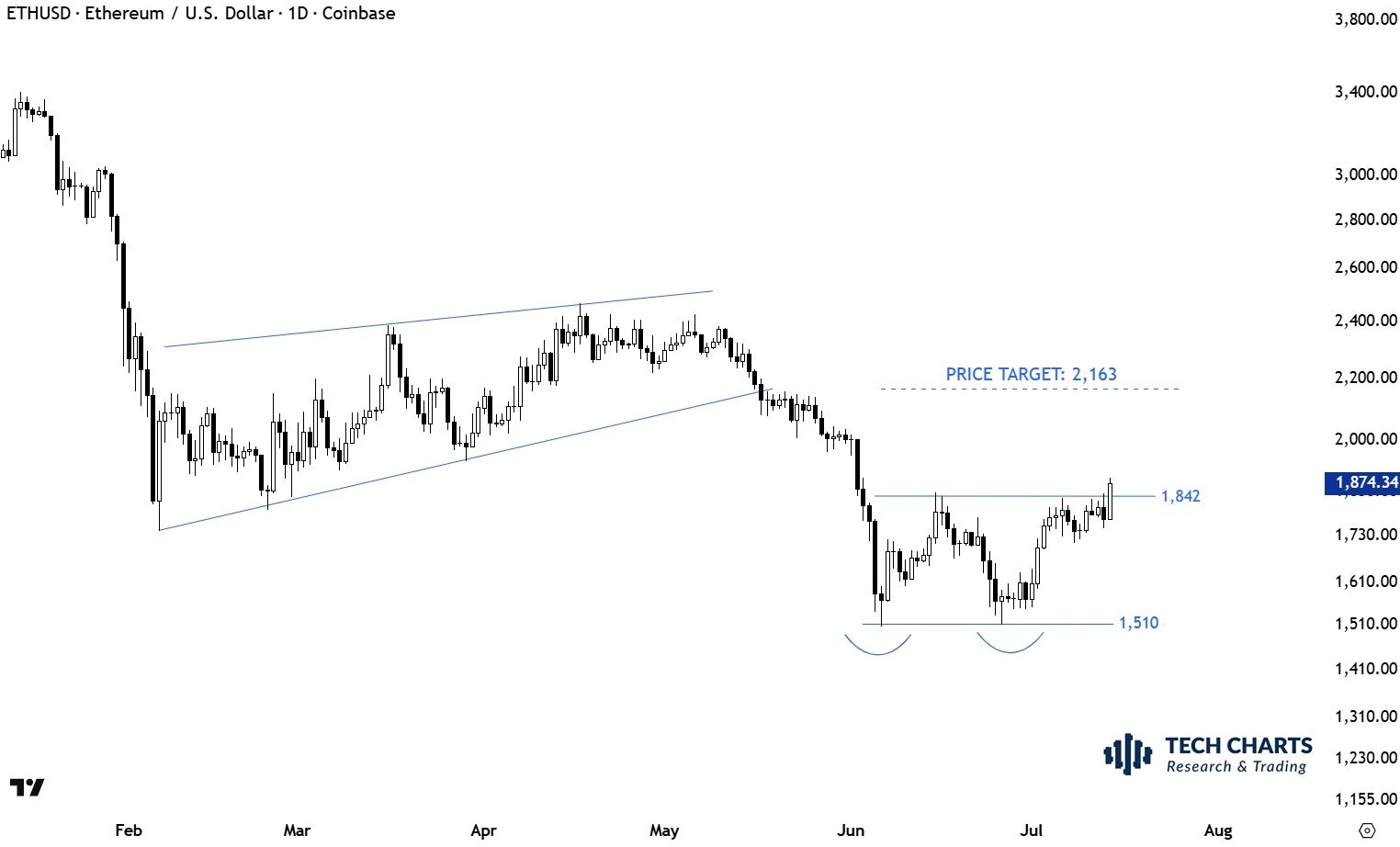
    Ethereum ($ETH) is showing strong technical signs of a short-term bottom reversal, with a projected surge to $2,163.

    Ethereum targets $2,163 following double bottom completion

    As shown in the chart below, $ETH has clearly formed a classic double-bottom reversal pattern near the $1,510 support. Even more, just two days ago, the coin broke above the $1,842 neckline resistance after a period of consolidation. At press time, $ETH was still sustaining this bullish momentum, trading at about $1,883 (+6.88% in the last 24 hours).

    Source: Tech Charts

    According to veteran chartist Aksel Kibar, this setup projects an upside target of $2,163 – calculated from the pattern’s move from the double bottom to the neckline. It also follows a similar short-term bullish prediction made by the analyst just three days ago, indicating continued bullish momentum in the reversal.

    Further supporting this thesis is the rising multi-month trendline, which shows higher lows between February and May. This trajectory means buyers are consistently accumulating even as prices rise, further reinforcing the previously mentioned bullish thrust.

    Recent developments fueling upside bias

    In addition to the above technical analysis, EthSystems, a spin-off from the Ethereum Foundation, recently launched as an independent for-profit research and engineering company. The Ethereum community expressed optimism for the event, as it signaled Ethereum’s commitment to providing blockchain privacy to heavily regulated institutions.

    Furthermore, today’s cooler-than-expected inflationary data encouraged investors to flow into crypto assets. Other than retail investors, institutions continue to accumulate the coin, with Bitmine Immersion Technologies now holding 5.77 million $ETH tokens (about 4.8% of the circulating supply).

    Key levels to watch for

    Important levels to watch out for now include the $1,842-$1,850 double-bottom neckline resistance. A downside penetration below this threshold could invalidate the bullish setup.

    Additional resistance lies between $1,900 and $2,000, which marks the highs hit between May and June just before the sharp decline.

    Breaking above these two zones, coupled with rising trade volumes, would pave the way for the $2,163 target.

  • DeepMind CEO Says AGI Will Be Bigger Than Electricity or Fire

    DeepMind CEO Says AGI Will Be Bigger Than Electricity or Fire

    In brief

    • Demis Hassabis says AGI is likely only a few years away.
    • He wants a new U.S. standards body to evaluate frontier AI models before deployment.
    • The proposal calls for pre-release testing that could eventually become mandatory for the most capable systems.

    For the second time this year, Demis Hassabis predicted that artificial general intelligence would arrive before the end of the decade. This time, however, he said it won’t simply be another technological breakthrough—it will rival the discovery of electricity or fire.

    In a blog post published Tuesday on X, the Google DeepMind CEO said AGI is “probably only a few short years away,” describing it as a technology that could reshape human civilization.

    “When we look back on this time in the decades to come, I think we will realise we were standing in the foothills of the singularity–nothing less than the dawning of a new age for humanity.”

    According to Hassabis, AGI, the point when computers can understand, learn, and perform a wide range of tasks as well as or better than humans, should not be compared with advances such as the internet or mobile computing because its impact could be even greater.

    “It is much more akin to the discovery of electricity or fire,” he wrote. “If you stop to think about it, we’ve essentially found a way to make sand think. It’s miraculous.”

    Despite that optimism, Hassabis warned that AI capabilities are advancing faster than society’s ability to understand and manage the risks, pointing to cybersecurity threats that already exist with today’s frontier models, adding that future systems could introduce biological, nuclear, and other national security risks.

    As AI becomes more agentic and capable of self-improvement, he argued, stronger technical safeguards will be needed to ensure humans remain in control.

    “On the horizon, we will need robust safeguards to maintain control of increasingly agentic, recursively self-improving systems–and tackle unknown issues that will only become clearer over time.”

    The news comes as AI leaders have spent much of the past year since the public launch of ChatGPT in 2022 warning that AGI could arrive sooner than expected. In January 2026, Anthropic CEO Dario Amodei said human-level AI could emerge within one to five years and warned governments were underestimating the pace of development. Then, in June, Hassabis predicted AGI would arrive by 2030 and warned society had “not long to prepare.”

    To address those concerns, Hassabis proposed creating a U.S. Frontier AI Standards Body modeled after the Financial Industry Regulatory Authority, or FINRA, a private organization that oversees U.S. brokerage firms. The federally supervised public-private partnership would be funded primarily by the AI industry and staffed by independent technical experts and open-source representatives to evaluate frontier AI models.

    “The rapid progress we’re seeing in AI requires a new approach to testing frontier AI model capabilities that is dynamic, adaptable, and rigorous,” he wrote. “The US is well positioned, given its economic and technical standing, to take the first step in developing such a framework.”

    The proposal follows similar calls made by the prominent members of the industry to establish oversight for advanced AI.

    In May 2023, during a hearing before the U.S. Senate Committee on the Judiciary, OpenAI CEO Sam Altman called for a federal agency to license powerful AI systems and require independent safety audits. More recently, last month, President Donald Trump signed an executive order creating a voluntary framework for reviewing advanced AI models before their release. That same month, Anthropic CEO Dario Amodei warned that AI is getting too powerful and safety rules akin to the Federal Aviation Administration (FAA) are needed.

    Despite the push to regulate AI development, Hassabis said the world has only a limited window to establish common standards before AGI arrives.

    “The future is not yet written, we must use this precious window before AGI arrives to shape this technology for the benefit of all humanity,” he wrote. “What we collectively do now will determine how the next phase of civilisation unfolds. By safely stewarding AGI into the world, we can enter a new golden age of scientific discovery and progress, and usher in a bright future of incredible human flourishing.”

    Daily Debrief Newsletter

    Start every day with the top news stories right now, plus original features, a podcast, videos and more.