Category: Business

  • Could Quantum Threats Bring Bitcoin Down to Zero? Bullish Michael Saylor Finally Gives a Clear Answer

    Could Quantum Threats Bring Bitcoin Down to Zero? Bullish Michael Saylor Finally Gives a Clear Answer

    Michael Saylor, one of the most influential figures in the Bitcoin world, made striking statements about the potential impact of quantum computing on Bitcoin in his latest appearance on a television program.

    Responding to concerns that quantum computers could break current encryption systems and leave the Bitcoin network vulnerable, Saylor urged investors to remain calm.

    Saylor stated that there is a general consensus within the cybersecurity community that it will be at least 10 years before quantum computers pose a serious threat. Arguing that there is no concrete danger at the moment, the renowned businessman said, “Bitcoin has undergone nearly 30 software updates in its 17-year history. When a threat emerges, the network, nodes, wallets, and exchanges will all transition to ‘post-quantum resistant’ cryptography.”

    Saylor, noting that the quantum threat will affect not only Bitcoin but also the global banking system, the internet, the defense industry, and giant technology companies, stated the following:

    “If a quantum threat becomes real, Google, Microsoft, Apple, BlackRock, and even the US and Chinese governments will have to solve the same problem. The Bitcoin community is the most sophisticated cybersecurity-aware community in the world. While the legacy systems used by banks are far weaker, Bitcoin will be at the forefront of this process.”

    Saylor likened quantum fear to the “Y2K” crisis that occurred at the start of the year 2000. He recalled that during that time, there was widespread panic about all computer systems collapsing and the world ending, but ultimately nothing happened. Saylor argued that such narratives are often fueled by “ambitious opportunists” to attract attention, gain power, or sell new products.

    Saylor noted that Bitcoin has faced dozens of different fear scenarios (FUD) in the past, such as “bandwidth insufficiency,” “China banning mining,” or “environmental impacts,” but each proved unfounded. He characterized quantum fear as “the last refuge of those who want to stay relevant.” He gave Bitcoin followers this message: “If you spend your entire fortune on insurance policies (or bad investments) for a risk with a 1% probability, you’ll be bankrupt before that risk even happens. When quantum arrives, we’ll update our software like an iPhone update and move on.”

    *This is not investment advice.

  • In South Korea, Groundbreaking New Regulations in the Cryptocurrency Sector Are on the Way

    In South Korea, Groundbreaking New Regulations in the Cryptocurrency Sector Are on the Way

    South Korea is preparing new regulations for financial influencers who give stock and cryptocurrency advice on social media. According to local media reports, Kim Seon-won, a member of the National Assembly from the Democratic Party of Korea, is working on a draft that would amend both the Capital Markets Law and the Virtual Asset User Protection Law.

    The proposed regulation aims to impose mandatory disclosure obligations on “financial influencers” who recommend stock or cryptocurrency transactions on social media and similar platforms. According to the draft, individuals who regularly provide investment advice to an unspecified number of people or who earn income from this activity will be required to publicly disclose the fees they receive, as well as the types and amounts of their holdings in relevant financial products and crypto assets. The scope and technical details of the implementation will be clarified by a Presidential decree.

    Under the new regulation, those who fail to comply with the obligations may face sanctions similar to those imposed for unfair trading practices in the capital market. These sanctions include penalties equivalent to those stipulated for violations such as market manipulation and front-running. The main aim of the bill is stated as increasing transparency in investment information, reducing conflicts of interest, and preventing investor losses resulting from information asymmetry.

    According to official data, the number of applications for “investment advisory services” in South Korea increased from 132 in 2018 to 1,724 in 2024. This more than twelvefold increase in six years indicates the rapidly growing role of social media influence in financial markets. Regulators are drawing attention to the fact that some individuals operating outside the formal economy are profiting through misleading statements, false advertising, and even market manipulation.

    Similar steps are being taken internationally. Regulatory bodies such as the Financial Conduct Authority in the UK and the SEC in the US have increased oversight and compliance requirements for social media accounts that produce financial content in recent years.

    *This is not investment advice.

  • Cryptocurrency Upbit Announces Listing of This Altcoin on Spot Trading Platform

    South Korea-based cryptocurrency exchange Upbit has announced it will launch new digital asset trading support for Centrifuge ($CFG). According to the announcement, $CFG will be listed in KRW, BTC, and USDT pairs.

    Deposit and withdrawal operations will open within 1 hour and 30 minutes of the announcement’s publication. Transaction support is scheduled to begin on February 26th at 2 PM.

    Only the Ethereum network will be supported for $CFG. Users should note that transfers over different networks will not be supported. The exchange also stated that the transaction start time may be delayed if sufficient liquidity is not available.

    Temporary restrictions will be applied at the start of trading. Accordingly, buy orders will be limited for the first 5 minutes. During the same period, sell orders below 10% of the previous day’s closing price will not be accepted. Furthermore, only limit orders will be allowed for the first 2 hours.

    The previous closing price for $CFG/KRW was 126.02 KRW, while as of 11:15 AM on February 26th, the price is at 126.35 KRW.

    Centrifuge is known as a project that aims to tokenize real-world assets (RWA) on the blockchain. The $CFG token is used for participation in network governance.

    *This is not investment advice.

  • Bitcoin (BTC) and Altcoins are on the Rise! Investors are Turning to This Altcoin! But the Danger Is Not Over Yet!

    Bitcoin (BTC) and Altcoins are on the Rise! Investors are Turning to This Altcoin! But the Danger Is Not Over Yet!

    Bitcoin (BTC) rebounded to $69,000 after weeks of selling pressure. This was reflected in altcoins as well, with Ethereum (ETH), Solana (SOL), Dogecoin (DOGE), and Cardano (ADA) experiencing double-digit gains.

    However, analysts warn that caution is advised regarding the rise. According to them, the rally appears to be a technical bounce triggered by bearish positioning and low liquidity, rather than strong fundamental catalysts.

    Speaking to Coindesk, LMAX Group analyst Joel Kruger said caution should be exercised regarding the sustainability of this recovery.

    Kruger described the movement as a technical recovery in a low-liquidity environment.

    At this point, Kruger noted that it was not yet accurate to characterize this recovery as the beginning of a sustained uptrend, and that it was too early to do so.

    Joshua Lim, FalconX’s co-head of global markets, said that some funds have turned to volatile altcoins and options following the rally.

    At this point, Jim noted that there was strong demand for bullish bets on Ethereum in the options market. Specifically, investors are aiming to profit from the short-term rise by purchasing call options in the $2,000-$2,200 range within the next two to three weeks.

    Lastly, Wintermute OTC trader Jasper De Maere pointed to $75,000, noting that fundamental indicators do not suggest this rise will continue for long.

    The analyst said that “the maximum pain point, $75,000, could act as a magnetic level towards the expiry date, but long positions appear weak.”

    The analyst added that while the outlook for Bitcoin remains uncertain, sustained breaks above key resistance levels around $72,000 and $78,000 would signal a stronger structural uptrend.

    *This is not investment advice.

  • Bitcoin Exchange Bithumb Announces Listing of a New Altcoin on its Spot Trading Platform! Here are the Details

    South Korea-based cryptocurrency exchange Bithumb has announced it will list its ETHGas ($GWEI) token on the Korean won (KRW) market. According to the announcement, $GWEI deposits and withdrawals will begin within one hour of the announcement’s publication.

    Transactions are scheduled to begin on February 26, 2026 at 2:00 PM. The reference price is set at 41.48 won, and deposits will require 33 network confirmations.

    $GWEI will only be supported via the Ethereum network. Transfers made through other networks will not be accepted. The exchange will implement temporary transaction restrictions for new listings to ensure investor security.

    Accordingly, buy orders will be restricted for the first 5 minutes after trading begins. During the same period, sell orders that are 10% below or 100% above the reference price will not be accepted. Furthermore, only limit orders will be allowed for the first two hours.

    The ETHGas project aims to reduce volatility in transaction costs and provide a more predictable structure by liquidating the block space on the Ethereum network. The platform allows users to develop hedging strategies against fluctuations in gas fees, while also aiming to enable validators to obtain more optimized block values.

    The $GWEI token is used within the network for functions such as governance and staking. Bithumb urged investors to review the project documentation and risk disclosures before trading.

    *This is not investment advice.

  • Solo bitcoin miner turns $75 of rented hashrate into a $200,000 block reward

    Solo bitcoin miner turns $75 of rented hashrate into a $200,000 block reward

    Talk about winning the lottery. A solo miner walked away with over $200,000 in bitcoin while renting just $75 of hash power.

    A solo miner validated block 938,092 around 8:04 a.m. UTC on Tuesday, earning the full 3.125 $BTC block reward using hashrate rented through on-demand cloud services, according to blockchain data from Mempool.space.

    The miner spent roughly 119,000 satoshis, about $75, to rent 1 petahash per second of computing power and used CKPool, a service that lets individual miners work independently while relying on a pool server to broadcast and submit solutions.

    The math on that return is absurd. It’s a 2,600x payoff on what amounts to a lottery ticket with better odds than most actual lotteries.

    Bitcoin’s network processes transactions by bundling them into blocks, which are added to the blockchain roughly every 10 minutes. Miners compete to solve a cryptographic puzzle for the right to add each block, and the winner collects the reward.

    The competition is measured in hashrate, the amount of computing power a miner throws at the puzzle. More hashrate means more guesses per second and better odds.

    Statistically rare

    A solo miner renting 1 petahash is like bringing a slingshot to a gunfight. The odds of that single petahash solving a block before the industrial operations do are vanishingly small, roughly equivalent to finding one specific grain of sand on a beach.

    But someone has to win each block, and probability doesn’t care about scale. As such, while solo-mined blocks remain statistically rare, they’re not as rare as they used to be.

    Data from solo mining aggregator Bennet shows 21 individual miners have successfully validated blocks over the past year, earning a combined 66 $BTC worth $4.1 million at current prices. That’s a 17% increase in solo blocks found year-over-year, with one landing roughly every 17 days on average.

    The rise of on-demand hashrate rental has lowered the barrier to entry.

    Miners no longer need to own physical hardware to take a shot. Cloud-based services let anyone rent computing power for as little as a few dollars, turning solo mining from an infrastructure-heavy operation into something closer to a scratch-off card with transparent odds.

    Meanwhile, the lucky block landed during an interesting moment for bitcoin mining economics.

    Network difficulty just climbed to 144.4 trillion after the latest adjustment, a 15% increase that reversed an 11% drop caused by severe U.S. winter storms earlier this month. The climb means miners now need on the order of 144.4 trillion hash attempts, on average, to find a valid block, compared with the very first blocks in 2009.

    That storm-driven decline was the sharpest hashrate drop since China’s 2021 mining ban, temporarily making blocks easier to find before the network recalibrated.

    And for one miner with $75 and good timing, the window was enough.

  • Bitcoin touches $70,000 before fading as altcoins lead the strongest bounce in weeks

    Bitcoin came within touching distance of $70,000 on Wednesday before pulling back to around $68,300 in Thursday morning trading, a nearly 5% swing from the session high to the overnight low of $67,700.

    The move marks the strongest attempt to reclaim the $70,000 level since the Feb. 5 crash but stopped short of a clean breakout.

    The more interesting story was underneath. Altcoins outperformed across the board, with ether up 8.5%, solana gaining 6.9%, cardano surging 10.8%, and dogecoin adding 8.3%. Bitcoin’s 4.3% gain was among the smallest in the top 10.

    That kind of divergence typically signals risk appetite returning to the edges of the market, where traders chase higher-beta moves once they believe the worst of the selling is done.

    “The wave of forced selling is starting to clear out,” said Daniel Reis-Faria, CEO of ZeroStack, in an email. “Altcoins are outperforming again, and more of them are ahead of bitcoin. That tells me we’re seeing a rotation.”

    The bounce arrived alongside a muted reaction to Nvidia’s quarterly earnings, which beat estimates but failed to sustain a rally. Nasdaq 100 futures slipped 0.3% after the report, and Nvidia shares erased most of their post-earnings gains to edge up just 0.2% in extended trading.

    The world’s most valuable company signaled concerns about an overheated AI economy, tempering what had been a multi-day recovery in tech stocks.

    Meanwhile, the macro backdrop remains fragile for a continued movement in crypto markets. Market maker Wintermute noted that cryptocurrencies have been losing ground alongside tech stocks as capital rotates into defensive and tangible assets.

    Crypto finance platform Matrixport flagged stagnation in stablecoin supply as a “significant obstacle” for bitcoin, and onchain data firm Glassnode expects broader liquidity to recover in six months at the earliest.

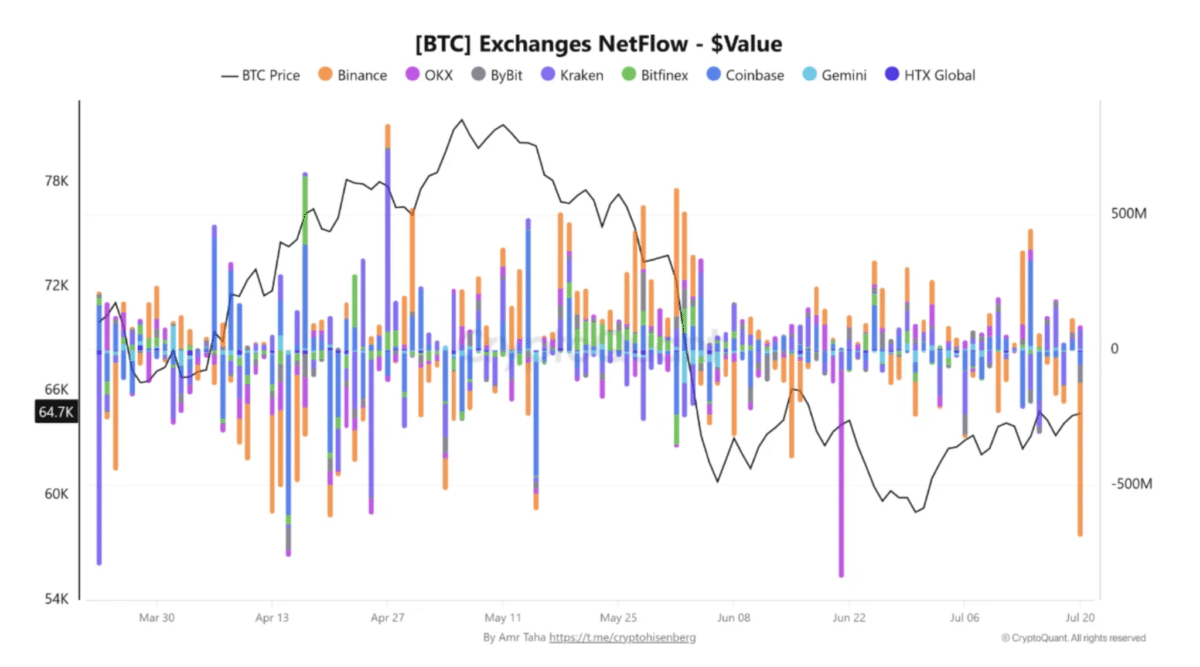
    The near-term risk is straightforward. Cryptoquant data shows selling has slowed on Binance, which supports the case for a short-term bounce. Elsewhere, crypto exchange Bitrue warned that a break below $60,000 could open up a move toward $50,000-$55,000 or even $47,000 if cascading liquidations accelerate.

    The gap between the short-term bounce and the medium-term trend remains wide — and Wednesday’s rejection at $70,000 did nothing to close it.

  • Bitcoin Treasury Company GD Culture May Sell BTC to Buy Back Shares

    Bitcoin Treasury Company GD Culture May Sell BTC to Buy Back Shares

    In brief

    • GD Culture earned board approval to sell some of its 7,500 Bitcoin in order to fund a $100 million share buyback plan.
    • Shares rose 15% amid the news, but are still down 60% from its 52-week high.
    • The firm accumulated the 7,500 BTC as part of an acquisition last fall.

    Publicly traded artificial intelligence and livestreaming firm GD Culture approved the sale of some of its 7,500 Bitcoin, or around $518 million worth, as part of its effort to fund a new share repurchase program, the firm announced on Wednesday. 

    The program, approved earlier this month by the firm’s board of directors, authorizes it to repurchase up to $100 million in GD Culture shares (GDC) intermittently over the next six months. 

    “The board’s authorization permits the company to execute the Bitcoin sales in one or more transactions, from time to time, as management determines to be in the best interests of the company and its shareholders,” the firm said in a statement. 

    “Proceeds from the Bitcoin sales are expected to be used to fund repurchases of the company’s common stocks pursuant to the share repurchase program.” 

    While the firm is authorized to sell all of its Bitcoin holdings, it is under “no obligation” to sell any specific amount and the program can be modified or discontinued at any time, according to its announcement. 

    GD Culture picked up the 7,500 BTC last September when it entered into a share agreement to acquire Pallas Capital and its holdings. Now it can start to sell off its treasury if it wishes to, though its total holdings are worth around five times more than the approved amount for share repurchases. 

    Shares in the firm are up around 21% following the news, recently trading at $4.04 but have still fallen more than 10% in the last month.

    It’s not the first crypto treasury to offload some of its crypto assets in order to fund share repurchase agreements. In October, Ethereum treasury firm ETHZilla sold around $40 million in ETH to help buy back shares as its stock traded below the value of its net assets. 

    Other firms have recently sold Bitcoin to fund other initiatives as well. Riot Platforms dumped $200 million in BTC during November and December amid what analysts believe is a bid to fund its AI initiatives. 

    Earlier this month publicly traded miner Cango did the same, parting ways with $305 million worth of the top crypto asset. 

    A representative for GD Culture did not immediately respond to Decrypt’s request for comment. 

    Daily Debrief Newsletter

    Start every day with the top news stories right now, plus original features, a podcast, videos and more.

  • Uniswap price pops 20% to $4 amid oversold rebound

    Uniswap price pops 20% to $4 amid oversold rebound

    • Uniswap price jumped to above $4 on Wednesday as Bitcoin retested $68,000.
    • The $UNI token could eye $5 amid an oversold bounce across crypto.
    • If bulls fail to rally, key support lies around $3.48 and $3.00.

    Uniswap ($UNI) price has surged nearly 20% in recent trading, climbing to intraday highs above $4.00 as top altcoins retest critical resistance levels.

    This rebound aligns with Bitcoin’s spike in the past 24 hours, which sees BTC trade above $68,000 and altcoins, including Ethereum, XRP, and BNB, target oversold bounces above $2,000, $1.50, and $620, respectively.

    As with these top altcoins, on-chain data shows Uniswap price ticking up from oversold conditions. Morpho was among the coins to see sharp gains on the day.

    Uniswap price pumps to above $4

    The sharp decline on February 5, 2026, saw $UNI price dump to $3.00, and a subsequent attempt to break higher failed as prices hovered in a range capped at around $3.60.

    Overall, weakness in digital assets amid macro headwinds contributed to this outlook.

    However, despite risk assets remaining largely bearish, $UNI’s uptick to $4.00 amid a 62% spike in daily volume reflects fresh optimism.

    Uniswap’s gains in the past 24 hours build on the positive movement that followed BlackRock’s recent strategic purchase of $UNI.

    The global asset management giant plans to use the tokens to facilitate trading of its BUIDL tokenized Treasury fund via Uniswap.

    Data on the market platform Coinglass highlights the improvement in on-chain metrics for $UNI.

    Open interest is picking up, and funding rates are positive. This suggests recent weakness has provided entry opportunities for buyers.

    Bitcoin’s push above $68,000 and Ethereum’s breach of $2,000 may catalyze further gains for small-cap tokens.

    What next for $UNI price?

    Although Uniswap’s price is up by double digits on the day, it remains in the red over the past week, month, and year-to-date.

    Uniswap Price Chart

    Uniswap price chart by TradingView

    Technical indicators also suggest that $UNI at $4.00 is below key moving averages, including the 50-day, 100-day, and 200-day SMAs.

    Daily RSI at 56, however, signals an extended bounce from oversold territory, and significantly, has room for another leg up before bulls hit overbought extremes.

    Meanwhile, the MACD histogram hints at fresh bullish momentum with $3.20 having formed a potential bottom.

    Bollinger Bands position $UNI above the upper band, which is currently at $3.81.

    If prices break above the 50-day SMA, bulls will have eyes on the 100 SMA ($5.09).

    This hurdle aligns with a horizontal resistance line that also acted as support in November and December 2025.

    However, near-term bearish targets are alive. The lower Bollinger band at $3.48 offers the first major demand reload zone. Below this, bulls could rely on support at $3.00.