Category: Business

  • Morning Minute: Wall Street Moving Onchain Will Drive the Next Bull Market

    Morning Minute: Wall Street Moving Onchain Will Drive the Next Bull Market

    Morning Minute is a daily newsletter written by Tyler Warner. The analysis and opinions expressed are his own and do not necessarily reflect those of Decrypt.

    GM!

    Today’s top news:

    • Crypto majors mostly flat despite falling stocks & rising oil; BTC at $65.5k
    • Senate Republicans publish new Clarity Act draft, Dem Leaders still oppose
    • SEC Commissioner Pierce warns some DeFi vaults and onchain lending fall under securities law
    • BTC ETFs see 7 straight days of inflows; ETH validator exit queue goes to 0
    • Rhynotic’s new FWA protocol token runs to $11M, pumps multiple NFT sets

    🏦 Bitwise’s CIO Says Wall Street Moving Onchain Will Drive the Next Bull Market

    The next crypto bull market won’t look like the last ones.

    That’s the argument from Bitwise CIO Matt Hougan, who laid out in a new memo that the coming cycle will be driven by the convergence of traditional and onchain finance, stablecoins, tokenization, 24/7 trading, instant settlement, and institutional DeFi, rather than the speculative demand that powered previous rallies. His key claim is that because this cycle would be built on real financial activity and revenue, it could be bigger than what came before, even if it arrives slower and with less volatility.

    Hougan framed the opportunity as two “lanes.”

    • The first is the “Hyperliquid Lane”—crypto-native protocols that generate serious revenue and route it back to their tokens. For those unfamiliar, Hyperliquid crossed $1 billion in cumulative revenue in June, is on pace for roughly $800 million this year, and directs 99% of that revenue into buying HYPE on the open market.
    • The second is the “Robinhood Lane”—established companies building real financial services on blockchain rails instead of running pilots. Robinhood Chain went live July 1 and has already passed $3 billion in volume.

    The Hyperliquid Lane fixes crypto’s chronic flaw, where applications rack up fees and volume without creating any demand for their token. He named Uniswap, Aave, and Morpho as protocols moving the same direction, along with onchain darlings like Pump.fun. The TradFi stampede, Citadel into Crypto.com, Morgan Stanley onto E*TRADE, the DTCC going live on tokenization, is his Robinhood Lane.

    So here we have a credible institutional voice arguing that revenue and crypto rails will drive the next cycle, not speculation. This is not necessarily a new opinion, as many on CT (Crypto Twitter) have made Hyperliquid their shining star for months now. And as for the institutional driver, that’s not really a new concept either. But it is important when the CIO of Bitwise writes the thesis up formally covering these two factors.

    It’s no longer “the institutions are coming.” It’s “the institutions are here—and they’re going to drive the next bull cycle.” We’ll find out soon if he’s right…

    🌎 Macro Crypto and Markets

    • Crypto majors are mostly flat despite red stocks and rising oil; BTC -0.3% at $65.5k; ETH even at $1,925; SOL even at $78; HYPE even at $59.30
    • Stable (+16%), WLFI (+13%) and ENA (+4%) led top movers
    • Oil +4.5% at $90; Gold -1.5% at $4,090
    • Stock futures are red after rough earnings calls from TSLA and Google; DOW -0.4%, Nasdaq -0.5%
    • Senate Republicans published a new CLARITY draft that would impose limits on Trump’s crypto empire along with other updates
    • Seven key Senate Democrats said the draft “falls short” on ethics, consumer protection, illicit finance, and market integrity
    • SEC Commissioner Hester Peirce warned that some DeFi vaults and onchain lending products may fall under securities laws, a notable caution from the agency’s most crypto-friendly commissioner
    • Franklin Templeton’s Sandy Kaul called blockchain the next AI trade, arguing that as autonomous agents transact in fractions of a cent, card networks become uneconomical and blockchains win the machine-to-machine payment layer
    • BitMEX (co-founded by Arthur Hayes) announced it will permanently close on Sept 23, 2026, and has stopped accepting new users
    • Ethereum’s validator exit queue has fallen from a peak of 2.6M ETH to 0, while its staking queue now has 2.48M ETH and a 43-day waiting period

    Corporate Treasuries & ETFs

    Meme Coin Tracker

    • Meme leaders were mostly flat; DOGE -1%, SHIB -1%, PEPE even, PENGU -1%, TRUMP +3%, BONK -3%
    • Robinhood chain was led by GME (+425x), AI (+80%), and SWOGE (+190%); Cashcat -25% to $48M and PONS -18% to $26M as prior winners sell off hard
    • Solana leaders included Jimothy (+5%), KET (+110%) and BOP (+170%); ANSEM -10% to $175M

    💰 Token, Airdrop & Protocol Tracker

    • Kalshi launched a US Midterms Hub with live odds on Senate and House races alongside polling and FEC data
    • An Arbitrum USDC bridge lost about $24.15M after attackers compromised its hot-validator signing path, clearing quorum to authorize a withdrawal the contract treated as legitimate
    • The Verus-Ethereum bridge was exploited for the 2nd time in 2 months with $7.54M drained, after attackers abused the bridge’s import path

    🚚 What is happening in NFTs?

    • NFT leaders were flat while multiple other sets climbed; Punks even at 32 ETH, BAYC even at 8.65 ETH, Pudgy even at 4.18 ETH; Hypurr’s even at 185 HYPE
    • Cyberkongz (+53%), Memeland MVPs (+29%), TTT (+38%), Creepz (+77%), mfers (+16%) and CrypToadz (+16%) led top movers
    • Robinhood NFTs were led by Hood Mundo (+39%) and Pepe Hood Town (+9%)
    • Rhynotic’s new Fake World Assets (FWA) NFT gacha platform saw its token soar to $11M overnight before retracing
    • An FWA user won a Cryptopunk off a 0.06 ETH gacha spin (550x return), before selling it back for FWA tokens

    Daily Debrief Newsletter

    Start every day with the top news stories right now, plus original features, a podcast, videos and more.


  • Polymarket to challenge France’s nationwide website block

    Polymarket to challenge France’s nationwide website block

    Polymarket added it does not take the other side of trades or profit from market outcomes, distinguishing its model from a gambling operator that sets odds and trades against customers.

    The French regulator said the platform remained accessible after trading restrictions were introduced and continued to promote an unauthorized gambling service.

    It also cited concerns over identity checks and suspected manipulation of weather-related markets.

    France is the latest country to order internet providers to block Polymarket. Ukraine imposed an ISP-level block in January, Argentina followed in March and Spain blocked Polymarket and Kalshi in May.

    France’s action goes beyond the trading restriction already in place. Polymarket had blocked transactions from the country since November 2024, but the ANJ ordered the entire website blocked because users could still view its markets and live probabilities.

    Other countries including Brazil, India, Indonesia and Romania have also restricted access or classified Polymarket as an unauthorized gambling platform. Ukraine currently has no legal framework through which the platform could operate, according to a government policy official.

    CoinDesk has asked Polymarket whether it is challenging enforcement decisions outside France and had not heard back at the time of writing.

  • Abu Dhabi’s Mubadala Capital joins tokenization push as Coinbase takes stake in onchain fund

    Abu Dhabi’s Mubadala Capital joins tokenization push as Coinbase takes stake in onchain fund

    Tokenization has become one of the fastest-growing corners of digital assets as traditional finance firms look to modernize fund infrastructure. Citi recently projected that tokenized securities could grow to roughly $5.5 trillion by 2030, while Boston Consulting Group and Ripple estimate tokenized assets across all asset classes could reach $18.9 trillion by 2033.

    Creating blockchain-based tokens of existing funds could help broaden access to a new set of investors and open the door for fund shares to be used as collateral or plugged into other onchain financial applications.

    For this particular case, KAIO provides the infrastructure that issues and administers Mubadala Capital’s tokenized fund. The company said Mubadala joins firms including Hamilton Lane, Brevan Howard and Laser Digital that use its platform to distribute investment products onchain, and currently has $144 million in tokenized funds on its platform.

    “This strategy was built on differentiated access — to deal flow, to co-investment, to a global network that most investors cannot reach on their own,” Max Franzetti, head of Mubadala Capital Solutions, said in a statement. “Bringing it onchain extends that access to a new class of qualified investors without compromising the institutional discipline that defines how we invest.”

    Brett Tejpaul, head of Coinbase Institutional, said that Coinbase adding the fund to its corporate balance sheet investment is a reflection of growing interest in regulated tokenized assets as treasury holdings. “As regulated assets become programmable, they can become part of a broader onchain economy that is more transparent, composable and accessible to qualified investors in eligible jurisdictions.”

  • 24/7 financial rails: How BNY plans to eliminate the weekend lag in U.S. Treasuries

    24/7 financial rails: How BNY plans to eliminate the weekend lag in U.S. Treasuries

    BNY, the world’s largest custody bank, plans to support round-the-clock settlement of conventional and tokenized U.S. Treasuries in 2027, after completing an after-hours trade involving the reserves of 2 stablecoin issuers.

    The bank will test tokenized Treasuries on a private blockchain by the end of the year and will extend its existing settlement network later this year to cover more of the Asian, European and U.S. trading days, according to a letter sent to clients reported by Bloomberg.

    The earlier transaction involved Ripple’s $RLUSD and OpenEden’s USDO with Ripple participating directly, while BNY’s cash-management business unit Dreyfus acted for OpenEden.

    Tradeweb handled the trade after Fedwire Securities had stopped processing secondary-market Treasury transfers for the day, according to the report.

    BNY said the transaction settled shortly afterward through existing cash rails. The securities were not tokenized, but the test instead showed that Treasury activity tied to stablecoin reserves could continue after the main U.S. settlement window closed.

    $RLUSD and USDO hold short-dated government debt as reserve assets. The tokens trade continuously, but the Treasuries behind them remain tied to weekday settlement windows.

    That can delay reserve adjustments following large creations, redemptions or collateral calls.

  • BitMEX to Close on September 23, Halts New Sign-Ups

    BitMEX to Close on September 23, Halts New Sign-Ups

    In brief

    • Crypto derivatives exchange BitMEX said Thursday it will shut down on September 23, 2026, and has already stopped new account registrations.
    • The company cited a strategic review of the business and the wider crypto industry as being behind the decision.
    • BitMEX urged users to close positions and withdraw funds before the deadline.

    BitMEX, one of crypto’s oldest derivatives venues, is shutting down.

    The platform will cease operations on September 23 at 04:00 UTC, its operator, HDR Global Trading, said Thursday, pinning the decision on a “strategic review of the business and the broader industry.” New account sign-ups have already been halted. The move, BitMEX said, “comes with a heavy heart.”

    Users have two months to get out. Trading continues as normal until August 26, when BitMEX will bar new positions and let traders only reduce existing ones. From there it will force-close open positions to wind the market down in an orderly fashion, and any left open at the deadline will be closed automatically. Even after the shutdown, the company said, users can still log in to withdraw balances—though those who leave funds parked will eventually be charged a monthly account fee.

    Founded in 2014 by Arthur Hayes, Benjamin Delo, and Samuel Reed, BitMEX built a template much of the industry still runs on. In May 2016 it launched the perpetual swap—a no-expiry futures contract offering up to 100x leverage. Crypto perps have since gone on to reach volumes of $61.7 trillion in 2025, per CryptoQuant, up $13.8 trillion on the previous year. BitMEX noted it had gone more than 11 years without losing user funds to a hack—a pointed claim in a year defined by nine-figure exploits.

    Its later history was rockier. BitMEX pleaded guilty in 2024 to violating the Bank Secrecy Act over lax anti-money-laundering controls, and paid $100 million in penalties. In March 2025, U.S. President Donald Trump pardoned Hayes and his co-founders, wiping out the criminal case that had shadowed the exchange for years. BitMEX told users to trade on “the many excellent platforms that have followed in our footsteps.”

    Daily Debrief Newsletter

    Start every day with the top news stories right now, plus original features, a podcast, videos and more.

  • BitMEX, the exchange that invented perps, is shutting down

    BitMEX, the exchange that invented perps, is shutting down

    The exchange has immediately halted all new account registrations following a strategic business review by its parent company, HDR Global Trading Limited. The wind-down ends an 11-year run for the Seychelles-incorporated venue, which debuted in 2014 and pioneered the foundational plumbing for modern digital asset derivatives trading.

    The wind-down forces an immediate reduction of risk across the system, because while standard trading will continue for the next few weeks, the platform will apply strict limits on Aug. 26 to stop users from opening any new positions. Between that date and the final September deadline, operators will systematically force close all remaining open contracts to ensure the market shuts down in an orderly manner.

    The main challenge BitMEX faces is how to offramp user assets into fiat currencies of their choice, as network congestion on the Bitcoin blockchain could cause significant withdrawal delays. However, the company’s current proof of reserves indicates that platform liabilities fully cover customer assets.

    This exit marks the end of an 11-year run for the digital asset derivatives venue, which maintained a clean security record and lost no user funds to hacks or smart-contract exploits despite facing years of intense regulatory enforcement actions by global authorities.

    The news comes just three weeks after BitMEX lost its CEO, chief financial officer and head of growth.

  • BONK Launches Circus on Robinhood

    BONK Launches Circus on Robinhood

    $BONK, the Solana-based token project, has launched Circus, a new platform for issuing tokens that could become available on Robinhood. The launch expands $BONK’s growing product ecosystem and aims to give Robinhood users access to newly issued digital assets.

    Details about the platform remain limited. $BONK has not yet announced which tokens will debut on Circus or explained how allocations and listing criteria will work. The project has only described the broader concept of bringing a crypto-native launchpad model to a platform mainly used by retail investors.

    The launch follows the rapid growth of $BONK’s other products. BONKtrade, the project’s trading platform, recorded more than $400 million in monthly volume in June. BONKBot, a trading automation tool that works through chat, processes around $1.5 million in transactions per day.

    Image: Magnific

  • Ripple MiCA Authorization Opens A Wider European Payments Lane

    Ripple MiCA Authorization Opens A Wider European Payments Lane

    Ripple MiCA Authorization Opens A Wider European Payments Lane

    Ripple has secured full MiCA authorization in Europe, giving the company a clearer regulatory path to expand crypto-enabled payment services across EU and EEA markets.

    The authorization applies to Ripple’s corporate payment entity and allows compliant operations under the European Union’s Markets in Crypto-Assets framework. That is an important distinction. This is not a blanket regulatory endorsement of $XRP trading itself. It is a licensing milestone for Ripple’s business activities under MiCA.

    Still, the development matters for $XRP watchers because Ripple’s payments business remains central to the token’s broader narrative.

    If Ripple can operate more cleanly across Europe, it may strengthen the company’s ability to work with banks, payment firms, fintechs, and institutional clients in one of the world’s most important regulatory blocs.

    TL;DR

    • Ripple has secured MiCA authorization for European crypto-asset services.
    • The approval supports Ripple’s compliant payment operations across EU and EEA markets.
    • The authorization applies to Ripple’s corporate payment entity, not direct regulatory clearance for $XRP trading.

    Why MiCA Matters For Ripple

    MiCA has become one of the most important crypto regulatory frameworks in the world.

    Instead of forcing firms to deal with fragmented rules across every European country, MiCA creates a more unified regime for crypto-asset service providers. That can make it easier for licensed firms to scale across member states while still meeting compliance obligations.

    For Ripple, this is particularly relevant.

    The company has spent years positioning itself as a payments and settlement infrastructure provider. Its core pitch has always depended on working with regulated institutions, not simply appealing to retail token traders.

    A MiCA authorization can therefore make business conversations easier.

    Banks and payment companies are more likely to work with a crypto firm when the regulatory status is clear. Compliance teams can point to a recognized framework. Legal departments can assess obligations more directly. Operational partners can understand the boundaries of what is permitted.

    That is exactly the kind of clarity Ripple needs if it wants to expand deeper into European payment corridors.

    What This Means For $XRP

    The $XRP market will naturally pay attention to the authorization, but the connection needs to be framed carefully.

    Ripple’s regulatory progress can improve the environment around its payment business. That may support the broader $XRP narrative if the company’s products continue to involve $XRP-related liquidity or settlement tools.

    But the authorization itself does not mean regulators have approved $XRP as an investment product. It does not mean all $XRP trading has received blanket clearance across Europe. It does not guarantee token demand.

    The strongest read is more measured: Ripple has gained a clearer legal route for its European crypto-asset service operations.

    That matters because institutional adoption depends on trust, licensing, and compliance. $XRP’s long-term utility case is stronger when Ripple can operate in major markets without constant regulatory uncertainty.

    Still, token price impact depends on actual usage, liquidity, and product adoption.

    Europe Is Becoming A Crypto Licensing Battleground

    Ripple’s MiCA approval also fits into a wider industry trend.

    Crypto companies are racing to secure European regulatory footing because MiCA offers something the US still lacks: a comprehensive digital asset rulebook. The framework is not light-touch, but it is relatively clear.

    That makes Europe attractive for firms that want certainty.

    Exchanges, custodians, stablecoin issuers, payment firms, and infrastructure providers all need to decide where to base operations and how to structure services. MiCA creates a pathway, but it also raises the bar.

    Firms that secure authorization early may gain an advantage.

    They can approach institutional clients with a stronger compliance story while rivals are still working through approvals. For Ripple, that could be meaningful given the company’s focus on cross-border payments.

    The Real Test Is Adoption

    Regulatory approval is useful, but it is not the finish line.

    Ripple still needs to turn authorization into real payment volume, partnerships, and institutional usage. Licenses create permission. They do not automatically create demand.

    The next thing to watch is whether Ripple uses the MiCA approval to announce new European clients, expanded corridors, or deeper integration with banks and payment providers.

    That is where the story becomes more important for $XRP holders.

    If authorization leads to more payment activity, the market may view it as a practical step forward. If it remains mostly a compliance milestone, the immediate effect may be limited.

    Either way, it is a positive development for Ripple’s European strategy.

    Crypto markets have spent years asking for regulatory clarity. In Europe, that clarity is now becoming operational. Ripple’s MiCA authorization shows how larger crypto companies are beginning to use that framework to expand regulated services rather than wait for perfect global rules.

    For Ripple, Europe just became a more navigable market.

    This article is based on Ripple and ESMA materials.

    This article was written by the News Desk and edited by Samuel Rae.

    This report is based on information released in official primary source disclosures at primary source documentation.

  • Bitcoin, Ethereum-linked protocols lose $35 million in multiple attacks hours apart

    Bitcoin, Ethereum-linked protocols lose $35 million in multiple attacks hours apart

    A bridge is a blockchain-based tool that lets assets move between two networks that otherwise cannot interact with each other. It holds real tokens on one side and issues claims against them on the other, and its safety depends entirely on correctly verifying that every withdrawal is genuinely backed by assets locked on the other chain.

    The Verus flaw let an attacker trigger payouts on the Ethereum side that were never properly backed on the Verus side, so the bridge released real money against a claim worth almost nothing.

    The attacker returned most of the funds in exchange for a bounty after the May attack. Verus then redeposited the recovered money into the same bridge on July 8, according to onchain records compiled by security researchers, and the bridge was drained again two weeks later.

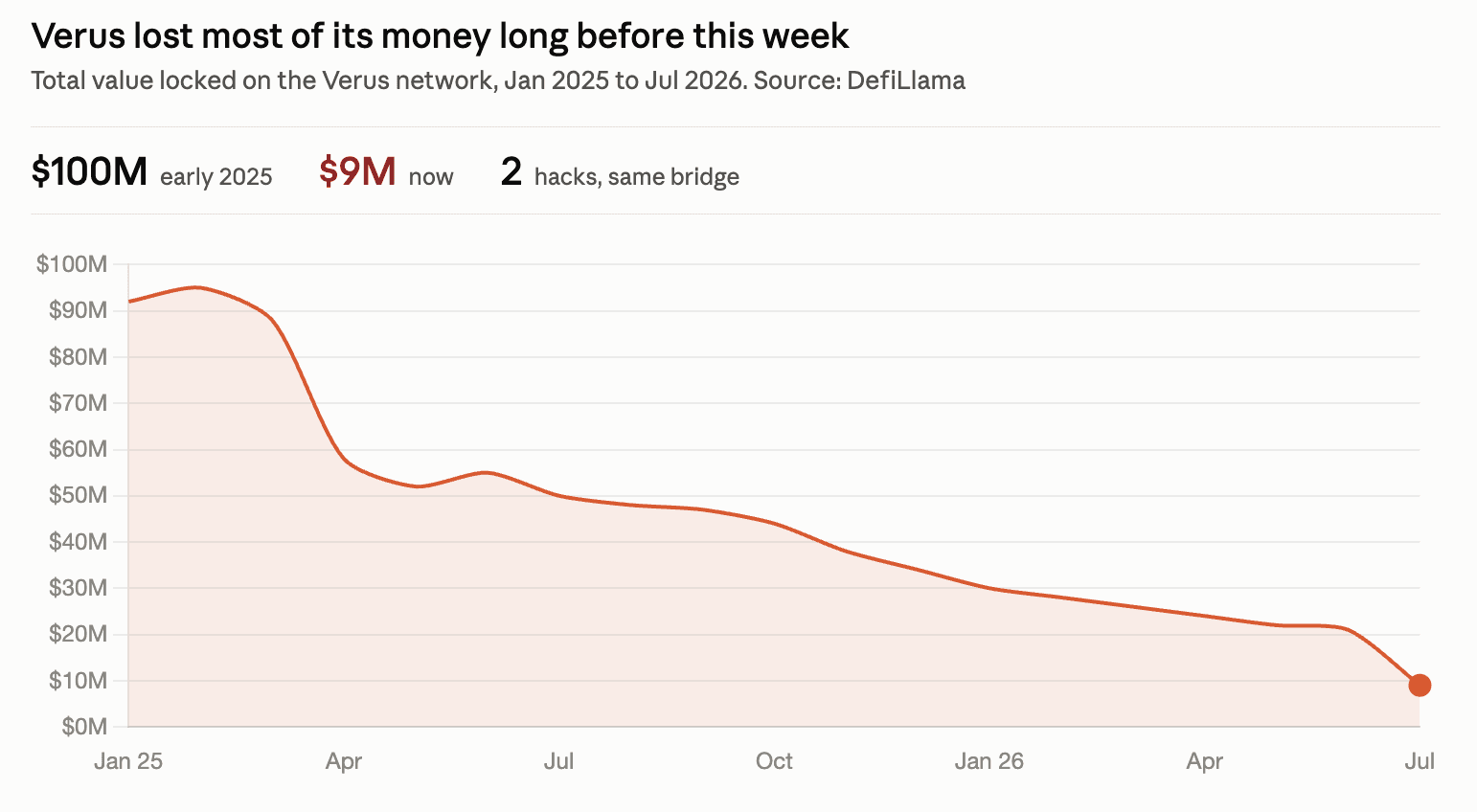
    The cost of that trust is visible in the protocol’s own numbers. Verus held close to $100 million in total value locked at the start of 2025, according to DefiLlama. It holds about $9 million as of Thursday, a slow bleed punctuated by a fresh drop this week as the latest hack landed.

    (Shaurya Malwa/CoinDesk)

    Such repeated failures do not just cost the money stolen in any single attack, but drain the confidence that keeps assets on the platform at all.

  • Cardano (ADA) Founder Charles Hoskinson Speaks Out for the First Time Following the Hack

    Cardano (ADA) Founder Charles Hoskinson Speaks Out for the First Time Following the Hack

    Cardano founder Charles Hoskinson made a statement following the security incident in the Midnight ecosystem that led to a sharp drop in the price of the $NIGHT token. Hoskinson stated that the attack did not affect the Midnight protocol or the $NIGHT smart contract on Cardano, but rather the problem occurred in the third-party bridge infrastructure.

    Hoskinson stated, “Midnight itself wasn’t hacked. $NIGHT’s smart contract on Cardano wasn’t hacked. What was hacked was the third-party bridge.”

    Hoskinson stated that initial findings indicate the incident is entirely limited to the Wanchain infrastructure, noting that the system has four core components—on-chain and off-chain—running on Cardano and BNB Chain. He emphasized the need for a comprehensive audit to determine which component was affected and how the vulnerability was exploited.

    Hoskinson stated that they were awaiting an explanation from the Wanchain team, saying, “Questions must be answered and audits must be conducted. We will get to the truth about why this happened, who is responsible, how much the loss is, and how the damage will be remedied.”

    Cardano’s founder also warned that similar attacks could become more frequent in the future due to advancements in artificial intelligence technologies. Hoskinson stated that AI has made significant progress in the field of information security, noting that vulnerabilities in systems can be found and fixed much faster than humans can.

    Related News Following a Hacking Attack, the Value of an Altcoin Dropped to Nearly Zero

    Hoskinson, who noted that he has been in the cryptocurrency sector for 15 years, said that the sector has started to become desensitized to these events due to the constant attacks and bridge security problems. Stating that this situation seriously undermines consumer confidence, Hoskinson argued that there is a need for next-generation financial infrastructures.

    According to Hoskinson, the $NIGHT project aims to combine the regulatory mechanisms, insurance products, and asset recovery capabilities of the traditional financial system with the features of cryptocurrencies, such as individual custody and self-sovereign identity. Hoskinson stated that this model aims to give users back control over how their money works.

    Hoskinson stated that the $NIGHT token has begun to recover after the sharp drop, indicating that the Midnight ecosystem has overcome its first major crisis. Hoskinson commented, “$NIGHT experienced its first major event and emerged stronger. Midnight has begun to recover and has passed its first major test.”

    *This is not investment advice.