Ethena [$ENA] has made some modest gains to get the week off to a good start. Since making the $0.078 low on Monday, July 20, the altcoin has rallied 13%. In the past 24 hours, its Open Interest has expanded by 7%.
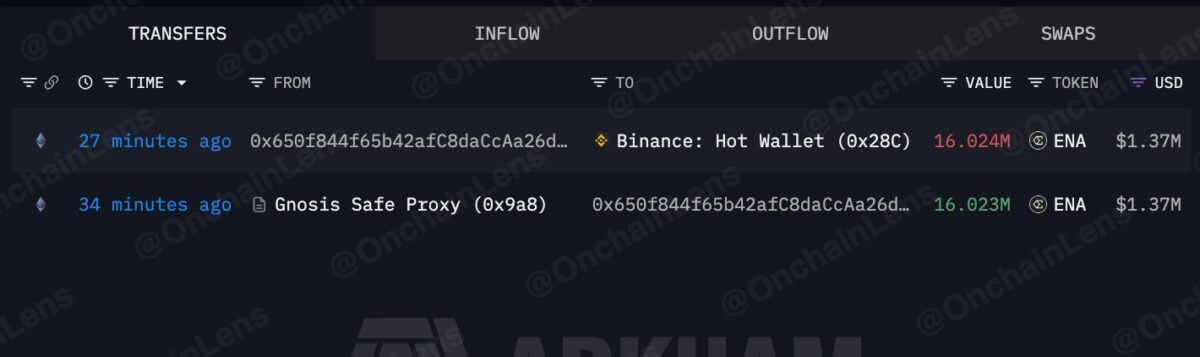
Source: Onchain Lens on X
On July 21, Onchain Lens observed a 16 million $ENA move, worth around $1.37 million. The wallet withdrew this from their Gnosis multisig wallet to Binance. Transfers to centralized exchanges generally point toward sell pressure.
Ethena holders have experienced profits, as seen on the daily transaction volume in profit metric. A rise in average order size also indicated potential whale interest in $ENA, AMBCrypto reported.
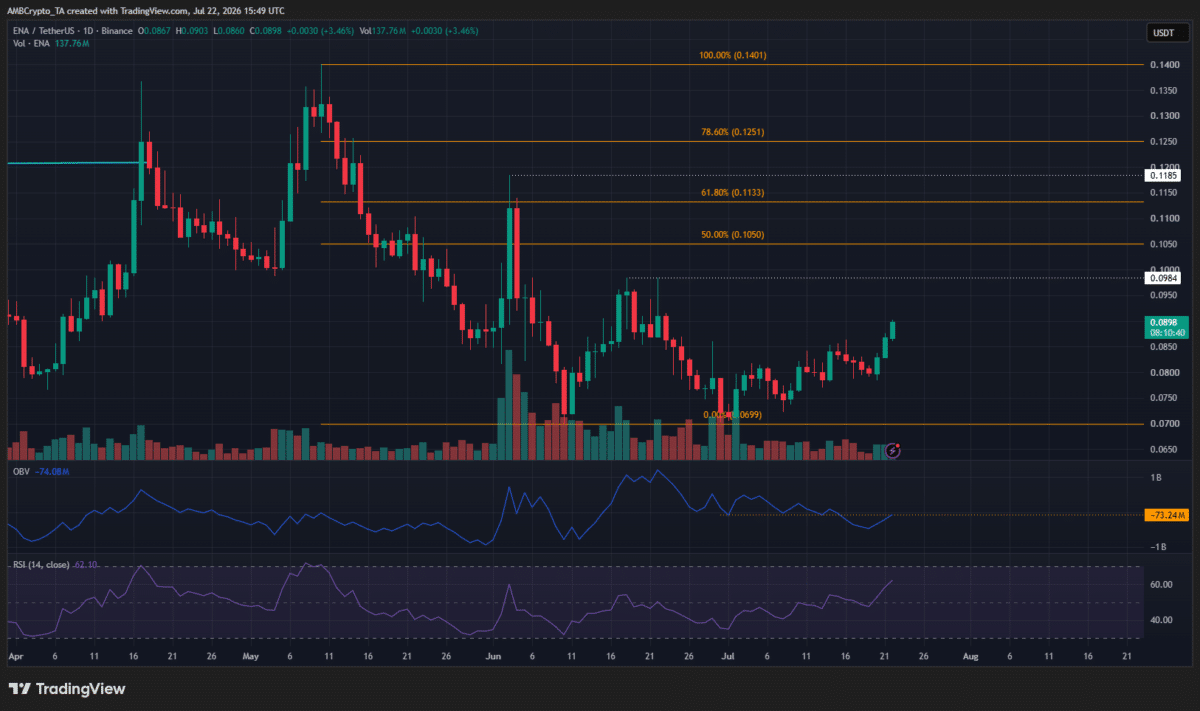
$ENA operates within a downtrend, but a temporary uptrend was underway
The $0.085 target presented has been met and cleared. However, the higher timeframe trend remained bearish.
Source: $ENA/$USDT on TradingView
The local highs at $0.098 and $0.118 are the potential price targets in case of a short-term uptrend. As the Fibonacci retracement levels show, the swing structure on this timeframe was bearish.
A rally could rise to $0.123, but the likelihood of this had been in question as $ENA repeatedly failed to breach the $0.085 resistance zone over the past three weeks. The gains at the start of this week were a positive sign.
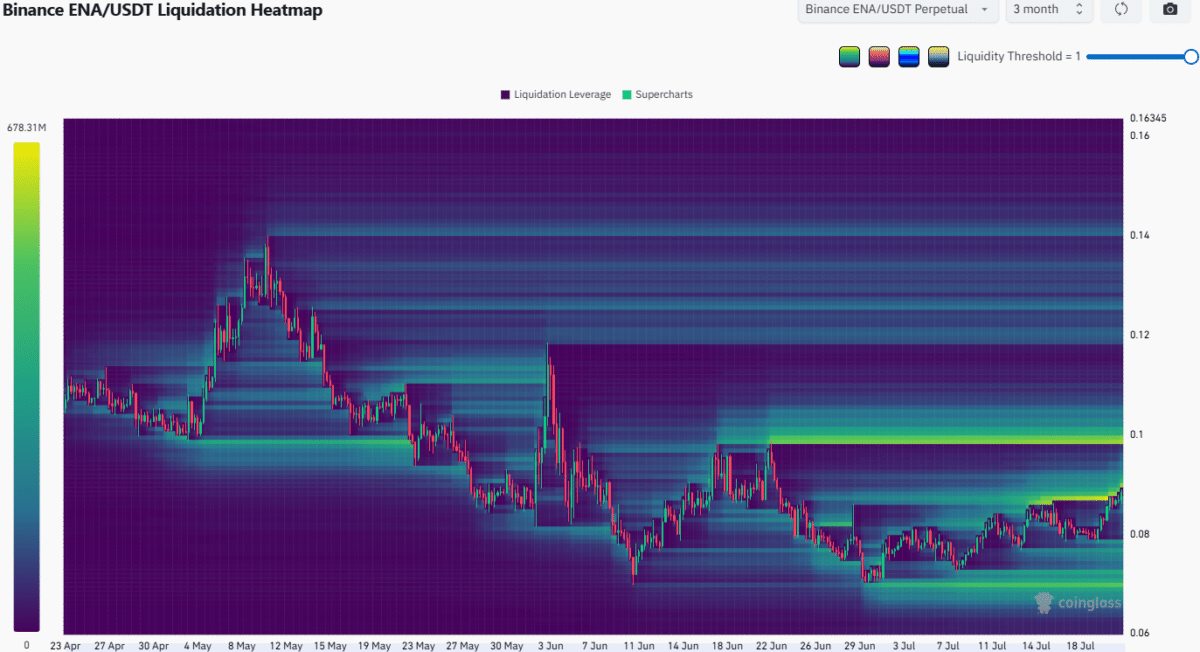
Source: CoinGlass
The liquidation heatmap of the past three months agreed. There were two magnetic zones to keep an eye on. The $0.09 and $0.10 had dense short liquidations that traders should keep an eye on.
Traders’ call to action- Cautiously bullish stance warranted
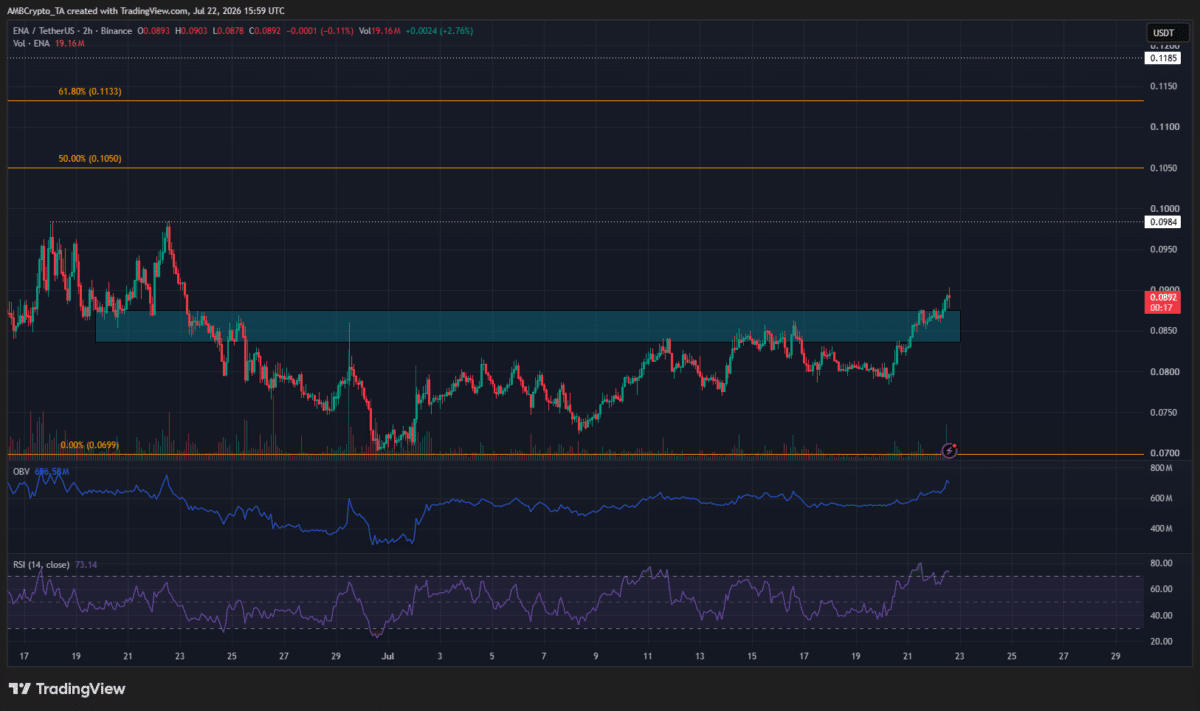
Source: $ENA/$USDT on TradingView
The $0.085 zone was flipped to support. The OBV was making new local highs to indicate increased buying pressure. The RSI showed strong bullish momentum, though a bearish divergence warned of a brief dip toward $0.085.
Such a dip would likely present a short-term buying opportunity. As noted earlier, the $0.098,$0.118, and $0.123 levels are viable targets for $ENA in a pullback within its higher timeframe downtrend.
Final Summary
The $0.085 local resistance zone was flipped to support, though a short-term RSI bearish divergence could cause a minor price dip.
Traders can wait for the current upward move to push toward $0.11-$0.12 before looking to take profits. Bitcoin volatility could hurt this short-term setup.
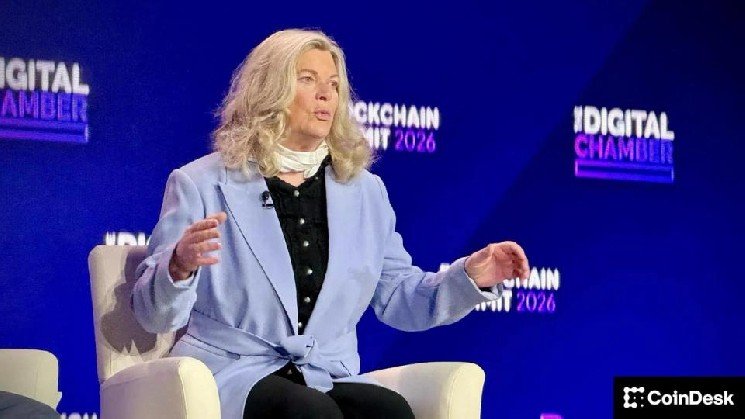
The U.S. Senate’s Digital Asset Market Clarity Act draft is still open to changes on a number of big-ticket items that include its government-ethics section, Senator Cynthia Lummis, one of the lead negotiators on the bill, said about the effort that’s “finally” getting closer to passage with the release of the text.
The Senate’s Judiciary, Ethics and Intelligence Committees all had input into the bill, Lummis told CoinDesk on Wednesday, and while the process has “been very difficult,” the bill is ready for additional feedback.
“It’s time to show everyone the fully integrated bill that we will be voting on, and get the feedback from the industry that’s about to be regulated, as well as others,” Lummis said. “So I’m pleased we’ve reached this point.”
Lummis released an updated text of the Clarity Act earlier Wednesday that merged the bills passed by the Senate Banking and Agriculture Committees into one longer bill. The updated text is not likely to be the final version of the bill.
The bill’s proposed conflict-of-interest limits for government officials’ crypto involvement will continue to be discussed through the weekend, and some of the illicit finance provisions may also see further discussion, Lummis said.
Bitcoin prices fluctuated close to $65,000 on Wednesday, July 22, as analysts pointed out key technical levels that traders should monitor.
The world’s largest digital currency by total market value fell to as little as $65,484.00, according to Coinbase data from TradingView.
At this point, the cryptocurrency had fallen close to 50% from the all-time high of more than $125,000 it reached in October 2025, a price reported by Reuters.
As the digital asset traded near the $65,000 level, several analysts highlighted key technical levels that short-term traders should watch.
Maxime Seiler, cofounder and CEO of STS Digital, offered some input on this matter, stating via email that “$70.000 to $72,000 is the upside zone to watch into month end, which lines up with where the bullish structures are set, and $67,000 to $68,000 is the immediate resistance that has to give first.”
“On the downside, $60,000 is still the level the market cares about,” he added, shedding some light on where bitcoin has support in this market.
Seiler also highlighted some macro developments, clarifying that “The main catalyst is the Fed meeting on July 28 and 29, which the market is treating as the thing that resolves the range one way or the other.”
“In addition, it’s worth watching alongside whether the ETF inflow streak holds,” he stated, referring to the flows into bitcoin exchange-traded funds.
Julio Moreno, head of research for CryptoQuant, supplied a similar take on the matter.
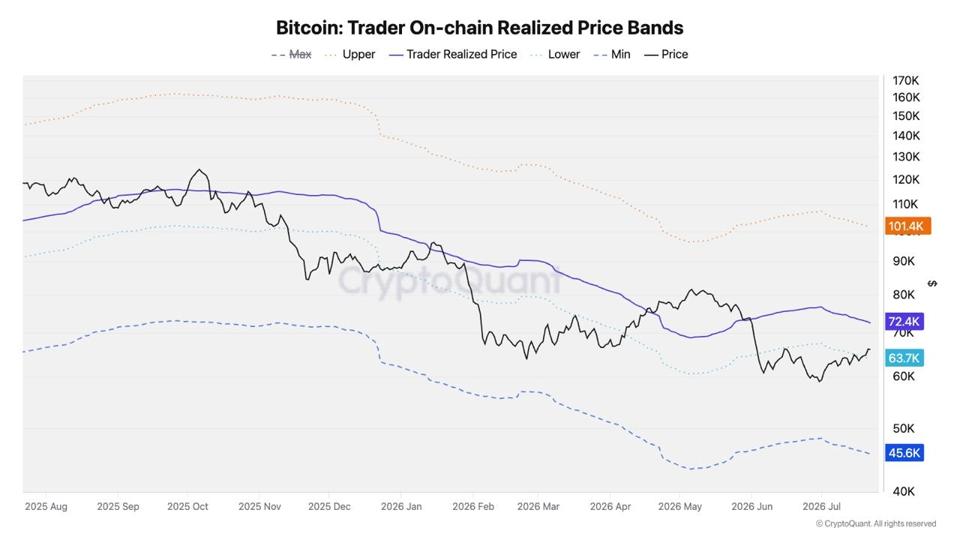
“From a traders’ perspective, I would watch the $64K price level as a support (dotted light blue line) and $72K as resistance (purple line) in the short term,” he said via email, referring to lines in a chart provided below.
“These levels are the lower band and traders’ on-chain realized price, and have been reliable support and resistance levels during this bear market,” noted Moreno.
Trader on-chain realized price bands
CryptoQuant
Tim Enneking, managing partner of Psalion, also chimed in.
“After months of indecision, it appears that $60k is finally a rather firm bottom for $BTC,” he said through emailed commentary.
“Since initially falling back to $60k in early February of this year (after breaking that level on the way up almost two years ago), $BTC has spent a full six months bouncing between $57k and $83k.”
“It’s spent the last almost two months between $57k and $67k, with $BTC today trying to push through the $67k ‘high’ set on June 15. Breaking that level is critical to continue putting in the higher lows and highs which began about one month ago.”
“My one fear is that this kind of looks like fall 2022, when $BTC also took its time putting in a bottom, and then completed one more leg down before moving up significantly beginning the following January.”
Ondo price has climbed 27% from $0.32 on July 15 to an intraday high near $0.42 as institutional tokenization deals and a decisive chart breakout have strengthened bullish sentiment around the RWA-focused token.
According to data from crypto.news, Ondo ($ONDO) price traded near $0.41 at press time, up about 2% on the day, with a market capitalization close to $2 billion. The token has outperformed Bitcoin and Ethereum over the past week as traders moved toward crypto projects tied to real-world financial infrastructure.
Recent interest followed Ondo Finance’s work with the Depository Trust & Clearing Corporation on a model for tokenizing securities held at the Depository Trust Company. Products linked to assets such as the SPDR S&P 500 ETF and Circle shares could use entitlements tied to securities held within existing custody systems, rather than stand-alone synthetic copies.
Ondo’s institutional case also includes a cross-border redemption completed with Mastercard, Kinexys by J.P. Morgan and Ripple. The transaction announced in May tested the redemption of tokenized U.S. Treasuries across two banking networks, giving investors another example of how regulated assets can move between blockchain and conventional payment systems.
Meanwhile, Ondo has expanded its tokenized-stock platform to more than 440 assets, while its website reports about $1.05 billion in value locked across those products. The company also introduced round-the-clock minting and redemption for tokenized stocks in June, reducing the dependence on U.S. market hours.
A separate agreement with Japan’s SBI Group added another source of demand for the RWA narrative. The companies plan to explore tokenized Japanese securities distributed through SBI’s network, with yen-based settlement through the JPYSC stablecoin.
Institutional deals have driven $ONDO’s breakout
Daily active addresses rose from 2,589 to around 3,300 on July 21 as the price approached $0.40, according to network data cited in the market analysis. The increase came alongside a sharp rise in trading volume, which helped $ONDO break from a descending channel that had controlled price action since May.
Spot buying also pushed cumulative volume delta back above zero, while derivatives open interest rebounded from its recent low. Those moves show that fresh capital entered both markets during the advance, although the speed of the recovery also forced traders holding short positions to close contracts as $ONDO crossed $0.39.
Investor sentiment has turned firmly positive after repeated failures below the same resistance. According to analyst Michaël van de Poppe, the token’s brief return to $0.34 created a successful retest before the latest push.
“I assume that, with this short retest at $0.34 and the fact that we’re having a test of this resistance so fast, it’s likely that we’ll continue to rally upwards.”
Van de Poppe placed $0.45 as the next likely objective and argued that strength in $ONDO could also pull other RWA tokens higher. His view matches the latest spot structure, though the token must first absorb sellers between $0.41 and $0.42.
Macro conditions have also favored assets with clear institutional links. Bitcoin traded near $66,000, and Ethereum hovered around $1,930 as both assets registered limited daily gains, while investors assessed commodity volatility and the next round of central-bank decisions. $ONDO’s 27% weekly advance has separated it from that subdued large-cap performance.
$ONDO price must secure $0.42 before targeting $0.47
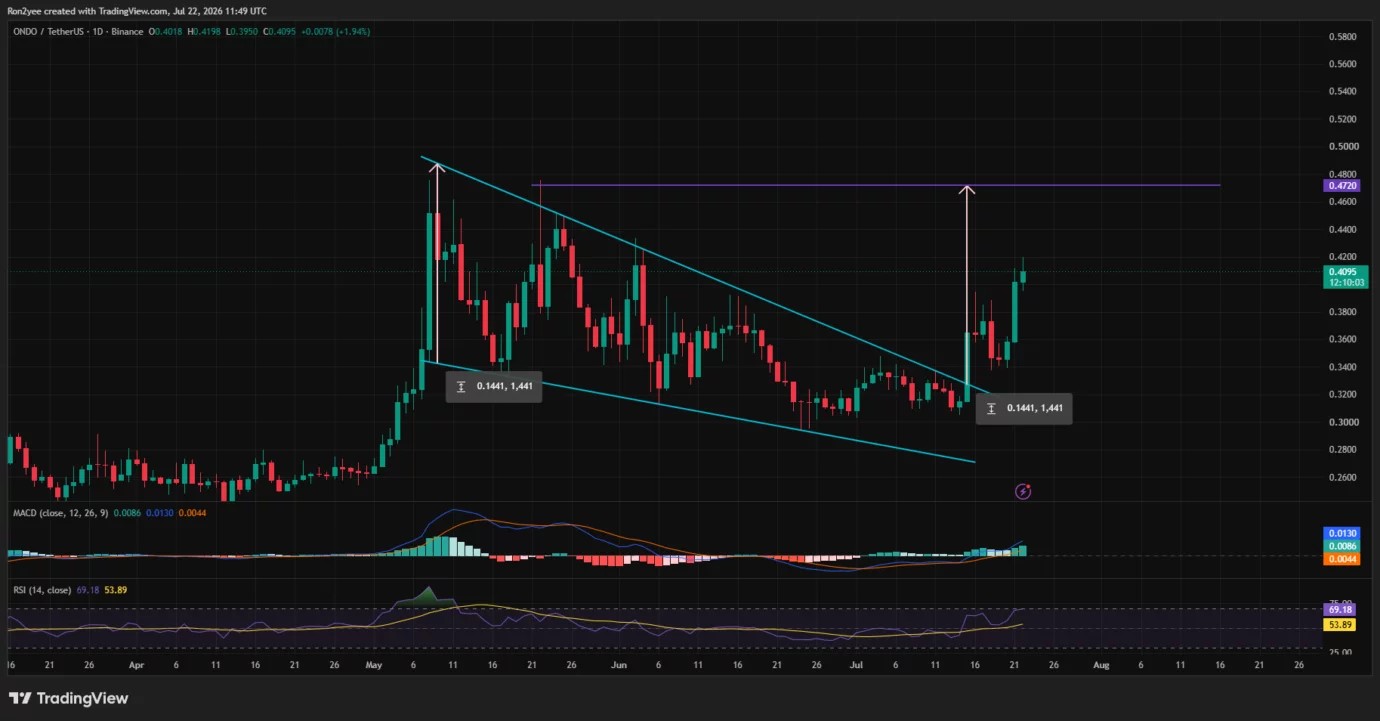
The daily chart shows $ONDO breaking above the upper boundary of its multimonth descending channel after several failed attempts. Based on the height of the channel, the measured move places the main bullish target near $0.472, an area that also served as resistance during May.
Ondo price daily chart has broken out of a descending channel pattern on the daily chart — July 22 | Source: crypto.news
Momentum supports the advance but leaves little room for a weak close. The daily relative strength index has reached 69.18, just below the conventional overbought threshold of 70, while its average remains at 53.89. The MACD line has risen to 0.0130 above the 0.0044 signal line, and the positive histogram has expanded to 0.0086.
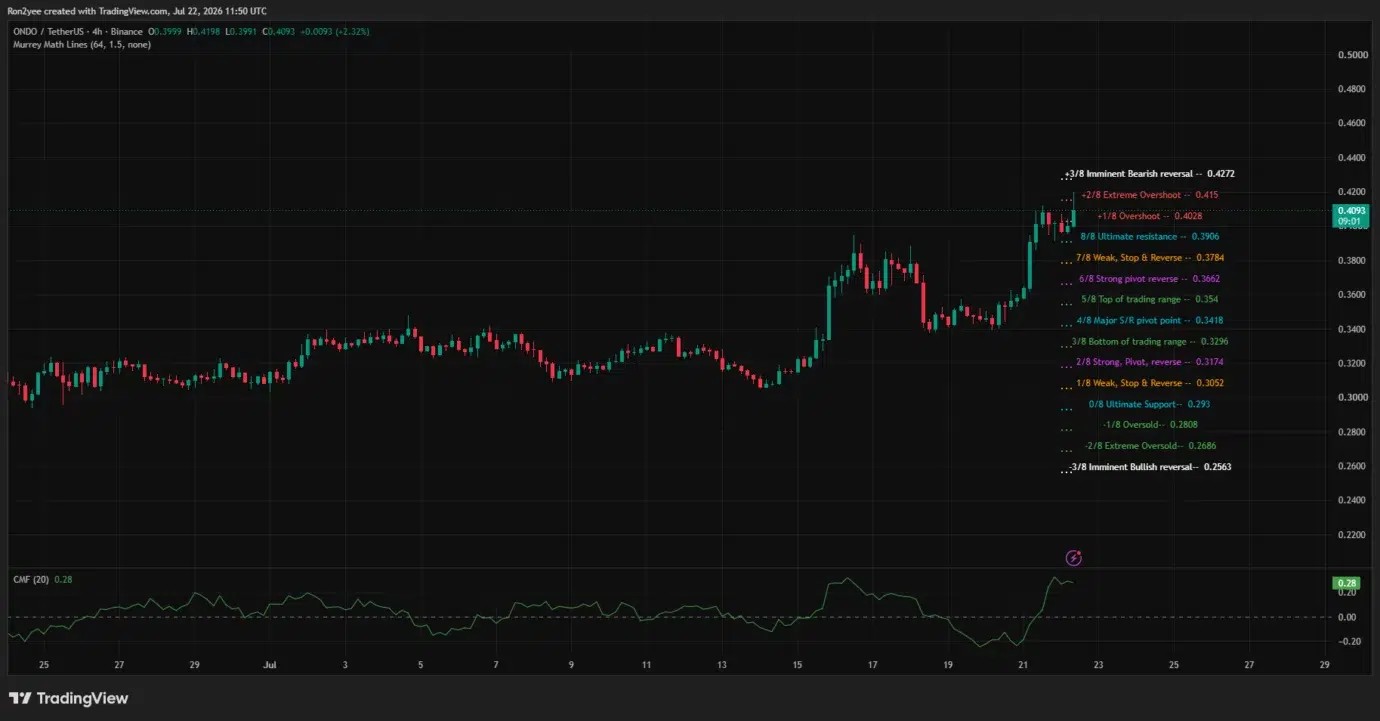
On the 4-hour chart, $ONDO has moved above the Murray Math ultimate resistance at $0.3906 and the $0.4028 overbought level. Price has now entered the band between $0.4028 and $0.4150, where traders may take profits after the rapid advance. The next extension sits at $0.4272 if buyers secure a 4-hour close above $0.415.
Ondo price 4-hour chart — July 22 | Source: crypto.news
Cash flow remains supportive, with the 4-hour Chaikin Money Flow reading at 0.28. A positive value of that size confirms that buying volume has outweighed selling volume during the breakout, though a drop below $0.3906 would weaken the immediate setup. Lower supports sit at $0.3784 and $0.3662.
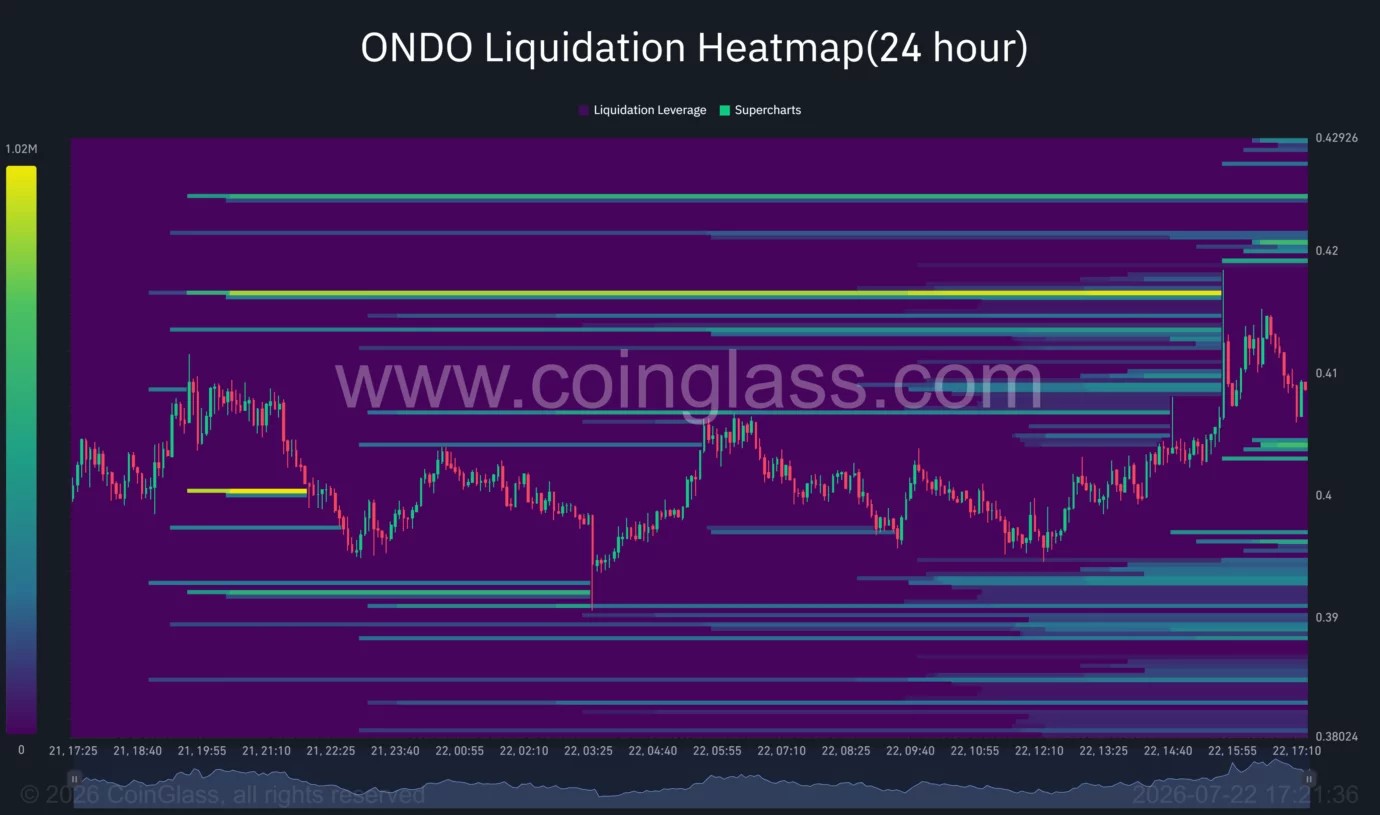
CoinGlass’ 24-hour liquidation heatmap places the largest nearby leverage pool around $0.416–$0.417, just above the current price. A push through that cluster could liquidate additional short positions and carry $ONDO toward $0.42. Below the market, leveraged positions are concentrated near $0.393–$0.390, with another dense pocket around $0.389.
Ondo liquidation heatmap | Source: CoinGlass
A daily close above $0.42 would open the route toward $0.45 and the channel target at $0.472. Rejection from the current resistance could send $ONDO back toward $0.39, while loss of that level would expose $0.378 and delay the bullish continuation.
Coinbase Canada CEO Eric Richmond confirmed the company is working to bring its “Everything Exchange” to Canadian users.
The idea is to offer a single app combining crypto, stocks, ETFs, and prediction markets—with no hard launch date announced.
Tokenized stocks—shares recorded on a blockchain that settle instantly and trade around the clock—are planned for non-U.S. users, including Canadians, this month, with full dividend rights included.
Coinbase has a new pitch for Canada: stop thinking of the company as just a crypto exchange, and start seeing it as the only financial app the country needs.
Eric Richmond, CEO of Coinbase Canada, told BNN Bloomberg this week that the company is pushing its “Everything Exchange” north of the border—a single platform where crypto, stocks, ETFs (funds that track a basket of assets like the S&P 500), and prediction markets (platforms where users bet real money on the outcome of real-world events, like elections or sports results) all trade from one account.
“I think chapter one of Coinbase in Canada was really about being a crypto exchange,” Richmond said. “But now phase two of that is the Everything Exchange. How do we create that one place for Canadians to have their entire financial experience in one app that’s underpinned by this technology that makes things frictionless, seamless, and 24/7?”
No hard launch date has been set for Canada. Coinbase says it is working closely with local regulators to get there—a relationship it has cultivated since becoming the first international crypto exchange registered in Canada in April 2024.
In the U.S., the build-out is already well underway. Coinbase opened stock and ETF trading to eligible American users in February 2026 and launched prediction markets in January through Kalshi, a federally regulated prediction market operator now valued at $22 billion. As Decrypt covered in June, the company’s roadmap for the Everything Exchange now includes nearly 10,000 stocks and ETFs on one platform.
Tokenized stocks—shares in real companies recorded on a blockchain instead of a traditional brokerage system, meaning trades settle instantly and the market never closes—are supposed to be coming to non-U.S. customers this month, according to a previous official blog. Richmond framed it as a matter of access.
On competition from Robinhood and traditional Canadian brokerages, Richmond wasn’t particularly worried. “I think people are starting to realize the fact that banks close at 4 p.m., or the markets close at 4 p.m., or that wires can take days to settle, or that access for high-net-worth individuals to certain products are gated for just those high-net-worth individuals,” he told BNN Bloomberg.
His five-word summary: “Rising tide lifts all boats.”
The Bank of Canada is expected to finalize stablecoin implementing regulations in 2027—the last major regulatory piece Coinbase needs before it can list a Canadian dollar stablecoin and fully roll out the Everything Exchange in the country.
Daily Debrief Newsletter
Start every day with the top news stories right now, plus original features, a podcast, videos and more.
The market for tokenized stocks reached a record $2.3 billion in market capitalization in mid-July, according to Token Terminal data, nearly doubling since March, when the sector first cleared $1 billion, and the growth is showing up across every major issuer at once.
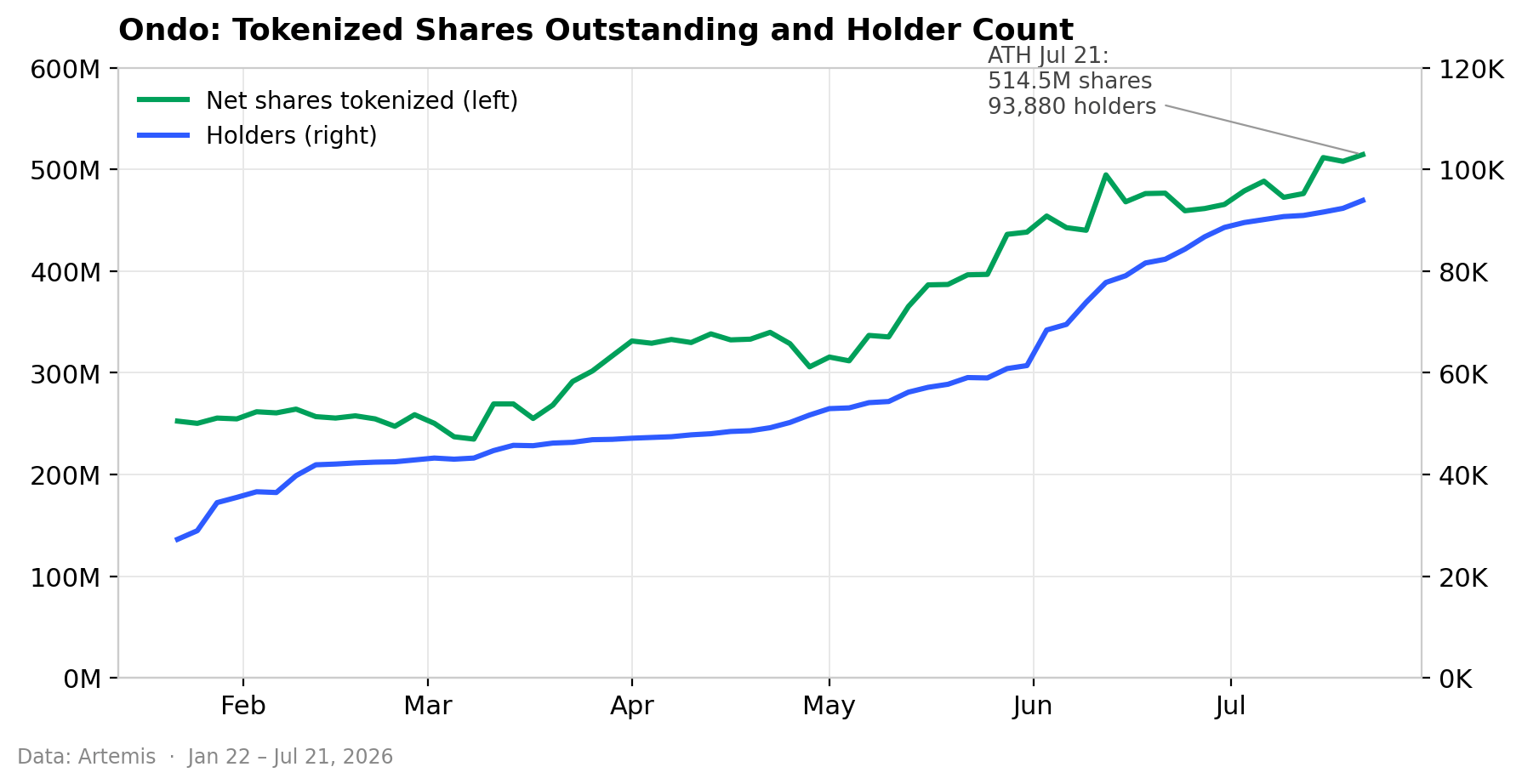
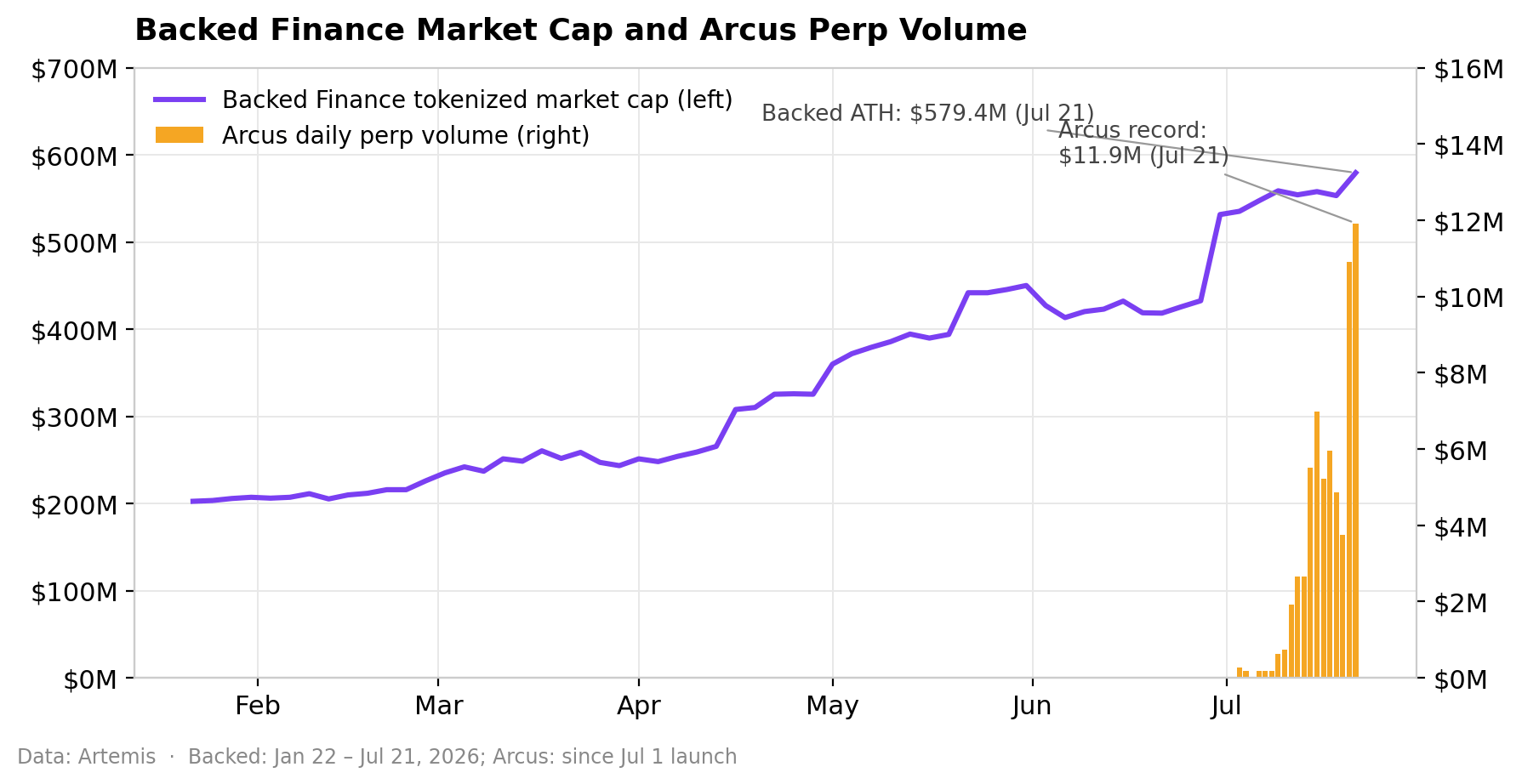
On July 21 alone, Artemis data recorded all-time highs for Ondo Finance’s tokenized shares outstanding (514.5 million) and holder count (93,880), Backed Finance’s tokenized market cap ($579.4 million), and Robinhood Chain’s tokenized shares (126,720) and equity holder count (36,170).
Arcus, the tokenized-stock exchange launched this month by the team behind dYdX, posted record daily perps volume of $11.9 million and record open interest of $6.8 million the same day.
Ethereum leads the sector with 34% of tokenized stock market share, followed by $BNB Chain at 30% and Solana at 23%, per Token Terminal. Tokenized stocks remain a small corner of the broader tokenized real-world asset market — roughly 5% by Token Terminal’s count, while DefiLlama tracks about $27.3 billion in active RWA market cap — but they have been the fastest-growing asset class on Ethereum this year.
Ondo Extends Its Lead
Ondo’s tokenized shares outstanding roughly doubled over six months to 514.5 million, while holder count more than tripled to 93,880 — both all-time highs on July 21. Data: Artemis.
Ondo Finance is the largest issuer with $955 million in onchain equities, per Token Terminal, and its July has been dense with catalysts. The firm partnered with Japan’s SBI Group on July 16 to tokenize Japanese stocks and explore settlement in JPYSC, SBI’s trust-backed yen stablecoin. It also switched on 24/7 minting and redemption for tokenized US stocks and ETFs, added voting rights to its tokenized stocks, and enabled tokenized stock collateral on OndoPerps, its perpetual futures venue — the product behind its record $39.8 million in open interest, per Artemis.
The firm’s catalog has passed 430 tokenized stocks and ETFs across Ethereum, Solana, and $BNB Chain, and its distribution now runs through MetaMask and Felix on Hyperliquid.
ONDO traded around $0.41 on July 22 with a market capitalization of $1.99 billion, near the top of its seven-day range of $0.32 to $0.41, per CoinGecko. The token jumped roughly 15% in the 24 hours after the SBI announcement.
Backed and the Exchange-Issued Wave
Backed Finance, the Swiss issuer behind the xStocks product distributed on Kraken, Bybit, and Solana DeFi, reached a record $579.4 million in tokenized market cap on July 21, per Artemis. Kraken said xStocks surpassed $25 billion in cumulative transaction volume within eight months of launch. Token Terminal puts xStocks’ onchain holdings at $507 million, with Binance’s bStocks third among issuers at $334 million — a sign exchange-issued products are becoming a distinct growth channel alongside DeFi-native issuers.
Backed Finance’s tokenized market cap nearly tripled since late January, jumping from about $430 million to over $530 million in a June 29 step-change before its July 21 record. Arcus perp volume, overlaid since its July 1 launch, hit $11.9 million the same day. Data: Artemis.
New Entrants: Robinhood Chain and Arcus
Robinhood’s Stock Tokens, issued on the company’s own Layer 2 that launched July 1, remain the smallest of the cohort at $19.3 million in tokenized market cap, but all three of the product’s Artemis metrics — market cap, shares tokenized, and holder count — hit records on July 21. The tokens are available in more than 120 countries and are already being used as collateral on Lighter, a derivatives protocol on the chain.
The speculative layer is arriving too. Arcus, launched July 1 by dYdX Labs with investment from Robinhood Crypto, offers 24/7 spot trading on 95 stock tokens with zero fees and is rolling out perpetual futures on equities, commodities, and indices with up to 50x leverage. The exchange is not available in the US, UK, or Canada. Its record $11.9 million in daily perps volume, while small against crypto-native perps venues, is an early data point for leveraged trading built on tokenized equities.
The Road to $3B
An Ondo executive said in May the company expects the tokenized equity market to reach between $2.5 billion and $3 billion by year-end, per TheStreet. At the current pace — the sector has nearly doubled in four months — that target implies slower growth than the market is delivering.
Holder counts remain the metric to watch. Ondo’s 93,880 and Robinhood Chain’s 36,170 tokenized-equity holders are records, per Artemis, but are small next to any retail brokerage’s user base. Whether 24/7 settlement, DeFi collateral use, and yen-settled Japanese stocks translate into sustained holder growth is what the next two quarters will show.
CertiK, a blockchain security firm, said on Wednesday that 52 confirmed physical attacks on crypto holders occurred in the first half of 2026. The amount of money at risk was ~$124.1 million, up from $10.5 million the previous year.
Nowadays, there is a much more common and much more expensive threat to anyone with a known identity who has real crypto.
There were 52 confirmed incidents, a 33.3% increase year over year from the 39 cases in H1 2025. CertiK defines a wrench attack as any form of violence, intimidation, or credible threat used to force someone to transfer digital assets, provide private keys, or unlock a wallet.
The tactic is an “established threat vector for cryptocurrency holders,” CertiK said. It works on even strong digital security because it attacks the person, not the software.
France drives Europe’s wrench attack wave
Of the 52 confirmed incidents, 39 were in Europe. France alone was home to 33 of them, according to CertiK. Europe was already highlighted as the riskiest region for crypto holders in CertiK’s 2025 wrench-attack report.
Increasingly, victims are being confronted in their own homes by attackers. CertiK reported that the number of crypto-related home invasions soared from one publicly reported case in H1 2025 to 20 in H1 2026. Kidnappings also increased, from 12 to 16.
Elsewhere, there was little movement. There were four cases of torture, as in the year before. Each period had one murder in association with a crypto coercion event.
The rise was attributed to home invasions. The attackers are now finding out where the targets live instead of waiting to catch them somewhere else.
$124 million exposure figure isn’t stolen crypto
The ~$124.1 million number is an estimated exposure, not a confirmed theft. It includes ransom demands, money victims paid, and assets later frozen by authorities or providers. Some of this money was never lost.
The average recorded exposure per incident rose from ~$270,000 in H1 2025 to ~$2.39 million in H1 2026. CertiK says its totals understate the true picture. Attack victims often don’t report them because they’re afraid of getting hurt, being taxed, or having their reputations hurt.
The half-year total obscures two different phases. The increase was led by Q1 2026, with 35 incidents compared to 22 in Q1 2025. January saw 15 cases compared to 9 a year ago, March had 13 compared to 7, and April shot up to 8 from 2. Then May and June were down below 2025. CertiK attributes that to a combination of better holder security, reporting delays, and law-enforcement pressure. Q2 2026 ended with 17 incidents, the same as Q2 2025.
Extrapolating the first half in a straight line would indicate about 100 incidents for the entire year. CertiK warns that this is not a prediction, especially given the differences between the two quarters.
Cryptopolitan reported this month that 63% of the 164,538 traders active in Robinhood Chain’s top memecoins were underwater. Wrench attacks target a different profile. Holders whose money and location are sufficiently obvious that it is worth the trouble to coerce.
CertiK’s advice is to break the link between a person’s public identity and their holdings. It proposes limiting data that links a name, location, or daily pattern of a holder to ownership of a crypto. Significant assets should be stored so that no one person can move them on demand.
Crypto holders should keep their wallets, signing tools, and recovery data separate. The company also says that people should make their homes secure, talk to their family about what to do in an emergency, and avoid using sensitive accounts on any devices they take with them when they travel.
New provisions limiting the ability of presidents and other federal officials to profit from digital assets have been added to the CLARITY Act, a bill under consideration in the US Senate that includes comprehensive regulations targeting the cryptocurrency market.
According to updated draft legislation obtained by CNBC, US presidents, federal officials, and certain public officials will not be able to issue cryptocurrencies or other digital assets, or sponsor such projects.
Senate Republicans, in an update to the CLARITY Act on Wednesday, included the first legal limits on how US presidents can earn income from the cryptocurrency sector.
Related NewsFlash Analysis of Four Altcoins: “Two Are Bullish, Two Are Bearish”
The CLARITY Act, which aims to comprehensively regulate the digital asset market, seeks to determine which institutions will oversee the cryptocurrency sector and under what rules. Newly added ethical provisions aim to prevent public officials from using their positions to profit personally from cryptocurrency or digital asset projects.
If the bill becomes law, U.S. presidents and other federal officials serving in office will face significant restrictions on issuing cryptocurrencies in their own names, sponsoring a digital asset project, or directly profiting from such ventures.
Previously, US President Donald Trump launched his own TRUMP token, which has recently experienced significant declines.
Qwen-Image-3.0, released July 21 by Alibaba’s Qwen team, accepts 4,500 tokens of instructions.
This enables single-pass generation of complex layouts like newspapers, storyboards, and dense infographic grids.
Unlike its predecessor, the release shipped without open model weights, benchmarks, or a technical report; it’s available at chat.qwen.ai with API pricing not yet disclosed.
Alibaba’s Qwen team launched Qwen Image 3.0 on Tuesday, and the pitch has nothing to do with how beautiful the output looks. It’s about whether the output can actually be used at work.
Most AI image tools—Reve, Nano Banana, Seedream—are designed to excel at specific areas: creativity, realism, editing capabilities, and so on. Qwen Image 3.0 is going in a different direction. “Qwen-Image-3.0 is not just pursuing ‘good-looking’—it is pursuing ‘useful,’ making image generation a truly deployable productivity tool,” the Qwen team wrote in the official announcement.
The centerpiece is what the Chinese behemoth Alibaba calls rich content. The model accepts up to 4,500 tokens, which is 4.5 times what the previous generation could process. Tokens are the units of text an AI reads; picture a token as roughly one word or part of a word, so 4,500 of them are several pages of detailed instructions
That’s enough to describe nine separate infographic panels in a single prompt and get them back as one complete image.
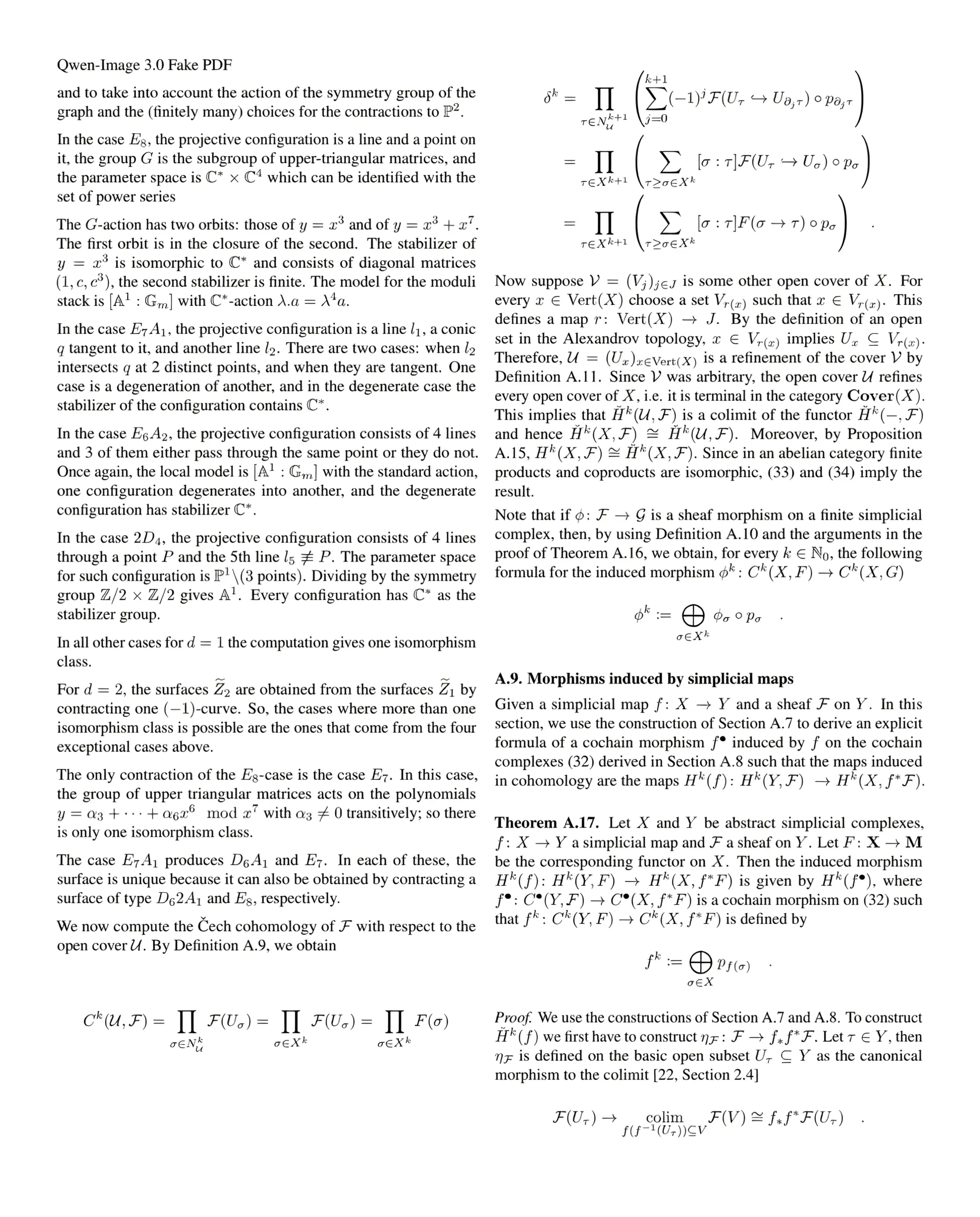
“The entire image above was generated by Qwen-Image-3.0 in a single pass, rather than being stitched together from multiple images,” Alibaba wrote in its blog. Each panel in the demo contains its own diagrams, formulas, captions, and fine-print text—rendered in one shot, not assembled in post.
This is the only model capable of achieving this without major errors.
The second part is what the company calls authentic details. Per Alibaba, the model “supports precise rendering of text as small as 10px, vividly reproducing details like pores and hair strands with lifelike, micro-level depiction.” Ten pixels is fine print—the kind you’ll see on pharmaceutical disclaimers. The model also handles LaTeX—the notation system researchers use to write complex mathematical equations—accurately across full academic paper mockups.
In our usual tests we give models a few sentences and evaluate how they process them. Qwen Image 3.0 was able to generate the image below, per Alibaba’s official blog.
We tried this feature using the model’s fastest configuration. Qwen Image 3.0 was able to reproduce one full article from Decrypt. The execution was genuinely impressive, but the result was not flawless.
The third pillar of Qwen Image 3.0 is deep knowledge. Per the Qwen team, the model “supports native rendering of 12 languages, simulates mainstream interfaces such as web pages, games, and livestreams, and draws on rich world knowledge.” It also connects to the internet to fetch live data, meaning prompting for a weather forecast visual for a specific city and date returns an accurate graphic, not a guess.
For example, Alibaba shared a photo of an insect on a leaf. The model was able to generate relevant text based on its understanding of the image.
Alibaba is pitching design studios, content teams, e-commerce operations, and educators who need production-ready visual assets in bulk.
It’s worth noting, though, that in Alibaba’s own Qwen-Image-Bench evaluation—a benchmark that scores image quality, aesthetics, and real-world fidelity across 18 models—Qwen Image 2.0 Pro, the previous flagship, placed fifth. OpenAI’s GPT Image 2 led the ranking. The new model may perform better, but the launch offers no measured way to confirm it, because it arrived without a benchmark table, downloadable weights, or technical report.
Qwen Image 1.0 launched with open weights under an Apache 2.0 license and a same-day technical report. This one didn’t. As part of Alibaba’s recent AI push, the evidence here is entirely the hand-picked example images the company chose to publish. API trials are open at chat.qwen.ai. Pricing hasn’t been announced.
Daily Debrief Newsletter
Start every day with the top news stories right now, plus original features, a podcast, videos and more.
After Bitcoin surged above $66,000, reaching its highest level in the past month, analysts noted that the $68,000 level could be a critical resistance point. According to experts, Bitcoin testing this region for the first time could create significant selling pressure as investors nearing their cost basis begin to sell.
Spot Bitcoin ETFs traded in the US recorded net inflows of $203 million yesterday, extending their positive streak for the sixth consecutive trading day. This brings the total net inflow since July 13 to approximately $779 million. Spot Ethereum ETFs also saw inflows of $37.5 million on the same day, marking a third consecutive day of positive trading.
Bitfinex analysts stated that the next significant level for Bitcoin is $68,000. They noted that this region coincides with the average cost level for short-term investors and the opening price of the second quarter. According to the analysts, investors who bought Bitcoin in the last five months and are still at a loss may choose to sell as the price rises back to their cost levels. Therefore, a strong supply is likely to be encountered during the first test of $68,000.
Related NewsFlash Analysis of Four Altcoins: “Two Are Bullish, Two Are Bearish”
Vetle Lunde, Head of Research at K33, stated that Bitcoin trading volumes continue to remain seasonally low. According to Lunde’s data, as of July 19th, the 30-day spot trading volume was only 62.4% of the annual average.
Institutional investor activity in the futures market also remains weak. Bitcoin open interest on the CME stayed below 100,000 BTC throughout July, reaching its lowest level since October 2023. This indicates that institutional participation has not yet recovered strongly. While ETF inflows improved during the same period, flows were largely driven by BlackRock’s IBIT fund.
CapitalCom analyst Daniela Hathorn considers the $63,000 level a significant support point in the short term. According to Hathorn, if Bitcoin remains above this level and settles back above the $65,000-$66,000 range, it could strengthen the upward momentum. Conversely, a loss of the $63,000 support could lead to increased profit-taking by investors, creating renewed pressure on the price.