Category: Business

  • Apple’s AI Slop Problem Left a $200K macOS Exploit Unreported

    Apple’s AI Slop Problem Left a $200K macOS Exploit Unreported

    In brief

    • Apple has limited how many bug reports a researcher can have open at once after a surge of AI-generated submissions.
    • Bynario says it found more than 50 macOS bugs in three weeks, including a chain that could hand an attacker full control of a Mac.
    • Apple’s security updates this week carried around five times as many fixes as previous cycles.

    Apple has capped how many vulnerability reports a researcher can file at once, after its security team was swamped by AI-generated submissions that invent flaws that do not exist, the Financial Times reported.

    The cap has already cost it a real one. Milan-based cybersecurity startup Bynario told the paper it used OpenAI’s ChatGPT to surface more than 50 bugs in the latest version of macOS over three weeks. Among them was a privilege escalation exploit chain, a class of flaw that hands an attacker unrestricted control of a machine.

    Bynario could not report it, because Apple had already refused further submissions. Chief executive Alfredo Pesoli put the exploit’s value on the criminal market at between $100,000 and $200,000, and said “maintainers and vendors have been flooded by the sheer amount of bugs” being uncovered. Apple told the FT it is now in contact with the firm and reviewing its work.

    Apple moved in June, adding a cap and a 30-day cool-off period on its security portal, with researchers required to apply for a bigger quota. Every alleged flaw still needs a human to confirm it, though Apple is using AI internally to triage the pile. Apple said it had “recently adjusted the number of new reports a researcher can have open at once,” and that researchers can ask for a higher limit at any time.

    The same tools are working for Apple. In security updates last week, it credited Anthropic and OpenAI software with surfacing flaws, and carried roughly five times the fixes of a normal cycle, according to the FT.

    A “submission flood”

    The issue of AI bug reporting volume has grown in recent months. In May, security firm Bugcrowd, whose clients include OpenAI, said submissions through its platform more than quadrupled across three weeks in March, and that most were fake. HackerOne and Nextcloud suspended their paid programs in April, with Nextcloud saying no rewards would be paid “regardless of severity” until it found a way to filter the low-effort reports.

    The volume is driven by the rewards on offer, with Meta, Microsoft, Apple and Crypto.com paying out at least $58 million between them in 2025, while Apple’s own top tier reaches $5 million for a single finding.

    At the same time, LLMs are becoming increasingly adept at spotting bugs. In March, Anthropic introduced Mythos, a cyber-focused model it initially restricted to selected technology companies, banks and researchers under Project Glasswing. Mozilla said it surfaced 271 vulnerabilities in Firefox during internal testing.

    In May, Vietnam-based security startup Calif said it had used a preview version to build the first public macOS kernel memory corruption exploit able to survive Memory Integrity Enforcement, the defence Apple announced last September as the biggest memory safety upgrade in the history of consumer operating systems. Calif found the bugs on April 25 and had a working exploit by May 1.

    Instead of filing a report, Calif carried the exploit to Apple’s California headquarters in person, saying it wanted to avoid “getting buried in the submission flood” that entrants in hacking contest Pwn2Own had been caught in. Bynario tried the portal three months later and could not get in.

    AI crypto threats

    As well as hunting down threats, AI is also being used to engineer exploits in the crypto space. Coldcard wallet manufacturer Coinkite has suggested that AI was likely used to uncover a bug in its open source firmware that sat unnoticed for five years, enabling attackers to steal more than $100 million from its hardware wallets.

    It comes two months after Zcash disclosed that researcher Taylor Hornby, working with Claude Opus 4.8, had found two lines of code in its Orchard shielded pool that allowed undetectable counterfeiting of ZEC for four years—prompting the privacy coin to roll out the Ironwood upgrade last month to address the vulnerability.

    Daily Debrief Newsletter

    Start every day with the top news stories right now, plus original features, a podcast, videos and more.

  • How Would Investors Respond to the Upcoming NFP Data?

    How Would Investors Respond to the Upcoming NFP Data?

    Prevailing crypto market trends suggest an ongoing decoupling of the ecosystem from its original FOMO-based speculative undertone. The influx of institutional investors via spot ETFs seems to have adjusted Bitcoin’s price patterns and those of top cryptocurrencies.

    It is now common to find experts and market analysts combining Bitcoin and mainstream assets such as the S&P 500 and Nasdaq. These assets are often highly influenced by mainstream economic indicators. One of the strongest market indicators expected this week is the Non-Farm Employment Change, also known as Non-Farm Payroll (NFP), on Friday.

    NFP Expectations for August

    This is one of the most significant indicators for the crypto market. It measures the change in the number of employed people during the previous month, and analysts consider it a significant metric for gauging the nation’s economic heartbeat.

    The consensus forecast as of the time of writing expects the economy to add between 85,000 and 91,000 jobs, showing a slight rebound from June’s highly disappointing print of 57,000. Meanwhile, the national unemployment rate is projected to edge up slightly to 4.3%. Meanwhile, the public and investor sentiment going into this event is highly anxious and cautious.

    The Federal Reserve’s latest actions have systematically stretched the market, with participants actively trying to price in the financial regulator’s potential monetary decisions. A strong print above 100,000 jobs could reinforce bets on a Q3 rate hike, while a second consecutive weak print would amplify fears of an economic slowdown.

    Investors’ Approach to the August NFP

    Despite these expectations, public confidence in the initial monthly data remains low. June’s figure missed estimates by over 50%, and prior months—April and May—suffered severe downward revisions totaling 74,000 jobs. This leaves investors cautious, knowing that things could change no matter the initial outcome.

    For most digital asset investors, a safe approach would be to monitor leading indicators such as the ISM Services PMI and Initial Jobless Claims scheduled for release before Friday. They could also consider tightening stop-losses on high-beta tech stocks (Nasdaq) and volatile crypto holdings (Bitcoin) before Friday morning to insulate against heavy>Investors would do well to analyze the indicator’s post-release revisions, looking beyond the headline and checking for any revisions. That would help in understanding the true trajectory of US employment, enabling better investment and trading decisions.

    Potential NFP Effect on Assets

    For context, the S&P 500 is up approximately 1.1%, riding an early August geopolitical relief. A stronger job market may trigger selling on rate-hike fears, while a moderate print keeps the “soft-landing” narrative alive. Meanwhile, the Nasdaq has rebounded from a 3.2% loss in July, reflecting a gain of roughly 1.7% in August. It is crucial to note that tech valuations are vulnerable to interest rate projections. Therefore, hot wage growth or high NFP could suppress recent tech gains.

    Bitcoin, the largest cryptocurrency by market cap, is hovering around $63,700 at the time of writing. The cryptocurrency has diverged from stocks in 2026, dropping significantly from highs due to high real interest rates. Investors believe a weak NFP that stops Fed hikes would benefit BTC the most.

    Related:Crypto Markets Brace for Volatility as Key Economic Data Arrives

  • Australia Crypto Tax Guide: Capital Gains Tax, Staking and DeFi Explained

    Australia Crypto Tax Guide: Capital Gains Tax, Staking and DeFi Explained

    Australia taxes cryptocurrencies under its existing income tax and capital gains tax rules rather than through a separate crypto tax regime. Depending on the transaction, investors may owe capital gains tax, ordinary income tax, or both.

    As of 2025-26, people who own crypto assets must report the following transactions: selling, trading, using, earning through staking, and using crypto in DeFi.

    The outcome of taxation will vary depending on the type of activity. Selling, swapping, spending, or gifting crypto can produce a capital gain or loss, while staking and some DeFi activities may create ordinary income.

    How Does Australia Tax Crypto?

    The Australian Taxation Office (ATO) considers investment cryptocurrency as a capital gains tax asset. CGT is not a separate tax; its rate depends on an individual’s marginal tax rate, and the investor simply includes net capital gain in assessable income.

    Australian residents for tax purposes, excluding temporary residents, report crypto income and capital gains from Australian and overseas platforms. Using a foreign exchange does not remove this reporting obligation.

    The 2025–26 income year ran from July 1, 2025, to June 30, 2026. Taxable crypto income and CGT events that occurred during this period belong in the 2026 tax return.

    Which Crypto Transactions Are Taxable?

    A CGT event happens when an investor disposes of crypto. This includes selling it for dollars, swapping it for another token, spending it, or giving it away. Using investment crypto to buy an NFT also disposes of the payment tokens.

    This does not automatically mean tax is payable. It means the investor must calculate whether the disposal produced a gain or loss.

    If an investor acquires Bitcoins for A$8,000 and subsequently exchanges them for Ethereum with a value of A$10,500, there will be an A$2,500 capital gain prior to any applicable deductions. Ethereum is a new asset with its own cost base and acquisition date.

    A cryptocurrency exchange is a disposal and an acquisition of a new asset in the eyes of the ATO. There is no CGT event when buying crypto assets using Australian dollars and holding them. Transferring crypto assets from one wallet to another under the same beneficial ownership is not a disposal.

    Capital gains may be exempt if crypto qualifies as a personal-use asset and was acquired for less than A$10,000. However, the ATO states that investment crypto generally does not qualify as a personal-use asset.

    How Capital Gains Tax Is Calculated

    Once a disposal is identified, the investor compares the capital proceeds with the cost base. The cost base includes the purchase price and eligible expenses such as exchange commissions.

    An investor buys Ethereum for A$4,000 and pays a A$40 fee. If the investor later sells it for A$6,500 with A$20 of eligible selling costs, the gain is A$2,440.

    Investors then combine their gains and losses for the year. Capital losses are applied before any CGT discount. An A$4,000 gain reduced by an A$1,000 loss leaves A$3,000. If the investor qualifies for the 50% discount after holding the asset for at least 12 months, the net gain falls to A$1,500.

    Capital losses can offset eligible capital gains, but not salary, staking rewards, or other ordinary income. Unused losses can be carried forward. The ATO provides the order in its crypto CGT guidance.

    How Staking Rewards Are Taxed

    Staking works differently because the investor earns new tokens. Their Australian-dollar market value is ordinary income when received, even if they stay in a wallet. That value also becomes the tokens’ cost base.

    Suppose an investor receives rewards worth A$500 and later sells them for A$700. The first A$500 is ordinary income, while the sale creates an A$200 capital gain before fees. A sale for A$350 would instead create a A$150 capital loss.

    The loss cannot cancel the earlier income because it only offsets capital gains. Reward tokens begin a new holding period when received.

    How DeFi Transactions Are Treated

    DeFi can combine income, asset exchanges, and new legal rights in one transaction. A protocol’s name does not decide the tax result. The key questions are whether the investor gave up an asset, received a different token or right, or earned a reward.

    Consider a liquidity pool. Depositing crypto can trigger a CGT event if the investor receives LP tokens representing a new CGT asset or legal right. Returning those LP tokens to withdraw crypto can trigger another CGT event.

    Wrapping ETH into WETH can trigger a CGT event. The treatment of lending, bridging and liquid staking depends on whether beneficial ownership remains unchanged or the original asset is exchanged for a receipt token or another right.

    Interest, yield, and incentive tokens can also be ordinary income when received. Selling them later creates a separate capital gain or loss. The ATO provides examples covering DeFi lending, liquidity arrangements, and wrapped tokens.

    ATO Tracking and Record Keeping

    The ATO’s>Crypto investors should keep complete records of wallet transactions, overseas trades, cost bases and DeFi activities.

    Records should show the date, token quantity, transaction type, Australian-dollar value, and fees. Investors should also retain exchange receipts, wallet addresses, account statements, and transaction IDs.

    Crypto Tax Filing Deadlines and Reporting Rules

    In myTax, disposals go in the “Capital gains or losses” section. Staking rewards and similar non-business receipts go under “Other income.” A reward reported as income still requires a later gain or loss calculation when sold.

    For most self-lodgers, the deadline is Monday, November 2, 2026, because October 31 falls on a Saturday. Tax-agent deadlines can differ.

    The new 30% minimum CGT rate does not affect the 2025–26 return. It applies to affected real capital gains accruing from July 1, 2027, alongside cost-base indexation. It is not a flat tax on every crypto gain

    Tax rules apply to crypto transactions even when no cash enters a bank account. Selling, swapping, spending, or gifting investment crypto triggers a CGT event. Staking and certain DeFi rewards count as ordinary income when received.

    Disposing of those rewards later triggers a separate CGT event. The calculation determines whether the disposal produces a capital gain, a capital loss, or neither.

    Relevant transaction values and taxable amounts must be recorded in Australian dollars. Investors uncertain about ownership changes or DeFi arrangements should consult an Australian tax professional.

    Related: US Crypto Exchange Licensing Explained From FinCEN to State Rules

  • Donald Trump’s Memecoin “TRUMP” Under Scrutiny: SEC Called Upon to Implement “Rug Pull”!

    Donald Trump’s Memecoin “TRUMP” Under Scrutiny: SEC Called Upon to Implement “Rug Pull”!

    US President Donald Trump has stood out in recent headlines for his support of Bitcoin and cryptocurrencies. In fact, Trump and his wife have altcoins bearing their own names, and his family also has cryptocurrency projects.

    While some anti-crypto US Democratic senators have opposed this, most recently Democratic senators Elizabeth Warren and Richard Blumenthal sent a formal letter to the SEC regarding Donald Trump’s Solana-based memecoin, Official Trump ($TRUMP).

    According to CNN, senators have written a letter requesting an investigation into Trump’s altcoin for potential market manipulation and practices that could harm investors.

    According to the report, Warren and Blumenthal stated in the letter that it should be investigated whether Trump poses a risk of “rug pull,” citing the irreversible losses suffered by millions of investors.

    No Rug-Pull Symptoms!

    As the Trump controversy continues, blockchain analytics firm TRM Labs stated that there is no definitive evidence that the Trump token was designed specifically for rug-pulling purposes.

    However, TRM Labs emphasized that the concentration of a significant portion of the token supply among insiders or linked addresses is a risk factor that needs to be closely monitored.

    TRM Labs stated in its assessment that while early investors and the issuer of the $TRUMP token made significant gains, numerous individual investors who bought later faced substantial losses.

    At this point, the company noted that a structure in which approximately 1 million retail investors suffered losses, even if not technically classified as a rug pull, could become more controversial over time.

    *This is not investment advice.

  • Layer-1 Blockchain Network Aptos Announces the Deployment of Privacy Feature on its Mainnet! Here Are the Details

    Layer-1 Blockchain Network Aptos Announces the Deployment of Privacy Feature on its Mainnet! Here Are the Details

    The Layer-1 blockchain network Aptos has announced the rollout of its new privacy solution, “Confidential $APT,” on its mainnet, which allows users to selectively keep their transaction data private.

    In a statement released on its social media platform X, the company said the new feature is optional and was specifically developed for corporate and regulatory compliance use cases.

    According to Aptos, Confidential $APT allows users to choose which information in their transactions is public and which remains private. This ensures the transparency of the blockchain while also allowing for the confidentiality of transaction details when needed.

    The company stated that the new feature is specifically intended for use in sensitive financial processes such as payrolls, corporate finance transactions, and business-to-business (B2B) payments. While privacy is paramount in the traditional financial world, the fact that all transaction data is publicly visible on open blockchains has been considered a significant obstacle for many organizations. With this solution, Aptos aims to offer an alternative to this problem.

    Recently, there has been a growing interest in privacy-focused technologies within the blockchain sector. Corporate companies and financial institutions, in particular, are showing increased interest in networks that develop infrastructure capable of protecting trade secrets while complying with regulatory requirements. Aptos aims to enhance its competitive edge in this area with its Confidential $APT.

    The company emphasized that the feature is entirely optional, stating that users can continue to conduct their transactions within the existing transparent structure if they wish. This provides a flexible usage model tailored to the diverse needs of both individual users and corporate clients.

    Industry experts believe that solutions that strike a balance between privacy and regulatory compliance can accelerate the enterprise adoption of blockchain technology. These features are particularly critical for businesses to be able to utilize blockchain infrastructure in sensitive processes such as payroll payments, internal financial transactions, and commercial payments.

    *This is not investment advice.

  • Bhutan’s GMC puts part of its bitcoin treasury to work after 10,000 BTC pledge

    Bhutan’s GMC puts part of its bitcoin treasury to work after 10,000 BTC pledge

    Gelephu Mindfulness City (GMC), a special administrative region in southern Bhutan, awarded 3iQ Corp. a mandate to manage part of its bitcoin $BTC$63,607.21 treasury, the firms said in an email.

    GMC declined to disclose the size of the mandate to CoinDesk.

    How the money will be run is the new information. GMC told CoinDesk it selected the Toronto-based company to generate long-term returns through a low-risk, market-neutral investment approach, meaning the reserve is to be deployed for yield rather than simply held.

    A market-neutral strategy covers a range of possibilities, including basis trades and lending. Such strategies usually yield at least 5% annually in the general market. GMC did not say whether any specific approach has been selected.

    In December, when Bhutan’s king, Jigme Khesar Namgyel Wangchuck, pledged up to 10,000 $BTC, then worth about $1 billion, the allocation was called a long-term national asset for the city’s development, with collateralization, treasury strategies or holding all listed as options still under consideration.

    The mandate’s size matters because the pledge behind it has been in question for months.

  • Why Jim Cramer’s quantum panic isn’t rattling bitcoin as price holds steady around $64,000

    Why Jim Cramer’s quantum panic isn’t rattling bitcoin as price holds steady around $64,000

    This reputation is not without foundation. Cramer’s prediction history is marked by notable flip flops and high profile misses.

    In December 2017, right as bitcoin was climbing toward its first run at $20,000, he called it “monopoly money” and said buying it was pure gambling and not investing. In September 2020, he supposedly bought the cryptocurrency around $10,000 after a podcast conversation with investor Anthony Pompliano, and later added more that year.

    The reversals kept coming. In June 2021, he sold most of his bitcoin holdings, citing China’s crackdown on crypto mining. Prices went on to hit lifetime highs near $70,000 by November 2021.

    In January 2024, he warned of a “nasty” bitcoin selloff following the debut of spot bitcoin ETFs in the U.S. While prices did drop slightly to $40,000, the decline was anything but nasty and by March, prices had rallied to $70,000.

    Cramer changed his view in January 2025, calling bitcoin “a great thing to have in portfolio” and urging investors to own the token themselves instead of seeking an indirect exposure through bitcoin-holding firm Strategy (MSTR).

    Last month, he swung bearish, calling bitcoin and gold “bad money” that’s being liquidated in favor of high-growth names like SpaceX, Apple and Nvidia. Now, in August 2026, he’s planning a full exit.

  • Marmot Researchers Turn to OnlyFans for Funding—And There Are Meme Coins Too

    Marmot Researchers Turn to OnlyFans for Funding—And There Are Meme Coins Too

    In brief

    • UCLA researchers launched an OnlyFans account called OnlyMarms after traditional research funding became harder to secure.
    • More than 10 OnlyMarms-inspired meme coins have appeared on Solana, though it’s unclear who created them or whether they’re connected to the research team.
    • The project has become an unlikely example of how internet culture and crypto can converge around scientific research.

    Scientists behind one of the world’s longest-running wildlife studies have turned to one corner of internet culture for funding—and found another waiting for them.

    Researchers at UCLA launched an OnlyFans account called OnlyMarms to help support a project that has tracked yellow-bellied marmots in Colorado since 1962 after traditional research funding became harder to secure.

    The idea came to professor Daniel Blumstein as research funding dwindled. A graduate student dubbed the account “OnlyMarms,” and the team leaned into the joke by promising subscribers “uncensored marmot content.” Blumstein said it has also become a way to reach new audiences.

    “Maybe this is a different audience than, you know, most of our science communication reaches,” Blumstein told NPR in an interview. “That’s great. Turns out, it’s even bigger than this.”

    The account has generated about $4,000 so far. Blumstein said the project ultimately needs between $75,000 and $100,000 a year to support graduate students and fieldwork, funding that federal grants once provided.

    The marmot project has also attracted attention from the crypto community.

    Over on Pump.fun, several OnlyMarms-inspired meme coins have appeared, though it’s unclear who created them or whether any are connected to the UCLA research team. Blumstein told NPR that the researchers did not create the tokens.

    “People have independently created a meme coin and told us to grab the transaction—to register it, and then we get the transaction fees. And that is blowing up,” he said. “Apparently, this is a meme coin for good that people like.”

    It wouldn’t be the first time an internet-famous animal inspired a cryptocurrency.

    In 2024, the Solana token Moo Deng, based on the viral pygmy hippo, launched on Pump.fun and briefly reached a market capitalization of about $680 million before landing listings on major exchanges, including Coinbase.

    The researchers have also partnered with a Colorado brewery on a “Marmot Tears” IPA and launched a public “Fat Marmot Week” competition.

    Blumstein said the situation reflects the state of scientific funding in the United States, noting that raising money through platforms like OnlyFans is a far cry from how research projects were funded when he was in graduate school.

    “No. It’s appalling,” he said. “What we’re doing is destroying the scientific structure and the university-federal partnerships that made us great, made us rich, made us the scientific leaders of the world. It’s being taken apart, and that’s really sad.”

    Daily Debrief Newsletter

    Start every day with the top news stories right now, plus original features, a podcast, videos and more.
  • Strategy Says MSTR Beat Bitcoin in Every Four-Year Holding Period

    Strategy Says MSTR Beat Bitcoin in Every Four-Year Holding Period

    Strategy Charts MSTR’s Performance Against Bitcoin

    Strategy Inc. (Nasdaq: MSTR) CEO Phong Le shared on Aug. 3 that MSTR outperformed bitcoin across every rolling four-year holding period since adopting its bitcoin strategy. The company compared annualized returns for investments made between August 2020 and August 2022, showing the stock generated stronger returns than bitcoin across every rolling four-year investment window.

    Le stated:

    “MSTR has outperformed $BTC in every four-year holding period since adopting the bitcoin Strategy. This is by design and aligns with our long-term objective.”

    Rolling holding periods compare returns from many starting dates instead of relying on a single entry point, providing a broader view of long-term performance. Bitcoin’s historical four-year cycle is often associated with halving events, making Strategy’s rolling-window analysis a different way to evaluate long-term returns.

    Le’s comments also align with Strategy Executive Chairman Michael Saylor’s view that institutional capital, exchange-traded funds, and corporate treasury adoption are reshaping bitcoin’s historical trading patterns. His recent comments describe a market increasingly driven by sustained demand rather than traditional four-year cycles.

    Institutional Ownership Continues to Expand

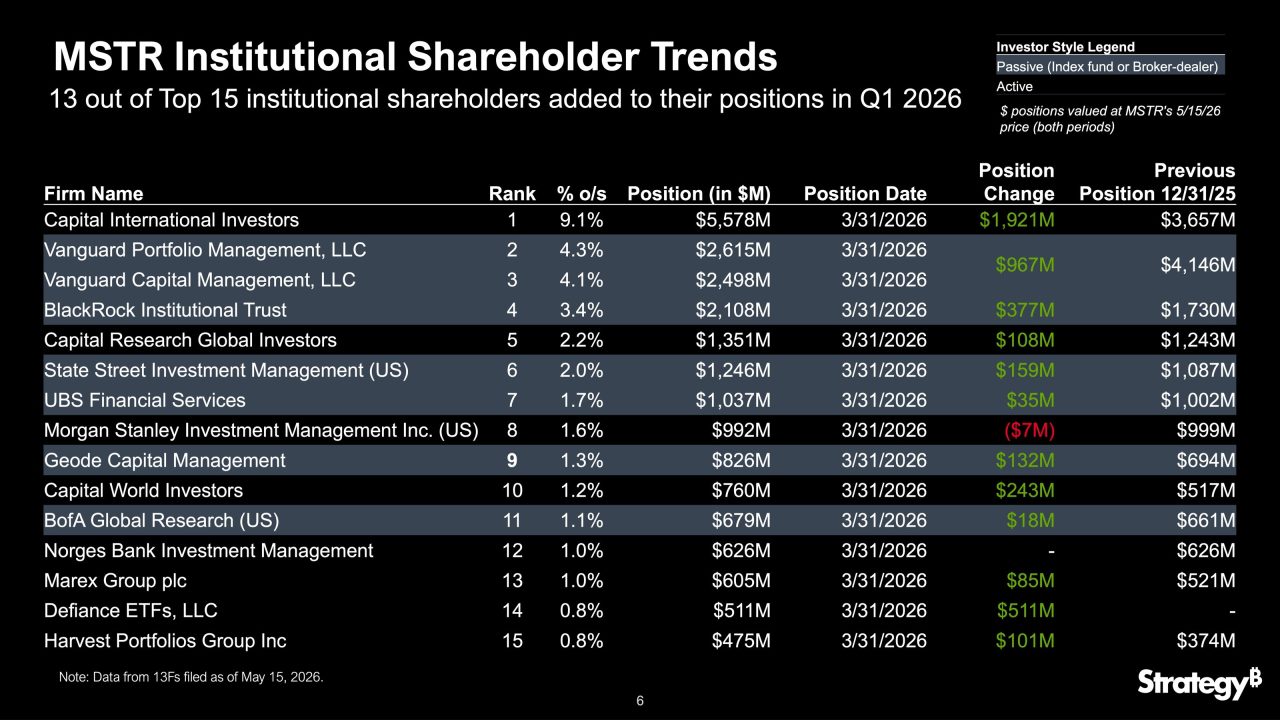
    Institutional investors continued adding MSTR shares during the first quarter, with 13 of Strategy’s 15 largest shareholders increasing their combined positions by 27%. Capital Group, Vanguard, Blackrock, Fidelity, and State Street ranked among the largest firms expanding their exposure, according to Le’s May 20 update on first-quarter institutional holdings.

    MSTR institutional holdings. Source: Strategy CEO Phong Le via X.

    Those positions contribute to broader indirect bitcoin exposure through mutual funds, pension plans, retirement accounts, and exchange-traded funds (ETFs) serving millions of investors.

    Investors have increasingly valued MSTR beyond the market price of its bitcoin holdings, reflecting Strategy’s ability to issue equity and preferred securities, raise capital efficiently, and use those proceeds to acquire additional bitcoin. The company argues those financing capabilities create value beyond the underlying treasury.

    Second-Quarter Results Show Strategy’s Capital-Market Scale

    In its second-quarter earnings release, Strategy reported holdings of 843,775 bitcoin as of July 27, a 4.5% year-to-date $BTC yield through July 26, and $17.06 billion raised through its capital programs during 2026.

    The company’s financing model also carries balance-sheet and dilution risks alongside its potential to increase bitcoin exposure per share. Its latest filing with the U.S. Securities and Exchange Commission (SEC) notes that changes in bitcoin prices, capital market conditions, financing costs, and future securities offerings could materially affect the company’s financial results and shareholders.

    Investors can monitor $BTC Yield, $BTC Gain, bitcoin per diluted share, leverage, and net asset value premium to assess whether the company’s financing strategy is increasing bitcoin exposure over time. The latest performance metrics are updated alongside changes in the company’s bitcoin treasury and capital structure.

    Bitcoin Sales Intensify Debate Over Preferred Financing

    Following the second-quarter update, Strategy completed its third bitcoin sale of 2026 to meet obligations tied to preferred securities. The transaction reduced its treasury from 843,775 bitcoin to 842,138 bitcoin while preserving most of the company’s accumulated holdings.

    That use of treasury assets has intensified scrutiny of a financing model built around preferred stock, equity issuance, and bitcoin-backed capital allocation. Economist Peter Schiff argues that selling bitcoin to fund preferred dividends transfers value away from MSTR shareholders, challenging management’s claim that diversified financing supports long-term treasury expansion.

    Current obligations show how the company’s preferred securities can influence capital allocation even while it maintains a substantial bitcoin reserve. Preferred dividend payments are backed by a $3.75 billion reserve covering more than 2.1 years of dividends and interest. Strategy also authorized separate $1 billion repurchase programs for MSTR and its digital credit securities, while the MSTR program remained unused through July 26.

  • Dogecoin’s Billy Markus Drops a One‑Word Reaction to Fresh Bitcoin Bear Calls

    Dogecoin’s Billy Markus Drops a One‑Word Reaction to Fresh Bitcoin Bear Calls

    • Bearish sentiment: Polymarket shows rising odds of Bitcoin dropping below $60,000, prompting Markus’ one-word reaction.
    • Mixed forecasts: Traders also see a chance of $BTC rising above $65,000 or $67,500, underscoring uncertainty.
    • Market weakness: $BTC and Dogecoin continue to slide amid fading legislative momentum and weak corporate earnings.


    Dogecoin co-founder Billy Markus offered a brief but telling response to new bearish chatter surrounding Bitcoin, reacting with a single word that captured the mood of many traders watching the market drift lower. His comment surfaced as prediction markets showed rising expectations that $BTC could slip under $60,000 before August ends.

    sigh

    — Shibetoshi Nakamoto (@BillyM2k) August 3, 2026

    Markus Reacts to Polymarket’s Bearish Odds

    Markus, known as “Shibetoshi Nakamoto” on X, replied “sigh” to a Polymarket post highlighting a 59% chance that $BTC might fall below $60,000 this month. The platform shared a screenshot showing traders increasingly positioning for a downside move. Markus’ reaction echoed the fatigue felt across the market, where prolonged uncertainty has replaced the sharp swings that often define crypto cycles. He has recently described the current environment as “boring,” framing it as a typical bear phase rather than a moment of panic. That sentiment aligns with the flat price action seen across major assets, including Bitcoin, which has struggled to regain momentum.

    Traders Split on August Price Scenarios

    Polymarket’s odds shifted further at the time of writing, with the probability of Bitcoin dropping below $60,000 rising to 63%. Yet traders remain divided. The platform also shows a 42% chance of Bitcoin climbing above $67,500 and a 71% chance of it pushing past $65,000 in August. Additional downside levels are in play as well, including a 37% chance of Bitcoin falling below $57,500. These mixed signals underscore a market searching for direction, with participants weighing both macro pressures and fading enthusiasm around recent US crypto legislation.

    Market Slump Extends Across Major Assets

    In the last 24 hours, Bitcoin traded down 0.68% to $62,707 after dipping to $62,210 intraday. The weekend brought further weakness, driven by disappointing earnings from Coinbase and Strategy, adding to concerns that speculative traders may be stepping back from riskier assets. Bitcoin is now down roughly 30% on the year, mirroring declines across several major cryptocurrencies. Dogecoin also slipped, falling 0.67% in the past day to $0.069 and dropping 4.35% over the week, reinforcing the broader cooling trend across the market.