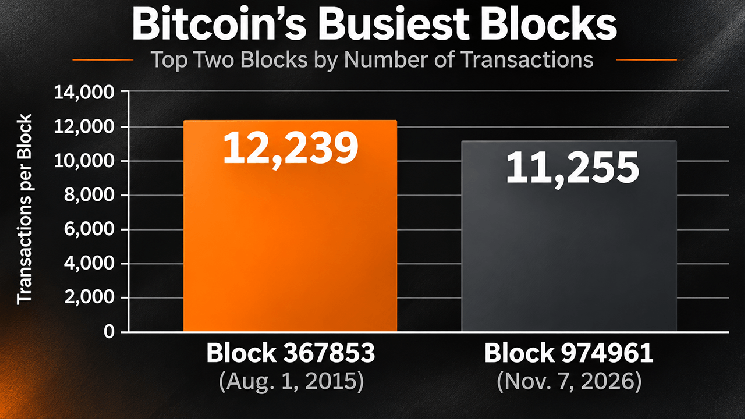
That distinction lasted only three days. On Nov. 7, Mononaut returned to X with another observation, this time documenting an even larger collection of transactions squeezed into a single Bitcoin block. The Mempool.space programmer said:
“New #2 record: 11,255. We’re rapidly closing in on the all-time high of 12,239 transactions from block 367853”
The new runner-up, block 974961, was mined at 18:24:12 UTC and measured approximately 1.1 megabytes (MB), according to blockchain data. Despite accommodating more than 11,000 transactions, it consumed 3,993,844 weight units, equivalent to roughly 99.85% of Bitcoin’s maximum block weight.
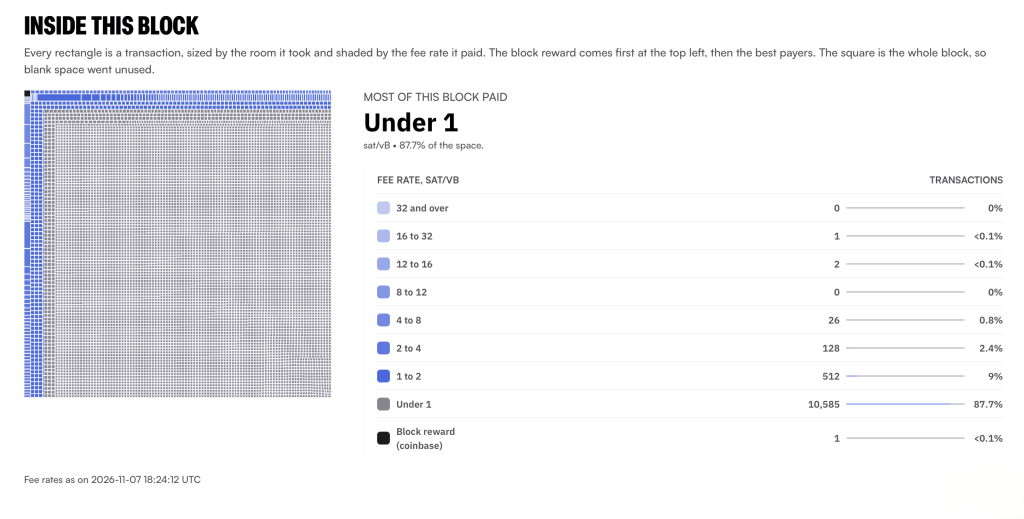
Even more curious was the economics behind the achievement. The block collected approximately 0.002405 $BTC in transaction fees, a negligible addition to the standard 3.125 $BTC block subsidy. Its 11,794 inputs and 23,122 outputs reflected an unusually large collection of compact transactions rather than a procession of conventional, high-value bitcoin transfers.
In other words, Bitcoin managed to accommodate an extraordinary number of transactions without requiring an equally extraordinary amount of block space or fee expenditure.
Why Does a Bitcoin Block From 2015 Still Hold the Record?
To appreciate the significance of November’s achievement, one must revisit Aug. 1, 2015, when mining pool F2pool produced block 367853. That block contained 12,239 transactions, a record that has survived more than 11 years of technological changes, network upgrades, and fluctuating transaction demand.
Unlike today’s Bitcoin blocks, which operate under a 4 million weight-unit limit, the 2015 block was constrained by the original 1 MB size ceiling. F2pool nevertheless managed to pack 12,239 transactions into approximately 999.96 kilobytes, an exceptional feat under the network’s earlier architecture.
The circumstances were hardly ordinary. Bitcoin was enduring a period of what some called spam attacks or deliberate network stress tests, including reported campaigns that generated enormous quantities of tiny, low-value transaction outputs.
The activity also brought renewed attention to Bitcoin’s unspent transaction output (UTXO) set, which became another point of discussion in the broader debate over network efficiency, scalability, and block size limits.
A UTXO represents bitcoin received through a previous transaction that remains available to spend. Every Bitcoin full node must maintain information about these unspent outputs to determine whether subsequent transactions are valid and whether the same coins are being spent twice.
During the 2015 UTXO waves, enormous quantities of dust outputs accumulated across the network. F2pool subsequently undertook cleanup efforts that consolidated these outputs, reducing the number of individual entries nodes needed to track.
Block 367853 emerged from that unusual episode. Rather than containing thousands of ordinary financial transactions, it included exceptionally small, nonstandard transactions, some measuring approximately 62 bytes, allowing the miner to maximize the number of transactions inside the available space.
F2pool also mined block 367851 that day, containing 9,647 transactions. Together, these blocks demonstrated how miners could construct unusually dense blocks using transactions that would not ordinarily propagate through standard network relay channels.
The 2015 record was therefore a product of specialized transaction engineering and network housekeeping, not simply overwhelming consumer demand for bitcoin payments.
How Segwit and Runes Are Pushing Bitcoin’s Transaction Limits
Fast-forward to 2026, and the mechanics behind Bitcoin’s densely packed blocks look considerably different. Much of the recent activity involves highly compact transactions associated with the Runes protocol, particularly minting activity involving UNCOMMON•GOODS, the first rune introduced around Bitcoin’s fourth halving in April 2024.
These transactions can use lightweight pay-to-anchor (P2A) outputs and carefully optimized structures, sometimes measuring approximately 80 to 100 virtual bytes. Their modest size allows miners to fit thousands more transactions into a block than would be possible using larger, conventional transaction formats.
Another important ingredient is Segregated Witness (Segwit), Bitcoin’s August 2017 upgrade that separated transaction signature data from the information used to calculate traditional transaction identifiers. Segwit introduced block weight, allowing witness data to count less heavily toward Bitcoin’s capacity limit.
The distinction matters because Bitcoin’s transaction capacity cannot be measured simply by counting bytes. Two blocks consuming comparable weight can contain dramatically different transaction totals depending on their contents.
That helps explain why block 974961 could accommodate 11,255 transactions while collecting virtually nothing in fees. The record-setting count reflects transaction efficiency and specialized protocol activity, not necessarily an equivalent increase in economic demand.
The development also raises an important distinction between transaction throughput and actual monetary settlement. A blockchain processing thousands of small token-related operations is not necessarily transferring more bitcoin value than one processing substantially fewer, larger financial transactions.
Seven of Bitcoin’s 10 Busiest Transaction Days Occurred in 2026
The extraordinary block counts are not isolated curiosities. Bitcoin’s daily transaction records tell a similarly compelling story, with seven of the ten busiest days in the network’s history occurring during 2026.
The all-time daily record remains April 23, 2024, when Bitcoin processed 927,010 transactions shortly after the fourth halving and the introduction of Runes. However, Oct. 23, 2026, came exceptionally close, recording 913,196 transactions, just 13,814 short of the historic peak.
October also delivered another major milestone on Oct. 5, when the network processed 904,518 transactions. Additional entries from July, August, September and June demonstrate that 2026’s elevated activity extended across multiple months rather than originating from one isolated episode.
Yet November has introduced an intriguing contradiction.
During the first seven days of the month, the Bitcoin protocol averaged approximately 534,200 transactions daily, roughly 25% below October’s average of 710,400. On Nov. 2, daily activity fell to 381,886 transactions, the lowest reading since March 17.
The slowdown coincided with considerable turbulence across cryptocurrency markets following the late-October Binance security breach and subsequent declines in bitcoin’s market price.
Nevertheless, the network produced its second-largest transaction block on Nov. 7, when daily activity recovered to 591,830 transactions.
This contrast illustrates why individual block records and daily transaction totals should be interpreted separately. A miner can assemble an exceptionally dense block containing specialized transactions even when overall network activity is running below its recent averages.
Will Bitcoin Finally Break Its 12,239-Transaction Record?
The remaining distance between Bitcoin’s newest milestone and its historic record is surprisingly narrow. Another 985 transactions beyond November’s second-place block would establish a new all-time high.
Whether that happens depends less on conventional bitcoin payment demand than on the continued production of exceptionally compact transactions and miners’ willingness to include them.
The broader picture is equally revealing. Bitcoin’s busiest transaction days increasingly reflect specialized blockchain applications, while traditional monetary activity represents only one component of total network usage.
For now, the 2015 record remains intact, but its longevity no longer makes it appear untouchable. Eleven years after F2pool filled a block with thousands of unconventional transactions, modern miners are approaching the same territory through entirely different technical methods. The contest demonstrates that Bitcoin’s transaction count is as much a function of how transactions are constructed as how frequently the network is used.
Leave a Reply