Bitcoin [$BTC] has spent days consolidating at the time of writing and was on the edge of a decisive move. The asset has failed to reclaim the $64K level for a third consecutive time, and the momentum behind each attempt has weakened.
Bitcoin will need far stronger momentum to force a rally, and several factors will decide whether that happens. Among them, the role of miners cannot be dismissed, since their actions tend to shape market direction.
Bitcoin mining stocks stay under water
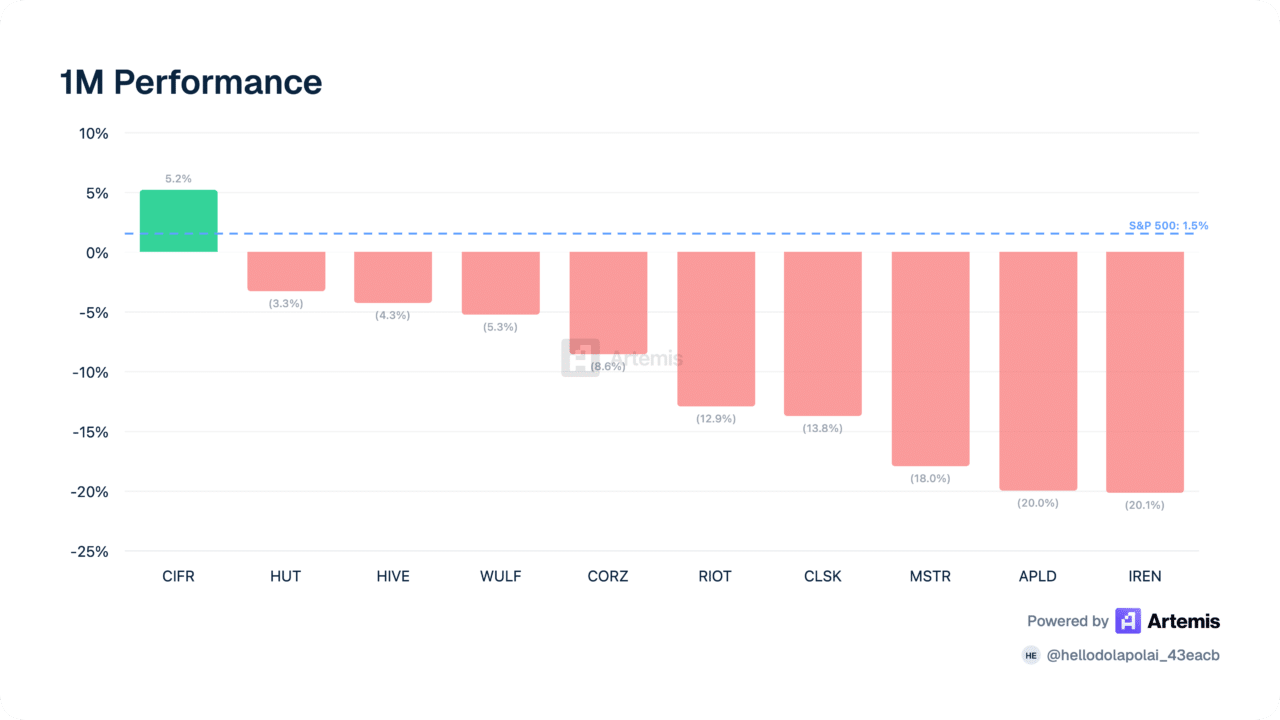
Bitcoin miners, responsible for securing the network, have traded underwater for weeks. Notably, over the past month alone, the Artemis Theme Tracker recorded a 10% decline across these Bitcoin mining stocks.
Source: Artemis
The tracker follows eleven Bitcoin mining stocks currently valued at $102.9 billion. Iris Energy [IREN] and Applied Digital [APLD] have absorbed the steepest losses over the past month, down 20.1% and 20%, respectively, while Hut 8 Mining and Hive Digital Technologies have slipped 3.3% and 4.3%.
Cipher Mining [CIFR] stood as the only name in the category to hold net positive, rising 5.2% over the same period and outperforming the S&P 500, which gained 1.5% across the month.
The question is whether miners will offload their $BTC, particularly as mining costs climb; paired with Bitcoin’s underperformance, that pressure could build further.
What will Bitcoin miners do
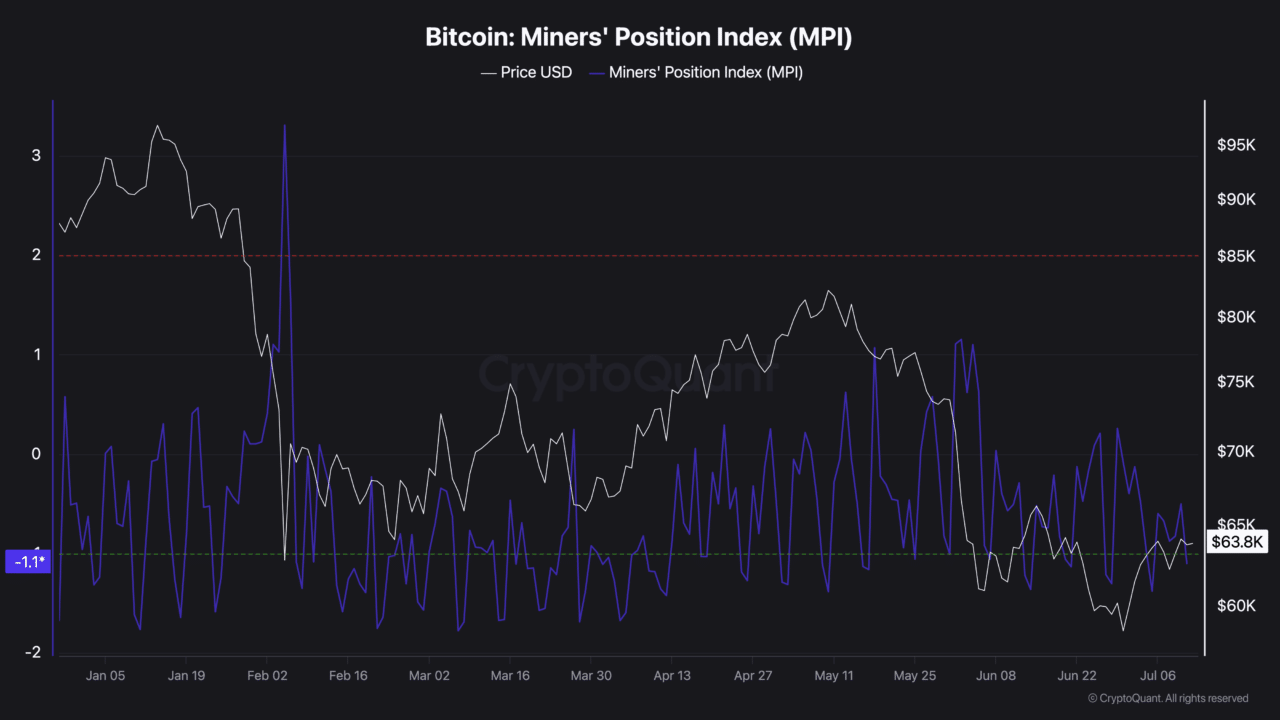
Miners have kept their Bitcoin positions steady despite the growing threat of selling in the market. At press time, the Bitcoin Miners’ Position Index (MPI) reflected near‑term confidence with a reading of -1.1, with miners continuing to accumulate.
The metric measures the ratio of total miner outflows in USD to their one-year moving average, and a reading below that average typically signals that miners are holding their assets.
Source: CryptoQuant
The Miner Supply Ratio, which tracks how much of Bitcoin’s supply miners hold, has likewise been climbing, an overall sign of accumulation.
The climb began on the 8th of July and has continued since, with the supply ratio reaching 0.05951 at press time. A sustained rise would reinforce a supportive dynamic for Bitcoin, provided miners keep their assets off the market.
Miners hold their reserves steady
Miners remain central to Bitcoin’s price performance, as their decision to sell or hold can steer direction.
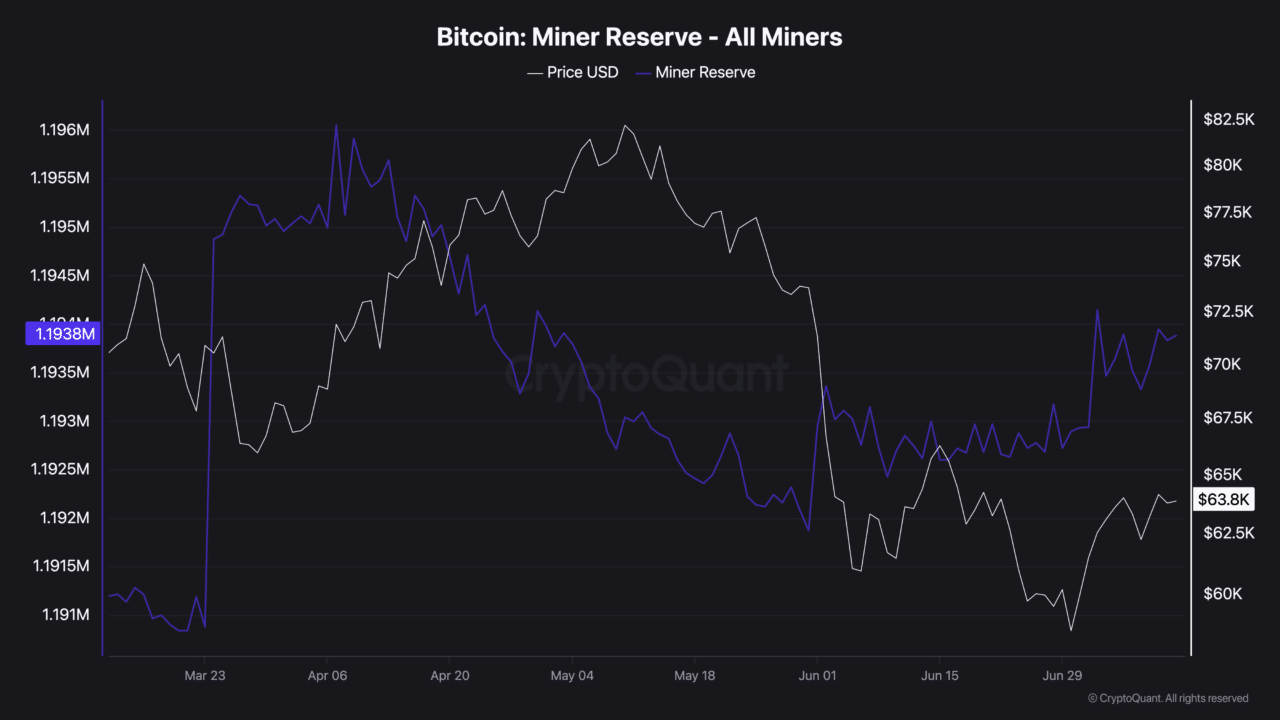
The group controls roughly 1.1933 million Bitcoin, just over 5% of the total supply in the market, and any move to sell could weigh on the asset and drag it lower.
Source: CryptoQuant
Currently, though, this group is doing the opposite despite the decline in Bitcoin’s price over the past weeks. Their holdings have edged up to 1.1938 million, one of the highest levels since early May.
Final Summary
Bitcoin miners are accumulating rather than selling, with holdings edging up to 1.1938 million $BTC, even as mining stocks trade under water.
Bitcoin has failed to reclaim $64,000 for a third straight time, and with the Miners’ Position Index at -1.1, miner conviction remains one of the few supports underpinning the asset.
Crypto markets have largely held on to gains over the weekend, but were looking a little shaky on Monday morning as traders digested the latest developments between the US and Iran.
The US has launched several waves of strikes on Iran over an Iranian attack on another container ship in the Strait of Hormuz. Iran has declared the Strait closed, while President Trump said otherwise.
Meanwhile, some heavy inflation reports could further rattle sentiment and add to the volatility as the bear market drags on.
“Q2 2026 earnings season has arrived, and Strait of Hormuz tensions are mounting again,” said the Kobeissi Letter.
Economic Events July 13 to 17
US Central Command reported on Monday morning that forces began launching more strikes against Iran “to continue degrading their ability to attack civilian mariners and commercial ships freely transiting the Strait of Hormuz.”
Crude oil prices were up around 4%, with WTI and Brent hitting $74.50 and $79, respectively, while US stock futures opened slightly lower.
June’s Consumer Price Index (CPI) inflation data is due on Tuesday, which could add to the market volatility. This is followed by the Producer Price Index (PPI) data out on Wednesday, measuring wholesale inflation.
Year-on-year measures for both headline CPI and PPI are expected to rise by 3.8% and 6.2%, respectively, reported Yahoo Finance. Rising inflation will put more pressure on the Federal Reserve to hike rates, which is bad news for risk-on assets such as crypto. The escalation of military action in the Middle East is also not good for dampening inflation concerns.
June Retail Sales data and July Philly Fed Manufacturing Index reports are due on Thursday, followed by July’s Michigan Inflation Expectations and Consumer Sentiment reports on Friday.
Key Events This Week:
1. Markets React to Strait of Hormuz Closure – Today, 6 PM ET
2. June CPI Inflation data – Tuesday
3. June PPI Inflation data – Wednesday
4. June Retail Sales data – Thursday
5. July Philly Fed Manufacturing Index – Thursday
6. July MI Inflation…
— The Kobeissi Letter (@KobeissiLetter) July 12, 2026
Several Wall Street banks and finance giants are reporting Q2 earnings this week, including JPMorgan Chase, Goldman Sachs, Bank of America, Wells Fargo, and Citibank on Tuesday, followed by Morgan Stanley and BlackRock on Wednesday.
Crypto Market Outlook
Total market capitalization has remained steady over the weekend, hovering around $2.26 trillion with a very minor dip on Monday morning after the latest airstrikes.
Bitcoin had held ground just above $64,000 for the past 12 hours or so but dipped to $63,400 during early trading, where it remains at the time of writing.
Ether prices fared a little better, holding above $1,800 for most of the past day following a 15% gain over the past fortnight. Escalation of conflict and higher inflation this week could send both much lower.
Bitcoin ($BTC) is trading around $63,396 on July 13, 2026. It is still nearly 50% below its all-time high of $126,198. While short-term price action remains choppy, Eric Trump says institutional adoption is accelerating faster than ever. He believes Bitcoin still has a long way to go.
Eric Trump Sticks to $1 Million Bitcoin Call
Speaking in a recent interview, Eric Trump said Bitcoin is entering a new phase of adoption. This is as traditional financial institutions continue embracing crypto.
“The floodgates are opening,” Trump said, pointing to major firms like Charles Schwab, Fidelity, and JPMorgan Chase expanding Bitcoin services. He shared that when he recently logged into his Fidelity account, he was prompted to create a digital asset wallet. Therefore, it is now easier than ever for customers to buy Bitcoin.
According to Trump, the biggest change is accessibility. Investors no longer need to rely on complicated wallets or self-custody. Now Bitcoin is available through spot ETFs and large financial institutions.
“We are on the one-yard line of cryptocurrency, and we’ve got another whole field to run,” he said.
Trump also doubled down on his long-term prediction, saying, “I do think it hits a million dollars eventually. I’ve never been more bullish on anything in my life.” He added that stronger crypto legislation in the U.S. has only increased his confidence.
Perhaps his boldest claim came when discussing institutional demand. “I talk to the biggest companies, the biggest families in the world, and every single one of them is racing to buy Bitcoin,” Trump said.
American Bitcoin Stock Struggles Despite Bigger $BTC Holdings
Interestingly, Trump’s bullish comments come even as American Bitcoin, the mining company he co-founded, continues to face pressure in the stock market.
According to Bloomberg, the company’s shares have dropped more than 95% from their peak, wiping out over $600 million from the value of Eric Trump’s roughly 6% stake over the past 10 months. The company recently carried out a 1-for-15 reverse stock split to maintain its Nasdaq listing. Still, it hit a record low last week.
Despite the weak stock performance, American Bitcoin continues to build its Bitcoin treasury. The company purchased 500 $BTC this week, taking its total holdings to more than 8,000 $BTC. However, its first-quarter results showed an operating loss of $118.2 million, including a $117.2 million Bitcoin impairment charge.
U.S. Strategic Bitcoin Reserve Adds Long-Term Confidence
Supporting the long-term bullish narrative, the U.S. government now holds around 328,372 $BTC, worth roughly $20-$25 billion. These assets are primarily acquired through criminal asset seizures. The holdings are managed as part of the Strategic Bitcoin Reserve (SBR), established under a White House Executive Order.
While Bitcoin remains well below its record high, growing institutional participation, improving regulation, and continued accumulation by both private investors and governments are keeping long-term expectations firmly intact.
UPDATED, with comment from AG: Oregon‘s attorney general has dropped a civil investigative demand for Paramount to turn over records related to its efforts to secure federal approval for its merger with Warner Bros. Discovery.
Oregon Attorney General Dan Rayfield also had asked a state circuit court judge to order Paramount to turn over the materials and to delay Paramount’s closing of its proposed acquisition of Warner Bros. Discovery by 60 days so the documents could be reviewed. A hearing has been scheduled for Monday in Multnomah County Circuit Court.
A Paramount spokesperson said, “We are pleased that the Oregon Attorney General has withdrawn its motion to delay this transaction. It was the right decision and avoids an unwarranted effort to delay a lawful, pro-competitive merger.
“Antitrust authorities around the world have carefully reviewed this transaction, clearing it or concluding that it does not violate any competition laws. That regulatory record underscores what the facts, the law and the economics make clear: this transaction will create a stronger challenger to dominant global streaming and technology platforms, expand consumer choice, increase investment in premium content and theatrical distribution, and create more opportunities for creators and workers. We look forward to completing the transaction and delivering those benefits.”
Jenny Hansson, communications director for Rayfield, said in a statement, “Paramount made it clear that they weren’t going to comply with the investigative demand, and that they think they’re above the law. We’re not going to let them waste Oregonians’ resources on these games. We’ve withdrawn the motion to consider our next steps.”
California Attorney General Rob Bonta and other state attorneys general are said to be considering a legal challenge to the transaction.
Rayfield sought Paramount records of lobbying of federal officials, as well as its role in a statement that the DOJ released in support of the transaction. The attorney general also sought documents “related to the formulation and execution of lobbying strategies aimed at obtaining regulatory approval of the proposed merger, which Respond as internally named ‘Project Warrior.’”
In a court filing, Paramount has objected to the document requests, arguing, among other things, that they impose “burdens and demands which are disproportionate” to the Oregon investigation and are “of such marginal relevance that the value of any materials sought is outweighed by the burden imposed on Paramount in having to provide such information.”
“Lobbying activities and related communications are wholly irrelevant to whether the proposed acquisition ‘violates Oregon’s antitrust laws,’” the company’s legal team wrote.
[This story contains spoilers for the season eight finale of Peacock‘s Love Island USA.]
After a season full of highs and lows and love and heartbreak, fans have crowned the winners of Peacock’s Love Island USA season eight.
Heading into Sunday night’s finale, viewers got to vote on which couple would take home the grand prize of $100,000 (split between the winning couple). The final couples were Trinity and Bryce, Aniya and Carl, Kayda and Zach, and Melanie and Sincere.
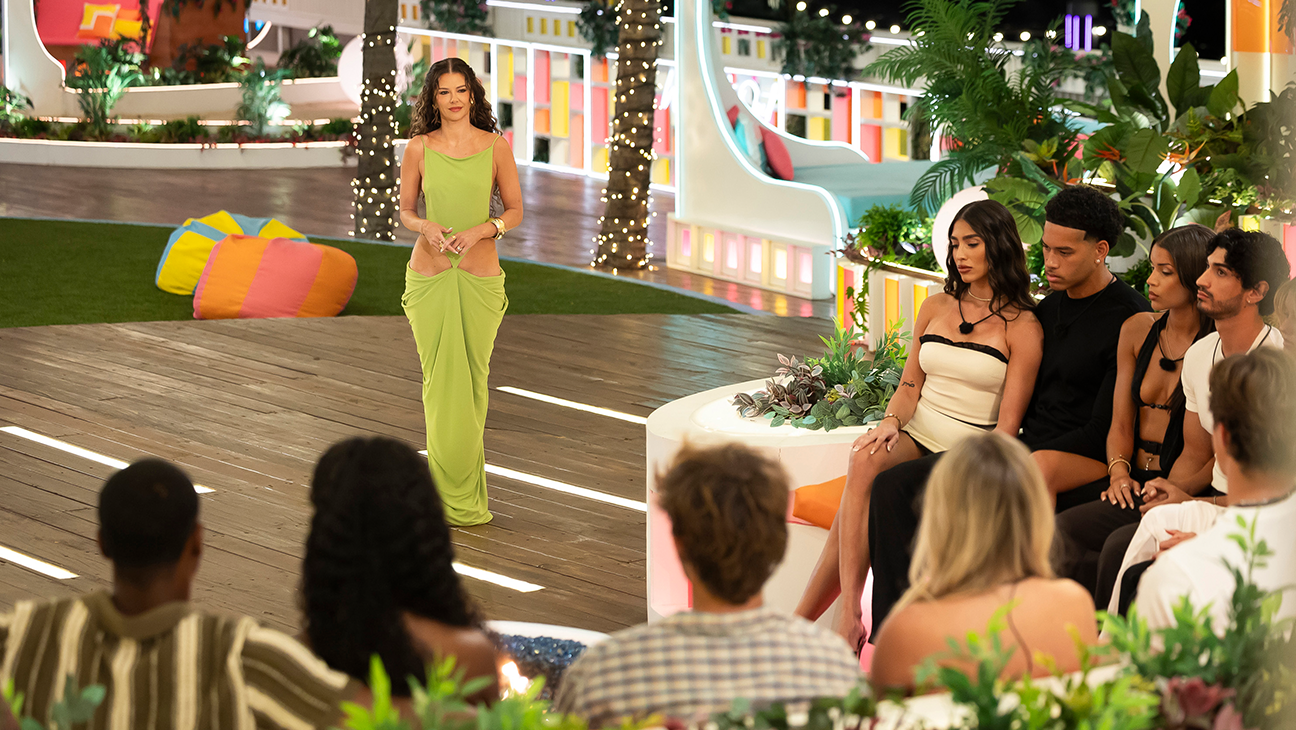
After couples went on their final Love Island USA dates during the finale, host Ariana Madix revealed the Islanders who received the most votes and captured America’s heart in the end were Trinity and Bryce. Aniya and Carl were the runners-up, with Melanie and Sincere coming in third place, and Zach and Kayda in fourth.
“I feel like I’m in a dream right now. I’m walking up here, I’m like, ‘Is this fucking real?’” an emotional Bryce said after winning. An overjoyed Trinity added, “I’m just so overwhelmed. I never would have expected in a million years I would be in this position right now.” The pair also told each other that they love them.
Peacock also announced Sunday that the Love Island USA reunion special will air on Aug. 31 at 6 p.m. PT/9 p.m. ET, with Madix and Andy Cohen returning as hosts. Additionally, Love Island: Beyond the Villa has been renewed for a third season and will premiere in 2027. The cast will be revealed later this year.
Though Trinity and Bryce seemed like an unlikely match at first, appearing to be more friends than lovers, their relationship actually became a slow burn, developing throughout the season. Once Casa Amor arrived, their true feelings finally came to the surface during the show’s ultimate relationship test. When they finally got reunited, they remained a power couple, eventually making it official as girlfriend and boyfriend before the show ended.
Trinity and Bryce on Love Island USA season eight.
Ben Symons/Peacock
While their relationship didn’t face too many hurdles, plenty of other Islanders throughout season eight did. From Sincere’s ongoing lies to Melanie and Kenzie’s shady exploring to KC’s hurtful words about Aniya and Zach’s commitment issues with Kayda, the season was still filled with more than enough drama.
In addition to the show being “able to carve out a unique place” in the television space, Madix also praised the casting team for casting Islanders who draw viewers in. “These Islanders are never together. They don’t meet. There’s no interaction where they can chemistry test the way you would on a scripted show,” the host previously told THR. “So you don’t know until they’re all in a room together what kind of sparks are going to fly. And yet year after year, the casting team does such an incredible job of finding the secret sauce amongst the cast to really make those sparks fly and make the show exciting.”
The season was also met with a few scandals when Alannah Keyser and Vasana Montgomery were removed from the show when respective social media posts emerged of them using the N-word. They’ve both since apologized.
Apple sued OpenAI and two former employees, alleging theft of hardware trade secrets.
The complaint claims former Apple employees accessed confidential files, shared supplier information, and used internal information at OpenAI.
The lawsuit follows OpenAI’s $6.5 billion acquisition of Jony Ive’s hardware startup io Products.
Apple has sued OpenAI and two former employees, accusing the ChatGPT maker of using stolen trade secrets for its consumer hardware efforts.
The complaint, filed Friday in the U.S. District Court for the Northern District of California, names former Apple senior system electrical engineer Chang Liu and former iPhone and Apple Watch design executive Tang Yew Tan, along with OpenAI Foundation, OpenAI Group PBC, and io Products.
Apple alleges Liu, who left the company in January after eight years, failed to return a company laptop and later accessed Apple’s internal systems through an authentication bug.
“While employed by OpenAI, Mr. Liu also exploited a rare, previously unknown authentication bug to access Apple’s shared network folders,” Apple’s attorneys said in the complaint. “Upon discovering that he had this unauthorized access to Apple’s systems, Mr. Liu did not report it, return his stolen Apple-issued work laptop, or delete the program that allowed the access.”
Apple alleges Liu downloaded dozens of confidential hardware files, including information about unreleased products, engineering presentations, technical specifications, and proprietary project data.
The company also alleges Tan, who spent 24 years at Apple before becoming OpenAI’s chief hardware officer, used confidential information from his time at Apple to benefit OpenAI.
The complaint claims Tan used Apple’s internal project names during OpenAI interviews and asked about unreleased products. Apple also alleges candidates were told to bring “actual parts,” for “show and tell.”
Apple further claims OpenAI’s recruiting process requested “CAD/design artifacts,” prototypes, supplier information, and details about employees’ work on Apple hardware.
Apple and OpenAI did not immediately respond to a request for comment by Decrypt.
The lawsuit follows OpenAI’s $6.4 billion acquisition of io Products, the hardware startup founded by former Apple designer Jony Ive. Ive is not named in the complaint.
According to the filing, OpenAI’s hardware division has hired more than 400 former Apple employees. Apple claims it contacted OpenAI in February with concerns about confidential information entering the company but did not receive a response.
The news comes after a separate trade secret dispute between OpenAI and Elon Musk’s xAI. In September, xAI sued OpenAI, alleging the ChatGPT maker recruited former employees to obtain confidential source code, training methods, and data center strategies.
OpenAI denied the allegations, and a federal judge dismissed the lawsuit in June, finding xAI failed to show OpenAI encouraged a former employee to disclose confidential information.
The lawsuit is a stark pivot from Apple and OpenAI’s earlier relationship.
In 2024, Apple tapped OpenAI to bring ChatGPT to Siri as part of its Apple Intelligence initiative. However, earlier this year, Apple turned to Google’s Gemini to power its next generation of AI models after delays stalled the rollout.
Daily Debrief Newsletter
Start every day with the top news stories right now, plus original features, a podcast, videos and more.
For longtime “Married at First Sight” viewers, Season 20 may feel a bit different. The new season, which debuts on July 12, is the first full season made for Peacock.
The series, produced by Kinetic Content, aired Seasons 5-18 on Lifetime before moving to NBC’s streaming service in 19 — but that deal wasn’t completed until after the 19th season was filmed.
“Season 19 was made for Lifetime. We edited it for Peacock, but we had already shot the show for Lifetime, so we had shot with a Lifetime lens on it,” says Chris Coelen, Kintetic founder and CEO. “This season, for the first time, is a true, full-scope Peacock season.”
Going in, the team knew that meant a full overhaul for Season 20. Coelen is forever grateful to the long partnership with A&E, who “were the first ones to take a chance on the series.” But with the changes in the business and marketplace overall, it was time for a change. That brought along more freedom, without the time constraints of network television.
It also meant, in a big shock to the fans, all new experts. Dr. Pepper Schwartz, Pastor Cal Roberson and Dr. Pia Holec exited after Season 19, with Paul C. Brunson and Dr. Lisa Paz coming in as the new experts to help each couple.
“Every season, it’s an ongoing conversation about what’s working, what’s not working, and I think our experts have worked for a really long time. I just think the opportunity came across to look at two really exciting new experts,” the executive producer says. “It made sense for us, moving to a new platform, a new home, to be able to bring some new experts to the table. And we’re really excited about the people that we brought on board.”
Over the last 20 seasons, there have been three or four experts at a time, but having two made sense with the new format, he says. “It felt a little less crowded and more focused, in terms of the ability for the experts to really develop a relationship with the participants in a different way.”
This season, set in Seattle, also features couples who are a bit older, and in turn, maybe a bit more ready to get married.
“I think it depends, partly, on the place,” says Coelen. “Different people are ready at different ages for a big commitment and the group of people that we have in this iteration felt like the right age that they were serious about marriage as a as a next step in their lives.”
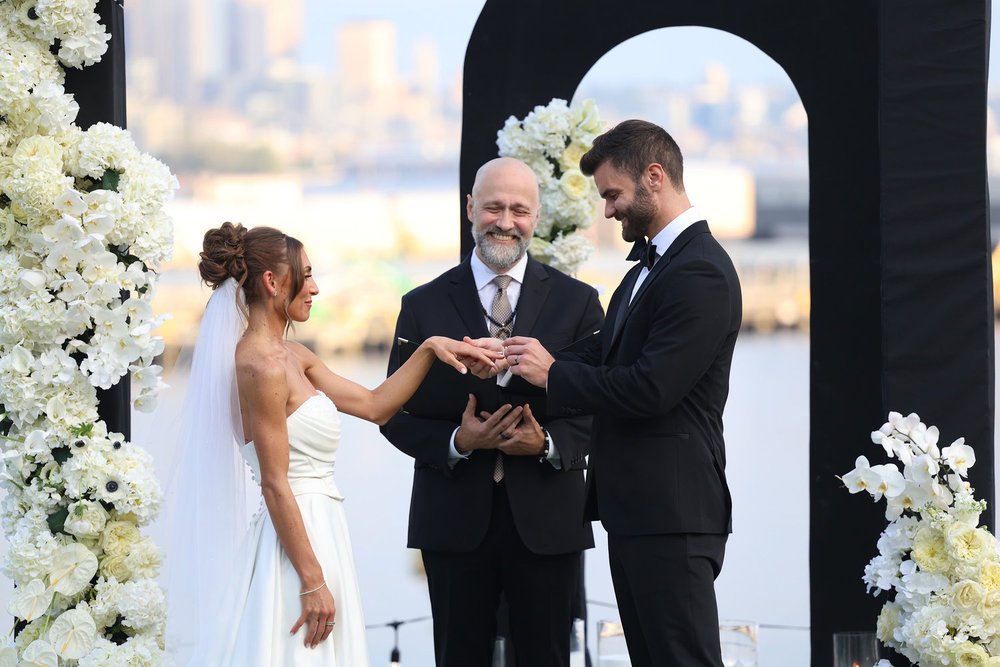
For the first time, “Married at First Sight” features a familiar face from the reality TV world. Nick Uhlenhuth has previously appeared on Netflix’s “The Circle” and “Perfect Match.” And at first, Coelen was hesitant about that, wanting to make sure that his intentions weren’t to be a reality TV star but to actually find his partner. Luckily, he had a real connection with Courteney Landis.
“When you look at how he and Courteney align, it has nothing to do with any of that. The way that they match up across so many different qualities is really ideal,” says Coelen. “I don’t even know that we originally went out thinking, ‘Let’s find somebody from another show.’ Those are things that we all talk about, but I think getting to know his family, getting to see the relationship role models around him and the way they talked about him, all of that added up to feeling like he was a really good choice.”
The first episode of “Married at First Sight” Season 20 is now streaming on Peacock.
SPOILER ALERT: This story contains major spoilers for “Evil Dead Burn,” now playing in theaters.
“Evil Dead Burn” breaks one of the fundamental rules of cinema: Don’t kill the dog.
“If you don’t do that in ‘Evil Dead,’ in which movie do you do that? These are the most insane, wild and basically evil movies,” director Sébastien Vaniček tells Variety, while acknowledging that he knew audiences would hate the scene. “There’s no limit, I can’t have limits!”
Of course, the dog comes back to life in a “badass” new form, as Vaniček says with a laugh, along with the rest of the humans that transform into evil Deadites after getting viciously slayed. But it’s just the beginning of Vaniček’s endlessly brutal film, which features everything from a woman getting impaled with a car seat headrest to pouring hot candle wax in her mouth.
The latest installment in the long-running horror franchise, first created by Sam Raimi with his original 1981 classic, follows a family on the brink of carnage after Will (George Pullar) dies in a car accident. His wife Alice (Souheila Yacoub), who faced abuse from him while he was alive, is left grieving with the rest of the family as Deadites take over their souls one by one.
Vaniček picks up where 2023’s “Evil Dead Rise” left off, but the film is only loosely connected to that movie and the 2013 series reboot “Evil Dead,” which collectively makes a loose trilogy. “Burn,” which was filmed primarily in New Zealand, marks French director Vaniček’s second feature after “Infested,” a much smaller-scale French film about a group of rapidly reproducing spiders invading an apartment.
Unlike the last two “Evil Dead” installments, Vaniček told Raimi and producer Rob Tapert that he wasn’t as interested in gore or pouring buckets of blood on his actors: “When I see it in movies, I’m not disgusted. It doesn’t deter me too much because I know how much it’s fake. But when I see the teeth on the sidewalk in ‘American History X,’ that’s the moment I can’t watch the screen anymore.”
Vaniček spoke with Variety about crafting the most brutal “Evil Dead” installment yet, how he pulled off some of the meanest kills and what that last post-credits scene could mean for the future of the franchise.
Courtesy of Warner Bros. Pictures
This new wave of “Evil Dead” movies features new characters and a new director at the helm. Coming off of “Infested,” what did you set out to bring to this long-running franchise?
That’s mainly why I wanted to do it. Ghost House Pictures, Sam Raimi and his team told me that the movie would be 100% my style. As soon as I told them what I understood about “Evil Dead,” and that we understood we were on the same page, they just let me do the movie I had in mind. Regarding the style, violence, brutality and the type of violence, I had carte blanche.
Did that creative freedom surprise you?
Yeah! You take that really seriously, and you don’t want to disappoint them because that’s such a huge gift. You want them to be proud of the movie. Without this freedom, to be honest, I think I would have done another movie in France instead.
The opening kill always sets the tone of these movies. How did you arrive at that lake scene as the perfect opener?
The first thing was we wanted the audience to know where they are, and for those who have seen “Evil Dead Rise,” I want them to be like, “OK, I know where it’s starting.” That film left us with one Deadite in the wild, so I wanted to use that. Then regarding the story of those two fishermen, in about seven minutes, we are introducing the elements and style we will have throughout the whole movie — the editing, sound design, music, characters.
What was your mindset behind crafting the kills, how much was done practically?
Everything that could have been done practically was done practically. The only thing we couldn’t do practically was holes in faces, so that’s the only moment where we had makeup with green areas on faces. But even the final monster is done practically — we just added CGI on him to have those holes. I definitely wanted to keep George [Pullar’s performance], his eyes and his face, and what he was giving to Souheila. The fire was one of the big challenges because I didn’t want to have CGI fire, so we had fire on set all the time. That was really tricky to work with fire because you are lighting the whole scene with real fire. It was pretty long and intense, but in the end, the audience feels it when you do things for real on set versus when you are faking it.
The dinner table with the family after they attend Will’s funeral stands out as one of the most tense scenes. The mother and father turn quite vicious on Alice. Can you break that down?
That was one of the most challenging because I don’t have a fight, I don’t have action. You have to play with sound editing in order for this tension to rise. We spent a long time writing it first because we wanted to have the best lines and the best moments and to be sure that all our characters are understandable — we know where they are, where they want to go, what’s going on, who is who. It had to be really clear. That’s the first time they are all together, and this scene is such a turning point that all the stakes are really high. I storyboarded the whole scene; I knew which shot I needed when, I knew the editing by heart, which close-up when. We rehearsed a lot with the actors to be sure that they knew when to grab the glass, when to grab the corkscrew, when to watch this and do that because there were so many moments where they had to watch something, and they didn’t have lines — it was also a question of acting without lines. That’s one of the scenes I’m most proud of.
The car scene, when Tia (Luciane Buchana) gets impaled with the car seat headrest, was also incredibly difficult to watch.
The car fight was an important one to me because I love these kinds of scenes. Right after the dinner, I wanted a turning point scene — something really intense for the audience. To have a huge fight in such a small environment was something I wanted to try as a director. With my cowriter [Florent Bernard], we were just watching our cars and thinking, “What would we use if we were fighting tigers in our car?” Those kinds of crazy weapons just happened because we were thinking about the craziest way to fight something. The headrest was one of them. When I started to write, I drew Tia with the headrest in her head. And then you arrive in New Zealand with these amazing crews, and you tell them your crazy concept. We had to find a way for this headrest to stay in Luciane’s head. Again, to do everything practically is such a pleasure.
The family dynamics really ground this film from the beginning. We have that moment where Joseph (Hunter Doohan) can’t shoot his father, who has turned into a Deadite.
That’s the essence of “Evil Dead”: Would you be ready to kill people you love? That’s what happened to Ash in the first one; that’s what happened in Fede’s movie with the brother and the sister, and the same with the mother in “Rise.” That’s why the “Evil Dead” movies are still alive, because they are asking the most horrible question on Earth. The answer for Joseph is no, he’s not ready to kill his father. But that’s a big metaphor because his father and family are horrible and he is [still] not ready to do that. The really cool thing with “Evil Dead” is that you can explore metaphors in a physical way. If you are talking about an abusive husband, you will see that husband as a monster, and you will literally see a monster at some point. That’s the very cathartic thing about “Evil Dead” — all the questions that are raised, you see them in the image and the characters going through horrible situations. The audience is so involved in the story because they are asking themselves the same question. We wrote a realistic character, and I think most people wouldn’t be ready to do it. I completely understand the character; that’s such a horrible choice to make.
The bathtub scene is also horrifying. You play with some unique camera work that disorients the audience.
I wanted to have fun with the camera! These movies are made for that. I already started to do these kinds of things with “Infested” because I wanted people to remember some movements, shots and scenes — that’s how I am as an audience member. I definitely played with all the tools I had.
Regarding the bathroom shots, there are two stunt doubles in the bathtub, and they both have two or three wires on them, with three or four people pulling the wires. That means you have 15 stuntmen behind the camera. That’s amazing teamwork to pull off this kind of shot.
The film has two post-credit scenes, and we see a very familiar face in the last one with Ellie (Alyssa Sutherland), who viewers may be surprised to see after she was killed off in “Evil Dead Rise.”
That’s the demand production had, and since they allowed me to do the movie I had in mind, they just gave me all the freedom I wanted. That’s the game — they wanted to have that one scene. I didn’t know what they wanted to do with it; I don’t know what they will do in the future; I don’t know what’s in the other movie and if she’ll be here or not.
It really opens up the possibilities for this franchise. You never know who is truly gone!
Yeah, I think audiences loved this character, and they want to see Ellie again. The studio understood that and made that possible. I can’t argue.
Your writing incorporates quite a bit of dark humor, particularly with the grandmother, Polly (Maude Davey), who is revealed to have survived during the first post-credits scene.
Maude’s way younger than the grandmother, but I had to cast someone who’s younger to do some of the movements and the stunts herself. Maude was 100% available for these kinds of things. She had five or six hours of makeup every day to become a 90-year-old grandmother, but her body moves fast. When she becomes a Deadite, she’s kind of an animal. I was able to capture amazing things with the body. The really interesting thing with Polly was, “What happens when Deadites take control of someone who’s ill, who’s gone already? What will they do with the body, what will they do with the brain?” Because Deadites are really smart creatures, they play with you. They want to torture you with not only the body but also the mind. The grandmother was such an interesting tool for us to explore different types of Deadites and manipulation.
Is it true that Bruce Campbell makes a surprise cameo appearance?
Fans will have to keep an eye open and they’ll see where he is.
Where do you see yourself going after gaining this experience on a bigger-budget feature? Do you want to do another “Evil Dead” movie or something more independent in the vein of “Infested?”
As soon as I have the freedom and the ability to write and direct my own stuff, I’m not against anything. I’m open to different franchises and studio movies and to do my own stuff. It was amazing to do something like “Evil Dead” and create something in a universe that people like because the playground is already here and amazing. I know what it is to work with the studio; I know it’s never 100% freedom, but at least to be sure that I’m able to do what I have in mind, people trust me, and we work hand in hand. I wouldn’t be able to direct a script I didn’t write, I would definitely have to put my hands in it.
I don’t think I would write and direct another “Evil Dead.” The only one who can do two “Evil Dead” movies is Sam Raimi! It’s a franchise that needs a fresh vision and fresh directors all the time. Fans want to be surprised, and if we want to keep the franchise alive, we need those different visions.
SPOILER ALERT: This article contains spoilers for the Season 8 finale of “Love Island USA.”
The public’s final vote for “Love Island USA” Season 8 decided on Bryce and Trinity as the winners of the reality dating series.
Bryce and Trinity were joined in the final four by second place finishers Aniya and Carl, third place finishers Melanie and Sincere and fourth place finishers Kayda and Zach. Bryce and Trinity took home the $100,000 cash price.
The pair were tight since the first coupling on the show, remaining steadfast over the course of the past month. Melanie and Sincere were also among the first couples paired up, after Sincere chose Melanie over Aniya, who initially showed interest in a connection during the premiere episode. Their connection became rocky during movie night, when it was revealed that Sincere was leading on both Melanie and Sol.
Meanwhile, Kayda and Zach formed their connection early on in the season after Zach chose Kayda, who was introduced as one of the bombshells, over Kenzie. Aniya and Carl connected later on in the season after Casa Amor and quickly became fan favorites.
As the show has only continued to grow in popularity, host Ariana Madix recently received her first Emmy nomination for hosting the Peacock program. Season 8’s premiere marked Peacock’s most-watched TV debut ever, totaling 3.7 million views, according to first-party data from NBCUniversal.
This season wasn’t without controversy, as two islanders were kicked out after racist videos of them saying the n-word resurfaced online. In Season 7, twocontestants were also kicked out of the villa after using racial slurs.
Madix will return to host a “Love Island” Season 8 reunion on Aug. 31 at 6 p.m. PT/9 p.m. ET. The series is produced by ITV America in association with Lifted Entertainment and WPP Media’s Motion Entertainment.
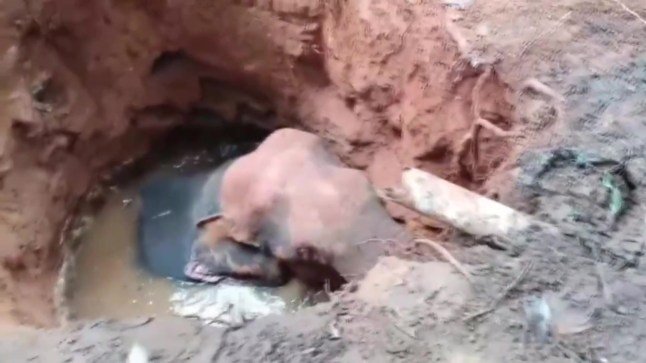
The elephant fell into the unmanned well earlier this week (Picture: Newslions / SWNS)
A 15-year-old elephant was trapped for 10 hours in an abandoned well before it was rescued.
The animal fell into a well in Ernakulam, in the southern Indian state of Kerala, on Tuesday at around 2.00am. According to the reports, the well didn’t have a wall, and was located near the home of doctor Thattayath Aliyar.
Forest officials rescued the elephant using an excavator, creating a mud ramp so it could safely escape.
Witnesses say the elephant struggled at first to climb out from the muddy water, but eventually managed to break free and return to the forest.
Forest department personnel were initially prepared to begin rescue operations in the early morning, but residents protested, demanding that the elephant be permanently relocated away from human habitation.
Villagers had their doubts about the rescue (Picture: Newslions / SWNS)
Sign up for all of the latest stories
Start your day informed with Metro’s News Updates newsletter or get Breaking Newsalerts the moment it happens.
The elephant fell at around 2am (Picture: Newslions / SWNS)
After a meeting, the area’s divisional forest officer, P. Karhik, assured villagers the elephant would be kept under 24-hour surveillance using drones and forest patrol teams upon release and would be captured if it were to stray into human areas again.
Authorities also said they would compensate the homeowner for damages and install an electric fence in the region. Only after these demands were met did the rescue operation begin, around noon.
Forest officials say that the top of the elephant’s trunk was damaged as part of an old wound. The injury restricts the elephant’s ability to forage for food and water, explaining why it frequently wanders into residential areas to find easily accessible sustenance.