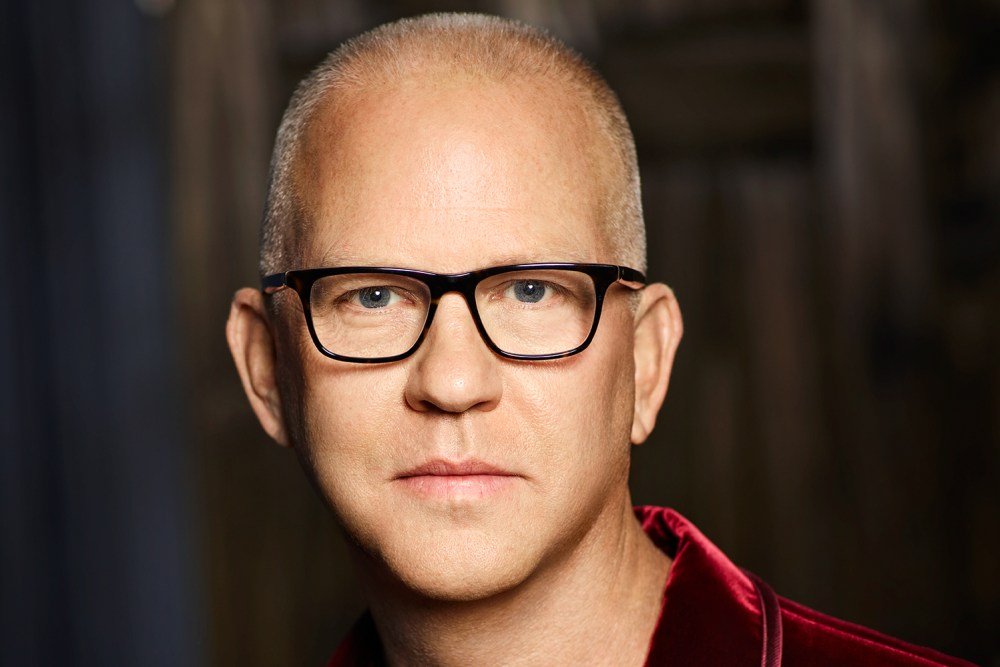
Variety‘s annual Showrunners Breakfast will return on August 14, featuring two spotlight conversations with a curated group of this year’s Emmy-nominated showrunners, plus the Norman Lear Creative Conscious Award presentation to Ryan Murphy.
Murphy will receive the award in recognition of a body of work that embodies Lear’s enduring legacy of creativity, visionary storytelling and social impact. Previous recipients include Chuck Lorre and David E. Kelley. Lear himself was the first honoree in 2019, when he received the predecessor prize, the Variety Creative Conscience Award, making it fitting for Variety to rename the award in his honor.
“Norman Lear’s legacy will forever live on via his landmark body of work, as well as through the generations of writers and showrunners whom he inspired,” said Variety Features Director Emily Longeretta. “Much like Lear, Ryan Murphy has never shied away from tackling social issues in his powerful storytelling and has been breaking barriers on television for more than 20 years. A driving force across multiple genres, we are so thrilled to present Ryan Murphy with the Norman Lear Award.”
The two spotlight conversations and participants will be announced shortly. The event’s guest list will consist of an exclusive group of showrunners recognized on Variety’s coinciding 2026 Showrunners Impact List.
“The Variety Showrunners Breakfast is a celebration of television storytelling among peers whose vision continues to define the medium and create culture,” said Donna Pennestri, Associate Publisher, Variety.
What does a serial killer’s mid-life crisis look like? We’re about to find out.
Paramount+ has dropped the first look (below) at season two of Dexter: Resurrection, which will premiere later this year (with a specific date to be announced later), and when Michael C. Hall returns as everyone’s favorite serial killer, season two will find his titular Dexter Morgan “caught between two killers — one notorious and the other terrorizing New York in ways no one ever anticipated — all while battling his greatest enemy yet: a mid-life crisis,” per the logline.
Son Harrison (Jack Alcott), meanwhile, “continues his own pursuit of justice as father and son face their darkest chapter.”
The returning cast also includes Uma Thurman, Ntare Guma Mbaho Mwine, Kadia Saraf, Dominic Fumusa, Desmond Harrington and James Remar.
Stevens, Cox, Bokeem Woodbine and Nona Parker Johnson join the cast for season two in series regular roles. Krysten Ritter returns in a guest starring role, with Gabriel Luna joining in a guest starring role this season as the Sleepy-Eyed Stranger.
James Remar as Harry Morgan with Michael C. Hall as Dexter Morgan in season two.
Matt Infante/Paramount+.
Uma Thurman as Charley with Hall as Dexter.
Matt Infante/Paramount+.
Hall as Dexter in season two.
Matt Infante/Paramount+.
Jack Alcott as Harrison Morgan.
Matt Infante/Paramount+.
Dominic Fumusa as Detective Melvin Oliva, Kadia Saraf as Detective Claudette Wallace and Bokeem Woodbine as Captain Mixon.
Desmond Harrington as Quinn.
Matt Infante/Paramount+.
Clyde Phillips is showrunner and executive producer of the Dexter sequel series, which brought Dexter back to life after the events of the 2021 limited series Dexter: New Blood. Prequel series Deter: Original Sin was un-renewed after one season.
Season one of Resurrection ended with Dexter discovering a file on the New York Ripper in the vault of Leon Prater (Peter Dinklage), a serial killer enthusiast and his season one primary adversary.
The first season of Resurrection filmed across Westchester County, Long Island and all five boroughs of the city, but moves to Manhattan full-time as Sunset Pier 94 Studios’ first major tenant.
The Paramount Television Studios and Counterpart Studios series is also executive produced by Hall, Scott Reynolds, Marcos Siega, Tony Hernandez, Lilly Burns, John Goldwyn, Sara Colleton, Veronica West, Kirsa Rein, Tanner Bean and Katrina Mathewson.
You can binge all of Dexter: Resurrection season one on Paramount+ and catch franchise stars like Erik King, Julie Benz, Ritter and Eric Stonestreet revisiting the larger Dexter universe with season three of Dexter’s Kill Room, Thursdays on YouTube.
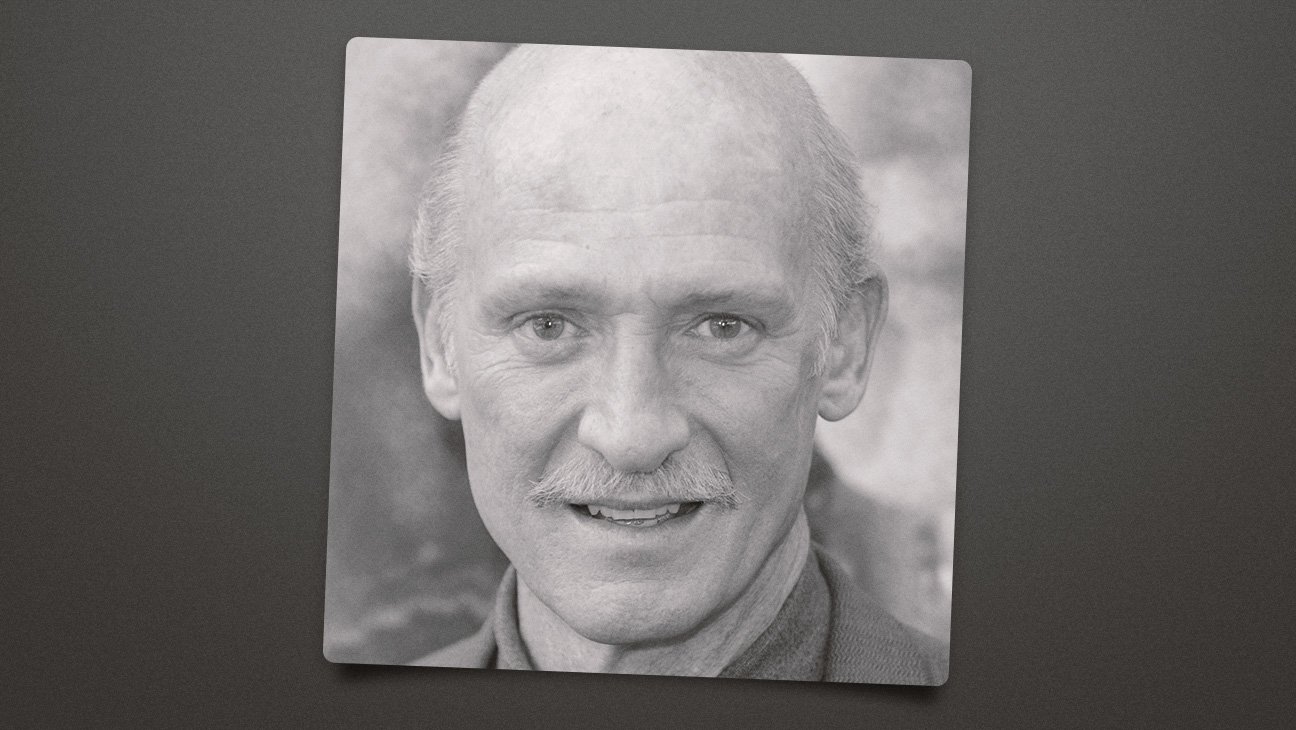
Kent Broadhurst, the character actor who appeared in films including The Verdict, Silkwood and Silver Bullet and wrote the screenplay that led to Laura Linney’s first Emmy Award, has died. He was 86.
Broadhurst died May 20 at Calvary Hospital in the Bronx, according to a paid obituary. He lived for the past 63 years in a building on Cornelia Street in Greenwich Village.
The St. Louis native did lots of theater work during his lengthy career, making it to Broadway in revivals of The Caine Mutiny Court-Martial in 1983 and A Doll’s House in 1997, and he wrote many plays as well.
Broadhurst might be best known for playing the anguished father of the murdered best friend of Corey Haim’s Marty Coslaw in the Stephen King-scripted horror film Silver Bullet (1985).
In an interview for the DVD, he said he arrived at a park at about 2 a.m. for the scene in which his character is taken to his dead son. “The prop department had presented [director Dan Attias] with the corpse of the boy that was just embarrassing, it was unusable,” he recalled. “It looked like a window mannequin that had been smashed with a hammer and smeared with cranberry juice.
“I could see [Attias] was in such a quandary, so I said, ‘I think I can give you what you need and you won’t have to show anything of the terrible thing I’m confronted with.’ He was so grateful, he said, ‘Oh, that’s great. I’ll just keep the camera on you.’”
Broadhurst penned the screenplay for the 2001 Showtime telefilm Wild Iris, directed by Daniel Petrie. Linney stars as a widow who lives with her son (Emile Hirsch) and mother (Gena Rowlands) in a home that doubles as a bridal shop.
Linney received the Emmy for outstanding lead actress in a miniseries or a movie — it was the first of her nine Emmy career nominations and first of her four wins — while Rowlands was nominated as well.
Born in St. Louis on Feb. 4, 1940, James Kent Broadhurst graduated from the University of Nebraska and headed to New York, where he appeared off-Broadway opposite Marcia Wallace in The Fourth Wall in 1968, among many other plays.
He made his big-screen debut in Stuart Rosenberg’s Brubaker (1980), starring Robert Redford, then followed with turns in Sidney Lumet’s The Verdict (1982), starring Paul Newman, and Mike Nichols’ Silkwood (1983), starring Meryl Streep.
In the 1983 NBC miniseries Kennedy, starring Martin Sheen, Broadhurst portrayed Richard Paul Pavlick, the postal worker who was arrested after he stalked president-elect John F. Kennedy with the aim of assassinating him.
After appearing in Silver Bullet, which was based on King’s 1983 novella, Cycle of the Werewolf, he worked on another horror film taken from a novel written by King, The Dark Half (1993), directed by George A. Romero.
His résumé also included such films as Marshall Brickman’s Lovesick (1983), John Turturro’s Mac (1992), Luc Besson’s Léon: The Professional (1994), A Couch in New York (1996) and Boys Life 2 (1997) and TV guest spots on The Equalizer, Spenser: For Hire, Reasonable Doubts, Walker, Texas Ranger, Babylon 5, Law & Order and Law & Order: SVU.
In 2000, Broadhurst stepped in to provide the onstage narration as a hypnotherapist for a Dream Theater concert in New York that was recorded for the video album Metropolis Pt. 2: Scenes From a Memory.
His plays included They’re Coming to Make It Brighter, Lemons, The Eye of the Beholder and The Habitual Acceptance of the Near Enough; some bowed at the Humana Festival at the Actors Theatre of Louisville.
Broadhurst also was a painter who created more than 2,000 canvases, some of which have been exhibited at the Broadhurst Art Gallery (named for him) at the Stissing Center in Pine Plains, New York.
“Friends and colleagues often described him as a Renaissance man — thoughtful, intellectually generous and devoted to the arts in all their forms,” his paid obituary notes.
Jennifer Aniston is set to star in Olivia Wilde’s Universal comedy “Naughty,” playing a single mom named Mallory — whose “trash-bag ex” is Santa Claus.
Peter Dinklage takes on the role as the king of Christmas.
Wilde — fresh off the success of her latest directorial effort “The Invite” — directs “Naughty,” which centers on Mallory, whose “only hope of securing custody of her son from her gaslighting trash-bag ex is to find Santa Claus and convince him to testify in her divorce hearing.”
Jimmy Warden (“Cocaine Bear,” “Borderline”) wrote the screenplay and original spec script. LuckyChap (the company led by Margot Robbie, Tom Ackerley, Josey McNamara and Milan Popelka), Wilde and Warden will produce.
The project was first announced in 2023 and described as “Bridesmaids” set at the North Pole. Universal has dated the movie for theatrical release on Nov. 5, 2027.
Executive VP of production development Sara Scott and director of production development Jacqueline Garell will oversee the project on behalf of the studio.
The casting update comes as Emmy and Golden Globe winner Aniston wraps up her tenure as executive producer and star of “The Morning Show” with its forthcoming fifth and final season on Apple TV. (Aniston also won SAG-AFTRA’s Actors Award for her performance as news anchor Alex Levy.) Meanwhile, Dinklage — who won a record four Emmys for “Game of Thrones” — recently booked a key role on FX’s “Alien: Earth” for its upcoming season.
Aniston, Dinklage, Wilde, Warden and LuckyChap are represented by CAA.
Aniston is also repped by Lighthouse Management & Media, and Hansen, Jacobson, Teller, and Dinklage by Jackoway Austen Tyerman.
Wilde is also repped by Untitled Entertainment, Narrative and Johnson Shapiro Slewett & Kole; Warden by Untitled Entertainment, Sunshine Sachs Morgan & Lylis and Ziffren Brittenham; and LuckyChap by Entertainment 360, Narrative and attorney Jeff Bernstein.
Kaitlyn Collins responded Monday to the string of insults President Trump lobbed at the CNN journalist during his first White House Correspondents‘ Association dinner speech, saying it was unsurprising, since hearing similar personal attacks has become normalized in the Oval Office.
From the podium at the Waldorf Astoria in Washington, D.C., Trump repeatedly lobbed insults at Collins, mocked her appearance and told her to “just smile,” and fumbled a convoluted joke comparing her to transgender influencer Dylan Mulvaney (who brushed off the comparison to Collins on TikTok over the weekend as a great compliment). That the joke landed with a thud was the real point of fascination from where Collins sat Friday night, after she was given an award for her coverage of Trump’s meeting with Ukrainian President Volodymyr Zelensky.
“In the room, I was not surprised when he insulted me. That happens pretty regularly inside the Oval Office. This is just a bigger venue where it was happening,” Collins told host Jon Stewart on Monday’s Daily Show. “What was most surprising to me was, the room was filled with a lot of his staffers, his Cabinet, his allies, Republicans in Congress — it was so quiet in the room during the president’s remarks.”
Stewart joked that the silence may have been out of respect for the president. He also pointed out how often Trump deflects Collins’ questions during White House briefings. She explained how that has shaped the way she asks them.
“That’s why I ask the questions the way I do — because I want anyone to be able to listen to what I’m asking, whether that’s at a briefing or during a moment with the president, and think, ‘I want to know the answer to that, too,’ or ‘That is a good question,’” Collins said. “I don’t want it to only serve one audience or one political leaning. I want anyone — from my family in Alabama, to people in the White House, to people in Washington — to be able to hear that question and think, ‘What is the answer to that?’”
Over the weekend, Trump carried the joke further, posting to Truth Social an AI-generated photo from a Budweiser ad placing Collins’ face on Mulvaney’s body.
The NU6.3 network update, codenamed Ironwood, has been activated on the Zcash mainnet. The new update introduces a new privacy pool to more securely verify the integrity of the $ZEC supply. Zcash has previously faced heavy criticism regarding its inability to verify the supply.
Zcash Open Development Lab (ZODL) announced that the Ironwood upgrade has been successfully activated on mainnet block 3,428,143. The update introduces a new privacy pool aimed at enhancing the security of the Zcash network and enabling independent verification of the circulating $ZEC supply.
With the introduction of Ironwood, certain restrictions will be applied to the existing Orchard privacy pool. Funds transferred from Orchard to Ironwood will need to pass through a “transition mechanism” before reaching the new pool. This mechanism aims to detect potential discrepancies in the $ZEC supply and maintain supply integrity.
According to Zcash, Ironwood was developed as a result of ecosystem-wide efforts following a vulnerability discovered in the Orchard privacy pool at the end of May. While the vulnerability was addressed with an emergency network upgrade, there is no evidence that the vulnerability was exploited, resulting in user funds being lost or the total $ZEC supply being affected.
Related NewsBREAKING: A Binance-Listed Altcoin Has Filed for Bankruptcy
Built on the updated Orchard protocol, Ironwood incorporates formal verification methods and independent security audits. These steps aim to make the protocol more resilient against potential future supply integrity vulnerabilities.
Users will need to migrate their existing assets from the Orchard pool to the new Ironwood privacy pool. Wallets that support Ironwood will provide a migration method for users. Those using the ZODL application can complete the migration process through the most current version of the application without creating a new wallet or changing their existing address.
Zcash stated that Ironwood would enhance the verifiability of the $ZEC supply while protecting the network’s privacy features, creating a stronger, long-term security infrastructure for the protocol.
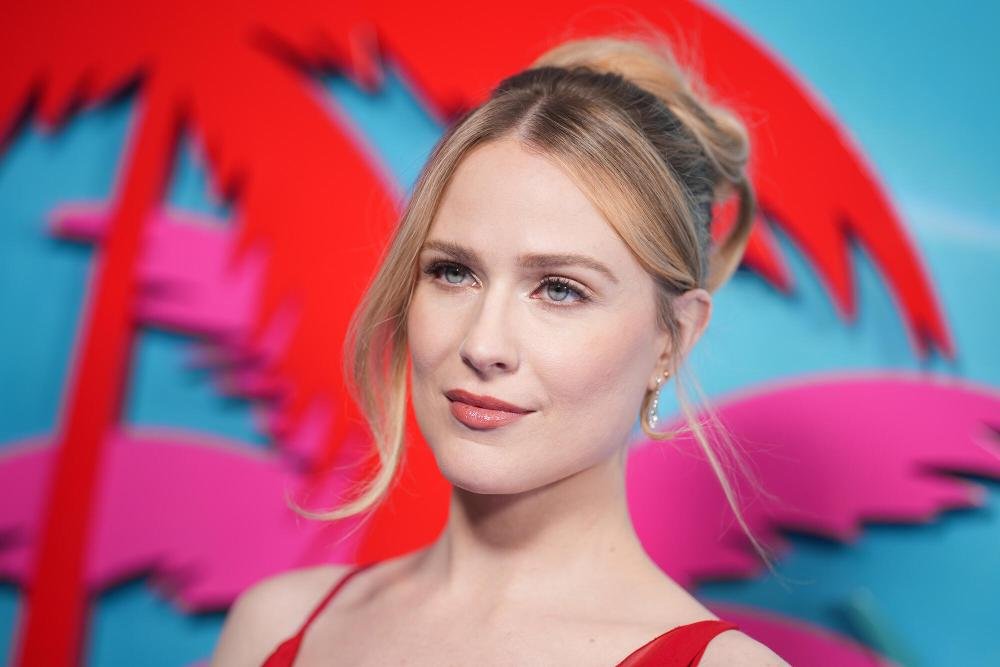
Evan Rachel Wood isn’t among the “Practical Magic” cast members returning for the forthcoming sequel — and she’s opening up about her disappointment. Speaking to “Entertainment Tonight” at the red carpet premiere of her new series “The Shards,” Wood called it “sad” not to be asked back for “Practical Magic 2.”
“It is sad, because we bonded with that cast so much as children, and so to miss out on the opportunity to look at that cast and look at that house as an adult and see the history in our eyes, it’s something that can’t be faked,” the actor said. “I’m sad that doesn’t get to exist, especially for the fans.”
In the 1998 movie, Wood and Alexandra Artrip played Kylie and Antonia Owens, the daughters of Sandra Bullock’s witch character. In the sequel, Wood is replaced by “The Act” star Joey King, while Artrip’s younger-sister character is played by “Game of Thrones” standout Maisie Williams.
The sequel, out September 11, is adapted from “The Book of Magic” by Alice Hoffman, a sequel to her own novel “Practical Magic,” which inspired the first film.
“I read the book and it seems like they’re not following the book,” Wood said. “I think in the book it would have made sense to bring me back; I think in the way they’re redoing it and approaching it, it didn’t make sense.”
This isn’t the first time Wood has spoken out about the film; last year, she wrote on Instagram” “I offered my services, even if it was one scene or one line. I was told they are re-casting. I am sorry to disappoint the fans. It was not in my control or my choice. I would have happily rejoined my sisters.”
Returning cast members include leads Bullock and Nicole Kidman as sisters and fellow practitioners of magic, as well as Stockard Channing and Dianne Wiest as their loopy aunts. Wood, who was 11 when “Practical Magic” came out, counts the movie as one of her very first roles; among the leading child stars of her generation, she went on to appear in “Thirteen,” “The Upside of Anger” and the TV series “Once and Again” before making the transition to grown-up stardom on “True Blood” and “Westworld.” Literary adaptation “The Shards,” on which Wood plays a wealthy L.A. mom in the 1980s, debuts on FX August 5.
Claude Opus 5 “one-shotted” a first-person shooter game with a prompt so simple, and results so impressive, people are struggling to believe it.
Others have rerun the prompt and the results check out.
Matt Shumer, the maker of the Claude-assisted game, calls the method a Gauntlet Loop: give an agent a real bar to beat, split the work among fresh critics, and never let the builder grade its own homework.
Just two days after Claude Opus 5 shipped, AI investor and former HyperWrite CEO Matt Shumer posted a video of a fully playable first-person shooter the model had built entirely on its own.
“Claude Opus 5 one-shotted this game,” he wrote, adding that not a single external asset made it into the build.
Now, you may think such a good quality output required a long, detailed, and careful prompt to guide the AI models through the complexities of building a polished first-person shooter.
Think again.
Claude Opus 5 one-shotted this game.
EVERYTHING you see in this demo is custom code… not a single external asset was used.
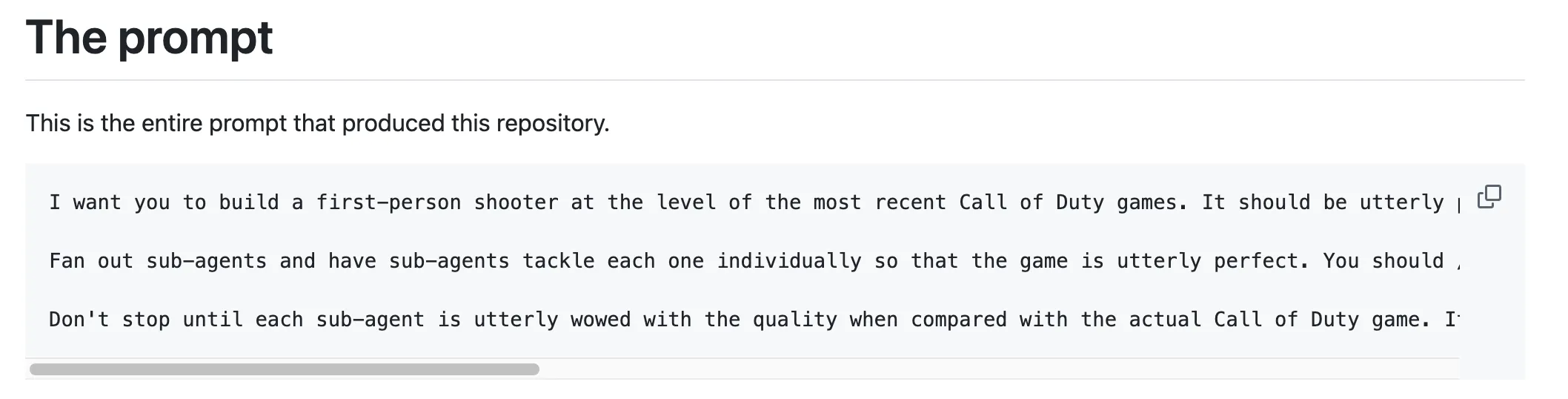
The prompt behind it ran three short paragraphs, published in full on GitHub. It told Opus 5 to build a shooter at the level of the most recent Call of Duty games, to fan out subagents—workers that each get their own separate memory and a narrow job—to tackle pieces individually, and to keep looping on every piece with a separate, harsh critic until it held up against real Call of Duty footage in a blind side-by-side. The result, per the prompt, should be “utterly perfect.”
That’s a reversal of how prompt engineers have taught people to work. The advice through the vibe-coding boom was to specify criteria instead of adjectives: say what “good” means instead of just asking for it. What should the code consider instead of saying “AAA.”
Shumer’s version does close to the opposite, asking its own subagents to be “utterly wowed,” and leaving the actual definition to a critic Opus 5 built for itself.
That was close to the entire brief. Shumer later wrote that he never specified the renderer, listed the game’s systems, or defined what “AAA quality” needed to include. He has started calling the approach a Gauntlet Loop: hand an agent a real, inspectable bar instead of a vague instruction, let it split the job into small pieces, and route each piece through a critic that never sees the builder’s own reasoning for its choices.
Two Claude Code features carry that loop. Subagents spin up in isolated context windows with their own instructions and tool access, so a critic grading the weapon model doesn’t inherit the builder’s excuses for why it looks the way it does. Ultracode is a Claude Code setting that pushes the model to its top reasoning effort and lets it write its own orchestration plan, fanning work across as many as 16 agents at once, capped at 1,000 per run.
Anthropic’s built-in /loop skill, built for repeated fix-test-adjust cycles, is what kept the run from stopping the moment the game looked decent. Shumer never specified a number of rounds. He let the critic keep naming a new gap and kept the builder chasing it for hours before he closed the session himself.
The finished build runs on Three.js and plain WebGL2, with roughly 55,000 lines of code spread across 11 subsystems. Every texture, mesh, animation, and sound gets generated inside the browser at load time—no downloaded models, HDRIs, image files, or audio files. Shumer’s own published critic log shows the score climbing from 3.59 out of 10 toward just above 5, still trailing the real game every single round.
Skeptics assumed hours of hidden manual coding, so Shumer published the entire prompt and codebase. That’s when the copycats started.
Same trick, three different builders
James Altucher, the former hedge fund manager and podcaster, ran the identical prompt and reported spending “a little over ten hours” and roughly 1.3 million tokens on Opus 5 to get there. His build, Operation Blackout, plays free in the browser and looks awesome.
The developer of Prompt Silo, pointed the same request at OpenAI’s rival flagship instead, posting “Sol 5.6 Ultra with same prompt”—Sol being the top tier of the three-model GPT-5.6 family OpenAI made generally available July 9 alongside cheaper Terra and Luna versions.
Developer Leon Lin tried the opposite move, going for the usual detailed prompt. Rather than copy Shumer’s short version, he set out to “reverse engineer a prompt for this game,” producing a document running some 20 sections deep that spells out everything from ragdoll physics to cascaded shadow maps. He fed that into Cursor using plain Opus 5 on high effort, with no subagents and no ultracode, and the result—a market-street shooter called Dust Corridor—plays in-browser too, and also looks great.
None of the follow-up builds has faced the blind test Shumer ran on his own project. His critic log still shows real Call of Duty winning every round he logged—the bar Altucher and Atom Tan Studio are chasing with his exact three-paragraph prompt, and the one Leon Lin is chasing with roughly 20 sections of his own.
How much of this is actually new?
Agentic coding tools like Claude Code write software the way a supervised junior engineer might: They read files, run code, look at the screenshots they generate, and hand pieces of the job to subagents and critics that check the result against a stated goal. That loop is real, and Shumer’s Gauntlet Loop is a genuine way to structure it. None of that, on its own, proves the model designed a game from imagination rather than recombining code patterns it had already absorbed.
Three.js ships its own pointer-lock camera controls as an official example, and that base pattern—mouse-look, WASD movement, raycasting for gunfire—has been forked and tutorialized across GitHub, gists, and dev forums for more than a decade. A coding model trained on public repositories has almost certainly seen hundreds if not thousands of near-identical shooters before it ever read Shumer’s prompt.
That doesn’t make Claude of Duty fake, but it makes “built from scratch” a harder claim to fully credit, so take those results with a grain of salt.
Researchers who study code-generating models have a name for the broader issue: data contamination, when a model does well on a task mainly because near-identical examples already sat in its training data, not because it reasoned out something new.
None of the first-person shooter builds published a check for that kind of contamination. Shumer’s own repo does contain Claude’s own creativity, if it’s fair to call it that way. That’s a reason to read “one-shotted a AAA game” as a capable agent working inside one of the most heavily documented genres in programming, not as proof an AI designed a shooter with no prior art to lean on.
Daily Debrief Newsletter
Start every day with the top news stories right now, plus original features, a podcast, videos and more.
“I’m just fully ready to get it out there and see who’s mad at me,” Barone tells Variety over Zoom with a sly smile. For the comedian and actor — who got her start in the New York City club scene before breaking through with comedy podcasts “Obsessed” and “Ride” alongside collaborator and bestie Benito Skinner — this moment has been a long time coming.
Over the past two years, Barone had been workshopping material for a potential special while touring, and decided last summer to start putting feelers out to buyers. Then, things happened fast — a few weeks after an L.A. gig in August, Netflix called.
“I don’t feel excitement very much, but that was a moment where I was like, ‘Holy shit, this is actually happening,’” she says. “It’s such a career milestone for any comedian and I just felt like, ‘Woah, they said yes.’”
But that doesn’t mean that Netflix is safe from being the butt of Barone’s jokes. In the first 10 minutes of “Galaxy Brain” — filmed at New York City’s Skirball Center in March — she razzes the streamer for the rarity of women-led specials and riffs on their advice for winning over viewers. It sets the tone that Barone is willing to go there, and over the next hour, no topic is off limits as she tackles bad behavior from the men in her field, Ozempic, sex, politics and more.
“I’m sure some of [the jokes] will be a little bit shocking, but I think women and queer people get shit on enough,” Barone says. “And it’s time to shit on people back.”
Below, Barone tells Variety more about “Galaxy Brain” (out now on Netflix), making jokes she wouldn’t be able to say online and what’s in store for Season 2 of “Overcompensating,” the Prime Video comedy series she co-writes and stars in with Skinner.
Mary Beth Barone before the “Galaxy Brain” taping.
SIDEWALKKILLA
What was your process for workshopping material for the special, and how much did it change?
When I first started doing the hour, I would say it was probably 90% different material. Obviously, our lives are constantly changing and I always want the set to feel current but also sort of evergreen. So if there’s any topical references, just making sure that will be relevant whenever it comes out and as long as the special is available — I guess until we all drown from global warning when the sea levels rise. It’s a tough process because sometimes there’s jokes that you love that just weren’t playing as well. But I wanted to balance anything topical with things that happened a really long time ago, so the Triangle Shirtwaist Factory, for example, or Jack the Ripper, things like that that are sort of timeless in their own way. I think one of the only super topical references was “Wicked,” and I thought about changing that out to be something that happened more recently — but then I just thought like, “Wicked” is forever.
You don’t hold back in “Galaxy Brain.” In the beginning of the special, you point out how rare it is for women to actually get Netflix specials and share advice they gave you for winning people over within three minutes. Why was it important for you to cheekily call that out?
They were really great about… they didn’t have me cut anything. They definitely gave me some best practices — that thing about getting people’s attention in the first three minutes was an actual conversation that we had. And I’m a good student, so of course I was going to try to do that. I used to have a joke in the beginning of the set that was poking fun at cities that aren’t New York, L.A. or Chicago, and they said, “You have three minutes to catch people’s attention, to win them over. You don’t want to alienate them right away.” So it was genuinely me on tour trying to figure out what to say in three minutes to make people want to keep watching, and working that into the set just felt really natural.
I think there’s a lot of edgy moments in the special. I want it to feel cheeky and also like, stand-up is such a specific performance piece that I can’t imagine going on stage and just launching in and not acknowledging the moment — that we’re all in a room together and I have a microphone and I’m going to try to make you laugh now.
Do you think the situation for women in comedy is improving at all?
The internet, of course, has done really, really good things for comedy and then some not so good things for comedy. But what’s great is it’s made comedy more democratic, because people can start with live performance and post online and then they create their own audience; the right people find them. And I think that’s translated into having more women and queer people who are stand-up comedians that can tour and support themselves financially. That’s been really fun to watch since I started comedy, when it was dominated by the club scene and if you couldn’t get in there and work your way up and be one of the boys, there was less opportunity. Now with all these indie venues — especially in New York and in so many other cities like Pittsburgh, Denver, Chicago — it’s been wonderful to be surrounded by more and more women and the LGBTQ+ community, because those are the people that I want to make laugh and those are the people that I want to be friends with.
You also don’t shy away from calling out male comedians.
They’re some of the worst people that we have!
You mention specific people, including Chris D’Elia, and later jokes mention J.K. Rowling, Woody Allen, Mark Zuckerberg and more. How did you decide who to call out specifically?
I wanted to strike a balance between cultural references and general experiences and moving through the world with my unique point of view, but there were just certain names that I felt like belonged in the canon of this special. What I try to do is write the joke about that person that no one else would or could write. So I do hope that’s where I landed with these ones, and I’m sure some of them will be a little bit shocking, but I think women and queer people get shit on enough and it’s time to shit on people back.
Mary Beth Barone in “Galaxy Brain.”
Courtesy Netflix
There are some jokes in the special that you say you wouldn’t be able to post online, including one about Ozempic that riffs on Kim Kardashian’s infamous “get your fucking ass up and work” quote — which she said to Variety, by the way. What’s the line for you when it comes to risky jokes and possibly offending people?
Here’s the thing about that — I understood what she meant and I think it started a conversation. And that, to me, is a successful interview.
With that joke specifically, part of what is so almost absurd about it is that it probably will end up online with a comments section, and that’s just part of putting out a special these days … But I think for me it’s like, of course I’m going to explore uncomfortable topics at times, but I don’t find joy or feel a sense of accomplishment punching down. I always want to feel like my jokes are punching up. And sometimes you find just by doing the jokes that they’re not always on the correct side of that line. But yeah, it’s difficult. I want to make the right people uncomfortable, and I want to offend the correct people. Sometimes it is trial and error.
Since the internet is forever, what’s your advice for comedians coming up now when it comes to navigating social media?
I’m sure there’s an instinct if you’re starting out to just post as many clips as possible and try to gain traction that way. But I would say that there’s no substitute for experience and stage time, and the more real-world experience you can get playing off of an audience — you need that foundation because you can’t really fake that.
And the comments section is always something you can look away from. I really struggle with that; I read comments. I’m trying to stop, and I’ve definitely created more boundaries for myself. There’s more and more people that I meet in the industry who don’t have internet access or they don’t use social media at all, they pay someone to post for them. It’s hard as a comedian, because I want my online presence to be an extension of me and feel very authentic, but I know people reach a limit where it’s just not healthy. I can, even now where I’m at, see how people completely lose themselves and their grip on reality … So I feel a lot of gratitude that things have happened really gradually for me. I’m 35 now, so I have so many friends from before, I have an amazing family, I have a lot of support and people that I can surround myself with that are not in the industry to ground me.
I do believe that the age you blow up at is the mental age you can be stuck at forever.
The other side of that too, which we see especially with comedians, is potentially a level of being out of touch where you have to fall back on just being offensive in order to feel like you’re saying something. So my pledge to the public is that if I ever reach a point where I can’t write about something that’s relatable, I just won’t do a stand-up special. I think when you have a totally frictionless life and you’re flying in a private jet everywhere and everyone around you is just saying yes to your every whim, that’s probably when you should just sit back and count your money and leave the public alone.
You’re wearing a stunning dress in the special. Who designed it and what inspired the look?
That is a dress by Jackson Wiederhoeft. We met with their team last year — pretty much as soon as we knew we were going to make the special, I knew that I wanted them to design the dress. And so the references that we gave were the dress in “The Little Mermaid” when she comes out of the water; so fabulous, so beautiful, burned in my brain as a kid. And then Megara from “Hercules” also sort of came in as a reference. I knew I wanted it to be lilac, and it was actually such a specific color that they had to custom dye the fabric and just completely blew me away with what they were able to create. And then on the corset, we had beading done in the shape of the Gemini constellation — because I’m a Gemini — so that felt like a fun tie-in to the sort of overall theme.
I also want to ask about “Overcompensating” Season 2 because I know you just wrapped filming. What can you tease about Grace’s arc this season?
It’s sadder but also funnier. What was cool about arriving to Season 2 was that the characters already felt really lived in, so Benny’s approach was like, what can we do that’s surprising but also fan service? I do think the direction it goes is going to surprise a lot of people, but I can say I have a really wonderful love interest this season and I am excited to see it on screen.
Perpetual futures have become one of crypto’s defining financial products, but DRW CEO Don Wilson says much of what people think they know about them is wrong.
In a series of posts on X, Wilson argued that perpetual futures — or “perps” — are simply futures contracts without an expiration date. The features often associated with crypto perpetuals, such as high leverage, auto-deleveraging (ADL) and around-the-clock trading, are characteristics of how some crypto exchanges chose to implement the products, not the contracts themselves.
“Most of what people think they know about ‘perps’ … has nothing to do with the contract itself,” Wilson wrote.
His comments come as interest in bringing perpetual futures into regulated U.S. markets continues to grow. Several exchanges and market participants have explored launching perpetual futures beyond crypto, though questions remain over how the products should be regulated and whether they fit within existing futures or swaps frameworks. Kalshi, which saw perps trading explode shortly after launching, recently submitted a proposal with regulators to expand its offerings to precious metals.
Unlike traditional futures markets, crypto exchanges like Hyperliquid operate continuously, use digital collateral and can calculate margin requirements in real time. Those technological differences allowed exchanges to offer products with higher leverage and alternative liquidation mechanisms, including ADL, which automatically reduces winning positions when losing traders cannot cover their losses.
Wilson said those design choices should not be confused with perpetual futures themselves.
“I’m not a fan of ADL,” he wrote, adding that there is “no reason it needs to be used for perps.”
Instead, Wilson argued that digital payment rails create opportunities to improve risk management. Traditional clearinghouses generally calculate margin once a day, with market participants often having until the following business day to post additional collateral. Because markets can move significantly during that window, clearinghouses require relatively large initial margin buffers.
With real-time settlement, however, exchanges can recalculate margin continuously and require traders to post collateral immediately, reducing the need for large upfront margin requirements while maintaining the same level of protection, Wilson said. Whether exchanges choose to translate those efficiencies into higher leverage is a business decision, not a defining feature of perpetual futures.
Wilson said the real innovation of perpetual futures is that they eliminate the need for investors to repeatedly roll expiring contracts, reducing transaction costs, market impact and roll slippage while allowing positions to more closely track the front of the futures curve.
He also urged regulators to focus on economic substance rather than legal labels.
“There’s no reason to treat perpetuals as swaps simply because they don’t expire,” Wilson wrote. “Economically, they’re futures.”
Wilson concluded by calling for perpetual futures to be available across a broader range of markets, including commodities, securities and crypto, arguing that they should be viewed as another tool for price discovery and risk management rather than as a crypto-specific innovation.