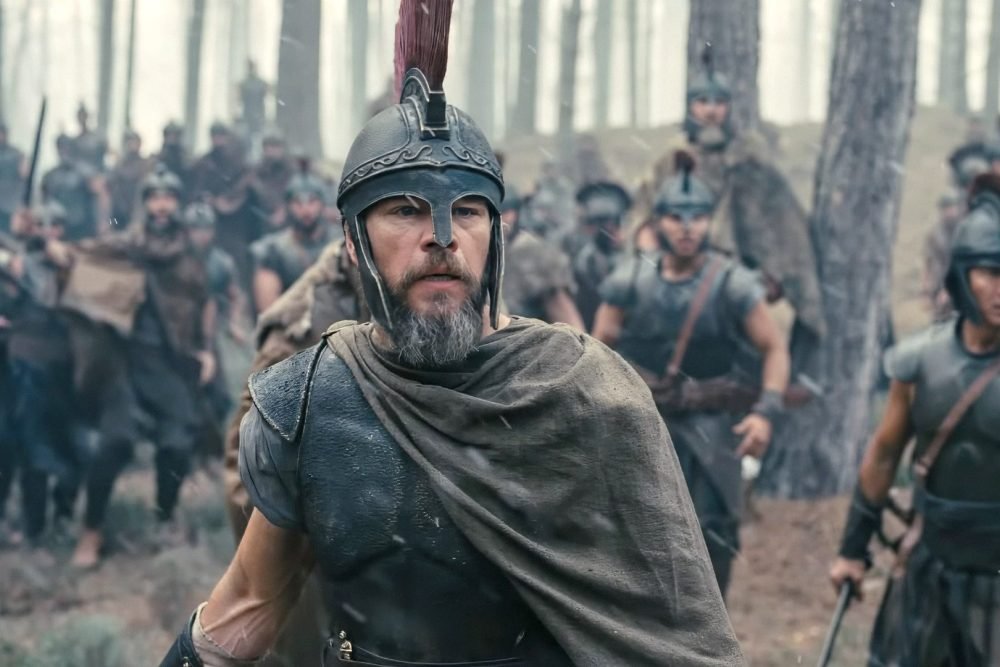
Ahead of its premiere, Dave Filoni has revealed that the Star Wars animated series Maul: Shadow Lord will return for a second season. The Lucasfilm co-president revealed that season 2 is already in the works, telling Esquire that “at the end of the day, people like that character.”
Filoni didn’t reveal any other details about the plot or release date for season 2. However, the news isn’t a great surprise given Lucasfilm’s past history with its animated series — The Clone Wars ran seven seasons, Star Wars Rebels four seasons, Star Wars Resistance two seasons and Star Wars: The Bad Batch three seasons.
Maul: Shadow Lord explores the Zebrak Sith Lord’s story about a year after the time of the Clone Wars. Season 1’s 10 seasons will stream twice a week on Disney+ starting on April 6 and run through May 6. It covers Maul’s plot to rebuild his criminal syndicate “on a planet untouched by the Empire,” according to Lucasfilm. “There, he crosses paths with a disillusioned young Jedi Padawan who may just be the apprentice he is seeking to aid him in his relentless pursuit for revenge.”
Bitcoin becomes the live market over Easter as oil shocks hit and traditional finance goes dark
The Bitcoin market now has three trading days where it will act as the live venue for geopolitical risk while much of traditional finance is closed.
As of Friday, April 3, Wall Street is closed for Good Friday; several other markets are shut or thinner than normal; and the macro backdrop has become harder, rather than easier, to price.
Iran launched missiles and drones at Israel and the Gulf states. Fires were reported at Kuwait’s Mina al-Ahmadi refinery. The Strait of Hormuz remains the central transmission line through which geopolitical risk is moving into oil, inflation expectations, and broader macro sensitivity.
At the same time, WTI surged 11.4% to $111.54, and Brent rose 7.8% to $109.03 in the latest repricing move.
Bitcoin, by contrast, remains open and is still clearing over $33 billion in volume over the last 24 hours.
It is trading around $67,150 after an intraday range of roughly $65,780 to $67,373.
$BTC/USD chart showing Bitcoin trading near $66,946 with key support and resistance levels marked.
Availability has become part of the market structure
Throughout 2026, Bitcoin has functioned less like a thesis trade and more like a weekend stress monitor.
So what happens when the world gets a fresh geopolitical shock, oil gaps higher, and many of the usual venues for price discovery are closed for a long weekend?
Put simply, Bitcoin’s role here comes from availability rather than ideology.
When cash equities are closed, parts of the commodities complex are offline, and broader liquidity is fragmented by a holiday calendar, Bitcoin becomes one of the few major liquid assets still offering continuous two-way pricing.
In that sense, the market is using $BTC as an immediate expression of changing sentiment.
Thin conditions can amplify moves. Crypto-native positioning can distort the signal. Weekend liquidity is not weekday liquidity. But none of that erases the core point.
If the next leg of geopolitical stress lands while traditional markets are dark, Bitcoin may be the first place investors see an immediate price response rather than the last place they confirm it.
The transmission mechanism is oil, and then rates, inflation expectations, and the dollar.
Oil first, then rates, then validation
That ladder matters. First comes the direct energy shock. Then comes the inflation read-through. Then comes the policy question.
If oil remains elevated because the Strait of Hormuz stays constrained or infrastructure damage widens, the inflation impulse becomes harder to dismiss as temporary.
That can move yields. It can support the dollar. It can also remove some of the macro oxygen that speculative assets need.
Bitcoin sits inside that chain whether crypto investors want it to or not. The move in crude is the mechanism through which geopolitical stress becomes a financing and liquidity question for the wider market.
In that sense, $BTC is trading the same macro regime that households, bond markets, and central banks are trying to map. No single directional verdict follows automatically for Bitcoin.
If oil keeps repricing higher and the market starts to harden again around a higher-for-longer policy, $BTC will have to show it can absorb a tougher liquidity backdrop rather than merely survive a geopolitical shock.
Holiday calendars are usually treated as scheduling details. This time, they are part of the structure, with a split between assets that can update instantly and those that cannot.
In closure windows, Bitcoin serves as a temporary price-discovery layer for global stress, even if it is not the final destination for defensive capital.
That is a narrower and more defensible claim than saying $BTC leads all other markets.
Monday’s reopening can always revise the message.
Equity futures can reopen in a different register. Oil can extend or retrace. Bond desks can reset the macro interpretation. But the availability premium still carries weight.
An open market has the first chance to express fear, relief, or confusion. This weekend, Bitcoin plays a more prominent role in that function than ever before. Even after multiple weekends of Bitcoin absorbing geopolitical developments.
The macro complication is that the geopolitical picture is landing into scheduled economic risk rather than replacing it.
The U.S. March jobs report is due Friday morning, with economists looking for a modest rebound after February’s weather- and strike-distorted weakness.
ADP showed 62,000 private-sector jobs added in March, which is not hot enough to settle the policy debate but not weak enough to clear it either.
That leaves Bitcoin trading into a layered setup.
First, there is a live war risk. Second, there is a live oil shock. Third, there is an incoming labor print that could still affect how quickly the market relaxes on rates.
That is what makes the current weekend different from a routine risk-off spell.
What Bitcoin is showing now, and what still needs confirmation
Bitcoin around $67,000 is a dangerous level for such a potentially volatile long weekend.
$BTC has already absorbed a material oil repricing move, a worsening geopolitical backdrop, and the closure of major traditional venues without losing continuous market function.
Bitcoin is acting as an open circuit for macro stress at a moment when other circuits are partially unavailable.
Being an open circuit does not make $BTC a safe haven, a superior hedging tool, or predictive in any strong causal sense.
It does mean the asset is temporarily serving a role that goes beyond the usual crypto narrative. It is one of the few major markets still speaking.
The clear way to assess Bitcoin over Easter is through three layers: availability, transmission, and validation.
The framework is historical first and causal second.
It organizes the next 48 to 72 hours without pretending Bitcoin has become an oracle for all global assets.
First comes the live signal. Then comes the cross-asset confirmation. Then comes the question of whether the move will be accepted once the full market returns.
Bitcoin will likely trade reactively to developments around Iran, Hormuz, and oil, while investors treat the market action as an early signal rather than a settled verdict.
If there is de-escalation or at least stabilization from some relief around Gulf infrastructure, fewer signs of direct spillover, and an oil market that stops repricing upward in an orderly fashion, then Bitcoin’s resilience through the closure window could be constructive rather than fragile.
However, if the conflict expands further, refinery damage worsens, or the NATO call on opening the Strait of Hormuz by force goes badly, the market may spend the weekend repricing in light of a more durable inflation shock.
In that environment, Bitcoin faces the harder test. It would have to trade through a rising oil regime and a tightening macro backdrop simultaneously.
That leaves the next test unchanged. The first move will have value, but acceptance on Monday carries more weight.
If Bitcoin continues to absorb the Easter weekend stress while oil, war risk, and the jobs narrative stay unresolved, the market will use $BTC price as a barometer for Monday’s open. However, anything that happens this weekend could easily be reversed and repriced within moments of Monday’s pre-market open.
Until then, the market is left trading signals without confirmation, more of a placeholder than a conclusion.
The question is whether Bitcoin is delivering something real, or just leaving a trail of clues for others to interpret, like an Easter bunny that may or may not have actually passed through.
K-pop agency SM Entertainment has announced that Mark Lee is departing the label and boy group NCT, along with its subunits NCT 127 and NCT Dream.
The 26-year-old’s exit from the group was announced in a statement released on the fan platform Weverse Friday afternoon Korean local time. “After a long period of careful and thoughtful discussion with Mark regarding his future activities, we have mutually agreed to conclude his exclusive contract as of April 8,” the statement reads. “Mark will conclude all activities as a member of NCT, including NCT 127 and NCT Dream.”
Lee has been a member of the now-24-member boy group NCT since its inception in 2016. The group introduced a first-of-its-kind system that broke it down into several smaller groups, known as subunits, which included both rotating and fixed member configurations. Earlier this week, Lee and the members of NCT Dream concluded their world tour with six shows in Seoul.
“Since his debut with NCT in 2016, Mark has demonstrated exceptional talent and versatility through both group and solo activities and has delivered remarkable performances over the years,” SM Entertainment said in the Weverse statement. “We are truly grateful for the time he spent with us, and we wholeheartedly support him as he begins a new chapter in his journey.”
The Korean label confirmed in their statement that NCT 127 will continue as a seven-member group (Johnny, Taeyong, Yuta, Doyoung, Jaehyun, Jungwoo and Haechan) and NCT Dream will continue as a six-member group (Renjun, Jeno, Haechan, Jaemin, Chenle and Jisung).
Lee took to Instagram to share a message to fans in both Korean and English. “Out of all the things my heart wants to say right now, I truly wish to say thank you. Thank you for loving, supporting and shaping me to become who I am today,” he said in the post.
“I will never forget the pieces of love and truth each and every Czennie (NCT’s fanbase) gave me. I’m not playing here, and I am for sure not playing with your guys’ hearts,” he later said in the post, which several members of NCT commented under showing Lee support. “You guys make me want to be a better person, and I hope my decisions in life can only become a positive impact to anyone watching.”
Lee released his first solo album, The Firstfirst, nearly one year ago in April 2025. “I think this album helped me find myself,” the Canadian-born rapper told THR ahead of that release.
Ten Muslim civil rights groups have issued a joint letter denouncing the arrest of a Palestinian American community leader in Wisconsin, Salah Sarsour.
The president of the Islamic Society of Milwaukee and a vocal Palestinian advocate, Sarsour was reportedly pulled over by 10 federal agents from Immigration and Customs Enforcement (ICE) while driving on March 30.
Recommended Stories
list of 3 itemsend of list
The joint letter explains that Sarsour was transferred to a detention facility in Illinois, then to Indiana, leaving his family “scrambling to determine his whereabouts”.
A lawful permanent resident, he had lived in the US for 32 years, according to the letter, and his wife and children are all US citizens. Sarsour has been in immigration detention ever since his arrest.
“We must be clear that Salah is being targeted on the basis of his Palestinian and Muslim background,” the letter, issued Thursday, said.
It was co-signed by organisations including the Council on American-Islamic Relations (CAIR), the Muslim Legal Fund of America, and the US Council of Muslim Organizations.
The groups noted that, under President Donald Trump, a number of immigrant activists, scholars and foreign students had been targeted for deportation based on their pro-Palestinian solidarity.
“His detention reflects a troubling trend we’ve seen with Mahmoud Khalil, Leqaa Kordia, Mohsen Mahdawi and other voices critical of Israeli oppression,” the groups wrote.
“This administration is weaponizing the U.S. justice system to advance the interests of a foreign state, Israel, at a time when it is carrying out a genocide in Gaza.”
The groups have launched an online campaign for Sarsour’s legal defence. By Thursday afternoon, it had earned over $35,500 in donations.
While the Trump administration has yet to issue a statement about Sarsour’s arrest, it has taken a hardline approach to pro-Palestinian activism.
When running for re-election in 2024, Trump pledged to crack down on protesters denouncing human rights abuses during Israel’s genocidal war on Gaza.
According to statements obtained by the Washington Post in May 2024, Trump reportedly called the protest movement a “radical revolution” and said that, if he were elected, he planned “to set that movement back 25 or 30 years”.
Within months of taking office in January 2025, Trump proceeded to take action.
Starting in March 2025, his administration moved to strip hundreds of millions of dollars in federal funds from universities that saw protests unfold on their campuses, citing claims of anti-Semitism.
Federal agents also arrested legal permanent residents like Mahmoud Khalil, a Palestinian student leader, stripping him of his green card.
One scholar, Rumeysa Ozturk of Turkiye, saw her student visa revoked for co-signing a pro-Palestinian opinion piece in her school’s student newspaper.
The arrests and subsequent efforts to rapidly deport the activists and scholars have prompted widespread condemnation as a violation of the Constitution’s First Amendment right to free speech and protest.
Officials in Wisconsin have been among the leaders to denounce Sarsour’s arrest as the latest in a series of efforts to stifle free speech. Two local alderpersons, JoCasta Zamarripa and Alex Bower, called the situation a “nightmare”.
“This is an illegal detention of a longtime permanent U.S. resident, as Mr Sarsour is a Milwaukeean who is lawfully present in our community,” they wrote in a joint statement on Thursday.
“The unacceptable activities by ICE — and especially illegally detaining citizens without due process — must stop immediately. How dare federal ICE agents come into our community and unlawfully detain a grandfather, a faith leader, a Wisconsinite!”
State Senator Chris Larson, meanwhile, underscored that the federal government has yet to offer any reasons publicly for Sarsour’s arrest.
“We have already seen numerous Muslim activists unfairly and unlawfully targeted by the Trump Administration for their beliefs and their speech,” Larson wrote.
“These Unconstitutional assaults on our freedoms should alarm all of us. When any individual or group is targeted by the government for their speech, all of our freedoms are threatened.”
Former clerk Tina Peters has become a cause celebre for the election denial movement and President Donald Trump.
Published On 2 Apr 20262 Apr 2026
An appeals court in the state of Colorado has ordered the resentencing of Tina Peters, a former county clerk convicted of involvement in an election meddling scheme in the United States.
The court overturned Peters’s nine-year prison sentence on Thursday, but not her conviction for helping to tamper with voting machines after the 2020 presidential race.
Recommended Stories
list of 3 itemsend of list
Her case has become a cause celebre for President Donald Trump and the election denial movement, after it emerged that she was seeking evidence to support Trump’s false claim that his 2020 loss was due to massive fraud.
In Thursday’s decision, the three-judge appeals panel ruled that a lower court had considered Peters’s personal beliefs when deciding upon a punishment, thereby rendering the sentence improper.
“The trial court’s comments about Peters’s belief in the existence of 2020 election fraud went beyond relevant considerations for her sentencing,” the appeals court wrote.
The panel cited comments from Judge Matthew Barrett, who blasted Peters as a “charlatan” promoting “snake oil” claims.
“Her offence was not her belief, however misguided the trial court deemed it to be, in the existence of such election fraud,” the appeals court said. “It was her deceitful actions in her attempt to gather evidence of such fraud.”
Peters was convicted in August 2024 for helping someone from outside the government gain access to the Mesa County election system and make copies.
That person was affiliated with efforts to overturn Trump’s 2020 loss, and the copies they obtained were then shared on social media.
False claims that the 2020 election was marred by massive fraud have been a persistent fixation for Trump and his allies, even after his successful re-election in 2024.
Trump’s efforts to remain in office after his 2020 defeat were the subject of a 2023 criminal indictment brought by former special counsel Jack Smith.
He alleged that Trump led a criminal conspiracy to undermine the election process and rally supporters to overturn the results. Those charges, however, were ultimately dropped when Trump took office again in 2025, as the US Justice Department has a policy against prosecuting sitting presidents.
Since his inauguration, Trump has continued to push the claims he won the 2020 race. He has also used his allegations of fraud to demand greater control over the country’s election infrastructure in advance of the upcoming 2026 midterm elections.
In December, the president pardoned Peters, even though she was not in federal custody, and the presidential power of pardon does not extend to state crimes.
The appeals court panel confirmed on Thursday that Trump’s pardon had no impact on state offences.
“We have found no instance where the presidential pardon power has been stretched in such a way as to invade an individual state’s sovereignty,” the panel said.
State Governor Jared Polis suggested last month that he could consider clemency for Peters.
SPOILER ALERT: This post contains spoilers for “7:00 pm,” the 13th episode of “The Pitt” Season 2, now streaming on HBO Max.
Katherine LaNasa says that her charge nurse character, Dana Evans, on “The Pitt” would never use the word “triggering,” but the Emmy winner can’t help but reach for it when trying to grapple with the end of Season 2’s 13th hour on the clock. For two episodes now, Dana has been at odds with Robby (Noah Wyle), her strongest ally in the ED and the person who typically levels her out —a service she also provides to him.
But neither is operating at their best by 7:00 p.m. on July 4th. Specifically for Dana, she’s triggered on two fronts. After her student nurse Emma (Laëtitia Hollard) was attacked by a coked-out patient, one that Dana subdued with a punch and a mysteriously handy shot of Versed, she is struggling to find any sense of calm as she bats away the PTSD of her own attack last season.
“She’s incredibly off balance,” LaNasa tells Variety. “She’s still really reeling from that punch. She didn’t take care of herself. I think it’s part of why it was really important to her that the rape victim set herself up to be able to get justice for herself, should she change her mind. Because Dana didn’t do it. Dana didn’t press charges. That’s a fine choice if you want to make that choice. But I don’t know that it’s working out well for Dana.”
Adding to her defensive behavior is Robby’s persistent inquisition about the tactics she used to handle Emma’s attacker. Every time he tries to ask about why she had a sedative in her pocket or questions what really happened, she launches into her own line of questioning about Robby’s increasingly concerning mindset around his impending motorcycle-bound sabbatical.
By the end of Episode 13, she has confronted him yet again about his inability to clearly state the true purpose of his trip and his volatile anger over the state of the ED ahead of his impending absence. She reminds him that they can survive without him until he is back, just like they did when she quit last season following her own assault.
Warrick Page/MAX
“What if I don’t come back?” he responds in the episode’s final exchange, cutting to black on a stunned Dana’s face.
“I think that if he leaves, she’s there all alone, and Dana is a person who doesn’t face her own need for help either,” LaNasa says. “But more importantly, there is just something very organically stressed out about her with him not being OK and not making a commitment to come back. It’s that kind of unwillingness to answer me or sometimes even look at me. That would be her worst nightmare, if anything happened to him. They’ve been through this for decades together. It would be like losing a spouse in a way. So I think she’s just up to here with her inability to reach him. He’s vital to her.”
This isn’t the first shouting match they have engaged in this season, or even this episode. Their last few encounters have left Dana on the brink of tears or screaming in anger at herself in the bathroom. Robby, for his part, isn’t exactly smiling after each bout either. But this final talk of the episode is their most honest and alarming.
Before he even admits he might not come back, Dana tells Robby that he’s being overly confrontational and aggressive, and he needs to go home if that’s what he wants. Her exact words are that he needs a time-out, like she used to give her kids; he responds by telling her he doesn’t need a mother. He had one of those, he says, and she walked out on him.
In that moment, Dana learns something deeply personal about her friend and colleague that she never knew, and emphatically apologizes for stepping on an emotional landmine she didn’t know was there. Robby responds, “It doesn’t matter. Who gives a fuck?”
“I like that moment, and I try to just justify it for myself,” LaNasa says. “You could just assume that people weren’t close [with family], and if they didn’t ever open up about their parents or something, you just let it be. I don’t have much of a relationship with one of my parents, and most people don’t really know that about me. It doesn’t really come up, so it makes sense why it hasn’t for them.”
But for Dana, her maternal instinct toward Robby comes from a genuine place of concern that her friend has decided to take his own life. “There’s a kind of panicky desperation that he triggers in her,” LaNasa says. “I think the whole thing feels terrifying, and I think it’s also happening at a time when she doesn’t feel OK. I had a therapist once that told my husband and I, ‘You both can’t have a problem at the same time. Who’s going to be the one who listens?’ At this point for Dana and Robby, nobody can listen. Nobody’s doing OK. Nobody is the pillar.”
Even though they spend the episode oscillating between avoiding each other and going at each other, Dana never loses sight of her bedside manner. She joins Emma to continue their season-long care for the unhoused Digby (Charles Baker), whom they have bathed and now offer to give a haircut. As they gently ease him into the idea of tidying up his appearance, they talk about his family and his daughter’s wedding. Emma’s kindness toward him leaves Dana beaming, a mentor-mentee relationship that is often reserved for Robby and his residents. After worrying about her safety all day, LaNasa says it wasn’t hard to muster pride for the young woman sitting in front of her.
“It’s easy to feel,” she says. ”I also feel really proud of Laëtitia. She just graduated from Juilliard and walked onto the set. It’s incredible.”
In that scene, Dana pulls back the curtain on her own family, which she doesn’t often talk about and audiences have never seen, given the series’ four-walls, single-day framework. She mentions that she has cut her husband Benji’s hair throughout their entire marriage; she later mentions her children to Robby in their heated exchange. While the series has never drawn audiences a full family tree for Dana, LaNasa often thinks about who she is outside her pressure-cooker job. It’s second nature to her understanding of Dana, so much so that she can launch into it at a moment’s notice.
“Dana has a middle daughter that has been tricky,” she says. “That has caused her a lot of stress. You’re only doing as well as your kids. If one of your kids is doing poorly, that’s how well you’re doing. I think that she’s got a daughter that kind of keeps her a little on edge, and she’s always hoping that one’s OK. In my imagination, she is very close to her granddaughter. She has a 23-year-old granddaughter, and that’s someone that she’s looking forward to seeing on certain nights. Those are the nights that she comes over, and they have their movie and their pizza or whatever they do. They have their little rituals.”
For Dana’s husband, LaNasa doesn’t fully buy into the little insight the show’s writers have given him so far.
“I know they said that he would fly off the handle, but I would say that I generally view him as just a big, calm hunk of a man,” she says. “I think that Dana’s home is very tidy and kind of minimal, and I don’t think that she has bad taste. She just likes things calm. I think she likes her family to come over. But I think Dana is tired. Dana is really tired. I imagine, also, that she went to the family cabin out in the woods somewhere after she got punched, and she was going to take some time off. But because she wasn’t getting any help, she just really wasn’t doing well. One of her daughters was like, ‘This isn’t working for you. You need to go get some help.’ So I think she got some help. I just don’t think she got enough help.”
All of that informs the person who stands in front of Robby at the end of episode 13, pleading for him to be honest about what he really envisions for this sabbatical. LaNasa was nervous about the writers’ choice to give the sturdy duo of Robby and Dana so many hurdles this season, but she ultimately gave in to that freefall.
“Noah was really down for us to have conflict, and I said, ‘Let’s do it,’” she says. “I trust [executive producers] John Wells and R. Scott Gemmill immensely. I didn’t want it to come across that they’re nasty to each other. I want the audience to know and for the story to be that they love each other, but that they’re human and they’re struggling.”
The lifestyles of the rich and famous are so often discussed and portrayed that it feels tawdry. These stories become dull tapestries of self-absorbed people doing self-obsessed things. However, in his Apple TV dramedy, “Your Friends & Neighbors,” Jon Hamm manages to paint an intriguing picture of the ultrawealthy. The show is an in-depth, outlandish and witty depiction of some of the world’s most deplorable — and the other folks who happen to get sucked into their manic orbits. Created by Jonathan Tropper, Season 1 was a fascinating assessment of the fragility of the American dream. In Season 2, “Your Friends & Neighbors” gets more textured, showcasing a different level of affluence, the costs of lies and why wealthy white men, in particular, constantly fail upward. In the final episodes of “Your Friends & Neighbors” Season 1, Andrew “Coop” Cooper (Jon Hamm) is exonerated after being accused of killing a neighbor. He is also given the opportunity to return to his former employer, the prestigious hedge fund Bailey Russell. Getting cleared of a gruesome crime has boosted his social cache in his upper-class neighborhood of Westmont Village, a fictional New York suburb. But, turning down his old job as a fuck you to his former boss, Jack Bailey (Corbin Bernsen), who had so viciously ousted him in the first place, has left Coop exactly where viewers met him one year ago, financially strapped and playing pretend. Coop appears content to continue on with his new stream of income, partnering with Westmont house cleaner Elaina (Aimee Carrero) to rob his friends and neighbors of their most valuable possessions, and then pawning them on the black market. However, the arrival of a new billionaire neighbor, Owen Ashe (a perfectly cast James Marsden), quickly proves to Coop that being suspected of murder barely registers on the list of terrible things that could happen to him, especially when he’s too preoccupied providing a life he’s not certain he wants anymore. At first glance, Ashe appears to be a charming man-boy who throws his money around like tic tacs and acquires friends like collectibles. Yet, lurking just below the surface is something so devilishly disturbing and sinister that it unnerves even Coop. There is an sinister quality to the widowed father’s appeal wafting throughout the entire season. An absolutely sensational performance by Marsden proves that, as much as people think they know about the filthy rich, they actually don’t understand anything at all. Ashe easily reels in the Westmont residents, latching on to them so they can’t get away before his true nature emerges. Still, this 10-episode second season is hardly just the Coop and Ashe show. Amid an unexpected life change, Barney (Hoon Lee), Coop’s best friend and business manager, finds himself jumping over the line of morality even as his wife Grace (Eunice Bae) gets increasingly suspicious. Former NBA champion Nick Brandes (Mark Tallman) is moving on following a bad breakup with Mel (Amanda Peet), Coop’s ex-wife. Mel is adrift after getting fired from her job as a therapist and isolated from her friend group due to Coop and Sam’s (Olivia Munn) affair. She is also increasingly rageful, especially as perimenopause begins wreaking havoc on her body. Meanwhile, though Sam is a social leper in Westmont, Ashe’s interest in her may be the currency she needs to return to the in-crowd. This season also zooms in on Coop and Mel’s teenage kids, Tori (Isabel Gravitt) and Hunter (Donovan Colan), as well as Ali (Lena Hall), Coop’s sister, who is trying to find her footing without Coop looming over her. Season 2 fully leans into the outlandish. It has yachts, fancy cars, affairs and piles of dog shit. Yet, it is also surprisingly tender and reflective. Episode 6, “For Everything Else, There Was Bowling,” acts as an interlude in the season, reminding the audience that despite all of the privilege and chaos swirling around Coop, he’s only human and life, particularly the most devastating parts of it, touches everyone, no matter where they fall on the socioeconomic scale. In its second season, “Your Friends & Neighbors” ups the stakes, unveiling a world that Coop and his Westmont comrades hadn’t been privy to before. Though this season boasts several truly bonkers moments, particularly from Mel’s perspective, the series has never been more fun or shocking. It once again proves that with enough money and access, there are no rules, and the sky truly is the limit.
“Your Friends & Neighbors” Season 2 premieres April 3 on Apple TV with new episodes dropping weekly on Fridays.
Sony Interactive Entertainment, owner of the PlayStation brand, has acquired Cinemersive Labs, a UK startup developing tools to convert 2D photos and videos into 3D volumes. The startup team will join Sony’s Visual Computing Group, a research engineering team focused on graphical technology, including game rendering, video coding and generative AI models.
Cinemersive’s most recent product is a virtual reality app called Parallax that works as a viewer for parallax photos — three-dimensional images that you can peer around with natural head movements — captured using traditional smartphones and professional cameras with stereo lenses. The startup developed custom AI tools to convert 2D images into 3D volumes to make Parallax possible, and Sony apparently wants to apply that expertise to its own projects.
“Following the acquisition, the Cinemersive Labs team will join SIE’s Visual Computing Group (VCG) and contribute to our broader efforts in advancing state of the art visual computing within games,” Sony says. “This includes applying machine learning to enhance gameplay visuals, improve rendering techniques, and unlock new levels of visual fidelity for players.”
Machine learning has been a major focus of Sony’s efforts to improve graphical performance on the PlayStation 5 and future hardware. The PlayStation 5 Pro was designed around a new GPU, faster storage and PlayStation Spectral Super Resolution (PSSR), custom AI upscaling tech that let the console run games at a lower resolution and then upscale them to 4K. The company recently squeezed even more performance out of the Pro with an updated version of PSSR it released in March. And with AMD, Sony is working on Project Amethyst, a multi-pronged collaboration to improve ray tracing and upscaling on the future consoles.
For April Fools’ Day, the developer of Look Outside released an update that added a new option to your interactions with NPCs: kissing. Instead of just fighting or talking to enemies and surviving neighbors in the cursed apartment building, you could give ’em a smooch. Their dialogue and sprites were updated accordingly, too. Cue stammering eldritch horrors with bright red blushing cheeks. April Fools’ Day is (thankfully) over now, but there’s good news for anyone who has been enjoying the lovefest or didn’t get a chance to try it. Developer Francis Coulombe has built in a way for players to access “smooch mode” going forward.
“If you started a game on April 1st and kissed the wounded neighbor, that save file is now permanently in smooch mode!” Coulombe posted on social media. “You can also activate smooch mode on a new save file by naming Sam ‘Casanova’.” I immediately started a new save to confirm and, yes, doing this does indeed allow you to go on a kissing spree. While you can’t smooch every single person/abomination you’ll run into, you sure can kiss a lot of them.
Want to kiss the Rat King? Go wild. Pierre? Yup. That weird bug guy in the basement who eats bandages? Unfortunately yes, he’s kissable too. This truly is the game that keeps on giving. We’re apparently getting a real, non-silly update in the near-future as well, so Look Outside fans are eatin’ good. Now, please excuse me while I get back to my Kiss Everyone (except Lyle) run.
$ALGO broke out of a descending pattern and surged 20% into a fourth straight daily gain.
Price now tests the $0.10-$0.11 zone as trading volume falls and momentum meets resistance.
Open interest hit a yearly high, showing stronger derivatives activity despite spot caution.
$ALGO extended its rally into a fourth straight day after breaking above a descending pattern that had reinforced a bearish structure. The move turned market attention toward whether the token could preserve its momentum at a historically important price area.
The breakout was followed by a roughly 20% climb to about $0.1125, a zone last seen on Jan. 31. That level aligned with the 50% Fibonacci retracement and triggered a pullback of more than 5% from the local peak.
Resistance Emerges After Sharp Four-Day Advance
At press time, $ALGO traded at $0.1071, up about 5% over the past 24 hours, with a market capitalization of $953.15 million. The token still held most of its breakout gains even after easing from its latest high.
The broader weekly picture also reflected renewed strength. $ALGO posted gains of roughly 27% over the week, although it remained down about 38% on a year-to-year basis. That combination showed improving short-term sentiment against a still-weaker long-term backdrop.
Trading activity, however, did not fully match the price rise. Volume fell 22.16% to around $127.98 million, indicating that participation cooled even as the token advanced. The latest price action placed the asset inside a resistance zone around $0.10 to $0.11.
That range now stands at the center of the current structure. It capped the latest push higher and overlapped with the 50% Fibonacci level near $0.1126. The reaction there suggested that buyers met heavier selling pressure as the rally approached a key barrier.
Derivatives Data Shows Rising Participation
While spot volume declined, derivatives data pointed to stronger positioning. CoinGlass data showed open interest rising 5.52% over the past 24 hours to $56.72 million, its highest level this year.
$ALGO Derivatives Open Interest (Source: CoinGlass)
That increase indicated fresh capital entering the derivatives market rather than a wave of position closures. It also suggested that traders were maintaining exposure during the rally instead of stepping aside after the breakout.
Derivatives volume added to that picture. It climbed to $513.46 million, marking an eight-month high and showing elevated activity around the token’s recent move. The jump underscored how closely traders were following price swings near resistance.
$ALGO Derivatives Volume (Source: CoinGlass)
The recent bullish tone also drew support from a separate narrative around blockchain resilience. According to an official report, Google Quantum AI cited the project more than 32 times in a paper on quantum threats facing major blockchains.
The document placed the project just behind Bitcoin and Ethereum in references tied to proactive work on post-quantum cryptography. That mention added another layer of visibility as the market tracked the token’s breakout and derivatives expansion.
$ALGO Technical Readings Highlight a Crowded Zone
Meanwhile, from a technical standpoint, the daily chart showed RSI at about 70.82. That reading is commonly associated with overbought conditions and points to a market trading near an elevated momentum threshold.
The same reading did not erase the rally, but it showed that the advance had already become stretched by conventional momentum standards. With price holding near resistance, traders were left watching whether strength could persist without stronger spot participation.
$ALGO 1-Day Price Chart (Source: TradingVolume)
For now, the chart presents clearly defined reference points. Resistance remains concentrated around $0.10 to $0.11 and at the 50% Fibonacci level near $0.1126, while $0.1204 marks the 61.8% retracement above.
Below the market, the first support level sits around $0.0951, which matches the 23.6% Fibonacci retracement. A deeper support area stands around $0.08 to $0.07, a zone that has repeatedly contained this year’s downside pressure.
Also Read: Chainlink Price Falls 3.5% as Altcoin Selloff Intensifies