Yi, who is now the co-CEO of Binance alongside its other chief Richard Teng, still uses the name Marge in meetings and chats, a person who previously worked with her at the firm told CoinDesk. The fact that the Simpsons cartoon characters are yellow is a reference to the corporate color of the exchange’s logo and marketing, the person said.
CZ resigned as the CEO of Binance in November 2023 after the U.S Department of Justice alleged he violated the Bank Secrecy Act. He pleaded guilty and was sentenced to four months in prison in April 2024. In October 2025, the ex-Binace CEO was given a presidential pardon by President Donald Trump.
According to Forbes, Zhao is the richest Canadian and the 17th-richest person in the world, with a net worth estimated at $111.1 billion as of April 2026.
Up until recently, Yi maintained a relatively low profile at Binance, having served as the firm’s chief marketing officer.
In August 2022, Yi became the head of YZi Labs (formerly known as Binance Labs), a venture capital firm and family office associated with Zhao that invests in Web3, artificial intelligence and biotechnology companies.
It didn’t take long for the rapacious crypto memecoin ecosystem to swoop on the news and create meme tokens in honor of the crypto power couple’s Simpsonian masquerade.
A video shows Syria’s president using a Visa card, one day after the US removed the country from the State Sponsor of Terrorism list. US sanctions had banned Syrians from accessing the global banking system for more than 15 years.
Doppler Finance is preparing to launch its native token, XDP. According to the company’s statement, XDP is designed as a utility and governance token to be used in the coordination layer of the protocol.
Doppler Finance stated that XDP aims to increase user participation in the protocol, support decentralized governance, and contribute to the growth of the ecosystem. The total supply of XDP will be limited to 10 billion tokens. More than half of the supply will be allocated to areas such as ecosystem development, vaults, partnerships, and community growth.
It was announced that the shares allocated to investors in the token distribution will be subject to certain lock-up and vesting conditions. This aims to prevent all investor tokens from being released to the market at once and to encourage long-term participation.
During XDP’s token generation event (TGE), 1% of the total supply will be distributed in an unlocked state. The distribution, which will be carried out as part of the Genesis airdrop, will include early adopters, contributors, and participants supporting the Doppler Finance ecosystem.
In addition, 43% of the total supply will be allocated to ecosystem incentives. This share will be used to support future Doppler Points seasons, XDP staking activities, and community programs.
Doppler Finance’s token economy is structured to encourage user participation and the long-term development of the protocol, with a high level of ecosystem allocation being noteworthy. The Genesis airdrop will allow early users to directly benefit from the token launch.
With the launch of XDP, Doppler Finance plans to shape its governance mechanism and user incentives around its native token. More information regarding the launch date and technical details of the distribution is expected to be shared later.
Palestine Action co-founder Huda Ammori tells Jazeera that US sanctions designating the group a terrorist organisation will not deter its supporters or stop the group’s direct action plans against Israeli weapons companies.
California Attorney General Rob Bonta took a victory lap following a proposed settlement of up to $17 billion for claims brought by 51 attorneys general against Meta, suggesting that the parent of Instagram and Facebook realized that a trial was not going well for their side.
As Bonta went through details of the settlement, including remedies designed to limit mental health harms and social media addiction among children and teens, he told reporters, “It’s also telling that Meta settled midway through Instagram President Adam Mosseri‘s testimony and before CEO Mark Zuckerberg could take the stand.”
The company was defending itself in a trial that started on Aug. 18 in California.
On the stand on Tuesday, Mosseri at one point was questioned by prosecutors about a feature, called Take a Break, a pop-up message suggesting to young users that they the give the app a rest after a fixed period of use. An internal document showed that only 1.8% of teens actually used the feature. A blog post by Mosseri around when it was introduced said “more than 90%” of users of the feature kept it on. But, the state AGs noted, the executive did not indicate that a very small number of people actually used it in the first place.
“The trial was not going well for Meta. Having Instagram President Adam Mosseri giving testimony as we settled, it was not random … I think they were dying to have him get off the stand. It was not going well for him,” Bonta said.
The settlement agreement still has to be approved by a federal judge.
It includes a set of new restrictions that Meta will place on social media for users under 18, including a default daily time limit of two hours that can only be lifted by a parent. Other defaults are designed to limit use overnight and during school hours, and a ban on displaying numbers of likes or reactions for users under 18.
Bonta also talked of the next step in their litigation: TikTok.
“As big as Meta is, it doesn’t stand alone,” Bonta said. “We’re continuing our fight across social media, including our litigation against TikTok, and we’ll continue to demand better from all parts of this industry through our ongoing work with the legislature.” Bonta and other state attorneys general filed the TikTok lawsuit in 2024.
Bonta also vowed to defend SB 976, the Protecting Our Kids from Social Media Addiction Act, a new California law that is being challenged by tech giants on First Amendment grounds.
Bonta said that, with the Meta settlement, his “hope and my belief is that we will see commitments across the industry.” In addition to TikTok, he called out Snap and YouTube.
Bonta later said that although YouTube is not the “same in its model as Meta and TikTok,” there are “similar features and products that YouTube uses that are along the same lines that … are designed to create excessive compulsive use that lead to mental health harms, and most importantly that hurt our children, and can and should be changed.”
He added, “I think this …constellation of solutions in terms in injunctive relief that we’ve delivered here that apply to Meta, I really think that YouTube and Snap and TikTok should be thinking very closely about them and their commitment to adopt the same.”
Several of the changes Meta agreed too are partly contingent on other social media players signing on. For instance, a default daily time limit of two hours for users under 18 that can only be lifted by a parent, under the settlement, would drop to one hour If other social media platforms agree to similar terms.
And a default nighttime block between midnight and 6 a.m. for users under 18 that can only be lifted by a parent would expand to cover 10 p.m. to 7 a.m. if other social media platforms follow.
This case and others lodged against social media giants have been compared to transformative litigation against big tobacco companies in the 1990s. Asked if he agress, Bonta said: “I think there are some similarities. There are also some limits to those similarities … Regardless, this is a major moment to clean up an industry that has been hurting our kids.”
“So, in the way that the impact of the solutions delivered in [big] tobacco were good for health, good for kids, good for Californians and Americans, this is similar … It’s similar in that fact that it’s a number of AGs banding together, asserting ourselves, exerting our authority, demanding better, requiring accountability, and enforcing the law and delivering results. It’s similar in that way that Congress hasn’t been delivering and has left a vacuum and a gap, so that the state AGs stepped in.”
He added, “It deals with public health. Different issues, but public health issues broadly … But I think the most important thing to focus on here, whether it’s similar tobacco or not, is this is transformative. This is momentous. This is a major step forward in the ongoing quest and journey to make sure that our children are safe everywhere, including online.”
The settlement involved attorneys general from 47 states, the District of Columbia and U.S. territories.
DeFi Development Corp., the Nasdaq-listed company that has spent the past year turning itself into a $SOL treasury vehicle, just shipped a product that isn’t a token purchase. The firm launched State of Solana on August 26, a public dashboard that pulls together real-time data on the Solana network’s market trends, staking yields, validator performance, and broader ecosystem activity.
The pitch is straightforward: give investors a single pane of glass for Solana intelligence instead of forcing them to stitch together data from a dozen block explorers and analytics sites. Additional research tools are planned, though the company hasn’t detailed a timeline.
What the dashboard actually tracks
State of Solana consolidates metrics that currently live across scattered sources. Users can monitor staking data, validator decentralization, DeFi activity, and ecosystem growth alongside $SOL’s price action.
The timing lines up with some notable on-chain milestones. Solana’s total value locked in DeFi sits at roughly $10.15B as of August 2026. The network’s token holder count recently hit a record 176.5 million, a figure that underscores just how much the user base has expanded over the past cycle.
$SOL itself was trading around $96.61 at the time of launch, putting the network’s market capitalization near $56.36B. For context, that TVL-to-market-cap ratio of about 18% suggests meaningful capital is actually being deployed on-chain rather than just sitting in wallets.
The dashboard is designed to surface these kinds of relationships. Rather than treating price as a standalone signal, it frames $SOL within the network’s operational reality: how much is staked, how validators are performing, where yield is flowing.
DeFi Development Corp.’s bigger Solana bet
If the dashboard feels like a side project for a company whose primary strategy is accumulating $SOL, that’s because it kind of is. DeFi Development Corp. has been on a buying spree, amassing 2,311,523 $SOL in its treasury as of August 2026. The company has set a target of 1.0 $SOL per share by December 2028, essentially asking shareholders to evaluate the stock as a proxy for Solana exposure.
Think of it as the MicroStrategy playbook, but for Solana instead of Bitcoin. The company trades on Nasdaq under the ticker DFDV, with shares hovering around $4.58 and a market cap near $142M.
That market cap is worth pausing on. The firm holds over 2.3 million $SOL tokens worth roughly $223M at current prices, yet the equity trades at a meaningful discount to its net asset value. Part of that discount reflects the stock’s rough stretch: DFDV has fallen 67.9% over the trailing twelve months.
The company also operates in on-chain finance directly. Its dfdvSOL token can be used as collateral on Jupiter Lend with up to 92% loan-to-value ratios and a 93% liquidation threshold. Those are aggressive parameters that let holders lever up their $SOL exposure through the firm’s liquid staking derivative.
Launching a data dashboard, in this context, is less about building a SaaS business and more about strengthening the information layer around the asset class DeFi Development Corp. has bet its entire balance sheet on.
Why ecosystem transparency matters now
Solana’s growth over the past year has been impressive by the numbers, but it has also been messy. Network congestion episodes, validator concentration debates, and the memecoin cycle’s boom-bust dynamics have all raised questions about the chain’s long-term fundamentals versus its speculative appeal.
A dashboard that surfaces validator distribution, staking yields, and TVL trends gives investors the raw ingredients to form their own views on those questions. It’s the kind of infrastructure that institutional allocators tend to want before committing meaningful capital.
With 176.5 million token holders on the network, Solana’s retail base is already enormous. The gap has been in structured, accessible analytics for the segment of the market that runs due diligence before buying. State of Solana appears aimed squarely at closing that gap.
For DeFi Development Corp. specifically, the dashboard could serve a dual purpose. If it drives broader awareness of Solana’s on-chain health metrics, that awareness could indirectly support the investment thesis behind DFDV itself. A more informed investor base is, in theory, one that better appreciates the value embedded in a treasury holding over 2.3 million $SOL tokens.
The risk, of course, is that transparency cuts both ways. If Solana’s metrics deteriorate, the same dashboard will make that visible too, and for a company whose stock has already shed nearly 68% of its value over the past year, that kind of visibility could amplify selling pressure rather than build confidence.
Whether State of Solana becomes a go-to resource or fades into the crowded field of crypto analytics tools will depend largely on execution: how quickly new features arrive, how granular the data gets, and whether the platform can differentiate itself from established competitors like Dune, DefiLlama, and Solana-native explorers that already serve overlapping audiences.
Federal Reserve Chairman Kevin Warsh is preparing to deliver one of the most important speeches of his tenure so far this week in Jackson Hole. The fundamental question that markets and Fed officials are seeking an answer to is clear: Is inflation in the U.S. remaining high due to temporary shocks such as tariffs and the Iran war, or is the economy still too strong in terms of demand?
The answer to this question could determine whether the Fed will raise interest rates in the coming period. While disagreements within the Fed are becoming increasingly apparent, three officials voted in favor of raising rates last month. Some other officials have signaled that they could join this group if necessary. Warsh, however, has not yet explicitly stated his position due to his new approach based on less communication.
Anil Kashyap, an economist at the University of Chicago, stated that Warsh is now expected to present an argument, adding, “Until he does, it may be difficult for him to rally the committee behind him.”
Inflation Messages in Jackson Hole Speech Will Be Followed
Investors will be looking for clues, particularly regarding Warsh’s assessment of the economy and the conditions under which he might tighten monetary policy, in his speech at the Kansas City Fed’s annual Jackson Hole conference in Wyoming on Friday.
The economic outlook that Warsh inherited can be interpreted in two different ways, and these two scenarios point to completely different outcomes in terms of monetary policy.
According to the first scenario, inflation has been above the Fed’s target for over a year due to a series of temporary shocks, such as tariffs and disruptions to energy markets caused by the Iran war. This view suggests the central bank may not need to respond to these shocks by raising interest rates; inflation could be expected to decline spontaneously once the effects of the shocks subside.
In the second scenario, these developments mask deeper imbalances in the economy. If demand is growing faster than supply, allowing companies to make price increases permanent, inflation cannot be expected to fall on its own, and the Fed may need to raise interest rates.
More moderate inflation data released in the last two months has temporarily eased pressure on the Fed to raise interest rates at its September meeting. However, it remains unclear whether the current interest rate level is sufficiently restrictive to sustainably bring inflation down.
There are concerns that the war with Iran, new tariffs, and the massive increase in AI investment could put prolonged upward pressure on prices.
Warsh has previously argued that the Fed has failed in its fundamental mission of achieving low inflation and has pledged to reshape the institution. However, implementing this approach requires a clear diagnosis of why inflation remains high.
In the US, inflation fell from around 7 percent to below 3 percent, but then rose again, halting its downward trend. Inflation has been above the Fed’s 2 percent target for over five years.
Federal Reserve officials also disagree on whether the current policy interest rate of around 3.6 percent is high enough to slow the economy and bring inflation down.
Officials on the hawkish side are calling for further monetary tightening, citing strong consumer spending, a boom in AI investment, and robust labor and credit demand. According to this group, the Fed is finding it increasingly difficult to claim it has a credible plan to bring inflation down to its target.
Other officials believe that price pressures may weaken spontaneously over time. Richmond Fed President Tom Barkin said last month that companies selling to consumers are quite pessimistic about making price increases permanent. According to Barkin, consumers are turning to cheaper products or postponing major purchases.
Warsh’s Silent Communication Strategy is Being Discussed
One of the most notable aspects of Warsh’s tenure as FED Chairman was his reduced role in providing guidance to the markets.
Warsh has long argued that central bankers talk too much and that published forecasts are eventually perceived by markets as commitments. However, at a time when disagreements within the Fed are increasing, the chairman’s failure to share his own views could make it difficult for him to lead the committee.
At last month’s meeting, Warsh reportedly made little effort to persuade dissenting members, resulting in three Fed officials voting in favor of raising interest rates. This was the highest number of dissenting votes in nearly a decade.
Warsh reportedly did not provide a detailed framework for his assessment of the economic outlook at FED meetings.
Prior to its June meeting, the Federal Open Market Committee (FOMC) adopted a stronger policy statement emphasizing its commitment to reducing inflation. Markets interpreted this shift as hawkish, significantly increasing the likelihood of an interest rate hike by September.
Long-Term Bond Yields Reach Highest Level Since 2007
Warsh’s communication style came under more scrutiny after the July meeting. In his press conference, the Fed chairman did not directly answer questions about how the current interest rate policy would bring inflation down.
Tim Duy, Chief US Economist at SGH Macro Advisors, argued that Warsh’s remarks might not be enough to convince Federal Reserve members.
While Warsh was speaking, short-term bond yields fell, but the US 30-year Treasury yield rose to its highest level since 2007. The 30-year mortgage yield also reached its highest level of the year at approximately 6.75 percent.
This market movement indicated that investors believe the Fed can tolerate somewhat higher inflation in the short term, but this could necessitate larger interest rate hikes later on.
Prior to the July meeting, Warsh had argued that the rise in bond yields had already tightened financial conditions and that this was part of the Fed’s job.
The FED chairman believes that more information can be gleaned from price movements in financial markets if the central bank does not constantly provide guidance to the markets.
Therefore, Friday’s Jackson Hole speech is critical not only for short-term interest rate expectations but also for understanding how the Fed’s monetary policy communication will be shaped under Warsh’s leadership.
A man who killed eight relatives at a family home in the US state of Montana had been asked to move out of the house weeks earlier, according to a man whose former wife and two children were among the victims. Police say the shooter also died from a self-inflicted gunshot.
Two governance proposals emerging within the Solana ($SOL) ecosystem could significantly alter the network’s token supply dynamics in the coming years. According to 21Shares’ assessment, if the proposals, dubbed SIMD-550 and SIMD-553, are implemented together, Solana’s total $SOL issuance over the six-year period could decrease by approximately $1.4 billion to $1.5 billion.
The SIMD-550 proposal aims to increase Solana’s annual rate of inflation reduction from the current 15% to 30%. If the proposal is accepted, the network’s long-term target of achieving a final inflation rate of 1.5% will be brought forward from approximately 2032 to the first half of 2029.
However, the faster decline in $SOL issuance will also lead to a decrease in staking yields. According to 21Shares’ estimate, the nominal staking yield could fall to around 2.25% in the third year of the new model’s implementation.
The second significant change on the supply side of Solana comes with SIMD-553. Approved and incorporated into the codebase on July 20th, the proposal introduces a new burning fee mechanism for computing units requested during financial operations.
Based on current network activity, approximately 600 to 800 $SOL are burned daily on the Solana network, but with the SIMD-553, this amount is estimated to increase to 7,500 to 9,000 $SOL. This represents an approximately tenfold increase in $SOL burning compared to current levels.
According to 21Shares, when the inflation reduction accelerated by SIMD-550 and the planned token burns with SIMD-553 are considered together, Solana’s net token issuance may decrease by approximately $1.4 billion to $1.5 billion over the next six years.
However, some uncertainties need to be resolved before these predictions can be finalized. While SIMD-550 is still subject to the final voting process, the actual impact of SIMD-553 will vary depending on how the validators’ fee mechanism is structured.
UPDATED 8:03 AM: Iowa and Montana are going to the Supreme Court to put a halt on antitrust efforts to prevent the $111 billion merger between Paramount and Warner Bros Discovery.
This case is about the legal limits on politicized antitrust enforcement by a small handful of states seeking to enjoin a $110 billion merger that the United States, most American states, and competition regulators worldwide have cleared,” insists the two red states in their Motion for Leave to File a Bill of Complaint against the 12 blue state led by Golden State AG and MAGA anti-poster boy Rob Bonta.
After threats Tuesday in an op-ed by Iowa Attorney General Brenna Bird, the Keystone State and the Treasure State filed paperwork with the High Court late last night – and they want a fast response.
“Expedited consideration now will alleviate the need for exceedingly hasty action later,” they state of the proposed stoppage of a ParaBros combo pending the initial litigation of July 13. “Mergers do not freeze well.”
In fact, barely letting the situation sit on ice at all, Iowa and Montana are looking at a deadline of September 15 to be exact.
That is two weeks before the $7 million a day ticking fee paid to WBD shareholders kicks in for the David Ellison-run Para. “It is no great burden to ask Defendant States to file their response on an accelerated timeline,” today’s filing asserts, citing Supreme Court Rule 21.
“The case is not an emergency yet, but the deadline for the merger is June 2027, and there would be little hope of resolving the case by then if a decision on hearing it were made in January,” the filing adds. “That is especially so if the Court first addresses the threshold question of whether it even has discretion to deny audience on the merits for cases within its original and exclusive jurisdiction.”
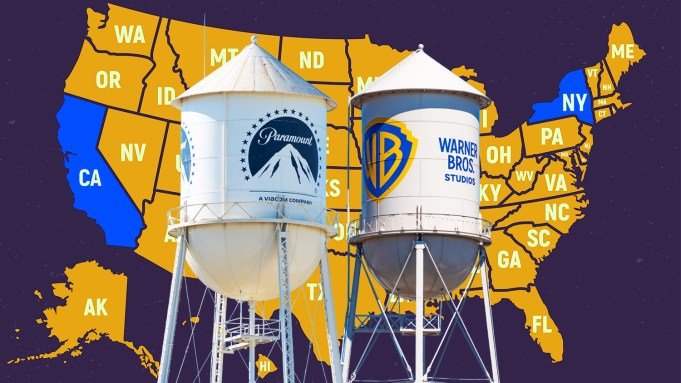
Awaiting a reaction from the conservative majority SCOTUS, which could reject or slow walk the request, Iowa and Montana’s action against the “State of Arizona, State of California, State of Colorado, State of Connecticut, Commonwealth of Massachusetts, State of Minnesota, State of Nevada, State of New Jersey, State of New Mexico, State of New York, State of Oregon, and State of Washington” is a roll of the dice for all concerned.
SCOTUS sign-offs on such requests are not rare for the Roberts court, but they aren’t common either.
Still, perhaps playing to their real audience, the Iowa and Montana motion also jumps into defending the Ellisons’ bottom line – as Bird did in her August 25 Daily Wire op-ed.
Blasting the blue states for running counter to a merger approved by 67 jurisdictions worldwide and seemingly fast-tracked by Donald Trump‘s DOJ,, the motion notes: “The costs are not limited to the companies themselves. Defendant States’ suit has injected uncertainty into every company that does business with Paramount or Warner Bros. Suppliers and other counterparties cannot make investment choices without knowing who the real decision maker is and whether the business relationship has a future once the deal closes (or does not close).”
There has been no full-on response yet from Bonta, but don’t expect the media savvy CA AG to be silent too long on this latest challenge. “We are reviewing the filing and will respond as appropriate,” a spokesperson for Bonta told Deadline this AM.
PREVIOUSLY, 10:09 PM: With friends like Iowa Attorney General Brenna Bird, does Paramount and David Ellison really need enemies?
In an op-ed penned for the conservative Daily Wire Tuesday, the Hawkeye State ally of Donald Trump is threatening to take California to the Supreme Court. Declaring that “California is once again trying to be the country’s regulator,” Bird wants to stop the antitrust lawsuit from the Golden State, New York and 10 other states against Paramount’s $111 billion purchase of Warner Brothers Discovery.
“Just like California should keep its hands off America’s bacon, California needs to understand that it doesn’t get to decide what Americans can choose to watch or stream,” the reelection-seeking Bird states of the state and its AG Rob Bonta.
“If California believes a transaction that 68 regulators approved is nevertheless illegal, it is free to make that argument,” she notes, lamenting the $7 million a day ticking fee and more Paramount will have to start paying WBD shareholders starting October 1. “But it should make it in the one court with the authority to bind all of us, and it should make it now, before the bill for the delay comes due,” Bird claps, leaving out any reference to the Empire State’s Letitia James and other AGs.
Yet, for all her rallying to the ParaBros cause, as well as some variations on what Bonta and gang are actually alleging in the March 2, 2027 trial-starting case before a federal judge in Oakland, Bird doesn’t seem to have actually filed anything with SCOTUS.
It also seems hard to see how even if Iowa did take California to the conservative majority Supreme Court, how they could get a hearing before next spring or even October, with the John Roberts-led high court not back in session until October 5.
However, let’s sidestep Bird getting a perch on SCOTUS’ fast tracked interim relief docket (AKA the emergency docket or shadow docket) for a second, and look at a possible route under the provisions of Article III, Section 2 of the Constitution. Even if the case fell within the “original jurisdiction” criteria and passed muster with the Justices, any ruling would likely still be drawn out — likely beyond the March 2027 trial already on the calendar. In the rare case SCOTUS picks up such a state-to-state battle, it would generally appoint a “special master’ to review the matter before getting directly on it.
All of which, like Paramount CEO Ellison accused Bonta in an August 4 NYT op-ed, makes Bird’s flag planter reek of politics.
Bird, who filed a brief in 2024 in support of the former Apprentice host’s ultimately successful bid to gain significant immunity from prosecution for acts taken while POTUS, sidesteps most of the meat of the actual antitrust suit the 12 states and the WGA are pursuing. A suit that Bonta, in an August 10 guest column for Deadline, paints as “a straight up antitrust enforcement case. One that is very cut and dry.” Instead, Bird, while giving the DOJ the benefit of the doubt, moves to blast Bonta and colleagues as “more hostile to this pro-competition merger than Europe and China.”
The ‘To Save American Movies, I’m Taking California To The Supreme Court’ entitled piece in the Ben Shapiro-founded outlet insists a ParaBros combo is good for high streaming subscription paying Iowans, competition and the movie and TV businesses. “The merger could create a company to compete: an estimated $6 billion in savings to reinvest, and a public commitment to release at least 30 movies in theaters every year. More movies mean more entertainment — and more competition means lower prices,” Bird says.
Bird also makes no mention of possible layoffs or other cuts from a Paramount and WBD melding. Cuts that every such M&A deal has seen. Cuts that the likes of the WGA SAG-AFTRA and the Teamsters warn of. Cuts that reports in both late June and last week to the L.A. County Board of Supervisors warned could see thousands pink slipped, and cost the region billions in wage and hundreds of millions in tax revenue.
L-R: Rob Bonta and David Ellison
Getty Images
Touting a Hollywood that few who live here may recognize, the Iowa AG chooses echoes the findings of earlier this year from Trump’s DOJ approving the merger. To that, right now, she says “more movies are being made, and more workers are being hired.”
While seemingly concurrently stressing that a joint “Paramount+ and HBO Max together are smaller than Netflix, smaller than Disney and smaller than Amazon,” Bird also throws out there that “a successful Paramount-Warner Bros. merger would change that.” Later in the op-ed, the long time pol says: “That is the opposite of a monopoly problem.”
Singing the tunes of the growing MAGA chorus that seeks to turn Bonta into the new Nancy Pelosi punching bag, Bird asserts “California is just dreaming up something radical” to go to war with Trump and his admitted “good friends” David Ellison and his Oracle founding father Larry Ellison.
“California argues that the Department of Justice waved this through as a political favor to Paramount’s owners,” Bird wrote Tuesday in a smudging of what is actually in the July 13 filing by the coalition of blue states. “Then someone should explain how the Department managed to get approval in China, Europe, Canada, and the other 60-plus jurisdictions. When regulators in 68 jurisdictions with different laws, different politics, and no stake whatsoever in American elections all reach the same conclusion, the outlier is not the consensus.”
Again, no filing seems to have occurred today so far at the Supreme Court from Iowa or Bird. Rob Bonta and Brenna Bird’s office do share the fact that neither of them responded to Deadline’s request for comment on the Iowa AG’s threat.