TL;DR: This like-new 2021 Apple iPad 9th Gen has 256GB of storage, an A13 Bionic chip, and a 10.2-inch Retina display for $209.99 (MSRP $479).
A tablet doesn’t need the latest hardware to handle everyday work, streaming, browsing, and video calls. This Grade A refurbished 2021 Apple iPad 9th Gen with 256GB of storage is only $209.99 (MSRP $479).
The A13 Bionic chip provides responsive performance for everyday apps, web browsing, and multitasking. And 256GB of built-in storage is another practical advantage. There’s room for apps, documents, photos, videos, and other content without starting with a smaller storage configuration.
For calls, the 12MP Ultra Wide front camera supports Center Stage, which automatically helps keep you in frame. Touch ID provides quick, secure unlocking, and stereo speakers handle audio for calls, music, and shows.
This model connects to the internet via Wi-Fi and offers all-day battery life.
It’s also Grade A refurbished, meaning it arrives in near-mint condition with very minimal to zero scuffing on the case.
Prices subject to change. PCMag editors select and review products independently. If you buy through StackSocial affiliate links, we may earn commissions, which help support our testing.
About Our Expert
StackCommerce Team (Sponsored)
Experience
Products featured in these stories are selected by our partners at StackCommerce. If you buy something through links on our site, PCMag may earn an affiliate commission.
After almost a year in the trenches pulling together his historic combination of Paramount Skydance and Warner Bros. Discovery, David Ellison has finally emerged victorious. On Monday, the Silicon Valley heir confirmed he’d reached a settlement with a group of state attorneys general, who sued to block the merger over antitrust concerns.
The proposed merger was met with heated opposition by activist groups, top talent like Mark Ruffalo and whispers by Ellison’s legacy media competitors. But groups like the Hollywood labor guilds are celebrating the settlement news, as the staring contest between Ellison and the AGs caused paralysis in development and spending seemingly across the board at both companies.
Here are the cheers, jeers and looming fears of the players involved in “ParaBros”:
WGA The outspoken union acknowledged that their own active litigation against the ParaBros. merger could no longer continue once the state AG’s settled, largely over the cost of duking it out in court.
“We continue to believe the merger will cause damage to writers and the industry at large. Now that the Attorneys General have settled with Paramount, however, as a nonprofit, the WGA must contend with the reality of forging ahead alone, with no backing from government enforcers, with a complex antitrust lawsuit that would cost millions of dollars to pursue through trial. Consequently, we have also settled our lawsuit with an agreement from Paramount to prohibit writer layoffs at CBS News Broadcast for 5 years, and to pay $17.5 million to our health fund along with our attorneys’ fees in the litigation. Though we were not successful in blocking the merger, our advocacy brought more attention to the harms that this merger—and others like it—will cause. We will continue to fight the harms of industry consolidation.
As the number of outlets to sell our work to and the corresponding diversity of programming shrinks, we need industry-wide structural separation between streamers and studios in order to promote competition in programming, like the Financial Interest and Syndication Rules once required in broadcast television. We will continue to fight for these goals.”
DGA The Directors Guild of America highlighted protections that the AG’s negotiated (read a comprehensive list of those here).
“We congratulate the parties on reaching an agreement that addresses a number of critical concerns related to the Paramount/WBD merger. The AG agreement contains important binding and enforceable commitments that protect theatrical film and television markets and domestic film jobs. Equally important, it brings clarity and stability to the industry during a period of decreased production. We especially thank California Attorney General Rob Bonta, and New York Attorney General Letitia James, for their leadership. We intend to continue our discussions with Paramount regarding domestic television production, with a focus on ensuring a competitive and robust marketplace that protects jobs.”
SAG-AFTRA The actors union underscored the power of collective bargaining.
“The settlement of the Attorneys General antitrust lawsuit, announced today, addresses some of our deep concerns about production levels and investment in U.S. production… We will continue to approach our relationship with Paramount with professionalism and the intention to work well together. We hope that the process of engaging with the attorneys general has impressed upon them the fact that in addition to collective bargaining, our members rely on the law to help protect our interests. These are the lowest standards that our employers must meet.All of the companies have the opportunity to exceed their legal obligations and make additional efforts to ensure that our workplaces are healthy and that employers honor our dignity.”
Mark Ruffalo “Task” star Ruffalo is the face of celebrity dissent over the merger, engaging in an ugly back-and-forth with Paramount after promoting what the studio called “antisemitic tropes.”
“Gavin Newsom hands huge win to Trump and his billionaire cronies,” Ruffalo wrote simply on X, referring to California Governor Newsom.
California Attorney General Rob Bonta If Ruffalo is the face of celebrity dissent, then Bonta was the final boss. Ellison’s most vocal opponent said this about his own settlement deal on Monday:
”Today, we have secured a settlement that resolves our antitrust concerns of the Warner Bros./Paramount merger — concerns that the merger will lower output and increase prices — by guaranteeing massive investment in domestic film production and providing enforceable guardrails to help keep cable prices competitive. Let me be clear: This settlement is not a vote of support for this merger. But we believe this settlement, which resolves our antitrust concerns in every market alleged in our case, protects competition and consumer choice, and puts workers’ needs, concerns, and futures first, is the best course of action. When we get down to brass tacks, what we heard over and over from people who would be most directly and immediately impacted by the merger is that what matters most is consistent film output, domestic production, and protecting the livelihoods of workers above and below the line. As such, our settlement provides court-enforceable commitments for more films, an infusion of an additional $1.5 billion into home-grown film production, and protections for workers who are impacted by the merger. There’s no Hollywood without the people who work on and off screen to make the magic happen, and today’s settlement protects workers, jobs, and Hollywood.”
Block the Merger Coalition The advocacy group formed this summer in response to the pending merger went, as predicted, scorched earth:
“We vehemently oppose the agreement to allow David Ellison to take over Warner Bros. Discovery. This is a bad deal for the future of film, entertainment, independent journalism, and a strong democracy in this country. We are disappointed and angry that the interests of average Americans have been trampled to benefit oligarch billionaires.“The Ellisons and other forces arrayed against us, but that didn’t stop us and so many others from standing up. We are proud of what we accomplished, and together, our coalition will keep fighting. From the thousands of leaders in the film and entertainment industry and elected officials, to the hundreds of thousands who joined them to make their voices heard, even in the face of potential retaliation, this was a grassroots movement that proved Americans are not going to take this corruption anymore. That energy is not going away.“This isn’t the last we will hear of the Ellisons or the fallout of this merger – and it’s not the last you will hear from us. Block the Merger was never just about one merger, but about the harms of media consolidation and promoting a diversity of voices. We will continue fighting for accountability and policy reforms to break up and prevent these large conglomerates. This one battle may be over in our efforts to defend democracy, but we won’t stop fighting until we win the war.”
Austin Abrams and Zach Cregger keep knocking them dead.
In 2023, the actor stuck with the writer-director after he lost his initial Weapons cast amid strike-related scheduling chaos. Abrams had attractive opportunities he could have pursued, but he wanted to work with the filmmaker who famously cut, out of nowhere, to Justin Long singing his way down PCH to kick off the second act of Barbarian (2022), the horror film that launched Cregger’s ascent toward becoming the top genre filmmaker working today.
That instinct to see Weapons through paid off handsomely. Abrams delivered a standout performance as an unhoused junkie thief in the critical and commercial hit that would go on to win an Oscar. Cregger then cast him as the lead of his Resident Evil reboot, which has now scored the franchise’s best reviews and highest-grossing opening weekend, taking in $60 million across its first three days.
If Cregger is the belle of the ball right now, then Abrams is the belle of the fall, with his survival thriller Whalefall — directed by Cregger collaborator and fellow genre specialist Brian Duffield — arriving Oct. 16. Between a courier caught in the middle of a zombie virus outbreak and a scuba diver swallowed whole by a sperm whale, both films put Abrams’ respective lead characters, Bryan and Jay, through uniquely harrowing one-man crucibles.
Having acted since he was 13, the 30-year-old Abrams is at a loss for words when describing what it means to lead back-to-back major studio movies. He’s equally reluctant to say which role put him through the wringer more.
“Honestly, in certain ways, they’re one and the same. Resident Evil generally had more laughs, just based on the nature of the comedy involved, so that helped lighten the load,” Abrams tells The Hollywood Reporter. “But I feel bad singling either one out as being harder to work on. They were both really challenging.”
(Spoilers ahead.) Cregger’s Resident Evil opens with Abrams’ medical courier juggling an organ delivery and a serious conversation with his girlfriend, Michelle, about her newly discovered pregnancy. He insists he’ll be home in 20 minutes so they can talk face to face, only to dodge the conversation by accepting a last-minute, faraway job that takes him to Raccoon City General Hospital.
While en route, Bryan and Michelle continue their phone call, but he doesn’t offer the most supportive response. Instead, he argues that they should preserve their current status quo. In other words, he’s afraid of the changes that come with growing up and becoming a father. Unsatisfied, Michelle tells him she’s going to stay with a friend and give him some time to reflect on the error of his ways.
Their talk is then interrupted by a bad signal and a woman in the road whom Bryan’s vehicle strikes. He helps the bloodied victim into his car, but a cop quickly pulls him over and takes responsibility for her. The officer’s SUV then flips over in front of Bryan, slowly confirming what viewers have likely already suspected about the sundress-wearing pedestrian. She is actually infected, and Bryan has become caught up in the franchise’s inciting t-virus outbreak.
After trying to offer aid to the now-deceased cop, Bryan uses the officer’s gun to shoot the rabid sundress woman and an infected guard dog at a nearby farm. He then makes his way inside the farmhouse to refuel, reload and call Michelle from the farmer’s landline now that he’s in jeopardy. When a concerned Michelle returns the call, he’s unable to answer because he just killed the infected farmer and blew the head clean off the reanimated pedestrian woman, who is widely believed to be the farmer’s wife. In a key moment, he witnesses their bodies fuse into one monstrous form that is unrelenting in its pursuit of him.
Bryan continues his journey on foot, making his way into a neighboring tunnel filled with abandoned vehicles. An RV blocks his path, so he climbs inside to make his way out through the back. There, he discovers a little girl and tries to help her, unaware that she’s already on the verge of transforming into a zombie. As her condition worsens, she turns on Bryan and sinks her teeth into his arm, forcing him to put her down. He soon crosses paths with two members of the Umbrella Corporation, who explain that a lab leak caused the outbreak. They also disclose that Bryan was tasked with delivering the “neutralizing base” to Umbrella scientists at Raccoon City General to complete an antidote.
After going through a series of even crazier near-death experiences, Bryan eventually arrives at the hospital, where he takes a moment in the parking garage to assess his rapidly spreading infection. Sensing he’s not going to make it, he tries to call Michelle once more, but is again greeted with no cell phone service. Thus, he records an audio message in which he expresses regret over his earlier response to the pregnancy news and that he’d love nothing more than to start a family together. He caps the recording in the most heart-wrenching way possible by saying, “I think you’d be an amazing mom.”
Bryan goes through even more insane scenarios before finally making it to the facility’s lab on the 28th floor. He delivers the key ingredient for the cure in the nick of time, but the bumbling Umbrella scientists fumble the ball on the one-yard line. They can’t finish the concoction before Bryan loses himself to the infection, and he ends up killing them one by one, becoming his own version of the amalgamation monster that has been stalking him since its inception at the farmhouse.
The movie closes with the realization that we’ve been watching an origin story for a Resident Evil monster, one that gamers typically mow down without a second thought to who they were before the outbreak. Thematically, Cregger reinforces the idea that change comes for us all, whether we’re ready for it or not.
“I thought it was crazy and shocking when I first read it. You follow this one guy the whole time, so hopefully you’re enjoying watching him and rooting for him,” Abrams says. “Then to have him not make it is really risky and gutsy, which is what I love about all of Zach’s work. So I was surprised by it, but I also loved that he would take that chance.”
In this age of unremitting test screenings and CinemaScore, downer endings typically score lower, so Abrams appreciates that Cregger and Sony weren’t afraid to figuratively twist the knife in the audience.
“With a lot of movies nowadays, they’re a little too afraid to do something like that — to kill off a character you really like. And if they do, the blow is softened in some way so it doesn’t hurt too much,” Abrams says. “Whereas a lot of older films don’t do that; they just rip your heart out. We’re here to feel, man. We’re here to go through something. So I’m just appreciative that Zach is willing to take a risk like that.”
If you’re like me, then you might have expected the aforementioned cushion to be a final reveal in which Michelle receives Bryan’s voice memo. Perhaps an unseen moment gave him a bar of service and a long enough opportunity to press send. That potential concluding beat would’ve offered the viewer the comfort of knowing that this now-single mother at least knows Bryan really did love her and the idea of starting a family together. Alas, Bryan not only becomes a monster, but Michelle’s last memory of him is his rather monstrous response to the prospect of having a child together.
“That’s part of the tragedy of it all. It’s so damn sad when you really think about it. She thinks he doesn’t want to have this baby, when he actually does. He realizes, ‘No, I love her. Having a kid isn’t as scary as I thought, and I want to do it with her,’” Abrams says. “So the fact that she’ll never know that is pretty damn tragic. He changed and got better, but no one will ever know about it. There’s something really beautiful and tragic about that.”
Below, during a spoiler conversation with THR, Abrams also discusses the 150-pound blood bag that nearly crushed him during his sprint through snowy Raccoon City.
***
Congrats on the fall of Austin Abrams. The season, not the collapse.
(Laughs.) Thanks, pal.
I watched your A24 Podcast episode with Skyler Gisondo, and you talked about how, growing up, he and Tye Sheridan were your boogeymen at auditions. Well, now that you have two huge studio movies coming out within a month of each other, do you feel like the new boogeyman?
I definitely don’t feel that way. As you get older, you realize that boogeymen don’t really exist in that context. Maybe I’ve got a little bit more of a shot now, but those guys are still such great actors. Have you seen Primetime yet?
Not yet, unfortunately.
See fucking Skyler in Primetime, and then tell me what you think about that.
Mythological framing aside, you’ve been working for more than half your life, and now you’re atop the call sheet. Do you consider this is a new beginning for you as a leading man?
It’s definitely different than it was before, but I don’t feel differently inside. I still feel like I’m trying to push myself and make new things. It’s not some ego trip or something like that.
I last spoke to you toward the tail end of Whalefall photography, so did you basically fly straight to Prague after that wrapped?
It was a really quick turnaround. We extended the Whalefall shoots a little bit, so the window for a break became non-existent. I got out to Prague earlier than I thought to do prep, so it was a very short window.
Austin Abrams stars as Bryan in Zach Cregger’s Resident Evil
Courtesy of Sony Pictures
Zach Cregger was very interested in the answer to this question. Between him and Brian Duffield, whose movie made you suffer the most?
(Abramslaughs and squirms in his seat.) Oh, man. Honestly, in certain ways, they’re one and the same. With Whalefall, I don’t know if you’ve ever worn a wetsuit all day long, but the incessant tightening on your skin is somewhat uncomfortable. With Resident Evil, the amount of running, mixed with the exactness needed to get the shot right, and nightshoots — makes it a hard competition. They’re both also filled with a lot of joy. Resident Evil generally had more laughs, just based on the nature of the comedy involved, so that helped lighten the load. But I feel bad singling either one out as being harder to work on. They were both really challenging.
Zach has talked about the 150-pound blood bag that nearly crushed you during the “jumper street” sequence. Were you pretty rattled at the time?
I kind of didn’t notice. It just happened, and then it was done. Personally, I wanted it to be close because that’s better for what we’re trying to make. There were a lot of other takes where it wasn’t as close, or it happened too soon and you didn’t even see it. It wasn’t until doing press that I was like, “Whoa, was it that close? I didn’t realize that.” At the time, you’re just in it. So I’m stoked that it looks close. If anything, I’m excited by it. But I didn’t really feel rattled at the time.
This is the sequence in Zach Cregger’s Resident Evil where Abrams, as Bryam, narrowly avoided a falling bloody bag on set.
Courtesy of Everett Collection
I really love your choice to give your medical courier character, Bryan, a feminine scream at times because he generally reacts the way 99 percent of us would in a zombie apocalypse. It’s such a departure from the traditional action hero, who’s expected to not only stay cool under pressure but also look cool while doing it. So was it liberating to not have to be concerned with vanity?
Definitely. I wanted to look like the antithesis of “the cool action hero” as much as I possibly could because that feels the most interesting. I haven’t seen it done as much. Shaun of the Dead lives in that realm as well. There’s a joy in being able to see this guy react naturally to all this crazy shit, and it’s just really interesting to watch. I always thought, How would this dude actually react to this? I just wanted it to feel really real-world. Whereas, if you have someone more experienced, it’s going to be a little less interesting to watch.
One of the parts I really enjoyed is earlier on with the dog. How do you even process a moment like that? What would you think that is? There was a period of time when I was like, Is this an alien?Does he think that these are aliens? That would probably confuse or frustrate audiences if my character was thinking it was aliens [because many of them already know what it is from the games]. But thinking about what it could be was a fun rabbit hole to go down while playing it.
In the ’90s, politicians began blaming video games like Mortal Kombat and Doom for real-world violence, and shooter games have remained a recurring scapegoat ever since. But I wonder if Zach is making a counterargument with this movie. Near the end, when Bryan successfully fires his last bullet, he screams, “Video games!” as a way of crediting them for his survival to that point. Do you see that moment as a suggestion that generations of people have actually learned problem-solving, survival skills and vigilance from playing these games?
Maybe, yeah. Growing up, the general vibe in the air, at least from parents, is you’re wasting your time playing video games. So to have the character triumphantly proclaim how much video games have helped him in that make-or-break moment is pretty funny. You’d have to ask Zach if he’s trying to say something deeper there, but it’s a funny little thing.
Austin Abrams as Bryan in Zach Cregger’s Resident Evil.
Dušan Martinček/Sony Pictures
Zach told me that he cut out as many jokes as possible because test audiences deemed the movie to be “too funny.” The movie is still a riot, but were you bummed to see any of those other comedic moments go?
There were a lot of [deleted] moments that cracked us up. There were also a lot of moments that we never filmed. We were like, “This is the SNL version of this movie. We can’t film that. That’s too ridiculous.” I don’t know if I can remember any of those scenarios off the top of my head, but there were moments. They weren’t jokes that I could tell you right now and you’d think they were funny. They were more situational.
The emotional message Bryan records for Michelle is your finest work in the film, and if that monologue wasn’t challenging enough, you then had to go straight into this deliberately embarrassing cry so that Cregger’s voice on the intercom could sell the situational humor. Was that dynamic shift difficult to pull off?
Not really. Zach and I both understood the needle we were trying to thread there. I also knew the edit would help with the comedic shift. When Zach goes out into the wide shot, that helps with the transition into the comedic aspect. So it didn’t feel too intimidating.
As far as Michelle goes, Zach’s wife, Sara Paxton, voiced the character, but I heard you suggested the photo of her for Bryan’s iPhone. Is it safe to ask who that is?
She’s a friend. We wanted a photo of me and her to represent Bryan and Michelle more tangibly.
The partial look at someone in a red shirt is you?
Yeah, that’s me and my friend in the original photo. But then, on the day, someone cropped the photo on the phone to be just her. So the original plan went out the window.
Austin Abrams stars as Bryan in Zach Cregger’s Resident Evil
Courtesy of Sony Pictures
I was not expecting the ending to go that way.
What were you thinking?
I figured Bryan wouldn’t make it out alive, but at the very least, I thought the lab would have some kind of cell signal booster so he could text his voice message to Michelle. If nothing else, I wanted her to know that the father of her baby was truly a good man. Anyway, what was your first reaction when you read that Bryan wouldn’t be cured and would instead become his own amalgamation of bodies?
I’ve been living with it for a while now, but I thought it was crazy and shocking when I first read it. I love that Zach takes those risks. You follow this one guy the whole time, so hopefully you’re enjoying watching him and rooting for him. Then to have him not make it is really risky and gutsy, which is what I love about all of Zach’s work. So I was surprised by it, but I also loved that he would take that chance.
With a lot of movies nowadays, they’re a little too afraid to do something like that — to kill off a character you really like. And if they do, the blow is softened in some way so it doesn’t hurt too much. Whereas a lot of older films don’t do that; they just rip your heart out. We’re here to feel, man. We’re here to go through something. So I’m just appreciative that Zach is willing to take a risk like that.
You used the phrase “soften the blow,” and that’s precisely what I was anticipating. I thought the movie would cut from Bryan’s snowball of body parts to Michelle’s phone, and she’d receive his voice message before the credits rolled. Do you remember if you expected some kind of button involving Michelle?
I don’t remember if I did, but who knows? Maybe he sent his voice memo while going up the staircase, and it’s just something we didn’t get to see.
One of my colleagues saw the ending as a kind of karmic consequence for Bryan not initially supporting his pregnant girlfriend. But along the way, he helps the sundress woman he hit with his car, rushes to aid the cop, tries to save the little girl in the RV and honors his commitment to get the package to Raccoon City General. So I see it less as Bryan deserving his fate and more as a reminder that a zombie outbreak is indiscriminate. How do you see it?
I wouldn’t say he deserved his fate, especially when you see him turn it around toward the end. That’s part of the tragedy of it all. It’s so damn sad when you really think about it. He leaves this voice note for his girlfriend, and maybe they’ll find his phone and somehow get it to her. But she thinks he doesn’t want to have this baby, when he actually does. He realizes, “No, I love her. Having a kid isn’t as scary as I thought, and I want to do it with her.” So the fact that she’ll never know that is pretty damn tragic. He changed and got better, but no one will ever know about it. There’s something really beautiful and tragic about that.
Austin Abrams, Andrea Miltnerova and Johnno Wilson in Zach Cregger’s Resident Evil
Dušan Martinček/Sony Pictures
In Weapons, Alden Ehrenreich’s character told James to get out of town, and bad things happened when he didn’t listen. In Gangster Squad, Ryan Gosling told your shoeshiner to go home, and bad things happened when he didn’t listen. In ResidentEvil, Michelle told Bryan to come home, and bad things happened when he didn’t listen. Nobody in The Line listened, and bad things happened to your fraternity pledge. Your characters need to start listening, don’t they?
(Laughs.) Yeah, you’re right. They’ve got a little bit too much lint in their ears. But if they listened, these movies would be a lot less interesting.
Touché. Just out of curiosity, have you read Zach’s script called The Flood?
No, I’m staying away from it because I want to be able to watch it without knowing anything.
From Wolfs and Weapons to Whalefall and Resident Evil, you’ve spent the last few years running for your life on screen. Looking ahead, have you asked your agent to find you something calm, soothing and relaxing?
(Laughs.) Yeah, I need a movie that’s like a lullaby — where the heart of it rocks you to sleep. Can we make a movie like that? But it all depends. A lot of it comes down to the filmmaker and what ends up coming my way. So I don’t want to talk too much about what might be next, but we’ll see.
*** Resident Evil is now playing in movie theaters nationwide.
Rob Bonta defended the antitrust settlement that allows Paramount to merge with Warner Bros. on Monday, saying in a 45-minute press conference that the deal includes independent monitoring and will result in more jobs in Hollywood.
But the deal does not include the three words — robust structural remedies — that California’s attorney general had said was the goal since filing suit in July. And while he went to some lengths to argue that the deal represents a “strong” outcome, he also acknowledged it was not his preferred result.
“I don’t think these two companies should merge,” he said. “But that’s not something that we are focused on with our resolution here.”
Bonta had come under increasing pressure in the last few weeks, as Gov. Gavin Newsom, Xavier Becerra, the cinema trade group, and labor leaders all expressed hope for a settlement. Paramount also did its best to increase the leverage on Bonta, threatening to relocate to Tennessee and seeking a court order to force the 12-state coalition to pay $1.88 billion for delaying the deal.
In the press conference, Bonta sought to downplay that pressure. “That’s not what I’m thinking about, that’s not my focus,” he said. making the case that the A.G.’s victories in court put pressure on Paramount to offer significant concessions.
“We got the antitrust resolution that we wanted,” he said. “Very strong remedies and commitments to address the concerns that we raised.”
As to whether he thought the states could have prevailed at trial next spring, he said that courtrooms “always have risk.” He also acknowledged concerns that prolonging the case would create “uncertainty” in Hollywood, an issue that had been raised by Paramount and some labor unions.
“This deal gives certainty about the future of production right here in L.A.,” he said, noting that Paramount had committed to increasing domestic production and to not selling its L.A. lots for at least five years. “That also generates important certainty for this industry that I think is craving it.”
He also argued that the outcome is dramatically different from the Hollywood’s last major merger, the Disney-Fox deal, which went unchallenged by antitrust authorities and led to reduced production.
“This agreement is the opposite of Disney-Fox,” he said. “The things that we saw in the Disney-Fox merger — a massive decrease in film production… this doesn’t just guard against that and protect against the downside; it locks in a massive upside.”
Bonta was alone at the podium, without his trial team or representatives from the other 11 states involved in the suit. He was also not joined by the Writers Guild of America, which filed its own antitrust suit and also resolved it over the weekend.
In a statement, the WGA said that the settlement terms “fall far short of adequately protecting writers,” but that it could not bear the cost of continuing its suit without support from the states.
William Tong, the attorney general of Connecticut, also expressed dismay that the deal does not include divesture of CBS and CNN, which he said was needed to save “ethical and independent journalism.”
“We fought aggressively for that remedy,” he said. “I am deeply disappointed that we could not do more.”
Bonta noted that all 12 states signed on to the settlement. He also said the WGA was not involved in the states’ negotiations.
“They brought their own case,” he said. “They decided whether or not they wanted to resolve their case and under what terms.”
Bonta said there was no key moment or provision that unlocked the deal, and struggled to offer a timeline of how the agreement came together.
“These days have blurred because we’ve been in some deep and robust conversations,” he said.
It’s officially the last New Music Friday of the summer, and artists did not play when it came to dropping fresh bangers. From A-list names and collaborations to highly anticipated albums, get your playlist ready and let’s have some musical fun.
Maluma & Shakira – AGUA
Shakira and Maluma reunite on “Agua,” their first major collaboration since 2018’s “Clandestino.” It marks their first merengue together, and they did not miss. The Colombian superstars turn up the heat and show off their chemistry and sexual energy in the spicy music video. Shakira looks incredible, per usual, as she flaunts her amazing body and signature dance moves.
CA7RIEL, Paco Amoroso, PinkPantheress, Fred again..–Sexy Magic
CA7RIEL, Paco Amoroso, PinkPantheress, and Fred again come together for “Sexy Magic,” which is featured on the long-awaited Grand Theft Auto VI soundtrack. CA7RIEL and Paco Amoroso are on fire, scoring 7 nominations at the Latin GRAMMYS, the second most after producer Edgar Barrera.
Piso 21, Micro TDH & Gangsta – Segunda Cita
Piso 21, Micro TDH & Gangsta will have you feeling flirty and ready for date night with “Segunda Cita.” It’s a powerhouse collaboration with all the artists seamlessly blending their sounds. It includes a sweet moment with Micro TDH celebrating their first collab with Piso 21, “Te VI’s” initiation into the billions club on Spotify.
Michelle Maciel – espresso martini
Mexican singer-songwriter Michelle Macielbegins a new chapter with her album La Gloria, a 13-track project that explores love, personal growth, and experimentation while blending corridos, reggaetón, and boleros. The album’s focus track, “Dolencias,” featuring Ana Gloria, brings the two artists together for a fun, dance floor-ready collaboration that highlights Maciel’s ability to move between genres.
Zulia – Birkin
Following the release of his album Ya No Me Importa Si Nadie Me Escucha, Venezuelan rising star Zulia drops “Birkin.” The singer has one of the most unique voices in music, with bold, sensual lyrics, and a smooth sound.
You may also like
Continue reading
Guaynaa- SE PARECE AL PAI
Puerto Rican singer Guaynaa gets into his salsa swag with “SE PARECE AL PAI.” The catchy track has incredible instrumentals, an infectious melody, and lyrics inspired by his own life as a father. It stars his wife, Lele Pons, and their daughter, Eloísa.
Rodrigo y Gabriela – Somos Como Tú
GRAMMY-winning Mexican guitar duo Rodrigo y Gabriela release their new album OurHome. They step into new territory with “Somos Como Tú,” their first-ever song featuring lyrics and vocals. The track explores migration, displacement, and the connections that unite people across cultures, marking a new chapter for the duo as they continue to expand beyond their signature acoustic sound.
Feid, Bad Gyal – DE DIOR XL
After postponing its release, Feid drops his new EP, EL GREEN PRINT: La Saga (Disc 2) – EL CLUB DE LAS 19 FLORES, the next chapter of his Green Print era. It includes collaborations with Vicente García, El Americano 4KT and Pirlo, Divino and Baby Ranks, Icon, Yandel, and Spanish star Bad Gyal.
Elvis Crespo, beele – PA´BAILAR
The one and only Elvis Crespo adds another collaboration with the new generation, this time with Beele. The genre-blending track has merengue, urban, and pop sounds with exciting instrumentals that will have you ready to move your hips.
MILEY – Let’s Get Married
Miley’s highly anticipated album Bass Persuades is here, and it’s beautiful. It’s the first album since dropping Cyrus and shows off the multifaceted sides of the singer. “Let’s Get Married” is a gorgeous track dedicated to her fiancé, Maxx Morando, and comes with an intimate music video starring the couple.
Daredevil is hanging up his mask after three seasons on Disney+.
Marvel’s “Daredevil: Born Again,” starring Charlie Cox as the blind lawyer-turned-vigilante, is ending with the upcoming Season 3, Variety has confirmed. The third and final season wrapped production a couple of months ago and is expected to premiere on Disney+ in 2027. Co-creator and showrunner Dario Scardapane has also exited the series, which is in the midst of post-production.
Cox originally debuted as the blind hero on Netflix’s “Daredevil,” which ran for three seasons from 2015-2018 and kicked off the mini, street-level Marvel universe on the streamer. It spawned “Jessica Jones”, “Luke Cage” and “Iron Fist” spinoffs and culminated with the team-up series “The Defenders.” Disney+ revived the show as “Daredevil: Born Again” in 2025 and brought back several of the main cast members, including Vincent D’Onofrio as Wilson Fisk, aka the Kingpin of New York City, Deborah Ann Woll as Karen Page, Elden Henson as Foggy Nelson and Wilson Bethel as Bullseye.
“Born Again” Season 2 started reuniting Netflix’s “Defenders” cast by bringing back Krysten Ritter as the super-strong private detective Jessica Jones in a supporting role, plus Mike Colter had a cameo in the finale as her lover Luke Cage. Paparazzi photos also leaked during Season 3 production, showing Finn Jones back as Danny Rand, aka the martial arts expert Iron Fist, alongside Ritter and Colter. They’re expected to team up once again to take down Kingpin, who’s been stripped of his title as New York City mayor. Meanwhile, Daredevil has found himself in jail, and his identity was made public in the wake of the Season 2 finale.
Hollywood Reporter first reported the news of the series ending.
Pepe price surged nearly 25% on Sep. 21 as the meme coin cleared a major resistance level, although an overbought 4-hour reading raises the risk of a short-term pullback.
According to data from crypto.news, Pepe ($PEPE) price traded around $0.00000499 at the time of writing after reaching an intraday high of $0.00000515. The rally lifted the meme coin by 24.75% during the daily session and extended its seven-day gain to nearly 40%, according to CoinGecko.
The token’s market capitalization climbed above $2 billion, while its 24-hour trading volume approached $900 million.
$PEPE’s advance came alongside a wider crypto rally led by Bitcoin, which crossed $85,000 for the first time in eight months. Bitcoin exchange-traded funds operated by firms including BlackRock and Fidelity received about $433 million on Friday, according to JPMorgan data cited by the Wall Street Journal.
Broader demand for risk assets helped $PEPE accelerate beyond the gradual recovery visible earlier in the week. However, its latest technical readings suggest that buyers may struggle to maintain the same pace without a period of consolidation.
Pepe price clears its major moving averages
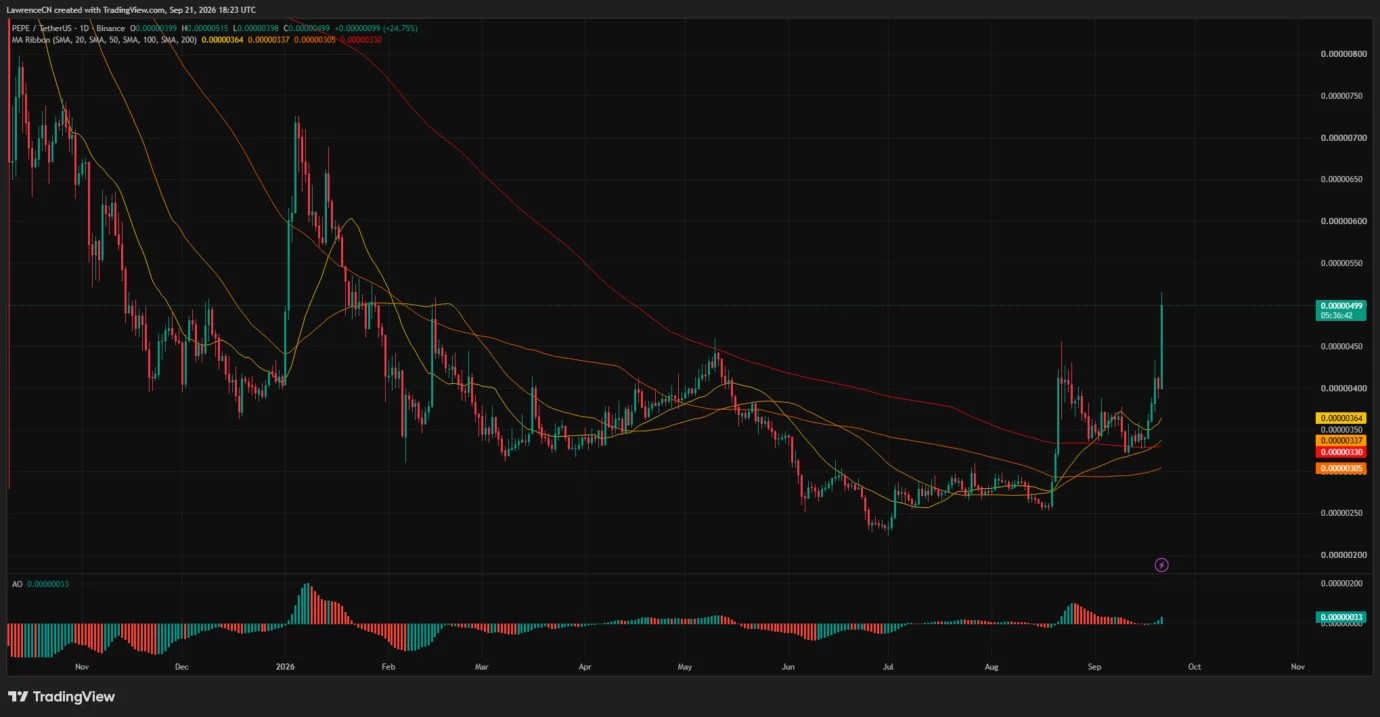
The daily $PEPE/USDT chart shows that the token has moved above its 20-day, 50-day, 100-day and 200-day simple moving averages.
$PEPE’s 20-day SMA stood near $0.00000364, while the 50-day and 100-day averages were located around $0.00000337 and $0.00000330, respectively. The 200-day SMA remained lower at approximately $0.00000305.
Trading above all four averages marks a sharp change from the bearish structure that controlled the market during the first half of 2026. Price had fallen from above $0.000007 in late 2025 to a June low near $0.00000220 before forming a base.
The daily Awesome Oscillator also moved into positive territory at approximately 0.00000033. A positive reading means short-term momentum is stronger than longer-term momentum, supporting the current bullish setup.
The next technical test sits between $0.00000515 and $0.00000550. $PEPE briefly touched the lower end of that area during the rally but had not produced a confirmed daily close above it at the time the chart was captured.
4-hour RSI warns of an overheated rally
Shorter-term readings show greater pullback risk after the rapid price increase.
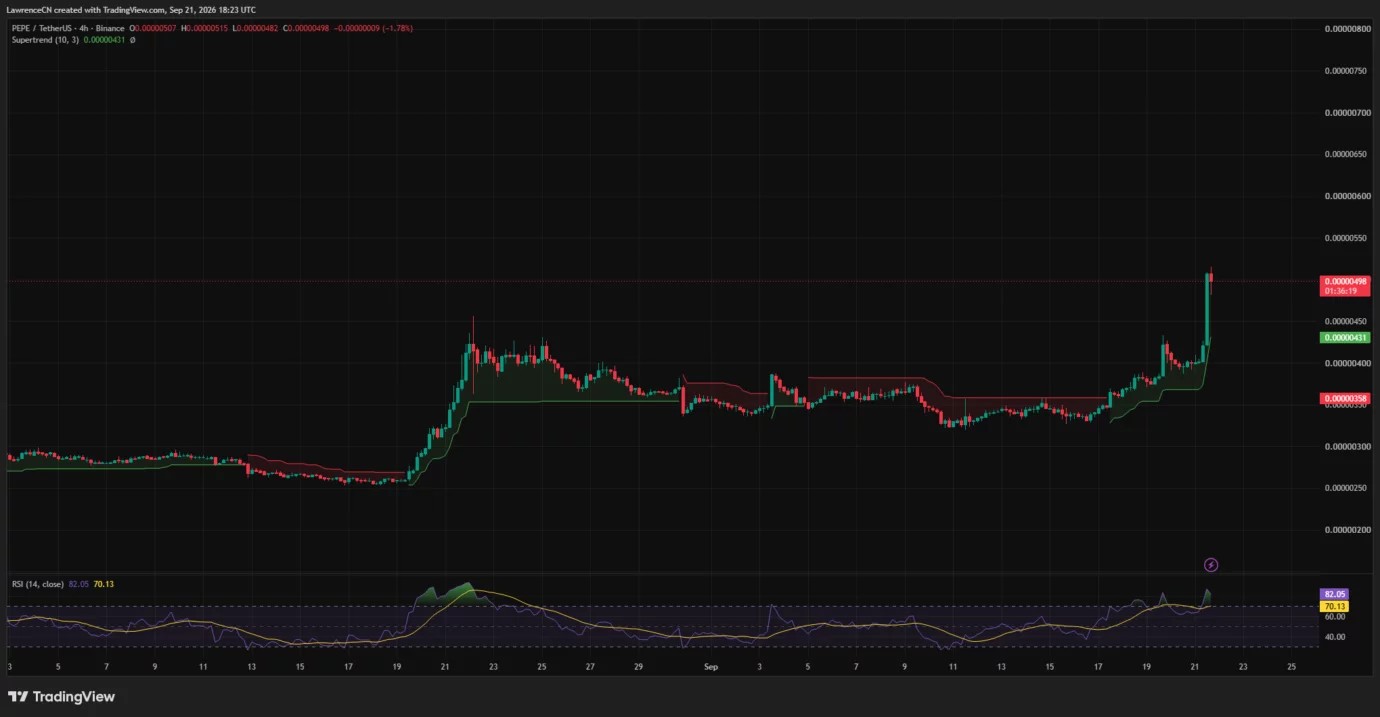
The 4-hour Relative Strength Index rose to 82.05, well above the 70 level commonly used to identify overbought conditions. Its RSI-based moving average stood at 70.13, confirming that momentum accelerated sharply during the breakout.
An overbought RSI does not guarantee an immediate fall, but it can indicate that buyers have already committed substantial capital over a short period. $PEPE’s latest 4-hour candle had declined 1.78% from its opening price after reaching $0.00000515, showing early profit-taking near the session high.
The 4-hour Supertrend remained bullish, with its support line near $0.00000431. Holding above that level would preserve the current short-term trend and could allow buyers to retest $0.00000515.
A drop below $0.00000431 would weaken the breakout and expose the former resistance area around $0.00000400. Deeper support sits near the 20-day moving average at $0.00000364.
$PEPE liquidation clusters increase pullback risk
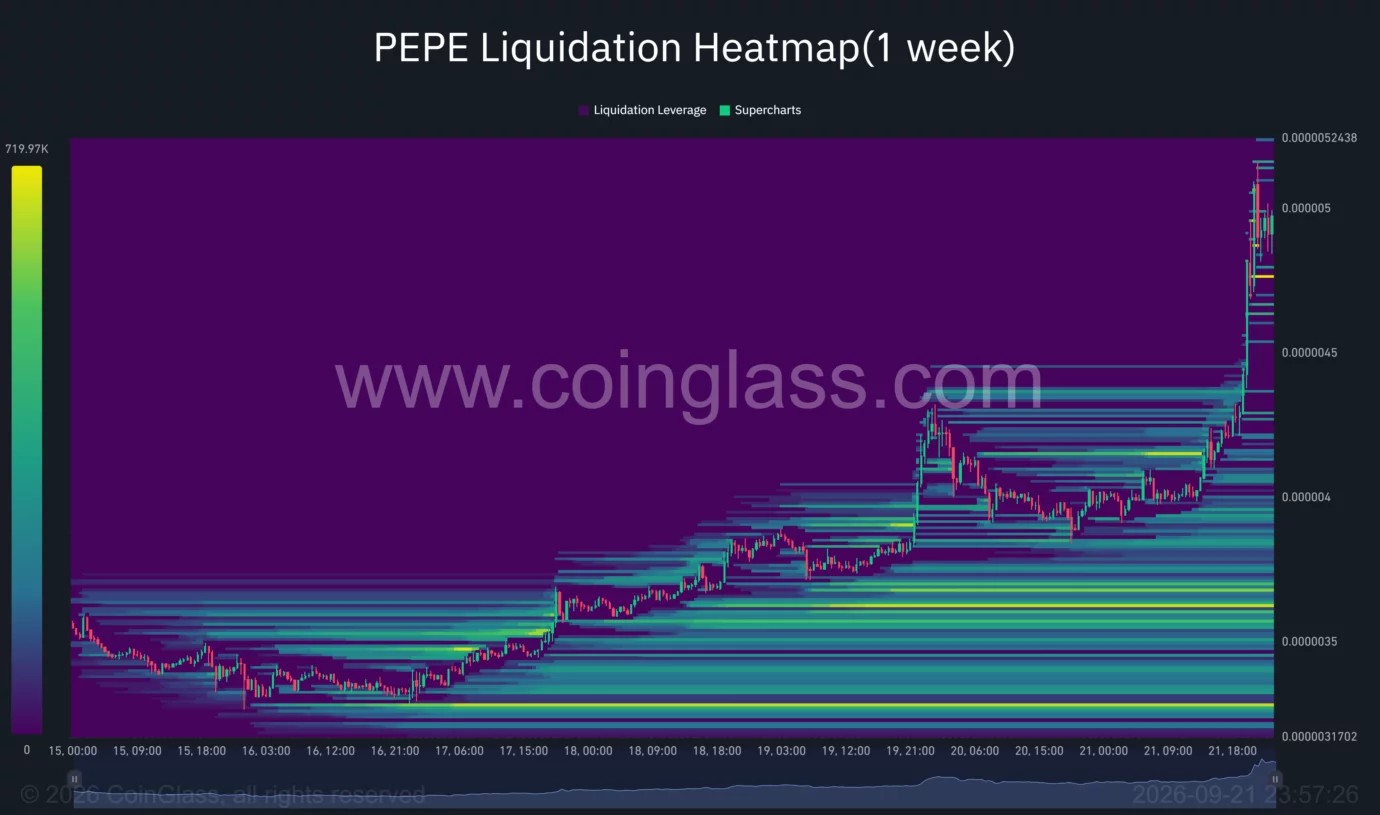
CoinGlass’s one-week liquidation heatmap shows that $PEPE’s rally moved through several concentrations of leveraged positions between $0.00000410 and $0.00000450.
Pepe liquidation heatmap | Source: CoinGlass
The largest remaining liquidity concentrations appear below the current price. Dense bands are visible around $0.00000355–$0.00000370, with another strong cluster near $0.00000320.
Liquidation heatmaps show where leveraged positions could face forced closure if the market reaches certain prices. They do not establish that price must move toward those zones, but concentrated leverage can add volatility when a reversal begins.
Smaller clusters also sit above $PEPE near $0.00000510–$0.00000524. A renewed move through the intraday high could force additional short liquidations and extend the rally before the market tests higher resistance.
$PEPE breakout puts $0.00001 back in focus
Crypto analyst Crypto Patel said $PEPE has risen about 97% from a higher-time-frame accumulation zone between $0.00000200 and $0.00000270.
“The accumulation move is already underway. The next trigger is the breakout.”
Patel identified $0.000004583 as the level $PEPE needed to reclaim and convert from resistance into support. The market has now traded above that threshold, but a daily close and successful retest would provide stronger confirmation than the initial intraday break.
The analyst listed $0.000010, $0.0000,16 and $0.000027 as possible longer-term targets if $PEPE also breaks its higher-time-frame downtrend. Those levels remain projections rather than confirmed destinations, with the first target requiring the token to roughly double from its current price.
$PEPE’s immediate outlook depends on whether buyers can defend $0.00000458 after the 25% daily advance. Holding that level would keep $0.00000515 and $0.00000550 in view, while losing it could send the token toward Supertrend support at $0.00000431 or the larger liquidation zone near $0.00000360.
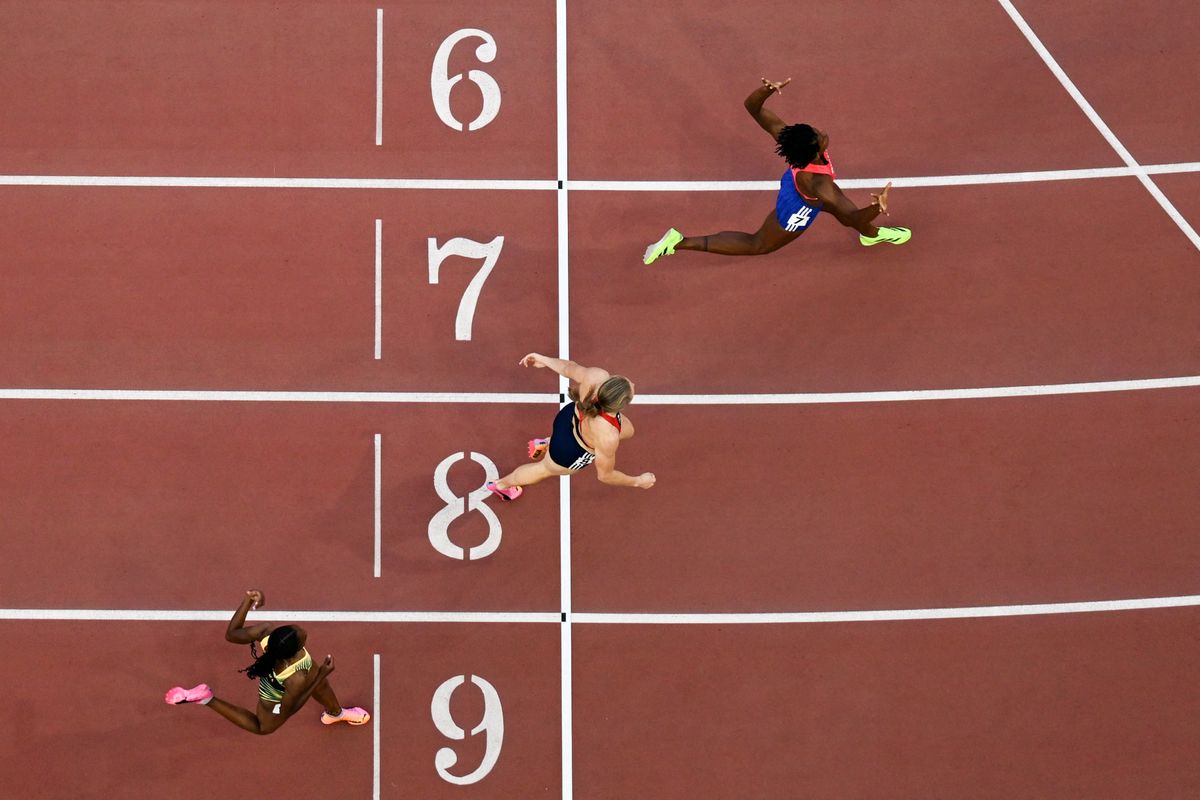
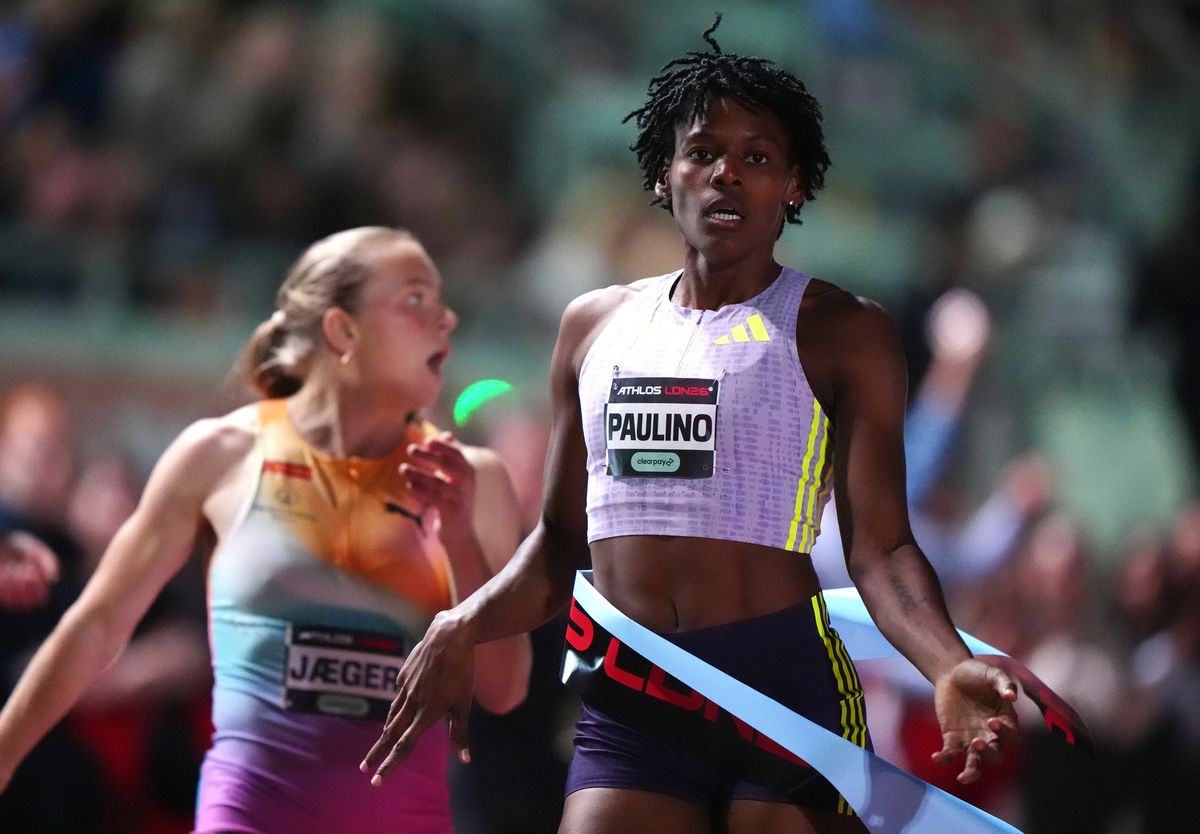
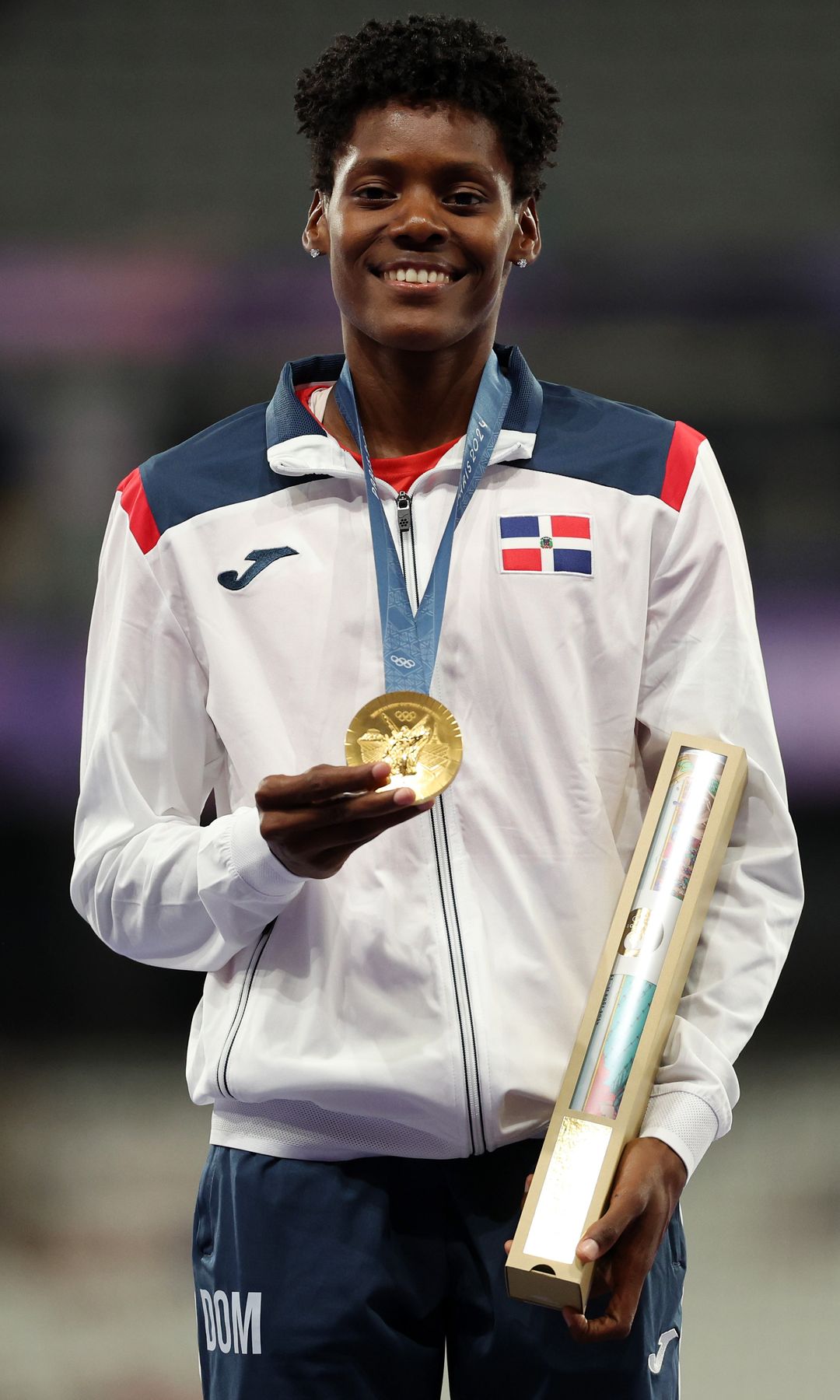
Marileidy Paulino has added another record-setting victory to a remarkable 2026 season. The Dominican Olympic champion won the women’s 400 meters at ATHLOS London on September 18, clocking 48.73 seconds to establish a new meeting record at StoneX Stadium. Paulino launched a dramatic late charge to defeat Norway’s Henriette Jæger, who finished just five hundredths of a second behind in 48.78.
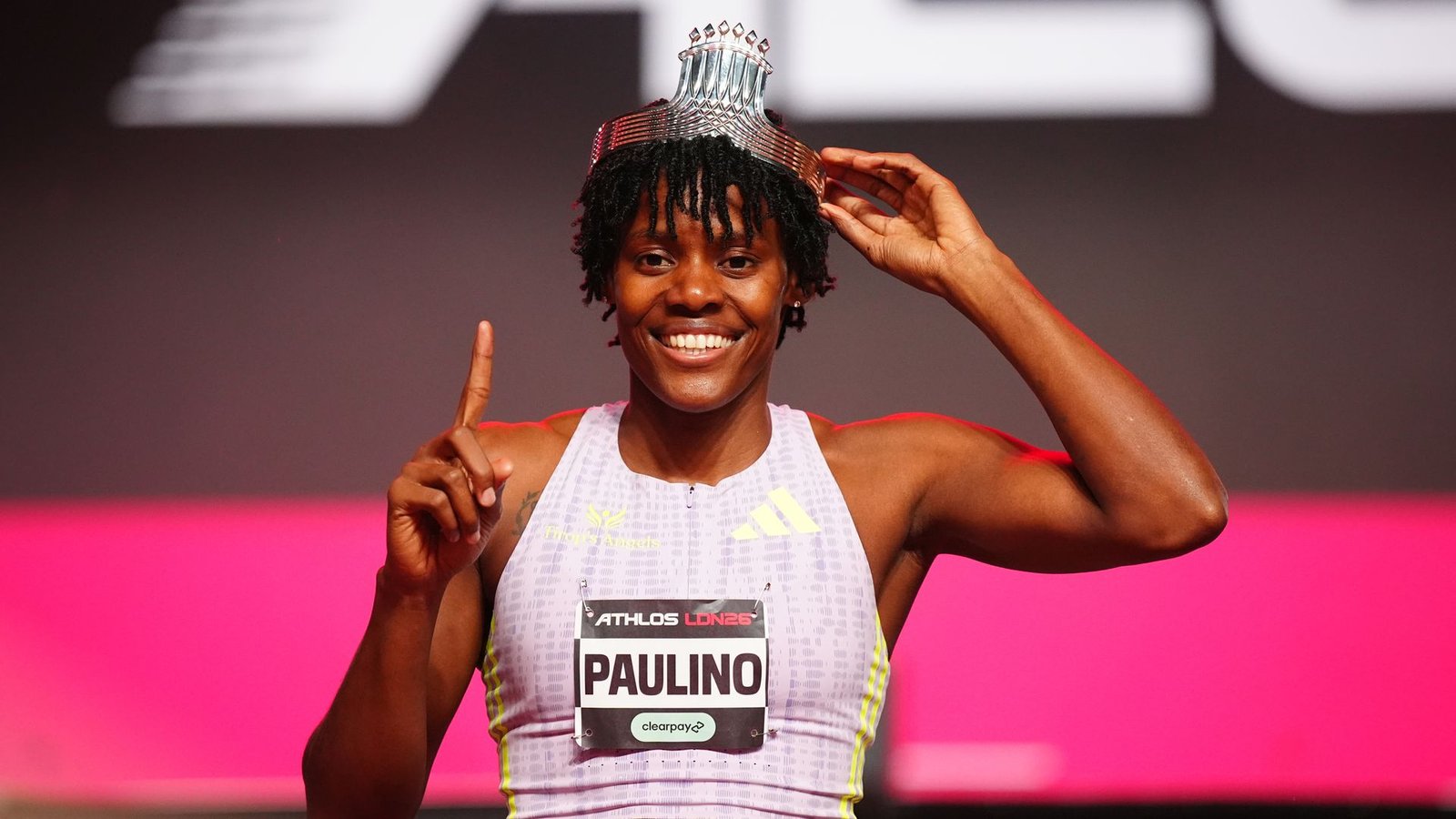
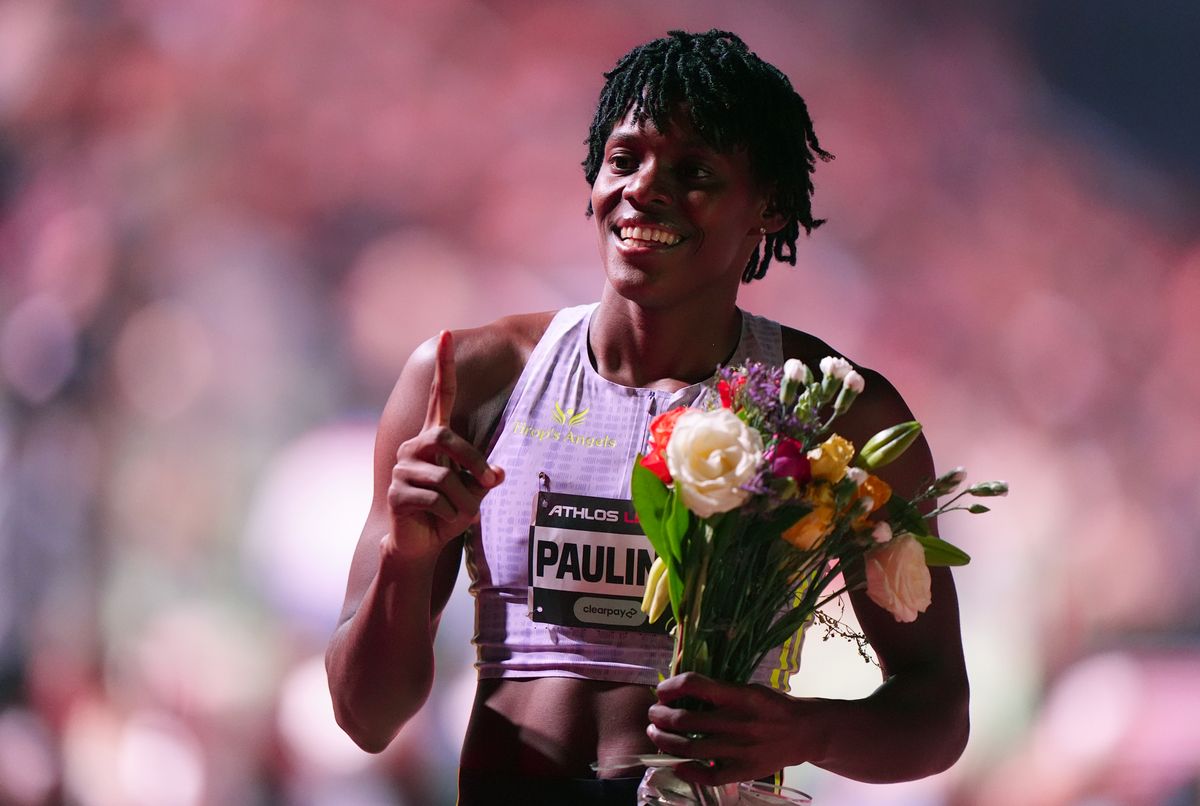
The victory earned Paulino first place at ATHLOS London and another signature crown moment at the women-focused track and field event.
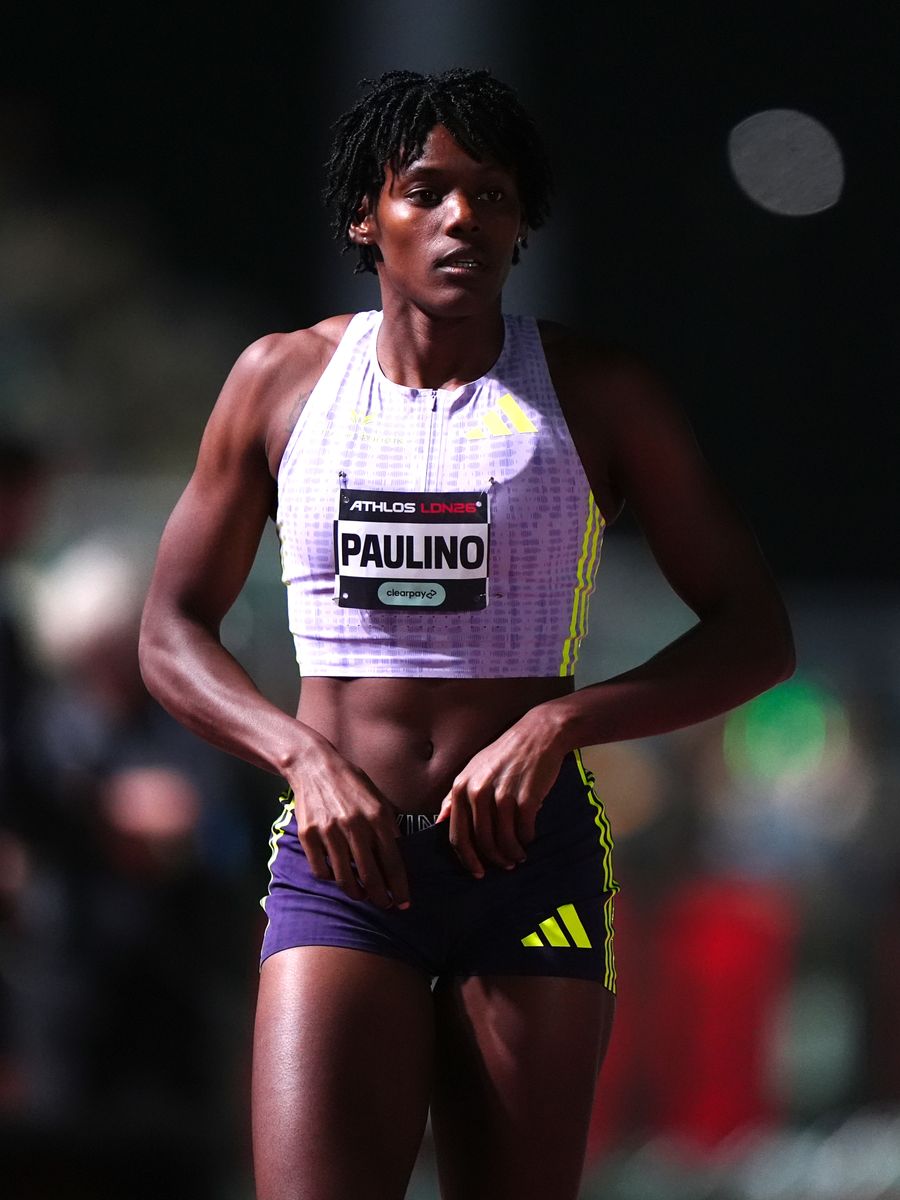
Marileidy Paulino of the Dominican Republic before the 400m during ATHLOS 2026 at the StoneX Stadium
But the 48.73 performance was significant for another reason. It marked Paulino’s 15th career 400-meter race under 49 seconds, tying the all-time record for the most sub-49 performances.
Marileidy Paulino Wins ATHLOS London 400m in 48.73
Paulino did not dominate the race from the opening gun. Jæger and Jamaica’s Nickisha Pryce started aggressively, with Jæger reaching the 200-meter point in 23.69 seconds. Paulino was running sixth at that stage, approximately half a second behind the Norwegian leader.
You may also like
Continue reading
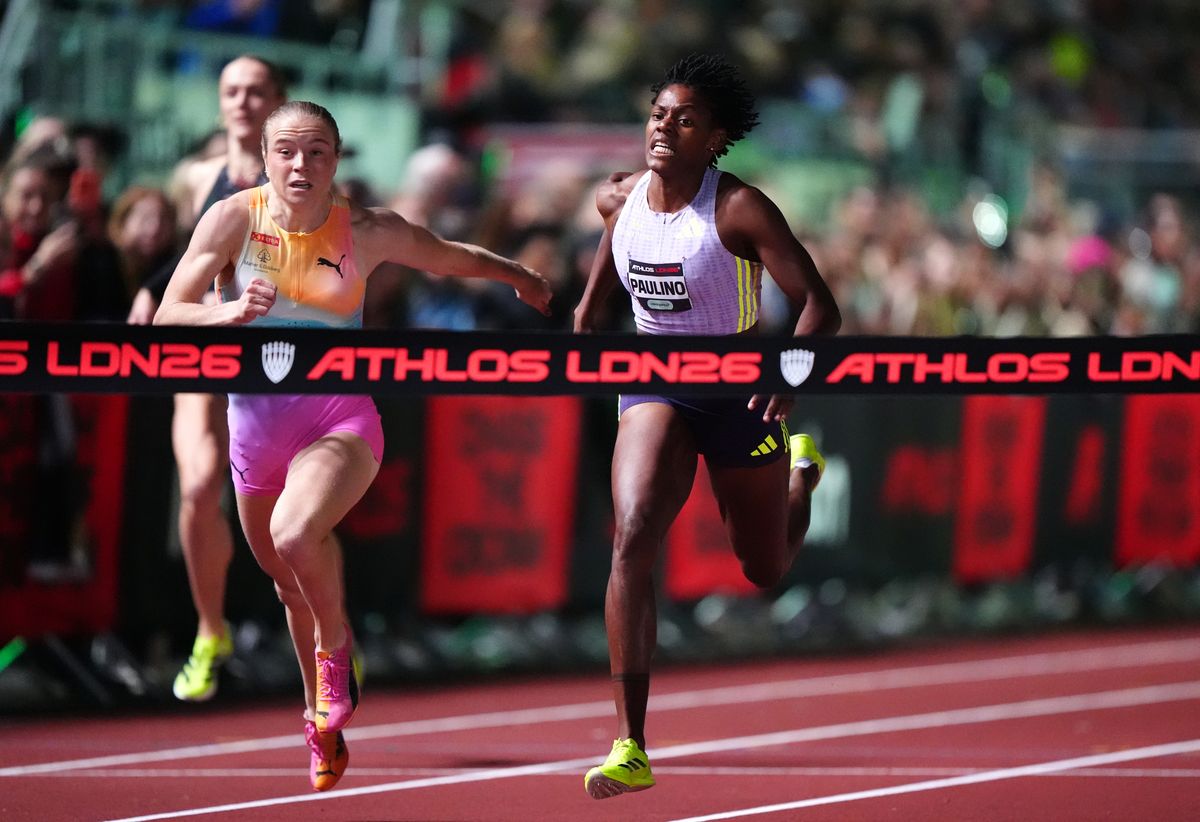
Then the race changed and Paulino began closing the gap around the final bend. With 100 meters remaining, she had moved into third, but Jæger still held the advantage.
Marileidy Paulino of the Dominican Republic wins the 400m during ATHLOS 2026
Paulino continued gaining ground down the home straight before catching Jæger in the closing meters. She crossed the finish line in 48.73, with Jæger recording 48.78 and Pryce taking third in 49.39.
The margin between first and second was only 0.05 seconds.
Dominican Republic’s Marileidy Paulino (top) celebrates her victory ahead of Norway’s Henriette Jaeger (C) and Jamaica’s Nickisha Pryce in the women’s 400m final
Jæger’s performance was historic in its own right. Her 48.78 lowered the Norwegian national record and made her the fastest European woman over 400 meters in 30 years, according to European Athletics.
Marileidy Paulino Ties the All-Time Sub-49 Record
Paulino’s ATHLOS performance was more than another win. Her 48.73 marked the 15th time in her career that she has completed 400 meters in under 49 seconds, equaling the all-time record. Eight of those sub-49 performances have come during the 2026 season alone.
That consistency helps put the scale of Paulino’s season into perspective.
Marileidy Paulino of the Dominican Republic wins the 400m during ATHLOS 2026
The Dominican sprinter entered ATHLOS London undefeated in 2026 and extended that streak with her late-race victory. World Athletics described the result as another win in an unbeaten season, while Dominican reports noted that she completed her competitive year without a defeat.
It also continued Paulino’s success at ATHLOS. She won the inaugural ATHLOS NYC 400m in 2024 with a time of 49.59 seconds.
What Marileidy Paulino Won at ATHLOS London
ATHLOS London offered significantly increased prize money for the 2026 season. According to ATHLOS, first place in each event was worth $65,000, followed by $35,000 for second and $20,000 for third. The organization also continued its tradition of presenting winners with its Tiffany & Co.-designed crown.
The London competition was particularly significant for ATHLOS because it marked the event’s first international stop after launching in New York.
Dominican Republic’s Marileidy Paulino approaches the finish line to win the women’s 400m final during the World Athletics Ultimate Championship
The women-only professional track and field competition featured seven disciplines: the 100-meter hurdles, 100m, 200m, 400m, 800m, mile and long jump.
Paulino was joined on the winners’ list by several major track stars. Sha’Carri Richardson won the women’s 100m in 10.80 seconds, Gabby Thomas took the 200m in 22.13 and Olympic 800m champion Keely Hodgkinson won her event in 1:56.40.
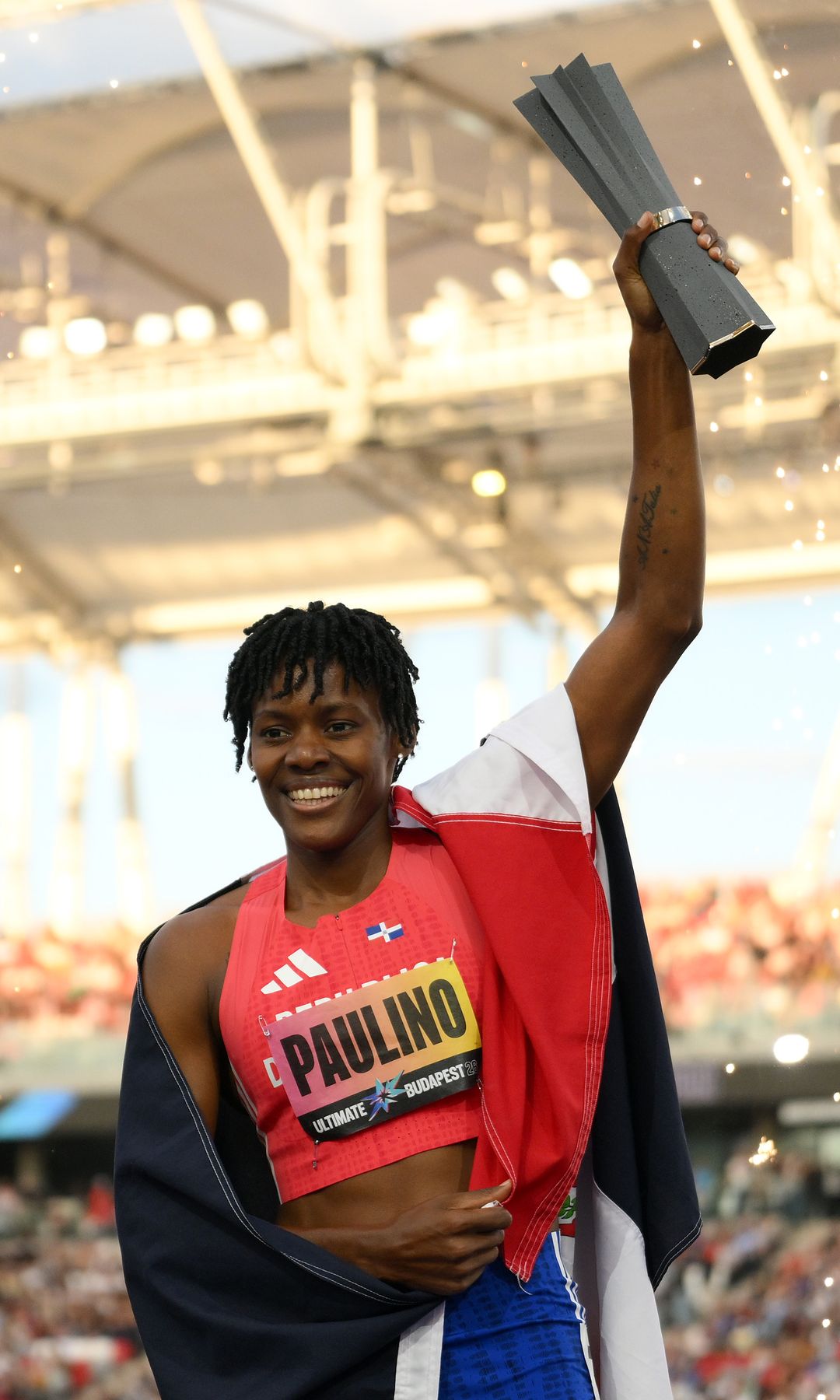
At the Paris 2024 Olympics, she won the women’s 400m gold medal in an Olympic-record 48.17 seconds. Her career has continued to build since then, with her 2026 campaign showing an extraordinary level of consistency below the 49-second barrier.
Solana’s blockchain is becoming a hub for innovation, particularly with the launch of a tokenized magazine based on the popular One Piece series. This initiative highlights the platform’s capability to revolutionize digital collectibles. Additionally, Raoul Pal will join the Breakpoint event to discuss the future of on-chain transactions, especially regarding the token supercycle. This growing interest in tokenization could bring new opportunities for Solana users.
The Latest
Recently, Phygitals launched a tokenized magazine tied to the One Piece franchise, leveraging Solana’s blockchain to transform how digital collectibles are created and traded. The Solana Foundation has also noted a surge in interest surrounding tokenized AI stocks, indicating a robust ecosystem that could attract more users and investors. Meanwhile, Solana co-founder Toly’s advocacy for the SGP 3 proposal aims to align incentives within the community while facing some pushback. These developments suggest a dynamic and evolving landscape for Solana as it continues to innovate.
What the Data Shows
The current market context shows mixed signals across the broader crypto landscape, with Solana’s unique offerings potentially standing out. Although specific volume data is not available, the excitement surrounding tokenized projects and AI stocks indicates a potential uptick in user engagement and interest. As the market adapts, Solana’s initiatives may lead to increased on-chain activity and participation from diverse user groups.
Solana is a high-performance blockchain platform designed for decentralized applications and crypto projects. Its jurisdiction encompasses various digital applications, making it a fitting choice for tokenization efforts. The platform’s capacity for scalability and speed attracts developers and businesses looking to leverage blockchain technology effectively.
What Traders Are Watching Next
Traders should keep an eye on Solana’s upcoming initiatives, particularly the outcomes of the Breakpoint event and the discussions around the token supercycle. The ongoing community debates regarding the SGP 3 proposal will likely influence sentiment and could lead to significant shifts in the ecosystem. As Solana expands its offerings, the market will be watching for increased adoption and engagement metrics.
This article is for informational purposes only and does not constitute financial advice.
Popular altcoin Avalanche (AVAX) is preparing for the Helicon update, which will bring significant changes to the network’s structure and staking economy.
According to the schedule announced by the Avalanche team, Helicon will be activated on the mainnet on September 22, 2026, at 6:00 PM Turkish time. The update was previously deployed on the Fuji testnet on July 28.
A total of six Avalanche Community Proposals will be implemented, including Helicon. These include a perpetual execution system for C-Chain, automatically renewing staking, a dynamic minimum gas fee, and a reduction in the minimum staking duration.
The update will also increase the expected uptime for validators and make changes to the staking reward curve. ACP-285, which will change the reward system, will be implemented gradually after Helicon is activated.
The continuous execution feature aims to increase C-Chain’s transaction capacity by allowing transactions to be prepared during idle times between blocks. The dynamic minimum gas price will also ensure that the fee floor is adjusted based on network demand.
Mainnet validators need to upgrade to AvalancheGo v1.15.0 before the hard fork. Validators that fail to update may not function properly on the network after Helicon is enabled.