Author: rb809rb

  • ‘Love Hypothesis’ Director Claire Scanlon Breaks Down the Biggest ‘Star Wars’ Easter Eggs, From Gracie Abrams’ Song to Color-Coded Wardrobes

    ‘Love Hypothesis’ Director Claire Scanlon Breaks Down the Biggest ‘Star Wars’ Easter Eggs, From Gracie Abrams’ Song to Color-Coded Wardrobes

    “Star Wars” has featured iconic locations throughout the franchise, taking audiences to Tatooine, Naboo and now, a campus biology lab at Stanford University.

    The romantic comedy “Love Hypothesis” premiered on Amazon Prime on Sept. 23, featuring Lili Reinhart and Tom Bateman as romantic interests who get caught in a fake-dating-turned-real-love trope. On the surface, there is no obvious connection to George Lucas’ franchise, but the story’s origin is actually deeply rooted in a galaxy far, far away.

    Ali Hazelwood’s 2021 source novel of the same name was originally written as a fan fiction about the “Star Wars” sequel trilogy’s Kylo Ren and Rey, titled “Head Over Feet.” She ultimately transformed her 2018 narrative into a New York Times bestselling novel years later, removing the most obvious “Star Wars” references. But those familiar with the story’s source material will be able to spot plenty of Jedi-adjacent references throughout the romantic comedy.

    Claire Scanlon, the film’s director, took a break from filming her next project, the Netflix comedy series “I Suck at Girls,” to break down the “Star Wars” references featured in “Love Hypothesis.” She reveals she wasn’t initially aware the plot was based on a fanfiction between Kylo and Rey, let alone the novel’s popularity on BookTok, a TikTok community that shares reading recommendations with each other.

    “Elizabeth [Cantillon, the film’s producer] said, ‘This is based on a book about “Star Wars” fan fiction and it’s from BookTok,’” Scanlon says while laughing. “And I was like, ‘I understand none of the words you just said to me.’”

    Perhaps the most overt nod to the galactic universe is the casting of Bateman, who plays the hard-shelled Kylo Ren-inspired Adam Carlsen. In real life, the actor is married to Daisy Ridley, who originated the role of Rey, though Scanlon confirms this connection didn’t influence his casting.

    Fans may have also picked up on the film’s opening song, “Mess It Up” by Gracie Abrams, whose father, J.J. Abrams, directed two films in the most recent “Star Wars” trilogy. But it wasn’t Scanlon who came up with this subtle nod, which she reveals was flagged by observant fans on social media.

    “Someone on TikTok or Instagram said, ‘They better use a Gracie Abrams song.’ And I was like, ‘Why would they want to use a Gracie Abrams song?’” she says, laughing about her initial cluelessness.

    Below, Scanlon breaks down the biggest nod to “Star Wars” in “Love Hypothesis,” and debunks some of the speculated references circulating online.

    Lili Reinhart and Tom Bateman in “The Love Hypothesis”

    ©Amazon/Courtesy Everett Collection

    Color Schemes

    Bateman’s character, Adam, is a clear reference to Kylo Ren, as well as nods from his intimidating demeanor to his telling nickname, “Dr. Evil.” Scanlon confirms that Adam also channels the character through his all-black wardrobe, which is mirrored by his minimally decorated office that features an almost entirely black color scheme.

    Reinhart’s character, Olive Smith, is primarily seen wearing her lab coat, but outside of the laboratory, she is dressed in red, blue and green outfits. Although these are all colors associated with different lightsabers, that choice was unintentional, Scanlon says. Some eagle-eyed fans also noted she frequently wears an all-red look, which is the color associated with Rey in “The Rise of Skywalker,” though Scanlon says that was just a coincidence.

    “Lili just likes the color red,” she says while laughing. “This is nuts. I got to tell Lili all these!”

    While this isn’t a reference to Kylo Ren, Scanlon also points out that as Adam spends more time with Olive, his color palette begins to soften from black to navy blue. The texture of his clothes also evolves from cold, hard fabrics to cashmere and softer clothes, representing Olive’s positive impact on him.

    Using the Name “Adam”

    Yes, Scanlon confirms the character Adam Carlsen is, in fact, named after Adam Driver, who originated the role of Kylo Ren. But the director also has a question for Hazelwood about some other characters.

    “I know Ali named Adam after Adam Driver, but did she name Tom Benton after Tom Bateman? The bad guy?” she asks, laughing. “Was she trying to push them apart? Was it just a coincidence? Or was she hating on Tom for being with Daisy and wanted Daisy and Adam Driver to be together?

    “Star Wars” Soundtrack

    Several moments throughout the film feature John Williams’ “Star Wars” themes, further emphasizing the parallels. “Star Wars” composer John Williams’ theme for Kylo Ren plays when Adam enters the coffee shop with Olive, causing the customers to freeze in fear.

    The fallen Jedi’s theme is used again near the end of the film when Adam goes to confront his colleague Tom. The director also points out that this scene was filmed from a low angle as Adam menacingly walks down an empty hallway, visually mirroring several shots of Kylo in the “Star Wars” films.

    Viewers also pointed out that a sample of “Rey’s Theme” was used when Olive tells her friends details of her relationship with Adam after they find the couple in the coffee shop. Scanlon says she doesn’t know if this was intentional, but it could’ve been slipped in from the music team.

    “This is fun,” Scanlon says before breaking down the next reference. “This is like a game!”

    Lili Reinhart in “The Love Hypothesis”

    ©Amazon/Courtesy Everett Collection

    Olive’s Hairstyle

    Olive frequently wears her hair in a high bun, which Scanlon confirms is a nod to Rey’s signature hairstyle of three buns on top of her head.

    Adam Carrying Olive

    One of the moments when the dynamic between Kylo and Rey shifted in the “Star Wars” films came when Kylo carried an injured Rey onto his ship, hinting at his romantic feelings for her. A similar moment occurs in “The Love Hypothesis” when Adam carries Olive after her feet begin to hurt following their sushi date.

    Although the scene mirrors the Kylo and Ren dynamic of alluding to the eventual shift in their relationship, Scanlon isn’t certain that choice was intentional. As far as she knows, it wasn’t a designated reference, but screenwriter Sarah Rothschild may have slyly incorporated the moment.

    Tom Bateman and Lili Reinhart in “The Love Hypothesis”

    ©Amazon/Courtesy Everett Collection

    Adam’s Speech About Being Evil

    During their date at the sushi restaurant, Adam opens up to Olive about how he never intended to be evil. He shared that his mentor was a sadist who had powerful friends in high places, very similar to Kylo Ren’s corruption after being mentored by Supreme Leader Snoke. This scene was directly taken from the book, Scanlon says, so it was likely a reference created by Hazelwood.

    In that same scene, Adam also jokingly calls Olive a rebel, which could be a nod to Rey’s allegiance to the Resistance. Scanlon isn’t certain if that’s an intentional reference, noting this may also have been a choice by Rothschild.

    Watch “The Love Hypothesis” trailer below.
  • Ahead of ‘Nobody Wants This’ Season 3, Adam Brody Declares His Support for “A Free Palestine”

    Ahead of ‘Nobody Wants This’ Season 3, Adam Brody Declares His Support for “A Free Palestine”

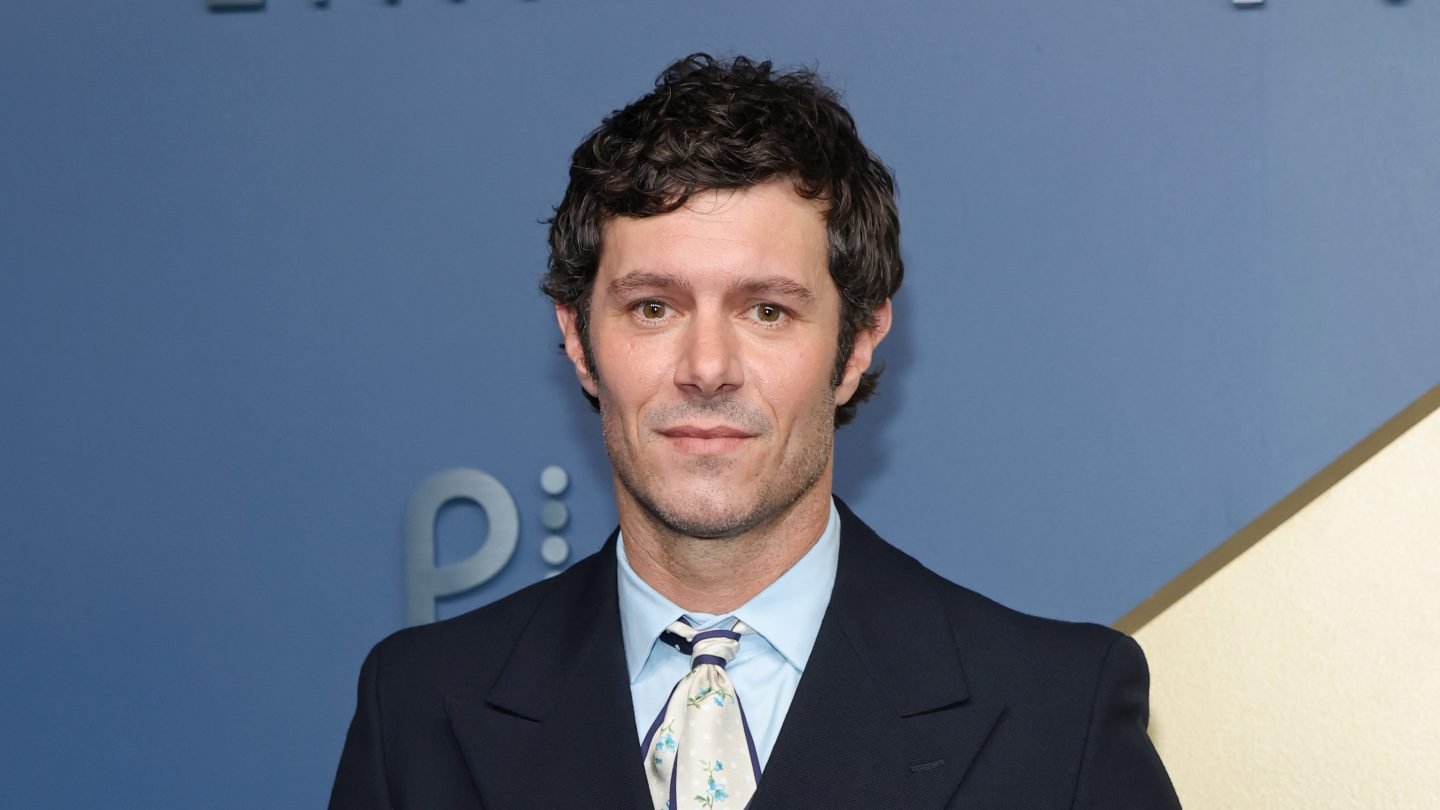
    Nobody Wants This star Adam Brody is sharing his thoughts on the ongoing Israel-Gaza war, telling GQ in a new interview that he is in support of “a free Palestine.”

    The actor, who appears on the Netflix series as a rabbi, discussed his political activism with GQ, and was asked if he thinks Hollywood has gotten more conservative. “I guess outspokenly so, yes. Again, as one side has more power, it makes sense that it draws people to it for all the human reasons that would be attractive: groupthink, your own well-being, your own money and success,” he said.

    Brody continued, “Between COVID, a second Trump term, Israel-Gaza, it’s really brought out some different beliefs that I was ignorant to, and then disheartened by.”

    The interviewer asked the actor how Israel-Gaza has come up in his messaging, to which he responded, “Truthfully, it hasn’t. I have spoken a lot about it privately. I haven’t spoken much about it publicly.”

    When asked if he’d like to speak about the topic, The O.C. actor said, “Put me down as thinking it’s a genocide. Put me down as wanting a free Palestine.”

    “It’s awful that it’s taken so much death and misery, but it does feel like it’s reaching a breaking point that it should have a while ago,” he continued. “I’m hopeful that another administration can really do some good and correct some of these policies that are helping that situation be as awful as it is.”

    Netflix is gearing up to release the third season of its Jewish rom-com Nobody Wants This on Oct. 22. Brody was nominated for a 2025 Emmy for his role in the series, and won the Critics Choice Award for best comedy actor that same year.

    In an August 2025 interview with The Hollywood Reporter, series creator Erin Foster said of the show, “It was really important to me and continues to be really important to tell positive Jewish stories. I know that it can be polarizing, but it shouldn’t be. This is not the show to tackle conflict in Israel and Palestine.”

    “I’m not the person to tell that story,” Foster added. “And after [the attacks on] Oct. 7 happened, there were conversations around if we were going to dive into it, and the truth is, the way that I can get my message across best is by shedding a positive light on Jewish characters and Jewish traditions. I don’t think somebody watching wants to see another voice give you their opinion on what’s happening.”

  • Scarlett Johansson Takes Break From Filming Overseas for ‘Paper Tiger’ NYFF Premiere After Skipping Cannes: ‘I’m Hallucinating’

    Scarlett Johansson Takes Break From Filming Overseas for ‘Paper Tiger’ NYFF Premiere After Skipping Cannes: ‘I’m Hallucinating’

    A very jet-lagged Scarlett Johansson reunited with co-stars Adam Driver and Miles Teller for the New York Film Festival premiere of “Paper Tiger,” which kicked off the festival’s 64th edition.

    “I’m hallucinating,” said Johansson, who just got off a long international flight, where she’s filming another movie. “It’s 5 in the morning — which is a great time to be doing an interview on stage.”

    “Paper Tiger” premiered in May at the Cannes Film Festival. However, this marked Johansson’s first time watching the movie (at least in a festival setting); she missed the Cannes premiere because she was shooting yet another movie, “The Exorcist: Martyrs.”

    “Don’t rub it in!” Johansson joked about her absence on the French Riviera.

    Set in 1986, “Paper Tiger” follows two brothers, Irwin and Gary Pearl, whose get-rich-quick scheme to help clean up the Gowanus Canal lands them in the crosshairs of the Russian mafia. Johansson plays Linda, wife of Teller’s character.

    Johansson, Driver and Teller walked the red carpet with Gray at Lincoln Center’s Alice Tully Hall and sat for a post-screening Q&A, during which they spoke about their close camaraderie during production.

    “No work required. There’s a mutual admiration between the four of us,” Driver said. “A set culture comes from the top down, and James sets a culture where everyone feels free. We immediately felt comfortable with each other.”

    Added Gray, “We had a nauseatingly lovely set. I love them. I’m not on the Today show. I’m telling you the truth.”

    Scarlett Johansson, Miles Teller and Adam Driver introduce “Paper Tiger” during the 64th New York Film Festival.

    Getty Images for FLC

    Before the screening began, Gray took the stage and consciously kept his intro remarks short and sweet.

    “When I was in film school many years ago, students would show their films, and the students that talked the most [before] often made the very worst movies,” he said. “So I am going to speak very briefly.”

    Gray praised the producers and actors who helped bring the film to life and reflected on his early dreams of being a filmmaker.

    “I can’t help but remember my mother and father when I said I wanted to be a movie director. ‘How are you ever going to do that?’ And here I am,” Gray said. “I’m not sure the lesson in that.”

    NYFF artistic director Dennis Lim introduced Gray as “one of the great living American filmmakers” and praised the director for championing a “singular” artistic vision.

    “It’s not easy to make personal films in the current landscape of American cinema,” Lim said. “The fact that there are 24 executive producers credited on this film, like, who speaks to that.”

    New York Film Festival’s 64th edition, which runs through Oct. 12, will host the world premieres of “Artificial,” Luca Guadagnino’s buzzy movie about OpenAI founder Sam Altman; Ava DuVernay’s documentary “14th”; director Tony Gilroy’s music drama “Behemoth!” with Pedro Pascal, Olivia Wilde and Will Arnett; and Takashi Yamazaki’s kaiju sequel “Godzilla Minus Zero.”

    “Premiere status is never the be-all and end-all for us,” NYFF artistic director Dennis Lim told Variety ahead of opening night. “Timing is always part of it. But I think we’ve proved in the last few years that we create a pretty interesting context for the launch of a film.”

    “Paper Tiger” filmmaker James Gray (center) with the film’s stars Roman Engel, Miles Teller, Scarlett Johansson, Adam Driver and Gavin Goudey.

    Getty Images for FLC

  • ‘Hanuman Ansh’ Indian Sleeper Hit’s International Distribution Strategy Unveiled by ‘K.G.F,’ ‘Kantara’ Outfit Hombale Films (EXCLUSIVE)

    ‘Hanuman Ansh’ Indian Sleeper Hit’s International Distribution Strategy Unveiled by ‘K.G.F,’ ‘Kantara’ Outfit Hombale Films (EXCLUSIVE)

    Indian devotional film “Hanuman Ansh” has grossed more than $3.5 million outside its home territory since Hombale Films took it to international audiences, and the company behind the blockbuster “K.G.F” and “Kantara” franchises has now detailed how it engineered the run.

    Written and directed by Vishal Chaturvedi and adapted from his book “Divine Detour: That Changed My Life,” the film follows Lakshman Das, a boy who leaves home after his mother dies, searching for the divine. Years of wandering and meditation later, he becomes the saint Neem Karoli Baba, known to devotees as Maharaj-ji. Shobhinaw Satyaa plays the title role opposite Chandan Anand, with Vihaan Shedge as the teenage Maharaj-ji and Anil Rastogi and Purnima Tiwari in supporting roles. Chaturvedi produced with Ragini Sona, Namrata G. Singh and Anupriya A. Nagar under his Swambhu Media Network banner.

    “Our strategy involved taking ownership of all global territories and collaborating with the biggest local partners in each region to ensure the best possible release footprint. By leveraging the data and learnings from our previous releases like ‘Mahavatar Narsimha,’ we were able to tap into the right locations and cinema chains. This targeted approach has yielded spectacular numbers,” says Hombale Films producer Chaluve Gowda.

    The Bengaluru banner partnered with Phars in the GCC and Prathyangara in North America, and the film opened internationally on Sept. 11. It marks a first for the company.

    “‘Hanuman Ansh’ is the first film outside of our own productions that we have full fledgedly distributed internationally. We truly believed in this project, as it perfectly aligns with our vision of taking Indian stories global,” Gowda says.

    North America leads the overseas tally, with $1.8 million from the U.S. and Canada, according to Hombale’s territory figures. Australia and New Zealand contributed $606,716 and the Gulf Cooperation Council region $577,870, with the U.K. adding $269,837. Singapore brought in $61,334 and Europe $41,171, while the rest of the world accounted for $483,006.

    Hombale previously backed the animated “Mahavatar Narsimha,” which went on to do more than INR300 crore ($31.3 million) in business.

    At home, the film has been a sleeper. Made for approximately INR2 crore ($209,000), “Hanuman Ansh” opened in India on Aug. 7 on some 250 screens through Cinépolis India. Word of mouth pushed it past 2,000 screens, and it has since grossed INR340.7 crore ($35.5 million) in seven weeks.

    Chaturvedi has planned the film as the first part of a trilogy.

    “We will always support the makers in bringing their ultimate vision to life. These are exactly the kinds of stories we want to champion as a production house, and we will continue to back creators who dare to tell such grand stories with all their heart,” Gowda says.

  • XRP ETF inflows hit $38M—can price break the $1.60 barrier?

    XRP ETF inflows hit $38M—can price break the $1.60 barrier?

    US spot $XRP exchange-traded funds saw around $38 million in two trading sessions, showing a fresh sign of investor demand.

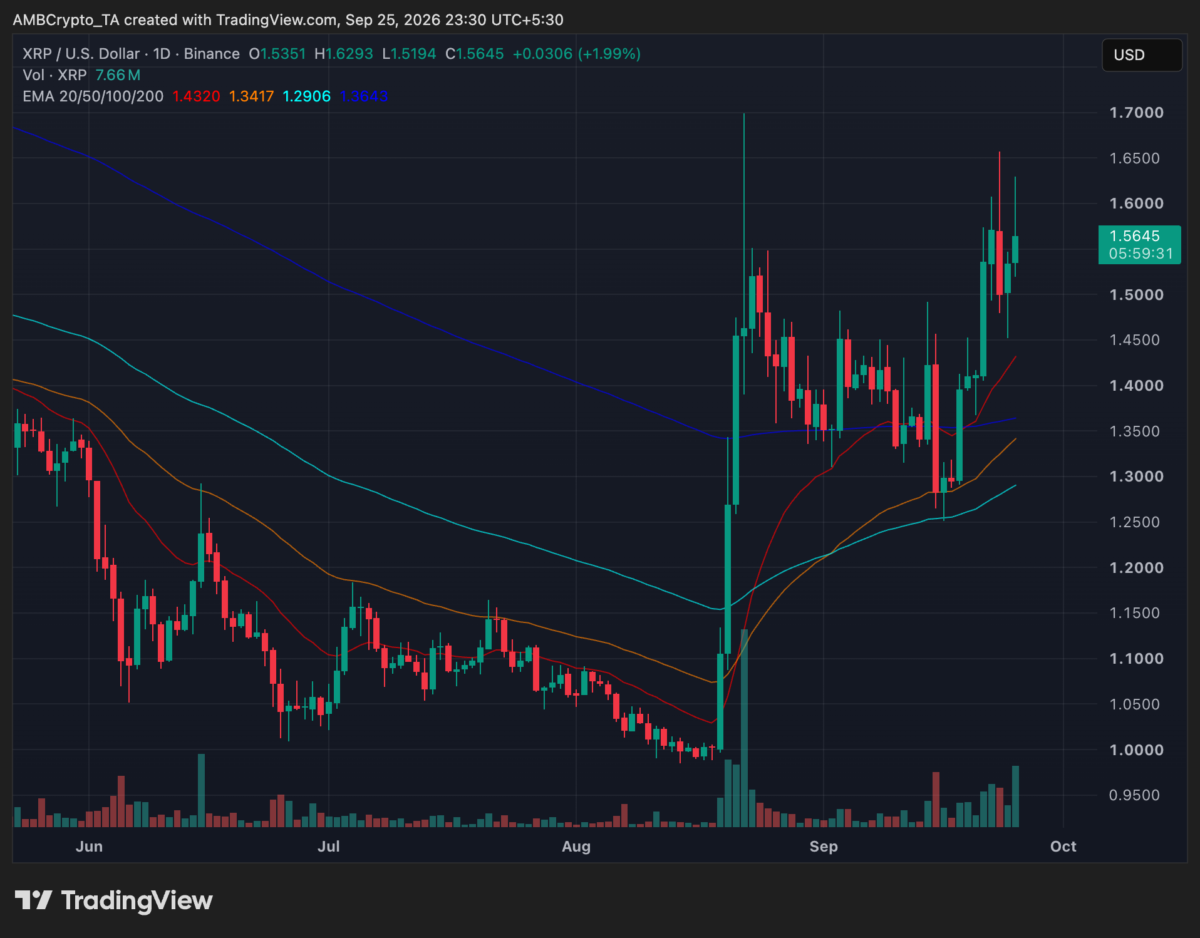
    $XRP has also recovered to around the $1.56 price level, but it has yet to overcome selling pressure near the $1.60 price level. It must overcome this level before the latest rise it is seeing can develop into a stronger one.

    Bitwise leads latest $XRP ETF inflows

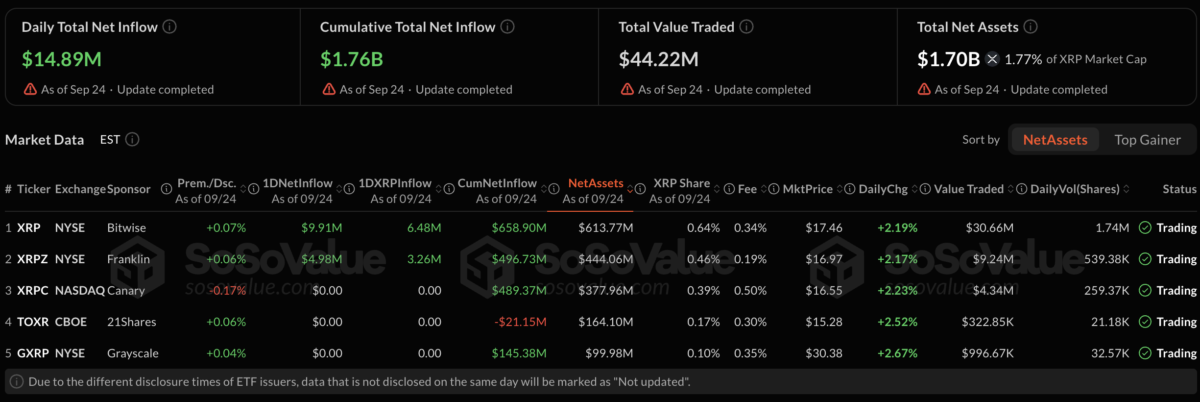
    $XRP ETFs saw $14.89 million in net inflows on September 24, according to SoSoValue data. This was after it saw around $23.17 million in the previous session, bringing the two-day total to just over $38 million.

    Bitwise’s fund led the latest daily inflows with $9.91 million. Franklin Templeton followed with $4.98 million, while no net movement could be seen from the other listed products.

    Source: Sosovalue

    The five funds now hold a combined $1.70 billion in assets. Their cumulative net inflows have reached $1.76 billion.

    Bitwise’s $XRP holdings have also grown. The fund held 401.42 million tokens on September 23, which is up by 14.18 million from two days earlier.

    Its $XRP was worth about $613.89 million, according to Bitwise’s official fund page.

    $XRP price faces its next test at $1.60

    $XRP traded near the $1.56 price level at the time of this writing, having gained about 2% during the session.

    The price has recovered from its recent dip, and it remains above the levels that have supported its rebound. Buyers have also returned, and they have done this with stronger trading activity.

    The next challenge now sits around the $1.60 price level. It has approached this area on different occasions, but sellers have not allowed it to hold above that level.

    A convincing move through the $1.60–$1.65 price region would show that buyers remain in control. It could also give $XRP room to extend its recovery.

    Source: TradingView

    For now, the $1.50 price level is the nearest level to watch if the price drops. If it holds above it, this would help it to preserve the short-term momentum.

    If it falls below the $1.50 level, it would make the recovery less convincing and could bring the price back towards the $1.43 price area.


    Final Summary

    • $XRP ETFs attracted approximately $38 million over two trading sessions.
    • $XRP has recovered to $1.56 but still faces resistance between $1.60 and $1.65.

  • Bitcoin could soon get Zcash-style ‘shielded’ privacy without changing its rules

    Bitcoin could soon get Zcash-style ‘shielded’ privacy without changing its rules

    Privacy has become a practical concern in recent months as developers try to make cryptocurrencies useful for payroll, business payments and everyday spending. Ordinary bitcoin transactions permanently expose amounts and addresses, but once an address is linked to a company or person, other payments associated with it become easier to follow.

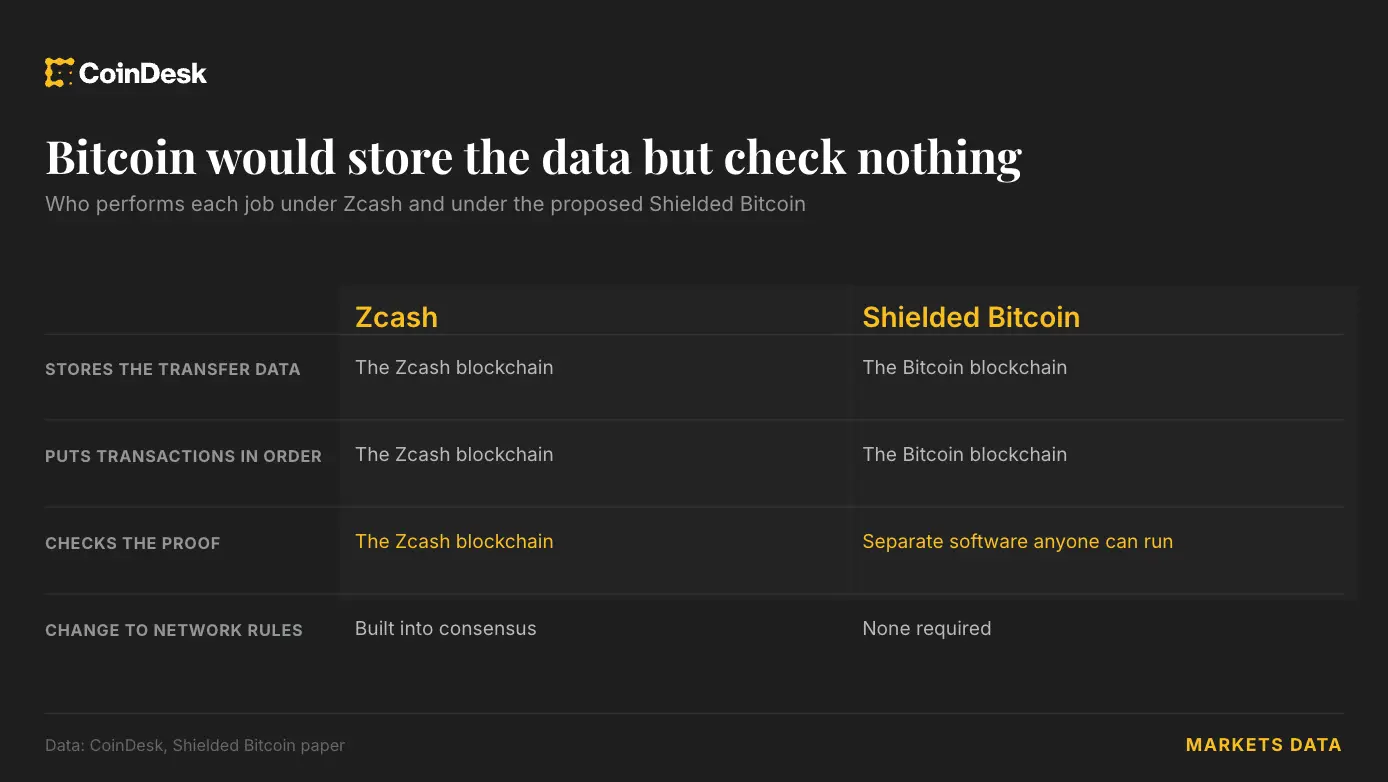
    Bitcoin would store the data but check nothing. (Shaurya Malwa/Coindesk)

    Ethereum is also reviewing a proposal for a shared private pool that would let people transfer ether and other tokens without publicly revealing payment details. Its authors cite payroll, treasury management and donations among the uses poorly served by fully public transactions.

    How Zcash works

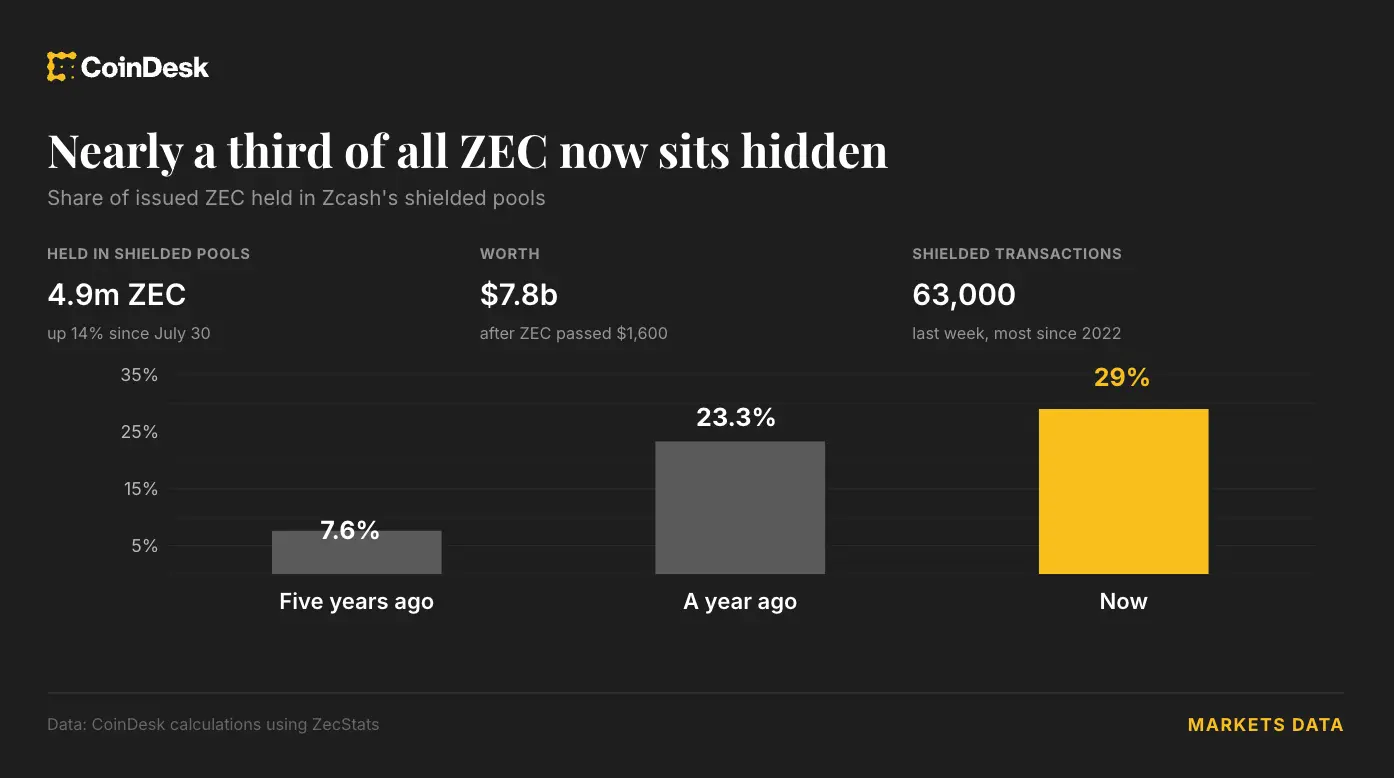
    Zcash lets users choose between transparent payments, whose addresses and amounts are public, and shielded payments that encrypt those details. Its shielded pools held about 4.9 million $ZEC on Friday, up 14% from July 30, according to CoinDesk calculations using ZecStats data. That represents roughly 29% of issued coins, worth about $7.8 billion following the rally.

    Zcash recorded roughly 63,000 shielded transactions last week, its busiest week for private transfers since 2022 and fourth-highest on record. Across the network, reported transfer volume exceeded $23 billion, the largest weekly total since 2021 and second-highest in its history.

    Nearly a third of all $ZEC now sits hidden. (Shaurya Malwa/CoinDesk)

    Zcash has attracted both investor money and attention amid those metrics. By early September, $ZEC had gained more than 2,300% over the preceding year and crossed $1,000. It extended the rally above $1,600 on Wednesday.

  • XRP Ledger’s Batch upgrade slips to Oct. 9 after validator support resets

    XRP Ledger’s Batch upgrade slips to Oct. 9 after validator support resets

    An $XRP Ledger upgrade expected to activate Sept. 29 has been pushed back by at least 10 days after validator support briefly fell below the level required to turn it on.

    The feature, called Batch, would let users submit up to eight transactions together. Its all-or-nothing option could let a buyer pay for a tokenized asset and receive it in one operation, preventing either side of the trade from completing alone.

    RippleX’s head of engineering, Ayo Akinyele, previously told CoinDesk that projects were being built around Batch and that Ripple would share more about work with asset managers once the feature went live.

    “Some projects are already being built with Batch in mind, so activation would allow that work to move closer to production,” he said. He did not name the partners or give launch dates.

    The corrected upgrade, formally named BatchV1_1, regained support from 30 of 35 trusted validators on Sept. 25, according to the XRPL amendment dashboard. That started a fresh two-week countdown, putting its earliest activation at Oct. 9 around 14:46 UTC if support holds.

  • TikTok to pay $100 million to Alabama in teen addiction settlement

    TikTok to pay $100 million to Alabama in teen addiction settlement

    TikTok has settled and agreed to pay the US state of Alabama at least $100 million dollars days before a teen addiction trial was set to begin. TikTok is the latest social media giant to face legal challenges over its handling of teenage addiction concerns.

  • Netanyahu compared Oct. 7 attack to ’16 9/11s’

    Netanyahu compared Oct. 7 attack to ’16 9/11s’

    Claim:

    Israeli Prime Minister Benjamin Netanyahu said Hamas’ Oct. 7, 2023, attack on Israel “is equal to 40,000 innocent Americans slaughtered in less than 24 hours. That’s 16 times 9/11. Sixteen 9/11s that occurred not very far from here.”

    Rating:

    Correct Attribution

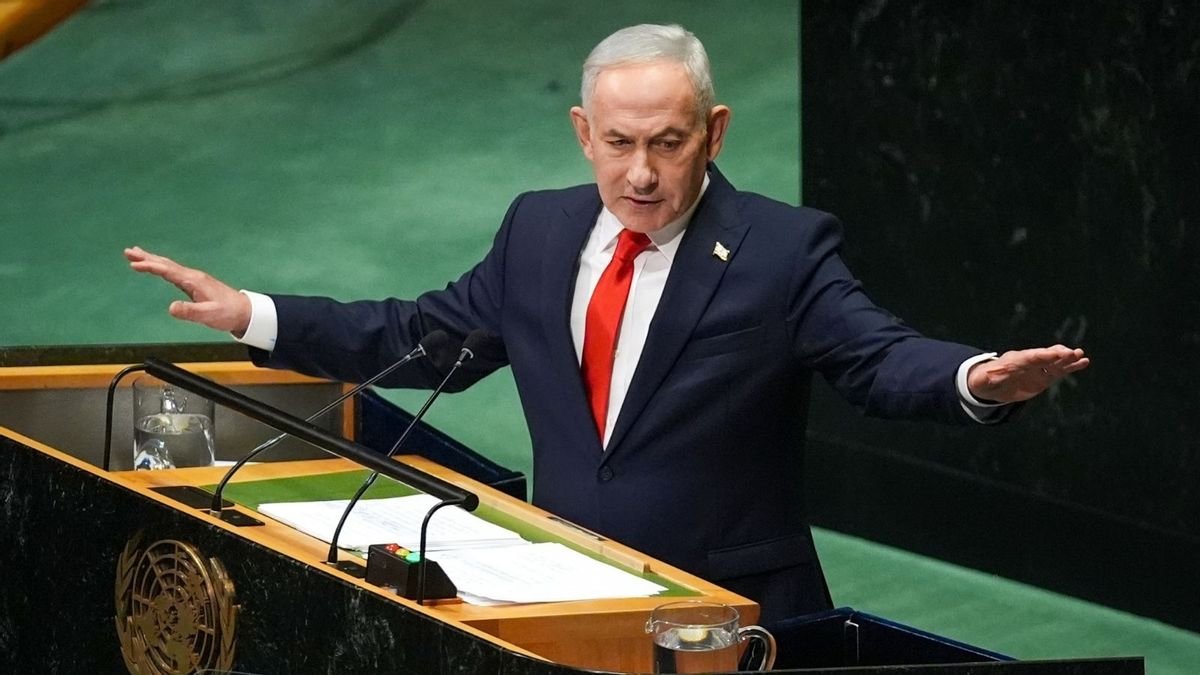
    On Sept. 24, 2026, Israeli Prime Minister Benjamin Netanyahu addressed the United Nations General Assembly, where many delegates walked out at the beginning of his speech. Following his speech, many people online attributed various quotes to Netanyahu, with some claiming he said Hamas’ Oct. 7, 2023, attack on Israel, was equivalent to “sixteen 9/11s.”

    According to numerous posts shared on Instagram (archived), X and Facebook, Netanyahu said the Oct. 7 attacks were “equal to 40,000 innocent Americans slaughtered in less than 24 hours. That’s 16 times 9/11 — 16 9/11s.”

    The quote was correctly attributed to Netanyahu. He was comparing the number of Israeli casualties in the Oct. 7 attacks to 9/11 deaths relative to both countries’ populations.

    During his speech, Netanyahu referred to the number of people killed in Hamas’ attack on Israel before drawing the comparison to the 9/11 terrorist attacks. He said (emphasis ours):

    These Hamas monsters, they slaughtered Holocaust survivors. They burned babies alive in front of their parents. They beheaded our men. They brutally raped our women and then they murdered them.

    Altogether, they slaughtered 1,200 Israelis that day.

    I want to give you an idea of what this means for a country of 10 million. Proportionately, this is equal to 40,000 innocent Americans slaughtered in less than 24 hours. That’s 16 times 9/11. Sixteen 9/11s that occurred not very far from here.

    Netanyahu said the above at the 11:28 mark in the video below:

    New York City Mayor Zohran Mamdani did not address the 9/11 comparison, but accused Netanyahu of repeating “baseless lies meant to sanitize his genocide of Palestinians,” the New York Times reported. 

    As Netanyahu approached the stage for his speech, a mixture of boos and cheers erupted and many delegates staged a mass walkout. Netanyahu defended Israel’s attack on Iran and denied accusations of committing genocide in Gaza. 

    Palestinian President Mahmoud Abbas delivered a prerecorded speech as the United States denied him a visa to attend the UNGA. Abbas said Palestinians were living through one of the most dangerous periods in their history and that Israel was engaging in “killing, destruction, starvation, attempts at displacement, as well as a genocidal war that has created an unprecedented humanitarian catastrophe.” He called Israel’s actions a “malicious colonial scheme aimed at making the lives of Palestinians more difficult in their homeland and forcing them to leave it.”

    For further reading, Snopes has reported on many claims about Netanyahu. 

    Sources

    Deng, Rae. “8 Rumors We’ve Investigated about Benjamin Netanyahu.” Snopes, 26 June 2025, https://www.snopes.com//collections/benjamin-netanyahu-rumors-collection/. Accessed 25 Sept. 2026.

    “‘Do Not Allow Another Nakba’, Mahmoud Abbas Warns in UN Speech.” Middle East Eye, https://www.middleeasteye.net/news/do-not-allow-another-nakba-mahmoud-abbas-warns-unga-speech. Accessed 25 Sept. 2026.

    “Israel’s Policies Threaten ‘Very Existence’ of Palestinians, Abbas Tells UN.” Al Jazeera, https://www.aljazeera.com/news/2026/9/24/israels-policies-threaten-very-existence-of-palestinians-abbas-tells-un. Accessed 25 Sept. 2026.

    “LIVE: Israel PM Netanyahu Speech at UN General Assembly 2026 (Full) .” YouTube, Associated Press, 24 Sept. 2026, https://www.youtube.com/watch?v=yGGRNErktOs. Accessed 25 Sept. 2026.

    “PM Netanyahu’s Speech at the United Nations General Assembly 2026.” Prime Minister’s Office Israel, 24 Sept. 2026, https://www.gov.il/en/pages/event-un240926. Accessed 25 Sept. 2026.

    Stack, Liam. “Mamdani Accuses Netanyahu of Spreading ‘Baseless Lies’ After U.N. Speech.” The New York Times, 24 Sept. 2026, https://www.nytimes.com/2026/09/24/nyregion/netanyahu-mamdani-un-speech.html. Accessed 25 Sept. 2026.

    “WATCH: Israeli Prime Minister Netanyahu Addresses 2026 UN General Assembly.” PBS, Sept. 24, 2026, https://www.pbs.org/newshour/world/watch-israeli-prime-minister-netanyahu-addresses-2026-un-general-assembly. Accessed 25 Sept. 2026.
     

  • Will Trump’s ‘public charge’ immigration rule save US billions? We investigated

    Will Trump’s ‘public charge’ immigration rule save US billions? We investigated

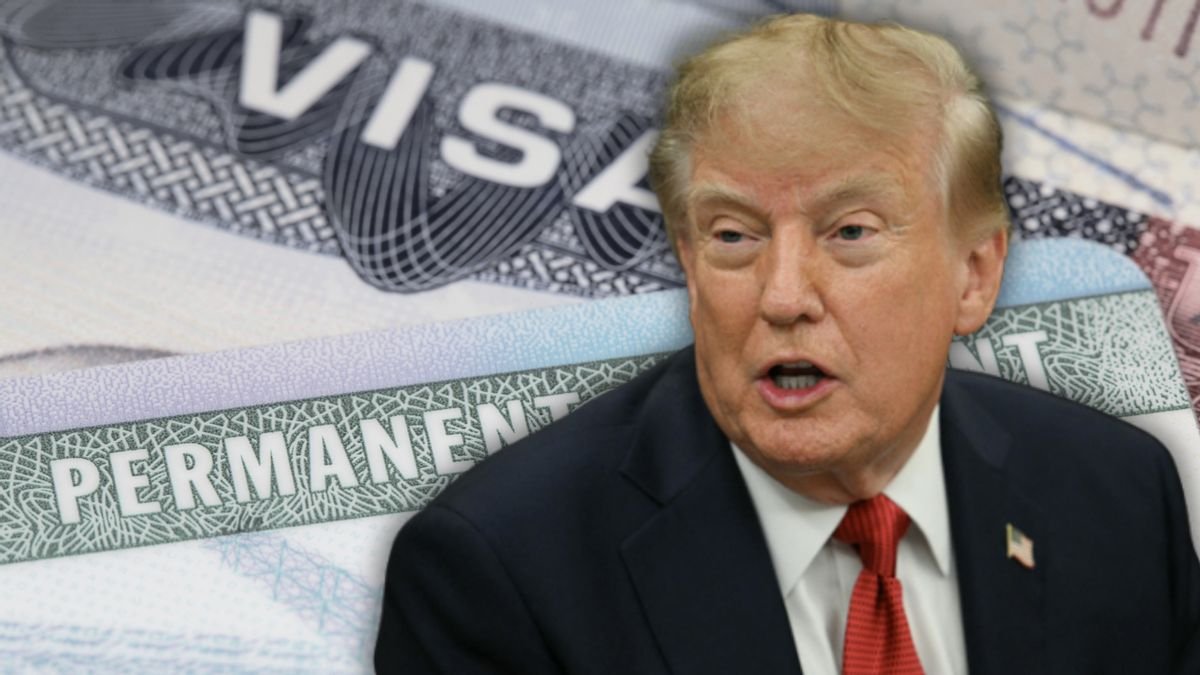
    • A rumor spread in September 2026 that U.S. President Donald Trump was set to save the country billions of dollars by invoking a supposedly “long-unenforced” law to deny certain immigrants entry into the country. According to the claim, Trump was enforcing a provision to bar access to anyone who is a “convict, lunatic, idiot, or any person unable to take care of themselves without becoming a public charge.”
    • The claim referred to the Immigration Act of 1882, which indeed prohibits certain immigrants from entering the country or obtaining green cards if federal authorities consider them to be a “public charge” based on their use of government benefits. That provision has existed since the act’s conception and includes the alleged phrasing about “convicts” and “lunatics” verbatim.
    • Trump was not invoking a “long-unenforced law,” but his administration in September 2026 announced it was changing how it interprets that “public charge” section of the Immigration Act of 1882 to further restrict who can enter the country or receive permanent residency. Previously, the government only considered cash assistance and long-term institutionalization as reasons a person could be denied under the public charge rule. 
    • Under the Trump administratin’s new rule, which went into effect on Sept. 18, 2026, the Department of Homeland Security removed those previous guidelines and designated immigration officers to use their own judgment to determine who constitutes as a “public charge.” 
    • DHS estimates the change will save federal and state governments $13.05 billion in benefit payments, though it’s unclear how, exactly, the agency came up with that number.
    • Immigration experts and some Trump critics say the department is not fairly considering the possible economic impact of people forgoing benefits out of fears of being deemed a “public charge” and thus denied certain legal immigration statuses.
    • A group of Democratic-led cities and states have filed two separate lawsuits challenging the rule. The courts haven’t yet made a decision in those cases, meaning it’s unclear if the rule will get overturned.
    • In sum, while the gist of the claim has some truth, the rumor misinterprets a September 2026 policy change by the Trump administration and misleadingly estimates possible savings when the real dollar amount is unknown.

    A rumor spread in September 2026 that U.S. President Donald Trump was on track to save the United States billions of dollars by invoking a supposedly unenforced law to deny certain immigrants entry into the country. 

    Social media posts (archived) claimed that Trump was beginning to enforce the Immigration Act of 1882, which denies entry to anyone who is a “convict, lunatic, idiot, or any person unable to take care of themselves without becoming a public charge.” These posts alleged the enforcement measures were expected to kick 5.6 million migrants off government welfare programs and save the U.S. government $13 billion a year. 

    The claim was misleading for multiple reasons. 

    Trump was not “invoking a long-unenforced law.” Rather, his administration changed the government’s interpretation of the Immigration Act of 1882’s “public charge” language to further restrict which immigrants can enter the country or receive permanent residency. The new rule, which went into effect on Sept. 18, 2026, applies to immigrants based on their use of public benefits.

    It’s true the Department of Homeland Security estimated the policy change will save federal and state governments $13.05 billion per year, supposedly affecting an estimated 1.3 million individuals, not 5.6 million. (It’s possible the “5.6 million” number in social media posts originated from a misreading of an analysis about the rule’s impact on Medicaid and the Children’s Health Insurance Program.)

    However, the true impact of the rule is unknown. 

    Most noncitizens who do not have permanent resident status are not eligible for many federal assistance programs, which means the rule generally targets people seeking green cards for permanent residency. 

    Immigration and family policy experts fear the change could have far-reaching consequences for immigrant families and local communities. A group of Democratic-led cities and states have filed two separate lawsuits against the rule, arguing it will drive up administrative costs, change states’ funding for public benefits and pressure people into forgoing legal access to benefits. 

    We asked for the DHS’ response to those accusations, and we await a reply. Because the courts have not yet ruled in those cases as of this writing, it’s unclear if the administration’s interpretation of the Immigration Act of 1882 is lawful and the DHS can fully implement it.

    Considering that major unknown, we did not put a rating on this claim.

    Here’s what you should know. 

    The definition and history of ‘public charge’

    The Immigration Act’s “public charge” rule only impacts a portion of immigrants attempting to enter the country using certain legal pathways. 

    According to U.S. Citizenship and Immigration Services, the rule largely doesn’t apply to immigrants who apply for green cards due to a humanitarian status like asylum. Meanwhile, it does apply to immigrants who are relatives of U.S. citizens, employed in the country and working with the American military, among others.

    The U.S. government previously stated that immigrants in the latter groups can be denied entry or legal permanent residency based on certain guidelines to determine whether they are a “public charge” — a label based on people’s use of government assistance or the perceived possibility they’ll need it in the future.

    When Congress first used the term “public charge” in the Immigration Act of 1882, many social safety net programs that exist today were not around, as Kunal Parker, a historian at the University of Miami School of Law, told NPR in 2019.

    In turn, federal officials have reconsidered how to enforce and define the 1882 provision.

    In 1999, a memo by the Department of Justice formally defined “public charge” as a person “primarily dependent on the government for subsistence,” as demonstrated by their use of public cash assistance, like Supplemental Security Income through Social Security, or long-term institutionalization at the government’s expense. (See Page 1, under “Definition of ‘Public Charge,’” in the memo.)

    The memo stated: “Officers should not place any weight on the receipt of non-cash public benefits (other than institutionalization) or the receipt of cash benefits for purposes other than for income maintenance.”

    That meant immigration officers could not consider benefits like Medicaid, food stamps and free or reduced school lunches as disqualifying factors for green cards (unless the person was in, or likely to need, a public institution for long-term care).

    In 2019, the first Trump administration issued a new rule that redefined “public charge” to include immigrants who receive “one or more public benefits,” including some types of Medicaid, housing assistance and other non-cash benefits, “for more than 12 months” in total within any 36-month period. 

    The courts struck down that rule after a lengthy legal battle.

    In 2022, former President Joe Biden issued a new policy that closely aligned with the 1999 memo’s definition of “public charge.” 

    Trump admin’s 2026 rule

    In July 2026, the Trump administration announced its new rule that rescinded Biden’s 2022 guidelines. The new rule eliminated “public charge regulations in their entirety” to give “broad discretionary authority to officers,” as outlined by the government’s Federal Register.

    “DHS is restoring the basic principle that immigrants must be able to support themselves,” DHS said in a statement on X. “We are reaffirming the requirement of self-reliance, protecting public resources, and ending policies that encouraged dependency on hard-working American taxpayers.”

    In other words, the Trump administration removed the existing guidelines to determine whether someone is a “public charge” and instead told immigration officers to use their own judgment to determine who gets the label. Here’s an excerpt from the DHS rule: 

    While officers will not have a list of “excluded” benefits to consider, officers will have the authority and discretion to consider all circumstances surrounding receipt of any one or more public benefits and determine whether the alien is inadmissible as likely at any time to become a public charge taking into account the statutory factors and applicable precedent. The receipt of public benefits is but one consideration in the totality of the circumstances.

    The Trump administration’s full July rule is available on the government’s Federal Register website. Under “Purpose of the Regulatory Action,” DHS states that officers may consider an immigrant’s use of “means-tested public benefits” (public benefits based on a person’s need for them); “any other individualized case-specific factors and circumstances,” and “any empirical data relevant to an alien’s self-sufficiency.”

    “Using good judgment and discretion, officers will more accurately assess an alien’s likelihood at any time of becoming a public charge, in the totality of the circumstances, as Congress intended,” the rule says.

    According to the DHS rule, officers will not consider benefits used by an applicant’s household members, including non-relative dependents. However, officers will consider the applicant’s “financial status” that led to a household member” needing to apply for or receive those benefits.”

    The rule’s potential impact

    Given how vague and open-ended the 2026 rule is, it’s difficult to estimate its future impact.

    The $13 billion estimation in savings originated from the DHS rule in the Federal Register: 

    DHS estimates that the total reduction in transfer payments from the Federal and State governments could be approximately $13.05 billion annually due to disenrollment or forgone enrollment in public benefits programs by members of households that include aliens who may be receiving public benefits.

    In other words, the $13 billion number is an estimate of how much money the government would no longer be handing out via public benefits, either due to people unenrolling or forgoing signing up all together.

    It’s unclear how, exactly, the DHS calculated the estimated savings. We asked for the department to explain its math in our interview request for this story, and we will update this report if we hear back.

    However, that prediction does not account for several factors, such as the economy’s loss in workers with fewer people being allowed to enter or live in the country. 

    A group of Democratic-led states, including California and New York, argued in a lawsuit filed Sept. 14 that the rule could harm local communities and economies (see Page 4):

    States will lose federal funding due to disenrollment in state programs, and public agencies will face substantial administrative costs as they attempt to mitigate confusion and fear. As households forgo their legal access to benefits—such as preventative healthcare, nutritional assistance, and school lunch—public health, local economies, public education, and public safety will suffer. The [DHS rule] will increase the prevalence of disease, drive up the costs of medical care, and increase poverty.

    On the same day, Democratic-led cities including New York City, Chicago and San Francisco, similarly filed a seperate lawsuit challenging what they described as the federal government’s attempt to deny green cards and visas to certain immigrants “without clear definitions or meaningful guardrails.”

    In the Federal Register documentation, DHS said the rule could impact state and local economies but attempting to quantify that impact is challenging due to “limited data and uncertainty” regarding how people might react to the rule. 

    Opponents fear downstream effects

    Immigration experts and some Trump critics worry the new rule could have far-reaching consequences for immigrant communities. For example, families with children who are citizens but have immigrant parents may suffer if the parents choose to forego benefits out of fear of running afoul to the “public charge” rule.

    After the first Trump administration announced changing the provision in 2019, a survey from the Urban Institute, a research nonprofit, found that one in seven adults in immigrant families reported avoiding public benefit programs in 2018 “out of fear of risking future green card status.” 

    Other research at that time predicted additional challenges for families impacted by the rule, like limited economic mobility, as well as downstream job cuts and other negative impacts on the economy.

    “The biggest impact of the first Trump administration’s public charge policy was to terrify families out of using public benefits they were eligible for, including for their U.S. citizen children, because they were afraid of falling afoul of the rule,” wrote Dara Lind of the American Immigration Council, a nonprofit advocating for immigrant rights. 

    “Even though the new [2026] policy isn’t the same as the old one, the fear of a new public-charge rule could be so powerful that it has the same effect,” Lind said in July.

    In the Federal Register documentation, the DHS said the change “may negatively impact the health and education opportunities for children,” including those who are citizens. However, the agency believes that impact “is outweighed by compelling legal and policy reasons,” such as “better ensuring self-sufficiency.”