On Monday night’s episode of “The Daily Show,” Jon Stewart gave audiences a comedic rundown of the recent developments in the relationship between Donald Trump and Chinese President Xi Jinping following Trump’s hosting of Jinping in Washington, D.C., for what was called a “reciprocal state visit” by the White House.
Stewart kicked off his monologue by introducing the two and setting the scene of their time together.
“Last week, a young man by the name of Donald Trump picked up a young man by the name of Xi Jinping, Chinese president, at the airport for a pivotal three-day visit to Washington. Now, as with any monumental meeting of superpowers, with profound repercussions for global safety and stability, it began with ‘House Tour,’” sang Stewart, before cutting to news videos of Trump pointing at a number of different areas.
“Trump spent most of Xi’s White House visit just pointing at shit, while Xi did his best effort to pretend to be impressed. Although I’m sure they talked about issues of national importance,” said Stewart, then alternating to news clips of Trump speaking to the press: “We had a great meeting, and he has great interest in granite,” he said.
“Does he? Does he love good granite?” asked Stewart. “Is that his ‘I love good granite face?’ Because it looks like his ‘I’d rather be standing in front of a tank in a square face… Like President Trump, I’m sure you’re proud of your new circular granite helicopter parking spot, but just so you know, this is Shenzhen, China. They’ve got a fully autonomous magnetic levitation train. Pretty sure he’s not blown away by carved rock in the shape of a circle.”
Stewart continued, pointing out that Trump must understand “the seriousness of the competition between our two nations” and would not undermine America’s national security. “I mean, national security is the whole reason we’re paying $600 million for this ballroom, right? So you’ll keep that behind the curtain, yeah?” Not quite — Trump invited the couple “through that beautiful curtain,” making them the first people to set foot in it. “Maybe Trump’s just trying to sell Xi Jinping on renting the ballroom out for his next big function,” joked Stewart.
He then brought up recent developments in China-U.S. relations, playing news clips explaining that China had been sending Iran weapons. And not only did this topic not appear to come up between the two presidents, but it seemed as though Trump offered to sell American weapons to China.
“How does America even stay on the map sometimes? I don’t even. How do we not just slide into the sea? All right, I had to have misheard that. I got to hear it from the president himself.” The show then cut to a clip of Trump denying this, saying that China probably would like to buy weapons from the U.S., though, “because we do make better equipment.”
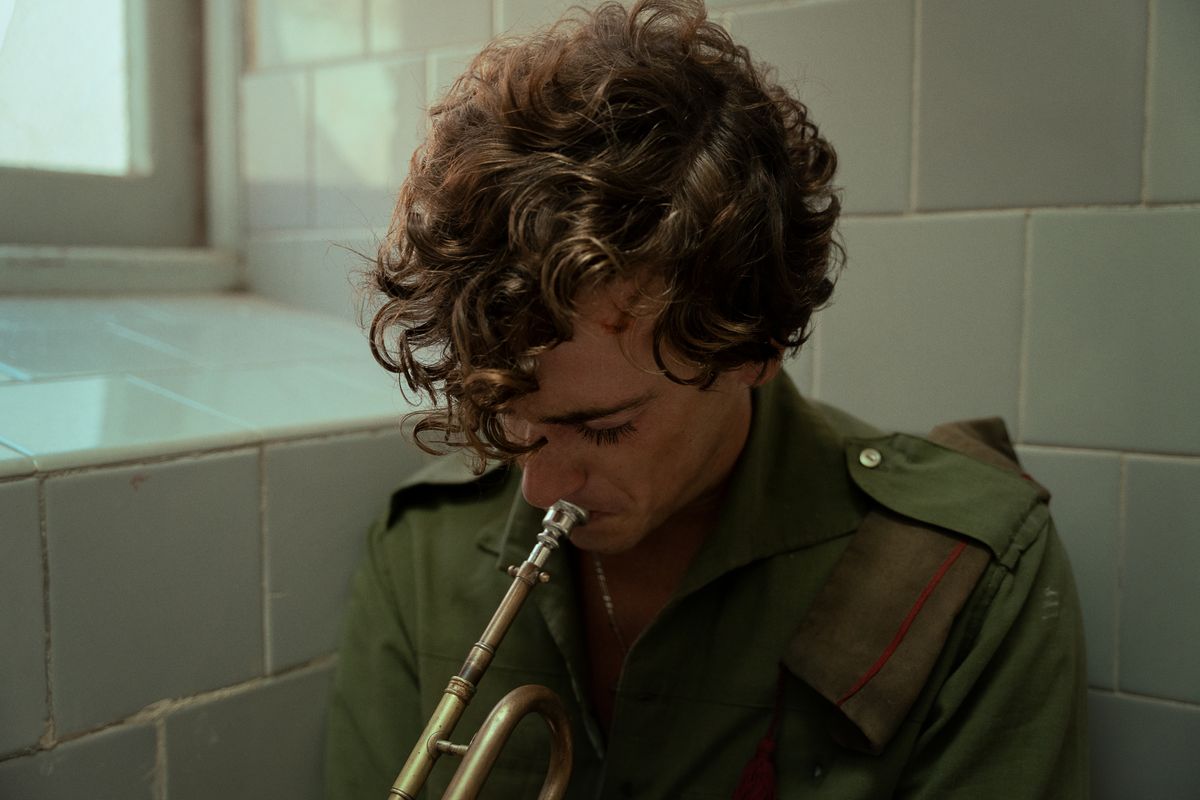
Penélope Cruz, Glenn Close and some of Spain’s most exciting stars come together in the official trailer for La Bola Negra, the acclaimed new film from Javier Calvo and Javier Ambrossi.
Penélope Cruz stars as Nené Romero in the award-winning Spanish-language drama La Bola Negra.
Released on Monday, September 28, the new preview offers a deeper look at the ambitious drama, which spans nearly a century of Spanish history to tell the interconnected stories of three generations of men.
Their experiences unfold in different eras, but their lives are linked through desire, pain, love and the emotional inheritance passed from one generation to the next.
Glenn Close portrays Isabelle Durand in the sweeping film from directors Javier Calvo and Javier Ambrossi.
The international ensemble includes Spanish music sensation Guitarricadelafuente in his feature acting debut, alongside ‘Elite’ star Miguel Bernardeau, Carlos González, Milo Quifes, Lola Dueñas and Julio Torres. Penélope Cruz and eight-time Academy Award nominee Glenn Close complete the star-studded cast.
Known collectively as Los Javis, Calvo and Ambrossi directed and produced the film and co-wrote its screenplay with playwright Alberto Conejero.
WATCH IT HERE:
The story draws inspiration from Federico García Lorca’s unfinished work La bola negra and Conejero’s acclaimed play La piedra oscura. Although Lorca is not the central character, the poet’s life, legacy and absence are felt throughout the film.
Set partly against the upheaval of the Spanish Civil War, the expansive drama examines how queer men experienced love, repression and silence in different periods of Spanish history. It also considers how wounds that were never openly discussed can continue to shape families decades later.
Guitarricadelafuente makes his feature acting debut as Sebastián in La Bola Negra.
From Cannes to Toronto:
The official trailer arrives as ‘La Bola Negra’ continues an extraordinary run on the international festival circuit.
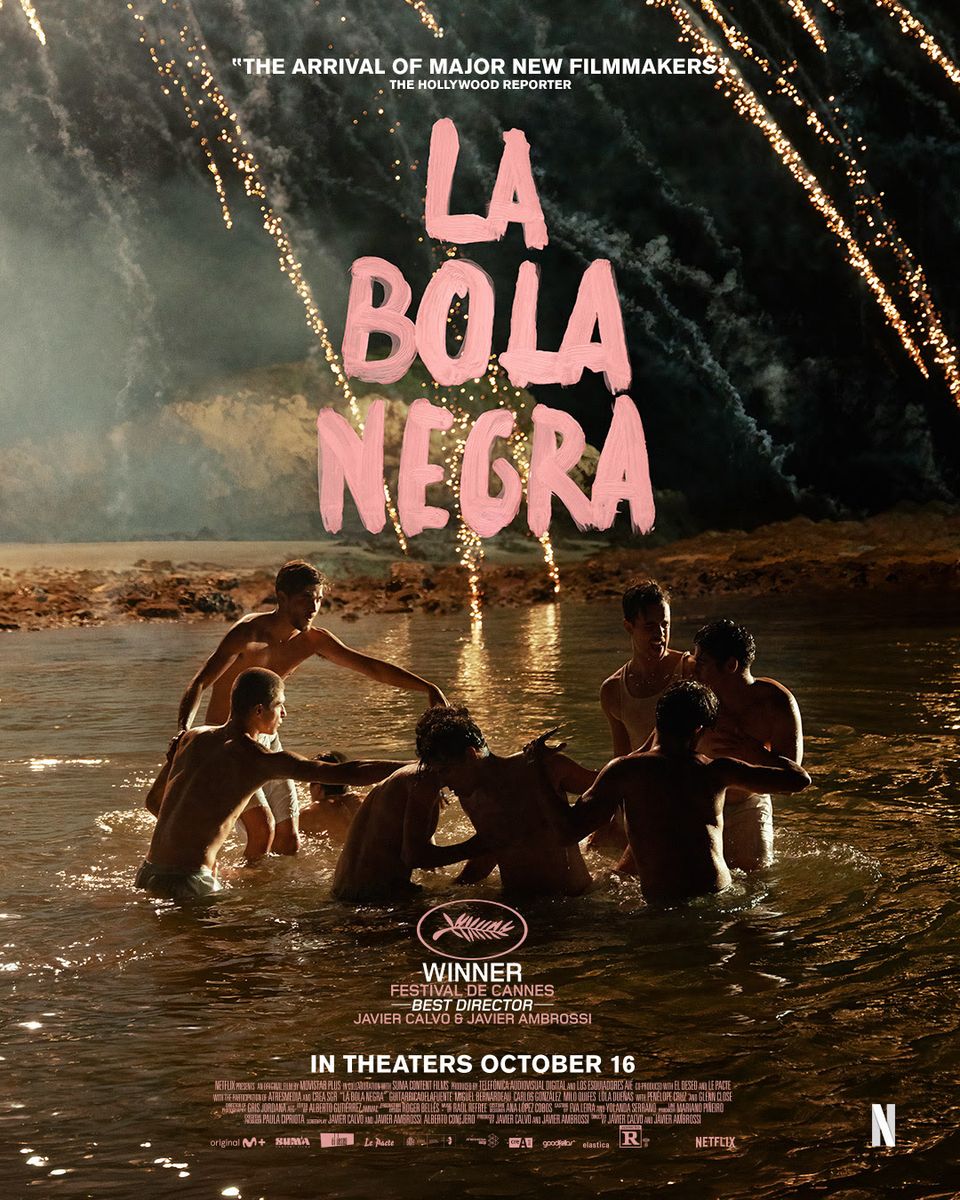
Calvo and Ambrossi received the Best Director Award at the 2026 Cannes Film Festival, sharing the honor with Polish filmmaker Paweł Pawlikowski for Fatherland.
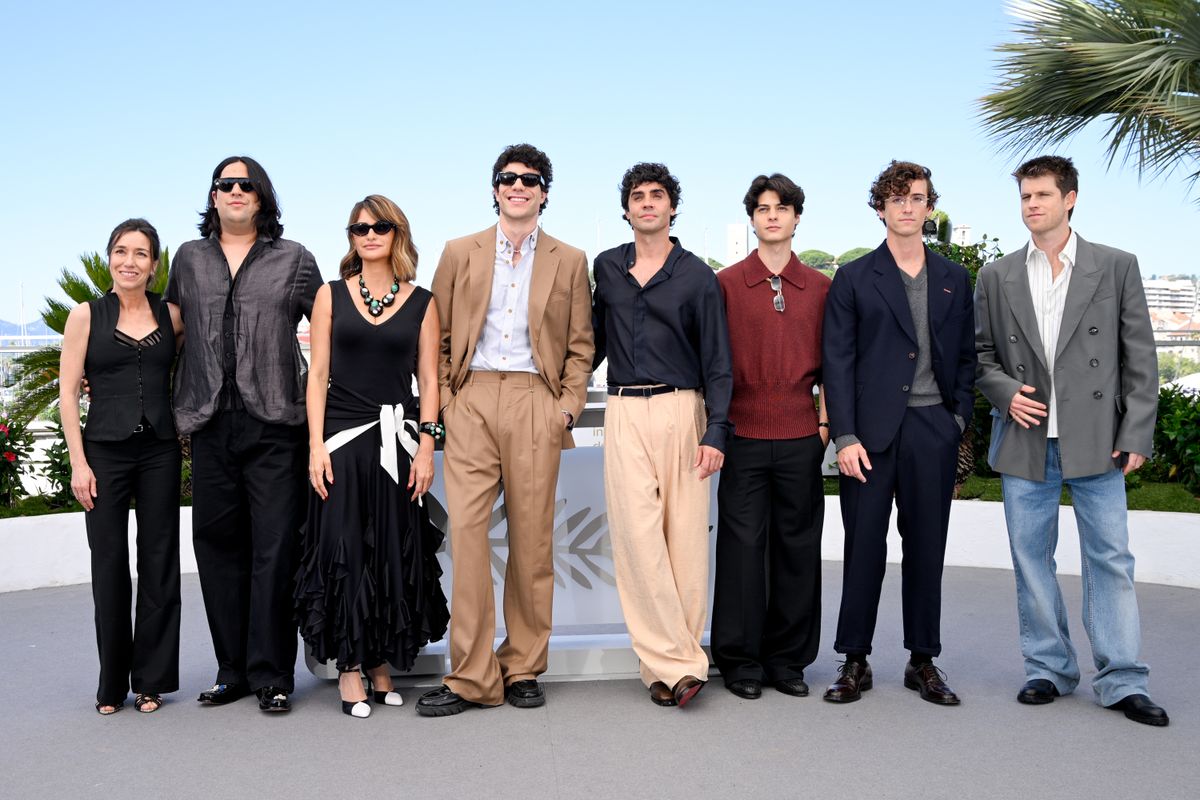
Guitarricadelafuente posed alongside Penélope Cruz, Lola Dueñas, Carlos González, Milo Quifes, Miguel Bernardeau and directors Javier Calvo and Javier Ambrossi at the La Bola Negra photocall during the 2026 Cannes Film Festival.
The recognition marked a significant international achievement for the Spanish filmmakers behind Paquita Salas, Veneno and La Mesías.
The movie subsequently captured the prestigious People’s Choice Award at the Toronto International Film Festival. Selected by festival audiences rather than a jury, the award has historically been considered a major indicator of future awards-season success.
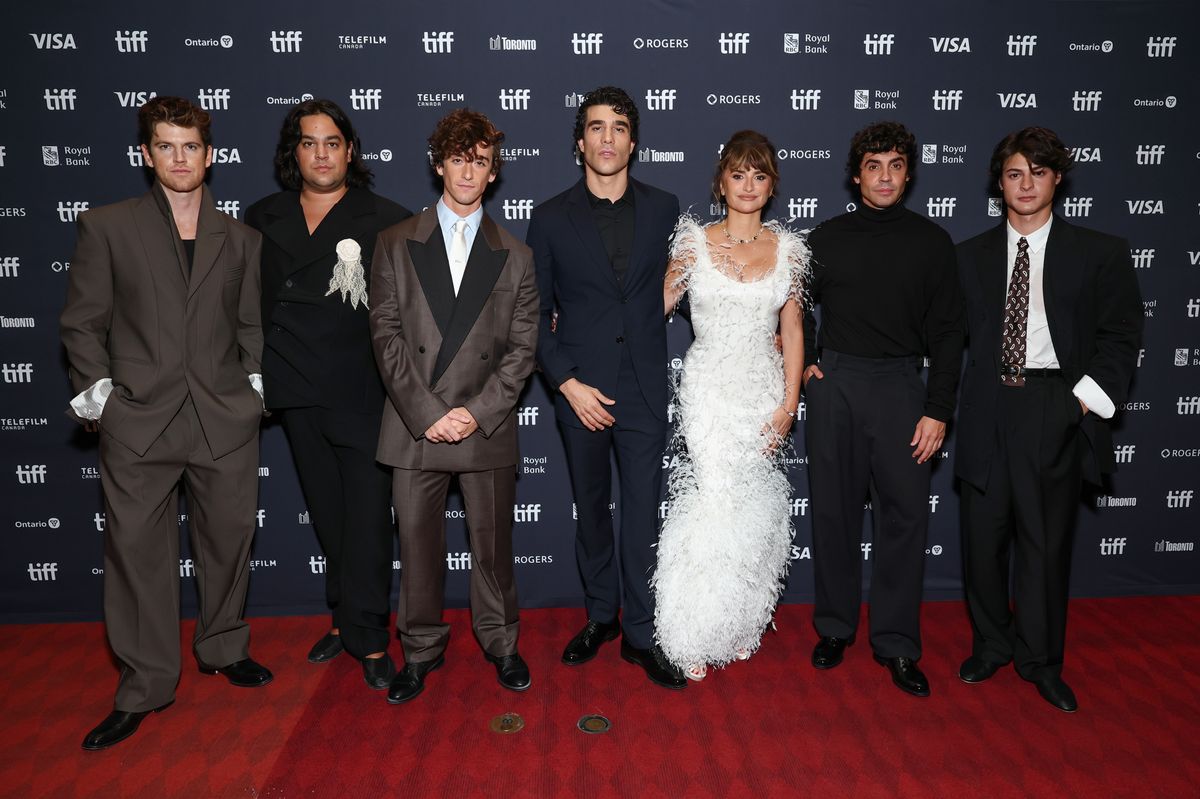
Guitarricadelafuente joined Miguel Bernardeau, Carlos González, directors Javier Calvo and Javier Ambrossi, Penélope Cruz and Milo Quifes at the Canadian premiere of La Bola Negra in Toronto on September 15, 2026.
‘La Bola Negra’ became the first non-English-language film to win Toronto’s top audience prize since the Lebanese drama Where Do We Go Now? in 2011.
Previous recipients of the award include eventual Best Picture Oscar winners 12 Years a Slave, Green Book and Nomadland. The Toronto victory adds to the growing awards buzz surrounding the Spanish-language epic and its filmmakers.
La Bola Negra explores desire, repression, memory and queer identity across three generations.
During its opening weekend, the film will screen at AMC Century City and AMC Burbank in Los Angeles, as well as the Angelika Film Center and the Paris Theater in New York. Tickets are currently available through the film’s official website.
The movie is produced by Movistar Plus and Suma Content Films in co-production with El Deseo and Le Pacte.
The rising trendline sits right where the 200-day EMA at $1.3683 and the 50-day EMA at $1.3605 cluster, which makes $1.37 a stronger floor than any single indicator would be alone. $XRP has about $0.11 of cushion above it, and it still trades above the 20-day EMA at $1.4515, with the Parabolic SAR at $1.4157 below price keeping the short-term trend bullish for now.
Related: Pi Network Price Prediction: Protocol 28 Sets October Upgrade Deadline as PI Trades Near $0.089
$XRP Support and Resistance Levels
$XRP News: Peter Brandt Says the Charts Alone Justify Owning $XRP
you are bit late to this one Peter https://t.co/cJPX21cPTV
— Ali Charts (@alicharts) September 27, 2026
Veteran trader Peter Brandt said owning $XRP doesn’t require being a “certified cult member,” arguing the charts are reason enough to hold a position. The $5.40 projection attached to his comments is the same long-term chart he posted last week, so it isn’t new, and he repeated that publishing a chart is not the same as holding a trade.
Two other analysts pointed to the same price area:
Ali Martinez flagged an inverse head and shoulders pattern with a neckline near $1.55, where a confirmed breakout could push $XRP toward $2, roughly 30% higher
Dark Defender called a parabolic move inevitable soon
$XRP has since slipped below that neckline area, trading near $1.48 against the roughly $1.52 cited in the report.
$XRP Derivatives: Longs Take the Hit as Trading Volume Jumps
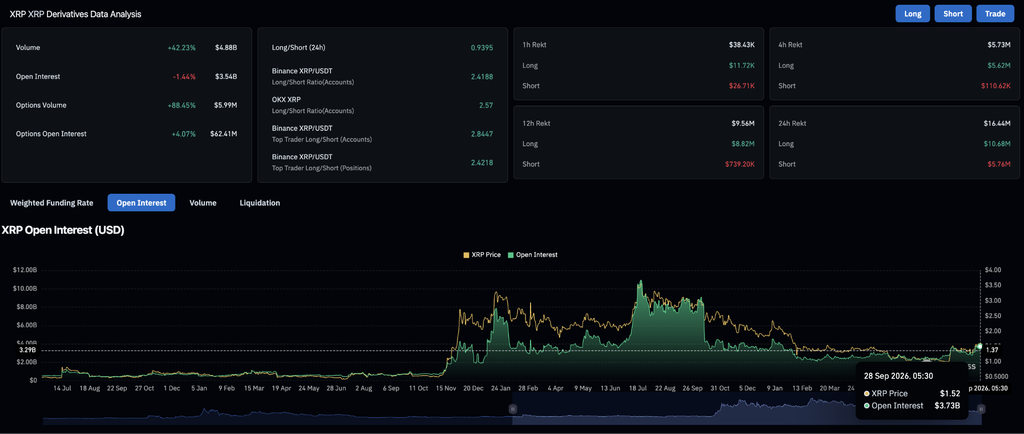
$XRP Derivative Analysis (Source: Coinglass)
$XRP derivatives volume jumped 42.23% to $4.88 billion over the past 24 hours, while open interest, the total value of open bets, slipped 1.44% to $3.54 billion. More trading alongside fewer open positions points to traders being forced out rather than adding new bets.
Longs took the bigger hit, with traders betting on higher prices losing $10.68 million against $5.76 million for those betting on lower prices, and nearly all of the last four hours’ $5.73 million came from longs. The crowd still leans bullish overall, with Binance showing 2.42 long accounts for every short account.
$XRP ETF Flows: An 11th Straight Week of Inflows Pushes Cumulative Total to $1.79 Billion
US spot $XRP ETFs added $22.65 million on September 25, capping a $75.59 million week that marked the 11th consecutive week of inflows and the largest weekly total since $110.49 million in late August. Cumulative net inflows stand at $1.79 billion, with total net assets at $1.77 billion.
Bitwise’s $XRP fund led Friday’s inflow at $18.39 million and remains the largest fund by net assets at $647.83 million, while Franklin’s XRPZ added $4.26 million and the other three funds were flat. 21Shares’ TOXR is still the only fund net negative since launch, down $21.15 million.
$XRP Exchange Flows: More Coins Leave Exchanges Than Arrive
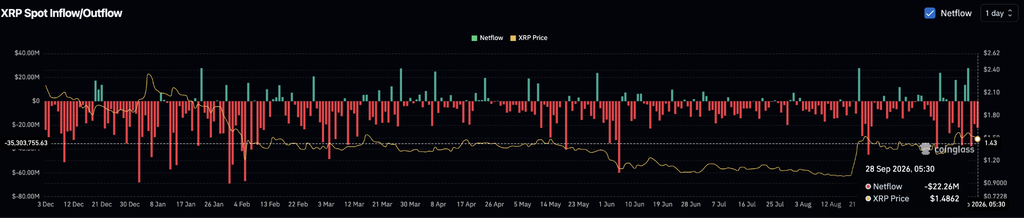
$XRP Exchange Netflow (Source: Coinglass)
$XRP’s spot netflow reads -$22.26 million so far today, meaning more coins left exchanges than arrived, which is typically read as holders moving $XRP off trading venues rather than lining it up to sell.
This tracks coins moving on and off exchanges, a separate measure from the ETF flows above.
$XRP Price Prediction: Bullish and Bearish Scenarios
$XRP holds the 20-day EMA at $1.4515 and reclaims the $1.55 neckline area analysts are watching. A confirmed break would put the triangle’s upper trendline near $1.64 in reach, and the $2 target cited by Ali Charts would need that trendline to clear first.
Bearish Case, Risk Level: $1.37 (200-Day EMA)
$XRP loses the 20-day EMA and the Parabolic SAR at $1.4157. More long liquidations would fit that scenario, exposing $1.3683, where the rising triangle trendline, the 200-day EMA, and the 50-day EMA at $1.3605 all meet, and a close below that would break the triangle’s lower boundary.
Related: Quant Price Prediction: QNT Surges Nearly 300% as Clearing House Selects Quant for Tokenized Deposit Network
FAQs
What is the $XRP price prediction right now?
$XRP could extend toward $1.55 and then the triangle’s upper trendline near $1.64 if it holds above the 20-day EMA at $1.4515. Losing that level risks a slide toward $1.3683, where the 200-day EMA and the triangle’s rising support meet.
Will $XRP reach $2?
It would need to clear roughly $1.55 first, the neckline of an inverse head and shoulders pattern flagged by analyst Ali Charts, who says a confirmed breakout could carry price toward $2. $XRP is trading below that neckline now, so it remains a scenario rather than a forecast.
Can $XRP reach $5.40?
Peter Brandt’s long-term chart implies an eventual advance to $5.40, but he described it as a projection rather than an active trade, and it reflects a decade of price structure rather than a near-term target.
Are $XRP ETFs still seeing inflows?
Yes. US spot $XRP ETFs logged an 11th consecutive week of inflows, adding $75.59 million last week and bringing cumulative net inflows to $1.79 billion. Two things to check: the triangle trendline values ($1.64 upper, $1.37 lower) are read off the chart by eye, and BeInCrypto’s $1.52 is older than the chart’s $1.4793, so I used the chart price.
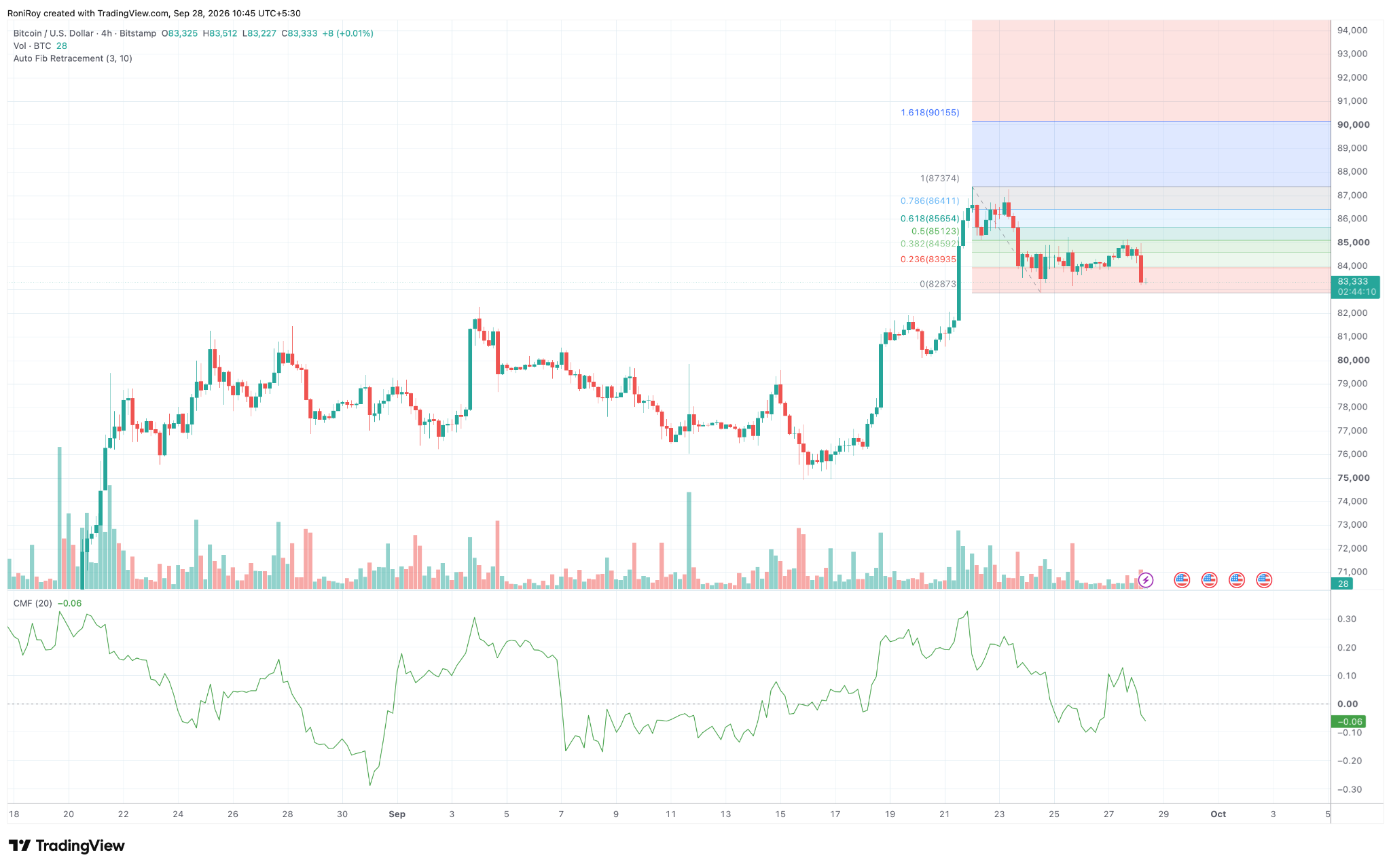
The decline accelerated on Sept. 24, leaving Bitcoin largely confined to the $83,000 to $85,000 area before Monday’s move towards the lower end of that range.
Oil prices moved higher after tensions between the US and Iran deteriorated over the weekend.
Brent crude rose roughly 1.5% to 1.6% towards $106 per barrel after US President Donald Trump rejected Iran’s latest proposal concerning the reopening of the Strait of Hormuz.
Higher oil prices have kept inflation risks in focus because energy costs can feed into transport and production expenses.
The Strait of Hormuz remains particularly important to energy markets, with roughly 20% of global oil supply passing through the waterway.
At the same time, US Treasury yields remained elevated alongside oil, with the 10 year yield trading around 5.2% during the Asian session and the 30 year yield near 5.52%.
Higher yields have tightened financial conditions while raising the return available on government debt.
Federal Reserve officials have maintained a hawkish stance as inflation remains above target.
St. Louis Fed President Alberto Musalem said last week that more rate increases would likely be needed to contain inflation, with the Fed’s preferred inflation measure having risen to 3.7% in July.
Market pricing has moved in the same direction. Traders were assigning roughly a 66% probability to another Fed rate increase in October, while close to 90 basis points of further tightening had been priced through late 2027.
The US dollar has strengthened alongside those expectations. The dollar index was around 101.15 on Monday, close to a two month high and on course for a roughly 1.7% gain in September.
Bitcoin’s drop through $84,000 triggered some leveraged selling as well.
Derivatives data showed $BTC long positions being liquidated around $83,200 to $83,500, including an $844,000 Hyperliquid position near $83,479.
The individual liquidations remained small compared with the large liquidation events seen during sharper market moves.
Despite the latest price decline, US spot Bitcoin exchange traded funds continued to receive fresh capital last week, which has helped cushion some of the selling pressure as $BTC retreated from its $87,000 high.
The funds recorded roughly $2.39 billion in net inflows during the five trading sessions through Sept. 25, according to SoSoValue data.
Monday accounted for $999 million, followed by $714.7 million on Tuesday, $347 million on Wednesday, $190.6 million on Thursday and $134.5 million on Friday.
Friday extended the positive run to seven consecutive trading sessions, during which the funds attracted close to $3 billion.
However, daily inflows have fallen in each session since Monday’s $999 million intake, suggesting that ETF buying has slowed even as the funds continue to record net inflows.
$BTC price analysis
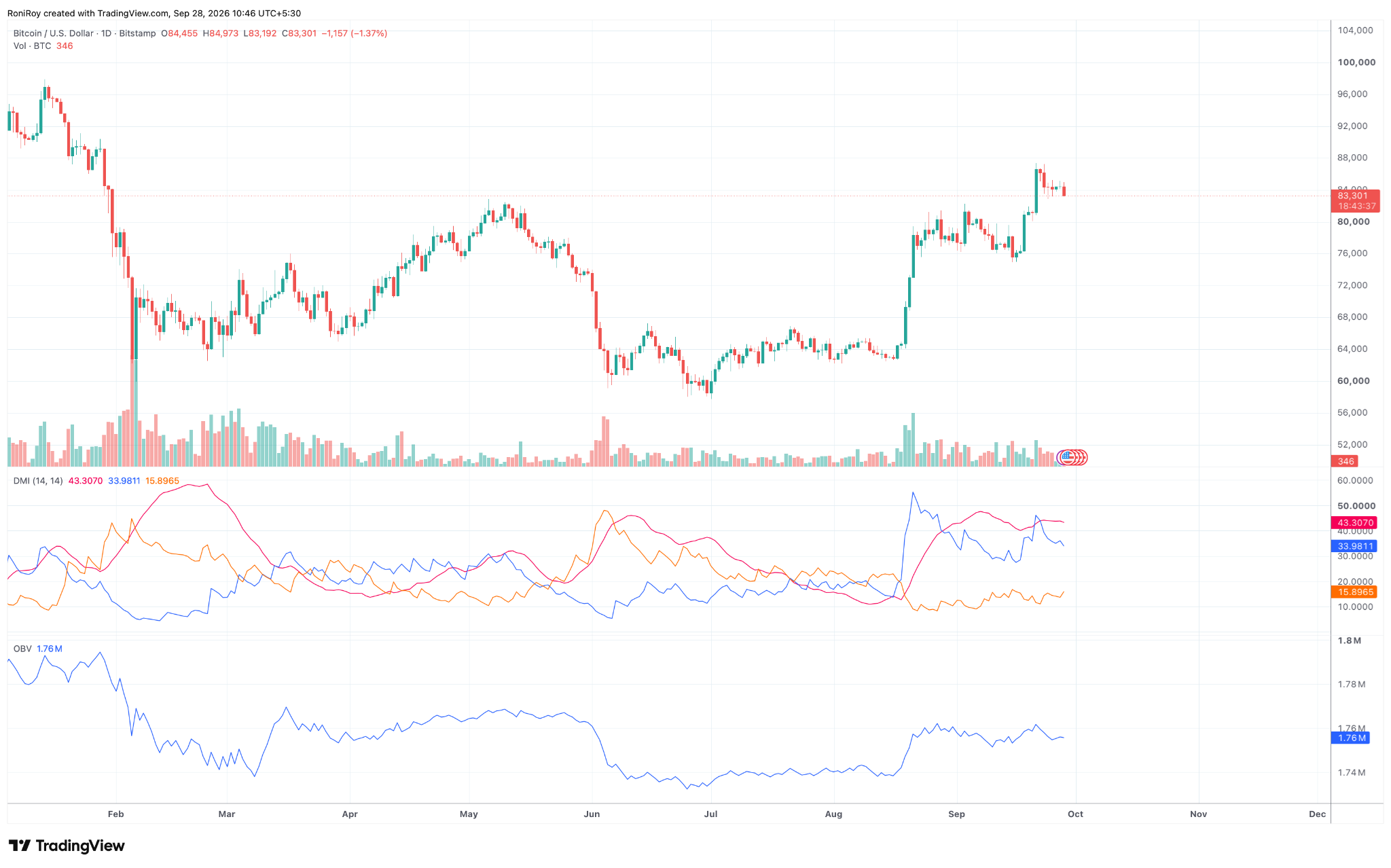
Bitcoin’s daily chart shows price holding above the breakout area established earlier in September, but buying momentum has weakened since $BTC reached $87,000. See below.
$BTC/USD 1-day price chart. Source: TradingView.
The Directional Movement Index still favours buyers on the daily timeframe.
The positive directional indicator stands at 33.98, well above the negative directional indicator at 15.90, while the Average Directional Index remains high at 43.31.
An ADX above 25 generally points to a well established directional move, but +DI has fallen from its recent peak as Bitcoin has retreated towards $83,000.
The gap between +DI and −DI means the larger daily trend has not yet flipped bearish.
A continued decline in +DI alongside a rise in −DI would weaken that structure, particularly if $BTC loses the support formed around $82,000 to $83,000.
On Balance Volume is near 1.76 million and has flattened after rising during Bitcoin’s September breakout.
OBV has slipped from its latest local high while $BTC has fallen from $87,000, showing that volume has not confirmed another push towards the recent high.
The 4-hour chart places the immediate support at $82,873, the low used for the latest Fibonacci range.
$BTC/USD 4-hour price chart. Source: TradingView.
Bitcoin is trading only slightly above that level after falling below the 23.6% retracement at $83,935.
Chaikin Money Flow has dropped to roughly −0.06 on the same timeframe.
CMF moved below zero during the latest selloff after briefly recovering into positive territory, indicating that selling volume has outweighed buying volume over its calculation period.
A 4-hour close below $82,873 would break the bottom of the current Fibonacci range.
The next visible price area sits around $81,000 to $82,000, followed by the previous breakout region around $80,000 if sellers continue to push $BTC lower.
Bitcoin would first need to reclaim $83,935 to move back inside the Fibonacci range.
Above it, the 38.2% level at $84,591 and 50% retracement at $85,123 form the next resistance levels.
A move through $85,123 would bring $85,654, the 61.8% retracement, back into focus.
The 78.6% level sits near $86,411, followed by the recent swing high around $87,374.
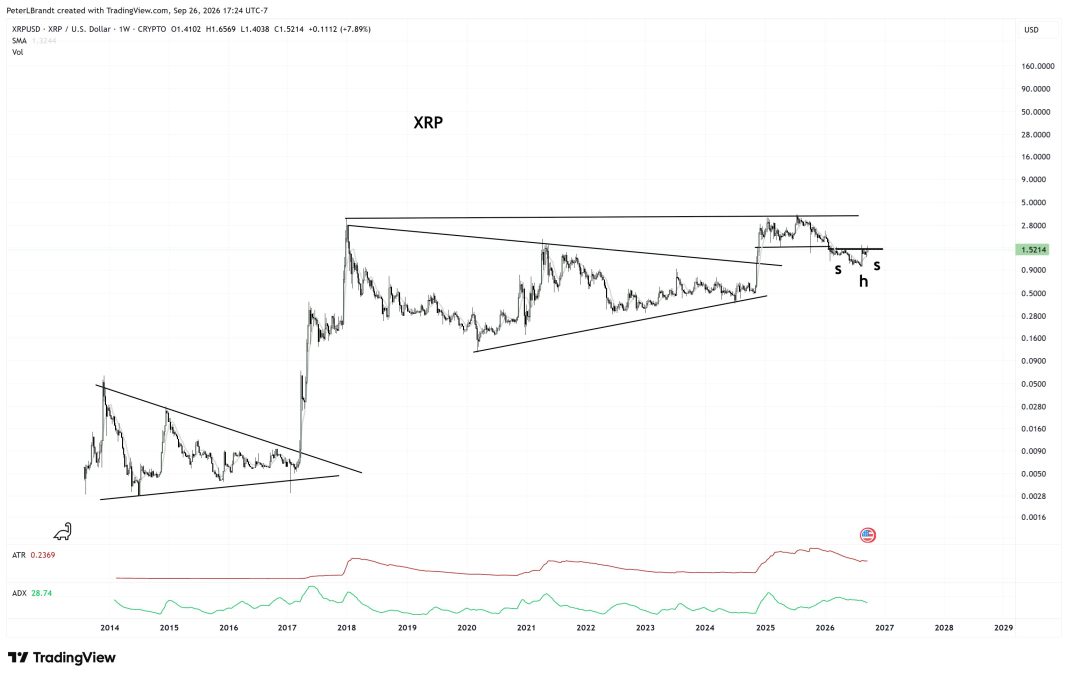
Peter Brandt’s weekly $XRP chart highlights two historical multi-year breakout structures and a potential inverse head-and-shoulders formation near $1.52. $XRP is testing a neckline around $1.50-$1.55, while the chart’s ADX stands at 28.74 and weekly SMA near $1.3244. Source: Peter Brandt/TradingView.
Brandt said investors do not need to become what he called a “certified cult member” to be interested in $XRP, adding that “the charts alone have always been enough reason for us to make a bet.” He then distinguished between keeping an open mind and following an asset without sufficient judgment.
Brandt’s chart places $XRP at approximately $1.5214, after a weekly candle that opened at $1.4102, reached $1.6569, and gained 7.89%. The token is also trading above the chart’s weekly simple moving average near $1.3244.
The most immediate structure appears on the right side of the chart, where Brandt labels three recent lows “s,” “h,” and “s”—shoulder, head, and shoulder.
This resembles an inverse head-and-shoulders formation, with a horizontal neckline sitting around the $1.50-$1.55 region. $XRP is currently testing this neckline rather than trading decisively above it.
Under classical chart analysis, the pattern would require a sustained break above the neckline before being considered confirmed. $XRP has already traded as high as $1.6569 during the latest weekly candle, but the chart’s closing reference remains near $1.52.
Using the approximate distance between the head around the $0.95-$1 region and the neckline near $1.52 produces a conventional measured-move area around $2.05-$2.10 if the structure confirms. This is a technical calculation from the pattern, not a target stated on Brandt’s chart.
Brandt’s Chart Also Tracks Two Major $XRP Breakouts
The chart does not focus only on the latest formation.
On the far left, $XRP’s price action between roughly 2014 and 2017 shows a tightening structure formed by descending resistance and rising support. $XRP eventually broke out of that formation during the 2017 market expansion.
A much larger structure followed after $XRP’s 2018 peak.
Brandt draws a descending upper trendline extending from the 2018 high and a rising lower trendline beginning around the 2020 period. These boundaries converged for several years before $XRP eventually broke above the descending resistance during its late-2024 rally. HTLtCe6WcAE2mZY
After that breakout, $XRP advanced into a broad range whose upper boundary sits around the $3.30-$3.40 area. The token has since retraced toward the lower part of this post-breakout range, creating the smaller shoulder-head-shoulder structure now highlighted on the chart.
This makes the $1.50-$1.55 zone important twice: it is both the immediate neckline of the possible inverse head-and-shoulders pattern and a horizontal level $XRP is attempting to reclaim after its 2026 decline.
ADX Shows $XRP Remains in a Meaningful Trend
Brandt’s chart also displays an ADX reading of 28.74.
ADX measures the strength of a trend rather than whether that trend is bullish or bearish. Readings above 25 are commonly associated with a market showing meaningful directional strength.
The chart’s ATR stands at 0.2369, representing roughly 15.6% of $XRP’s $1.5214 reference price. This indicates that weekly price ranges remain relatively wide. HTLtCe6WcAE2mZY
Brandt Previously Questioned $XRP’s Fundamental Valuation
Brandt’s latest chart-based interest comes after much more skeptical remarks about $XRP’s fundamentals.
During a recent Cointelegraph interview, Brandt acknowledged that $XRP “can be effectively used for transactional purposes cheaply.” However, he argued that transactional utility alone does not automatically mean an asset should become more valuable. Pasted text
He separated $XRP’s transactional role from Bitcoin’s store-of-value thesis and Ethereum’s ability to support applications and other functionality. Pasted text
His latest comments therefore draw a distinction between fundamental conviction and technical trading. Brandt is not presenting the chart as proof of $XRP’s underlying valuation; rather, he is saying that its price structure alone can provide a reason to consider a trade.
Brandt has also previously mapped an eventual $XRP advance toward $5.40, although that separate projection did not include a specific deadline and did not confirm that he had opened a position. TokenPost
For the current weekly setup, the first technical hurdle remains the $1.50-$1.55 neckline area. A sustained move above it would confirm more of the inverse head-and-shoulders structure, while failure to hold the area would leave $XRP inside its broader consolidation.
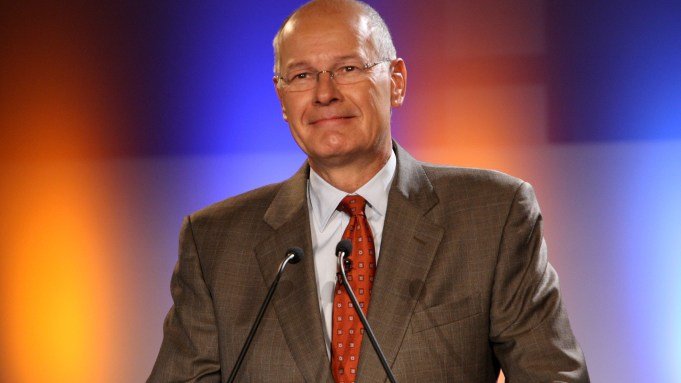
Smith’s return is official as of Monday, when he will appear at a Common Ground live event hosted by the network. The network confirmed his return, first reported by People. He told the publication, “I have long believed that there is more that unites us than divides us. It’s in our bones. It’s part of America’s DNA.”
Smith departed the network in March, 2024 after 12 years, with a send-off on NBC’s Today. “I have nothing but gratitude,” he said. “Every time I would always come on this show, I was always welcomed so generously. I’ve had just this unbelievable array of phenomenal experiences since coming to NBC, and so I’m really full of nothing but gratitude. Every time I’ve come on, everyone would drop their phones, pay attention to the story and then respond.”
Smith previously hosted CBS This Morning and its predecessor, The Early Show, for 17 years. After departing NBC News in 2024, he has been teaching at Central College in Iowa.
Arkam, Susan M. . “The Failures of the UN in the Israel-Palestine Conflict.” OpenGlobalRights, https://www.openglobalrights.org/failures-un-israel-palestine-conflict/. Accessed 8 Sep. 2025.
United Nations. “United Nations Charter (Full Text).” United Nations, https://www.un.org/en/about-us/un-charter/full-text. Accessed 8 Sep. 2025.
United States – General Debate, 81st Session | UN Web TV. 22 Sept. 2026, https://webtv.un.org/en/asset/k17/k17vgtoa6m.
“Withdrawing the United States from and Ending Funding to Certain United Nations Organizations and Reviewing United States Support to All International Organizations.” The White House, 5 Feb. 2025, https://www.whitehouse.gov/presidential-actions/2025/02/withdrawing-the-united-states-from-and-ending-funding-to-certain-united-nations-organizations-and-reviewing-united-states-support-to-all-international-organizations/.
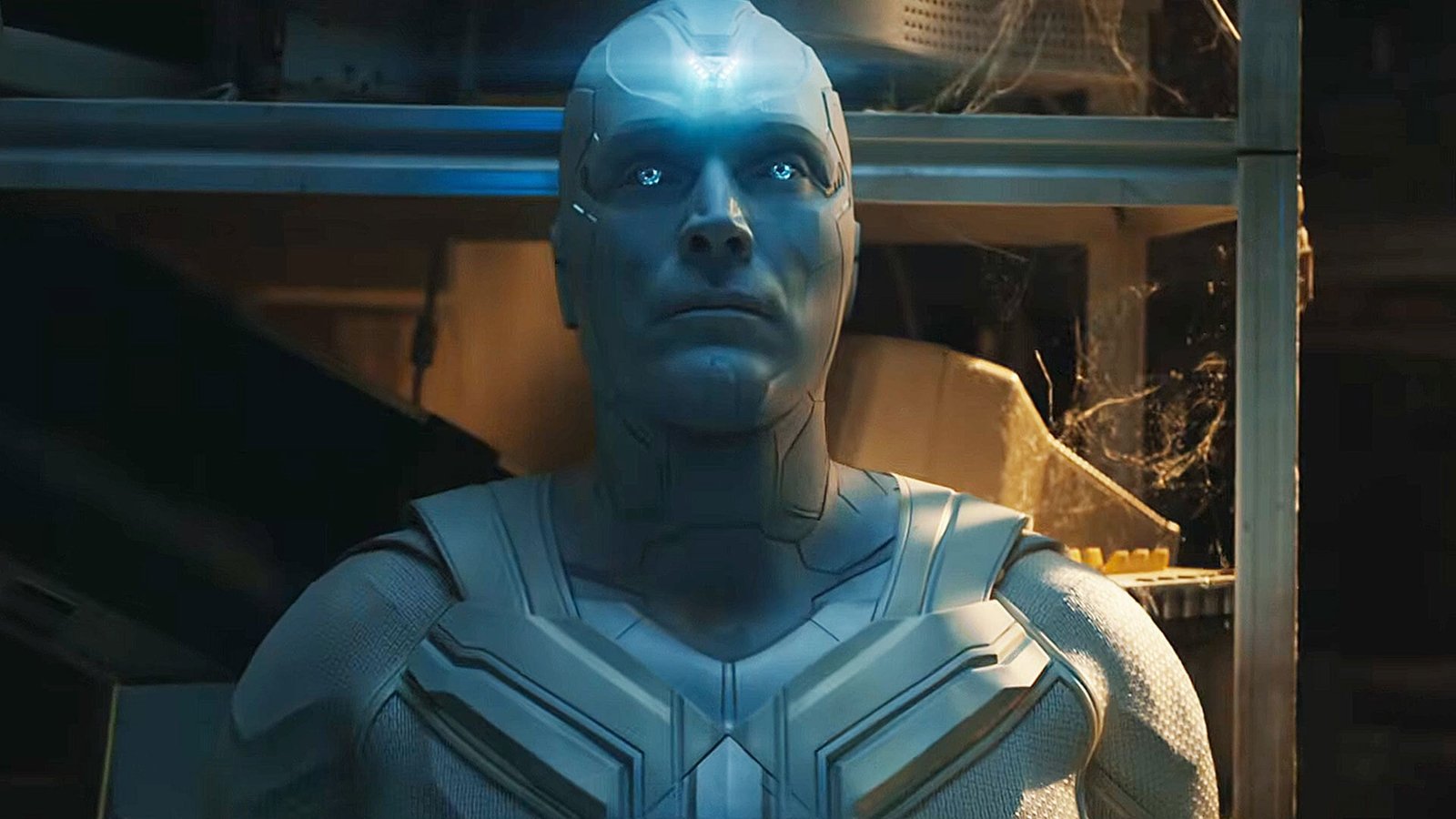
October’s a great month for all sorts of content on Disney+ and Hulu,. We’ve got the return of the Vision in a new Marvel limited series, all of the Hunger Games movies (except the latest one), tons of TV premieres, and lots more. Here are our three top choices for the month to come.
Coven Academy (October 2, Disney+)
October is spooky month, and Disney+ and Hulu have their fair share of horror-adjacent programming premiering. Of interest to the teenage set is new series Coven Academy, which is set at a New Orleans school that only enrolls the most promising witches and warlocks. This sounds very similar to Marvel comic series Strange Academy, but there are only so many ideas in the world, right? Creator Tim Federle has plenty of experience with this kind of thing, having previously helmed High School Musical: The Musical: The Series.
After the events of WandaVision, Marvel fans were curious what would become of our favorite synthezoid (look it up!). Jac Schaeffer, that show’s creator, was scheduled to helm this follow-up as well before bowing out of the Marvel machine, and VisionQuest has been kicking around in development for a bit. After the Vision returns to life, he must figure out who he is, dodge bounty hunters looking to bring him down, and reconnect with a teenager who may or may not be his son.
Directors: Christopher J. Byrne, Vincenzo Natali, Gandja Monteiro, Terry Matalas
Cast: Paul Bettany, James Spader, Diane Morgan
Genre: Science Fiction
Rating: TV-14
Super Scam Me (October 17, Hulu)
In 2025, romance scammers bilked ordinary men and women out of over a billion dollars using a variety of crooked tactics. In the new National Geographic documentary Super Scam Me, journalist Maria van Zeller transforms herself into the perfect prey to dive deep into how romance fraud works, talking to victims and eventually becoming entangled with a man who claims to be a four-star general looking for love. With the help of a white hat hacker, she unmasks him and hunts him down for a face-to-face conversation.
Director: Jeff Plunkett
Cast: Mariana van Zeller
Genre: Documentary
Rating: TV-MA
Everything Coming to Hulu and Disney+ in October 2026
October 1
Hulu: Big City Greens – Seasons 1-2 Hulu: Desert Law – Season 1 Hulu: Alita: Battle Angel (2019) Hulu: Aloha (2015) Hulu: Aloha en Español (2015) Hulu: Barbarian (2022) Hulu: Blippi & Meekah’s Very Merry Treasure Hunt Hulu: Die Hard (1988) Hulu: Die Hard With a Vengeance (1995) Hulu: Die Hard 2 (1990) Hulu: Edward Scissorhands (1990) Hulu: The Empty Man (2020) Hulu: Ghostbusters (1984) Hulu: Ghostbusters en Español (1984) Hulu: Ghostbusters: Answer the Call (2016) Hulu: Ghostbusters II (1989) Hulu: Ghostbusters II en Español (1989) Hulu: Grown Ups (2010) Hulu: Grown Ups en Español (2010) Hulu: Grown Ups 2 (2013) Hulu: Grown Ups 2 en Español (2013) Hulu: Hereditary (2018) Hulu: The Hills Have Eyes 2 (2007) Hulu: The Holiday (2006) Hulu: The Holiday en Español (2006) Hulu: Hotel Transylvania (2012) Hulu: Hotel Transylvania en Español (2012) Hulu: Hotel Transylvania 2 (2015) Hulu: Hotel Transylvania 2 en Español (2015) Hulu: Jeff Dunham: I’m With Cupid (2024) Hulu: Jeff Dunham’s 250th Red, White, and Blue Birthday Special (2026) Hulu: Larry Flynt for President (2021) Hulu: Live Free Or Die Hard (2007) Disney+: Mickey Mouse Clubhouse+ – Season 2 Premiere Hulu: Midsommar (2019) Hulu: Night at the Museum (2006) Hulu: Night at the Museum: Battle of the Smithsonian (2009) Hulu: Night at the Museum: Secret of the Tomb (2014) Hulu: Nightmare Alley (2021) Hulu: No Good Deed (2014) Hulu: No Good Deed en Español (2014) Hulu: Premature (2014) Hulu: Scrubs – Season 2 Two-Episode Premiere Hulu: Shark Tank – Season 18 Two-Episode Premiere Hulu: Soul (2020) Hulu: Soulm8te (2026) Hulu: The Substance (2024) Hulu: Surf’s Up (2007) Hulu: Surf’s Up en Español (2007) Hulu: Surf’s Up 2: Wavemania (2017) Hulu: Surf’s Up 2: Wavemania en Español (2017) Hulu: The Swan Princess (1994) Hulu: The Swan Princess en Español (1994) Hulu: The Sweetest Thing (2002) Hulu: The Sweetest Thing en Español (2002) Hulu: Testament of Youth (2015) Hulu: Testament of Youth en Español (2015) Hulu: The Watch (2012) Hulu: True Lies (1994) Hulu: Vampires Suck (2010) Hulu: William Shakespeare’s Romeo + Juliet (2020)
October 2
Disney+ and Hulu: Adventure Time: Side Quests – Season 2 Disney+ and Hulu: Austin City Limits Music Festival 2026 Livestream Day One Disney+ and Hulu: Coven Academy – Season 1 Hulu: Mafia Mamma (2023) Hulu: One Spoon of Chocolate (2025) Disney+: Pupstruction – Season 3 Premiere Hulu: Tokyo Revengers: War of the Three Titans Arc
October 3
Disney+ and Hulu: Africa Earth’s Wild Home – Season 1 Disney+ and Hulu: Austin City Limits Music Festival 2026 Livestream Day Two Hulu: Celebrity Wheel of Fortune – Season 7 Hulu: Hereditary (2018) Hulu: Midsommar (2019)
October 4
Disney+ and Hulu: Austin City Limits Music Festival 2026 – Livestream Day Three Hulu: The Bachelorette – Seasons 20-21
October 5
Disney+ and Hulu: Between Steps – Season 1 Premiere Hulu: Gachiakuta – Season 1, Part 1
Hulu: Jamie Foxx: Take Care of Yourself Disney+: Kiff – Halloween Special Episode Disney+ and Hulu: Merry Berry Love – Season 1 Premiere Disney+: Phineas and Ferb – Halloween Special Disney+ and Hulu: Surviving Alaska: Women of the Wild – Season 1 Disney+: Vampirina: Teenage Vampire – Season 2
October 8
Hulu: Abbott Elementary – Season 6 Premiere Hulu: Beyblade X – Season 3A Hulu: Road Wars – Season 7
October 9
Disney+ and Hulu: Benefits with Friends – Season 2 Hulu: 2026 LoL KeSPA CUP SVOD – Season 1 (Dubbed) Hulu: LOL Live With Just Nesh (2026)
October 10
Disney+: The Banana Bowl – Streaming Live at 8pm ET Disney+: Cartoonified! With Kiff: Shorts – Season 2 Premiere Hulu: Hokum (2026)
October 11
Hulu: Mission: Yozakura Family – Season 2, Cour 2 Premiere
October 12
Hulu: Campfire Cooking in Another World With My Absurd Skill – Season 1 Hulu: Haikyu!! – Season 1 (Dubbed)
October 14
Hulu: The Hunger Games (2012) Hulu: The Hunger Games: Catching Fire (2013) Hulu: The Hunger Games: Mockingjay – Part 1 (2014) Hulu: The Hunger Games: Mockingjay – Part 2 (2015) Hulu: The Hunger Games: The Ballad of Songbirds & Snakes (2023) Hulu: The Lowdown – Season 2 Premiere Disney+ and Hulu: Megastorm – Season 1 Disney+: VisionQuest – Season 1 Premiere
]October 16
Hulu: 9-1-1 – Season 10 Premiere Hulu: 9-1-1: Nashville – Season 2 Premiere Hulu: Grey’s Anatomy – Season 23 Premiere Hulu: Heather McMahan: By a Thread (2026)
October 17
Disney+: Chibi Tiny Tales – Season 8 Premiere Disney+: Locker Diaries: Coven Academy Hulu: Night Patrol (2025) Disney+ and Hulu: Super Scam Me
October 18
Hulu: Companion (2025) Hulu: Wolf Man
October 19
Hulu: The Room Next Door (2024)
October 20
Recommended by Our Editors
Hulu: Phony – Season 1
October 21
Disney+: CMA Presents I Will Always Love You: A Celebration of Dolly Parton – Streaming Live @ 9pm ET
October 23
Hulu: Rome Underground – Season 1 Hulu: RZA’s One Spoon of Chocolate (2025)
October 24
Hulu: Dolly (2025)
October 25
Hulu: Last Breath (2025) Hulu: Last Breath en Español (2025)
October 26
Hulu: The Mob – Premiere
October 27
Hulu: Classroom of Elite – Season 1 (Subbed & Dubbed) Hulu: The God of High School – Season 1 (Subbed & Dubbed)
October 28
Disney+: Marvel’s Iron Man and His Awesome Friends – New Episodes
October 29
Hulu: Love Island Australia – Season 8
October 30
Hulu: Cars That Changed History: Complete Season 1 Hulu: The Gentleman Thief (2025)
About Our Expert
K. Thor Jensen
Contributing Writer
Experience
K. Thor Jensen is a writer and cartoonist living in the Pacific Northwest. He has contributed to dozens of prestigious outlets, including PCMag, Tested, Clickhole, and Newsweek. His second graphic novel, Cloud Stories, was released in 2017.
The network is 100 years old. The commercials, however, are new.
NBCUniversal is trying to expand the sponsorship model it used for the 50th anniversary of “Saturday Night Live” in 2025 and customize it for its coming celebration of a century of its flagship broadcast network. If sponsors like it, the company will have a tested system of garnering ad support that it can tap as it continues to seek out tentpole events, including, potentially, the Los Angeles Olympics in 2028, and the 75th anniversary of “The Tonight Show” in 2029, to win the big audiences advertisers continue to demand from broadcast, even in the streaming era.
“Clients are not asking for more places to put their messaging,” says Alison Levin, a president at NBCUniversal’s ad sales and partnerships unit, during a recent interview. “They are looking for meaningful ways to show up when audiences are engaged.”
Allstate, Capital One, Purina Dog Chow, Smucker’s, Volkswagen and Xfinity have all signed up to sponsor the event, which will air as a three-hour special on December 10 and feature a litany of celebrities and famous figures, all at the Dolby Theater in Los Angeles.
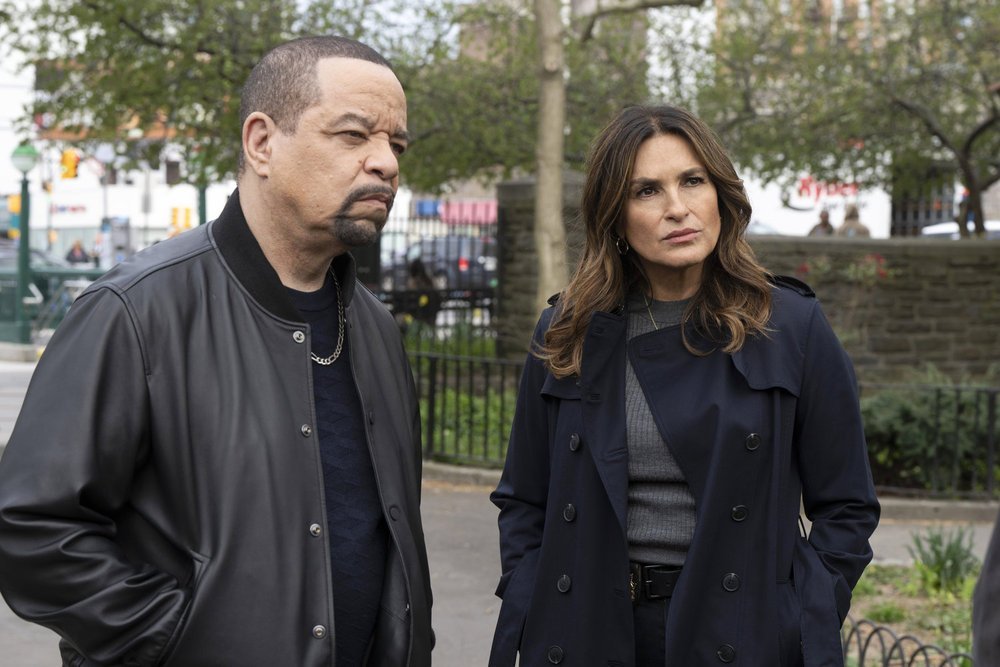
The sponsors don’t have to wait to get noticed. Already, Capital One has launched a commercial that features Mariska Hargitay and Ice-T in their roles as Olivia Benson and Fin Tutuola from “Law & Order: SVU.” Benson even turns to the camera at the end of the spot and utters the financial-services company’s famous slogan, “What’s in your wallet?”
“One of the things that we seek in general is just opportunities to participate in cultural moments that we think people are going to care about,” says Marcy Brye, a senior director at Capital One who works on media partnerships. What’s more, she says, “the opportunity with NBC 100 is so rare.” A case in point: Capital One’s new ad appeared during NBC’s recent Emmys telecast, right after a pre-taped sketch in which Taylor Swift made a cameo during an “SVU” spoof that featured many of the series major cast members. “We knew our ad placement was scheduled right after a special segment, though we didn’t know the specifics in advance,” says Brye.
Indeed, because the 100th anniversary special won’t be duplicated, like an annual awards program, or last for weeks, like a soccer tournament, advertisers likely feel assured their backing of the extravaganza will get noticed. The goal, says Levin, is to create “bespoke, high-touch moments” that can be seeded across top NBCU programing ranging from live sports telecasts to popular programs such as “Love Island” or “The Traitors.”
Some of the sponsors must have liked what they experienced when they supported the “SNL” 50th anniversary. Allstate and Volkswagen took part in the advertising around that program, with Allstate backing a commercial vignette that paired its popular advertising character Mayhem (played by actor Dean Winters) with the Please Don’t Destroy comedy trio that became popular though taped vignettes on “SNL.” Volkswagen, meanwhile, ran a commercial that had “SNL” veterans like Fred Armisen, Bill Hader and Kristen Wiig repirse their characters from the show’s popular “Californians” sketch.
“That work performed so well for us,” says Rachael Zaluzec, chief marketing officer and executive vice president of consumer experience for Volkswagen of American. “It gave us so much visibility.” The automaker will launch a new commercial tying it to the anniversary in November, she says, and recreate sets from NBC programs at the L.A. Auto Show in that same month.
These collaborations often take months to forge, and NBC first announced it would seek bigger sponsorships tied to the anniversary in January of this year. The company may be following the steps it took previously. For the SNL 50th anniversary, NBCU started discussions months ahead of schedule. In March of 2023, “SNL” executive producer Lorne Michaels made a presentation in Studio 8H, the program’s longtime home at NBC’s New York headquarters, to around 100 advertisers about what to expect from the anniversary. At the time, NBC, sketched out plans for a series of retrospectives around “SNL” as well as at least one documentary about the program.
Comcast’s Xfinity service is attaching itself to a countdown clock that shows up during important NBC moments that lead up to the special. Look for the timer to turn up during NBC ‘s coverage of the Thanksgiving Day Parade as well as ahead of the actual extravaganza, says Julie Scelzo, chief creative officer for Xfinity and Comcast, which is also the parent of NBCU. The countdown graphics help to “build the anticipation,” she says. “It gives the audience something to pay attention to.”
All eyes on Madrid! The Spanish capital and film and TV production hub is bringing together media and entertainment industry folks, including producers, creatives and executives from Europe, Latin America, the U.S. and beyond, to discuss Spanish- and Portuguese-language content opportunities and hot industry topics at the sixth edition of Iberseries & Platino Industria this week.
Organized by the Secuoya Foundation, Spain’s largest rights collection agency EGEDA, and the Ibero-American Federation FIPCA, the big annual event, which runs Tuesday through Friday, will once again feature keynote addresses, panel discussions, screenings, pitching sessions, and social events, along with all sorts of innovations.
AI, microdramas, co-productions, literary adaptations and much more will be in the spotlight during four jam-packed days in Madrid.
Among the many high-profile speakers and panelists at Iberseries are the likes of Katina Medina Mora, who has directed such series as Off Campus, The Summer I Turned Pretty, Emily in Paris and Swagger and such films as LuTo, Luis Fernández, chairman of NBCUniversal Telemundo Enterprises, and Pedro Pina, vp, YouTube EMEA.
THR caught up with Iberseries & Platino Industria co-directors Samuel Castro, head of Iberseries, Juan Alía, head of Platino Industria, and Adriana Castillo, general coordinator of Platino Industria, to preview the 2026 showcase of the Spanish- and Portuguese-language content industry event and what’s different this year.
What’s new for this year’s edition?Could you highlight any new offerings and innovations?
SAMUEL CASTRO This year, we wanted to reinforce our commitment to the industry and further establish Iberseries & Platino Industria as a truly business- and networking-driven event. With this in mind, we have launched two new pitch sessions: Euro Atlantic Series Co-Pro Pitch, focused on European series projects seeking international co-production and financing partners; and the Fundación SGAE Pitch Session, featuring outstanding projects from Spanish-speaking showrunners.
ADRIANA CASTILLO One of the things we have worked on this year is making Iberseries & Platino Industria useful at different stages of a project’s journey. We do not want it to be simply a place where talent comes together; we want it to be a place where talent finds the conditions to grow: financing, partnerships, distribution and real international opportunities.
That has led us to open new doors this year. We created the Literary Works Pitch for Audiovisual Adaptation, strengthened international co-production through the Euro Atlantic Series Co-Pro Pitch and the Co-Production and Financing Forum, and opened spaces to discuss new ways of telling stories, including vertical fiction and microdramas.
For me, the important thing is that these are not isolated activities. We are trying to connect the dots. A creator can arrive with an idea or an IP and meet producers, financiers, platforms, studios, distributors, or potential partners. Ultimately, what we want is to shorten the distance between a good story and the people who can help bring it to life.
JUAN ALÍA I do not think the novelty lies simply in adding more activities. When an edition ends, we sit down to look at what worked, what we can improve and, above all, what the industry is asking of us. This year, we have opened up more avenues for projects to find financing, partners and buyers, and we have broadened the scope with areas such as literary IP and vertical fiction.
For us, the key is usefulness. We want professionals who come to Madrid for four days to have real opportunities to find the content, project, or partner they are looking for. If those meetings lead to synergies, co-productions or new lines of business, then the event is fulfilling its purpose.
Why did it make sense to add the first edition of Euro Atlantic Series Co-Pro Pitch to your already busy program? And Sony Pictures Television’s Elevator Pitch will also return. How successful was that last year?
CASTRO Euro Atlantic Series Co-Pro Pitch was created with the aim of promoting the co-production and international circulation of European fiction, docuseries and animation projects conceived from the outset to travel across territories and connect with global audiences. It is another reflection of the increasingly international scale of Iberseries & Platino Industria, as we continue evolving from an Ibero-American event into a truly global industry platform.
Samuel Castro, co-director Iberseries & Platino Industria
Courtesy of Iberseries & Platino Industria
The selection committee for this first edition also brings together highly respected professionals from the European audiovisual industry, including Laura Miñarro, vp of international business and co-production at Buendía Estudios (Spain), Diego del Pozo, fiction manager at Atresmedia Televisión (Spain), José Fragoso, programming director at RTP1 and RTP Internacional (Portugal), and Georges Huercano, development and co-productions manager at RTL (Belgium).
Can you tell me a bit about why you added the new literary works adaptation pitch event?
CASTILLO It emerged quite naturally from what we had been hearing from the industry. In our conversations with [streaming] platforms, studios and producers, IP comes up again and again. Executives are looking for attractive properties, of course, but above all they are looking for powerful stories, distinctive worlds and characters capable of sustaining an audiovisual life.
At the same time, there is an enormous catalogue of stories in the publishing world, and there is not always a natural space for the publishing and audiovisual sectors to meet, or even to speak the same business language. We saw a clear opportunity to build a bridge between them.
This is not about bringing a book fair to an audiovisual market. It is a curated business space where publishers and literary agencies can present works directly to producers, studios and platforms looking for material to adapt, and then continue those conversations through one-to-one meetings.
Literary IP also brings something extremely valuable to the audiovisual pipeline: narrative development and, in many cases, a story that has already connected with a community of readers. But our interest goes beyond a one-off rights sale. We want to foster longer-term relationships between publishers and producers, help those catalogues circulate internationally and identify stories that can genuinely find a second life on screen.
In that sense, the pitch [event] also reflects something we are seeing across the industry: the search for IP has become much more strategic. It is no longer simply a question of whether a book is well known; it is about whether there is a powerful story there and what can be built from it.
ALÍA In this case, we are not inventing a need; it is something the market has been signalling to us for some time. Platforms and production companies are increasingly looking for IP, while publishers and literary agencies have enormous catalogues of stories. What was missing was a more direct and structured meeting point between the two sectors.
If a publisher or agency leaves Madrid having started a real conversation with a production company, studio or platform, then the pitch has already been useful.
Everybody is talking about AI in the industry. How important a topic will that be at Iberseries? And what other key themes do you expect to be in focus at this year’s edition?
CASTRO AI will have the prominence it deserves, but always from the perspective of understanding it as a regulated tool at the service of creators, technicians and audiovisual production professionals.
Among this year’s activities focused on AI, I would particularly highlight the workshop “Artificial Intelligence for Creators: Enhancing Audiovisual Storytelling,” led by Concepción Díaz, head of AI trainings EMEA at Google, and the conference “AI in Action: New Production Models,” featuring Erik Barmack, founder & CEO of Wild Sheep Content (USA), and Johann Choron, partnerships & Gen AI lead for film & TV at Google EMEA (France).
How is attendance trending this year compared to what I think was a record last year?
CASTRO It is still difficult to give a definitive answer. The industry as a whole is going through a period of some contraction, and companies seem to be taking a more cautious approach. Against this backdrop, we have deliberately chosen to offer a more disruptive and ambitious program this year. I hope that this will encourage even more industry players to join us.
Are there any key new companies or industry sub-sectors coming to the event this year?
CASTILLO Yes, and I think what is particularly interesting this year is not only the arrival of new companies, but also the way different areas of the industry are beginning to connect within Iberseries & Platino Industria.
We are also seeing very interesting models emerging from the meeting point between traditional audiovisual players and digital communities. Disney+ and Luzu TV are a great example. ‘Somos así, la serie de Nadie dice nada’ comes out of an alliance between one of the leading streaming platforms and one of Argentina’s most influential digital communities. A live-streaming phenomenon is being transformed into fiction, and that raises a very interesting question for the industry: how do you take a community with such a strong relationship with its creators and build a fictional universe around it without losing the authenticity that made it successful in the first place?
Adriana Castillo, general coordinator of Platino Industria
Courtesy of Iberseries & Platino Industria
Then there is the increasingly important role of audience intelligence. JustWatch adds another dimension to that conversation with its session on intent-based marketing: how behavioural signals and audience preferences can help us understand not only what people have watched, but what they are looking to watch next, and how that information can be used to make more efficient marketing decisions. Netflix, for example, is participating through different parts of the programme. One of them addresses an increasingly important challenge for the audiovisual industry: how we train the next generation of professionals, how we reduce access gaps in training and how we build a more diverse, equitable talent base with broader territorial reach across Ibero-America.
A panel featuring FORMA, the training initiative promoted by FIPCA [, an intercontinental organization that brings together producer associations and audiovisual companies,] with the support of Netflix, is a good example of the kind of collaboration we want to encourage more and more at Iberseries & Platino Industria: initiatives that not only respond to the needs of today’s productions, but also strengthen the industry over the long term.
The platform is also involved in content presentations, so its presence connects training, industry development and programming.
ALÍA I think what matters is that we are trying to open the scope as widely as possible. Netflix, Disney+, Luzu TV and JustWatch are very different players, but each represents a very specific change taking place in the sector: training and professionalisation, the transition from digital communities to fiction, and the growing importance of audience data in marketing and decision-making.
CASTRO One of our main [goals] this year has been to give the event an even stronger European dimension. We have attracted major companies such as Banijay, Mediawan, Beta, ARTE and RAI, to name just a few. But perhaps even more significant is the growing number of European production companies interested in co-producing with Spain. This is reflected in the participation of leading professionals such as Iris Bucher, Femke Wolting from Submarine and Nathalie Perus from Atlantique Productions, among others.
It is not about adding companies simply for the sake of adding logos. We want the event to be the opportunity the producer or executive has been looking for.
Which Spanish- and Portuguese-language or -produced films and series have highlighted the global appeal of Iberian content?
CASTILLO There are some very clear examples. El Eternauta (series The Eternaut) from Argentina and O Agente Secreto (film The Secret Agent) from Brazil have shown, in very different ways, how stories deeply rooted in a specific place and culture can have an international life and reach new audiences. And I think that is very important: global does not have to mean neutral. Very often, the specificity of a story – its language, its characters, its social context, even its sense of place – is precisely what makes it interesting to other audiences.
This year, we will present Véspera, HBO Max’s new Brazilian original series based on Carla Madeira’s bestselling novel. It is a complex family story, deeply Brazilian in origin, but built around emotions, relationships and moral conflicts that are entirely universal.
For me, Véspera also connects with another conversation we are having this year: the strength of literary IP. It shows how a successful Portuguese-language novel can move into another medium and potentially reach a completely new audience. That circulation between books and screens, between local identity and international audiences, and between Spanish- and Portuguese-speaking territories, is exactly the kind of movement we want to promote through Iberseries & Platino Industria.
ALÍA I think Spanish- and Portuguese-language content no longer has to prove that it can travel. Titles such as El Eternauta and O Agente Secreto make that quite clear: they emerge from very specific cultural realities and yet work internationally.
Juan Alía, co-director of Iberseries & Platino Industria
Courtesy of Iberseries & Platino Industria
That is also why we believe it is important to present titles such as Véspera at Iberseries & Platino Industria. A market should not only look at what has already worked; it should also help upcoming projects find partners, circulate and reach new audiences.
CASTRO Portugal is particularly important to us this year. We have worked closely with APIT and the Portugal Film Commission to bring a delegation of Portuguese producers to the event, including Nicky Correia from SIC, Bruno Lima from Coral Europa, Pandora da Cunha Telles from Ukbar Filmes and Piet-Hein Bakker from Plural Entertainment, among others. Their participation reflects both the strength of Portuguese production and our commitment to strengthening connections between the Portuguese, Spanish and wider international audiovisual industries.
Is there anything else you would like to highlight?
ALÍA Ultimately, what matters to us is that all of this is useful. The number of accredited professionals is important, of course, as is the event’s international character, but the real assessment does not end on 2 October.
What will truly make us happy is to look back in two or three years and see that projects presented here in a pitch, a forum or a meeting have become reality, have reached a cinema, a television channel or a platform and, above all, have reached audiences. If Iberseries & Platino Industria has contributed to that, then we will feel that we have done our job well.
CASTILLO I would certainly highlight Mexico, which is our Country in Focus this year. We were very clear that the objective was to put forward a specific industry proposition.
For several years, the conversation around Mexico has focused on its talent, the size of its market and its production scale. These are already recognised strengths. This year, we want to take the conversation one step further and ask another question: why produce in Mexico today? There are new conditions that make this conversation particularly relevant: incentives, such as [the Tax Incentive for Film and Audiovisual Production] EFICA, production infrastructure, specialised technical services, post-production, film commissions and, of course, a production community with enormous experience in both Mexican and international projects.
That is why there will be a series of activities designed to position Mexico from different angles: its creators and stories, of course, but also its production capacity, its services and its potential to become a partner on international projects.
I think that is the message we want to leave: Mexico has always had stories and talent. What is particularly interesting today is the combination of that creative strength with increasingly competitive conditions for making films and series in the country.
CASTRO There are two highlights I would particularly mention this year. The first is Pedro Pina’s keynote, “YouTube: A Strategic Partner for the Audiovisual Ecosystem,” which will explore YouTube’s increasingly important role within the audiovisual industry.
The second is the Mediawan Spotlight, featuring Elisabeth d’Arvieu, CEO of Mediawan Pictures and chief content officer of Mediawan, which I believe will be another major moment in this year’s program.